TalkGold—the Ponzi forum where Quadriga’s Patryn and Cotten first met

Previously, I wrote that QuadrigaCX cofounders Michael Patryn and the now-deceased Gerald Cotten worked together for a period at Midas Gold, a Liberty Reserve exchanger that ran from 2008 until May 2013, when it was pulled offline. Now it appears that their connections stretch back even further.

According to data gathered by Reddit user QCXINT, the two business partners were active on TalkGold, a popular forum for pushing high-yield investment programs, aka Ponzi schemes, as early as 2003. Likely, that is where they first met. Evidence also suggests the two were active on BlackHatWorld, a site for discussing dubious marketing strategies for websites. Cotten also appears to have been a Ponzi operator himself. 

This is a long post, so here is a quick summary of what’s ahead:

  • Cotten began promoting Ponzi schemes in his teens.
  • He was posting on TalkGold under the username “Sceptre.” 
  • Michael Patryn, aka Omar Dhanani, posted on TalkGold as “Patryn.”
  • “Patryn” and “Sceptre” joined TalkGold in 2003, within months of each other.
  • Michael Patryn also posted as “Patryn” on MoneyMakerGroup and BlackHatWorld.
  • “Sceptre” first appeared on BlackHatWorld in 2012, but changed his profile name to “Murdoch1337.” 
  • “Sceptre” posted as “Lucky-Invest” on TalkGold to promote a Ponzi.

What is a high-yield investment program?

HYIP schemes typically promise ridiculously high rates of returns, but behind the scenes, no real investment is taking place. The operator simply uses money from new investors to pay off earlier ones, all the while skimming funds off the top for himself. When the supply of new investors runs dry, the scheme collapses. All Ponzi schemes collapse at some point.   

Screen Shot 2019-04-23 at 11.49.46 AM
Flimflam man Charles Ponzi, 1920.

Ponzi schemes are nothing new. The name stems from Charles Ponzi, an Italian immigrant who defrauded tens of thousands of Bostonians out of $18 million in 1920. Ponzi went to jail, and when he got out, the U.S. promptly deported him to Italy. New York financier Bernie Madoff ran a $65 billion Ponzi, the largest in history. His Ponzi fell apart during the financial crisis when too many customers started trying to pull their money out. Madoff was convicted in 2008.

In the early 2000s, the internet and the advent of early centralized digital currencies, like E-gold and Liberty Reserve, saw a new wave of Ponzi schemes. Operators anonymously set up their storefronts online and used e-currencies to obscure the source and flow of funds.

HYIP operators typically rely on social media and referrals to create hype and make their offerings appear legitimate. Despite the red flags, many people invest in HYIPs, thinking that if they get in early enough, they can make a buck.  

An entire subculture has proliferated around HYIPs. There are sites that track and monitor HYIPs, and forums where people go to promote and learn more about HYIPs. There’s even an HYIP subreddit.

When an HYIP scheme collapses, the collapse is generally blamed on a hack, a theft, or a bad investment—some type of external event that is plausibly at arm’s length from the operator. When that happens, the HYIP operator begins issuing “refunds”—in good faith, of course.

Some HYIP operators even go to the effort of setting up long-winded spreadsheets and paying back dribs and drabs over months. Naturally, the first people to get paid back are generally insiders or the operators themselves—under different names—who then proclaim what a great guy the operator is, and how decent it is of him to spend all of his time and effort refunding everyone.

The U.S. Financial Industry Regulatory Authority (FINRA), the regulatory body charged with governing business between brokers, dealers and the investing public, writes that “virtually every HYIP we have seen bears hallmarks of fraud.”

TalkGold and MoneyMakerGroup

Starting in January 2003, TalkGold and sister site MoneyMakerGroup were two hugely popular internet forums for launching and promoting HYIPs. The sites were pulled offline on August 21, 2017, a day after the Department of Justice filed an asset forfeiture complaint against the Krassenstein brothers, Edward and Brian, who ran the sites. Homeland Security raided the twins’ Florida homes a month later.

According to BehindMLM, the DoJ docs read:

“Since at least 2003, Brian and Edward Krassenstein … have owned and operated websites devoted to the promotion of fraudulent HYIPs. In particular, the Krassenstein run sites ‘talkgold.com’ and ‘moneymakergroup.com’ are discussion forums in which HYIP operators advertise and promote their fraud schemes to potential victims.”

Patryn on TalkGold

Michael Patryn, formerly Omar Dhanani, was arrested in October 2004 on charges related to his involvement with Shadowcrew, a cybercrime message board. Operating under the pseudonym “Voleur,” French for thief, he offered Shadowcrew members an e-money laundering service—wire him cash, and he would fund your E-gold account, helping to obscure your financial trail. 

After the Shadowcrew bust, TalkGold users began to speculate that “Patryn,” a prolific poster on TalkGold, was in fact, Dhanani—and there is good reason to suspect that he was. 

“Patryn” joined TalkGold on April 3, 2003. His profile linked directly to VFS Network, a network for several digital currency exchangers, including three that Patryn himself operated: Midas Gold, HD Money, and Triple Exchange. VFS Network (stands for Voleur Financial Services) was also his business. 

Screen Shot 2019-04-23 at 12.21.53 PM

“Patryn” also openly admits on TalkGold that he operates Midas Gold. The business registration for Midas Gold also lists “Omar Patryn” (one of Patryn’s known aliases) as its sole director. 

Further, Patryn appears to have used the profile name “Patryn” on MoneyMakerGroup, with the same link to VFS Network. He joined MoneyMakerGroup on November 27, 2007, six months after he got out of a U.S. federal prison, where he served 18 months related to his earlier Shadowcrew arrest.

Sceptre on TalkGold

Cotten was likely “Sceptre” on TalkGold. Sceptre joined TalkGold on July 4, 2003, three months after “Patryn” joined. Cotten would have been 15 or 16, at the time.  

TalkGold members were able to list “friends” on the site. A May 2013 profile page for Patryn shows that he had six friends—one of whom is Sceptre. Similarly, a May 2013 profile page for Sceptre shows he had one friend—“Patryn.”  

The two also interacted. Many of Sceptre’s TalkGold posts appear alongside Patryn’s in the same thread, either promoting or defending VFS Network, Midas Gold, or one of the other exchanges that Patryn operated. (There is also evidence to suggest that Cotten, not Patryn, was the main operator for Midas Gold.)  

On December 7, 2009, when a user on TalkGold complains that he is having issues with Midas Gold, Sceptre replies: “I’ve never had any problems with M-Gold. They are usually very efficient.” Patryn follows on the same thread with, “M-Gold does not work during weekends. What is your order reference number? I will have it taken care of ASAP.”

On September 29, 2012, “Patryn” responds to someone complaining about Midas Gold keeping their money. (This was not unusual, by the way. There were many complaints about Midas Gold withholding customer funds. See here, here and here.)

“Patryn” writes:

“To the best of my knowledge, both of us have been responding to your emails. You sent me five emails yesterday demanding that I hurry up and resolve this issue. Your issue will be resolved ASAP. Unfortunately, I cannot force the banks to speed up their investigation process.”

In the same thread, Sceptre replies to “Patryn,” almost mocking the customer.

“lol, I’m surprised you’re willing to help him. You offer your dispute resolution for free, and he thanks you by spamming your inbox and complaining that you don’t reply while you’re sleeping.”

In September 2012, a poster asks, “I am looking for a LR Exchanger into HD-Money.” (Basically, the poster wants to convert one digital currency, Liberty Reserve, into another, HD-Money, without having to go through fiat). Sceptre replies, “For this type of trade I would use ecashworldcard.” Patryn follows by posting a link to his HD-Money site, which lists Ecash World Card as an offering.

Cotten and Patryn on BlackHatWorld

BlackHatWorld is a forum where people go to discuss “black hat” marketing tactics. Paid shilling (paying someone to promote your product on social media), negative SEO attacks (improving your SEO ranking by destroying your competitor’s) and gaming a search engine’s algorithm are all topics of discussion on this forum.

These tactics are generally used by Websites that only plan to stick around long enough to make a quick financial gain, which is exactly what HYIPs aim to do.

Someone going by “Patryn” was also active on BlackHatWorld. This person joined on September 6, 2012, and was last active on September 7, 2017. He only posted nine messages.

Another poster—”Murdoch1337″—in BlackHatWorld, was much more active. He joined on February 12, 2012, and his last activity was January 8, 2017. This person appears to have previously been posting as Sceptre, and we believe this was Cotten. 

Screen Shot 2019-04-23 at 2.21.23 PM

(QXCINT also tells me that one of Cotten’s email accounts—g@mailhoose.com, which was tied to a number of Cotten’s domain registrations—has or had an active account on BlackHatWorld, but the method he used was too technical for me to confirm independently.)

Murdoch1337 appears as the original poster in a thread titled “Sceptre’s Spectacular Content Services!!! – $1.50 per 100 words” — an indication that Sceptre likely switched his profile name to Murdoch1337 sometime after he started the thread. He responds to other posters in the thread as if he is the one offering the content services. “That’s all the review copies for now,” he writes. “For everyone else, feel free to place your orders using the order info in my original post.”

On September 10, 2013, Murdoch1337 posts an ad for a developer to help him with an upcoming cryptocurrency exchange. In the ad, he writes:

“I am looking for a programmer who is familiar with Bitcoin to develop a website that is very similar to Bitstamp…Also, I’m looking to get this project built and online quickly, so if you are able to do it quickly, that is a bonus.”

This ad was posted three months before Quadriga launched in beta. The timing makes sense given that Quadriga was based on WLOX, an open-source exchange solution available on Github, which would have dramatically reduced the time it took to create a functioning crypto exchange. Alex Hanin built the Quadriga platform, though it is not clear if Cotten actually recruited Hanin via this ad on BlackHatWorld.

An almost identical ad with the title “Bitstamp clone – Bitcoin trading project” was posted on Freelancer.com. The job poster, who was anonymous, had 38 projects on the site. He left a few telling details behind on one of the projects:

Hi

I’m looking for programmers who are knowledgeable when it comes to Bitcoin and I found you.

I have a number of projects that need work, including a new Bitcoin exchange. Are you able to build sites like this? If so, i’d like to get in touch

Thanks

Gerry

Skype: gerrywc

email: sceptre@countermail.com.

S&S Investments and Lucky Invest

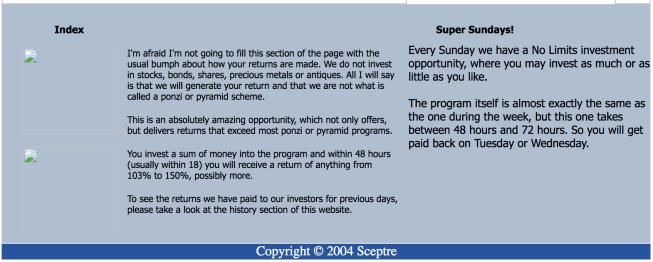
One of Sceptre’s HYIPs was S&S Investments, a website that opened for business on January 1, 2004. (“Copyright @2004 Sceptre” is written at the bottom of the page.) He promotes the scheme as a way to double your money

“You invest a sum of money into the program and within 48 hours (usually within 18) you will receive a return of anything from 103% to 150%, possibly more.”

Screen Shot 2019-04-25 at 10.09.52 AM

He is sure to point out that this is “not what is called a ponzi or pyramid scheme.” It offers returns that are far better!  

In case the first offer sounded a little too far fetched, he changes the text later to something only slightly more believable. S&S now becomes a “fixed-term investment,” which pays 115% in a week….”you can invest and walk away in profit after just 7 days!”

Screen Shot 2019-04-25 at 10.15.00 AM.png

Of course, S&S ultimately collapses, and discussion around it gets moved to the “Closed / Scammed Programs” section of TalkGold, where Sceptre continues to string along anxious investors, who continue to hold out hope for a “refund.” He writes:

“Refunds WILL take some time. I cannot guarantee that they will all be made quickly. The refund process is likely to spread over a long period of time, but I am willing to do my best to refund everyone to the best of my ability. Please be patient and you will receive a lovely surprise in your e-gold, a refund from S&S Investments,” Sceptre writes.

One TalkGold user reviewed what he considered to be the 12 biggest HYIP “scams” on TalkGold. This is what he wrote about S&S Investments:

“S&S Investments is an interesting program because it was operated by a ‘well known’ person in the HYIP arena. I use the quote marks, because this person was not well known at all, in fact he was very anonymous. No one knew his name, other than his nickname he used to post with, Sceptre. He used anonymous proxies, he was very well hidden. Yet because he had over 1000 posts on TalkGold, he earned a kind of pseudo-trust that people get from being very visible and always online.

Sceptre started off with a small little program that promised to pay back a large amount after a few days. It soon grew to become very, very popular, and it was not long before he upgraded to a fully automated script.

Sceptre wouldn’t tell people how he made the money, he just said that was his little secret. Virtually everyone invested into S&S Investments based on his post count on TalkGold. “He’s made a lot of posts on TalkGold, therefore he must be honest” seemed to be the general opinion of the investors.

S&S Investments went for sometime before cracks started to appear. First the website went offline, then was back again, but withdrawals weren’t being honoured, then the site went offline again. Finally, Sceptre made an announcement that S&S Investments were closed and refunds were to promised.

For a while, refunds did proceed, but then things started to dry up. Since the summer, no more refunds have been processed.

Hey, just because someone has thousands of posts on a forum, doesn’t mean he’s a trustworthy guy. Use your head, look at what the whole program is offering.”

In May 2004, Sceptre appears to switch to another TalkGold profile, “Lucky-Invest,” to promote a Lucky Invest HYIP. 

At one point in a thread, he apparently forgets to log out of Lucky-Invest and continues responding as if he were Sceptre, until another poster calls him out:

“You forgot to sign in as ‘sceptre’. ohhhhhhhhhhhhhh . .. looks like Lucky-Invest changed their message!!! . . . too funny!!! . .. did you get caught Sceptre??? hahaha ;)”

Sceptre/Lucky-Invest replies:

“I’m not trying to hide. Lucky Invest, the Newest Investment/Game. My profits go to help pay refunds. THIS IS A GAME, IT WILL NOT HAVE ANY REFUNDS.”

This is a straight out admission that Lucky Invest was not an actual investment. It was a “game.” In other words, a fraud. Essentially, Sceptre/Lucky-Invest/Gerald Cotten is saying: When you give me your money, it is mine. There are no refunds in this game, just me sharing my profits.

Knowing that Cotten and Patryn did business together on TalkGold does not tell us where the CA$250 million worth of crypto and fiat that went missing on Quadriga went. (Only a fraction of those funds have been recovered so far.) But it does bring up questions. Was Cotten really just a starry-eyed Bitcoin libertarian? Or was he a seasoned con artist who had no qualms about taking other people’s money?

If you like my writing, consider supporting my work by subscribing to my Patreon for $5, $20, or $50 a month. Every little bit helps!

News: Craig Wright suing more people, exchanges respond by delisting BSV, and Arwen launches

I am trying to make my news posts shorter with an effort to focus mainly on cryptocurrency exchanges, unless something else comes up that is just fun to write about. If you enjoy my stories, tips are always welcome via Patreon.

At a hearing on April 18, Quadriga’s court-appointed monitor continued its battle with the exchange’s third-party payment processors to get them to hand over transaction records and funds. The court also extended Quadriga’s creditor protection until June 28.

Screen Shot 2019-04-19 at 9.53.58 AM
Dorian Nakamoto, one of those who turned out not to be Craig Wright.

Craig Wright, who claims to be Satoshi, is suing people who are accusing him of not being Satoshi. (Wright has yet to prove he actually is.) As mentioned in my last newsletter, it all started when Wright sued twitter user Hodlonaut. Wright has now followed with libel suits against Bitcoin podcast host Peter McCormack, Ethereum co-founder Vitalik Buterin and crypto blog Chepicap. (CoinGeek, a publication financed by Calvin Ayre, Wright’s billionaire backer, has a full story.)

Naturally, the Bitcoin community is up in arms. In response, Binance—an exchange that has been traditionally unselective in the coins it lists—has delisted BSV (stands for Bitcoin Satoshi’s Vision), the coin that resulted from the bitcoin fork spearheaded by Wright and Ayre. The move was followed by several other exchanges delisting BSV, including Kraken, ShapeShift and Bittylicious. Blockchain.info removed support for BSV from its wallet.

Kraken’s BSV delisting was in response to a poll it put up on Twitter. This quote from Kraken founder Jesse Powell is priceless. He says:

“In this case, it is a unique case for us, we haven’t delisted any other coins because the founders, people who are promoting it turned out to be total assholes.”

Angela Walch, a law professor at St. Mary’s University School of Law, compared the #DelistBSV movement to Visa and PayPal not processing Wikileaks transactions and expressed surprise the crypto world was cheering it.

Meanwhile Gemini’s Tyler Winklevoss says Gemini never listed BSV in the first place, and Chandler Guo, a Chinese miner who has made a fortune on ICOs and Bitcoin forks, announced that he would do the opposite and list BSV.

Crypto exchanges just aren’t pulling in the gazillions they used to. Binance generated about $78 million in profit last quarter, up 66 percent quarter-over-quarter. But that still falls short of full year 2018, when the exchange made $446 million in profits. Coinbase brought in revenue of $520 million in 2018, down 44 percent year-over-year.

Hacks, inside jobs and irreversible goof-ups are pushing some crypto exchanges to the brink. Coinnest, once South Korea’s third-largest exchanges, is closing. Users have until April 30 to get their funds off the exchange. Coinnest lost $5.3 million in a botched airdrop in January, though it blames its closure on low trading volume.

Elsewhere, on April 10, Bittrex’s application for a BitLicense (required to do business in New York State) was rejected—in part, because Bittrex customers were using fake names, like “Give me my money,” “Elvis Presley” and “Donald Duck” to trade.

Bittrex says the NY Department of Financial Services (DFS) “sent four people who didn’t know anything about blockchain.” DFS responded again, saying the exchange “continues to misstate the facts” and “presents a misleading picture about the denial.”

Binance is about to begin the process of moving its BNB (currently an ERC20 token) off the Ethereum network and onto Binance Chain, its custom blockchain. Interestingly, The Block’s Larry Cermak notes that Binance has quietly changed its white paper to remove a clause about the exchange using 20 percent of its profits to buy back BNB.

Arwen, a self-custody solution that uses on-blockchain escrows and off-blockchain atomic swaps to allow traders to maintain control of their keys while they trade, launched on Singapore’s KuCoin earlier this week. KuCoin raised $20 million in VC funding last year, and it is the first exchange to partner with Arwen, created by a company of the same name based in Boston.

Finally, Intercontinental Exchange (ICE), the owner of the New York Stock Exchange, is reportedly eyeing a New York license for its crypto exchange Bakkt. The launch date for Bakkt has been delayed for months due to skepticism from the CFTC. The regulator appears most concerned over how tokens will be stored.


Judge extends Quadriga’s creditor protection, and EY squabbles with third-party payment processor

Screen Shot 2019-04-18 at 12.45.52 PMPOSConnect, a third-party payment processor holding funds on behalf of failed Vancouver-based crypto exchange QuadrigaCX, has come up with more excuses to delay handing over the money.

Today, at a short and mostly procedural hearing held at the Supreme Court of Nova Scotia, the main topics were extending Quadriga’s creditor protection and dealing with lingering issues related to Quadriga’s third-party payment processors, mainly POSConnect.

Justice Michael Wood agreed to extend the stay until June 28, unless Quadriga’s Companies’ Creditors Arrangement Act (CCAA) proceedings are terminated before then. Quadriga officially entered into a bankruptcy earlier this month. 

The rest of the 30-minute proceeding was mostly taken up by a back-and-forth between POSConnect’s lawyer and Elizabeth Pillon, a lawyer for Ernst & Young, the court-appointed monitor in Quadriga’s CCAA procedures.

At issue, POSConnect is sitting on CA$281,000 of Quadriga funds. EY wants the payment processor to deliver CA$278,000 right away. The plan is to leave CA$3,000 to cover rolling monthly fees associated with keeping the account open. 

POSConnect recently granted George Kinsman, EY’s senior vice president, online access to Quadriga’s documents and transaction data on the platform, and EY would rather pay POSConnect CA$500 a month than risk the firm cutting off all online access.

Pillon said more than 500,000 transactions worth CA$400 million in Quadriga funds were funneled through POSConnect—and sorting all that out is going to take time.

Meanwhile, POSConnect is reluctant to hand over any funds at all. The firm argues that it is due CA$22,000 in legal fees—an amount the POSConnect lawyer called “insignificant” compared to the hundreds of thousands of dollars spent so far in efforts to put Quadriga’s financial affairs in order.

EY is running short on patience. “POSConnect has thrown out more hurdles in respect to their obligation to delivers statements and property than any other third-party payment processor,” Pillon told the judge.

As she explained, EY has been reaching out to POSConnect since February 6 to find a means to get information and funds. Yet it wasn’t until late yesterday that POSConnect put forward $22,000 for legal fees and an administrative cost of $350 an hour to provide reporting—without providing any accounting to support those fees.  

Justice Wood said he did not have enough information before him to determine what reasonable legal fees would be for POSConnect. POSConnect will be added to an existing order for other third-party processors, which will require another hearing anyway.

Wood expressed regret that he would no longer be overseeing the Quadriga proceedings. He has been promoted to chief justice of the Appeal Court of Nova Scotia.

Thanks to TheWholeTruthXX for sending me an audio of the hearing. 


News: 51-foot yacht for sale, Bitfinex enables margin trading with Tether, Craig Wright threatens legal action

Spring is in the air! What are your summer plans? If you are considering buying a boat—or maybe even an “almost new” 51-foot Jeanneau with “very, very few hours” for half a million USD—now would be the time!

Screen Shot 2019-04-13 at 7.26.10 PM

The yacht belonged to Quadriga’s now-deceased CEO Gerald Cotten. Here is a video of him putting Canada’s plastic money into a microwave. Here he is tossing Winnie the Pooh into a bonfire. And this is him playing with Pokémon cards.

The latest on QuadrigaCX

I wrote about how Michael Patryn and Cotten appear to have been working together at Midas Gold, a Liberty Reserve exchanger, prior to founding Quadriga. David Z. Morris at Breakermag covered the topic as well. (He credited me, so I’m real pleased about that.)

At a court hearing on April 8, Quadriga was given the go-ahead to shift into bankruptcy. The move will save costs and give Ernst & Young (EY) more power as a trustee. 

“The trustee can also sell QuadrigaCX’s assets and start lawsuits to recover property or damages,” Evan Thomas of Osler, Hoskin & Harcourt told Bitcoin Magazine. “The trustee will collect whatever it can recover for eventual distribution to creditors.”

An “Asset Preservation Order” for Jennifer Robertson, Cotten’s widow, was filed on April 11. Law firm Stewart McKelvey is setting up three separate trusts to “collect and preserve” any surplus funds from estate assets, personal assets and corporate assets. Depreciable assets, such as Cotten’s yacht, will be sold.

Per the order, Robertson will continue to receive her drawings from her business Robertson Nova Property Management “in accordance with current levels, for the purposes of satisfying ordinary living expenses.” She will also have access to cash from the “personal assets” account to maintain her properties and to cover legal expenses.

Robertson has 10 days from the court order to provide EY with a list of all her assets—including cash on hand.

A cap on pay for Miller Thomson LLP and Cox & Palmer has been raised from CA$250,000 to CA$400,000. The team will continue to represent Quadriga’s creditors in the bankruptcy.

Quadriga’s third-party payment processors now have 10 business days (as opposed to five previously) from when they receive this court order to deliver the following to EY:

  • VoPay—CA$116,262.17.
  • Alto Bureau de Change—assets and property.
  • 1009926 BC—all records and transaction-related information.
  • POSConnect—access to Quadriga’s online account to George Kinsman, who is a partner at EY.
  • WB21 (now Black Banx)—all records and account statements related to its Quadriga dealings.

The next hearing to discuss issues remaining from the Companies’ Creditor Arrangement Act, including those tied to third-party payments processors, is scheduled for April 18.

Other crypto exchanges

Popular US-based crypto exchange Coinbase suspended trading of BTC-USD pairs for two hours on April 11 due to a “technical issue” with its order book. BTC-USD is a critical trading pair due to its volume and its impact on bitcoin price measures.

It appears that somebody dumped a load of BTC into the exchange’s buy orders causing liquidity to dry up. Coinbase doesn’t want that to happen, so likely that is why it wiped the books, cancelling any outstanding buy or sell orders.

Coinbase Pro, Coinbase’s professional exchange, is continuing to expand its altcoin reach. The exchange is listing three more altcoins: EOS (EOS), Augur (REP), and Maker (MKR). Coinbase first committed to listing MKR in December, but according to The Block’s Larry Cermak, due to low volume, Coinbase decided to hold off listing MKR.

Crypto credit cards are back in vogue. Coinbase has launched a Visa debit card. The “Coinbase Card” will allow customers in the U.K. and EU to spend their crypto “as effortlessly as the money in their bank.” The exchange says it will “instantly” convert crypto to fiat when customers complete a transaction using the debit card. PaySafe, a U.K. payment processor, is the issuer of the card. In the past, these crypto Visa cards have been known to suddenly lose access to the Visa network, so fingers crossed.  

Another executive is leaving Coinbase. The firm’s institutional head Dan Romero has announced he is leaving after five years. This is the third executive to depart Coinbase in six months. Director of institutional sales Christine Sandler left last month, and ex-vice president and general manager Adam White quit in October.

Switzerland-based crypto exchange Bitfinex has lifted its $10,000 minimum equity requirement to start trading. This will undoubtedly bring more cash into the exchange. “We simply could not ignore the increasing level of requests for access to trade on Bitfinex from a wider cohort than our traditional customer base,” CEO Jean-Louis van der Velde said in a blog post (archive).

Meanwhile, Bitfinex customers are complaining (here and here) that they are unable to get cash out of the exchange. Now some are saying they are having trouble getting their crypto out of Bitfinex as well. 

Reddit user “dovawiin” says, “Ive been trying repeated attempts for 2 weeks to withdraw funs and it always says processing. Ive submitted multiple tickets with delayed answers. Ive cancelled and attempted again a few time after waiting 48Hours with no results. Im currently trying again and nothing for over 24 hrs. This is ridiculous.”

Bitfinex also enabled margin trading on Tether. Margin pairs include BTC/USDT and ETH/USDT. Tether has already admitted to operating a fractional reserve, so this is basically adding more leverage to what’s already been leveraged. I’m sure it’s fine though—nothing to worry about here.  

Johnathan Silverman, a former employee of Kraken, is suing the crypto platform for allegedly failing to pay him for work he did. Kraken says it got out of New York in 2015. Silverman says the exchange still maintained an over-the-counter trading desk in the state, which requires licensing for crypto businesses. Kraken told Bloomberg, Silverman “is both lying and in breach of his confidentiality agreement.”

Finally, Malta-based Binance, one of the largest crypto exchanges by volume, is partnering with blockchain analytics firm CipherTrace to boost its AML procedures.

Other interesting stuff

All hell broke lose on Twitter Friday when news got out that Craig Wright is making legal threats against Twitter user “Hodlonaut,” who has been publicly calling Wright a “fraudster” and a “fake Satoshi.” Wright has never been able to prove that he is Satoshi.  

In a letter shared with Bitcoin Magazine, SCA ONTIER LLP, writing on behalf of Wright, demands that Hodlonaut retract his statements and apologize, or else Wright will sue him for libel. The letter even includes this bizarre prescribed apology:

“I was wrong to allege Craig Wright fraudulently claimed to be Satoshi. I accept he is Satoshi. I am sorry Dr. Wright. I will not repeat this libel.”

Hodlonaut deleted his Twitter account upon receiving the news. And the crypto community formed a giant backlash against Wright. Preston Byrne is assisting Hodlonaut pro-bono, Peter McCormack is selling T-shirts that say, “Craig Wright is a Fraud,” and Changpeng Zhao, the CEO of crypto exchange Binance threatened to delist Bitcoin SV—the token spearheaded by Wright and billionaire backer Calvin Ayre.

Ayre is also demanding apologies related to some photos of him circulating on Twitter with extremely young-looking women. Coin Rivet writes, “We have agreed to pay Mr Ayre substantial damages for libel. We have also agreed to join in a statement to the English High Court in settlement of Mr Ayre’s complaint.”

China’s National Development and Reform Commission (NDRC) released guidance that includes shutting down Bitcoin mining. “The risk to Bitcoin in the longer term is other governments taking their cue from China—and taking proof of work more seriously as a problem that needs to be dealt with,” writes David Gerard.

Another Bitcoin mining company has gone belly upBcause llc filed for Chapter 11 in Illinois. (Steven Palley uploaded the docs on Scribd.) The company is based in Chicago, but its mining rigs are in Virginia Beach. In January 2018, Virginia Beach Development Authority gave the firm a $500,000 grant to build the $65 million facility. Bcause promised to create 100 full-time jobs, with average salaries of $60,000 a year. 

But by January, the price of Bitcoin was already on its way down—so much for all those jobs. At least the neighbors won’t have to suffer the noise anymore.

Last summer, Virginia Beach resident Tommy Byrns, told Wavy News:

“The issue is the noise, the relentless noise … it’s kind of created an atmosphere where we can’t talk to each other in the backyard. You have to go in the house to talk … this was pushed through without any warning into anybody … and now look what we have.” 

Crypto, the movie, is out. Gerard wrote a full review for DeCrypt on his new battery-powered AlphaSmart Neo 2 keyboard—a 1990s flashback that keeps him from shit posting on Twitter. The film was mediocre—but it stars KURT RUSSELL.


Quadriga: Patryn, Cotten and Midas Gold—a Liberty Reserve exchanger

Screen Shot 2019-04-09 at 5.18.37 PM

The now-defunct Canadian crypto exchange QuadrigaCX was founded in November 2013. Where did its co-founders, Michael Patryn and the now-supposedly-deceased Gerald Cotten, first meet? Did they  exchange pleasantries in the Vancouver Bitcoin community earlier that year? Did they meet online in some bitcoin chat forum? Or did they have other prior business dealings even further back?

New evidence uncovered by Reddit user QCXINT suggests that Cotten appears to have been involved with Patryn at Midas Gold, a Liberty Reserve exchanger, set up by Patryn in 2008.

Patryn and Midas Gold

Formerly Omar Dhanani, Patryn is a convicted felon who was arrested in connection with online identity theft ring Shadowcrew.com in October 2004. He was 20 at the time. Working out of his parent’s home in Southern California, he was a moderator on the forum. He also offered forum members an electronic money laundering service. Send him a Western Union money order and—for a fee of 10% of a transaction—he would filter your money through E-gold accounts. E-gold was an early centralized digital currency. Dhanani served 18 months in a US prison and was released in 2007.

After the US deported him to Canada, Patryn picked up where he left off. In April 2008, he founded Midas Gold Exchange. He was listed as the company’s sole director under “Omar Patryn,” with a company address in Calgary—though he was living in Montreal at the time. A few months earlier, the digital currency exchange service launched on M-Gold.com. (Here is an archive of the site taken in its early days, and here is an archive showing an updated design taken just before things took a dive).

In January 5, 2008, the earliest entry on the website reads:

“We have finally launched this website, and are requesting that clients place all future orders through the Contact Us page. We have, of course, been in business since 2005 and hope to continue providing you with the same great service throughout the new year. Thank you once again for your business, and have a happy New Year!”

There are no names of actual people anywhere on the site. But an October 17, 2009, entry gives the impression that a whirl of activity is going on behind the scenes.

“We apologize for the delays experienced for many clients during the course of this week. We are currently undergoing a massive corporate restructuring. During this time, some exchange directions are temporarily disabled. All pending orders should be processed within one business day.”

Digital currencies listed on the site included E-Gold, HD-Money, WebMoney, WMZ E-Currency and AlterGold E-Currency. Midas Gold even started accepting bitcoin in June 2011, but Liberty Reserve was by far its main money maker.

How Liberty Reserve worked

A Costa Rica-based centralized digital currency service, Liberty Reserve was like PayPal for criminals. You could use it to anonymously transfer the system’s digital currency LR, worth $1 apiece, to anyone who had an account on the system. The system served millions of users around the world before May 2013, when it was shut down by the U.S. government.

To set up an account on libertyreserve.com, all you needed was a valid email address. You could make up whatever fake name you wanted because the site had virtually no KYC/AML to validate identities. You could, literally, use the service to send huge amounts of money around the world without anyone batting an eyebrow. 

There was one caveat. You could not fund your Liberty Reserve account directly. If you wanted to buy LR, you had to go through a third-party exchanger, such as M-Gold. Conversely, if you wanted to redeem your LR for cash, you also had to go through an exchanger. 

LR exchangers would buy LR in bulk and sell them in smaller quantities, typically charging a 5% transaction fee. This setup allowed Liberty Reserve to avoid collecting banking information on its users, which could leave a financial trail—exactly what criminals want to avoid when choosing a digital currency. 

Founded by Arthur Budovsky and Vladimir Kats, Liberty Reserve went into operation in 2005. Eight years later, the system had more than 5.5 million users worldwide and processed more than $8 billion. Most of that volume came from the U.S.

During 2009 to 2013, Liberty Reserve was in full swing. These were the sunshine days of its criminal activity. A huge number of transactions were related to high-yield investment programs—better known as Ponzi schemes—credit card trafficking, stolen ID information and computer hacking.  

Cotten’s email

A data dump—in one of the USA v. Kats et al. court exhibits (see attachment #180 for GX 1305) related to the takedown of Liberty Reserve—shows that Midas Gold ranked 342 of the top 500 Liberty Reserve accounts in volume.

The name on the Midas Gold account is Omar Patryn, but the email address linked to it is geraldcotten@gmail.com. What does this mean? It means whoever owned that email had the authority to operate the Midas Gold account for Liberty Reserve. They could reset the password, enable or disable 2FA, and authorize transactions. 

The data indicates Midas Gold bought up more than $5 million worth of LR. At 5% of a transaction. That equates to profits of around $250,000—not a lot, but decent wages.

Screen Shot 2019-04-09 at 10.49.15 AM
Rank: 342, Category: Exchanger, Associated website: http://www.m-gold.com, All currencies: $5,221,489.02, LR: $5,081,353.88, Account name: Midas Gold Exchange, First name: Omar, Last name: Patryn, Email: geraldcotten@gmail.com

The email suggests that Cotten and Patryn may have worked at M-Gold.com together—though its not clear if Cotten was involved from the beginning or joined later. If anything, this could even suggest that Cotten had more control over Midas than Patryn.

Let’s pause for a moment. If you were going to be involved in a dodgy business, why would you use an email address that pointed directly to you? That seems like a dumb thing to do, but then Cotten was still a young con at this stage. Maybe this was a rookie mistake. Also, is this really Cotten’s email? Quite likely, yes.

We think this is his email because he appears to have used the same email address for several domain registrations, including, cloakedninja.com, where you could buy proxy sites to hide your IP address, and celebritydaily.net, an entertainment news blog. A historical WHOIS data snapshot of these site reveals they both have a registration address of 346-1881 Steeles Ave W Toronto. Quadriga Fintech Solutions, the owner and operator of QuadrigaCX, is linked to the same address. 

Screen Shot 2019-04-09 at 3.56.21 PM.png

Patryn’s Liberty Reserve account

In addition to the Midas Gold account, Patryn had his own account on Liberty Reserve, but his account had no associated website. He appears to have had at least three other exchangers at the time—HD Money, E-cash World and Triple Exchange. It’s possible he was selling LR through those sites as well as Midas Gold, and was just using the one account. Or else, Cotten could have operated Midas alone, while Patryn handled the other businesses.

Approximately $18.4 million worth of LR went through Patryn’s Liberty Reserve account. Of Liberty Reserve’s 500 largest accounts by volume, his ranked 88. If he took a 5% cut of every transaction, he would have pulled in $920,000.

Screen Shot 2019-04-09 at 12.32.59 PM
Rank: 88, Category: Exchanger, Associated website: [field empty], All currencies: $18,653,708.71, LR: $18,416,444.50, Account type: Currency, First Name: Omar, Last Name: Patryn, email: admin@patryn.com

A passage from the court filing explains:

“Data obtained from Liberty Reserve’s servers reflects the extensive use of the company’s payment system by criminal websites. The Government analyzed the top 500 accounts by transaction volume, i.e. funds sent and received, to attempt to determine the type of activity associated with each account. The total transaction volume for these accounts is approximately $7.26 billion, or approximately 43% of the total volume of transactions on Liberty Reserve’s entire system.”

Also according to the analysis, of the top roughly 500 accounts, 44% were associated with exchangers, 18% could not be categorized, and the remaining 38% were categorized as follows:

“157 of the accounts, accounting for approximately $2.6 billion in transactions, were associated with some form of purported ‘investment’ opportunity. The vast majority of these accounts were linked to websites that, on their face, were clearly ponzi schemes, i.e., HYIPs. Others, at best, were associated with unregulated ‘forex’ (foreign currency trading) websites—which are likewise known to be prominent sources of fraud.”

The demise of Liberty Reserve

Screen Shot 2019-04-09 at 12.57.29 AM

Good things never seem to last, and in May 2013, Budovsky was arrested in Spain for running a massive money laundering enterprise. Kats was arrested in Brooklyn, and the the domain libertyreserve.com was seized.

Shortly afterward, US authorities seized more than 30 domains registered as Liberty Reserve exchangers in a civil forfeiture case, including M-Gold.com. According to court docs: “The defendant domain names were used to fund Liberty Reserve’s operations; without them, there would not have been money for Liberty Reserve to launder.” 

Following the shut down of Liberty Reserve, users were told to contact the court to recoup their lost funds—on the basis they were conducting legitimate business. According to court docs filed in April 2016: “Notwithstanding that Liberty Reserve had more than 5 million registered user accounts, only approximately 50 individuals have contacted the Southern District Court of New York since May 2013.” Most appeared to be victims of HYIPs and other scams. And only one Liberty Reserve exchanger contacted the court about a potential claim—and that claim was not pursued.

A few months after M-Gold.com was seized, QuadrigaCX launched in beta. The rest is history—or history in the making—depending how you look at it. 

Did you like this story? Please support my work on Patreon, so I can keep on doing it.

News: EY goes after Quadriga’s payment processors, more exchange hacks, the SEC tells us what we already know

I had to take my website offline for a few hours Tuesday, so if you were searching for one of my stories and got a weird message, my apologies. I asked WordPress to downgrade my site from a business plan to a premium plan, and when they did, a bunch of my content disappeared, so I had to put Humpty-Dumpty back together again.

Big thanks to my now 18 patrons, who are making it easier for me to focus on writing about crypto. If you like my work, please consider supporting me on Patreon, so I can keep doing what I am doing.  

Now onto the news, starting with Quadriga, the defunct Canadian crypto exchange that I won’t shut up about. (Read my timeline to get up to speed.)

Ernst & Young (EY), the court-appointed monitor charged with tracking down Quadriga’s lost funds, released its fourth monitor report, which reveals more money going out then coming in. The closing cash balance for March was CA$23,268,411. Incoming cash for the month was CA$4,232, and total disbursements was CA$1,463,860—most of which was paid to professionals. A full half of that (CA$721,579) went to EY and its legal team.

EY is trying to chase down money held by Quadriga’s payment processors. It has drafted a “Third Party Payment Processor Order” for the court to approve on Monday. If that goes through as is, several payment processors, including WB21, will have five business days to handover funds and/or Quadriga documents and transaction data. If they don’t comply, they will be in contempt of court. A shift from CCAA to bankruptcy proceedings will also give EY more power to go after funds as a trustee

Christine Duhaime, a financial crimes lawyer who worked for Quadriga for six months in 2015 to early 2016, wrote “From Law to Lawlessness: Bits of the Untold QuadrigaCX” for CoinDesk, where she talks about how Quadriga went off the rails following its failed efforts to become a public company.

In the article, Duhaime—who in February called for a government bailout of Quadriga’s creditors (archive)—openly admits to having lost CA$100,000 in funds on the exchange. She claims her involvement with the exchange stopped in early 2016. “I’m glad we were let go by QuadrigaCX for being one of the ‘law and order’ folks,” she said.  

I have been corrected on detail here:

She does not mention this in her article, but in 2015, she also owned 20,000 shares of Quadriga stock. It is possible she has since sold the holdings.

Preston Byrne, an attorney at Byrne & Storm, PC, tweeted, “No offense to @ahcastor but this claim that @cduhaime may have owned shares in Quadriga looks to be incorrect. She’s listed as the principal contact for an SPV, and the SPV is the named purchaser. A retraction is in order.”

SPV stands for special purpose vehicle, typically used by firms to isolate them from financial risk. I’ve reworded the paragraph as follows:

This 2015 British Columbia Report of Exempt Distribution, a document of Quadriga Financial Solutions’ ownership, lists Duhaime as the contact for 1207649 B.C. Ltd, which owns—or owned—20,000 shares of Quadriga. I was unable to find the corporate files for 1207649 B.C. The address in the report matches that of Duhaime’s office.  

Update (April 9): I found the corporate files. The actual company name appears to be 1027649 B.C. Ltd.—with the numbers “2” and “0” transposed. The company was founded on February 16, 2015 and dissolved on August 1, 2017. The sole director is “Anne Ellis,” and the registered office is Duhaime Law.

According to court documents, Cotten and Quadriga co-founder Michael Patryn had been seeking to buy back shareholdings after Quadriga’s public listing failed, so it is possible one of them may have bought back those shares as well. I reached out to Duhaime for comment a few times, but she has not responded. 

Duhaime may have left Quadriga behind, but she continued to have business dealings with Patryn, who we now know is convicted felon Omar Dhanani

She and Patryn co-founded Fintech Ventures Group, which calls itself “an investment bank focused on digital currency, blockchain, and AI-focused technology.” According to a January 2016 archive of the company’s site, Duhaime was Fintech Venture’s “Digital Finance Maven & Co-Founder.” (Interestingly, former Quadriga director Anthony Milewski worked there, too, as the company’s “Investment Relations Extraordinaire.”) 

Duhaime and Patryn were also both advisors at Canadian crypto exchange Taurus Crypto Services, according to this June 2016 archive. (Milewski shows up here again, this time as an advisor.) The exchange was founded in 2014 and shut down in January 2017, when the business shifted to over-the-counter trades.  

Like Duhaime, Patryn also claims his involvement with Quadriga ended in early 2016. Although the Globe and Mail said that in October 2018, “it received an e-mail pitch from an ‘executive concierge’ company called the Windsor Group offering up Mr. Patryn for interviews to discuss virtual currencies and describing him as a Quadriga director.” Patryn told the Globe he did not know what the Windsor Group was, nor had he authorized anyone to pitch him as a Quadriga director, as he never served on the board.

Patryn had a personal website michaelpatryn.com, but it got taken down. Here is a 2011 archive and here is a 2014 archive. From 2016 on, the archives point to his LinkedIn profile, where he now goes by “Michael P.” having dropped all but the first initial of his last name. According to his LinkedIn, he has been an advisor for numerous cryptocurrency platforms going back to November 1999. I guess that means his work at Shadowcrew in 2004 and the 18 months he spent in jail for conspiracy to commit credit and bank card fraud and ID document fraud qualifies as advisory services.

Patryn appears to enjoy the limelight. Several reporters told me they had no trouble reaching him. At one point, Patryn even went into the “Quadriga Uncovered” Telegram group—basically, the lion’s den, where hundreds of pissed off Quadriga creditors sat waiting on their haunches —where I am told he calmly deflected accusations.

Meanwhile, I’ve been practicing my authoritative stare and baritone.

Other exchanges

Elsewhere in cryptoland, there have been a number of exchanges hacks. Singapore-based exchange DragonEx was hacked on March 24 for an undisclosed amount of crypto.

Blockchain data firm Elementus suspects that Coinbene, another Singapore exchange, was also hacked. On March 25, Elementus noted that $105 million worth of crypto was on the move out of the exchange. Coinbene totally denies it’s been hacked, claiming that delays in deposits and withdrawals are due to maintenance issues. 

A third exchange, Bithumb was hacked on March 30. The South Korean crypto exchange lost 3.07 million EOS and 20.2 million XRP, worth around $19 million. Bithumb thinks it was an insider job.

Helsinki-based LocalBitcoins, a once go-to for anonymous bitcoin transactions, has added know-your-customer (KYC) identity checks to comply with new laws in Finland. The change goes into effect in November. Per the company’s announcement, this is actually good news for bitcoin, because it will create a “legal status for crypto assets, which should improve significantly Bitcoin’s standing as a viable and legit financial network.”  

A study by reg-tech startup Coinfirm found that 69 percent of crypto exchanges don’t have “complete and transparent” KYC procedures. And only 26 percent of exchanges had a “high” level of anti-money-laundering procedures.

With crypto markets in the dumps, exchanges are looking for new ways to attract volume. To that end, San Francisco-based Coinbase is launching a staking service to lure in institutional investors. The service, which starts with Tezos (XTZ), will pay investors to park their money in XTZ. The coins are kept in offline cold wallets. The catch is that the interest will be paid XTZ, and of course, crypto is highly volatile. 

The price of XTZ went up 70 percent on the news.

Cryptocurrency exchange Binance is launching a new fiat-to-crypto exchange in Singapore later this month. (It’s been launching these crypto onramps all over the word.)

Binance also says it’s planning to launch its decentralized exchange (DEX) later this month. The DEX is built on a public blockchain, Binance Chain. Basically, Binance is looking to create an economy for binance coin (BNB), which is totally not a security.

Other interesting news bits 

Screen Shot 2019-04-05 at 11.03.29 AMThe the U.S. Securities and Exchange Commission issued a “Framework for ‘Investment Contract’ Analysis of Digital Assets.” There is not a lot new to see here. A footnote in the document makes clear this is “not a rule, regulation, or statement of the Commission,” just some thoughts from the SEC’s staff about how they interpret existing securities laws. 

Stephen Palley, partner at law firm Anderson Kill, appeared on Bloomberg sporting a beard to explain the framework—definitely worth five minutes of your time to listen to.

Justin Sun, the founder of blockchain project Tron, bungled a Tesla promotional giveaway. After a widespread cry of foul play, he decided to make it up to everyone by giving away—two Teslas. This wasn’t the first time a Tron promotion raised eyebrows.

Nocoiner David Gerard wrote a Foreign Policy piece on “How Neo-Nazis Bet Big on Bitcoin (and Lost)” that was translated for Newsweek Japan.

The ever outspoken Jackson Palmer did a good interview with Epicenter Blockchain Podcast on the history of Dogecoin and the state of cryptocurrency in 2019.

Nicholas Weaver, who gave the “Burn it with Fire” talk at Enigma, spoke to Breaker about why cryptocurrencies don’t really work as currencies.

Finally, Dream Market, the last standing marketplace from the once infamous “big four” sites that dominated dark web trading in the mid-2010s, announced plans to shut down.


EY recommends Quadriga shift to bankruptcy, moves to preserve Robertson’s assets and wrestles with payment processors

Ernst & Young (EY), the court-appointed monitor in Quadriga’s creditor protection procedures, filed its fourth monitor report with the Supreme Court of Nova Scotia on April 1.

In the latest twist in the ongoing Quadriga saga, EY is proposing Quadriga shift from its Companies’ Creditor Arrangement Act (CCAA) proceedings into proceedings under the Bankruptcy and Insolvency Act (BIA).

Bankruptcy offers key advantages. Namely, it would remove the need for several professionals, leaving more money to repay Quadriga’s 115,000 creditors. According to court docs, $250 million CAD ($190 million USD) in crypto and fiat were on the exchange when it collapsed, but likely only a fraction of that will be found.

In a bankruptcy, EY would become a trustee. That means Quadriga’s newly appointed chief restructuring officer (CRO) would no longer be needed. Company directors, Jennifer Robertson (the widow of Quadriga’s dead CEO Gerald Cotten) and her stepfather Tom Beazley, would also step out of the picture. (Robertson has already indicated, she doesn’t want to continue serving as a director anyway, which is why she opted for a CRO.)

Quadriga also won’t be needing a representative counsel. Last month, Stewart McKelvey, stepped down from the CCAA proceedings over a potential conflict of interest. The firm was representing both Quadriga in its CCAA proceedings and handling Cotten’s estate. Quadriga has not hired a replacement—and it won’t need to for a bankruptcy. 

Cox & Palmer and Miller Thomson LLP, the legal team representing Quadriga’s affected users, would stay on. The recently formed seven-person committee that serves as the voice for Quadriga’s creditors, would also continue with their work. 

But here is where things get interesting—as trustee, EY would be given additional investigatory powers without further relief from the court that will be of assistance in investigating the business and affairs of Quadriga, “including the right to compel production of documents and seek examination of relevant parties under oath.”

Finally, bankruptcy would allow for the potential sale of Quadriga’s operating platform.

Preserving Robertson’s assets

In late January, after Cotten’s death and before Quadriga filed for creditor protection, Robertson was moving aggressively to protect her newly acquired assets. She moved two properties into the Seaglass Trust, and Cotten’s airplane and yacht both went up for sale. EY has put a stop to any more of this by filing an “asset preservation order.”

During the course its investigations into Quadriga’s business and affairs, EY says it became aware of occurrences where the corporate and personal boundaries between Quadriga and Cotten were not formally maintained. EY notes that it appeared “Quadriga funds may have been used to acquire assets held outside the corporate entity.”

The asset protection order involves all assets held by the Cotten Estate, Robertson and the Seaglass Trust, and Robertson Nova Property Management—the company that Robertson purchased several properties under between 2016 and 2018. The order will allow EY’s investigation of Quadriga to continue “without concern that assets possibly recoverable for the applicant’s stakeholders may be dissipated,” the report said.

Likely Robertson is agreeing to the plan because, according to the report, EY “temporarily discontinued its preparation for a mareva injunction pending the negotiation and agreement of the draft Asset Preservation Order.”

A mareva injunction would have completely frozen all of the assets. Under an asset preservation order, Robertson is able to maintain control of her properties. She just can’t sell or transfer them. She has agreed to provide a list of relevant assets to EY. And she will be working with EY on monetizing some of the assets to preserve their value.

Wrestling with third-party payment processors 

Screen Shot 2019-04-03 at 12.29.10 PMQuadriga had no company bank accounts. Instead, it relied on a patchwork of third-party payment processors. As a Quadriga customer, you would send cash to one of these payment processors, and Quadriga would credit your account with Quad Bucks, which you could then use to buy crypto on the platform. When you put in a request to withdraw fiat from the exchange, a payment processor would wire you money. 

After Quadriga ceased operating on January 28, several of these third-party payment processors were left holding money on behalf of Quadriga and its users. EY mentions the following payment processors in its fourth report:

  • POSconnect 
  • VoPay  
  • Billerfy     
  • Costodian  
  • ePADregistry  
  • WB21 (now Black Banx) 
  • 700964 N.B. Inc.  
  • 1009926 B.C. Ltd. 
  • Robertson Nova Consulting Inc (RNCI)
  • Alto Bureau de Change

The monitor has been wrestling to get funds from several of these companies, a few of which weren’t exactly at arm’s length from Quadriga. RNCI was operated by Robertson — who earlier told the court she was not involved Quadriga’s operations. Apparently Cotten used RNCI bank accounts to transfer money to Quadriga customers. Robertson is cooperating though. She says RNCI is currently not holding any Quadriga funds, and she is working to get bank statements of all transfers her company made to EY. 

700964 N.B. Inc. and 1009926 B.C. Ltd. were both run by Quadriga contractors. 700964  N.B. was run by Aaron Matthews, Quadriga’s director of operations, and 1009926 B.C. was run by Aaron Vaithilingam, Quadriga’s former office manager. 

EY has in its possession 1,004 bank drafts, worth $5,824,340 CAD, written out to 1009926 B.C. It had trouble depositing those checks, because 1009926 B.C., the company, had dissolved. (This is yet another example of how sloppily Quadriga handled its affairs.) Now that 1009926 B.C. has been restored, Royal Bank of Canada (RBC) is asking for additional documents to deposit the bulk drafts. But Vaithilingam is not responding to EY’s letters.

EY has also reached out to WB21, the third-party payment processor holding on to roughly $9 million USD ($12 million CAD) in Quadriga funds. WB21 recently changed its name to Black Banx, and it has an office in Canada.  

EY wrote to Michael Gastauer, the sole director of WB21, in February, requesting the company return any Quadriga funds to EY. WB21 responded by saying that Quadriga’s account was was closed in December 31, 2018, and it was entitled to withhold funds if there was “reasonable doubt that the end user has engaged in fraudulent activity.” On March 9, EY wrote again requesting copies of the agreements. WB21 wrote back saying it was only holding $11.77 CAD and $5.53 USD and that it “might be able to provide further information” upon conclusion of an internal investigation.

EY is not buying it, and you can bet it’s probably had enough of these shenanigans. The monitor is convinced WB21 is holding “a significant amount of funds.” The monitor also writes that WB21 has been uncooperative and has not provided “even basic info” and that it is inappropriate for WB21 to continue holding funds pending some investigation.

(Related story: “Diving into WB21—the company holding $9 million of Quadriga money“)

Here is another surprise—EY just discovered that Jose Reyes, who runs Billerfy and Costodian, operates yet another third-party processor, which has also received funds from Quadriga. Despite all the work Reyes has done with EY trying to sort out the $26 million in Bank of Montreal (BOM) drafts, he neglected to mention his other company ePAD also held Quadriga money. EY sent letters requesting account information, but so far, Reyes has not responded. (Read the interpleader order for more history on Reyes.)

EY also wrote to POSconnect who is supposedly holding $331,764 CAD in Quadriga funds. POSconnect followed up stating that it only owed $300,000, but that under the terms of its agreement with Quadriga, it would continue holding the funds until April 28. The monitor wrote again requesting immediate return of the funds.

VoPay is supposedly holding $217,000 CAD on behalf of Quadriga. In February, VoPay told Quadriga’s counsel that it was not in a position to return the funds, because it had gotten legal threats from Quadriga customers. VoPay confirmed it is holding $116,262 CAD for Quadriga and requested indemnity from EY, which EY says it can’t provide and again requested VoPay give back the money asap.

Alto Bureau de Change is a currency exchange shopfront in Montreal. Alto believed it had never done business with Quadriga, but EY noted a transfer from Quadriga to Alto of $160,000 CAD worth of bitcoins and $30,000 CAD processed on behalf of Quadriga by NB Inc. EY believes that Alto currently holds either $20,876 or $36,213 of Quadriga funds.

EY is seeking a court order to get several of the third-party payments processors to hand over funds and/or any documentation related to Quadriga.

The monitor’s research into Quadriga’s missing funds is winding down. It plans to file its final monitor report in a few weeks. Oddly, this report did not mention anything about recovery of the platform’s historical data on AWS—a big issue in the third report.

The next hearing is scheduled for April 8.

I’m in a podcast — “Why Won’t Amy Castor Just Shut Up About QuadrigaCX!”

Yesterday, I did a podcast with CoinSpice’s C. Edward Kelso. He turned it around fast, and the podcast was live a few hours later.

Kelso asked me about collapsed Canadian crypto exchange QuadrigaCX and also about legal threats made to me by WB21 (now Black Banx), the third-party payment processor holding $9 million in Quadriga funds, after I wrote about them.

WB21 has a history of threatening reporters, so this was nothing new. But after so much bad press, WB21 rebranded, and I wrote about that, too.

It is always a little overwhelming talking about Quadriga. The story is so long, involved and complex that it really belongs in a Netflix series.

This being my first podcast, I purchased a blue Yeti USB microphone and a pair of Audio-Technica ATH-M50x professional studio monitor headphones.

News: WB21 rebrands, Patryn is without a doubt Dhanani, and Quadriga creditors now have a committee

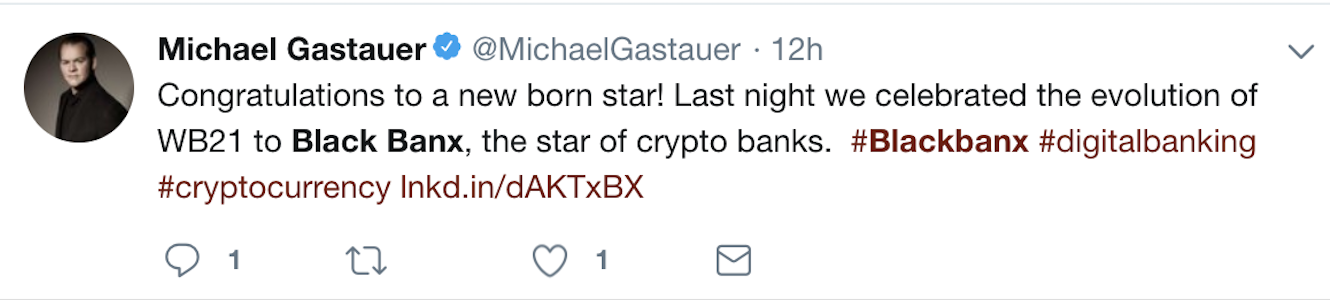
What do you do when bad press gets you down? Silly rabbit, you change your name. WB21, the firm that has been holding on to several millions of dollars in Quadriga funds is now Black Banx!

According to the firm’s press release (archive): “WB21 decided to rebrand its corporate image using the more expressive name ‘Black Banx’ to better describe the business activities and the companies [sic] rebel approach in the banking industry.”

(WB21 founder Michael Gastauer has since deleted a tweet about the event.)

Screen Shot 2019-04-12 at 8.25.10 PM

Here is the kicker. Black Banx is registered at The South Quay Building, 189 Marsh Wall, London, England—the same address as WB21. However, the address in the press release is 88 Queens Quay West, Toronto, Ontario.

Wait what? Black Banx has an office in Canada?

I looked up the address on Google. This is a humungous office building. It is also home to Royal Bank of Canada, which is, coincidentally, the bank where Quadriga’s court-appointed monitor Ernst & Young (EY) set up accounts to hold money on behalf of Quadriga creditors. Black Banx is likely using a virtual office or a coworking space in the building. If anyone in the area cares to take a look, let me know.

(Read my Quadriga timeline for a complete history of the Canadian crypto exchange.)

WB21 threatened me with legal action after I wrote about them. I responded by publicizing the emails and documents they sent me in a tweet. Bitcoin advocate Andreas Antonopoulos, who has 473,000 Twitter followers, found my tweet and retweeted it.

That led to few crypto news outlets, such as News BTC and CoinGeek, running stories on the incident, with some added dramatic flair. (The CoinGeek headline actually misses the point a bit and says I’m in a “tussle” with QuadrigaCX.)

Interestingly, I found an old story in Bitcoin Magazine from June 2016 when WB21 first started accepting bitcoin deposits—with the help of BitPay to convert bitcoin to fiat. After the news broke, many bitcoin investors saw WB21 as a way to cash out of their bitcoin.

Former WB21 user Adrian Bye told me, “I’m not in the US, and for me, and many others, getting crypto into fiat is quite complicated, so we have to look into alternative solutions.” He sent $40 worth of bitcoin to WB21 to “test out the system” and never saw that money again.

On the topic of “changing your name,” Bloomberg straight out announced that Quadriga cofounder Michael Patryn is convicted felon Omar Dhanani. Bloomberg tracked down official documents showing two name changes. According to the report, “Patryn changed his name from Omar Dhanani to Omar Patryn with the British Columbia government in March 2003. Five years later, he registered a name change to Michael Patryn in the same Canadian province.”

Combine this new information with the 2005 booking photo of Dhanani the Globe and Mail (archive) pulled up recently, and you have a pretty strong case that Patryn is Dhanani—but I’m sure he still denies it.

Quadriga’s creditors now have official representation. Miller Thomson and Cox & Palmer appointed a seven-person steering committee to help them represent the exchange’s 115,000 creditors. One of the members, Eric Bachour, also lost money in Mt. Gox, the Tokyo-based exchange that collapsed in 2014. He is probably suffering from a horrible case of deja vu right now.

Earlier, I wrote on how Quadriga’s representative Stewart McKelvey (aka “Applicants’ Counsel”) withdrew from the CCAA case. The details were murky based on a statement by the firm. New details have emerged in a letter Miller Thomson (aka “Representative Counsel”) sent to Quadriga creditors. From the letter:

“Representative Counsel sent two letters to Applicants’ Counsel expressing discomfort with the conflicts of interest presented by Stewart McKelvey’s representation of both the Applicants and Ms. Robertson. The Monitor expressed similar concerns. We advised Applicants’ Counsel that, in our view, this represented an irreconcilable conflict that needed to be addressed without delay.”

Basically, there was a “concern” of a potential conflict of interest, because Stewart McKelvey represented both Quadriga in its CCAA case and the estate of Jennifer Robertson, the widow of Quadriga’s dead CEO Gerald Cotten. But there was no evidence of a conflict of interest per se. At least that’s how I read it.

Quadriga creditors are waiting patiently for Ernst & Young to file its fourth monitor report. It has been more than three weeks now. The last report was filed on March 1.

Some Quadriga creditors are wondering how to report their crypto gains and losses in  their tax filings without their Quadriga trading histories. Reddit user “Cyphrus21” who claims to be a CPA, suggested they make a best guess and file an amendment later when the information becomes available. (If it ever becomes available.) He/she notes: “Lastly, Quadriga didn’t become insolvent / delisted until 2019, so you cannot declare your loss on that event until when you file your 2019 tax return in 2020!”

Other exchange-related news  

Last year, I wrote an in-depth article on Binance, the crypto exchange based in Malta, for The Block. I still have a hard time keeping up with CZ’s business schemes. (CZ is the CEO of the exchange.) Recently, Binance announced that it is changing the sale format of Binance Launchpad, its token launch platform, from a “first-come-first-served” to a lottery system based on your BNB holdings.

BNB is Binance’s own Ethereum-based ERC20 token. The exchange has been struggling to create an ecosystem around the coin, and this is really grabbing at straws.

ShapeShift is a non-custodial exchange that lets you swap out one coin for other. Founded in 2013, the exchange did not implement KYC identity checks until late 2018. ShapeShift was upset about a September 2018 WSJ report that claimed the exchange was being used to facilitate money laundering. To clean up its image, ShapeShift asked blockchain analytics firm CipherBlade to repeat the investigation.

I took a look at CipherBlade and found some, well, interesting stuff. Here’s my story: “Blockchain analytics firm CipherBlade steps in to launder ShapeShift’s image.” Shortly after my story went live, Ben Munster covered the topic for DeCrypt. A few days later, David Gerard brought even more CipherBlade details to light in his post.

U.S.-based crypto exchanges are handling 29 percent of bitcoin trading—much more than what was previously thought. That is because overseas exchanges have an abundance of fake volume, according to a report by Bitwise Asset Management, a firm working to create a crypto ETF. According to Bloomberg, this makes the US (home of Coinbase and Kraken) the world’s second-largest domicile for crypto exchanges by trading volume after Malta (home of Binance).

Also interesting

R.I.P. Bitmain’s massive IPO. The bitcoin mining giant filed to list its shares in Hong Kong in September. (I wrote about it for Bitcoin Magazine.) But it appears the fall in the price of bitcoin has taken too big of a toll on the company.

Billionaire venture capitalist Tim Draper, who has a history of defending fallen Theranos CEO Elizabeth Holmes, is in the Theranos documentary. He is wearing a screaming purple bitcoin tie.

A failed ICO is trying to flog itself  on eBay.

Fresh out of 12 years in prison, former Enron CEO Jeffrey Skilling is exploring a new energy project that runs on—you guessed it—a blockchain. Bloomberg’s Matt Levine writes this imaginary conversation:

“Skilling: We are building a platform to connect energy investors and projects.

Investor: Wait isn’t that kind of what you built at Enron?

Skilling: Yes, thanks for remembering!

Investor: Except it was a huge fraud and investors lost all their money and you went to prison for it?

Skilling: Yes but that’s why we’ll put this one on the blockchain.

Investor: Ooh, I love blockchains.

Skilling: The power of crypto is that you don’t have to trust me.

Investor: It’s true, that is how crypto works.

Skilling: Sure I went to prison for fraud, but this has the power of immutable code.

Investor: It’s so immutable!

Skilling: Can I have your money now.

Investor: All of it, here it is.”

(Thanks to Cas Piancey, who first noticed that WB21 rebranded.)

If you like my work, please support me on Patreon, so I can keep writing newsletters like this one. You can be a subscriber for as little as a few dollars a month.

CipherBlade CSO and founder Richard Sanders responds

Early Friday, I published “Blockchain analytics firm CipherBlade steps in to launder ShapeShift’s image.”

The story was about how crypto exchange ShapeShift requested analytics firm CipherBlade to repeat a September 2018 report by the Wall Street JournalThe original report said ShapeShift had been used to facilitate $9 million in money laundering over a period of several years. The investigation took place before ShapeShift implemented KYC identity checks in October 2018.

After I published my story, CipherBlade founder and CSO Richard Sanders sent me a response late in the evening on March 24. What follows is his letter in full, which adds a little more background to the whole story. Thank you, Richard.

Hey Amy,

Thanks for taking the time to review some items I noticed in your article. I’ll quote particular items and provide some feedback on each.

The second WSJ report does not address what happened to Quadriga’s missing funds, only that, according to two independent researchers, some ether left the online accounts of the platform and moved through ShapeShift before Quadriga became insolvent. But the implication was the same—money laundering.

I haven’t looked into this myself, but FYI, I believe ShapeShift looked into this. If I recall correctly, these transactions were indicative of liquidity—if you can’t find the bit I’m referencing, let me know, and I’ll hunt it down for you. I’d equally be happy to review proof the WSJ provides behind their claim, but to be frank, don’t expect that to be provided by them.

To defend its reputation, ShapeShift “requested” CipherBlade, a hitherto unknown

This has been addressed in numerous articles, so I’m not sure how to appease the “requested” bit here. However, this request was done indeed—ShapeShift has been aware of CipherBlade for some time now (as most major exchanges/platforms are) and knows what we do. Regarding the ‘hitherto unknown,’ we’ve spent precisely $0.00 on marketing. In this current phase, we just don’t need to—we have more than enough requests coming our way, primarily via word of mouth. We’re quite well known by the current demographics that constitute the largest demand for our services (ICOs, exchanges, attorneys) – and while we may not yet be on the tip of the tongue of the average person in blockchain, we’re certainly well-known enough to get a stream of word of mouth referrals large enough that we can’t take all of the requests.

It is important to clarify what the new report actually says. It does not vindicate ShapeShift. It only says the laundering was less than what WSJ said. But money laundering is money laundering, and no matter how you slice or dice it, or who else is allowing it, it’s still money laundering.

I’ll start with saying that I have extensive respect for the way you worded this—the report indeed did not vindicate ShapeShift. ShapeShift was very, very aware that if our findings were damning, they’d still be our findings. However, I will disagree with the “but money laundering is money laundering” bit. There is significant importance behind analyzing the extent instances of laundering takes place on any platform. Analyzing how much money has gone through any system contingent with volume is a KPI that’s existed before blockchain was a thought, and continues to be a metric of review for anyone in the know on these topics. Obviously, in a perfect world, the amount would be $0 – but we live in a far from perfect world. If you’d like to break down percentiles of dirty funds going through other platforms, I’m keen to discuss more in-depth – but the short version is that, relative to other platforms, the percentile of laundered funds that went through ShapeShift is substantially lower, and yeah, this matters a lot.

The company is based in Pittsburgh.

I personally am based in Pittsburgh, and the core team is spread out mostly in Europe. This datapoint, as you linked, is from our LinkedIn, which has a location of Pittsburgh since it is much more of a tech hub and place someone may decide to meet me in person. Your other due diligence on registered office/incorporation aside, I simply find it sensible to be public-facing enough to a degree to say “hey, I’m here if anyone cares to meet.” This is more than many companies have done, and frankly, a step I think as an industry we must demand more of – so why not practice what I preach, right?

You can file “incident reports” on CipherBlade’s website. A basic report costs $100. Adding a police report brings the price to $350. The platform accepts payments in bitcoin, ether and go—the latter being an obscure coin that mainly trades on Binance. The company does accept cash, but only via bank wires. 

So by now, a few other articles analyze bits about our Report function (and why it exists,) but allow me to go more in-depth with you directly: often times (and this ties into why people would pay for a Report) law enforcement doesn’t have the training on how to handle these types of incidents. Local/state police in the US often don’t even know where to direct victims (typically, would be an IC3 report) and victims (and sometimes law enforcement) often don’t know what should be in a report of one of these incidents. While I wish I had all of the time in the world to help everyone for free, I don’t – and the fees we charge for help on these reports, to be quite candid, is obviously not of a level that is highly attractive to us as a business. This may be explained better on a call, as it’s a lot to type in a brief paragraph – but the short version is that most incidents aren’t reported at all, and the few that are reported often don’t have what LE needs in them. The reports we generate give LE everything in what I like to call “a nice pretty box with a bow on it,” increasing the likelihood of action on these reports.

“Matthew [Greene] paints a picture of a company doing James Bond-level work.”

I have to chuckle a bit here, because I hear this joke on at least a weekly basis. Yeah, we do some pretty… interesting stuff, and indeed, some of it does involve tradecraft (I have and do cover both the cyber and physical realms in these cases,) but that’s pretty rare.

Sanders is the public face because his background, experience, training, and connections “hedge the risk he is exposed to,” Matthew [Greene] said. He added that Sanders likes “to joke that we should state on our website that all death threats should kindly be addressed to him directly.”

I mean, again, in fairness—I know you’re quoting Matthew here with the hedge the risk portion, but it’s simply the reality. There are indeed death threats we receive—and many in the industry get these (though, obviously, based upon angering criminals and friends of criminals, we get more,) so you’d likely have some context. The majority of these threats hold little to no merit of concern even for the average person – those making the threats are highly unlikely to act on them. However, we have done numerous reports that have identified sophisticated criminal organizations and even nationstate actors as responsible for a particular incident (actually, no less, one of these was identified via someone that filed via Report—and we identified a key logger ran by a particular organization that was benefiting a particular nationstate.)

If you do want a hilarious quote for an article, do feel free to ask me what another journalist once did – if I’m scared about this.

Where am I going with all this? Nowhere, other than, when a company issues a report that downplays money laundering on a crypto exchange, you may be interested in finding out just how that company actually knows about the subject—of money laundering, that is. The answer may surprise.

So I disagree extensively with your wording here, and here is why—all of the items regarding the company registration/incorporation have already been covered. Our knowledge of laundering primarily stems from my knowledge of laundering, drawn across an extensive case history. Without delving into cases, let’s simply say this – I can respect and appreciate the due diligence attempted on a company, and it would be fair to analyze connections in the way you did. However, to imply a company that has someone like me public-facing being knowledgeable of money laundering by premise of past history therein is a pretty insane accusation if you contemplate my background, holding of a security clearance, the fact I’m extremely public-facing (and, certainly, US Gov’t keeps tabs on what I’m doing and who I associate with)—it’s simply not a strong connection to make. I can go far more in depth about my knowledge of money laundering, whether in crypto, fiat (suitcase of cash stories?) or both—tell me what you need to know.

Lastly, I need to chuckle with you on this one…

His bio reads a bit like an Internet tough guy.

My military service making me have a label of “tough guy” (let alone internet tough guy, which, typically, is someone faking the funk and hasn’t served) isn’t warranted. In reality, I’m a huge softy. I’m continually baffled why I’m hearing multiple claims basically alluding to “badass” “tough guy” or other variations. I volunteered to do a job, and I did that job. It was my choice to do it. I expect no (nor do I want) any labels ranging from “brave” to “tough guy”—either side is just not applicable. There is courage in numerous lines of work, just like there is courage in being a journalist hunting for truth in the best interests of the public. We all have our roles. I served my role as a soldier, and I now serve my role as someone cleaning up this industry. I’m a bit baffled as to why CipherBlade, and especially in particular myself, are receiving labels that essentially amount to “scary”—the only people that need to be scared of me are people that have commit crime.

Put simply—I think that equipping you with some perspective from my end may prove beneficial to you. Make whatever revisions you see fit having had read this, and feel free to ask me any questions you have. I certainly assess you as the type receptive to getting the record straight.

Side note, props for your work on Quadriga. I was just in Toronto to do a solvency and security audit on an exchange… you know, the types of steps folks like you and I are pushing to make fair expectations. It’s a damn shame it had to come to that, but the overall vibe of transparency is reflected in both situations here.

Cheers,

Rich

(Sanders also wrote a lengthy response to David Gerard’s CipherBlade report.)

Blockchain analytics firm CipherBlade steps in to launder ShapeShift’s image

Screen Shot 2019-03-21 at 11.13.16 PMShapeShift was none too pleased when the WSJ put out a report in September 2018 claiming that the crypto exchange was being used to facilitate money laundering.

In an article titled “How Dirty Money Disappears Into the Black Hole of Cryptocurrency,” WSJ said it did an independent investigation and learned that ShapeShift facilitated at least $9 million worth of money laundering over several years.

Founded in 2013, with headquarters in Colorado, ShapeShift made a name for itself early on by allowing anyone to instantly switch out one crypto for another—while requiring no personal information. That changed in September 2018 when the firm announced it would soon require a log-in. ShapeShift didn’t specify why it added know-your-customer identity checks, but likely regulatory pressure was behind the move.

Nonetheless, the WSJ story was bad press for ShapeShift, one of the oldest of the crypto exchanges. The last thing you want when regulators have their eyes on you is to be associated with criminals. Of course, this was not the first time ShapeShift had been linked to criminal activity. In August 2017, WannaCry ransomers also tried to funnel their bitcoin through the exchange. ShapeShift responded by freezing their accounts.

Erik Voorhees, the exchange’s founder and CEO, fought back against WSJ’s claims on Twitter“We are aware of the poorly-researched piece written against us by someone at WSJ. The implications are disingenuous and misleading,” he said when the story came out. He also posted a lengthy rebuttal online.  

In February, WSJ struck again, this time stating that ShapeShift allegedly received hundreds of thousands of ether from Canadian crypto exchange QuadrigaCX in the months before its CEO, Gerald Cotten, died under mysterious circumstances, taking with him the secret to the whereabouts of 100s of millions of dollars in customer funds.  

The second WSJ report does not address what happened to Quadriga’s missing funds, only that, according to two independent researchers, some ether left the online accounts of the platform and moved through ShapeShift before Quadriga became insolvent. But the implication was the same—money laundering. 

To defend its reputation, ShapeShift “requested” CipherBlade, a hitherto unknown blockchain analytics company, to do a separate investigation. On Thursday, the analytics firm unveiled the results of what it said was a months-long project in a Medium post under the headline “How Truth Disappears Into the Black Hole of Shoddy Journalism.”

It what it claims was a recreation of the 2018 WSJ report, CipherBlade announced that “the WSJ’s $9 million ‘laundering’ claim was overstated by a factor of 4x.”  

It is important to clarify what the new report actually says. It does not vindicate ShapeShift. It only says the laundering was less than what WSJ said. But money laundering is money laundering, and no matter how you slice or dice it, or who else is allowing it, it’s still money laundering.  

CipherBlade said its analysis was based upon publicly available data and that it made extensive use of the “txstat” function of ShapeShift’s public API. The company also denies that ShapeShift or anyone else paid for the investigation. “We did this as pro bono work because CipherBlade has an interest in preserving the reputation of highly compliant and helpful organizations like ShapeShift,” the firm said

Crypto trade publications jumped on the redemptive news. “WSJ’s ShapeShift Exposé Overstated Money Laundering by $6 Million, Analysis Says,” wrote CoinDesk. (The pub also included a glowing comment from Voorhees, who said that “Crypto is bringing light, truth, and openness to finance.”) The Block published a story with the headline, “WSJ’s ShapeShift money-laundering claims greatly overstated, says CipherBlade.” 

Meanwhile, Voorhees took the opportunity to once again condemn WSJ on social media. “A respectable publication would issue a retraction or correction. WSJ made up false claims against [ShapeShift] both quantitative and qualitative, in order to push an anti-crypto, pro-bank surveillance agenda. WSJ may lie, but blockchains don’t,” he tweeted.  

One question nobody seemed to be asking was, “Who is CipherBlade?”

In short, CipherBlade is a firm with links to hundreds of shell companies and a director who has associations to Panama law firm Mossack Fonseca, one of the world’s largest providers of offshore financial services—but I’m sure, none of that means anything.  

The company is based in Pittsburgh. Its registered office is located at Nwms Center, 31 Southampton Row, London. And the company is incorporated in the Marshall Islands.

On its website, the eight-month-old CipherBlade claims to have “recovered millions of dollars of stolen funds, prevented dozens of ICO scams, and professionally handled PR disasters and other emergency situations.” The company was founded in August 2018. 

You can file “incident reports” on CipherBlade’s website. A basic report costs $100. Adding a police report brings the price to $350. The platform accepts payments in bitcoin, ether and go—the latter being an obscure coin that mainly trades on Binance. The company does accept cash, but only via bank wires.

The only employee listed on CipherBlade’s website is Richard Sanders, the company’s chief security officer and co-founder. His bio reads a bit like an Internet tough guy. He “served in US army Special Operations Forces” and “rose to site security lead at Google.” A spokesperson for the company going by “Matthew” (no last name given) told me in an email that the company does have other employees—they just aren’t on the website. 

Matthew paints a picture of a company doing James Bond-level work. Sanders is the public face because his background, experience, training, and connections “hedge the risk he is exposed to,” Mathew said. He added that Sanders likes “to joke that we should state on our website that all death threats should kindly be addressed to him directly.”

The company’s only human director is Genevieve Magnan, a 36-year-old woman, who is a citizen of Seychelles, an archipelago island off of the Indian Ocean. Seychelles is “an offshore magnet for money launderers and tax dodgers,” according to a 2014 International Consortium of Investigative Journalists (ICIJ) report

According to her LinkedIn profile, Magnan is the corporate administrator for Seychelles-based AAA International Services, a “corporate services provider” — essentially, a company that helps other companies set themselves up in off-shore jurisdictions.

CipherBlade describes Magnan as a nominee director, whose only role is to be publicly visible in paperwork, such as the company registry. Matthew explained to me that the purpose of this company setup is to keep most of the CipherBlade team “shielded,” based on the nature of its work. “We’ve worked cases that involve very dangerous individuals and groups, including nation-state actors,” he said.

A little more digging pulls up a maze of companies. Magnan, for instance, holds shares of Sera Company, a holding company for an issuing company based in Cyprus (with a placeholder name “The Bearer”) that holds shares in 20 other companies.   

Screen Shot 2019-03-21 at 11.24.04 AMShell companies are ghost companies that have no significant assets or operations of their own. They are not illegal. In fact, ICIJ, which houses the leaked Panama Papers database—where I got a lot of the information for this story—makes it clear that “there are legitimate uses for offshore companies and trusts.”

I don’t want to suggest or imply that CipherBlade or any of the companies that it is linked to have done anything improper—as Matthew said, CipherBlade’s setup has a purpose, obviously. However, shell companies lend themselves to illegal activity. Criminals know how to use them to move money and create a house of mirrors to fool the system.

As examples, one company Magnan is listed as being a director of — Big365.com—is the recipient of a disgruntled review on Forexpeacearmy. “Jeff_calgary” claims the firm disappeared with his money. Magnan also appears to be the director of StocksM, which another Forexpeacearmy user describes as a high-yield investment, aka ponzi, scheme.

Where am I going with all this? Nowhere, other than, when a company issues a report that downplays money laundering on a crypto exchange, you may be interested in finding out just how that company actually knows about the subject—of money laundering, that is. The answer may surprise.


Thanks to and Cas Piancey and David Gerard, who inspired and contributed to this story.

News: Quadriga’s law firm steps down, WB21 bullies another reporter, Tether admits it’s running a fractional reserve

Travel has been a bit exhausting lately, but my talk on QuadrigaCX at the MPWR Crypto Mining Summit in Vancouver, B.C. went well. If anyone wants to learn more about the events leading to the collapse of Canada’s largest crypto exchange, I’m told the video should be up within 30 days. I’ll post as soon as it’s available.

I’m also quoted in a BBC radio documentary on Quadriga. David Gerard and Frances Coppola are in there, too. I’m available for more talks on Quadriga and Bitfinex/Tether. If you are interested, send me an email, so we can line something up. 

I depend on reader support for the work I do. If you benefit from my stories and the resources I make available for free, please take a minute to subscribe to my Patreon account. Every little bit counts.

Now onto the news—first Quadriga. 

Stewart McKelvey, the law firm representing Quadriga in its Companies’ Creditor Arrangement Act (CCAA) has withdrawn amid concerns of a conflict of interest. What’s weird is that nobody outside of Ernst & Young (EY), the the court-appointed monitor, knows what the “potential” conflict of interest is exactly. 

The firm was also representing the estate of dead Quadriga CEO Gerald Cotten and his wife Jennifer Robertson. In and of itself, that does not necessarily represent a conflict of interest. I mean, EY would have known about this from the beginning, right? But some new info appears to have surfaced. I suspect the details will emerge eventually. We just have to keep waiting for those monitor reports to come out. 

Screen Shot 2019-03-18 at 2.58.12 PMYou recall my story on WB21, the payment processor holding $9 million in Quadriga funds? It seems like every reporter who has written about WB21 has received some type of threat—usually, a legal threat. (My story was also followed by threats on social media and email.)

Now a reporter has come forward saying that after he wrote a story on WB21, a thug appeared at his door. Totally unrelated, I’m sure. 

I’m surprised more media outlets have not covered WB21 in relation to Quadriga. But I suspect that will change soon—after all, $9 million is no small change. What I still don’t get is why Quadriga did not do due diligence before partnering with the firm. The internet is littered with people claiming to have lost money on WB21. This is one more example of how irresponsibly Quadriga conducted its business.

EY should be coming out with a fourth monitor report soon. I’ll be curious to hear if they’ve gained access to Cotten’s AWS account, which contains the platform’s historical transaction data. According to court docs, the Quadriga database was backed up hourly. (You would expect a lot more frequent backups for an exchange handling hundreds of millions of dollars in customer funds.) Also, I’m curious to learn more about the role of Quadriga’s new chief restructuring officer—and what his hourly rate is. (I’m almost certain I’m in the wrong business.) And has the representative counsel pulled together a committee of jilted Quadriga users yet? Until that happens, they have no voice to represent.

In a written statement on March 13, Robertson said that Cotten had mixed his private funds with those of the exchange’s. She wrote: “While I had no direct knowledge of how Gerry operated the business, he told me that he had been putting his own money back into QCX to fund user withdrawals in 2018 while the CIBC money remained frozen.” 

This is not new information. Robertson already mentioned this in her first affidavit, filed with the court on January 31. “Gerry told me that he was advancing his own personal funds in order to ensure that payments were made to Quadriga users,” she wrote. I can’t say what this means, other than more sloppy bookkeeping for EY to sort out. 

Reddit users claim that the Royal Canadian Mounted Police (RCMP) is collecting info on Quadriga. “They are suspicious and are coordinating with the FBI,” Reddit user “u/e_z_p_z-” wrote in quoting someone on Telegram. I contacted RCMP to verify, but they were tight lipped on the matter. “The RCMP is aware of the allegations against QuadrigaCX. We will not be providing any further information,” a spokesperson told me.  

Amidst the backdrop of the Quadriga fiasco, two Canadian financial authorities have published a consultation paper. The Canadian Securities Administrators (CSA) and the Investment Industry Regulatory Organization of Canada (IIRO) are seeking input from the fintech community on how to shape regulatory requirements for crypto platforms. If you want to share your ideas, submissions are open until May 15.

I don’t think bitcoiners realize how broad of an impact the Quadriga mess will have on crypto markets. Exchanges are key to bitcoin’s liquidity, and exchanges need banking. If Canadian banks were leery of crypto-related funds in the past, now they will completely steer clear of the stuff. And my guess is regulators will do their utmost to make sure what happened at Quadriga (one guy managing gobs of other people’s money on his laptop from wherever he happened to be) never happens again—not on Canadian soil, at least.

In other crypto-exchange-related news, Tether, the company that issues the stablecoin of the same name, admitted that it is operating a fractional reserve. This has been widely suspected for a long time. Tether parted ways with its accountant in January 2018 (never a good sign), and it has never had a proper audit. Amazingly, despite this news, tether has not lost its peg and the price of bitcoin has remained unaffected.

David Gerard wrote a hysterical piece on Tether for DeCrypt“Every 24 hours, the entire $2 billion supply of tethers sloshes around 3.5 times, performing vital work for the market: completing the Barts on the price charts, burning the margin traders, and keeping the game of musical chairs going just that little bit longer,” he writes.

Bitfinex’ed, the pseudonymous tweeter and persistent critic of Bitfinex, unlocked his twitter account, so you can now retweet his tweets again.

[Read my Tether timeline to learn the full history of Tether and Bitfinex, the crypto exchange that it is linked to.]

Mark Karpeles, the former CEO of Mt. Gox, the Tokyo-based crypto exchange that went bust in 2014, was sentenced in Japan. Judges found him innocent of the major charges of embezzlement and breach of trust, but guilty of improper management of electronic funds. They gave him a suspended sentence of four years. Essentially, that means, as long as he stays out of trouble, he won’t go to jail and is a free man.

CBOE Futures Exchange (CFE), the first U.S. exchange to introduce a bitcoin futures product in December 2017, has decided to pull the plug on bitcoin futures trading.

Bitcoiners have long counted on a flood of institutional money to prop up the price of bitcoin—but it is just not happening. As the crypto markets began to tumble in 2018, CBOE saw scant trading volume on its bitcoin futures product. It also lost market share to Chicago Mercantile Exchange (CME) bitcoin futures, which launched the same month.

Trading volumes for bitcoin futures on both these exchanges pale in comparison to BitMEX, an unregulated exchange in Hong Kong, where you can gamble your bitcoin away at 100x leverage. (I wrote a story on BitMEX for The Block in January.)

More than six months since Intercontinental Exchange (ICE), the parent company of the New York Stock Exchange, revealed its plans for a bitcoin futures market, Bakkt is still awaiting regulatory approval.

Elsewhere, the bear market continues to take its toll on crypto exchanges.

Trading volumes on Coinbase are dropping precipitously. The Block estimates that the U.S.-based exchange will make less than half the amount on trading commissions in 2019 than it did the prior year—if market conditions remain the same.

To make up for that, Coinbase is raising some of its trading fees. It is also listing more coins, the latest being Stellar Lumens. Stellar was started by Ripple co-founder Jed McCaleb, with lumens aimed at being part of a low-cost payment network. A bit of history here: McCaleb was the creator of Mt. Gox, which he later sold to Karpeles.

Bithumb, the largest cryptocurrency exchange in South Korea, plans to shed 150 of its 310 employees, according to CoinDesk.

And Hong-Kong based crypto exchange Gatecoin (not to be confused with crypto payment processor CoinGate) is facing liquidation. The story of Gatecoin reads like a series of Mr. Bill episodes. (Terrible things always happened to Mr. Bill.) After losing $2 million worth of crypto to a hack in 2016, the exchange hopped from three different banks only to have its bank accounts frozen at every one of them. Gatecoin gave up on the traditional banking system and turned to an unnamed French-regulated payment processor in September 2018. The firm returned the favor by keeping a large portion of Gatecoin’s funds. Now, a court has ordered the exchange to shut down.

You have to wonder if there isn’t more to this story. Why was this exchange booted off so many different platforms? Who was the payment processor that kept its money?


Quadriga’s representative withdraws from CCAA hearings over ‘potential’ conflict of interest

Screen Shot 2019-03-15 at 10.14.59 PMStewart McKelvey, the law firm that has been representing Quadriga in its Companies’ Creditors Arrangement Act (CCAA), is stepping down due to a “potential” conflict of interest.

Maurice Chiasson, a partner at the law firm, sent a letter to the Supreme Court of Nova Scotia on March 13. He explained that his firm was stepping down in response to concerns brought up by court-appointed monitor Ernst & Young.

Stewart McKelvey was representing both Quadriga in its CCAA hearing and the estate of the firm’s dead CEO, Gerald Cotten. The letter hints that new information has surfaced since February 5, when the hearings began.  

“We have been advised that the concerns regarding a potential conflict have arisen as a result of information, which has come to the attention of the monitor since the start of the CCAA process,” Chaisson said in the letter.  

He adds that, “Notwithstanding that no information has been disclosed, which provides a basis to conclude there has been or is the potential for conflict, we are of the view that the appropriate course in these circumstances is to withdraw from our representation of the application companies in the CCAA process effective immediately.”

The firm will continue to represent the estate of Jennifer Robertson, Cotten’s widow.

Chetan Phull, a Toronto lawyer, who specializes in crypto and blockchain, told me it is uncertain why Stewart McKelvey is not insisting that the conflict be disclosed. 

“It is even more curious why the firm believes the best course of action is to withdraw, without any evidence of a conflict or potential for conflict,” Phull said.

He noted that a conflict could arise from less obvious aspects of this case, such as whether Robertson breached a duty of care owed to the “corporate applicants” (meaning Quadriga CX) or a dispute with regard to how the firm’s legal fees should be paid.  

“At the end of the day, the letter is intentionally vague, probably to avoid raising issues that would prejudice the applicants,” Phull said.

Roughly $220 million CAD ($165 million USD) is still missing or unaccounted for after Quadriga became insolvent. Meanwhile, Robertson seems to have done okay. 

In a will signed weeks before his death on December 9, Cotten left an airplane, a yacht, and properties worth millions of dollars to his new bride. Robertson was also left in charge of Quadriga, since she inherited a large share of stock in the company.

Even while Quadriga users were experiencing delays in getting cash out of the exchange, Cotten and Robertson were buying up properties. Between mid-2016 and late-2018, the two bought 16 properties, worth $7.5 million CAD ($5.6 million USD), according to CBC.

Before Quadriga filed for creditor protection on January 31, Robertson removed Cotten’s name from the ownership of four Nova Scotia properties, took out collateral mortgages on all four and moved at least two of the properties into the Seaglass Trust, according to the Chronicle HeraldIt is not clear if Stewart McKelvey set up the trust.

Robertson is owed $300,000 CAD ($225,000 USD), which she put up to kick off the CCAA process. On March 5, the court deferred an order to pay her back.


News: I’m speaking in Vancouver, Kraken’s obsession with Quadriga, and Patryn may have been trading on BitMEX

Hello new readers! If you enjoy my crypto meanderings and paywall-free Quadriga resources, please subscribe to my Patreon account. I’m an independent writer, and I need your support. You can subscribe for as little as $2 a month.  

I will be giving a presentation on Quadriga at MPWR Crypto Mining Summit in Vancouver, B.C. on March 12 at 4:15 p.m. local time. If you lost money on Quadriga, you can get into the event for free. Simply send an email to community@biresearch.ca.  

I’m obviously insane to have driven to the Quadriga hearing in Halifax on March 5, given the weather conditions. I went with fellow crypto-skeptic Kyle Gibson. We spun off the road twice. It was horrifying. Apparently, my car was burning oil the entire way.  

On the upside, seeing the hearing live at the Nova Scotia Supreme Court was really cool. Also, while in Halifax, I interviewed with Sheona McDonald, who is working on a Quadriga documentary. I hope to see her again in Vancouver, where she is based. 

As far as the hearing goes, the big news is that Quadriga was granted a 45-day stay and the judge gave a thumbs up to the appointment of Peter Wedlake, a senior vice president and partner with Grant Thornton, as a chief restructuring officer (CRO) for the firm.

I was struck by the number of paid professionals sitting before the judge—somewhere between eight and nine, and a few others in the back of the room. What is the hourly rate for a lawyer? And some of them had to fly in, too. 

And now, one more mouth to feed: the CRO. According to court documents, Quadriga needs a CRO for “ongoing direction” related to its affairs during its Companies’ Creditor Arrangement Act (CCAA) and in the event of an “anticipated sales process.”  

This talk of selling Quadriga is a recurring theme, so watch for it to come up again. The biggest value in the sell would likely be Quadriga’s user base. A similar effort is being made to revive Mt. Gox, the Tokyo-based crypto exchange that went bust in 2014.

The law firms for Quadriga’s affected users have so far heard from 800 creditors—not a lot, when you consider there are 115,000 affected users. But keep in mind there is no formal claims process at the moment.   

How will customer claims be evaluated? Court-appointed monitor Ernst and Young (EY) is working to gain access to the exchange’s platform data in AWS, where all the customer trades are located. (EY had to get a court order at the hearing to do so.) It will be interesting to see what the monitor finds when it cracks that egg—maybe nothing. Other trails have already been wiped clean. Quadriga has no books and six identified bitcoin cold wallets were found empty, except for an inadvertent transfer reported earlier. 

I recently wrote about WB21, the shady third-party payment processor that is holding $12 million CAD ($9 million USD) in Quadriga funds, according to court documents submitted in January. After I published the story, WB21, threatened me with legal action. I responded by posting the documents they sent. Since then, I’ve been getting anonymous threats via social media and email, telling me to stop talking about Quadriga.  

Kyle Torpey wrote how bitcoin users in Canada are being targeted with audits by the Canada Revenue Agency (CDA). It is possible this could deter some affected Quadriga users from registering their claims, particularly if they are worried about anyone finding out about their crypto investments. 

Elsewhere in the news, Kraken is offering a reward for any info leading to the finding of Quadriga’s lost coins. The US-based crypto exchange writes:  

“It is up to our sole discretion which tips warrant a reward, if any. The total of all rewards will not exceed $100,000 USD. Kraken may end this reward program at any point in time. All leads collected by Kraken will be provided to the FBI, RCMP or other law enforcement authorities, who have an active interest in this case.”

Screen Shot 2019-03-10 at 4.11.20 PM.pngKraken’s CEO Jesse Powell has done two podcasts talking about Quadriga. Why is he so interested? If you recall, Kraken acquired Canadian crypto exchange Cavirtex in January 2016, so it has some Canadian customers. A few people I spoke with speculated that Kraken may have an interest in acquiring Quadriga’s user base. Otherwise, $100,000 USD seems like a lot of money to throw around for an exchange that let go of 57 people in September.

After this post went live, Powell sent me a few comments via email. He assured me the only purpose of Kraken’s reward was to help locate more assets for the Quadriga creditors and uncover any potential foul play. I reminded him that EY is already doing its own investigation into the lost funds. As of yet, Quadriga is not a criminal case.

As for acquiring the Quadriga platform and its user base, Powell thinks the platform is worthless and the user base probably significantly overlaps with Kraken’s already. “We would be open to acquiring the client list, but it wouldn’t be for much,” he said.

He also pointed out that “a lot of money” is relative and unrelated to his firm’s earlier layoffs. “Kraken increased its profitability in September,” he said. “Would you think $100,000 USD was a lot for Amazon, who let go a few hundred people last February?”

Lest there be any lingering doubt, Globe and Mail posted convincing evidence linking Quadriga cofounder Michael Patryn to convicted felon Omar Dhanani. The two appear to be one and the same. I think we can lay that one to rest now. 

Meanwhile, The Block wrote about Patryn allegedly trading large positions on BitMEX, an unregulated exchange that lets you bet on whether the price of bitcoin will go up or down. You place all your bets in bitcoin, and you can leverage up to 100x. It’s a great way to risk losing all of your money. (I wrote about BitMEX for The Block last year.) There’s been speculation as to whether Patryn was gambling with Quadriga’s customer funds.

Earlier, Coinbase also brought up the possibility that Quadriga was operating a fractional reserve after the exchange suffered multimillion dollar losses in June 2017 due to a smart contract bug.

Bottom line: anything is possible. Nobody knew what was going on inside Quadriga — and they still don’t. The exchange had no official oversight and as of early-2016, only one person was in charge of that platform and all the money it held, and that was Gerald Cotten, the exchange’s now deceased CEO.  

More information will come out as EY continues with its work. I can only imagine the private conversations occurring between the accountants (and lawyers) as more details in the CCAA process emerge. Welcome to crypto!

Read “How the hell did we get here: a timeline of Quadriga events” for the full story.

On and (literally) off the road to Quadriga—the perilous drive to Halifax

We made it to the Quadriga hearing alive. That was all I could think of when my friend and I stumbled into the Nova Scotia Supreme Courthouse on March 5, somewhat hungover, but all in one piece.

The insolvency of Quadriga, the biggest crypto exchange in Canada, is a true tale of intrigue. As a journalist, I could not get enough. My distraction was such that good sense and attention to life’s smaller details often went out the window.

A few weeks ago, Kyle Gibson, my equally Quadriga-obsessed comrade, and I thought it a great idea to drive to from our hometown of Boston to Halifax to witness the hearing firsthand. Flights to Halifax are expensive and involve lots of stops. Why not drive?

We talked about it all week—what food to bring in the car, who would be at the trial, and how many days we would stay in Canada.

I had been away all week in Los Angeles. On Sunday, March 3, I flew into Boston on a redeye—because who needs sleep? We set off that afternoon in my 2001 Honda with just enough time to make a quick stop at the liquor store. 

Saddled up with beer, wine and a few bags of trail mix, we headed north. That night, we found ourselves winding through the dark backroads of Maine. Other than intermittent signs warning of us of moose, we were surrounded by scant evidence of civilization.

After crossing the border into Canada, we drove on to Saint John, New Brunswick, and stopped at a hotel. We’d made good progress—400 miles down and only 300 miles to go—and we were immensely proud of ourselves. We drank a few beers, got stoned, and promptly fell asleep.

In the morning we awoke to the sound of snow plows. “Kyle, did you check the weather forecast,” I asked, peering sleepily out the window at my snow-covered car in the parking lot below. Snow was blowing and visibility was such that you could barely see across the street.

“I’ll go clean off the car,” Kyle said, putting on his boots and jacket. We were used to rough Boston winters, but had we read the local weather reports, we would have learned that this was a serious winter storm even by Canadian standards.

A documentary filmmaker whom I was supposed to meet in Halifax sent an email. “Are you going to make it?” she wrote. “I saw all the flights in Boston were cancelled.” I wrote her back, “We are diving, so we’re fine. See you at the hearing!”

By mid-afternoon, the storm had eased, and we were on our way again. The roads were not well plowed. And the landscape looked eerily dystopian with snow covered conifers and windmills scattered in white fields of nothingness. As we drove, we noted a few 18-wheelers that had gone off the road. They looked like crippled mastodons. We thought little of it, other then, wonder what happened to them? And kept driving.

A few hours later, I was dozing in the passenger seat when I heard Kyle go, “Uh, oh, uh oh.” The car was slipping from one side of the road to the other. Like hapless observers, we watched as everything happened in slow motion. Eventually, the car went completely off the road and into the median, where it came to a muffled stop in several feet of snow.

“I’m sorry. I’m sorry,” Kyle said, shaking his head and hitting his hands against the steering wheel. “We’re fine,” I said, trying to ease his guilt. “Everything is fine.”

We were fortunate in that the roads were mostly empty, which meant there were no cars to hit us while we were swerving. But this was also a problem. Who was going to find us? I thought of the Stephen King novel “Misery,” where the writer goes off the road in a storm and gets rescued by an insane person. 

Moments later, a Canadian policeman pulled up out of nowhere, and bounded out of his car. He had a bald head and big white teeth, and a gun slung low around his waist. He cheerfully told us he had been out arresting people all day when he spotted our car poking out of the snow. He wanted to check if we were okay. “Arresting people?” I said. What people was he talking about? There was virtually nothing around us.

With a big smile, he explained that only bad people come out in weather like this. He promptly called a tow truck, and within 30 minutes, we were back on the road again.

Kyle and I laughed at our little mishap, and Kyle insisted on getting behind the wheel again. “Good for you,” I said. “Back in the saddle!” Our progress continued, a little slower this time, but we were totally fine.

Also, we were armed with a new plan. If the car started skidding again, instead of breaking, we would accelerate and steer out of the situation. “That’s what you are supposed to do,” I explained. “Okay,” said Kyle. “That’s what we’ll do then.”

By the time we entered Nova Scotia, temps were warmer and the roads were free of snow. I was behind the wheel going 60 mph. But it was dark, and we had no idea we were driving on black ice.

Just like that, the car spun out of control again, but this time, the road was filled with 18 wheelers. We slid wildly back and forth across the freeway, before a 180-degree spin threw our backend into a snowbank and left us pointing into oncoming traffic. My attempts to accelerate and steer out of the situation had proven absolutely worthless. 

“Jesus Christ,” I said, realizing for the first time our lives were in danger. “It’s okay!,” said Kyle, who leapt out of the car and began tossing snow out from around the tires. I jumped out, too, imagining it only a matter of time before another car hit the same patch of black ice and slammed into us. We were going to die.

A woman in a Honda CRV pulled up ahead of us and got out of her car. She was wearing yoga pants. “Are you okay?” she asked with the same cheerfulness as the police officer we had run into earlier. “We’re fine,” I said, explaining to her that we were from Boston. 

“Are those winter tires or all-season?,” she asked looking at my car. All season, I told her, which is fine because all season means all seasons—and winter is a season.

She offered to call a tow, but we declined. “He’s going to dig us out,” I said pointing to Kyle who was kicking up snow. “Okay,” she said, getting back into her SUV. “I’m going to pick up my son, but if you’re still here on the way back, I’ll stop again.” As she got ready to leave, she stuck her head out the window and shouted, “Welcome to Canada!” 

By then, Kyle had flung most of the snow out from around the tires. We hopped back in the car, and after lurching backward and forward a few times, managed to propel the car back onto the frozen highway and do a quick u-turn (with the front wheels still spinning on the ice) to face the right direction.

Terrified, we drove 25 mph with our hazard lights on the rest of the way to our Airbnb. When we got there, we dragged all our stuff upstairs and proceeded to drink copiously. Before heading to bed, I looked at Kyle, and said, “Welcome to Canada.”

Court grants Quadriga a 45-day stay and approves appointment of a new mouth to feed: a chief restructuring officer

Screen Shot 2019-03-06 at 3.17.26 AMQuadriga was granted a 45-day stay from its creditor protection deadline, and the judge gave a thumbs up, albeit reluctantly, to the appointment of a chief restructuring officer (CRO).

Canada’s largest crypto exchange was granted creditor protection on February 5, after its CEO died, leaving the company belly up. Now, a growing team of professionals are working to to track down the exchange’s fund.

In front of Nova Scotia Supreme Court Justice Michael Wood on Tuesday, sat eight or nine lawyers and representatives of court-appointed monitor Ernst and Young (EY). Some had to fly in from out of town to attend the hearing. Looking at the group, you easily grasp how Quadriga’s Companies’ Creditors Arrangement Act (CCAA) has already gone through $410,000 CAD ($307,000 USD) in professional fees. 

Wood asked what would happen if the stay was not extended. “I think you would have a free for all,” said Maurice Chaisson, Quadriga’s lawyer, who is with law firm Stewart Mckelvey. Chaisson described a situation where creditors from different jurisdictions would begin filing lawsuits willy nilly. Ultimately, Wood granted the stay, telling the court, he felt Quadriga was working in good faith.

When it came to appointing a CRO—a person who would relieve Jennifer Robertson, the widow of Quadriga’s dead CEO, of some of her duties—the judge was not so easily swayed. Robertson and her stepfather Tom Beazley are the only two remaining directors of the company, after a third director, Jack Martel stepped down.  

“This is another cost, another burden,” Wood said. Chaisson argued that the CRO would bring value to the CCAA process, especially if Quadriga were to be sold down the line or if “the cryptocurrency search turned out to be highly successful.” (The most recent monitor’s report identified six bitcoin cold wallets that had all been emptied.) “I think the CRO, in that circumstance, would have a useful role to play,” he said. 

Chaisson was not the only one to mention the possibility of selling the platform in the future. Speaking on behalf of EY, Elizabeth Pillon, a lawyer with Stikeman Elliott, said, “at this stage, We are still in the data recovery, the asset recovery mode. This might move next into the platform monetization.” She was also in support of a CRO.

Lawyers from Miller Thomson and Cox & Palmer, the law firms representing the Quadriga users were concerned with assembling a committee to represent the creditors. “We are in a bit of a bind,” Gavin MacDonald, a partner at Cox & Palmer told the court. The official committee is not yet formed. We do not have a body from whom we can receive instructions.”   

Wood emphasized he did not think the term CRO was appropriate. He described the CCAA process as a search for funds, not the restructuring of a company. In a compromise, he agreed to the appointment as long as the CRO would work at the direction of the monitor to ensure there would be no duplication of work and to keep costs to a minimum. (As a note, nobody has yet said what the CRO’s hourly fee is.) 

The judge also granted an order allowing the monitor to gain access to trading platform data stored in the cloud. Quadriga’s CEO Gerald Cotten kept all of the platform on Amazon Web Servers (AWS), but he kept the AWS account in his name — not the company’s name. The data is important to verifying the claims of the creditors and determining what happened to the business prior to Cotten’s death. 

Wood also deferred an order on repaying Robertson the $300,000 CAD ($225,000 USD) that she put up to kick off the CCAA process.

The next hearing is scheduled for April 18 at 9:30 a.m.

Third EY monitor’s report on Quadriga reveals empty bitcoin cold wallets and a dribbling of new funds

Screen Shot 2019-03-02 at 3.33.35 PMErnst and Young (EY), the court-appointed monitor in Quadriga’s Companies’ Creditor Arrangement Act (CCAA), has filed its third report in Nova Scotia Supreme Court.

The defunct crypto exchange was holding $250 million CAD ($190 million USD) in crypto and fiat at the time it went bust. EY has been trying to track down any recoverable funds—and it’s not finding much.

The majority of the recoverable money will likely come from Quadriga’s third-party payment processors. The monitor has written to 10 known payment processors requesting they hand over any funds they are holding on behalf of Quadriga. (Previously, EY identified nine payment processors. Now it has added one more, though it does not reveal the name.) Here is the grim news: since its last report filed on February 20, EY has only recovered an additional $5,000 CAD ($3,800 USD) from the payment processors. 

This is in addition to the $30 million CAD ($23 million USD) EY has already recovered from the two payment processors Billerfy/Costodian and 1009926 B.C. Ltd. 

More money is out there, but getting at it may be tough. As I wrote earlier, WB21 is sitting on $12 million CAD ($9 million USD), which it is refusing to relinquish. EY notes that “further relief from the court may be necessary to secure funds and records from certain of the third party processors.”

So negligent was Quadriga in its bookkeeping that it appears to have lost track of some of its money altogether. EY located a Quadriga bank account at the Canadian credit union containing $245,000 CAD ($184,000 USD). The account had been frozen since 2017.  

EY also reached out to 14 other crypto exchanges looking for accounts that may have been opened by Quadriga or its dead CEO Gerald Cotten. EY did not name any of the exchanges, but four replied. One of them was holding a small amount of crypto on behalf of Quadriga, which it has handed over to EY.

I don’t know this for sure, but it is possible the exchange that returned the funds may have been Kraken. 

[Update: I was wrong. Kraken CEO Jesse Powell says, “Nothing recovered from Kraken. So far, we have not discovered any accounts/funds believed to belong to Quadriga.”]

Two thirds of the customer funds ($180 million CAD or $136 million USD) that Quadriga held at the time of its collapse were said have been in the form of crypto located in cold, or offline, wallets that only the exchange’s dead CEO had access to. However, it is looking more and more like those funds may have never existed. 

EY identified six cold wallet addresses that Quadriga used to store bitcoin in the past. Other than the sixth wallet, there have been no deposits into the identified bitcoin cold wallets since April 2018, except for the 104 bitcoin inadvertently transferred to one of them from Quadriga’s hot wallet on February 6, 2019. 

Post April 2018, the sixth wallet appears to have been used to receive bitcoin from another crypto exchange account and subsequently transfer the bitcoin to the Quadriga hot wallet. The sixth wallet is currently empty. The last transaction from the sixth wallet was initiated on December 3, 2018, days before Cotten died.

The monitor also identified three other potential Quadriga cold wallet addresses used to store cryptocurrency, but provided no detail.

Quadriga apparently created 14 fake accounts on its own exchange for trading fake funds. Deposits into some of the accounts “may have been artificially created and subsequently used for trading” on the platform, the report said.

A few other items in the monitor’s report caught my attention.  

Quadriga’s platform data is stored in the cloud on Amazon Web Services (AWS). But because the account was in Cotten’s personal name and not the company’s, EY is seeking a court order to authorize access. Here is where that gets weird: EY notes that there is possibly another AWS account in the name of Jose Reyes, the principal of Billerfy. Why would a payment processor need access to Quadriga’s transaction data?  

Also buried in the monitor’s report are signs EY may be getting frustrated in its dealings with Robertson and her stepfather Tom Beazley. They are the only two directors left at Quadriga. A third director, Jack Martel, resigned last month.

Recall that in her second affidavit, Robertson sought the appointment of a chief restructuring officer (CRO) for Quadriga. EY states that it “continues to see some benefit” of having someone independent of Robertson and Beazley making decisions at Quadriga.

The wording is careful, but the report goes on to say that in order for EY’s investigation “to proceed appropriately, without any conflict or appearance of any conflict,” EY needs to communicate with Quadriga “in an appropriate manner and at an appropriate time.”

Finally, less than one month in, the cost of Quadriga’s CCAA procedures now sits at $410,000 CAD ($309,000 USD).  

Diving into WB21—the company holding $9 million of Quadriga money

Screen Shot 2019-02-27 at 5.51.35 PM

A “bitcoin friendly” payment processor with a reputation for accepting bank wires and not actually processing them, is allegedly sitting on $12 million CAD ($9 million USD) of Quadriga funds.

WB21 is not showing any sign of wanting to hand over those funds either. That has some Quadriga creditors worried that more of their money has vaporized.

When Quadriga, the largest crypto exchange in Canada, went belly up earlier this year, it owed its customers $250 million CAD ($190 million USD). Two thirds of those funds are in the form of cryptocurrency stuck in cold wallets that only the company’s dead CEO Gerald Cotten held the keys to.

Meanwhile, Ernst & Young, the court-appointed monitor in Quadriga’s Companies’ Creditors Arrangement Act, is trying to round up any funds that remain. EY has contacted nine third-party payment processors that may be holding money on behalf of Quadriga. Two of them, Billerfy/Costodian and 1009926 BC LTD, are in the process of signing over $30 million CAD ($23 million USD) to EY. 

But according to an affidavit filed by Cotten’s widow Jennifer Robertson on January 31, WB21 has another $9 million CAD and $2.4 million USD “but is refusing to to release the funds or respond to communications from Quadriga.”

After this story was published, Amish Patel, WB21’s global head of litigation, told me in an email that the balances stated by Robertson “are not confirmed,” and that the account is “under investigation.” Patel also accused me of defamation and threatened me with legal action if I did not make several updates to this story.

So, who is WB21?

WB21 stands for “web bank 21st century.” Launched in Switzerland in late 2015, the company touts itself as a virtual bank that lets you “streamline” opening up a bank account from 180 countries. But it is really a payment processor with a shady past that Quadriga got involved with—another shady business partner, what are the odds?

In June 2016, WB21 announced that it was accepting bitcoin deposits. Send in your bitcoin, and WB21 will credit your account in fiat—though it relies on payment service BitPay to convert the bitcoin to fiat. “The funds are instantly available on the account and can be sent out by wire transfers or spent with a WB21 debit card,” WB21 says. 

The startup went on to launch a PR campaign that consisted of mainly, well, making stuff up. After 10 months of doing business, WB21 claimed it had 1 million customers and that it had sent cross-border payments totaling more than $5.2 billion.

Those number don’t really add up, especially when you consider it took Transferwise, one of the biggest London-based fintech companies, four years to get a comparable $4.5 billion in transfer money. Also, as Gruenderszene points out, in September 2016, WB21’s official app had only 100 downloads on Google’s Play Store.

In defense, WB21 CEO Michael Gastauer told Gruenderszene that WB21 doesn’t rely on its mobile app. A few hours after the conversation, Gruenderszene noted that the app disappeared from the store. 

Boasting a $2.2 billion valuation, WB21 also claimed that Gastauer sold Apax Group, a previous payments business, for $480 million, and that WB21 turned down a $50 million funding round after Gastauer invested $24 million of his own money. Kadhim Shubber at the Financial Times did some digging and found no evidence of Apax being sold.

Yet Forbes (wait, did Forbes pull that story? Try this link), The Huffington Post and Business Insider all wrote about WB21’s incredible success. Though to its credit, Business Insider later added it was “unable to independently verify these numbers.”

In late 2017, WB21 even got itself in the Wall Street Journal after announcing that it was moving its European head office from London to Berlin after the Brexit vote.

How did WB21, a company spewing so many questionable facts and figures, manage to get all this media coverage? Like another company that we’ve been hearing about lately, the payment processor leveraged the power of social media. WB21 has a Twitter account with 65,000, mostly fake, followers.

Screen Shot 2019-02-28 at 2.34.44 PMGastauer, a man in his mid-40s who hails from Germany, also appears in an impressive Youtube video at a hitherto unheard of “Global Banking Award 2018” event in Frankfurt, where he apparently won the award. Dressed in a tux, with a fog machine in the background, he is seen in the video giving a speech on the future of banking. “How do you come up with an idea like this?,” he says in the video speaking of his business successes. “Do you wake up one morning thinking you want to revolutionize an 80 trillion dollar industry?”

But the truth has a way of catching up. In October 2018, the U.S. Securities and Exchange Commission revealed a civil lawsuit accusing Gastauer of aiding and abetting the fraudulent sale of $165 million USD worth of shares in microcap stocks.

“In reality, WB21 Group was not a registered bank, and Gastauer’s ‘solution’ was actually a circumvention of banking regulations designed to disguise his clients’ [ . . .] identities,” the SEC said.

As it turns out, this was not Gastauer’s first run in with authorities. Writing again for the Financial Times, Shubber notes:

“In 2010, [Gastauer] was given an 18-month suspended sentence by a court in Switzerland for commercial fraud and counterfeiting. Around the same time, a British gambling company sued him in London for allegedly taking millions of pounds from it. He had set up a payments processor, the company claimed, but kept the payments.”

Shubber goes on to comment:

“The story of Mr Gastauer is not just about alleged wrongdoing in the financial markets; it shows how an accused fraudster might sell himself and his fantastical story using the modern tools of the internet age.”

A Google search finds the Internet littered with WB21 customers claiming the company stole their money.

In August 2018, “bitcoinjack” wrote of WB21 on Reddit: “They will accept incoming funds and credit your account but you will never be able to get it out. They will lie about outgoing payments until you give up.”

Consumer review website Trustpilot has a long list of people complaining that WB21 has taken their money and gone silent.

Quadriga customers began having trouble with WB21 about a year ago. Several complained on Reddit that their bank wires were either not coming through or delayed. In response, Quadriga covered for WB21, blaming the delays on a bank in Poland that it was using:

“We used WB21 for about a week, but the vast majority of delays related to wires comes from the fact that the intermediary bank that handled CAD wires for the Polish bank cut them off due to the association with Bitcoin. We had to reissue all of these from other payment processors, all manually, which has caused delays.”

(This story was updated on March 5, 2019, to include a statement from WB21.)

‘Platform error’ blamed for BTC being sent to Quadriga’s dead CEO’s cold wallet

Screen Shot 2019-02-21 at 3.02.45 AMThe 104 bitcoin (worth $468,675 CAD) that Canadian crypto exchange QuadrigaCX “inadvertently” sent to its dead CEO’s cold wallets on February 6—a day after the company filed for creditor protection—was due to a “platform setting error.”

That and other news was included in Ernst & Young’s (EY’s) second report, released on February 20. EY is the court-appointed monitor in Quadriga’s Companies’ Creditors Arrangement Act (CCAA). At least now we know that the bitcoin wasn’t sent by somebody clumsily pushing a wrong button. Still, that single automation wiped out more than half of Quadriga’s hot wallet funds.

The rest of the hot wallet funds, worth $434,068 CAD, are now safe from Quadriga. On February 14, EY transferred the coins into cold wallets that it controls. The funds include 51 bitcoin, 33 bitcoin cash, 2,032 bitcoin gold, 822 litecoin, and 951 ether. But all of this is a mere drop in the bucket compared to the $250 million CAD owed to Quadriga’s 115,000 creditors—most of which is presumably lost forever.

Also in the report: Recall that Quadriga elected a new board following the death of its CEO Gerald Cotten on December 9. The new directors included Cotten’s widow Jennifer Robertson, her stepfather Thomas Beazley and a man named Jack Martel, who nobody knew too much about. Apparently, Martel stepped down on February 11.

And more money is needed to fund Quadriga’s CCAA process. EY and Quadriga’s law firm Stewart McKelvey have already burned through the nearly $300,000 CAD Robertson put up to initiate the process in January.  

Additional money for the CCAA process—and ultimately for Quadriga’s creditors—will come from Quadriga’s payment processors, once they hand the money over to EY in the form of bank drafts. EY also has to get a bank to agree to accept the bank drafts, which is not an easy thing to do. Most banks want nothing to do with Quadriga’s money. 

Costodian, a company created by payment processor Billerfy specifically to manage Quadriga’s funds, is holding $26 million CAD in bank drafts. After the Canadian Imperial Bank of Commerce froze those funds in January 2018, the Ontario Superior Court of Justice took control of that money, and in December, released the funds back to Costodian in the form of bank drafts issued by the Bank of Montreal (BOM).

According to EY, Costodian has so far handed over four BOM bank drafts totaling $20 million CAD. But it is waiting for a court order before releasing two more bank drafts.

One of those is for roughly $70,000 USD. These are personal funds belonging to Costodian’s principal Jose Reyes. EY has determined that those funds do indeed belong to Reyes, but he still needs to sign the check over to EY for disbursement.

The other BOM bank draft in question is for $5 million CAD. Of that amount, Custodian claims that $61,000 CAD also represent Reyes’ personal funds, and that $778,000 CAD is due to Custodian for unpaid processing fees.

Quadriga creditors don’t agree that Costodian should be paid these fees. To resolve the issue, EY notes that “a separate dispute resolution mechanism will be required during the course of these CCAA proceedings.”

In addition, Stewart McKelvey is holding 1,004 in bulk drafts totaling $6 million. These drafts were issued to 1009926 BC LTD, a payment processor run by a former Quadriga contractor. The problem is 1009926 BC LTD was dissolved in January 2018 for failure to file an annual report, so EY is looking to potentially restore the company.

EY is currently negotiating with the Royal Bank of Canada (RBC), where it hopes to deposit most of these checks. RBC is proceeding with caution, however.

According to EY, “a stranger to the CCAA proceedings, RBC has expressed hesitation to accept and disburse the BMO drafts, bulk drafts and future amounts, without direction and relief from the court.”

A hearing is scheduled for February 22 to give direction to the banks and to the third-party payment processors, so the funds can be freed up.

After that, another hearing to extend the stay of the CCAA proceedings is scheduled for March 5 in Halifax, where angry Quadriga creditors are looking to stage a protestThe protesters are urging the court to discontinue the CCAA proceedings and launch a criminal probe into Quadriga.  

Update (February 21, 12:30 ET): I made some changes to clarify the amount of personal funds that Custodian principal Jose Reyes claims belong to him in two BOM bank drafts.

Two law firms appointed to represent QuadrigaCX creditors

Screen Shot 2019-02-19 at 7.31.36 PMQuadrigaCX creditors now have a legal team to represent them in the crypto exchange’s Companies’ Creditors Arrangement Act (CCAA) proceedings.

Nova Scotia Supreme Court Judge Michael Wood appointed law firms Miller Thomson and Cox & Palmer to represent the more than 115,000 Quadriga creditors, who are owed a total of $250 million CAD. Most of that money— $180.5 million CAD—is stuck in cold wallets after the company’s CEO died in India. He was the only one who held the keys.  

To offer some background, a CCAA is a federal law in Canada that gives insolvent companies, such as Quadriga, time to restructure themselves and come up with a so-called plan of arrangement. It is not quite like a bankruptcy. A company can still operate and pay its employees during the proceedings.  

When Quadriga was granted creditor protection on February 5, the judge issued a 30-day stay, to keep any lawsuits at bay. The court also appointed Ernst & Young as a monitor to oversee Quadriga’s business and help Quadriga put together its plan of arrangement.

If that plan is accepted by the court and the creditors, Quadriga users will likely be able to recoup some of their losses more expediently. If the plan is rejected, the stay will be lifted, and creditors can forge ahead with their lawsuits.

In the case of Quadriga, because there are so many creditors, the court felt it appropriate to find them legal representation. Three teams of lawyer vied for that position on February 12. Justice Wood reviewed their credentials and made his final decision today.

In his ruling, he explained that he chose Miller Thompson/Cox & Palmer because both firms have extensive insolvency experience. In the coming weeks, Cox and Palmer, which has an office in Halifax, will take the lead on the civil procedure and court appearances, while Miller Thompson, which is headquartered in Toronto, will handle “project management, communication and cryptocurrencies.”  

The judge noted in his ruling that the firms’ proposal was “thought out carefully with a view to minimizing costs.” The team proposed an initial $250,000 cap on fees. They also said that they would communicate with creditors via social media, and that they would advocate for user privacy, something Quadriga users indicated was important to them. 

Appointing a representative counsel and a stakeholder representative committee in complex CCAA proceedings is not unusual, the judge said. Such measures are usually undertaken when the group of stakeholders is large and without representation, many of them would struggle to effectively participate in the CCAA proceedings.

He also agreed with Quadriga’s lawyer Maurice Chiasson and others that assembling a committee of users to represent the broader group of creditors was something that needed to happen quickly.

“The anecdotal evidence at the hearing is that many people are extremely upset, angry and concerned about dishonest and fraudulent activity,” he wrote. “There are reports of death threats being made to people associated with the applicants. All parties agree that this user group needs representation as soon as possible.”

Quadriga’s stay of proceedings expires on March 7. A hearing is planned for March 5 to update the court on what progress Quadriga and its monitor Ernst & Young have made.

Update: According to an email Ernst & Young sent to creditors, Quadriga will, in fact, seek to extend the stay of proceedings. The monitor writes that “the stay of proceedings may be extended for any period that the Court deems appropriate. There is no standard timeframe for the completion of proceedings under the CCAA.”

Ernst & Young is posting updates to the CCAA proceedings on its website.

News: QuadrigaCX loses another $500K, more funds stuck on payment processors, details of Cotten’s embalming

The news keeps getting worse for QuadrigaCX creditors. The Canadian crypto exchange has apparently jettisoned another $468,675 CAD worth of bitcoin into deep space.

On Feb. 6, literally, one day after Quadriga applied for creditor protection, the exchange “inadvertently” sent 104 BTC to its dead CEO’s cold wallet, according to an initial report released by court-appointed monitor Ernst & Young.

When Quadriga CEO Gerald Cotten died in India on Dec. 9, he carried into the afterlife with him the keys to the exchange’s cold wallets, where $180 million CAD—now $180.5 million CAD—worth of crypto is stored. Unless Cotten springs from the grave, any crypto in those wallets is as good as gone.

You have to scratch your head till it bleeds on that one. Why was anyone at Quadriga allowed to touch those coins after the company applied for creditor protection? EY is now moving to safeguard the remaining crypto, a stash now down to 51 bitcoin, 33 bitcoin cash, 2,032 bitcoin gold, 822 litecoin, and 951 ether, worth a current value of $434,068 CAD. Basically, more than half the money in the hot wallets is now gone.

(To get the full details on the history of the exchange, read my article How the hell did we get here? A timeline of Quadriga events.)

Money stuck on payment processors

EY is also working to retrieve about $30 million worth of cash from nine Quadriga payment processors. So far, EY has yet to collect a dime, and one of the processors is stubbornly insisting that “it has the right to continue to hold funds in its possession pursuant to the terms of its agreement with the Applicants.”

Which payment processor would that be then? How about WB21? According to Robertson’s affidavit filed on Jan. 31, WB21 is holding roughly $9 million CAD and $2.4 million USD of the exchange’s money. Even before EY took over, WB21 was “refusing to release the funds or respond to communications from Quadriga.”

A quick Google search reveals that WB21 has long been plagued by accusations that it is a scam. A year ago, Quadriga customers were complaining on Reddit that they were having trouble getting their wires from WB21. And it also turns out, the U.S. Securities and Exchange Commission is suing WB21’s CEO for fraud. (You can find the full SEC complaint here.)

Creditors need their own lawyer

Quadriga’s 115,000 creditors need proper representation. On Feb. 14, three legal teams appeared in court to vie for the position of representative counsel. Nova Scotia Supreme Court Judge Michael Wood said he plans to have a final decision next week.

All this legal stuff is getting expensive. So far, Robertson has put up $250,000 CAD of the $300,000 CAD she promised in her affidavit to fund the CCAA process. And the funds are being gobbled up quick. Quadriga’s lawyer Maurice Chiasson said the money will run out in two weeks, if not sooner.

After that, where will the money come from? Likely, out of whatever funds EY pulls from those nine payment processors.

Meanwhile, more funny business is starting to surface. In her sworn affidavit, Cotten’s widow stated that she had no dealings with Quadriga prior to Cotten’s death. Yet, three Quadriga creditors (archive) claim they received wires from Robertson’s real estate company, Robertson Nova Property Inc.

The wire transactions occurred in 2016 and 2017. This is interesting, given Jennifer only changed her name to Robertson in April 2017.

Cash delivered to your door

Screen Shot 2019-02-15 at 9.04.16 PMDid you know that if you wanted to cash out of Quadriga, you could opt to have actual boxes of cash dropped off at your door? That was an actual service Quadriga offered its customers. A few have suggested that the money may have come from bitcoin ATM machines that Quadriga operated.

Remember, Quadriga had no corporate banking. That is why, when you sold bitcoin for cash on the exchange or wired in money via one of Quadriga’s payment processors, your online wallet was credited with QuadrigaCX Bucks—not real bucks.

But who knew? I’ve been speaking to Quadriga creditors and some of them had no clue that the “CAD” they saw in their online wallets was basically Quad Bucks. 

“Everyone knows CAD equals Quad bucks now, but I didn’t know that until after the implosion,” one creditor who preferred to remain anonymous told me. “I guess it was in the terms [and conditions], but it wasn’t marked Quad bucks.” 

Some traders also told me that bitcoin sold for a premium on Quadriga. That meant, you could buy bitcoin on another exchange, such as Kraken, and then sell it for a profit on Quadriga. As an added incentive to move your crypto onto the exchange, Quadriga also offered free cash withdrawals, as long as you did not mind waiting two weeks or so for the money to hit your bank account. You had to pay a fee for express withdrawals.

Details of death emerge

Finally, the Globe and Mail sent its investigative reporters to India, where Cotten and his wife celebrated their honeymoon just before Cotten died. People are still wondering if his death was staged. “That Mr. Cotten did indeed die is a certainty among police and medical professionals in India, and The Globe reviewed hotel, hospital and embalming records that give no suggestion of anything abnormal,” the Globe writes.

But why was Cotten’s body taken from the hospital where he died back to the hotel where he had been staying? (According to Cotten’s death certificate, Fortis Escorts Hospital was the place of death.) Partly because of this, Simmi Mehra, who works at Mahatma Gandhi Medical College & Hospital, refused to embalm the body.

She told The Globe: “That guy [a representative from the hotel] told me the body will come from the hotel. I said: ‘Why the hotel? I’m not taking any body from the hotel, it should come from Fortis.”

The Globe and Mail report also reveals tragic details of the oft-overlooked Angel House orphanage that Cotten and Robertson sponsored. Apparently, the money they donated only paid for building materials. Several doors are still missing from the structure, including one to the toilet. And the operator of the orphanage is sinking into debt.

The orphanage appears to be yet another example of the wake of destruction that Cotten, who otherwise lived as though money were no object, carelessly left in his passing.

How the hell did we get here? A timeline of QuadrigaCX events


QuadrigaCX, the largest cryptocurrency exchange in Canada, has gone belly up, leaving 115,000 of its customers and all of Canada wondering, “What the hell just happened?”

Some $180 million CAD worth of crypto seemingly vanished when Gerald Cotten, the founder of the exchange, died in India at the age of 30, taking with him the keys to the exchange’s offline cold wallets—which, for Quadriga customers, essentially translates into “all of your money is gone.” The exchange’s customers are collectively owed $250 million CAD in both crypto and fiat.

As is often the case, it’s never a matter of what just happened. If you dig deep enough, you’ll find that the funny business—and there was plenty of it—started long ago.

I’ve cobbled together what I could find on Quadriga and assembled it into a timeline. But before we delve into that, let me introduce you to a few more characters.

Jennifer Robertson is Cotten’s widow, a woman he bequeathed all of his worldly belongings to shortly before his death. In addition to becoming the largest shareholder of Quadriga, she now owns a yacht, an airplane and millions of dollars worth of property—assets that hordes of jilted Quadriga customers feel they now have a right to.  

And then there’s Quadriga co-founder Michael Patryn. Some people—actually, a lot of people—believe Patryn is convicted money launderer Omar Dhanani who changed his name to disguise his criminal past after the U.S. deported him back to Canada. I am not saying Patryn is Dhanani. I’ll leave you, the reader, to draw your own conclusion. But I’d be remiss not to include Dhanani’s earlier dealings on my timeline.  

Also, a few words on how the exchange handled its banking. Quadriga had no company bank accounts. If you wanted to purchase crypto on the exchange, you would send fiat to one of Quadriga’s third-party payment processors via bank wire, Interac e-transfer or bank draft. Once your fiat was received, Quadriga would credit your account with QuadrigaCX Bucks, a digital stand-in for real dollars, Canadian or USD.   

According to the terms of service on the exchange’s website:

“All account fundings are considered to be purchases of QuadrigaCX Bucks. These are units that are used for the purposes of purchasing Bitcoin or other cryptocurrencies. QuadrigaCX Bucks are NOT Canadian Dollars. Any notation of $, CAD, or USD refers to an equivalent unit in QuadrigaCX Bucks, which exist for the sole purpose of buying and selling Bitcoin and other cryptocurrencies.

QuadrigaCX is NOT a financial institution, bank, credit union, trust, or deposit business. We DO NOT take Deposits. We exist solely for the purposes of buying and selling cryptocurrencies.”

Billerfy Labs, owned and operated by a man named José Reyes, was one of Quadriga’s payment processors. Under shell company Costodian, Reyes opened several accounts at Canadian Imperial Bank of Commerce, a top bank in Canada. Quadriga customers would send their money to one of these accounts.  

If you wanted to redeem your Quad Bucks, you would send a request to Quadriga. The exchange would then forward that request to Billerfy, which would aggregate withdrawals before moving large sums (say, $100,000 CAD) out of Costodian’s accounts at CIBC to an account held by Billerfy at another bank. And from there, Billerfy would wire the funds directly to you.

In a nutshell, this is how Quadriga moved money. It is also how the exchange got itself into a sticky situation during the crypto boom period of 2017-2018. That is when millions of dollars began pouring into Billerfy/Costodian accounts, arousing the suspicion of CIBC. Banks have to comply with strict anti-money-laundering policies. This makes them strongly averse to anything that looks like, well, money laundering.  

And with that, our story actually begins a decade and a half ago.

Timeline

October 26, 2004 — The gig is up for 20-year-old Omar Dhanani. He is one of 28 people arrested in connection with Shadowcrew, an online bazaar for stolen credit and bank card numbers and identity information. These items were bought primarily with E-gold, a digital currency purportedly backed by real gold. Criminals were drawn to E-gold because it allowed them to transfer funds with little more than an email address.  

Working out of his parent’s home in Fountain Valley, California, Dhanani served as a moderator on the Shadowcrew forums. He also offered Shadowcrew members an e-money laundering service. Send him a Western Union money order, and for a 10% fee, he would filter your money through E-gold accounts, adding a layer of anonymity to any purchases you planned to make.

On Oct. 4, 2014, going by the pseudonym “Voleur” (French for thief), Dhanani boasted in a chat room that he moved between $40,000 and $100,000 a week, according to a U.S. Secret Service affidavit. He was also known to use the pseudonym “Jaeden.”

(At the time of Dhanani’s arrest, authorities seized $99,402 in USD, $1,858.86 in Western Union money orders, and a 2000 Mercedes Benz CLK320. Most of the cash was taken from the home of Alex Palacio, a reviewer on the Shadowcrew site, who later forfeited the money. But Dhanani later tries to get back the car, the money orders and $4,822 in cash, which was taken from his father’s bedroom.)

October 29, 2004 — After news of the Shadowcrew bust hits the streets, users on Ponzi-promotion forum TalkGold begin discussing the possibility that “Patryn,” a prolific poster on the forum, is actually Omar Dhanani. The majority of the so-called high-yield investment programs on the forum accepted E-gold.

After the Shadowcrew investigation wrapped up, investigators turned their focus on E-gold. In April 2007, the DoJ charged E-gold’s proprietors with money laundering and illegal money transmitting, pretty much spelling the end for E-gold. Nevertheless, E-gold paved the way for other digital currencies, including Liberty Reserve, to take its place in underground economies.

May 9, 2005 — The District Court of New Jersey sets conditions for Dhanani’s pretrial release, which includes a bond for $250,000. His parents, Nazmin and Nabatbibi Dhanani, post equity in their home with the clerk of the District Court for the Southern District of California.

May 18, 2005 — Dhanani is released from custody and free on bail until sentencing.

June 27, 2005 — In a civil forfeiture case related to the $99,402 in cash taken from Alex Palacio, Omar Dhanani and Omar’s father Nazmin, Omar appears to have changed his surname to “Patryn.” (The document reads: “Omar Dhanani aka Omar Patryn.”)

The government argues that the money was derived from proceeds of ID and access device fraud as well as money laundering and are therefore subject to forfeiture. The plaintiffs ask the judge to stay the case until Dec. 30, 2005. 

November 18, 2005 — Dhanani pleads guilty to one count of conspiracy to transfer identification documents related to his Shadowcrew arrest. According to court docs, the crime took place from August 2002 to Oct. 26, 2004. (US. DOJ, Indictment, Wired.) Note that Dhanani appears not to have faced charges for operating an E-gold exchanger. 

August 24, 2006 — A New Jersey judge sentences Dhanani to 18 months in federal prison and three years supervised release. He is also ordered to pay a fine of $1,000. The court recommends he participate in the Bureau of Prisons Inmate Financial Responsibility Program. (Judgement)

May 23, 2007 — Dhanani is released from prison. (He was likely credited for time served following his arrest in October 2004.)

April 4, 2008 — After the U.S. deports him to Canada, Dhanani returns to doing what he does best: moving money. He registers Midas Gold Exchange in Calgary under “Omar Patryn.” Soon after, Midas Gold launches at M-Gold.com, offering digital currency exchange services.

Midas is a “pre-approved” money exchanger for Liberty Reserve, a Costa Rica-based digital currency service with its own digital currency, LR.

Users could buy LRs for $1 apiece and use them to pay anyone else who had a Liberty Reserve account. Generally speaking, if you wanted to buy LR, you had to go through a middleman, or so-called “exchanger.” M-Gold is such an exchanger. It buys LR bought in bulk from Liberty Reserve and sells LR in smaller quantities, charging 5% on every transaction. By using exchangers, Liberty Reserve was able to avoid collecting ID information on its users.

A number of Midas Gold Exchange customers are displeased with Patryn’s level of service. They register their grievances on Complaints.com.

October 22, 2009 — “Michael Patryn” registers MPD Advertising Inc. in Vancouver, B.C. Nazmin Dhanani is listed as an officer—and we know Na MPD dissolves on Aug. 18, 2013. (Companies of Canada)

May 20, 2013 — Arthur Budovsky, the main man behind Liberty Reserve, is arrested in Spain and charged with running a $6 billion money-laundering enterprise. Cofounder Vladimir Kats is arrested in Brooklyn, N.Y. Other principals are nabbed in Brooklyn and Costa Rica. Three days later, the website libertyreserve.com is seized.

Shortly afterward, U.S. authorities seize more than 30 domains registered as Liberty Reserve exchangers in a civil forfeiture case. M-Gold.com is one of them. According to court docs,  “the defendant domain names were used to fund Liberty Reserve’s operations; without them, there would not have been money for Liberty Reserve to launder.”

August 21, 2013 — Michael Patryn and his partner Lovie Horner register World BJJ Corporation in Vancouver. (BJJ stands for Brazilian jiu-jitsu, a form of martial art.) (Government of Canada)

October 31, 2013 — Liberty Reserve co-founder Vladimir Kats pleads guilty to money laundering and operating an unlicensed money transmitter business. (DOJ press release) 

While Liberty Reserve may be history, a new digital currency, Bitcoin, is making headlines. Unlike E-gold and LR, Bitcoin is decentralized, making it more difficult to shut down. In a 2015 YouTube video, where he is explaining plans to take QuadrigaCX public, Patryn claims he got involved with bitcoin in mid-2013—just after Liberty Reserve had been shut down.  

November 4, 2013 — QuadrigaCX is incorporated in Vancouver, B.C. (The actual operating company is 0984750 BC Ltd.) Patryn is a co-founder along with 25-year-old Gerald Cotten. A big hurdle for Canadian bitcoin exchanges is banking. (Affidavit)

In a later interview with Decentral Talk Live, Cotten explains how there was no easy way to buy bitcoin at the time:

“If you recall, back in the summer of 2013, there really weren’t many options here in Canada for people to buy and sell bitcoins…There was one exchange [Cavirtex] that was pretty much leading the pack….and then, other than that, you pretty much had to send a wire over to Japan [a reference to now-defunct bitcoin exchange Mt. Gox], if you wanted to buy Bitcoin…. You couldn’t hook up your bank account anywhere. It was just such a challenge.”

December 23, 2013 — Just before the platform launches, QuadrigaCX registers as a money services business with the Financial Transactions and Reports Analysis Centre of Canada, or FinTRAC, the country’s anti-money laundering watchdog. 

According to Bitcoin Magazine: “While it isn’t strictly required by law, such registration is perceived by banks as a sign of legitimacy, and registration has minimized the number of banking issues [Quadriga] has had to face.”

(FinTRAC doesn’t consider a virtual currency platform a money services business, but that will change on June 1, 2020, when new AML laws take effect.)

December 26, 2013 — QuadrigaCX launches in beta with a staff of five. Website architect Alex Hanin continues to oversee the maintenance of the platform via Connect Development Ltd, a business registered in the U.K. (Georgia Straight)

January 30, 2014 — Boasting 1,000 users, QuadrigaCX moves out of beta. In addition to listing bitcoin, the exchange plans to add dogecoin and litecoin. Cotten boasts that one of the main selling points of his exchange is that users can fund their accounts directly with Interact e-Transfers, a funds transfer service in Canada. “It’s the fastest way to get bitcoins in Canada,” he tells Georgia Straight.

Also on this day, Quadriga launches its first Bitcoin ATM. The Lamassu machine, which sells for $5,000 USD, is installed at Quadriga’s office at 332 Water Street in Vancouver. It’s a one-way ATM, meaning users can deposit cash to buy BTC, but they can’t sell bitcoin for cash on the machine. Cotten’s dream is to open Bitcoin ATMs all over Canada and link them directly to his exchange. (Georgia Straight, CoinATMRadar, YouTube)

“The plan with the ATMs is they’re going to be hooked up to our exchange. So, if someone makes a purchase from our ATM, it makes an equivalent trade on our exchange, which basically refills the ATM instantly. Our plan is to spread our ATMs around Vancouver and not just Vancouver—around the country,” he tells Georgia Straight.

Soon after, Quadriga advertises on its website that it is looking for partners to host Bitcoin ATMs on their premises. (Bitcoin ATMs generally charge high-transaction fees and offer a notoriously easy way for criminals to launder money, especially in Canada, where at this time, no KYC is required for transactions under CA$1,000 per day. It is easy enough to get around this limit, however, by going to to the same machine multiple times in one day.)

May 14, 2014 — In another bank workaround, Quadriga announces that it will accept gold. Users can deposit or withdraw funds from their Quadriga accounts in gold bullion. Patryn tells Bitcoin Magazine: “As we have a great deal of past experience with gold trading, it was not a particularly large leap to enable XBT/XAU trades on our website.”

(It’s unclear what past experience in gold trading Patryn is talking about here, unless he is referring to running E-gold exchangers, such as Midas Gold and the one he operated in 2004 while he was a moderator on Shadowcrew. While it is true, E-gold was purported backed by actual gold, the exchangers were middlemen, who sold E-gold for cash.)

Accepting gold also means that Quadriga now has to actually store the gold. Bitcoin Magazine writes (emphasis mine):

“Anything can be lost or stolen, of course, but QuadrigaCX is big on security. Nobody wants their funds gambled on a fractional reserve system, so all deposits are backed by gold held in their vault, which the directors have years of experience storing and securing. Full details on their storage system are obviously unavailable, but their known security measures are comforting: their office itself lies behind a barred entrance, and neighbors the office of their security company.” 

October 6, 2014 — Whiteside Capital Corporation, a shell company linked to QuadrigaCX, is incorporated in British Columbia. The bigger plan taking shape here is that Quadriga wants to go public via a reverse takeover, which is when a smaller private company buys a larger public company. Doing so requires Quadriga to reorganize itself. (Affidavit)

November 12, 2014 — Ancetera Networks LTC., another shell company linked to QuadrigaCX, is incorporated in British Columbia. Since the company’s only purpose is to hold shares, it also has no employees or contractors. (Affidavit)

January 26, 2015 — Ancetera Networks changes its name to Fintech Solutions. Lovie Horner is listed as an executive.  Other directors include Anthony Milewski, William Filtness and Natasha Tsai. (BC Laws, Bloomberg, Business Wire)

Fintech Solutions holds 40,748,300 shares. Of these, Cotten holds 16,800,000 shares (41.2%); Lovie Horner owns 4,200,000 shares (10.3%); and Crypto Group, a Hong Kong Company, of which Patryn is the sole director, owns 7,095,000 shares (17.4%). (Affidavit)

January 31, 2015 — Despite the positive media coverage, Quadriga is struggling. According to a company prospectus, the trading platform pulled in a mere $22,168 CAD in revenue in the quarter ending Jan. 31, 2015. The company’s net loss for the period was nearly $90,000 CAD. 

February 2015 — Unable to grow the company organically, Cotten and Patryn push forward with a plan to take Quadriga public. They raise $850,000 CAD in capital from Canadian brokerage houses Haywood Securities, Jordan Capital Markets, PI Financial, and Wolverton Securities.  

February 5, 2015 — According to a listing in S&P Global, Lovie Horner joins QuadrigaCX as VP of business development. She has a background in fashion design.  

February 23, 2015 — Two of Canada’s biggest crypto exchanges shutter, making Quadriga the largest in Canada. Vault of Satoshi closed on Feb. 17, and Cavirtex announces plans to wind down by March 25. (Bitcoin Magazine) Cavirtex ends up being absorbed by Kraken, a U.S. crypto exchange. 

March 3, 2015 – Quadriga officially announces its plans to go public in a reverse takeover of Whiteside Capital, a shell company set up in October 2014. 

In an episode of the #BlockTalk podcast, Patryn explains that a reverse takeover will eliminate the paperwork involved with getting listed the usual way—via an IPO. The exchange is set to trade under “Quadriga Fintech Solutions.” Public trading is expected to commence with the Canadian Securities Exchange by early April.

Quadriga boasts it will undergo a full financial audit by Wolrige Mahon LLP. “We’re excited to be able to provide an unparalleled level of transparency by merging legacy financial audits with innovative blockchain technology,” Cotten tells Bitcoin Magazine.

After the big announcement, things quickly go downhill. Quadriga burns through all of its investment capital, and Patryn brings a lawsuit against Robert Lawrence, the Vancouver businessman he enlisted to help take the company public.

Globe and Mail, which reviewed the court documents, writes:

“In Mr. Patryn’s telling, Mr. Lawrence failed to perform his duties properly and the company was never able to list. Mr. Lawrence raised a total of $850,000, of which $150,000 came from Mr. Patryn. But by June, 2015, the company had run out of money and lost 45 percent of its market share, according to Mr. Patryn’s statement of claim. Mr. Patryn said much of the money had to be spent correcting the “poor quality” of Mr. Lawrence’s work. Investors pitched in another $600,000, including $200,000 from Mr. Patryn, to keep the company from failing.

By February, 2016, Quadriga gave up on its plans to list and severed its relationship with Mr. Patryn, he said in court documents, owing to his perceived association with Mr. Lawrence. “News of his termination from QCX has materially and negatively affected his ability to secure similar work in the financial technology industry,” Mr. Patryn’s statement of claim read.

In a response, Mr. Lawrence denied the allegations and said Mr. Patryn approached him, not the other way around. Moreover, Quadriga’s failure was its own fault – and Mr. Patryn was the company’s “controlling mind,” he asserted. (Mr. Cotten is scarcely mentioned in the lawsuit.) Mr. Lawrence sought to have it dismissed. No filings have been made in the case since 2016. Mr. Lawrence could not be reached for comment.”

April 14, 2015 — With great enthusiasm, Quadriga renews plans to install Bitcoin ATMs across Canada. A fleet of new SumoPro two-way bitcoin ATMs is on its way from supplier BitXatm. Two-way, means users will be able to both buy and sell crypto on the machine. Quadriga says the new units will be delivered in batches of five in several major cities, including Vancouver, Toronto, and Montreal. (BitXatm tweet)

According to Bitcoin Magazine, QuadrigaCX already has more than 40 Bitcoin ATM machines across the country. And the plan was to add more. Journalist Christie Harkin writes: “Like most other independently owned bitcoin ATMs across Canada, these machines will trade on the QuadrigaCX platform. These new BitXATM machines also will be modified to allow for direct cash deposits and withdrawals from customers’ Quadriga CX balances.”

September 29, 2015 — According to SEDAR, a system for filing securities documents with Canada’s regulators, QuadrigaCX publishes its last “certification of interim filings.” In other words, its last financial audit.  

November 12, 2015 — Quadriga announces the formation of a blockchain R&D lab in partnership with Christine Duhaime, an “anti-money laundering expert,” according to her website. However, like past Quadriga projects, this one is long on hot air and short on follow through. According to a press release, the lab’s first task is to develop a “platform with two core functions: handling the onboarding and client data management for financial crime systems using the Blockchain and facilitating machine to machine (M2M) payments with Internet of Things (IoT) providers for connected cities.” 

(Note: According to an article she wrote for Coindesk in March 2019, Duhaime said she was hired in 2015 as the exchange’s regulatory attorney to help draft a statutory prospectus, meaning a legal document that describes a security to investors. She was terminated after six months, she said, “because QuadrigaCX executed a management hard fork overnight, which started the company down a path of lawlessness.”)

December 2015 — Cotten sets up the famed Chris Markay account on Quadriga. It is a fake account operated by him. Initially, Cotten funds the account with fake dollars and uses it to purchase real bitcoin from Quadriga customers. (OSC report)

February 29, 2016 — At this juncture, Patryn has supposedly left Quadriga and split ways with Cotten. The reason, he tells the Globe and Mail, is because he disagreed with Cotten’s decision to call off listing the company. Quadriga makes a passing mention on Reddit that Patryn is gone; otherwise, there is no formal announcement. On the heels of Patryn’s departure, Quadriga directors Anthony Milewski and Lovie Horner also resign. (Business Wire)

March 8, 2016 — QuadrigaCX is banned from selling securities altogether when the British Columbia Securities Commission issues a cease trade order. Apparently, Quadriga has not submitted a financial audit for the year ended Oct. 31, 2015. A “Management’s Discussion and Analysis” is also missing, according to the order. 

March 18, 2016 — Director William Filtness and Chief Financial Officer Natasha Tsai step down from QuadrigaCX. From here on out, Gerald Cotten is a one-man band, managing the majority of work from his laptop, wherever he happens to be. The servers are in the cloud on Amazon Web Services. According to court documents filed in January 2019, he also “took sole responsibility” for handling the exchange’s virtual currency.  

November 3, 2016— Quadriga enters into an agreement with Billerfy, a third-party payment processor run by José Reyes. (Interpleader order, archive)

November 30, 2016 — Quadriga allows its FinTRAC registration to lapse. (The exchange registered with the Canadian regulator in 2013, even though, according to laws at the time, it was not required to do so.)

February 2017 — Cotten registers an upscale Cessna 400. The plane’s market price at the time is about half a million Canadian dollars. Cotten is a pilot, but the airplane ends up sitting on the runway, barely used. While it only costs about $50 a month to tie down a plane at Debert Airport in Nova Scotia, Cotten was always behind on bills. (Globe & Mail)
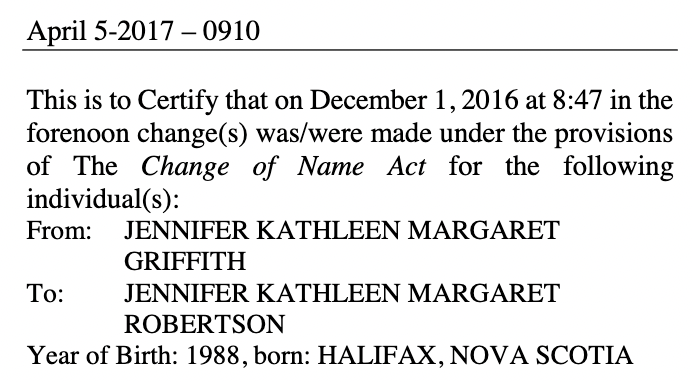
Screen Shot 2021-03-03 at 12.31.35 PMApril 5, 2017 — Cotten’s partner, Jennifer Kathleen Margaret Griffith, changes her last name to Robertson. (Royal Gazette) 

According to CBC, she has also used the name “Jennifer Forgeron” in the past.

Nobody knows for sure why she changed her name to Robertson. 

June 2, 2017 — Quadriga announces on Reddit that it has lost some 67,000 ether worth $14.7 million USD due to a software glitch. The Ethereum contract is known, confirming the money is stuck in Cotten’s wallet, not stolen. The exchange writes:

“While this issue poses a setback to QuadrigaCX, and has unfortunately eaten into our profits substantially, it will have no impact on account funding or withdrawals and will have no impact on the day to day operation of the exchange.”

About this same time, according to court documents filed two years later, Quadriga’s “Chris Markay” account—an alias controlled by Gerald Cotten—is credited with $100 million fake bucks. 

July 18, 2017 — Despite his company’s recent financial setback, Cotten manages to register his 51-foot yacht, The Gulliver. The boat features three cabins, a six-person dining area , a dishwasher, a gas stove, a washer and dryer, an en-suite bathroom with a standing shower, along with a swim platform with teak battens.

Cotten bought the boat from Sunnybrook Yachts after telling the salesperson he wanted something that could take him to the Caribbean without having to stop in Canada or the U.S. for gas. (Vanity Fair)

Meanwhile, Bitcoin is in the midst of its biggest bull run yet. In mid-2017, one BTC was worth about $2,500 USD. By Christmas, it would be valued at eight times that. Yet, even as Quadriga was acquiring more customers, and making more money than ever on trades, there were signs of trouble brewing.

August 21, 2017 — Quadriga customers begin reporting delays in getting cash off the exchange. (What they see in their accounts are Quad Bucks, a stand-in for fiat money. But many Quadriga customers don’t know this.) In emails with clients, Cotten blames the “Canadian banking cartel” for the wire delays, saying they are out to “stifle bitcoin adoption” in the country. (Globe and Mail)

September 26, 2017 — On behalf of Billerfy, the payment processor he operates and that services QuadrigaCX, José Reyes applies to open three commercial banking accounts at the Canadian Imperial Bank of Commerce’s Beaver Creek Branch. (Interpleader order)

September 27, 2017 — Reyes visits the CIBC Bayview Village Branch, and opens personal checking, savings and U.S. dollar accounts. (Interpleader order)

November 28, 2017 — CIBC’s anti-money laundering department reviews Reyes’ account opening documentation at the Beaver Creek Branch. After the bank learns that Billerfy is a money service business, it closes the accounts. (Interpleader order)

November 30, 2017 — Reyes applies to open two small business banking accounts at CIBC’s Bayview Village Branch on behalf of Costodian, a shell company he set up to open accounts under. One is an “expense account,” the other is a “transaction account.” Reyes tells CIBC that Costodian is “[n]ot related to Billerfy’s CMO business.” (Interpleader order)

December 17, 2017 — After a spectacular run-up, bitcoin reaches an all-time high of nearly $20,000 USD. In 2017, $1.2 billion USD worth of bitcoin traded on Quadriga. The exchange took a commission on every trade. (But as court docs reveal, Quadriga kept no books, had no formal record of accounting, and business and customer funds were all mixed together.)

December 4 – February 20, 2018 — At the height of the crypto bubble, tens of millions of dollars flood into the bank accounts that Reyes opened up at CIBC to collect Quadriga funds. In three months, 388 depositors make 465 deposits to Costodian’s “transaction account” in the total amount of $67 million CAD. (Some of the money is eventually withdrawn, leaving roughly $26 million CAD.)

December 22–28, 2017 — Reyes transfers $2.3 million CAD from Costodian’s “transaction account” to his personal checking and savings accounts. He admits to CIBC he did not notify Quadriga prior to transferring the money to his personal accounts. From here out, the bank takes a hands-off approach to those funds. (Interpleader order)

January 8, 2018 — CIBC is unsure of who the $26 million CAD belongs to, so it freezes two accounts belonging to Costodian and José Reyes. In an interpleader order, the bank asks the justice system to take possession of the funds and decide who they belong to—QuadrigaCX, Costodian or the depositors. Cotten fights back, claiming CIBC had no right to freeze the funds. Quadriga has already credited depositors with Quad Bucks, he says.   

In 2018, the bitcoin bubble bursts. According to official reports, by the end of 2017, there were some 20,000 fake bitcoin on Quadriga. Clients have no idea they have been paying cash for fake crypto. As market prices plummet, when customers go to sell their bitcoin, Cotten struggles to come up with the money to cover it. The issues with CIBC only compound the problem.

February 8, 2018 — According to the Globe and Mail, a new company, 700964 NB, is registered in New Brunswick as “part of a network of entities that helped move millions of dollars around so Quadriga could take deposits and facilitate withdrawals, sometimes in the form of physical bank drafts, for its clients.” Aaron Matthews, Quadriga’s director of operations, and Sarah-Lynn Matthews, his wife, are listed as owners, but the address on the registration leads to a rickety trailer in a mobile home park.

February 16, 2018 — CIBC is still trying to sort out who the $26 million CAD belongs to. The bank asks Jose Reyes (the person who controls the frozen accounts) if it is okay to speak to someone at Quadriga. Reyes says no, because Cotten had indicated that he was not interested in speaking with anyone at CIBC. (Interpleader order)

March 6, 2018 — Reyes finally gives CIBC the okay to contact Cotten directly. (Interpleader order)

March 15, 2018 — CIBC dashes off an email to Cotten asking to speak with him briefly by phone. Cotten declines and requests that CIBC only send him questions in writing. (Interpleader order)

March 21, 2018 — CIBC emails Cotten questions regarding the relationship of Quadriga with Costodian/Billerfy and the depositors and Quadriga’s entitlement to the disputed funds. Neither Cotten nor anyone else from Quadriga responds. (Interpleader order)
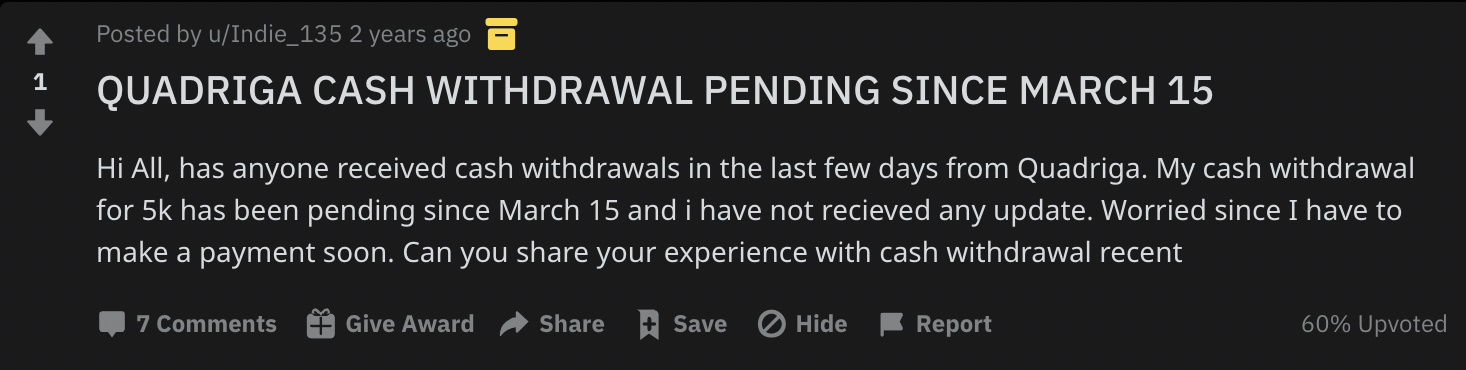
Screen Shot 2021-03-04 at 7.28.02 PMMeanwhile, Quadriga clients start complaining on Reddit that their cash withdrawals are delayed. 

July 2018 — In the midst of all this, Michael Patryn is working on cleaning up his reputation. He hires Reputation.ca to remove negative content about him on Complaints.com, where he is referenced as a money launderer. Patryn later sues Reputation.ca for not moving fast enough, according to the Globe and Mail, who reviewed the court documents.  

October 8, 2018 — Cotten and Jennifer Robertson get married, according to several Reddit posters who claim they saw Robertson’s Facebook page. (The Globe and Mail earlier reported the wedding was in June. However, the OSC report also confirms the wedding was in October.) According to the OSC report, it was a small private ceremony in Scotland. 

November 9, 2018 — The Ontario Superior Court grants CIBC an interpleader order allowing the court to take control of Custodian’s $26 million CAD—which it is holding on behalf of Quadriga—until the ownership of the funds can be established. (CoinDesk.)

November 27, 2018 — Cotten signs a will, leaving all his belongings to Robertson, including several properties, a 2017 Lexus, an airplane, a 2015 Mini Cooper and a 51-foot Jeanneau sailboat. He goes a step further and details the distribution of his assets should Robertson not survive him, even specifying that $100,000 CAD goes to his two chihuahuas, Nitro and Gully.

After some digging, CBC learns that Cotten’s widow has a company called Robertson Nova Property Management, which was incorporated in June 2017. Between May 2016 and October 2018, Robertson, her husband and her company bought 16 properties worth $7.5 million CAD. The properties range from $94,000 CAD for a waterfront lot in Lunenburg County to $2.5 million CAD for nine row houses in Bedford.

“Little is known about Ms. Robertson, who appears to have used three different surnames since she began buying real estate in Nova Scotia with Mr. Cotten in 2016,” reports Globe and Mail in February 2019.

November 30, 2018Cotten and wife Jennifer Robertson arrive in New Delhi, India. They have come to the country to celebrate their honeymoon and participate in the opening of an Angel House orphanage they sponsored. (Globe and Mail)

December 3, 2018 — Physical cash pickups up to $2,500 are now available for Quadriga customers. Quadriga states on Reddit (archive): “We have partnered with selected stores to provide local cash pickup — as we have just started exploring this new method, only one store in Montreal, QC has been set up at the moment. We have another store going live next week in Cornwall, ON and hopefully many more.”

December 4, 2018 — Quadriga announces that the Ontario Superior Court is releasing the Costodian funds, which CIBC held “hostage.” Quadriga writes on Reddit (archive): “According to our counsel, the funds should be paid out by the end of this week.” However, new problems arise when the court issues the funds back to Costodian in the form of bank drafts, which Custodian has trouble depositing. No bank will touch the money. 

(By this time, according to official reports, Cotten has lost a total of $115 million CAD trading on the platform by trading with fake assets. So far, he has covered those losses with customer money. Now, with another $26 million CAD that has become inaccessible, he is running out of time. His Ponzi is collapsing.)

December 8, 2018 — At 5:15 p.m. Cotten and Robertson land in Jaipur, India, where they plan to spend four nights at the Oberoi Rajvilas for $923 CAD a night. Soon after the couple check-in, Cotten gets a bellyache. At 9:45 p.m., he checks into Fortis Escorts Hospital. He spends the night at the hospital in a private room. (Globe and Mail) 

December 9, 2018 — Cotten’s condition deteriorates. At 7:26 p.m. local time he is declared dead due to complications of Crohn’s disease. The cause of death is cardiac arrest. Robertson withholds the news from Quadriga customers for more than a month. Meanwhile, the exchange continues to accept deposits. (Globe and Mail, Affidavit)

December 10, 2018 — Dr. Simmi Mehra, who works at Mahatma Gandhi Medical College & Hospital, refuses to embalm Cotten’s body, in part because the body was coming from the hotel where Cotten had been staying—not Fortis, the hospital where he died. Most bodies are brought to her by ambulance, she said. Additionally, she is uncomfortable with the lack of detail and documentation surrounding the death.

December 10, 2018 — Cotten’s body is then taken to SMS Medical College, which issues an embalming certificate. Sangita Chauhan, who heads the anatomy department there, does not actually see the body. Instead, a junior staffer handles the processing. The body is picked up by staffers at Oberoi, the hotel where Cotten and his wife were staying. (Globe and Mail)   

December 10, 2018 — Robertson checks out of the Oberoi and heads back to Canada “with the body,” according to the Globe and Mail. She arrives in Halifax the following day. 

December 13, 2018 — Cotten’s death is registered with the Government of Rajasthan Directorate of Economics and Statistics in India. “The death certificate, obtained by The Globe, lists his “address at time of death” as the Oberoi Rajvilas.” However, a death certificate, later obtained by CoinDesk, lists his “place of death” as Fortis Escorts Hospital. 

December 13, 2018 — The Angel House orphanage that Cotten and Robertson funded opens in Venkatapuram, India. The money the couple donated only paid for materials. The building is still missing several doors, including one to the bathroom. And the man running the orphanage is going into debt. 

December 14, 2018 — A closed-casket funeral service is held for Cotten at J.A. Snow Funeral Home in Halifax, Nova Scotia. He is buried that day. (Reddit)

Meanwhile, withdrawals from Quadriga have all but ground to a halt. Reddit /r/QuadrigaCX has become awash with people complaining they cannot get their money out of the exchange. (David Gerard)

January 14, 2019 — Quadriga finally lets the world know that its CEO is dead. Cotten’s widow posts an announcement on the Quadriga website explaining that Cotten passed away in India while opening an orphanage. To quell any suspicions that he ran off with everyone’s money, she bestows her husband with a host of virtuous qualities:

“Gerry cared deeply about honesty and transparency—values he lived by in both his professional and personal life. He was hardworking and passionate, with an unwavering commitment to his customers, employees, and family.”

Robertson recommends that Quadriga’s head of operations, Aaron Matthews, assume the role of interim president and CEO. Matthews later denies he was CEO. (Tweet)

Meanwhile, Quadriga’s customers are now having trouble getting their crypto out of the exchange. Unlike cash, which has to go through a third-party payment processor, crypto should move directly from the exchange to the customer. This leads to concern that maybe the crypto funds aren’t actually there.
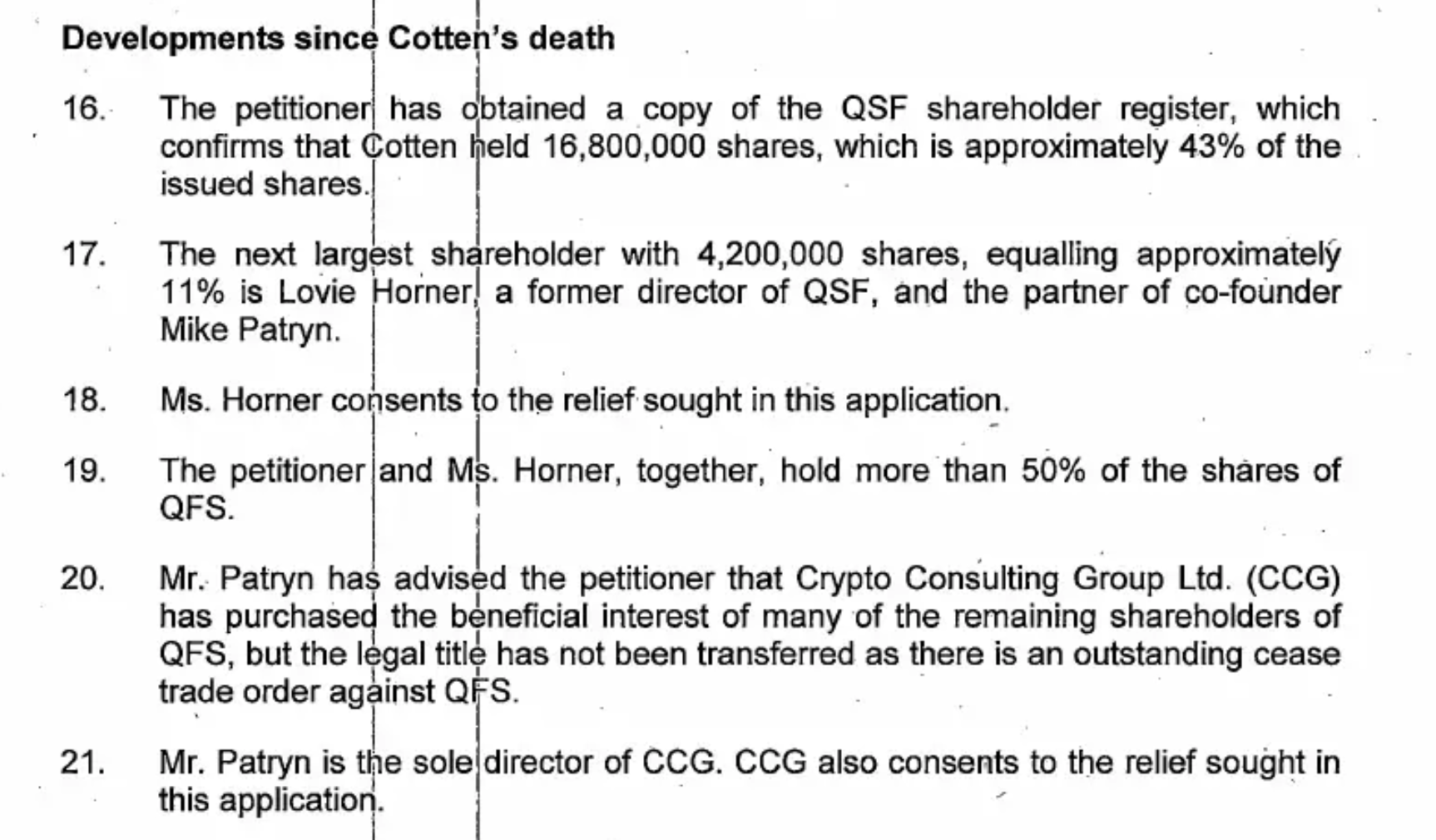
Screen Shot 2020-07-13 at 9.54.19 PMJanuary 22, 2019 — Robertson sends a petition to the Supreme Court of British Columbia requesting a shareholder meeting to appoint new board members to Quadriga Fintech Solutions because, effectively, the company has no board. Per the petition, the owners of QFS are Cotten (43%), Lovie Horner (11%), and Mike Patryn (who had purchased most of the rest), with some other minor shareholders.

January 25, 2019 — It’s Friday. Quadriga holds a shareholder meeting. Robertson, her stepfather Thomas Beazley, and a man named Jack Martel are appointed as new directors. They decide to suspend Quadriga’s operations but hold off on sharing this news with Quadriga customers. (Affidavit)

January 26, 2019 — The newly appointed directors instruct that the platform be paused. According to an affidavit Robertson files with the court on Jan. 31, “The pause will mean that future trades of cryptocurrency will be temporarily suspended, including the settlement of cash or the trading of currency between users.”

January 28, 2019 — All weekend long, anxious Quadriga customers wait to hear some news. On Monday, they awake to find a large notice on the exchange’s website indicating the site is down for maintenance. (CoinDesk)

January 29, 2019 — Cotten’s widow moves to protect her property. According to the Chronicle Herald, at the end of January, “Robertson took her deceased husband’s name from the ownership of four properties, worth a combined $1.1 million [CAD], then took out collateral mortgages on all four in favour of a trust of which she is a trustee, and finally transferred ownership of at least two of those properties to that trust.” The name of the trust is the Seaglass Trust.

January 31, 2019 — Quadriga’s anxious customers still don’t know what is going on. The exchange’s website remains in “maintenance mode” for three nail-biting days. Then a new notice appears on the site, basically stating Quadriga customers’ worst fears: the exchange is bankrupt. Quadriga’s board members have applied for creditor protection with the Nova Scotia Supreme Court. A preliminary hearing is set for Feb. 5.

Buried in the notice is more alarming news. Quadriga is scrambling to locate the keys to its cold wallets. Most exchanges typically keep the majority of their crypto in offline “cold” wallets for security reasons. The situation is akin to a bank misplacing all of its money—or worse, the money getting stuck in a vault and the only person with the key is dead. 

February 5, 2019Maurice Chaisson, a lawyer with Stewart McKelvey, represents Quadriga in a Nova Scotia court for its creditor protection hearing. The court appoints Ernst & Young as a monitor in charge of tracking down the $250 million CAD, in cash and in crypto, collectively owed to Quadriga’s customers. The exchange is granted a 30-day stay, meaning its clients are unable to sue the exchange in that time. (CoinDesk) 

Quadriga updates its website with a new announcement and a Q&A explaining what it means to file for creditor protection under the Companies’ Creditors Arrangement Act. 

February 5, 2019 — With keys to the exchange’s cold wallets supposedly gone missing, many are wondering if Cotten staged his death. CoinDesk posts a death certificate with Cotten’s name misspelled “Cottan.” Apparently, fake death certificates are easy to come by in India.

February 7, 2019 — Fortis Escorts, the hospital in Jaipur, India where Cotten passed, releases a statement confirming his death. Cotten arrived at the hospital in a “critical condition” with “pre-existing Crohn’s disease and was on monoclonal antibody therapy every 8th week.” He was diagnosed with septic shock and other horrible things. (CoinDesk)

February 8, 2019 CoinDesk reports that crypto funds were moving through the Quadriga platform up to Cotten’s death. In a series of transactions sent from the exchange’s internet-connected hot wallets, more than 9,000 ETH moved from Quadriga to a handful of other exchanges, including Binance, Bitfinex, Kraken and Poloniex. Most of that crypto was transferred the week before Cotten’s death, but there is no telling who initiated the transactions—the exchange, its customers, or both.

February 8, 2019 — The Ontario Securities Commission, or OSC, announces it will look into what happened at Quadriga. . The news comes just days after the British Columbia Securities Commission said it had no reach into the exchange. (Reuters.)

February 11, 2019 — Jack Martel, one of the newest member of Quadriga’s board resigns, leaving Jennifer Robertson and her stepfather Thomas Beazley as the only two directors. (Second report of the monitor.)

February 12, 2019 — Things just keep getting worse for Quadriga creditors. In its initial report, the monitor reveals that on Feb. 6—a day after Quadriga was granted creditor protection—the exchange “inadvertently” sent 104 of the bitcoin it was holding in its hot wallets (worth roughly $468,675 CAD) to its dead CEO’s cold wallet, which nobody can access. 

The hot wallets now contain 51 bitcoin (BTC), 33 bitcoin cash (BCH), 2,032 bitcoin gold (BTG), 822 litecoin (LTC), and 951 ether (ETH), worth $434,068 CAD—less than half the value of what they held before.

February 14, 2019 — Nova Scotia Supreme Court Judge Michael Wood appoints law firms Miller Thomson and Cox & Palmer to represent Quadriga creditors throughout the CCAA proceedings. Miller Thomson is the lead counsel located in Toronto; Cox & Palmer is the local counsel. The scope of their work is spelled out here.

February 20, 2019 — In its 2nd Report of the Monitor, Ernst & Young reveals that the sending of 104 BTC to Quadriga’s cold wallets earlier was due to a “platform setting error.” The CCAA process is also running low on funds. EY has in its possession tens of millions of dollars in bank drafts from Quadriga and its payment processors. The problem is getting a bank to accept the funds. (Read my story here.)

February 22, 2019 — The court issues a “Banking arrangement order” at the request of Ernst and Young. The order offers limited protection to the Bank of Montreal and the Royal Bank of Canada for handling bank drafts related to Quadriga and its payment processors.

There is also an issue of a a disputed $5 million CAD bank draft—EY has determined that $60,958.64 CAD of that is owed to Costodian principal Jose Reyes, because these were his personal funds. And $778,213.94, which Custodian claims it is owed in unpaid transaction fees, will go into trust account pending further order of the court.

February 25, 2019 — Robertson files a second affidavit. In it, she asks for an extension of the stay of proceedings in the CCAA and the appointment of Peter Wedlake, a senior vice president and partner at tax and accounting firm Grant Thornton, to the position of chief restructuring officer for Quadriga. The CRO would fill the director position left vacant by Jack Martel stepping down on February 11. Thornton has cryptocurrency experience and is a “certified bitcoin professional.

Screen Shot 2021-03-04 at 7.45.33 PMFebruary 28, 2019Globe and Mail (archive) tracks down a booking photo of Omar Dhanani and posts it alongside a screen grab of Michael Patryn taken from a Youtube video. The two faces look strikingly similar.  

March 5, 2019 — Justice Michael Wood grants Quadriga a 45-day stay and approves the appointment of Peter Wedlake as chief restructuring officer. (My coverage here and here.)

March 13, 2019 — The law firm representing Quadriga in the CCAA proceedings tells the court that it is stepping down, effective immediately. Stewart McKelvey had been representing both Quadriga and the estate of Quadriga’s dead CEO. This led to concerns of a potential conflict of interest from the monitor and the representative counsel. Stewart McKelvey will continue to represent Robertson’s estate.

March 19, 2019Bloomberg straight out announces that Michael Patryn is Omar Dhanani. Reporters tracked down the actual documents showing two name changes. “Patryn changed his name from Omar Dhanani to Omar Patryn with the British Columbia government in March 2003. Five years later, he registered a name change to Michael Patryn in the same Canadian province.” There is no doubt now of Patryn’s true past and identity. 

March 19, 2019 — The representative counsel in Quadriga’s CCAA now have a voice to listen to. Miller Thomson and Cox & Palmer appoint a steering committee to help them represent 115,000 of the exchange’s creditors. The members include: Parham Pakjou, David Ballabh, Eric Bachour, Ryan Kneer, Magdalena Gronowska, Eric Stevens and Nicolas Deziel, with Richard Kagerer and Marian Drumea assigned as alternates.

April 2, 2109 — EY releases its fourth monitor report. The monitor proposes that Quadriga shift from its Companies’ Creditor Arrangement Act proceedings into proceedings under the Bankruptcy and Insolvency Act.

EY is moving to preserve Robertson’s assets, so that she can’t liquidate or transfer them. The monitor is also grappling with a host of former Quadriga third-party payment processors to track down more missing money.

April 8, 2019 — Quadriga is officially placed into bankruptcy.  The transition means EY will be granted enhanced investigative powers as a trustee.

April 18, 2019 — Justice Wood extends Quadriga’s creditor protection to June 28. On that date, the CCAA proceeding will expire and Quadriga will enter a pure bankruptcy.  

May 10, 2019 — EY publishes its trustee’s preliminary report. The report is dated May 1, but looks to have been published several days later. It reveals what many Quadriga creditors likely already know — most of their money is gone. Quadriga has US$21 million but owes creditors US$160 million.

June 19, 2019 — Quadriga’s publishes its fifth report of the monitor, and it is a doozy. The report begins to draw a clear picture of the huge fraud that was taking place inside the exchange. Most notably, it describes how millions of dollars worth of funds were funneled off the exchange via slush accounts set up by Gerald Cotten himself. The biggest is the “Chris Markay” account.

The numbers are somewhat different than earlier. According to EY, the exchange owed 76,000 users (not 115,000) $215 million CAD (not $250 million CAD) in fiat and crypto. So far, only $33 million CAD has been recovered. (My story in Decrypt)

August 26, 2019 — In a second report of the trustee filed with the Supreme Court of Nova Scotia, EY notes that there are now four law enforcement agencies and regulators requesting information about Quadriga. It reveals two: the Royal Canadian Mounted Police and the FBI. The identity of the other two remains undisclosed, though Coindesk reports that one may be an Australian investigative agency and a later story in Vanity Fair suggests one is a federal agency in Japan.

Separately, EY also recommends moving Quadriga’s ongoing bankruptcy proceedings from Halifax to Toronto to reduce costs. “As the majority of the professionals are located in Ontario, there would be significant cost savings to transferring the proceedings to Ontario,” the auditor said. “There are very few remaining ties to Nova Scotia at this time.”

September 10, 2019 — A Nova Scotia judge approves the request to move the Quadriga bankruptcy process to Toronto. The court proceedings for the shuttered exchange have been held in Halifax since January 2019, following its founder’s untimely death.

October 7, 2019 — EY files its fourth report of the trustee. Jennifer Robertson, Cotten’s widow, agrees to turn over roughly CA$12 million (US$9 million) in assets to EY Canada. In a statement, she said she had “previously thought [the assets] were purchased with Gerry’s legitimately earned profits, salary and dividends.”

Robertson’s, stepfather, Thomas Beazley, will also transfer to EY any assets he bought with money that came from Quadriga, including a 2017 Toyota Tacoma truck.

Meanwhile, Robertson will get to keep her clothing and personal items, her wedding band (worth CA$8,700) and a 2015 Jeep Cherokee. She will also retain about CA$90,000 in cash, a CA$20,000 Registered Retirement Savings Plan and her shares of the company. She will have to vacate her home in Fall River, N.S., by the end of the month.

November 18, 2019 — Einstein, another cryptocurrency exchange in Canada, goes belly up. The news comes out that there’s nothing left at all. The money and cryptos are all gone. The British Columbia Securities Commission had been investigating Einstein since May 2019 — after multiple complaints from customers who couldn’t access their funds, going back to January 2018, David Gerard reports in his blog.

December 13, 2019 — Law firm Miller Thomson sends a letter to the Royal Canadian Mounted Police on behalf of Quadriga creditors requesting the RCMP exhume Cotten’s body and perform a post-mortem autopsy to confirm his “identity and the cause of death.” Of course, they want this done before spring when the warmer weather is sure to cause the body to further decompose.

January 8, 2020 — Argo Partners, a New York City hedge fund that specializes in purchasing bad debt against bankrupt entities, begins reaching out to Quadriga creditors to see who might interested in selling stakes in their remaining funds. An announcement (archive) on the firm’s website says that anyone interested in “receiving a price quote for your claim” should fill out an online form or call the firm directly.

January 22, 2020 — Miller Thomson, the representative counsel for QuadrigaCX creditors, asks creditors for help in identifying any records related to Crypto Capital Corp. In a letter (archive) posted on its website, the law firm said that it had received information that a “Panamanian shadow bank” may have been a payment processor for the exchange in the final quarter of its operation. In other words, Q4 2019.

Crypto Capital at one time listed Quadriga on its website as a client. The exchange’s now-deceased founder also admitted to using the firm in the past. In an email to Bloomberg News on May 17, 2018, Gerald Cotten wrote: “Crypto Capital is one such company that we have/do use. In general it works well, though there are occasionally hiccups.”

I found evidence strongly suggesting that financial documents from Quadriga’s former users do, in fact, link to Crypto Capital.

January 22, 2020 — EY’s 5th trustee report reveals the accounting firm racked up nearly $500,000 USD in costs responding to law enforcement requests in the second half of 2019.

January 28, 2020 — Miller Thomson gets fed up with the RCMP’s inaction, so it sends a letter to Bill Blair, Canada’s Minister of Public Safety and Emergency Preparedness, who is the person responsible for the RCMP. Will Cotten’s body will be exhumed by springtime, or not? That is the question.

June 1, 2020 — All virtual currency exchanges in Canada as well as foreign virtual currency exchanges serving Canadian residents are now required to register as a money services business with the country’s anti-money-laundering watchdog FinTRAC. 

June 11, 2020 — The Ontario Securities Commission publishes its review of QuadrigaCX. Gerald Cotten operated Quadriga like Ponzi scheme, the OSC said. “What happened at Quadriga was an old-fashioned fraud wrapped in modern technology.”  

# # #

News: QuadrigaCX has gone bust, Kik is fighting back, and Tether rose to 4th place, briefly

QuadrigaCX customers’ worst fears have come to pass. The Canadian exchange is officially insolvent, and all the crypto is gone—well, most of it anyway.

On January 31, after filing for creditor protection, Jennifer Robertson, the widow of the exchange’s now-deceased CEO Gerald Cotten, filed an affidavit with the Supreme Court of Nova Scotia. As it turns out, Cotten was the only person who held the keys to the exchange’s cold wallets—encrypted wallets where cryptocurrency is kept offline. When he died in December, all that crypto became inaccessible.

According to the affidavit, QuadrigaCX owes 115,000 customers some $250 million CAD ($190 million USD) in both crypto and fiat. Roughly $192 million CAD ($147 million USD) were in crypto assets, most of it in the cold wallets.

In addition to the lost crypto, $30 million CAD is currently held by payment processor Billerfy. Three other third-party payment processors are holding a combined $565,000 CAD. And another $9.2 million USD is stuck inside WB21—a money transfer service that, surprise, surprise, is being sued by the U.S. Securities and Exchange Commission (SEC) for fraud.

But here is where things get strange. Two weeks before he died, Cotten signed a will leaving $100,000 CAD for his two dogs, according to the Globe and Mail (archive.)

I’m not insinuating any foul play here, but let’s go over what we have: Cotten and Robertson supposedly got married two months before his death. Cotten writes up a will to make sure his dogs are taken care of and Robertson takes ownership of 43% of the shares of Quadriga Fintech Solutions, the parent company of QuadrigaCX, should anything awful happen to him. Once that’s all said and done, something awful happens. Cotten goes off to India to help needy children (so nice of him) and dies.

Screen Shot 2019-02-03 at 7.47.19 AM

A month later, Robertson posts an announcement on the exchange’s website telling everyone the company’s CEO is dead. He was a kind, honest, upstanding, guy…after all, he sponsored an orphanage. And then later: Oh, and by the way, all the money is gone, because only Gerald knows where he put it.

[Update: A new twist to this plot may be developing. One Reddit user claims to have found the QuadrigaCX litecoin cold wallet addresses—and the funds appear to be on the move.] 

Elsewhere in the news, Canadian social media startup Kik plans to fight an expected SEC enforcement action over an initial coin offering (ICO). (Read my coverage here.) Kik raised $100 million in 2017 by selling its kin token. In a response to a Wells notice from the SEC, Kik argues that its token is a currency, therefore, it cannot be a security, and besides, the company never marketed kin as an investment anyway.

You could almost go along with that, as long as you completely ignored this 2017 Youtube video of Kik’s CEO Ted Livingston telling everyone how rich they could become if they owned kin. “We’re gonna put [kin] inside Kik and it will become super valuable on day one, we think.” Oops! (Read the full coverage in The Block.)

Two “professional hacking groups” are behind the majority of publicly reported hacks of crypto exchanges and other cryptocurrency organizations, according to a crypto crime report published by blockchain data analytics firm Chainalysis. The two nefarious groups so far have raked in $1 billion of hacking revenues for themselves. Of course, even thieves don’t keep their holdings in bitcoin. They converted everything to fiat.

If you thought SingularDTV was a dreadful name, the blockchain entertainment company has come up with something even more bad. SingularDTV has changed its name to Breaker. The company has a new logo, too—a circle comprised of small lines swirling inward meant to represent the “the hive mind,” a type of groupthink that decentralized projects like to associate themselves with.

Breaker owns Breaker Magazine, which changed its name to BreakerMag to avoid confusion. To go along with the new branding, Breaker (we’re talking about SinglarDTV now) also released a cringe-worthy video that starts with a man gyrating his hips and saying, “It’s like this,” and then devolves into a woman ripping a pink beauty mask off her face. As if the name change wasn’t awkward enough.

Nicholas Weaver, a researcher at International Computer Science Institute, gave a talk at Enigma, a USENIX conference, called “Cryptocurrency: Burn it with Fire!,” where he argued the entire cryptocurrency and blockchain space is effectively one big fraud. Here are the slides to the presentation. The video is not up yet, but Weaver gave a similar talk in April 2018. (It’s funny, watch it.)

For a brief period, tether (USDT), the stablecoin associated with the crypto exchange Bitfinex, rose to become the fourth largest crypto by market cap at $2 billion. It has dropped back down to sixth place now, but who knows, maybe it will rise up again. (Read my tether timeline to learn why tether is so important to crypto markets.)

Banking giant JP Morgan says bitcoin is now worth less than the cost to mine it. “The drop in Bitcoin prices from around $6,500 throughout much of October to below $4,000 now has increasingly pushed margins further and further negative for just about every region except low-cost Chinese miners,” the bank’s analysts said. (Bloomberg)

Despite all the hype, decentralized exchanges (DEX) are not attracting much interest. According to a report in Diar, DEX volume is at an all-time low—something that’s unlikely to change, mainly due to poor usability issues. Another reason to avoid DEXs:  anyone can list any token they like—even if it’s not a legitimate one.

Binance has come up with yet another harebrained business scheme. The Malta-based crypto exchange now allows customers to buy crypto using their credit cards. I can’t see this working out too well. Banks generally distance themselves from all things crypto, and many won’t allow you to put crypto on credit cards. And even if they do, weird things happen. US-based crypto exchange Coinbase no longer accepts credit cards, but when it did, Visa actually overcharged buyers—though, it did eventually issue refunds.

An Italian bankruptcy court found Francisco Firano (aka “Francisco the Bomber”) personally liable for $170 million in losses related to the BitGrail hack in April 2018. (Last year, I wrote a story about the hack for Bitcoin Magazine.) The BitGrail Victims Group posted scans of the court documents along with an explanation of the court’s decision on Medium.

In a big win for nocoiners, David Gerard, author of “Attack of the 50-foot Blockchain,” wrote a op-ed for The Block titled “The Buttcoin Standard: the problem with Bitcoin,” where he basically takes apart bitcoin and criticizes the horrendous energy waste of proof of work. Gerard’s article was solid. But just as you might expect, bitcoiners objected en masse, and even attacked The Block cofounder Mike Dudas.

Most of the criticisms were attempts to discredit the author and consisted of vague comments, such as “[Gerard’s] thought process is fundamentally broken at the protocol level,” “I was hoping for a more astute criticism,” and “terrible journalism!

Apple cofounder Steve Wozniak, who used to go around comparing bitcoin to digital gold, admits he sold all his bitcoin at its peak. “When it shot up high, I said I don’t want to be one of those people who watches and watches it and cares about the number. I don’t want that kind of care in my life,” he said at the Nordic Business Forum. “Part of my happiness is not to have worries, so I sold it all and just got rid of it.” (Satoshi Times)

And finally, the police department in Lawrence, Kansas has been getting reports of bad actors calling people up at random to demand bitcoin.

Social media startup Kik is kicking back—at the SEC

screen shot 2019-01-29 at 12.23.59 amKik is ready to go to battle. The Canadian social media startup has decided to take on the U.S. Securities and Exchange Commission (SEC). At issue is whether Kik’s digital token kin is a security.

Kik raised $47.5 million in September 2017 by selling kin in an initial coin offering, or ICO — though, Kik prefers to call it a token distribution event. That was after Kik pre-sold $50 million worth of kin to a group of 50 wealthy investors, mainly blockchain hedge funds. The presale was a simple agreement for future tokens, or SAFT, which is basically, a Reg D exemption, where the investors would get the tokens at some point in the future after things were up and running.

What is kin?

On its website, Kik describes kin as a “digital currency” that you can use to “earn points for watching video ads, then use points for stickers and custom emojis.” Kin is different from other in-house loyalty points, because it “can be bought and sold for real money.” In other words, you could use Kin as a utility token in the Kik app and also trade it on crypto exchanges for other coins, like bitcoin and ether.

Kik initially announced its token sale in May 2017, four months ahead of its ICO. At the time, the company banned Canadians from taking part in its public sale, because the Ontario Securities Commission (OSC) had already deemed its token to be a security. But that didn’t stop Kik from opening its sale up to U.S. citizens.

Although Kik consulted with lawyers before its public ICO, as far as what I’m reading, they never actually reached out to the SEC for guidance. And it’s not like they weren’t given fair warning that this might pose a problem. 

Fair warning

By mid-2017, the SEC had already begun its crackdown on ICOs. Two months prior to Kik’s ICO, the regulator issued an investigative report concluding that tokens sold by the DAO (a decentralized investment fund that ran on Ethereum) were securities. That report was a cautionary tale to any other project thinking about raising money in an ICO. In a public statement at the time, the SEC said:

“We encourage market participants who are employing new technologies to form investment vehicles or distribute investment opportunities to consult with securities counsel to aid in their analysis of these issues and to contact our staff, as needed, for assistance in analyzing the application of the federal securities laws.” (Emphasis mine.)

But instead of proactively reaching out to the SEC, Kik sat back and waited to hear from them—not a great strategy. 

The SEC first contacted Kik two days after Kik’s token offering began. “It was a friendly contact for information, which we happily responded to,” Kik CEO Ted Livingston wrote in a blog post. But from there the conversations “ramped up,” and on November 16, 2018, the SEC sent Kik and the Kin Foundation a Wells notice—essentially, a letter stating that the regulator was about to bring an enforcement action against them. On December 7, Kik sent back a 31-page response.

As far as the SEC sees it, Kik is in violation of section 5 of the Securities Act of 1933, which states that it is illegal to sell securities unless you register with the SEC or else apply for an exemption, such a private placement, which limits a sale to accredited investors—i.e., wealthy people who can survive the loss, if things go wrong. 

As mentioned, Kik’s private token sale was a Reg D exemption. (Here is the SEC filing from September 2017.) According to SEC rule 506 of Regulation D, purchasers receive “restricted securities,” meaning that the securities cannot be sold for at least six months to a year. Also, Reg D does not pre-empt something from being a security.  

The problem with SAFTs

In general, the problem with SAFTs is that, for various legal reasons (see SEC rule 144), even after the holding period, you can probably only sell your coins to other accredited investors. In other words, you cannot freely trade those coins on the secondary market. Obviously, that limits kin’s usability. It also makes kin not a very good currency, because you can’t actually buy and sell it for real money—at least not that easily.

The basic rule for determining wether something is a security is the Howey test, which states that a security is “an investment of money in a common enterprise with a reasonable expectation of profits to be derived from the entrepreneurial or managerial efforts of others.” In its response letter, Kik claims kin is not a security according to the Howey test, because Kik never marketed its ICO as an investment.

“Simply put, Kik did not offer or promote Kin as a passive investment opportunity. Doing so would have doomed the project, which could only succeed if Kin purchasers used Kin as a medium of exchange (rather than simply holding it as a passive investment). Accordingly, Kik marketed Kin, not as an investment opportunity, but rather as a way to participate in a fundamentally new way for consumers to access digital products and services, and for innovative developers, and their users, to be compensated for the value they provide.”

But Kik’s main rebuttal is that kin is a currency—so securities laws don’t apply.

Let’s take a look at Page 11 of the 1934 Securities Exchange Act. It says:

“The term ‘‘security’’ means any note, stock, treasury stock, security future, security-based swap, bond, debenture, certificate of interest or participation in any profit-sharing agreement… but shall not include currency or any note, draft, bill of exchange, or banker’s acceptance which has a maturity at the time of issuance.”

Lawyers will have to debate how to define kin. But just as the SEC’s Munchee order in December 2017 made it clear that calling a token a “utility token” does not unmake it a security, calling a token a “cryptocurrency” may prove equally as futile—especially, if the token doesn’t actually work as a currency.

News: Radio silence from QuadrigaCX, wash trading doesn’t pay, and KYC data turning up on the dark web

screen shot 2019-01-26 at 11.46.22 pmQuadrigaCX customers are still waiting to get their funds. The Canada-based crypto exchange has been eerily quiet since reporting on January 14 that its CEO Gerald Cotten died in India—a month earlier. 

Since then, the only sign of life has been a single tweet warning customers that another twitter account was fake.

Trouble began a year ago when the Canadian Imperial Bank of Commerce froze about $22 million in US dollars in an account opened by QuadrigaCX’s payment processor. The majority of the frozen funds were released in December, but customers still aren’t getting their money. In recent developments, one user on Reddit claims that he received $18,000. But several more of the exchange’s customers are complaining that their fiat withdrawals are being marked as completed with no money coming through.  

Customers are unable to move crypto out of the exchange either. Some report that requests are simply left pending.

According to a petition submitted to the Supreme Court of British Columbia on January 22, QuadrigaCX was to hold a shareholders meeting on January 25 to appoint a new director. When Cotten died on December 9, he left the company with no officers, and no way to carry out its business. Still, it is not clear if that is what is holding up funds or if something nefarious is going on. Two days after the shareholders meeting, the exchange still hasn’t posted an update.  

Crime, or in this case wash trading, doesn’t pay. Two executives at South Korean crypto exchange Komid are heading off to jail for faking volume, according to BlockinPress. Choi, the CEO, was sentenced to three years; Park, another executive, was sentenced to two years. Court documents say the faked volume led Choi and Park to earn $45 million.

Know-your-customer (KYC) data (ID cards, drivers licenses, and more) from several top exchanges, including Binance, Bittrex, Bitfinex, and Poloniex, appears to have surfaced on the dark web. Binance claims the data is not coming from its servers. Bitfinex also claims its databases have not been breached.

Since the markets crashed, crypto exchanges are looking for ways to boost their profits. To that end, Coinbase announced that is expanding its institutional trading services to Asia. The San Francisco-based exchange also now supports SWIFT wire transfers that will allow clients in Asia to fund their accounts from banks based outside the U.S.  

Immutability (aka “be your own bank”) has been a big selling point for blockchain. But it also makes mistakes especially painful. Korean crypto exchange Coinzest (not to be confused with Coinnest, a separate exchange) accidentally airdropped $5.3 million worth of bitcoin and other crypto to its customers. 

Polkadot, a project founded by former Ethereum CTO Gavin Wood, aims to solve the problem of blockchain interability. (If you’re not sure what that means, Wood tries to explain it here.) In October 2017, Polkadot raised $145 million worth of ETH in an ICO. Shortly after, $98 million of those funds became frozen due to a bug in Parity wallets, another Wood project. But that’s okay, because you can always get more funding.

In fact, earlier this month, Ethereum gave Parity Technologies, the umbrella company that Parity and Polkadot fall under, a $5 million grant. (Read this Reddit thread to get a sense of how the community felt about that.) Now Polkadot is reportedly looking to raise $60 million through another ICO, according to the Wall Street Journal. Polkadot still does not have a working product.

After one year of serving as CEO of decentralized media platform po.et, Jarrod Dicker has stepped down and returned to the Washington Post. Po.et allows journalists to create time-stamped titles for their work on a blockchain. The problem is, creating archives of our work is not a problem we journalist have. (I mean, there are lots of services that do that, and most of them are free.) Rather, it appears to be just another thinly veiled excuse for launching an ICO. Po.et raised $10 million in August 2017. 

Crypto lawyer Stephen Palley reports on the latest developments in the Tezos class action suit for The Block. In support of “yeah, this was a securities offering,” plaintiffs in the case cite emails from Tezos CEO Kathleen Breitman with securities-like wording. Oops! Tezos raised $232 million in an uncapped ICO in June 2017. The project has gotten criticism for raising above and beyond what most startups need to launch a business.

Galaxy Digital, the crypto merchant bank launched by former hedge fund manager Michael Novogratz, is reportedly raising $250 million for a credit fund aimed at helping needy crypto firms, according to Business Insider. If you are curious about how Novogratz got into crypto (hint: he was Ethereum co-founder and crypto billionaire Joe Lubin’s roommate at Princeton), read this New Yorker piece from April 2018. 

Bitcoiners don’t like to pay taxes. Some crypto folks are getting riled up about Senator Elizabeth Warren’s proposed wealth tax, calling it “theft.” Warren wants to levy a 2 percent tax on assets over $50 million and a 3 percent tax on assets over $1 billion.

Kyle Gibson, a crypto enthusiast and avid researchers who lives in Boston has pulled together a wealth of information on the Texas Department of Banking Memo 1037 and what it could mean for crypto, beyond stablecoins and their issuers. It is worth a read.