I’ve fallen behind on crypto news, mainly because I’ve had this job writing about cash and ATMs for the last seven months. But now I’m trying to get back into it, so here’s a rundown on the news of the week that stuck out.

On top of the list, lawyers for QuadrigaCX creditors want to exhume Gerald Cotten’s body. They’ve dashed off a letter to the Royal Canadian Mounted Police seeking a post-mortem autopsy of the body as well “to confirm both its identity and the cause of death.” That sounds horribly gruesome, particularly since, he was buried a year ago.
He was apparently not cremated. After his death in India on Dec. 9, 2018, his body was embalmed, flown to Canada and buried. No formal autopsy was done, however, so foul play has not been ruled out. Lawyers would like the body pulled from the ground before spring for obvious reasons.
Cotten’s widow said she was “heartbroken to learn of this request.”
(Read my Quadriga timeline to get up to speed on the details of the now defunct Canadian crypto exchange.)
In other news, the legal standoff between the New York Attorney General’s Office and iFinex, the parent company of Tether and Bitfinex, continues.
In late 2018, the NYAG demanded iFinex hand over documents related to an ongoing investigation of its activities, and iFinex has been trying to avoid doing so ever since.
In August, the court ruled iFinex needed to cooperate. iFinex appealed, and recently, the NYAG filed its lengthy response. The response contains a lot of what we already know, but it’s a good refresher if you want to catch up on the entire saga. You can also read Tether’s response to the NYAG’s response filed on Friday.
You recall Cryptopia, the New Zealand crypto exchange that collapsed after a $16 million hack in January? Liquidator Grant Thornton released a second report on Wednesday detailing its progress in recovering the funds. So far, it’s recovered NZ$10.9 million ($7.2 million) but reconciling the over 900,000 active customers on the exchange at the time it went belly up in May is proving a gargantuan task. Likely creditors won’t recoup any of their money anytime soon, and let’s not even talk about the legal fees.
In a podcast interview with Eric Weinstein, managing director at Thiel Capital, published Wednesday, Vitalik Buterin casually mentioned how he managed to convince the Ethereum Foundation to sell 70,000 ETH when the coin peaked in late 2017, resulting in $100 million liquidity. ETH would have been valued at around $1,400 at the time — 10x what it’s worth today. It’s good to know the Ethereum Foundation isn’t starving.
Canadian bitcoin ATM operator Instacoin announced it’s adding support for seven stablecoins — including tether. You can buy and sell up to C$10,000 worth of crypto in a day on these street corner exchanges without having to present any form of identification. Can you imagine if Western Union operated in this fashion?
On Tuesday, U.S. prosecutors arrested four men men for allegedly running a $722 million crypto ponzi scheme. From April 2014 through December 2019, BitClub Network solicited money from investors all over the world in exchange for shares of crypto mining pools. In private conversations, the operators called their clients “dumb” and “sheep” and “idiots.” What do you call people who get caught running these types of scams?
Shopin founder Eran Eyal pled guilty Thursday to defrauding investors of millions of dollars through three investment schemes, including a $42.5 million ICO. After conducting an unregistered securities offering by selling Shopin tokens in 2017, he never created a functional platform. (Here’s the PR and complaint.)
In a tweet, crypto lawyer Stephen Palley said: “The SEC’s ICO enforcement work has quickly become indistinguishable from other types of enforcement litigation. Crypto’s novelty receives no special treatment. Like any other securities offering — you have to register, you can’t make misstatements, and you can’t misuse funds.”
Singapore-based VeChain Foundation’s buyback wallet was hacked on Friday. According to a report in CoinDesk, VeChain said it is working with cybersecurity firm Hacken to track the movement of VET tokens should the criminals try to cash out. The hacked funds represent a little over 1% outstanding VET, which has a fixed supply of 86.7 billion. VeChain is calling the mistake “human error,” because we’re all only human.
Bottle Pay, a service that once allowed users to send tiny amounts of bitcoin via social media, is shutting down due to new AML regulations in the E.U. The Fifth Anti-Money Laundering Directive goes into effect in January and expands existing legislation to include the crypto space imposing strict KYC and AML practices. Users have until the end of the month to withdraw their funds.
Lawrence Lewitinn, former editor-in-chief of Modern Consensus, is now managing editor of markets for CoinDesk. He wrote his first piece about Bitmain’s Texas Hedge. A Texas hedge is a high reward, high risk venture that’s generally a recipe for disaster. Lewitinn does a good job explaining.
In an article written for The Block, Palley claims that Bitcoin-linked investment scheme known as HEX is not a ponzi, but it’s obviously an unregistered security offering.
@Cryptodeleted and @Cryptodeleted2 — the twitter accounts that archived deleted tweets — were shut down by Bitcoin maximalists.
# # #
 When you openly defy the U.S. government and travel to North Korea — one of the U.S.’s foremost enemies — to teach crypto and blockchain tech at a conference, you can’t really expect things to go well. I mean, can you?
 It’s no fun when the money’s all gone. Two weeks after Polish crypto exchange Bitmarket shut down due to “lack of liquidity,” the
  Dmitri Vasilev, the ex CEO of defunct crypto trading platform Wex, was
  BitMEX, the Hong Kong-based bitcoin derivatives exchange, has finally released
  Recently, I visited a Bitcoin ATM in Los Angeles and spent time chatting with the owner of the machine. He told me that his machine charged a 7% transaction fee for bitcoin purchases—5% if you are selling bitcoin—and they only do ID checks for amounts over $280.
 If you were paying close attention a year ago, you may have heard John Oliver
  And then, of course, the exact same thing happened. In
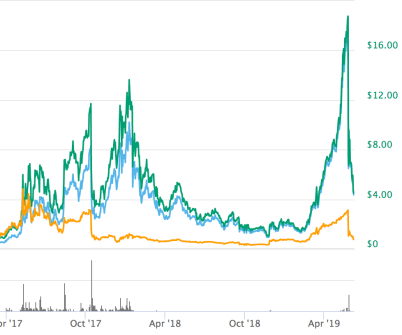
 UNIS SED LEO, the full name of Bitfinex’s shiny new utility token, is in its second week of trading. The price started at around $1, but it’s already climbed to a high of $1.52, according to
  I just had my

 Basically, that equates to, you could get shares of iFinex (Bitfinex and Tether’s parent company) or LEO tokens (a new token Bitfinex recently created) or whatever is in the soup bowl that day. And you may end up with something that has as much real world value as horse manure—just not as good for the roses.
 Ernst & Young (EY) has issued a
  The price of bitcoin (BTC) is organically decided by traders—big ones, and only a few of them.
  Bitfinex will not be able to dip into Tether’s reserves for 90 days, except to maintain normal business activities, according to a New York judge. The crypto exchange must also “promptly” hand over documents to the New York Attorney General (NYAG).
 Reginald Fowler, the
  Bitfinex has a $851 million shortfall due to issues with Crypto Capital. How is it going to fix that? Here is an idea: Why not just print more money?
 Binance, the world’s largest crypto exchange by volume, and the world’s largest tether exchange, has been hacked.
 Another source I spoke to—who did not want his identity revealed—said the recent hack has all the hallmarks of a sophisticated, multi-pronged attack that might be more the work of nation-state elements rather than your typical “lone hacker.”
 Bitfinex was not happy with the New York Attorney General’s April 24
  It’s still not clear where all that money went. Bitfinex says the funds were “
 Fowler, 60, is a former minority owner of the Minnesota Vikings and the original
  According to an April 24
 Amy Castor