News: Quadriga creditors want Cotten’s body exhumed, NYAG/iFinex standoff continues, Bottle Pay shutting down 

I’ve fallen behind on crypto news, mainly because I’ve had this job writing about cash and ATMs for the last seven months. But now I’m trying to get back into it, so here’s a rundown on the news of the week that stuck out. 

Coffin Open

On top of the list, lawyers for QuadrigaCX creditors want to exhume Gerald Cotten’s body. They’ve dashed off a letter to the Royal Canadian Mounted Police seeking a post-mortem autopsy of the body as well “to confirm both its identity and the cause of death.” That sounds horribly gruesome, particularly since, he was buried a year ago. 

He was apparently not cremated. After his death in India on Dec. 9, 2018, his body was embalmed, flown to Canada and buried. No formal autopsy was done, however, so foul play has not been ruled out. Lawyers would like the body pulled from the ground before spring for obvious reasons.

Cotten’s widow said she was “heartbroken to learn of this request.”  

(Read my Quadriga timeline to get up to speed on the details of the now defunct Canadian crypto exchange.)

In other news, the legal standoff between the New York Attorney General’s Office and iFinex, the parent company of Tether and Bitfinex, continues.

In late 2018, the NYAG demanded iFinex hand over documents related to an ongoing investigation of its activities, and iFinex has been trying to avoid doing so ever since.

In August, the court ruled iFinex needed to cooperate. iFinex appealed, and recently, the NYAG filed its lengthy response. The response contains a lot of what we already know, but it’s a good refresher if you want to catch up on the entire saga. You can also read Tether’s response to the NYAG’s response filed on Friday. 

You recall Cryptopia, the New Zealand crypto exchange that collapsed after a $16 million hack in January? Liquidator Grant Thornton released a second report on Wednesday detailing its progress in recovering the funds. So far, it’s recovered NZ$10.9 million ($7.2 million) but reconciling the over 900,000 active customers on the exchange at the time it went belly up in May is proving a gargantuan task. Likely creditors won’t recoup any of their money anytime soon, and let’s not even talk about the legal fees.

In a podcast interview with Eric Weinstein, managing director at Thiel Capital, published Wednesday, Vitalik Buterin casually mentioned how he managed to convince the Ethereum Foundation to sell 70,000 ETH when the coin peaked in late 2017, resulting in $100 million liquidity. ETH would have been valued at around $1,400 at the time — 10x what it’s worth today. It’s good to know the Ethereum Foundation isn’t starving. 

Canadian bitcoin ATM operator Instacoin announced it’s adding support for seven stablecoins  —  including tether. You can buy and sell up to C$10,000 worth of crypto in a day on these street corner exchanges without having to present any form of identification. Can you imagine if Western Union operated in this fashion?

On Tuesday, U.S. prosecutors arrested four men men for allegedly running a $722 million crypto ponzi scheme. From April 2014 through December 2019, BitClub Network solicited money from investors all over the world in exchange for shares of crypto mining pools. In private conversations, the operators called their clients  “dumb” and “sheep” and “idiots.” What do you call people who get caught running these types of scams? 

Shopin founder Eran Eyal pled guilty Thursday to defrauding investors of millions of dollars through three investment schemes, including a $42.5 million ICO. After conducting an unregistered securities offering by selling Shopin tokens in 2017, he never created a functional platform. (Here’s the PR and complaint.)

In a tweet, crypto lawyer Stephen Palley said: “The SEC’s ICO enforcement work has quickly become indistinguishable from other types of enforcement litigation. Crypto’s novelty receives no special treatment. Like any other securities offering — you have to register, you can’t make misstatements, and you can’t misuse funds.”

Singapore-based VeChain Foundation’s buyback wallet was hacked on Friday. According to a report in CoinDesk, VeChain said it is working with cybersecurity firm Hacken to track the movement of VET tokens should the criminals try to cash out. The hacked funds represent a little over 1% outstanding VET, which has a fixed supply of 86.7 billion. VeChain is calling the mistake “human error,” because we’re all only human.

Bottle Pay, a service that once allowed users to send tiny amounts of bitcoin via social media, is shutting down due to new AML regulations in the E.U.  The Fifth Anti-Money Laundering Directive goes into effect in January and expands existing legislation to include the crypto space imposing strict KYC and AML practices. Users have until the end of the month to withdraw their funds. 

Lawrence Lewitinn, former editor-in-chief of Modern Consensus, is now managing editor of markets for CoinDesk. He wrote his first piece about Bitmain’s Texas Hedge. A Texas hedge is a high reward, high risk venture that’s generally a recipe for disaster. Lewitinn does a good job explaining. 

In an article written for The Block, Palley claims that Bitcoin-linked investment scheme known as HEX is not a ponzi, but it’s obviously an unregistered security offering.  

@Cryptodeleted and @Cryptodeleted2 — the twitter accounts that archived deleted tweets — were shut down by Bitcoin maximalists. 

# # #

 

DOJ arrests Ethereum Foundation coder for teaching North Korea how to launder money, evade sanctions

Virgil MediumWhen you openly defy the U.S. government and travel to North Korea — one of the U.S.’s foremost enemies — to teach crypto and blockchain tech at a conference, you can’t really expect things to go well. I mean, can you?

It’s hard to know then, if Virgil Griffith, head of special projects for the Ethereum Foundation, knew what was about to happen or if he was completely caught off guard on Thanksgiving Day — a day when everyone else in the U.S. was stuffing themselves with turkey, mashed potatoes and gravy — when the DOJ arrested him at LAX.

According to a statement by the U.S. Attorney’s Office for the Southern District of New York, he is charged with violating the International Emergency Economic Powers Act, which prohibits U.S. citizens from exporting goods, services or technology to North Korea without approval from the Treasury Department. The maximum sentence is 20 years.

In April, Griffith traveled to North Korea — or more formally, the Democratic People’s Republic of Korea — to allegedly deliver a presentation and technical advice on using crypto and blockchain tech to evade sanctions at the Pyongyang Blockchain and Cryptocurrency Conference.

That’s a big no-no. In September 2017, the U.S. issued a travel ban to North Korea. U.S. citizens are not allowed to go there without a special validation.

According to the unsealed complaint, Griffith knew full well that it was illegal to travel to the DPRK. He sought permission from the Department of State and his request was denied. Still — and this is the mind boggling bit — he went anyway.

In his presentation at the conference titled “Blockchain and Peace,” Griffith allegedly discussed how a blockchain and a smart contract could be used to benefit the DPRK.

The complaint states:

“At the DPRK Cryptocurrency Conference, GRIFFITH and other attendees discussed how blockchain and cryptocurrency technology could be used by the DPRK to launder money and evade sanctions, and how the DPRK could use these technologies to achieve independence from the global banking system.”

In an interview that took place with the FBI in November, Griffith said the presentation amounted to a “non-zero transfer of technical knowledge” and that the information included “basic concepts accessible on the Internet,” the complaint said. So did he actually “export” any new information to the DPRK? I’m not so sure.

Griffith’s flouting of U.S. laws did not stop there, however. He also allegedly communicated about violating sanctions with a financial transaction.

“After the DPRK Cryptocurrency Conference, GRIFFITH began formulating plans to facilitate the exchange of cryptocurrency between the DPRK and South Korea, despite knowing that assisting with such an exchange would violate sanctions against the DPRK.”

Griffith is presumed innocent until proven guilty. Still, he is in deep water and will need a really good lawyer to dig him out of this mess.

Who is Virgil Griffith?

Labeled an “internet man of mystery” by The New York Times in November 2008, Griffith, 36, has a doctorate from the California Institute of Technology in computations and neural systems and a B.A. in computer and cognitive science from the University of Alabama. He is a U.S. citizen who lives in Singapore.

He is also the founder of a data-mining tool called WikiScanner, which makes it possible to figure out which organization made which edits to a Wikipedia entry by cross-referencing IP addresses with a database of IP address owners.

The NY Times article described him as a “troublemaker” and a “twerp” and said Griffith’s problems with authority emerged early on. He spent several school days in detention. Also, according to the article:

“In his public school, he worried about gangs; his mother pulled him out and briefly homeschooled him. Eventually, he graduated from the Alabama School of Math and Science, even though he once threatened to sue the school — for a proposed policy of mandatory drug testing — and skipped his final exams to travel in Greece.”

Griffith joined the Ethereum Foundation in 2015. In an interview, he told developer Makoto Inoue that met Ethereum Founder Vitalik Buterin pre-Ethereum, which would likely have been sometime in 2014, after Buterin dropped out of the University of Waterloo and started traveling the world to learn more about crypto.

“While I was a graduate student Vitalik slept in my closet for about two months,” Griffith told the interviewer. 

‘But danger is my fetish’

What could Griffith have possibly been thinking to do something so incredibly stupid? He once tweeted, “But danger is my fetish,” so maybe that was the thrill.

For many, Griffith’s actions are a flashback to Ross Ulbricht, the creator of the Silk Road, now serving a life sentence for drug trafficking and money laundering. On Thanksgivings, Ross’ mother puts a plate piled high with food in front of an empty chair at the table. One can’t help wonder if Griffith’s family faces a similar future.

Like Ulbricht, Griffith’s actions appear that of a narcissist thinking he was too special, too clever to get caught. So confident was he that he openly flaunted his trip to North Korea. For instance, on Aug. 13, he literally tweeted a picture of his visa to go there. In another tweet, he referred to the journey as a “Trip of a lifetime.”

I recommend reading Ben Munster’s September story in Decrypt on the upcoming 2020 “Pyongyang Blockchain and Cryptocurrency Conference.” In it, Munster describes the government-sponsored event as offering an “exclusive environment of confidentiality and contacts with the highest government officials and engineers.”

Munster spoke with an attendee of the 2019 conference, who told him that “the main things (the North Koreans) were interested in were using Bitcoin to get around sanctions, and using Ethereum for U.N.-less courts.”  The source went on to describe how North Korea has trouble enforcing agreements outside of its own borders:

“‘Generally they load up Chinese people with millions of dollars in cash [and send them across the border], but half the time, these people just disappear with the money. There’s not much they can do about it.’ As such, North Koreans ‘desperately want a way to have agreements that work outside their own borders,’ he explained. ‘I told them about smart contracts. They were very excited about that.’”

The cryptosphere reacts

A few of the folks in cryptoland appear to be downplaying the seriousness of Griffith’s behavior — some calling the government’s case “misdirected” and portraying Griffith as a sweet guy with the best of intentions.

“Hoping that this concludes quickly, and teaches a valuable lesson to all, but with a minimum of wasted time and effort for Virgil, who is a valuable technical contributor,” tweeted Emin Gün Sirer, a Cornell professor working on his own blockchain protocol.

Crypto lawyer Stephen Palley retorted: “I mean, it’s the Southern District of New York — they are not really in the teaching lessons business.”

One Ethereum developer wondered aloud on twitter if Griffith was trying to teach North Korean citizens with the hope he was “setting them free” from the regime — a humanitarian mission, if you will.

As for the Ethereum Foundation, it issued a formal statement to Vice, saying it was not represented in any capacity at the events outlined in the Justice Department’s filing, and it “neither approved nor supported any such travel, which was a personal matter.”

News: Bitmarket CEO turns up dead, Bitfinex to NYAG: ‘Yeah but no but,’ more weirdness from Tron

human-figure-outline-imprinted-on-grass-picture-id177395889It’s no fun when the money’s all gone. Two weeks after Polish crypto exchange Bitmarket shut down due to “lack of liquidity,” the lifeless body of its CEO, Tobiasz Niemir, turned up in the woods. It’s not clear if he fell in with shady characters or he put that bullet in his head all by himself.  

Here is an interview with Niemer done shortly before his death.

You remember BTC-e, the crypto exchange that was shut down in mid-2017? The U.S. is now suing the exchange and its operator Alexander Vinnik to recover penalties of $100 million imposed by FinCEN for allegedly violating the Bank Secrecy Act. Vinnik, a Russian national, is facing extradition requests from both the U.S. and Russia. (Here are the court docs.) 

Binance has been shilling its centralized BNB token. The crypto exchange regularly burns (destroys) large numbers of the token to increase the value of whatever is left. The BNB burn is “meaningless nonsense to fool suckers,” writes David Gerard. “Anyone taking Binance posts about BNB seriously as any sort of trading signal is dumb enough to trade literally any shitcoin they see, and probably deserves to.”

The hearing for Reggie Fowler, the AAF investor tied to Bitfinex’s missing $850 million, has been moved to December. (Here are the court docs.) Also, recall that he was released on $5 million bail secured by several pieces of cheap real estate and two financially responsible people. Who were his wealthy friends? A source tells me it was his ex-wife Lori Fowler and Molly Stark, the director of Spiral Volleyball, a company he owned. It pays to stay on good terms with your exes.

(Update Dec. 22: Lori Fowler and Molly Stark signed the court documents for his release.)

Bitfinex and Tether filed court docs arguing once again that they are not doing any business in New York and tether is not a security. (Here is Bitfinex counsel Stuart Hoegner’s affidavit and an accompanying memorandum of law submitted by the company’s outside counsel). It all boils down to “yeah, but, no, but yeah.” We’ll hear from the judge on Monday, July 29 as to what he thinks. 

Big whoops: Swedish crypto exchange Quickbit says it has leaked the data of 300,000 customers. According to the exchange, a third-party contractor left the data unprotected while upgrading on the exchange’s servers. 

Elsewere in cryptoland 

After bidding an astounding $4.5 million in a charity auction for the privilege to have lunch with billionaire Warren Buffet, Tron CEO Justin Sun cancelled last minute, claiming a bad case of kidney stones. But come to find out Sun’s been on the lam from China since November 2018. He is living in San Francisco now, which was where the lunch was supposed to have taken place. 

Sun was, however, feeling well enough to attend the Tron after-party on July 25, even though nothing actually happened before the party, since lunch was cancelled.

According to Chia founder Bram Cohen, Sun also forgot to make a scheduled payment as part of Tron’s mid-2018 acquisition of file sharing service BitTorrent. Someone needs to explain to Bram that kidney stones can take a lot out of a person.

In other news, the IRS is sending out scary letters to bitcoin holders, reminding them that they need to report any gains in crypto trading and pay their taxes. “Taxpayers should take these letters very seriously, IRS Commissioner Chuck Rettig said. 

How did the IRS get all this info? Previously, a court ordered Coinbase to hand over the personal identifying information of customers who had transactions of $20,000 or more on the exchange between 2013 to 2015.

An MIT fellow thinks the structure of Facebook’s Libra was lifted verbatim from a paper that he and two other scholars published last year. What say you, Facebook? Are you stealing people’s ideas? It’s not like you’ve done anything like that in the past.

On the subject of Libra, one of the big selling points of the project was that it had 27 partners backing the project. But the CEO of Visa reminds us, no companies have officially joined yet. They’ve only signed non-binding letters of intent. 

Telegram is under the gun. The popular messaging service has sold $1.7 billion worth of its Gram tokens to investors. Now it needs to build a Gram wallet into Messenger by October or give all the money back — and we’re sure it doesn’t want to do that.  

Finally, Sergey Ivancheglo (aka “Come from Beyond”), the founder of IOTA and one of the project’s core developers, quit the IOTA Foundation. The two remaining directors are non-developers, but we’re sure they’ll handle everything just fine on their own. Nice bunch of people, really. 


News: Former Wex CEO arrested, CFTC probes BitMEX, Facebook’s Libra grilled in Washington

Since I’m now the editor of an ATM website, let’s start with bitcoin ATM news. LibertyX is adding 90 machines to its bitcoin ATM network. It now has over 1,000 machines.

Actually, these are not new machines. They are traditional cash ATMs that are bitcoin enabled. A software upgrade on the machines allows users to buy bitcoin with a debit card. The ATMs continue to dispense cash as well. 

According to CoinATM Radar, there are now 5,200 bitcoin ATM machines on this earth. Who the heck is using them? At least one operator, frustrated by a lack of business, has moved his Bitcoin ATM into his mother’s garage. 

In the exchange world —

Criminal in handcuffsDmitri Vasilev, the ex CEO of defunct crypto trading platform Wex, was arrested in Italy. Wex was a rebrand of BTC-e, an exchange that was shut down in 2017 for being a hub of criminal activity. BTC-e was also linked to the stolen bitcoin from Mt. Gox.  
Economist Nouriel Roubini — aka “Dr. Doom” — has stepped up his attack on crypto derivatives exchange BitMEX. In a scathing column in Project Syndicate, Roubini claims sources told him the exchange is being used daily for “money laundering on a massive scale by terrorists and other criminals from Russia, Iran, and elsewhere.” 

Days after Roubini’s column came out, Bloomberg reported that the CFTC was investigating whether BitMEX allowed Americans to trade on the platform. In fact, we know that crypto analyst Tone Vays, a New York resident, was trading on the platform until November 2018 when his account was terminated.

Regulators are cracking down on crypto exchanges. As The Block’s Larry Cermak points out, the situation is getting “quite serious.”

Elsewhere, Bitpoint, the Tokyo-based crypto exchange that was recently hacked, says it will fully refund victims in crypto, not cash. Roughly 50,000 users were impacted when $28 million worth of crypto vanished off the exchange. Two-thirds of the stolen funds belonged to customers of the exchange. 

U.S. crypto exchange Coinbase has killed off its loss-making crypto investment packages. After shutting down its crypto index fund due to a lack of interest, it closed its much ridiculed “Coinbase Bundle.” The product launched eight months ago with the aim of making it easy to purchase a market-weighted basket of cryptocurrencies. 

Malta-based Binance found itself $775,000 richer when it stumbled across nearly 10 million Stellar lumens (XLM). Turns out, the exchange had been accidentally staking (receiving dividends) on its customers lumens for almost a year. It’s planning to give the tokens away in an airdrop and will also add staking support for customers.  

Tether, the stablecoin issued by Bitfinex/Tether, is now running on Algorand, a new blockchain protocol. It’s also running on Omni, Ethereum, Tron and EOS. Presumably, running on a plethora of networks makes tether that much harder to shut down. It’s sort of like whack-a-mole. Try to take it off one network, and tether reappears on another. 

There are now officially more than $4 billion worth of tether sloshing around in the crypto markets. That number almost doubled when Tether inadvertently issued $5 billion unbacked tethers when it was helping Boston-based crypto exchange Poloniex transfer tethers from Omni to Tron. Oops.

Also interesting —

David Gerard is working on a book about the world’s worst initial coin offerings. He recently uncovered another cringe-worthy project. “Synthestech was an ICO to fund research into transmutation of elements, using cold fusion — turning copper into platinum. Literally, an ICO for alchemy. Turning your gold into their gold.” 

Facebook’s Libra had a busy week.

U.S. Secretary of Treasury Steven Mnuchin gave a press briefing on crypto at the White House. (Here’s the transcript.) He is concerned about the speculative nature of bitcoin. He’s also seriously worried Libra will be used for money laundering. He said the project has a long, long way to go, before he feels comfortable with it. 

Unlike bitcoin, which goes wildly up and down in price, Libra would have a stable value, because it would be pegged to a basket of major currencies, like the dollar, euro, and yen. Although, nobody is quite sure how that will work and what currencies it will be pegged to. Tether has a stable value, too, of course.

After his talk, Mnuchin flew off to Paris, where he met with finance ministers from six other powerful countries at the G7 summit. Everyone there agreed they need to push for the highest standards of regulation on Libra. 

Meanwhile, David Marcus, the head of the Libra project, got a grilling in Congress over privacy and trust issues. (You can watch the Senate hearing here and the House Financial Services Committee hearing here.) Nobody believes Facebook will keep its word on anything.

All of this is happening, of course, just after the social media giant got a $5 billion slap on the wrist for privacy violations following the Cambridge Analytica scandal.

The dumb tweet of the week award goes to Anthony Pompliano, co-founder of a digital asset fund Morgan Creek Digital, who says dollars aren’t moved digitally, they are moved electronically. For some reason, he has 250,000 followers on Twitter. The historic tweet even made it in FT Alphaville.

Apple co-founder Steve Wozniak has joined an energy-focused blockchain startup in Malta. The Mediterranean island nation is gung-ho about blockchain. It is also a haven for money laundering and the place where a female journalist who tried to expose government corruption was blown up in 2017. 

U.S authorities have charged former Silk Road narcotics vendor Hugh Brian Haney with money laundering. The darknet market was shut down in 2013. Special agents used blockchain analytics to track down Haney and seize $19 million worth of bitcoin. 

This clever young man has made a business out of helping crypto exchanges inflate their volume. 

ConsenSys founder Joseph Lubin is being sued by a former employee for $13 million. The employer is alleging fraud, breach of contract and unpaid profits.

Former bitcoin core developer Peter Todd is being sued for allegedly touching people inappropriately.

And finally, bitcoin ransomware Ryuk is steadily making its way into China.  


News: NYAG calls Bitfinex out, Bitfunder founder off to jail, Roubini pissed at Bitmex

A few people asked me where I’ve been lately. I’ve been working! I recently started a full time job. I’m the editor of a website about ATM machines. I recently wrote Spanish authorities: bitcoin ATMs expose hole in AML laws” and Bitcoin ATMs: Why Vancouver doesn’t want them.” (By the way, if you are curious how criminals use bitcoin ATMs to clean money, this moneylaunder.com article does a nice job of explaining the process.) 

I also write a newsletter on money. You should sign up for it

On to the news — 

Much ado about exchanges

Crypto exchange Bitfinex is doing a lot more business in New York than it’s led us all to believe. The NYAG’s recent court filings — a Memorandum of Law and an affirmation from assistant Attorney General Brian Whitehurst, along with 28 pieces of evidence — reveal a full picture of the company’s dealings in the state.  

Why does it matter? Because his means NYAG has jurisdiction to push ahead with its investigation into Bitfinex and Tether’s ongoing shenanigans. Decrypt’s Ben Munster also points out that Bitfinex “loaned tethers to a New York trading firm.” There’s an open question as to whether the funds were ever paid back.  

Also, Bennet Tomlin had a good thread on the NYAG’s filing.

By the way, there are now nearly $3.9 billion tether sloshing around in the markets, pushing up the price of bitcoin, which briefly crested $13,000 on July 10. 

I nearly missed this bit of news from a few weeks ago: Ireland-based cryptocurrency exchange Bitsane went poof!, leaving its 246,000 users high and dry. Users began having issues withdrawing crypto from the exchange in May. And on June 17, the exchange’s website along with its twitter and facebook accounts vanished.  

Bitmarket, the second largest Polish crypto exchange, has shut down citing a loss of liquidity. Approximately 1,300 bitcoin are stuck on the exchange, and users are rightfully pissed off. They have formed a Facebook group and are planning a class-action lawsuit. The exchange was acting goofy before the shutdown. Reddit user u/OdoBanks says users were asked to change passwords and provide additional KYC for withdrawals.

Founder of bitcoin stock exchange Bitfunder will be spending 14 months behind bars for lying to the SEC about a hack that cost clients 6,000 BTC. Instead of telling his customers the truth in 2013, operator Jon Montroll misappropriated funds to hide the losses.  

Cryptocurrency exchange hacks don’t happen too often — only once every few weeks. Japan’s Bitpoint is the latest to make headlines. The exchange’s hot wallets were hacked to the tune of $32 million worth of crypto, most of which were customer funds. On Monday, the exchange found another $2.3 million missing on exchanges “that use the trading system provided by Bitpoint Japan,” according to Japan Today

(Update, July 15, 11:30 a.m. EST — previously, I indicated Bitpoint located $2.3 of the missing funds, but actually the exchange found more money missing.)

Speaking of Japan, the country’s top regulator says 110 crypto exchanges are waiting for licenses right now. Under Japanese law, crypto exchanges need to register with the Financial Services Agency to operate in the country. As of now, there are only 19 licensed exchanges in Japan. The FSA has been slow to license after the Coincheck hack

Binance burned 808,888 of its native BNB tokens — about $24 million worth. This is the eighth burn of BNB coins, which are totally not a security. The price of the remaining BNB goes up every time there is a burn. Keep in mind, until any crypto is converted to fiat, its value is completely theoretical. 

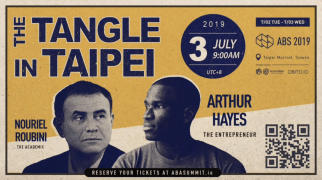
Screen Shot 2019-07-14 at 11.26.10 PMBitMEX, the Hong Kong-based bitcoin derivatives exchange, has finally released the tapes (round 1 and 2) from its “Tangle In Taipei,” a July 3 debate between Bitmex CEO Arthur Hayes and NYU professor Nouriel Roubini. The two have been going at it online.

A man is suing Gemini — the NY exchange operated by the Winklevoss twins — after $240,000 was stolen from his money market account and wired to Gemini, where it was used to to purchase crypto on the exchange.  

Due to heightened oversight on online crypto exchanges, users are increasingly asked to fork over their IDs and addresses. The shift is giving peer-to-peer exchanges, which typically don’t impose such KYC checks, a boost, according to Bloomberg

Other interesting stuff

Founders of the Tezos crypto platform object to sharing emails between them regarding the Tezos “fundraiser” because they are married. Steven Palley has the full story

New York City’s Monroe College was hit with a ransomware attack that shutdown the college’s computer systems. The attackers want the college to fork over $2 million worth of bitcoin to free up the computers.  

President Trump blasted bitcoin on Twitter. He is no fan of Facebook’s Libra either. There’s only room in this country for one currency, and that’s the almighty dollar.

The Federal Trade Commission has fined Facebook a gobsmacking $5 billion for privacy violations. It’s the biggest fine in FTC’s history. Surprise, surprise, Facebook’s stock went up on the news. 

An angry mob burned down the home of a man behind bitcoin ponzi scheme in South Africa after he admitted all the money was gone. 

Finally, police in China cracked down on a cartel of illicit bitcoin miners who stole nearly $3 million worth of electricity. A local power company tipped off authorities after they noticed a peculiar surge in power use.  

My story in Decrypt: “QuadrigaCX CEO traded millions in fake funds to fund luxury lifestyle, alleges trustee”

Ernst & Young released its fifth report of the monitor last night, and it was a doozy. I covered the report for Decrypt. If you have not read my story yet, check it out here.

The monitor’s report is 70-pages long, and I recommend finding a nice comfortable spot and reading all of it. It is page after page, paragraph after paragraph, of “What the hell?”

According to the report, from 2016 onwards, QuadrigaCX went completely off the rails. Gerald Cotten, the exchange’s now-deceased CEO, clearly had no interest in running a legitimate business. He treated customer funds like his own personal bank account—a bit like Bernie Madoff, only a lot more recklessly.

Cotten gambled with his customers’ money, went on lavish vacations, flew on private jets, and bought properties, an airplane, a yacht, whatever toys he wanted. Now most of the funds on the exchange are gone, and EY still has no clue as to where the cash proceeds went. The big question is, did Cotten really act alone?

QuadrigaCX co-founder Michael Patryn is not mentioned in the report. According to what we’ve been told, he completely stepped away from the business in early 2016. After that, Cotten allegedly became a recluse and ran the business into the ground single handedly.

EY has also released a three-part (1, 2, 3) sixth monitor’s report detailing the costs of professional services related to Quadriga’s Companies’ Creditor Arrangement Act. Moving forward, EY is now the trustee in Quadriga’s bankruptcy proceedings.

# # #

I wrote “Bitcoin ATMs—Why Vancouver doesn’t want them”

I started digging into Bitcoin ATM machines, and the research led me to write “Bitcoin ATMs—Why Vancouver doesn’t want them.” Vancouver, as we know, does not like Bitcoin ATMs. The mayor of the city wants them banned.

I suspect that the collapse of crypto exchange QuadrigaCX, which was based in Vancouver, also left a bad taste in the city’s mouth.

A source close to the matter told me that Quadriga had between two to four Bitcoin ATMs in its early days, but those were gone by 2017. The exchange was offering cash withdrawals. Where did all that cash come from? It’s own Bitcoin ATMs and later, the company had partnerships with other Bitcoin ATM operators, the source told me.

IMG-7392Recently, I visited a Bitcoin ATM in Los Angeles and spent time chatting with the owner of the machine. He told me that his machine charged a 7% transaction fee for bitcoin purchases—5% if you are selling bitcoin—and they only do ID checks for amounts over $280.

Bitcoin ATMs vary. Some charge up to 19%, and some only let you buy bitcoin and other crypto—no selling.

In other news, I am now the editor of ATM Marketplace and World of Money. I’ll be writing about cryptocurrency, but also covering ATM machines, money and payments in general. As long as I get to read, research and write all day, I’m happy. 

CLAM flash crash forces Poloniex to socialize $14M worth of BTC in losses — here’s what happened

Crypto markets are extremely volatile. You never know how wildly up or down the price may go or when. This turned out to be a disaster for US crypto exchange Poloniex when an obscure token that it offered peer-to-peer margin trading on suffered a flash crash.

On May 26, the price of  CLAM dropped so violently that margin borrowers blew their margins multiple times over. The loss was huge: 1,800 BTC, valued at around $14 million.

Now Poloniex has to figure out how to extract the losses from the borrowers. For now, lenders will have to suck up the loss. On 14:00 UTC on June 6 — a full 10 days after the incident — Poloniex applied a 16.202% haircut to the principal of all active BTC loans. Even lenders not active at the time of the crash were affected.

Prior to announcing the haircut, Poloniex suspended trading for several hours on Wednesday as part of a “planned” maintenance. It wasn’t until trading resumed that margin lenders realized a portion of their BTC was missing. 

In a Medium postPoloniex revealed that a large part of the loans were collateralized in CLAM — so both the borrowers’ positions and their collateral lost most of their value. In other words, the funds simply evaporated, and there was nothing to repay loans with.  

The exchange says it has frozen all defaulted borrowers’ accounts until they repay their loans, as spelled out in the the company’s terms of service

“As we recover funds, we will return them to affected lenders. We’re also exploring other ways to help defray margin lender losses,” Poloniex wrote.  

Naturally, the margin lenders, which only account for 0.4% of Polo’s user base, are completely pissed off. Why did Polo not have better risk management in place? Why did it not have an insurance fund set up to absorb the loss? And why did  Polo allow margin trades — and collateral loans — on an extremely illiquid coin in the first place?

What is margin trading?

Margin trading is risky business, even more so when you are trading crypto assets, due to their high volatility. When you trade on margin, you put down a collateral and borrow against that, doubling, tripling, quadrupling — or whatever — your trade.

Trading on margin magnifies your profits, but also your losses. If the trade goes in your favor, you can repay the loan and tuck in a nice profit. But if the price of the asset slips enough so it looks like your trade won’t pay off, the exchange can call in your margin, and you lose all of the collateral you put down for the loan.  

Bitcoin derivatives exchange BitMEX loans you the funds for margin trades. Poloniex does something different. It uses peer-to-peer margin trades, where a common pool of lenders puts up BTC, CLAM, and other coins. They get paid in interest. According to Poloniex’s website (archive), only customers who are outside of the US are allowed to loan their funds on the exchange.

As a lender, you set your own daily interest rate, and Poloniex takes a fee of 15% from the interest earned. Margin traders consume lending offers starting with the lowest rate. If your rates are too high, your funds sit in the pool, and you don’t earn any interest. 

CLAM, the casino coin

Screen Shot 2019-06-06 at 10.36.34 PMIf you were paying close attention a year ago, you may have heard John Oliver mention CLAM on “Last Week Tonight,” along with Titcoin, Jesuscoin, Trumpcoin and a bunch of other coins with hilarious names.  
CLAM stands for “Caritas Libertas Aequitas Monetas,” which roughly translates to freedom, fairness, equality coins — whatever that means. The coin launched in May 2014, as a fork of Blackcoin (BLK), which launched in February 2014 as a fork of Peercoin, an early proof-of-stake coin.  

On May 12, 2014, CLAM was sent to all active users of bitcoin, litecoin and dogecoin —three popular coins at the time. Every unique wallet address pulled from those blockchains that had a balance above zero got about 4.6 CLAM. The total amount of CLAM distributed to those addresses was 14,897,662.

CLAM was mainly intended for use on Just-Dice, a gambling site created by a Canadian known only as “dooglus.” Originally Just-Dice relied on bitcoin. But due to new bitcoin regulation in Canada, dooglus decided to switch to CLAM in late 2014. 

The circulating supply of CLAM is only 3,624,208. Nearly all of that—99.81%—is traded on Poloniex. At one point, CLAM was listed on Bittrex and Cryptopia, but Bittrex delisted the coin in October 2018 and Cryptopia went belly up in May 2019.   

According to CoinMarketCap, CLAM has a daily trading volume of less than $100,000, meaning the coin barely has a pulse. Three months ago, two traders complained on Reddit of long delays withdrawing CLAM as they waited for the lifeless network to pick up their transactions.

I withdrew CLAM 11 days ago. Poloniex Support said ‘as soon as a miner picks up the transaction’ How f@%#$%g long is that?,” wrote Reddit user interop5. (Technically, CLAM is a proof of stake coin, so it relies on stakers, not miners.)

CLAM’s lack of liquidity makes it extremely easy to manipulate. All you need is one person to put up a large sell order to crash the price. Poloniex has yet to release details on what happened, but we can guess it was something along those lines. 

History repeats 

As a result of the flash crash debacle, Poloniex has removed CLAM from margin trading, along with three other coins: bitshares (BTS), factom (FCT), and maidsafecoin (MAID). The exchange outright admits these coins lacked sufficient liquidity:

“In order for margin liquidations to process in an orderly manner, the market must have sufficient liquidity, and these tokens currently lack that liquidity. We will continue to monitor them and may reinstate margin trading for them in the future”

This is not the first time Poloniex removed CLAM as a margin market and collateral coin. It was removed in early November 2017 due to low liquidity, after an earlier flash crash, despite CLAM’s liquidity never recovering, at some point, Poloniex decided to add CLAM back as a margin market and collateral coin—though I’m not sure exactly when.   

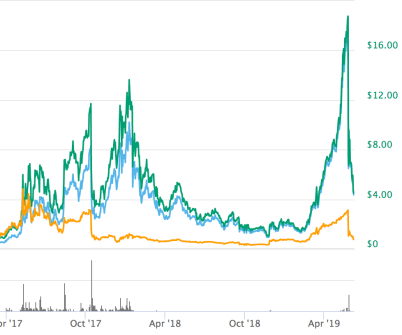
Screen Shot 2019-06-08 at 7.20.19 AMAnd then, of course, the exact same thing happened. In February 2019, the price of CLAM started to climb rapidly on Poloniex. In a matter of six weeks, it went from around $1.50 to a high of nearly $20 on May 26. At that point, the bottom fell out with CLAM losing three-quarters of its value in the blink of an eye. It sunk down to around $5.

According to Andrew Hires, a neurobiology professor at the University of Southern California, who has been watching the exchange, Poloniex had been struggling with its CLAM wallet for months. He tweeted:

“All deposits had to be manually credited via ticket. This screwed up the sell-side liquidity. Huge bids (>500BTC), presumably margin longs, crept up over months, pushing $ price up 17x. Just after it hit $20, everything imploded.” 

Spreading the loss

Socializing losses is unique to crypto exchanges. Like Poloniex, OKEx also socializes extreme margin losses, but literally requires customers to pass a test on their terms of service before they can trade futures, so they are absolutely clear on how it works.

According to crypto lawyer David Silver, socializing losses could open Poloniex to a lawsuit. Another lawyer, Stephen Palley, disagrees. Palley told The Block, he doesn’t think Poloniex breached its terms of service.

On the other hand, Emilien Dutang, who was pinged by the haircut and says he offered margin lending on the exchange after the flash crash, is threatening legal action.

None of this bodes well for Poloniex. Circle acquired the exchange in early 2018 with the intention of cleaning it up and dealing with a humongous backlog of support tickets. But at this level, Poloniex appears only slightly more competent than QuadrigaCX.

# # #


The HODLcast: “QuadrigaCX with Amy Castor and David Gerard”

Sasha Hodder of The HODLcast interviewed me and David Gerard, author of “Attack of the 50-foot Blockchain,” about collapsed Canadian crypto exchange QuadrigaCX.

Sasha is an attorney with DLT Law Group, P.A., which focuses on supporting crypto-related businesses. David’s work has had a huge influence on me, so you can imagine how much fun I had doing a podcast with him.

QuadrigaCX is the story of how two sketchy characters—one, a convicted felon, and the other, a young man who seemingly had been running ponzi schemes since his teenage years—came together and launched a crypto exchange. A match made in heaven, right?

David and I talk about how this was even possible; the appalling, amateurish way the business was run; and the impact this could have on future crypto regulation.

Screen Shot 2019-06-02 at 11.36.22 AM


News: LEO getting pumped, Cryptopia scrambles to save its data, Poloniex says it’s stopped ignoring customers

This newsletter is reader supported. If you appreciate my work enough to buy me a beer or cup of coffee once a month, that’s all it costs to become a patron. I’m trying to pick up freelance gigs when I can, but one of the joys of writing for my own blog is I can write whatever I want, when I want. On to the news…

Bitfinex and LEO

Screen Shot 2019-05-29 at 5.43.17 PMUNIS SED LEO, the full name of Bitfinex’s shiny new utility token, is in its second week of trading. The price started at around $1, but it’s already climbed to a high of $1.52, according to CoinGecko. I’m sure the price increase is totally organic—not.

There are 1 billion LEO in circulation—660 million issued on Ethereum and 340 million issued on the EOS blockchain. 

Crypto Rank warns that 99.95% of LEO coins are owned by the top 100 holders. Also, Bitfinex still has not disclosed information about the investors. “We consider that the token can be manipulative,” Crypto Rank tweeted.

Given its $850 million shortfall, Bitfinex needs to pull in more money. It recently entered the initial exchange offering (IEO) business. IEOs are similar to initial coin offerings (ICOs), except that instead of handing you money directly to the token project, you give it to the exchange, which acts as a middleman and handles all of the due diligence.

Tethers

As the price of bitcoin goes up—at this moment, it is around $8,730—the number of tethers in circulation is going up, too. There are now more than $3 billion worth of tethers sloshing around in the crypto markets, pushing up the price of bitcoin.

Whale Alert says $25 million worth of tethers were taken out of the supply and put into the Tether Treasury. Kara Haas tells me, don’t worry, $150 million Ethereum-based tethers were just issued, and they more than make up for the difference.

Omni tethers, Ethereum tethers, Tron tethers. Tethers appear to be constantly coming and going, bouncing from one chain to another. It gets confusing. But maybe that is the point—to keep us confused. And to add to the jumble, tethers are now executing on EOS.

In the next couple of weeks, Tether is also planning to issue tethers on Blockstream’s federated sidechain Liquid. And later this year, the Lightning Network.

I updated my recent tether story to note that if you want to redeem your tethers via Tether, there is a minimum redemption of $100,000 worth—small detail. Also, I still haven’t found anyone who has actually redeemed their tethers.

Cryptopia’s data—held to ransom?

Cryptopia filed for liquidation on May 14. Liquidator Grant Thornton New Zealand is now scrambling to save the exchange’s data, held on servers hosted by PhoenixNAP in Arizona. The tech services wants $1.9 million to hand over the data.

Grant Thornton is worried Phoenix will erase the SQL database containing critical details of who owned what on the exchange. It filed for Chapter 15 and provisional relief in the Bankruptcy Court of the Southern District of New York. (Here is the motion.)

According to the motion, Cryptopia paid Phoenix for services through April. But when it offered to pay for May, Phoenix ended the service contract and “sought to extract” $1.9 million from the exchange. Grant Thornton says only $137,000 was due for the month of May. Phoenix also denied the liquidators access to the data.

On May 24, the court granted motion. (Here is the order.) Phoenix has to preserve the data for now, but Cryptopia has to pay $274,408 for May and June as security in the temporary restraining order. 

Meanwhile, Cryptopia liquidators’ first report is out. The New Zealand exchange owes 69 unsecured creditors $1.37 million (these are just the ones who have put in claims thus far) and secured creditors over $912,000, with an expected deficit of $1.63 million.

Turns out January 14, the day Cryptopia suffered its fatal hack was the exact same day Quadriga announced the death of its CEO Gerald Cotten, who, uh, had been dead since December 9. The two defunct exchanges had a few other things in common, which I outline in my first story for Decrypt.

Poloniex 

Living in Cambridge, I found it strange that nobody in the local blockchain community knew anyone who worked at Poloniex, based in Somerville, the next town over. I was told Polo staff kept a low profile for security reasons. But I also wonder if they were trying to avoid pissed off customers, whose inquiries they ignored for months.

When Circle acquired Polo in February 2018, it inherited 140,000 support tickets. Now, more than a year later, Circle says it’s all caught up. Polo’s customer support has been “completely transformed” and 95% of inquiries are now handled within 12 hours.

Coinbase

Yet another executive has left Coinbase, president and COO Asiff Hirji. This is the third C-level executive to leave the San Francisco crypto exchange this year.

Recently, Coinbase said it was offering a crypto debit card in the UK—a Visa with a direct link to your Coinbase wallet that lets you spend crypto anywhere Visa is accepted. Financial Time’s Izabella Kaminska thinks that could open a back door for dirty money.

Coinbase plans to add margin trading. Leveraged trading lets you supersize your trading power, because you are borrowing from the exchange, but it also supersizes your risk.

It is easy to understand why Coinbase would want to get a piece of the margin trading business. BitMEX has been reeling in the profits with its bitcoin derivative products. The company’s co-founder is now a billionaire who has so much money, he is giving it away.

Binance is also talking about putting margin trading on the menu.  

Elsewhere in cryptoland 

Kik, the messaging app that raised $100 million selling its kin token in 2017, thinks decades old securities laws need revamping. It wants to create a new Howey test.

The Canadian startup launched DefendCrypto.org, a crowdfunding effort to fight the SEC. It’s contributed $5 million in crypto, including its own kin token, toward the effort.

Ted Livingston, Kik’s CEO says there was no promise kin would go up in value, like a stock. But that is not what at all what he implied during a presale pitch.

Craig Wright, the self-proclaimed inventor of bitcoin, created a hoopla when he filed registrations for the bitcoin code and Satoshi white paper. Disagreements over the significance of the registration have spilled out into his Wikipedia page. Drive-by editors even tried to change Wright’s name to “Craig Steven Fart face.”

Taotao, a new crypto exchange is launching in Japan. It is fully licensed by the Financial Services Agency, the country’s financial watchdog, and it is 40% owned by Yahoo Japan.

As long as the price of bitcoin keeps going up, that is all that matters to bitcoiners. David Gerard delves into the origin of the phrase “Number go up.”

Geoff Goldberg, well-known for his battles against the relentless XRP armies, has been mass reported for calling out the bots that run rampant on twitter. No good deed goes unpunished, apparently. Twitter has effectively silenced him for seven days.

Finally, the Associated Press has a new entry on crypto—sorry, cryptocurrency.

# # #

Related stories:
Social media startup Kik is kicking back—at the SEC
Turns out, you can make money on horse manure, and tethers are worth just that
“QuadrigaCX traders lost money on Cryptopia on the same day in January”—my first story for Decrypt


“QuadrigaCX traders lost money on Cryptopia on the same day in January”—my first story for Decrypt

Screen Shot 2019-05-28 at 6.56.36 PM.pngI just had my first story published in Decrypt, and you should read it!

Some background — I had been getting a few direct messages from QuadrigaCX traders who also lost money on Cryptopia, the NZ-based altcoin factory that recently went kaput. This led me into researching Cryptopia and learning the two exchanges shared a few commonalities.

Oddly, the death of Quadriga CEO Gerald Cotten was announced on January 14, the exact same day Cryptopia was hacked. This could be a wild coincidence, but still, it’s weird.

Both companies were run by amateurs, both had dollar-pegged tokens—Quadriga used Quad Bucks and Cryptopia came up with the idea for NZDT on a lark—and they both experienced crippling banking issues.

The Canadian Imperial Bank of Canada froze accounts belonging to Quadriga’s third-party payment processor Costodian in January 2018. And ASB Bank closed Cryptopia’s NZDT account just weeks later—another weird coincidence.

More details in the article!

# # #


News: Kraken sets out to raise millions, Circle is cutting staff, Bitfinex scores another tiny victory in court

Crypto exchanges are struggling. Revenue growth is not what it was during the bubble of 2017, and regulators are cracking down. You can’t just list any old coin anymore without considering, “Is the SEC going to deem this a security?” And the cost of hiring lawyers, responding to subpoenas, and staying compliant is cutting into profits. So what are exchanges doing? They are laying off staff and/or trying to raise more money, while they hold out hope for the big institutional money that will come any day now.

Kraken and Bnk to the Future

Screen Shot 2019-05-24 at 12.12.57 AM

Recently, customers of Kraken got an interesting email offering a “rare, but limited opportunity.” Some folks thought the email was spam, but it was real.

Turns out, the San Francisco-based trading platform is partnering with Bnk to the Future as a way to raise funds by selling preferred shares of its stock. You can own a piece of Kraken for as little as $1,000. (In the US, you need to be an accredited investor, though.) 

The exchange hopes to rustle up $15.45 million. (Originally, it wanted to raise $10.2 million, but lifted the goal.) As of this writing, Kraken has raised $6.2 million from 942 investors. The crowdfund runs until June 20.

In December, Kraken tried to raise money at a $4 billion valuation, and it reportedly raised $100 million early this year, which it used to buy Crypto Facilities, a regulated London-based crypto derivatives exchange.  

In 2016, Bitfinex also used Bnk to the Future when it encouraged its customers to exchange their BFX tokens to shares in iFinex, the parent company of Bitfinex and Tether. BFX was the token that Bitfinex gave to its customers in compensation for funds they lost when the exchange was hacked. The exchange sold $57.39 million worth of iFinex shares in this manner, basically converting stolen funds to shares.

Bitfinex customers didn’t have much of an option. BFX tokens were dropping in value, and they wanted to get their money back.

Bitfinex/Tether and the NYAG law suit

Bitfinex joyously declared another small legal victory on May 22, when New York Supreme Court judge Joel M. Cohen granted a motion limiting the scope of the documents Bitfinex and Tether have to hand over to the New York Attorney General’s office.

The day prior, the companies had filed a motion to dismiss the case outright with three new court docs: proposed order to show cause, a memorandum in support of the motion to dismiss, and an affidavit by their general counsel Stuart Hoegner.

Lawyers for the companies argued the Bitfinex platform does not allow New Yorkers to trade (putting it outside of the NYAG’s jurisdiction), the Martin Act doesn’t apply to them (because tether is not a security or commodity, they said), and the document requests were too onerous. The NYAG has seven days to respond, and the judge scheduled a hearing for the motion to dismiss on June 29. 

According to Hoegner’s affidavit, which I read late one evening, you can’t actually redeem tethers 1:1 unless you bought them directly from Tether, which means if you got them on an exchange somewhere, too bad. You won’t be too surprised to learn then, that I can’t find a single person who claims to have either bought or redeemed tethers via Tether Ltd.

The Block got hold of a court transcript from the Bitfinex court hearing on May 16. “Tether actually did invest in instruments beyond cash and cash equivalents, including bitcoin,” a lawyer for Bitfinex told the court.

Wait, what? Bitcoin? Tether invested in bitcoin?

The entire purpose of tether is to be a stable asset that traders can use to escape market volatility. Yet, Tether is taking its reserves—money that it was supposed to keep an eye on, so that tethers always remained fully backed—and investing it in a highly volatile asset. What if bitcoin crashes? What then of the stablecoin? 

We learn something new about Tether everyday, it seems. According to CoinMarketCap, every 24 hours, the entire $3 billion supply of tethers changes hands 7.5 times, but not really, because most of that volume is fake.

The Block analyst Larry Cermak posted a graph of exchanges that trade tether, and some of the ones with the highest volume are obscure platforms nobody has heard of. “If I were to make an educated guess, at any given time, only a maximum of 15% of the total Tether volume is real,” he tweeted. In other words, it is all wash trading, i.e., trading bots simultaneously buying and selling tether to create the appearance of frenetic activity.

As far as I can tell, tether’s actual value is on par with horse manure—giving true meaning to the word “stablecoin”—just not as good for the roses. 

Circle and Poloniex

Circle, the Boston-based company that bought crypto trading platform Poloniex in February 2018, is laying off 30 people—10 percent of its workforce. The company blames the layoffs on an “increasingly restrictive regulatory climate.”

Last week, I mentioned that Poloniex geofenced nine altcoins, meaning people in the US will no longer be able to trade those coins on the exchange after May 29. Circle said  recent guidance from the SEC was a trigger for the move. I took another look and realized that one of the coins was Decred—a fork of bitcoin. Why Decred?

It’s possible the project’s premine and governance structure look a little to shareholdery, and Circle, which is backed by Goldman Sachs, is not in a position to risk listing any coins on Poloniex that might be construed as securities.

QuadrigaCX

I finally got around to writing up QuadrigaCX Trustee’s Preliminary Report. Ernst & Young basically says the money is all gone. Also, it adds that Quadriga’s financial affairs were a complete mess, and they’ll probably never sort everything out properly.

Remember the photo of 1,004 checks sitting on a stovetop? EY finally deposited those into a disbursement account on April 18. What a surprise for this trader to learn the money was freshly sucked out of his bank account two years later!

Also interesting, Black Banx (formerly WB21), the third-party payment processor allegedly holding $CA12 million in Quadriga funds is now issuing Visa cards without Visa’s consent. Antony Peyton, the finance journalist who had a thug show up on his doorstep last time he wrote about them, has been researching the company.

Cryptopia

New Zealand crypto exchange Cryptopia went belly up on May 14. Turns out, for the last nine months—since before the January hack that put it out of business—Adam Clark, the exchange’s former founder and programmer, has been building a new crypto exchange. According to his LinkedIn profile, he’s been working on Assetylene since September 2018. So, if you lost your money on Cryptopia, you can try again on Assetylene. I’m sure they’ve got their security issues sorted out by now.

Meanwhile, the funds that were stolen from Cryptopia are on the move. Whale Alert, who has been keeping on eye on the transfers, says funds from Cryptopia recently went to Huobi, where they were likely traded for other coins. Whale Alert also noted 500 ETH going to decentralized exchange EtherDelta.

Elsewhere in cryptoland

Facebook is getting ready to launch its GlobalCoin cryptocurrency payments system in 2020. They probably want to do something like PayPal combined with social media. David Gerard asks: “Why are on earth are they doing this as a cryptocurrency?” As he explains, nothing about putting this on a blockchain makes any sense whatsoever.

Bestmixer.io, one of the largest crypto mixers and tumblers, was shut down by Dutch authorities with the help of Europol and Luxembourg law enforcement. According to Europol’s press release, it was responsible for $200 million in money laundering.

Well, this is a shocker. The SEC has again delayed the VanEck bitcoin ETF proposal. Here is the order. The new deadline for the SEC to make a decision is August 19, and it can delay one more time for a final deadline of October 18, Jake Chervinsky tweeted. It’s been eight years, and the SEC has yet to approve any bitcoin ETFs in the US.  

Bitcoin is set to overtake the existing financial system—or maybe not. In a recent report, the European Central Bank says crypto poses no threat to financial stability in the euro zone. A “very low” number of merchants currently allow buying of goods and services with bitcoin, and there is no “tangible impact on the real economy.”

The IRS is planning to publish new tax guidance for crypto holders and traders. The last time it issued guidance was November 2014, back when it said crypto would be treated as property and you had to report earnings as capital gains.

 # # #


Turns out, you can make money on horse manure, and tethers are worth just that

Screen Shot 2019-05-23 at 9.22.35 AM

Did you know, there is an actual business for horse manure?  

“It’s wild,” one horse farmer told Stable Management. “You can take this stuff that nobody wants and turn it into something of value.”  

You can do something similar in the crypto word. Shitexpress was a service that delivered horse poop anywhere in the world for bitcoin. Now, instead of sending actually poop, you can send tethers, a stablecoin issued by a company of the same name, Tether Limited.  

Tethers are a major source of liquidity in crypto markets. In lieu of the US dollar, you can use them to enter and exit positions in times of volatility. As such, tethers are responsible for the health and wellness of dozens of crypto exchanges, including Binance, Huobi, Bittrex, OKEx, Poloniex and others, that don’t have direct banking.

Inner workings

When Tether first entered the world in 2015, tethers were promised as an I.O.U. For years, Tether assured us that every tether was worth $1—as in, one actual US dollar that Tether had on hand that you could redeem your tethers for.  

Tether and its sister company Bitfinex, one of the largest crypto trading platforms by volume, are now being sued by the New York Attorney General. As court documents reveal more of the companies’ inner workings, people are asking: What are tethers worth? Is one tether worth a dollar? Less than a dollar? What can I get for my tethers?

For a while, the thinking was, well, maybe one tether is worth 74 cents, because in his first affidavit, filed on April 30, Stuart Hoegner, Bitfinex and Tether’s general counsel, said tethers were only 74% backed. In other words, Tether was operating a fractional reserve, kind of like a bank, but sans regulatory oversight or deposit insurance.

Tether updated its terms of service on February 26, to let you know tethers weren’t fully backed, but if you weren’t paying close attention—i.e., checking the Tether website every single day—you may have missed it. Tether says it can amend, change, or update its terms of service “at any time and without prior notice to you.”

Now, it’s looking like one tether is worth whatever someone gives you for it. If someone gives you bitcoin for a pile of tethers, hurray for you, that is the value of your tethers. If the person who got your tethers can pass them off to someone else for bitcoin, or another crypto of value, then yay for them! It’s called the greater fool theory, and, so far, it seems to be working—Tether is still trading on par with the dollar.   

But if you take those tethers to Tether, the company that, so far, has shoveled $3 billion worth of them onto the markets, and say, “Hey, can I redeem these for dollars, like you have been promising me all these years?,” they will most certainly tell you, “Sorry, no.”

Are you verified?

You can only redeem tethers under certain conditions, such as you bought loads of them directly from Tether—and you are not a US citizen.

In Hoegner’s recent affirmation, filed on May 21, he says you have to be a “verified” Tether customer to redeem tethers. 

“Only verified Tether customers are entitled to redeem tether from Tether for fiat on a 1:1 basis. There is no right of redemption from Tether on a 1:1 basis for any holders of tether who obtained the tokens on a secondary market platform and who are not verified Tether customers; on the contrary, such holders of tether have no relationship with Tether and are expressly precluded from redeeming tether on a 1:1 basis for Tether.”

In that paragraph, Hoegner reminds us three times—just to make sure we understand his point—that whoever you are and however you ended up with your tethers, the company is under no obligation to give you cash back for those tethers.

Per Tether’s terms of service, only those who bought tethers directly from Tether Limited—aka “validated users”—can redeem tethers. Anyone who got tethers on the “secondary market,” meaning, an exchange, is not able to redeem those tethers.

As court docs reveal, from November 2017 to December 2018, you could only buy tethers for cash directly from Bitfinex. Per Tether’s website, as of November 27, 2018, you could once again buy tethers directly from Tether. However, you have to buy a minimum of $100,0000 worth. According to Tether’s definition, Bitfinex is a secondary market.

Also, if you want to redeem tethers on Tether, you have to redeem a minimum of $100,000 worth at a time, and you can’t redeem more than once a week.

Further, if you live in the US, you have zero chance of ever redeeming your tethers for cash. Hoegner says that as of November 23, 2017, Tether ceased servicing customers in the US, and at this time, “no longer provides issues or redemption to any US customers.”

To summarize, if you are a US citizen holding a bag of tethers, Tether will give you nothing for them. If you acquired tether on Bitfinex or some other exchange, Tether owes you nothing. And if you don’t like that, too bad, because Tether also says in its terms that when you buy tethers, you waive any rights to “trial by jury or proceeding of any kind whatsoever.”

Wait, this doesn’t look like a dollar!

If you are one of the lucky few who purchased $100,000 or more worth of tethers via Tether’s website—and you are not a US citizen—and would like to redeem 100,000 or more of them, you may or may not get actual dollars back any time soon.

In its terms of service, Tether says it “reserves the right to delay redemption or withdrawal” of tether in the event of illiquidity—meaning, if they don’t happen to have cash on hand today. The company also says that it reserves the right to pay you “in-kind redemption of securities and other assets” held in its reserves.

Screen Shot 2019-05-27 at 12.06.21 PMBasically, that equates to, you could get shares of iFinex (Bitfinex and Tether’s parent company) or LEO tokens (a new token Bitfinex recently created) or whatever is in the soup bowl that day. And you may end up with something that has as much real world value as horse manure—just not as good for the roses.

Update (May 27): This story has been updated to reflect that if you buy or redeem tethers from Tether, you have to buy or redeem a minimum of $100,000 worth.


# # #

QuadrigaCX Trustee’s Preliminary Report: Yup, your money’s all gone

Screen Shot 2019-05-20 at 9.24.58 PMErnst & Young (EY) has issued a Trustee’s Preliminary Report for failed Canadian crypto exchange QuadrigaCX. Essentially, the message to Quadriga’s creditors is: Most of your money is gone, and we’ll probably never find it again.

According to the report—filed on May 1, and published on EY’s website on May 10—Quadriga owes a total of CA$215 million, but it only has about CA$29 million to distribute to its 76,319 affected users. (Earlier court docs estimated 115,000 affected users. Apparently, a more accurate count is now available.)

The lengthy 50-page report mainly rehashes what we already know. But it is worth a read—especially the first 14 pages, the rest is mostly appendixes—if you need a refresher on what has happened so far. I’ll try and summarize the important bits. 

Three legal entities

The report addresses assets and debts for three legal entities: 0984750 BC Ltd (operating as QuadrigaCX) and parent companies Quadriga Fintech Solutions and Whiteside Capital Corporation. The breakdown gets a little confusing because some of the numbers overlap, but as of April 12:

  • 0984750 BC Ltd—had CA$28,649,542 and owed CA$215,697,147.
  • Quadriga Fintech Solutions—had CA$254,180 and owed CA$214,873,113.
  • Whiteside Capital—had zero assets and owed CA$214,618,937.

Quadriga’s financial affairs are a total mess, and EY will probably never be able to sort everything out. “A complete and fulsome review of Quadriga’s financial affairs will take considerable time and effort to pursue and may not be possible or cost-effective to complete.” It is relying on unaudited information for this report.  

Tracking down the funds

To note, Quadriga filed for creditor protection under the Companies’ Creditors  Arrangement Act, or CCAA, on February 5. It is currently transitioning into bankruptcy, a process that will be completed by June 28. EY is the court-appointed monitor in Quadriga’s CCAA procedures and the trustee in its bankruptcy procedures. 

Costodian: the frozen bank accounts

Most of Quadriga’s cash on hand comes from third-party payment processor Costodian. In January 2018, Costodian’s bank froze about CA$25.7 million in funds that Costodian was holding on behalf of Quadriga. Costodian later got the money back in the form of bank drafts, which it was unable to deposit because no bank would touch the funds. When Quadriga applied for creditor protection, Costodian signed over the drafts to EY, who worked with the Royal Bank of Canada to accept the drafts. EY put most of that money into a “disbursement account.”

Related to the Costodian bank drafts, there are CA$778,214 in disputed funds. Costodian claims it is entitled to unpaid processing fees. According to EY, “Quadriga takes the position that no additional fees are payable.” EY is working with Costodian’s lawyer to resolve the issue. If the parties can’t reach a compromise, they will return to court.

EY has put CA$720,000 of Quadriga’s money into a reserve account to address any final CCAA obligations. Any funds remaining in this account after the accountants and lawyers get paid will be transferred into Quadriga’s bankruptcy account. EY will include a final accounting of the CCAA’s administration in its final monitor’s report.

Hot wallet funds

Quadriga also held some crypto in its hot wallets. Those funds have been safely moved into offline cold wallet storage under EY’s control. The funds include approximately BTC 61.33, BCH 33.32, BTG 2.66, LTC, 851.73, ETH 960.36. In its report, EY estimates these funds are worth CA$500,000, but crypto prices fluctuate, so they are worth more now, and could be worth less in the future.

On February 6, before EY took control of the funds, Quadriga inadvertently sent 104 BTC from its hot wallets to its cold wallets. Those funds are as good as gone. Nobody can access Quadriga’s cold wallets, because only the company’s CEO Gerald Cotten held the keys, and he is dead.  

Bulk bank drafts

Remember the photo of 1,004 checks sitting on a stovetop? Those were known as the “bulk drafts,” worth CA$5,838,125.92. The checks were written out to 1009926 B.C. Ltd., a “third-party” (I say that tongue in cheek) payment processor run by Aaron Vaithilingam, Quadriga’s former office manager. The company had dissolved, so it was impossible to cash the checks. They apparently just sat on a stove.   

EY re-instated 1009926 B.C. Ltd., and the checks were signed over and deposited into the disbursement account on April 18. (What a surprise for this trader to learn the money was freshly sucked out of his bank account two years later!) EY held the money in the disbursement account for 30 days—in the event of any “bank recourse issues”—before sending it to Quadriga’s bankruptcy account.

Payment processors and other crypto exchanges

There is still a chance more Quadriga funds could be recovered. Quadriga money is still being held by several third-party payment processors, mainly BlackBanx (formerly WB21), which is allegedly holding CA$12 million of Quadriga funds. EY says it is continuing to work on the matter, but it doesn’t know how much it can recover.  

EY is also investigating other crypto exchanges where Quadriga supposedly stored some of its crypto. The accounting firm notes, “many of the cryptocurrency exchanges have not cooperated with the monitor’s requests to date.” EY is going to keep after them, but says it may need to seek help from law enforcement.  

Jennifer Robertson and all her properties

During the course of its investigations, EY learned that “Quadriga funds may have been used to acquire assets outside the corporate entity.” Cotten and his wife (now widow) Jennifer Robertson purchased a number of assets, including an airplane, a yacht and several properties. As a result, EY negotiated a voluntary preservation order on Robertson’s estate. EY says her assets may be worth CA$12 million. 

Robertson herself is a secured creditor, after putting up a total of CA$490,000 in pre- and post-CCAA filing advances, according to EY’s report. (The money was needed initially to kick off the CCAA process.) EY anticipates the debt will be challenged. Of course it will!

Fintech and Whiteside

A few months back, EY learned about CA$254,180 that Quadriga had tucked away in a Canadian credit union and totally forgot about—it’s only money, after all. The account, which had been frozen since 2017, was held under Quadriga Fintech Solutions, but the money pertained to Quadriga’s (0984750 BC Ltd.’s) operations.

EY writes, “The estimated net realizable value of the account receivable from the Fintech Account is net of Fintech’s estimated bankruptcy administration costs.” Bankruptcy is  apparently an expensive ordeal. As for Whiteside, it had no assets, so CA$25,000 was taken out of Quadriga’s disbursement account to fund its bankruptcy costs.

There are still questions as to what happened to CA$190 million of funds, mostly crypto, that has seemingly vanished from Quadriga. EY says it intends to file an investigative report by the end of June. Hopefully, that report will reveal more clues. 

# # #

Related stories:
How the hell did we get here? A timeline of Quadriga events
Diving into WB21, the company holding $9 million of Quadriga money
EY recommends Quadriga shift to bankruptcy, moves to preserve Robertson’s assets, and wrestles with payment processors

Was this story helpful to you? Did you enjoy it? You can support my work for as little as $5 month on Patreon.


News: $250 million longs wiped out by bitcoin whale, Binance reopens withdrawals, Bitfinex set to trade LEO

Screen Shot 2019-05-18 at 5.17.10 PMThe price of bitcoin (BTC) is organically decided by traders—big ones, and only a few of them.

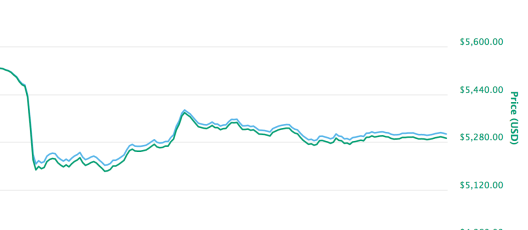
In the morning of May 17, the price of bitcoin did a nosedive, dropping from around $7,726 to $6,777 in about 20 minutes. The plunge was due to the actions of a single large trader (a “whale”) putting up 5,000 BTC (worth about $40 million) on crypto exchange Bitstamp.

The massive liquidation wiped out $250 million worth of long positions on BitMEX, a bitcoin derivatives exchange based in Hong Kong. (The BTC price it used bottomed at $6,469.15.) This, in turn, caused bitcoin’s price to plummet on other exchanges.

It’s hard not to view this as intentional price manipulation. 

BitMEX relies on two exchanges—Bitstamp and Coinbase Pro—equally weighted, for its Bitcoin-US dollar price index. Bitstamp and Coinbase both have low trading volumes, which makes them particularly vulnerable to price manipulations. It is like rolling a bowling ball down an alley and there are only two pins. You just have to aim for one.

Dovey Wan, partner at crypto asset investment fund Primitive Ventures, was the first to spot the dump on Bitstamp. She tweeted“As NO ONE will simply keep 5000 BTC on exchange, this is deliberately planned dump scheme, aka manipulation imo.” 

Despite the hit, the price of bitcoin magically recovered. As of this moment, it is trading at around $7,300. Bitstamp has launched an investigation into the large trade.

Delay, delay, delay

In the wake of such blatant price manipulation, it is tough to imagine that the SEC will ever approve a bitcoin exchange-traded fund (EFT).

On May 14, the US regulator again delayed a decision to approve the Bitwise ETF proposal. The deadline for the SEC’s ruling on the VanEck bitcoin ETF is May 21, but I’m betting that will get pushed out again, too.  

Bitfinex

The New York Supreme Court has ordered Bitfinex to stop accessing Tether’s reserves for 90 days, except for normal business activities. The judge modified the New York Attorney General’s original order to ensure it does not restrict Tether’s “ordinary business activities.” Bitfinex played up the event as a “Victory! Yay, we won!” sort of thing, but the NYAG’s investigation is ongoing, and the companies still have to hand over documents.  

Traders clearly don’t have much confidence in Bitfinex at the moment. Amidst the regulatory drama swirling around Bitfinex and Tether, they are moving a “scary” amount of bitcoin off the exchange. 

Meanwhile, Bitfinex is pinning its hopes on its new LEO token. Paolo Ardoino, the company’s CTO, tweeted that Bitfinex raised $1 billion worth of tethers—not actual dollars, mind you, but tethers—in a private sale of its new token LEO. Bitfinex has yet to disclose who actually bought the tokens, but I’m sure they are totally real people. 

Bitfinex announced that on Monday, May 20, it will begin trading LEO in pairs with BTC, USD, USDT, EOS, and ETH. It will be interesting to see if traders actually buy the token. US citizens are not allowed to trade LEO. 

Binance

After freezing deposits and withdrawals for a week following its hack, Binance opened up withdrawals again on May 15. Traders are now free to move their funds off the exchange. 

Binance is looking to create utility around its BNB token. The exchange burned all of its Ethereum-based BNB tokens and replaced them with BEP2 tokens—the native token of Binance Chain. The cold wallet address is here.

Cryptopia, Poloniex, Coinbase

New Zealand crypto exchange Cryptopia is undergoing a liquidation after it experienced two security breaches in January, where is lost 9.4% of all its assets. Its customers are understandably pissed and outraged.

After the breach, the exchange was closed from January until March 4, when it relaunched in a read-only format. Ten days later, traders woke up to a message on the exchange’s website that read, “Don’t Panic! We are currently in maintenance. Thank you for your patience, and we apologize for the inconvenience.” Cryptopia closed permanently on May 15. Grant Thornton NZ, the company handling the liquidation, expects the process will take months.

In the US, regulatory uncertainty continues to plague exchanges. Boston-based Poloniex, which Circle acquired last year, says it will disable US markets for nine tokens (ARDR, BCN, DCR, GAME, GAS, LSK, NXT, OMNI, and REP). “It is not possible to be certain whether US regulators will consider these assets to be securities,” the exchange says. 

Meanwhile, Coinbase is using the $300 million it raised in October to gobble up other companies. The San Francisco-based exchange is in talks to buy Hong Kong-based Xapo for $50 million. Xapo’s coveted product is a network of underground bitcoin cold storage vaults. The firm is rumored to have $5.5 billion worth of bitcoin tucked away in bunkers across five continents. 

Elsewhere in Cryptoland 

John McAfee has disappeared. “He was last seen leaving a prominent crypto person’s home via boat. He is separated from his wife at the moment. Sources are claiming that he is in federal custody,” says The Block founder Mike Dudas.

McAfee’s twitter account is now being operated by staff, who later denied he was in custody, posting pics of McAfee with his wife in their “new” backyard. 

Decrypt’s Ben Munster wrote a hysterical piece on Dudas, who has a habit of apologizing post tweet. “He tweets like Elmer Fudd shoots his shotgun; from the hip, and nearly always in the foot.” The story describes Dudas as a real person with human foibles.  

Bakkt says it’s moving forward with plans to launch a physically settled bitcoin futures product in July. The company does not have CFTC approval yet—instead, it plans to self-certify, after which time, the CFTC will have 10 days to yea or nay the offering.

Both CME and CBoe self-certified their bitcoin futures products as well. The difference is this: they offer cash equivalents to bitcoin upon a contract’s expiration. Bakkt wants to deliver actual bitcoin, which may give the CFTC pause.

The SEC has fined Alex Tapscott, co-author of the book “Blockchain Revolution,” and his investment firm NextBlock, $25,000 over securities violations. (Here is the order.) And the Ontario Securities Commission fined him $1 million.

In 2017, NextBlock raised $20 million to invest in blockchain and crypto companies. In raising the money, Tapscott falsely touted four blockchain bigwigs as advisors in slide decks. After being called out by then-Forbes writer Laura Shin, the company returned investors’ money. But the damage was done, and the SEC went after them anyway.

Tim Swanson pointed out that the the Stellar network went down for about two hours, and only those who run validator nodes noticed. Apparently, nobody actually cares about or uses the Stellar network.  

According to a report by blockchain analysis startup Chainalysis, 376 Individuals own one third of all ether (ETH). Based on a breakdown of the Ethereum initial coin offering, which I wrote for The Block earlier this year, this comes as no surprise.  

Robert-Jan den Haan, who has been researching Bitfinex and Tether since way back when, did a podcast interview with The Block on “What the heck is happening with Bitfinex.” If you are Bitfinex-obsessed like I am, it is worth listening to.   

Apparently, kicking back at regulators is super costly and something you may want to consider before you launch a token that doesn’t have an actual use case. SEC negotiations have cost Kik $5 million, as the media startup tries to defend its KIN token.

# # #

New York Supreme Court: Bitfinex may not touch Tether’s reserves for 90 days

Screen Shot 2019-05-16 at 8.30.44 PMBitfinex will not be able to dip into Tether’s reserves for 90 days, except to maintain normal business activities, according to a New York judge. The crypto exchange must also “promptly” hand over documents to the New York Attorney General (NYAG).

On May 16, New York Supreme court judge Joel M. Cohen granted Bitfinex’s motion to modify a preliminary injunction obtained by the NYAG. The judge called the original ruling vague, over broad, and not preliminary, meaning it lacked a specified time limit. He also held that the Martin Act—New York’s powerful anti-fraud law—“does not provide a roving mandate to regulate commercial activity.”

Decision and order

NYAG’s original petition consisted of two parts: a directive to Bitfinex and Tether to “produce evidence,” and a preliminary injunction to ensure that the respondents maintain a status quo while the NYAG’s investigation is ongoing.

In his 18-page decision and order, the judge granted the directive—Bitfinex and Tether still have to surrender documents—and agreed to modify the preliminary injunction, so as not to restrict the companies’ “ordinary business activities” any more than necessary.

The modified injunction spells out the following:

Tether cannot loan, extend credit or transfer assets—outside of its ordinary course of business—that would result in Bitfinex having claims on its reserves.  

(In an earlier letter to the court, iFinex, the parent company of Bitfinex and Tether, claims that Tether’s business model depends on it “making investments and asset purchases with the proceeds it derives from selling tethers.” Presumably, since this is an ordinary part of the company’s business, Tether can continue to invest its reserves, though it is not clear how it is investing the funds.)

Tether and Bitfinex cannot distribute or dividend any funds from Tether’s reserves to executives, employees, or agents of Bitfinex—except for payroll and normal payments to contractors and vendors.  

The companies are barred from destroying or altering any documents and communications, including material called for by the NYAG’s 2018 investigative subpoenas.  

If the NYAG wants to extend the 90-day injunction, two weeks before the injunction expires, it must submit a letter to the court. Bitfinex will then have seven days to submit a response. Based on that, the judge will decide whether to hold a hearing.

Victory, for now…

In a post on its website, Bitfinex revels in its victory. The exchange claims the NYAG sought the April 24 order “in bad faith” and vows to “vigorously defend” against the agency’s actions. Bitfinex adds that it remains committed to protecting its customers, its business, and its community against the NYAG’s “meritless claims.”

Most tether holders (the NYAG calls them “investors”) entered into their contracts under the assumption that tethers were fully backed. Each tether was supposedly worth $1—until late February, when Tether changed its terms without actually telling anyone.

Around the same time, Tether made a questionable loan to Bitfinex for $900 million. (Both companies are run by the same individuals, and the same people signed the agreement on either side.) Bitfinex has already dissipated $750 million of those funds. The remaining $150 million appear to be safe—at least for now.

To note, the investigation into whether Bitfinex violated the Martin Act is still ongoing. As a result of today’s ruling, Bitfinex still has to hand over documents and communications about its “business operations, relationships, customers, tax filings, and more.” The NYAG has been requesting those documents since November.

A transcript of the hearing is available here, courtesy of The Block. 

Update (May 19): I updated this story to clarify that there were two parts to NYAG’s original order. Additionally, I noted that Tether can still invest its reserves.

Update (May 21): I added a link to the full transcript of the hearing.

# # #

Related stories:
Bitfinex to NYAG: You have no authority! We did nothing wrong!
NYAG: Bitfinex needs to submit docs and stop dipping into Tether’s reserves
The curious case of Tether: a complete timeline of events


Reginald Fowler, man tied to missing Bitfinex funds, out on $5M bail

Screen Shot 2019-05-02 at 1.33.58 PMReginald Fowler, the ex-NFL owner arrested in connection with operating a “shadow bank” that processed hundreds of millions of dollars of unregulated transactions on behalf of crypto exchanges, is out on $5 million bail.  

The U.S. Government previously argued that Fowler should be detained without bail. The government thought he was too much of a flight risk due to his overseas connections and access to bank accounts around the world. But for the time being, at least, Fowler is a free man, albeit, with restrictions.

Order and letter

The order setting conditions of release was filed with the District Court for the District of Arizona on May 9. A letter of motion, submitted by U.S. Attorney Geoffrey Berman and addressed to Judge Andrew Carter of the District Court of Southern New York, was entered on May 8.

Copies of the letter went to defense attorneys James McGovern and Michael Hefter, partners at Hogan Lovells in New York. Fowler’s arraignment is set for 4:30 p.m. on May 15 at the Southern District Court of New York. 

Fowler was arrested in Arizona on April 30. The bond is being posted in New York, because the District of Arizona does not include secured bonds in bail packages. 

According to conditions set forth in the bond, Fowler cannot travel outside of the Southern District of New York, the Eastern District of New York, and Arizona. He also had to surrender his travel documents and his passport. 

The properties and the wealthy friends

Fowler’s $5 million personal recognizance bond is secured by two unnamed “financially responsible” co-signers and the following properties: 

  • 3965 Bayamon Street, Las Vegas, Nevada
  • 8337 Brittany Harbor Drive, Las Vegas, Nevada
  • 4670 Slippery Rock Drive, Fort Worth, Texas
  • 4417 Chaparral Creek Drive, Fort Worth, Texas
  • 8821 Friendswood Drive, Fort Worth, Texas

A quick look on Zillow indicates the properties are cheap investment houses, worth perhaps $1.5 million in total, if that. This would mean that the additional $3.5 million is secured by Fowler’s wealthy friends, whoever they are.

The LLC on the five properties is Eligibility LLC, 4939 Ray Road, #4-349 Chandler, Arizona 85226. The mailing address points to a UPS store, so it is basically a P.O. Box.

Global Trading Solutions LLC, a company linked to Fowler’s shadow banking operation, had the same mailing address for a time, but the address was later changed.

Indictment

On April 11, Fowler and Ravid Yosef, an Israeli woman who lived in Los Angeles and is still at large, were indicted on charges of bank fraud. Fowler was also charged with operating an unlicensed money services business. 

Fowler’s company—or one of his companies—was Global Trading Solutions LLC, which provided services for Global Trade Solutions AG, the Switzerland-based parent company of Crypto Capital Corp.

Cryptocurrency exchanges used Crypto Capital as an intermediary to wire cash to their customers. The firm is allegedly withholding $851 million on behalf of Bitfinex, a crypto exchange that is currently being sued by the New York Attorney General.  

# # #

Thanks to Nic Weaver for locating the court documents. He spends his beer money on PACER, so you don’t have to.

News: Money laundering in real time, Binance has you covered, maybe, and Bitfinex ready to IEO with LEO

A lot is going on in cryptoland right now—most of it involves investigations, a New York Attorney General (NYAG) lawsuit and missing funds, but I don’t want to sound negative.

The destiny of all crypto exchanges is to be hacked, apparently. Last year, thieves stole $950 million worth of cryptocurrency from exchanges. So, in many ways, it’s not surprising to hear that Binance, the largest crypto exchange by volume, got hacked a second time.

Binance, all funds SAFU

Thieves looted more than 7,000 BTC from Binance in a single transaction. The hackers, however, are not free yet! They still need to move that $41 million worth of BTC into fiat,  a feat that typically requires layering funds into smaller and smaller amounts (generally using a script of some sort), moving it through coin mixers, and then funneling it through various exchanges until they can exit into cash. 

Thanks to blockchain, we can watch this money laundering happen real time. The first transaction out of Binance consisted of of 44 outputs. The hackers have since consolidated the bitcoin into seven addresses of mostly amounts. Now we wait.

After the hack, Binance suspended all deposits and withdrawals for seven days. Traders on the platform can’t dump their bitcoin—or their tether. If bitcoin were to crash, they would be trapped. Fortunately, bitcoin is not crashing—it’s pumping. As I write, bitcoin is now at $6,800, having shot up $1,000 within a week.

According to one expert, the boost is partially due to “a rare alignment of celestial bodies forged in an ancient supernova”—thus, number go up. Makes total sense to me.

Binance says it has an insurance policy—its SAFU fund—to cover losses on the exchange. Nobody knows for certain what is in that fund, because there has never been an outside audit, but Binance’s CEO CZ says they have enough bitcoin to cover the losses. Phew!

In a recent blog post, CZ also said the exchange is revamping its security measures, including its 2FA, API and withdrawal validation processes. Also, withdrawals and deposits should resume “early next week.”

Bitfinex’s legal woes

If you need to get up to speed with the Bitfinex and Tether saga, I covered the NYAG lawsuit in my previous newsletter. Robert-Jan den Haan also wrote a complete timeline of Bitfinex’s history with its third-party payment processor Crypto Capital.

We have podcasts, too. I discuss the Bitfinex drama with Sasha Hodder on HodlCast, and Robert talks about it with Laura Shin on her Unconfirmed podcast.

In response to the NYAG’s court order, Bitfinex submitted a motion to vacate. The NYAG filed an opposition, and Bitfinex responded. At a hearing on May 6, New York Supreme Court judge Joel M. Cohen called the preliminary injunction “amorphous and endless.” The prelim will stand, but he is giving both parties a week to sort it out.

Bitcoin was selling at a 6% premium on Bitfinex—a sign that traders are willing to pay more to get rid of their tether and get their funds off the exchange. The price of bitcoin on the exchange was so off-kilter that CoinMarketCap, a website that aggregates bitcoin pricing from top exchanges, stopped pulling from Bitfinex.

The Bitfinex premium disappeared when Binance halted withdrawals on its platform, Larry Cermak doubts it has anything to do with Binance though. He thinks it’s because Bitfinex started processing cash withdrawals again.

Twitter user “Bitfinex’ed,” disagrees. When bitcoins and tethers are stuck on Binance,  that effectively reduces the supply and makes it that much easier to pump the market, he told me. He think prices will crash when Binance reopens withdrawals.

“I am lion, hear me roar”

Screen Shot 2019-05-10 at 9.39.37 PMBitfinex has a $851 million shortfall due to issues with Crypto Capital. How is it going to fix that? Here is an idea: Why not just print more money?

The exchange’s latest plan is a token sale, or exchange traded offering (ETO), on its own platform. It will be selling a new token LEO—as in lion.

Earlier this week, iFinex, the parent company of Bitfinex, released a white paper outlining the business proposition behind the token offering. Each LEO is worth 1 USDT, which is worth $1 USD. This is not the first time Bitfinex has issued a new token to pull itself out of a financial mess. (It created a BFX token after it was hacked in 2016.)

Bitfinex shareholder Dong Zhao told CoinDesk that iFinex has received hard and soft commitments of $1 billion for the token sale. Perfect. That should definitely eleviate all of Bitfinex’s money problems.

QuadrigaCX

Ernst & Young, the trustee for failed Canadian crypto exchange QuadrigaCX, released a preliminary report describing the company’s assets and liabilities. In a nut, Quadriga has US$21 million in assets, but owes creditors US$160 million.

Elsewhere

Recently, Negocie Coins, a crypto exchange that you probably have never heard of, rose to number three on CoinMarketCap’s top exchange’s list sorted by volume. How is this even possible? Clay Collins, founder of market data company Nomics, made a video, explaining how crypto exchanges use ticker stuffing and volume spamming to game the system.

FinCEN has released a new “interpretive  guidance” for money services businesses using cryptocurrency. If you are not sure if you are a money transmitter, David Gerard breaks it down for you. Sasha Hodder also covers the new guidance in Bitcoin Magazine. And there were several tweet storms—here, here, and here.

The FinCEN document has far reaching implications, such as, it appears Lightning Network (LN) operators qualify as money transmitters. Emin Gün Sirer says he is not surprised “given how similar LN is to hawala networks, and given the role hawala networks played in financing terrorism pre-9/11.”

The US banking committee is concerned about Facebook’s attempt at a cryptocurrency—Facebook coin—and how the social media giant is treating people’s’ financial information. It’s published an open letter with questions for Facebook.

Redditor u/BioBiro, who needed to acquire bitcoin for a totally legal purchase, complains about the rigamarole he had to go through. Among other things, “Now there’s two pictures of me and my driving license on their server for the rest of time, I guess.”

Consensus, CoinDesk’s big money maker conference, kicks off in New York next week. Last year it had 8,500 attendees, pulling in ~$17 million in ticket sales—and that’s before sponsorships. Arthur Hayes, CEO of bitcoin derivative exchange BitMEX, was one of several who rolled up to New York Hilton Midtown in a lambo.

# # #

My work is reader supported. If you’ve read this far, please consider becoming a patron

Binance hacked to the tune of $41 million, but no worries, funds are SAFU

Screen Shot 2019-05-07 at 10.22.41 PMBinance, the world’s largest crypto exchange by volume, and the world’s largest tether exchange, has been hacked.

The hackers drained the exchange’s hot wallets, taking 7,000 bitcoin, worth approximately $41 million, in a single transaction. The hack only amounted to 2% of the exchange’s total holdings. Everything else was in its offline cold wallets.

“All of our other wallets are secure and unharmed,” Binance CEO Changpeng Zhao (aka “CZ”) wrote in a blog post on Wednesday morning, May 8, Asia time. 

The stolen funds are visible in this transactionHours before the announcement, the exchange said it was undergoing maintenance.

CZ explained the hackers were able to obtain a large number of user API keys, two-factor authentication (2FA) codes, and “potentially other info.” 

To pull off the heist, hackers used a variety of techniques, including phishing, viruses and other attacks. “We are still concluding all possible methods used,” CZ said. “There may also be additional affected accounts that have not been identified yet.” 

In the meantime, Binance has suspended all customer deposits and withdrawals, but trades will continue. “Please also understand that the hackers may still control certain user accounts and may use those to influence prices,” CZ noted.

He explained that the the hackers had the patience to wait, and execute well-orchestrated actions through “multiple seemingly independent accounts at the most opportune time.”

The exchange will use its Secure Asset Fund for Users (SAFU) to cover the losses. In mid-2018, after an earlier hack, Binance began to allocate 10% of all trading fees received into the fund, as a way to insure against extreme losses. 

After being up for 29 hours, an exhausted CZ did a 37-minute Periscope stream to answer questions about the hack. “It’s one of those days,” he said. “Yeah, it’s been rough.”

What happened?

At this point, few details of the incident are public—and speculation is rampant. 

It appears the hackers were able to drain the exchange’s hot wallets without a manual authorization. Typically, large outbound transfers (often over 100 BTC) need to be manually vetted. For instance, crypto exchange Liquid, based in Tokyo, keeps 100% of its funds in cold storage and manually processes all withdrawals. It is a slower process for getting funds off an exchange, but more secure.

Cornell University professor and blockchain researcher Emin Gün Sirer thinks the Binance hackers knew the per-account limits, and used multiple compromised accounts to withdraw the entire hot wallet. “This shows how difficult it is to build secure services with our current coin infrastructure,” he told me. 

Gün was amazed at Binance’s decision to keep trading even though it doesn’t know the full extent of the hack or how many accounts were affected.

As he explained, “They know some 2FA has been compromised, but they don’t know which customer accounts are compromised—yet they enable trading.” In other words, someone could carry out risky trades in the next week, and if the trades lose money, they could say that their 2FA was compromised and the trades were unauthorized. 

“Continuing to trade in an unknown scenario opens them up to unlimited legal risk,” he tweeted“This is ballsy beyond belief.”

Freezing withdrawals

Binance is freezing withdrawals for a week—that means 188,000 Bitcoin are stuck on the platform—a move that could create an artificially restricted supply.

You can’t withdraw bitcoin off the exchange, but Binance itself—and insiders—can. This could allow a privileged few to take advantage of price differentials on other exchanges.  

“If you want to sell a lot of bitcoins onto the market, and capture as much liquidity as possible, you want to be the only one selling,” Twitter user Bitfinex’ed told me. “You don’t want other people selling to the same orders you want to sell to. Binance freezing withdrawals means those people are stuck there and can’t sell for real money.”

Previous hack

This isn’t the first time Binance has been hacked. It experienced another sophisticated hack in July 2018, where oddly enough, 7,000 BTC—the same amount of bitcoin as this recent hack—was also withdrawn and resulted in an “emergency maintenance.”

The earlier attack went something like this:

Syscoin (SYS)—a minor altcoin with a low volume and small order book — was hit by a hack caused by a bug in its wallet. The attackers then sent the ill-gotten SYS coins to Binance, where they created a torrent of buy orders via the Binance API. This pushed the price of SYS as high as 96 BTC, at one point. The hackers then withdrew the bitcoin, prompting Binance to cease trading and to reset all of its APIs.

The incident is what prompted Binance to create its SAFU insurance fund, which at the time, contained only Binance’s own BNB on-exchange token. Those who suffered a loss as a result of the hack, were compensated in BNB. It is not clear, however, if that will be the case this time. CZ says he has enough bitcoin to cover the loss. 

It is entirely possible the same hackers who pulled off this earlier hack were also the ones behind the recent hack. If so, who were they?

North Korea 

Screen Shot 2019-05-08 at 7.06.25 AMAnother source I spoke to—who did not want his identity revealed—said the recent hack has all the hallmarks of a sophisticated, multi-pronged attack that might be more the work of nation-state elements rather than your typical “lone hacker.”


He speculated that it was possible this was the work of APT 38, a covert cybercrime cell that specializes in financial institutions, and more recently, cryptocurrencies, to prop up North Korea’s economy. 

The group, according to cybersecurity firm FireEye, doesn’t operate by a quick smash-and-grab strategy typical of day-to-day cybercriminals, but with the patience and precision of a nation-state threat actor that has the time and tools to sit and wait for the perfect moment to launch an attack.

“APT 38 operators put significant effort into understanding their environments and ensuring successful deployment of tools against targeted systems,” FireEye experts wrote in a report. “The group has demonstrated a desire to maintain access to a victim environment for as long as necessary to understand the network layout, necessary permissions, and system technologies to achieve its goals.”

The Binance investigation is ongoing. I’ll update this post as more information surfaces

# # #


Bitfinex to NYAG: You have no authority! We did nothing wrong!

Screen Shot 2019-05-06 at 5.42.29 PMBitfinex has filed yet another rebuke to the New York Attorney General’s ex parte court order.

The April 24 order basically tells Bitfinex to submit documents and stop dipping into Tether’s reserves, which it has done, so far, to the tune of $750 million.

Bitfinex filed a motion to vacate or modify the order on May 3. On Friday, the Office of the Attorney General (OAG) opposed the motion. And on Sunday, Bitfinex filed a response to the opposition. The reply memorandum in further support of the motion to vacate or modify the order was filed by law firms Morgan, Lewis & Bockius LLP and Steptoe & Johnson LLP.

In the memo, Bitfinex argues that “nothing in the Attorney General’s opposition papers justifies the ex parte order having been issued in the first place.” It lists a bunch of reasons for this—essentially, a lot of “buts,” which equate to Bitfinex saying, “It wasn’t me, you can’t prove it, and anyway, nobody was harmed by the thing I totally didn’t do.”

Here is a summary—also, I am not a lawyer. 

But, tethers are not a securities!

The OAG claims Bitfinex violated the Martin Act, New York’s anti-fraud law, which grants the agency expansive powers to conduct investigations of securities fraud.

Bitfinex argues that the OAG did not even try to explain how tethers (the dollar-backed coins issued by Bitfinex’s affiliate Tether) qualify as securities or commodities in the first place. In its opposition, this is what the OAG did say, in a footnote:

“The Motion to Vacate wrongly suggests that an eventual Martin Act claim stands or falls on whether ‘tethers’ are securities or commodities. It does not. The Bitfinex trading platform transacts in both securities and commodities (like bitcoin), and is of course at the core of the fraudulent conduct set forth in OAG’s application.”

This looks like an attempt by Bitfinex to pull the OAG into the weeds, and the OAG is not going there. The fact that Bitfinex does trade in securities and commodities (the CFTC considers bitcoin a commodity, and the SEC considers most ICO tokens to be securities) is enough to bring Bitfinex under the OAG’s purview. ‘Nuff said. 

But, this is so disruptive!

The ex parte order is “hugely disruptive,” says Bitfinex, because it freezes $2.1 billion of Tether reserves—what’s currently left to back the 2.8 billion tethers in circulation—prohibiting any investment of any kind, for the indefinite future. 

In other words, Bitfinex feels like it can do whatever it wants with the cash that tether holders gave it for safe keeping. Tether works like an I.O.U., which means Bitfinex is supposed to hold onto that money for redemptions only.  

The big reason Bitfinex wants to bend the rules here is that it is desperate for cash to stay in operation. If it can’t get that cash from somewhere, the exchange is potentially in danger of running aground, or getting into even more trouble with regulators. At this point, Bitfinex is even trying to raise $1 billion in a token offering. 

But, we didn’t do anything wrong!

Bitfinex argues it has not committed fraud. It has taken hundreds of millions out of Tether’s reserves, but that is okay, because it updated Tether’s terms of service to make it clear that reserves could include loans to affiliates. What’s more, Bitfinex says it updated the terms before it drew a line of credit from Tether for $900 million.

(It has so far dissipated $750 million of that loan—which was signed by the same people on either side of the transaction—with access to another $150 million.)

In its memo, Bitfinex says:

“This disclosure gave anyone holding or considering buying tether the opportunity to take their money elsewhere if they chose, defeating any allegations of fraud.” 

In fact, Tether did update its terms of service on its website on February 26, 2019, but it did so silently. It was not until two weeks later, when someone inadvertently stumbled upon the change, that the news became public. In contrast, a bank would totally be expected to reveal such a move—at the very least, to its regulators.  

The OAG also claims that in mid-2018, Bitfinex failed to disclose the loss of $851 million related to Crypto Capital, an intermediary that the exchange was using to wire money to its customers. Bitfinex argues that, as a private company, it had “no duty to disclose its internal financial matters to customers.”

If Bitfinex were to go belly up all of a sudden, traders could potentially be out of their funds, but apparently, that is none of their business. Also, Bitfinex went beyond not disclosing the loss. It even lied about it, telling its customers that rumors of its insolvency were a “targeted campaign based on nothing but fiction.”  

The OAG’s opposition to Bitfinex’s move to vacate, literally has an entire section (see “Background”) that basically says, “We’ve caught these guys lying repeatedly, here are the lies,” which Bitfinex does not even address in its memo.

But, nobody has been harmed!

The OAG’s job is to protect the public, but Bitfinex says “there has been no harm to tether holders supposedly being defrauded, much less harm that is either ongoing or irreparable.” Particularly now, it says, after it made the details of its credit transaction—the one where it borrowed $900 million from Tether—fully public.  

“Holders of tether are doing so with eyes wide open,” Bitfinex says. “They may redeem at any time, and Tether has ample assets to honor those requests.”

Ample assets, that is, as long as everybody doesn’t ask for their money back all at once. Bitfinex’s general counsel Stuart Hoegner already stated in his affidavit, which accompanied the company’s move to vacate, that tethers are only 74% backed.  

Tether’s operation fits the definition of a fractional reserve system, which is what banks do, which is why banks have a lot of rules and also backing and deposit insurance.  

But, “the balance of equities favors Bitfinex and Tether!”

Bitfinex and Tether would be fine, if the OAG would just go away. The agency is doing more harm than good, Bitfinex argues. 

The exchange argues that a preliminary injunction would not protect anyone, but would instead cause “great disruption” to Bitfinex and Tether—”ultimately to the detriment of market participants on whose behalf the attorney general purports to be acting.”

It maintains that it needs access to Tether’s holdings because it needs the “liquidity for normal operations.” That is, Bitfinex admits it does not have enough cash on hand, without dipping into the reserves.

But, what’s good for Bitfinex is good for Tether. “For its part, Tether has a keen interest in ensuring that Bitfinex, as a dominant platform for Tether’s products and known affiliate, can operate as normal,” the company says. 

Besides, the OAG has no business “attempting to dictate how two private companies may deal with one another and deploy their funds,” says Bitfinex.

It maintains the OAG’s actions have actually done harm. In the weeks leading up the order, the crypto market was rallying after an extended downturn. In its court document, Bitfinex writes: 

“This rally was halted by this case, which resulted in an approximate loss of $10 billion across dozens of cryptocurrencies in one hour of the April 24, 2019 order becoming public.”

Not only that, but Bitfinex itself was harmed by the publicity brought on by the OAG’s lawsuit. The exchange says the balance of it cold wallets “have fallen sharply, an indication that customers have been drawing down their holdings.”

It is likely that Bitfinex is going to have to surrender the documents the OAG is asking for at some point—and that may be what it is trying to avoid. Its attempts to vacate the OAG’s order appears to be an effort to buy time, while it scrambles to figure out how to come up with the nearly $1 billion it needs to stay afloat—a token sale may be just the thing.

Update:

On May 6, New York Supreme Court judge Joel M. Cohen ruled that the OAG’s ex parte order should remain in effect, at least in part. However, he thinks the injunction is “amorphous and endless.” He gives the two parties a week to work out a compromise and submit new proposals for what the scope of the injunction should be.

On May 13, iFinex, the parent company of Bitfinex and Tether, submitted this letter and this proposed order to the court. Among other things, iFinex is asking for a 45-day limit on the injunction and to replace three paragraphs—one of which would allow Tether employees to get paid using Tether’s reserves.

For its part, the OAG submitted this letter and this proposed order. The OAG is not opposed to Tether’s employees being paid, but it wants Tether to to pay its employees using transaction fees—not reserves.

# # #

What happened next?
NY Supreme Court Judge: Bitfinex may not touch Tether’s reserves for 90 days

Related stories:
NYAG: Bitfinex needs to submit docs and stop dipping into Tether’s reserves
The curious case of Tether: a complete timeline of events

Was this material helpful to you? You can support my work by becoming a subscriber on Patreon for as little as $5 a month. It only takes a minute!


NYAG: Bitfinex needs to submit docs and stop dipping into Tether’s reserves

Screen Shot 2019-05-05 at 1.09.10 PMBitfinex was not happy with the New York Attorney General’s April 24 ex parte court order, which demanded that the crypto exchange stop dipping into Tether’s cash reserves and hand over documents that were requested in November 2018. It struck back with a strongly worded motion to vacate, or overturn the order.

On May 3, the Office of the Attorney General (OAG) submitted an opposition to that motion. The agency argues that Bitfinex violated the Martin Act, New York’s anti-fraud law, widely considered the most severe blue sky law in the country.

Legally, Tether and Bitfinex are separate entities, but they are managed by the same individuals. To note, the OAG’s order does not prohibit Bitfinex from operating. Nor does it prohibit Tether from issuing or redeeming tethers (USDT) for U.S. dollars.

The order simply prohibits Bitfinex from helping itself to anymore of Tether’s funds. This, of course, poses a problem for Bitfinex, because it desperately needs cash to stay afloat. (It’s latest effort to fill the gap is a token sale, but that is another matter.)

There are currently 2.8 billion USDT in circulation, and each of them is supposed to be backed 1:1 with the dollar, but as of now, they are only 74% backed.

The alleged fraud

The OAG began investigating Bitfinex late last year. If there is any question as to how Bitfinex allegedly committed fraud and misled its customers, the OAG spells that out clearly in its memorandum. I’m paraphrasing some this. 

Bitfinex failed to disclose to its clients that it had lost $851 million of “wrongfully commingled” client and corporate funds to Crypto Capital, an overseas entity, which it used as an intermediary to wire US dollars to traders on its platform.

Bitfinex knew in mid-to-late 2018 that Crypto Capital’s inability—or unwillingness—to return the funds meant it would have problems filling out client requests to withdraw cash off the exchange. Nevertheless, it told the public that rumors of insolvency were a “targeted campaign based on nothing but fiction.”  

In November 2018, Bitfinex tried to cover up the loss by moving (at least) $625 million from Tether’s legitimate bank account into Bitfinex’s account. In return, Bitfinex “credited” $625 million to Tether’s accounts with Crypto Capital. OAG says the credit was “illusory,” because the money at Crypto Capital was lost or inaccessible.

(In its motion to vacate, the OAG notes that Bitfinex contradicted itself by saying the “credit” Bitfinex gave to Tether was $675 million—a $50 million discrepancy.)

Bitfinex later shifted to a new strategy. It engaged in “an undisclosed and conflicted transaction” to let Bitfinex dip even further into Tether’s reserves. The exchange took out a $900 million loan from Tether, secured by shares of iFinex—the parent company of both Tether and Bitfinex. OAG says there is little reason to believe the iFinex shares have any real value, especially in the event iFinex itself defaults.

In March 2019, $900 million represented almost half Tether’s available reserves at the time, but Bitfinex and Tether did not disclose this to its customers. In fact, up until February 2019, Tether telling its customers that USDT was fully backed. Bitfinex told the OAG that it has already dissipated $750 million of Tether’s funds.

Bitfinex demonstrates “a pattern of undisclosed, conflicted, and deceptive conduct” that its customers would “find material, and indeed, essential to buying tethers and trading assets, like bitcoin, on the Bitfinex platform,” the OAG said.

In its motion to vacate, Bitfinex argues that the Martin Act stands or falls on whether tethers are securities or commodities. It does not, the OAG says. In fact:

“The Bitfinex trading platform transacts in both securities and commodities (like bitcoin) and is of course at the core of the fraudulent conduct set forth in the OAG’s application.”

Related events

The OAG points to other events that underscore the need to maintain the status quo.

Since the original order, two individuals, Reginald Fowler and Ravid Yosef, were charged with bank fraud in connection with their operation of a “shadow bank.” Fowler was arrested on April 30, while Yosef is still at large.

The operation processed hundreds of millions of dollars of unregulated transactions on behalf of numerous cryptocurrency exchanges and associated entities—“several of which,” the OAG says, are at the center of its own investigation. 

This appears to indicate the OAG’s is looking into other exchanges, which makes sense, given it sent out a questionnaire to more than a dozen cryptocurrency exchanges in April 2018, requesting they disclose key information about their operations.

While the OAG does not specifically state that the “shadow bank” is Crypto Capital, it points to the Memorandum in Support of Detention of Fowler, which said that companies associated with Fowler “failed to return $851 million to a client of the Defendant’s shadow bank.” 

The OAG’s investigation is still ongoing.

# # # 


News: More Bitfinex drama, Crypto Capital, a dodgy football businessman and a relationship coach

There is so much going on now with Bitfinex. My eyes are burning and my head hurts from reading piles of court docs. Here is a rundown of all the latest—and then some.

The New York Attorney General (NYAG) is suing Bitfinex and Tether, saying tethers (USDT) are not fully backed—after $850 million funneled through third-party payment processor Crypto Capital has gone missing.  

Screen Shot 2019-05-04 at 2.10.08 PMIt’s still not clear where all that money went. Bitfinex says the funds were “seized and safeguarded” by government authorities in Portugal, Poland and the U.S. The NYAG says the money was lost. It wants Bitfinex to stop dipping into Tether’s reserves and to handover a mountain of documents.

In response to the NYAG’s ex parte order, Tether general counsel Stuart Hoegner filed an affidavit accompanied by a motion to vacate from outside counsel Zoe Phillips of Morgan Lewis. Hoegner admits $2.8 billion worth of tethers are only 74% backed, but claims “Tether is not at risk.” Morgan says New York has no jurisdiction over Tether or Bitfinex. Meanwhile, the NYAG has filed an opposition. It wants Bitfinex to stop messing around.

Football businessman Reggie Fowler and “co-conspirator” Ravid Yosef were charged with running a “shadow banking” service for crypto exchanges. This all loops back to Crypto Capital, which Bitfinex and Tether were using to solve their banking woes.    

In an odd twist, the cryptocurrency saga is crossing over into the sports world. Fowler was the original main investor in the Alliance of American Football (AAF), an attempt to create a new football league. The league filed for bankruptcy last month—after Fowler was unable to deliver, because the DoJ had frozen his bank accounts last fall.  

The US government thinks Fowler is a flight risk and wants him held without bail. The FBI has also found a “Master US Workbook,” detailing the operations of a massive “cryptocurrency scheme.” They found it with email subpoenas, which sounds like it was being kept on a Google Drive?

Yosef is still at large. She appears to have split her time between Tel Aviv and Los Angeles. This is her LinkedIn profile. She works as a relationship coach and looks to be the sister of Crypto Capital’s Oz Yosef (aka “Ozzie Joseph”), who was likely the “Oz” chatting with “Merlin” documented in NYAG’s suit against Bitfinex.  

All eyes are on Tether right now. Bloomberg reveals the Commodity and Futures Trading Commission (CFTC) has been investigating whether Tether actually had a stockpile of cash to support the currency. The DoJ is also looking into issues raised by the NYAG.

Meanwhile, bitcoin is selling for a $300 to $400 premium on Bitfinex — a sign that traders are willing to pay more for bitcoin, so they can dump their tethers and get their funds off the exchange. This isn’t the first time we’ve seen this sort of thing. Bitcoin sold at a premium on Mt. Gox and QuadrigaCX before those exchanges collapsed.

Bitfinex is still in the ring, but it needs cash. The exchange is now trying to cover its Tether shortfalls by raising money via—of all things—a token sale. It plans to raise $1 billion in an initial exchange offering (IEO) by selling its LEO token. CoinDesk wrote a story on it, and even linked to my Tether timeline.

Did a sex-trafficking site sparked the Crypto Capital investigation? Also, Decrypt’s Tim Copeland takes a look at the payment processor’s dark past.

Tether wants to move tethers from Omni to the Tron blockchain. Tron planned to offer a 20% incentive to Omni USDT holders to convert to Tron USDT on Huobi and OkEx exchanges. But given the “recent news” about Bitfinex and Tether, it is delaying the rewards program.  

Kara Haas has an article on AccountingWeb and a Twitter thread on the potential accounting implications of Tether’s definition of “reserves.”

Coinbase is bidding adieu to yet another executive. Earn.com founder Balaji Srinivasan, who served as the exchange’s CTO for a year, is leaving. It looks like his departure comes after he served the minimum agreed period with Coinbase. 

Elsewhere, BreakerMag is shutting down. The crypto publication had a lot of good stories in its short life, including this unforgettable one by Laurie Penny, who survived a bitcoin cruise to tell about it. David Gerard wrote an obituary for the magazine.

The Los Angeles Ballet is suing MovieCoin, accusing the film finance startup of trying to pay a $200,000 pledge in worthless tokens—you can’t run a ballet on shit coins.

Police in Germany and Finland have shut down two dark markets, Wall Street Market and Valhalla. And a mystery Git ransomware is wiping Git repository commits and replacing them with a ransom note demanding Bitcoin, as this Redditor details.

# # #


US Government wants man at center of massive ‘cryptocurrency scheme’ held without bail

The U.S. government wants a football businessman linked to an investigation into $850 million of missing Tether and Bitfinex funds to be held without bail.

According to a memorandum in support of detention filed with the District Court of Arizona on May 1, Reginald Fowler poses a serious flight risk due to his overseas connections and access to hundreds of millions of dollars.

The court doc also presents startling new twists in an already tangled plot—a “Master US Workbook,” which details the financial operations of the “cryptocurrency scheme,” fake bond certificates worth billions of dollars, and a counterfeit money operation.

Reggie Fowler

Screen Shot 2019-05-02 at 1.33.58 PMFowler, 60, is a former minority owner of the Minnesota Vikings and the original main investor in the Alliance of American Football —an attempt to form a new football league. The AAF collapsed when Fowler withdrew funding—after the Department of Justice froze his bank accounts in late 2018.

I did a search on Pacer and got a number of hits showing Fowler has been in and out of courts for years. In fact, in 2005, ESPN reported that he had been sued 36 times.

Most recently, Fowler was charged with bank fraud and operating an unlicensed money services business. These crimes relate to his alleged involvement in a “shadow bank” on behalf of cryptocurrency exchanges, in which hundreds of millions of dollars passed through accounts that he controlled in jurisdictions around the world. 

Fowler operated Global Trading Solutions LLC in the US, which provided services for Global Trade Solutions AG, the Zug, Switzerland-based parent company of Crypto Capital Corp, a third-party payment processor. At one time or another, Crypto Capital serviced QuadrigaCX, Bitfinex, Kraken, Binance, and BitMEX—some of the top crypto exchanges.

In October and November 2018, five U.S. bank accounts were frozen—three of them were Fowler’s personal accounts and two were held under Global Trading Solutions. On April 11, Fowler was indicted in the Southern District of New York. And on April 30, he was arrested in Chandler, Arizona, where he lives. 

Fowler is looking at spending the rest of his life in prison—the bank fraud counts alone carry a maximum sentence of 30 years. 

The cryptocurrency scheme was not limited to the U.S. Fowler set up bank accounts around the world and coordinated the scheme with co-conspirators in Israel, Switzerland, and Canada, according to court documents. The scheme involves a “staggering amount of money,” and the government believes that Fowler still has access to overseas bank accounts.  

Master US Workbook

Even more revealing, via email search warrants, federal prosecutors have obtained a document entitled “Master US Workbook,” which details the operations of the scheme. The workbook lists 60 bank accounts. It shows the scheme received over $740 million in 2018 alone. As of January 2019, the combined bank balance was $345 million. Approximately $50 million is held in U.S. accounts. The rest is located overseas. 

Apparently, Fowler had “shown a willingness to help himself to these funds in the past.” In mid-2018, he sent $60 million from scheme accounts to his personal bank accounts, feds said. Scheme members set up a “10% fund” from client deposits, available for his personal use. The government does not know the location of those accounts.

After Fowler’s bank accounts were seized in October 2018, he agreed to cooperate with FBI agents and keep the investigation confidential, which he did not do. When agents sent him emails, he would share those with other scheme members.  

Other illegal activity

Fowler appears to have been involved with other illegal activities, such as wire fraud related to the 10% fund. He also tried to take out loans by presenting banks with fraudulent bond certificates worth billions of dollars. 

FBI agents also found evidence that Fowler was involved in a counterfeit money operation. They found $14,000 in fake bills consisting of sheets of $100 bills in a filing cabinet in his Chandler, Arizona office.

After examining the sheets, a special agent for the U.S. Secret Service “determined that they were undergoing a process common in counterfeiting schemes to turn paper bills into passable currency. In fact, the FBI also recovered black carbon paper from the office, which is often used as part of this process for making believable counterfeit bills.”

# # #

New York Attorney General: Bitfinex is hiding $850 million in losses

Screen Shot 2019-04-26 at 7.04.55 AMAccording to an April 24 court filing, New York State Attorney General Letitia James has alleged that crypto exchange Bitfinex lost $850 million and then tried to pull the wool over people’s eyes by dipping into Tether’s reserves.  

Tether issues a dollar-pegged stable coin of the same name. According to the Office of the Attorney General (OAG), Bitfinex has so far siphoned $700 million from Tether funds, meaning that tethers are not fully backed. Given that tether is an essential source of liquidity in the crypto markets—currently, there are 2.8 billion tethers in circulation—this is not good news for bitcoin. 

I’ve updated my Bitfinex/Tether timeline to bring you up to speed on the full history of these companies’ past shenanigans. Bitfinex and Tether are operated by the same individuals, and their parent company is Hong Kong-based iFinex. I recommend reading  the entire 23-page court document. It reveals a lot about what has been going on under the covers at Tether/Bitfinex. I’ll try and summarize.

What happened

Bitfinex was allowing residents of New York to trade on its platform. This is not supposed to happen. Effective August 8, 2015, any virtual currency company that wants to do business in New York State needs to have a BitLicense. This led the OAG to launch an investigation into Bitfinex and Tether in 2018.

Banking has been an ongoing struggle for Bitfinex since April 2017, when it was cut off by correspondent bank Wells Fargo and its main banks in Taiwan. At different periods, Bitfinex has turned to Puerto Rico’s Noble Bank, Bahamas’ Deltec Bank, and more recently, HSBC via a private account with Global Trading Solutions LLC.    

Meanwhile, Bitfinex has had to rely on third-party payment processors to handle customer fiat deposits and withdrawals—a fact that it has never been completely up front about. (In fact, the HSBC account turns out to be part of the shadow banking network set up by its payment processor.)

Since 2014, Bitfinex has sent $1 billion through Panama-based Crypto Capital Corp. Bitfinex also told the OAG that it had used a number of other third-party payment processors, including “various companies owned by Bitfinex/Tether executives,” as well as other “friends of Bitfinex” — meaning human-being friends of Bitfinex employees willing to use their bank accounts to transfer money to Bitfinex clients.

This is basically Bitfinex setting up shell companies and playing cat and mouse with the banks—and it sounds a lot like what Canadian crypto exchange QuadrigaCX was doing before it went belly up in January. (Quadriga also used Crypto Capital, but the payment processor is not holding any Quadriga funds.)

By mid-2018 Bitfinex customers were complaining they were unable to withdraw fiat from the exchange. This is apparently because Crypto Capital, which held “all or almost all” of Bitfinex funds, failed to process customer withdrawal requests. Crypto Capital told Bitfinex that the reason the $850 million could not be returned was because the funds were seized by government authorities in Portugal, Poland and the U.S.

Bitfinex did not believe this explanation. “Based on statements made by counsel for Respondents to AG attorneys… Respondents do not believe Crypto Capital’s representations that the funds have been seized,” the court document states.

(This is not in the court filings but Crypto Capital shared this letter with its customers in December 2018. The letter is from Global Trade Solutions AG, the parent company of Crypto Capital Corp——not to be confused with Global Trading Solutions LLC. The letter states that GTS AG is being denied banking services in the U.S., Europe, and elsewhere “as a result of certain AML and financial crimes investigations” by the FBI and cooperative international law enforcements and/or regulatory agencies.”)

In communication logs from April 2018 to early 2019 shared with the OAG, a senior Bitfinex executive “Merlin” repeatedly beseeched an individual at Crypto Capital, “Oz,” to return funds. Merlin writes: “Please understand, all this could be extremely dangerous for everybody, the entire crypto community. BTC could tank to below $1K if we don’t act quickly.” A Crypto Capital customer, who asked not to be named, told me that Merlin is Bitfinex CFO Giancarlo Devasini

Borrowing money from Tether

Rather than admit it was insolvent, Bitfinex/Tether tried to cover up the problem. According to the court docs, in November 2018, Tether transferred $625 million in an account at Deltec in the Bahamas to Bitfinex. In return, Bitfinex caused $625 million to be transferred from an account at Crypto Capital to Tether’s Crypto Capital account.

Essentially, Bitfinex tries to create the money by doing a one-for-one transfer of real money at Deltec for funds that don’t actually exist at Crypto Capital. Once they realized that this was probably a terrible idea, they re-papered the transfer as a loan.

Bitfinex then borrowed $900 million from its Tether bank accounts. The loan is secured with shares in iFinex stock. In case you didn’t quite follow that, Bitfinex and Tether are basically the same company, so you can think of this as Bitfinex borrowing money from itself—and then backing the loan with shares of itself.

According to the OAG, “The transaction documents were signed on behalf of Bitfinex and Tether by the same two individuals.”

OAG is fed up with the nonsense. It has obtained a court order against iFinex. Under the court order, Bitfinex and Tether are to cease making any claim to the dollar reserves held by Tether. iFinex is also required to turn over documents and information as the OAG continues its probe.

The court has also ordered that iFinex identify all New York and U.S. customers of Bitfinex whose funds were provided to Crypto Capital and the amount of any outstanding funds—and provide a weekly report evidencing any issuance or redemption of tethers. 

Bitfinex responds

Bitfinex has issued a response (archive), stating that the OAG court filings “were written in bad faith and are riddled with false assertions.” It claims the $850 million are not lost but have been “seized and safeguarded.” 

The exchange continues to deny any problem. It writes:

“Both Bitfinex and Tether are financially strong—full stop. And both Bitfinex and Tether are committed to fighting this gross overreach by the New York Attorney General’s office against companies that are good corporate citizens and strong supporters of law enforcement.”  

What does this mean?

It means Bitfinex is in real trouble. The New York’s Attorney General is one of the most powerful in the nation. That should worry Bitfinex.  

New York law allows the AG to seek restitution and damages. On top of that, there is also the Martin Act, a 1921 statute designed to protect investors. The Act vests the attorney general with wide-ranging enforcement powers. Under the Act, the attorney general can issue subpoenas to compel attendance of witnesses and production of documents. Those called in for questioning do not have a right to counsel.

The attorney general‘s decision to conduct an investigation is not reviewable by courts. As Stephen Palley, partner at Anderson Kill, points out, the iFinex action arises out of a Martin Act investigation and “Violations of the Martin Act can be civil and criminal.”

Finally, if $850 million is really missing, not just stuck somewhere, Bitcoin is in real trouble, too. Tether could lose its peg and drop substantially below $1. Remarkably, tether’s peg seems to be holding steady now.  

Since the news broke, the price of bitcoin has dropped several hundred dollars. A valiant effort is being made to pump the price back up, and it’s working, sort of—for now.  

Screen Shot 2019-04-26 at 6.54.29 AM