Tether, FTX, and Deltec Bank: MONEY TIME

  • By Amy Castor and David Gerard

There’s a lot of class action lawsuits in crypto. We mostly don’t note these — they so rarely go anywhere — but a consolidated class action against FTX’s various enablers has turned up some interesting allegations concerning everyone’s favorite stablecoin, Tether, and its remaining US dollar banker, Deltec Bank of the Bahamas.

Tether has banked with Deltec since 2018. Deltec was one of the few banks in the world that would have anything to do with Tether after their deal with Crypto Capital led to $850 million of the Tether reserve being frozen.

We already knew that FTX/Alameda, also based in the Bahamas, was in it up to their necks with Tether. Alameda was Tether’s largest customer between 2020 and 2022 that wasn’t a crypto exchange.

The new allegations, filed in a Florida federal court, are that Deltec was an active and enthusiastic part of the FTX and Alameda business schemes that lost billions of customer dollars and for which Sam Bankman-Fried is now in jail.

The amended complaint

The new amendment to the complaint, filed on February 16, is based on 7,000 pages of direct text messages that were offered up in discovery. The full amended complaint is 158 pages. The Deltec shenanigans are paragraphs 133 to 260. [Motion, PDF; Complaint, PDF; Case docket

The complaint hammers on Deltec’s relationship with Tether, FTX, and Alameda. It states that Jean Chalopin, the head of Deltec, and Gregory Pepin, Deltec’s deputy CEO, played a key role in FTX’s money laundering.

FTX/Alameda: MONEY PARTY THE BEST PARTY

Bankman-Fried’s empire came crashing down in November 2022, when it was revealed the company had an $8 billion hole in its customer accounts. The complaint lists the various defendants in the case — Gary Wang, Nishad Singh, Caroline Ellison, Ryan Salame, and others. 

Deltec provided banking for FTX Trading, FTX US, and Alameda. Pepin manually allocated incoming customer funds to FTX accounts and moved the funds to Alameda. Deltec also extended a “secret line of credit” to Alameda of $1.8 billion.

Deltec was a money launderette for FTX. They would happily let all those annoying compliance requirements slide for their very good friends at FTX.

Deltec would pass compliance questions from intermediary banks to FTX or just make up fake invoices to account for otherwise unexplained transactions. Here’s Pepin:

[Ibanera] are asking info about [the foregoing FTX customer] do you have the agreement linked to this deposit? so i can get [the wire] release asap?

Idea 🙂 Send me a PDF of the term and condition + Invoice and I’ll send

… Now if you send me a XLS sample or whatever of invoice I can populate invoice myself later can do? 

Pepin would send ecstatic messages in the group chat when a batch of wires came in. The complaint has a whole page of Pepin posting like this:

MOOONNNEEEYYY TTTIIIIMMMMEEEE

I HEAR A MONEY TIME IS HAPPENING HERE I THINK I NEED TO BE A PART OF IT

doing my best to hold the wall but such money tsunami is hard to handle dude

MONEY PARTY THE BEST PARTY

it is MONEY TIME INDEEDE

Deltec Bank also moved FTX customer deposits directly to Alameda on request, in the billions. Deltec would even run out of cash to pay FTX customer withdrawals and have to ask Alameda to cover for them. Pepin: “Lena you send today the 300m? or later? As we won’t have liquidity”.

Moonstone Bank

Chalopin bought Farmington Bank in Washington in 2020 in a deal with FTX, turning a tiny local bank into a crypto service company — mostly for FTX and Alameda. The bank was then renamed Moonstone.

Moonstone joined the Federal Reserve without notifying the Fed of its change of business plan from a local farmers’ bank to a crypto money launderette. The Fed shut Moonstone down in August 2023.

North Dimension: Ipad 11 “ich Cell Phone

North Dimension was a fake electronics company that FTX/Alameda created so they could set up accounts at Silvergate Bank and Signature Bank in its name. FTX had customers wire money to North Dimension’s Silvergate and Signature accounts so that it would go directly to Alameda. This was part of the money laundering charge that Bankman-Fried was convicted on.

Pepin made sure that deposits from North Dimension came through to Deltec and were sent to FTX or Alameda as needed.

FTX put actual effort into the North Dimension bit of the fraud, if only the barest minimum. North Dimension even had a website!

The site didn’t actually work — all the product links went to the contact page. It was “rife with misspellings and bizarre product prices,” including “sale prices that were hundreds of dollars above a regular price” — such as the fabulously desirable “Ipad 11 “ich Cell Phone,” normally $410, but available at a sale price of just $899.

The North Dimension website is in the Internet Archive. The “About” page is a trip. The company logo comes from DesignEvo Free Logo Maker — it’s their “3D Orange Letter N” logo. You can see every penny of the twenty-five cents they spent on this. [North Dimension home page, archive; product page, archive; about page, archive; DesignEvo]

Tether and Deltec

When Tether became a Deltec customer in November 2018, it deposited about $1.8 billion — making up nearly half of Deltec’s total deposits at the time.

Alameda was the second-largest creator of tethers (USDT) — “about one-third of USDT minted at any time went to Alameda.”

The USDT was funded with FTX customer deposits which Deltec routed to Alameda. Remember that Alameda and FTX were claiming at this time to be completely separate operationally.

Alameda created and redeemed tethers directly via Alameda and Tether’s Deltec accounts. Alameda would first send a message to the Alameda/Tether/Deltec group chat. Transfers would often have to wait for Pepin to be awake.

Alameda pumping out new tethers seems to have been the engine for the billions of tethers printed in 2020, 100 million at a time: “In total, Alameda minted more than $40 billion USDT through this scheme, encompassing nearly half of USDT in circulation at the time.”

How solidly backed was USDT by the account at Deltec? About as solidly as it was in 2017 when Tether didn’t have a bank account at all for months at a time:

… in November 2018, Deltec Bank provided an assurance letter stating that USDTs were fully back by cash, one U.S. dollar for every USDT. However, the next day, Tether began to transfer hundreds of millions in funds out of its Deltec Bank account, such that within 24 hours, Deltec Bank’s assurance letter was no longer true.

FTX’s alleged Tether scam

The complaint postulates that Alameda was furiously printing tethers so that Alameda could make less than a tenth of a percent from arbitraging the price of USDT:

Upon information and belief, Alameda and Tether profited from the scheme as follows. Alameda would create USDT in amounts and at times that would inflate the market price of the stablecoin. Alameda would promptly sell the USDT in the market, at several basis points above the purchase price. Tether, in turn, would receive U.S. dollars for stablecoins it minted from nothing.

This sounds unlikely to us — there just isn’t the volume on any existing USD-USDT trading pair. To turn USDT into dollars in any quantity, you need to buy crypto then sell that at an actual-dollar exchange.

Deltec allowed Alameda a three-day grace period to pay for its freshly created USDT — that $1.8 billion line of credit. We think Alameda’s scam would have been to do some market-moving trades to make enough dollars to pay for the tethers they’d just bought.

Attachments to the complaint

Also attached to the complaint is a declaration from Caroline Ellison, former head of Alameda. Ellison apparently settled with this class action’s plaintiffs in January 2024 and offered to assist them. This declaration asserts the accuracy of the claims in the complaint as far as Ellison directly knows.

FTX former counsel Dan Friedberg adds a declaration. Friedberg has also settled with the plaintiffs of this class action. He only confirms the plaintiffs’ claim that Avinash Dabir managed FTX’s celebrity sponsorships out of FTX’s Miami office.

The last attachment on the amended complaint is a transcript of a podcast with Dabir talking to Joe Pompliano on the Joe Pomp Show about FTX’s celebrity sponsorships.

Harborne corrects the record by lawsuit

Christopher Harborne, shareholder of 12% of the Tether empire under his Thai name, Chakrit Sakunkrit, is suing the Wall Street Journal for an article it wrote in March 2023. The story was about Tether’s efforts to get banking after they were cut off by correspondent bank Wells Fargo in 2017. [Complaint, PDF, archive]

The WSJ story said that Harborne aided Tether’s efforts to skirt the traditional banking system by using his company AML Global to set up an account at Signature Bank: “The Sakunkrit name had earlier been added to a list of names the bank felt were trying to evade anti-money-laundering controls when the companies’ earlier accounts were closed, but Mr. Harborne’s hadn’t.”

Harborne states that “AML’s Signature Bank account was never used for Tether or Bitfinex whatsoever.” WSJ told him that the story didn’t imply that he had committed crimes, but he is suing over a claimed inference that he had.

WSJ edited the story on February 21 to remove the bits about Harborne. [WSJ; archive of March 3, 2023]

Harborne’s lawyers also reached out to Mike Burgersburg, a.k.a. Dirty Bubble Media, asking him to take down his article on Harborne. Mike kept the story up but made edits. [Dirty Bubble, archive of November 30, 2023]

Originally Mike had noted that the account Harborne set up at Signature was a back door for Bitfinex to access the US banking system. His source was the WSJ. “This was edited because WSJ removed those comments from their story. I am not making this claim, and there is no evidence at present for this assertion,” Mike said. 

Tether is run by a handful of people, some known and many unknown. Former CTO Paolo Ardoino is the named CEO and he acts like a social media intern. This reeks of Ardoino being the fall guy for whoever actually is running Tether.

Harborne doesn’t want to be thought to be that person. He says he “is not now and never has been in any management or executive role at Bitfinex or Tether; he is merely a minority shareholder.” A large chunk of his net worth is apparently in ether. His son, Will Harborne, has worked for various iFinex entities over the years.

Squeal!

Pig butchering scams, a.k.a. romance scams, have taken $75 billion from victims, according to a study by University of Texas finance professor John Griffin and his student Kevin Mei.

Once scammers collect the funds, they most often convert them to tethers: “Funds exit the crypto network in large quantities, mostly in Tether, through less transparent but large exchanges—Binance, Huobi, and OKX.” [SSRN]

Zeke Faux researched Tether’s pig butchering use case in depth for his book Number Go Up. That chapter of the book was put up by Bloomberg as a teaser. [Bloomberg, 2023, archive]

Griffin has been following Tether for some years. He was behind another paper on Tether money flows, 2018’s “Is Bitcoin Really Un-Tethered.” That study showed how Tether was used to prop up the price of bitcoin for most of the 2017 crypto bubble. 

Tether shills on Twitter have been frantically congratulating Tether on its “deal” with the Department of Justice to combat romance scams. No such deal has been announced. [Twitter, archive]

Just in case

USDT tokens are currently available on 15 different blockchains. Most of the issuance is on Ethereum and Tron.

Tether has proudly announced a recovery tool in case any of these blockchains have problems and your USDT becomes inaccessible. [Tether, archive]

We doubt Tether would make an announcement like this without a gun to their heads. So this reads to us like Tether reassuring the crypto whales that their tethers will be protected if Tron goes down.

Heading for the trillion

Tether crossed 100 billion USDT in circulation on March 5. This is completely in line with Dan Davies’ theory from Lying for Money that frauds snowball over time: 

The reason for this is that unlike a genuine business, a fraud does not generate enough real returns to support itself, particularly as money is extracted by the criminal. Because of this, at every date when repayment is expected, the fraudster has to make the choice between whether to shut the fraud down and try to make an escape, or to increase its size; more and more money has to be defrauded in order to keep the scheme going as time progresses.

The news about crossing 100 billion made it into Reuters, which noted Tether’s remarkably non-transparent reserves and the risks Tether poses to crypto and the broader financial system. [Reuters; Reuters]

Tether needs to be shut down. We’ve been saying this since 2017. It’s a risk to anyone who holds crypto. It’s also helped to accelerate other scams, so they’ve grown to a whole new level. 

As we write this, Tether has just printed 2 billion USDT — its biggest issuance yet. Tether has printed 5 billion new USDT in just the past week. Gotta keep number going up. MOOONNNEEEYYY TTTIIIIMMMMEEEE!

Image: Gregory Pepin photographed on the ipad 11 “ich sell phone.

(Updated March 12 at 5PM ET to add a quote from Mike Burgersburg and clarify why he edited his story on Tether.)

_______________________________________________

And now, a word from our sponsors

We write this newsletter for money. Please send us some! Here’s Amy’s Patreon and here’s David’s. For casual tips, here’s Amy’s Ko-Fi and here’s David’s.

Patrons can get free “Bitcoin: It can’t be that stupid” stickers! Just message one of us with your postal address.

Another way that you can help our work: if you liked this post, tell just one other person. Send them a link! It really helps. Thank you!
Crypto collapse: BlockFi even deader, crypto miners going broke, Sam will not shut up, Binance and Tether are fine

the wonderful thing about bitcoin is that ‘sorry i was too dumb to do things properly so it all collapsed’ is not only a feasible explanation but historically likely

— Boxturret on SomethingAwful

Shut up, Sam

If you may be in legal trouble, any lawyer has one piece of advice: stop talking. If you’ve just filed a high-profile bankruptcy with maybe billions of dollars missing: stop talking. If you’ve got prosecutors sniffing around your activities: stop talking.

Sam Bankman-Fried never got the memo, or he did and threw it in the trash. In reference to his lawyers, he told Tiffany Fong: “they know what they’re talking about in an extremely narrow domain of litigation. They don’t understand the broader context of the world.” [YouTube; Twitter]

Despite producing reams of potential “evidence” that could one day be used against him, SBF will talk to any reporter, anywhere, any time of day. On Wednesday, November 29 he spoke on an NYT DealBook panel. On Thursday, November 30, he spoke to Good Morning America.

He loves the camera. But he still can’t tell you where the money went.

In the DealBook interview with Andrew Ross Sorkin, SBF said he “never tried to commit fraud,” and he didn’t knowingly commingle $10 billion in customer funds. He frames the whole matter as he seemingly lent Alameda customer funds from FTX as a risk management problem that got out of hand. Well, it sure did that. [Video; Transcript

George Stephanopoulos from Good Morning America, who actually flew to the Bahamas to talk to SBF, was a lot tougher on him. SBF again denied “improper use of customer funds,” saying he failed at oversight. “You said one of your great talents in a podcast was managing risk.” “That’s right.” “Well, it’s obviously wrong.” [GMA; Twitter]

As Lying for Money author Dan Davies points out, prosecutors just have to show that SBF intentionally deceived clients as to what was happening to their money. When you tell people their money is segregated and it’s not, that’s fraud. “The offence was committed the minute it went in the wrong account.” [Twitter]

If you ignore your lawyer because you’re smarter than everyone, no lawyer is going to work with you. Martin Flumenbaum at Paul Weiss already dumped SBF. We’re hearing unconfirmed rumors that David Mills, his father’s colleague at Stanford, who was advising SBF, is also refusing to work with him further. [Semafor; Twitter]

A lot of FTX employees bailed after the company filed for bankruptcy. But a few have soldiered on — likely so they can nail SBF, who screwed them over about as much as he screwed over all of his customers and investors. While SBF is telling his side of the story to reporters, FTX employees are leaking emails. NYT wrote about the absolute chaos that FTX lawyers and execs endured in wresting power away from the deluded SBF in the wee hours of November 11. [NYT]

If Sam’s lawyer had jumped in front of the camera and ripped Sam’s larynx out with his bare hands, he could reasonably bill it as extremely valuable and important legal services to his client.

Extremely predictably, there goes BlockFi 

In January, there were three big crypto lenders — Celsius, Voyager, and BlockFi. Now all three are bankrupt, and our emails are clogged with new bankruptcy filings.

After weeks of frozen withdrawals, BlockFi filed for voluntary Chapter 11 on November 28 in New Jersey. [Petition, PDF; bankruptcy docket on Kroll; CNBC; press release]

BlockFi was already a dead firm walking. They were dead after Three Arrows blew up in May. FTX kept BlockFi’s head above water with a $400 million credit facility — but then FTX imploded. [Twitter

The New Jersey firm doesn’t just have more liabilities than assets — a lot of the assets are missing too. All of BlockFi’s cryptos were in FTX. They were using FTX as their crypto bank.

BlockFi has over 100,000 creditors. Assets and liabilities range between $1 billion and $10 billion. There’s $1.3 billion in unsecured loans outstanding and $250 million in customer funds locked on the platform.

BlockFi has $256.5 million cash on hand — after selling their customers’ crypto:

In preparation for these chapter 11 cases, BlockFi took steps to liquidate certain of its owned cryptocurrency to bolster available cash to fund its business and administrative costs. Through the process, BlockFi was able to raise $238.6 million of additional cash, for a total unencumbered cash position as of the Petition date of $256.5 million.

Ankura Trust is BlockFi’s largest unsecured creditor to which it owes $729 million. Ankura is typically brought in to represent the interest of others in bankruptcy. If so, who are those creditors? We’d love to know.

FTX US is BlockFi’s second-largest unsecured creditor, with a $275 million stablecoin loan. This is the credit facility that SBF “bailed out” BlockFi with in June.

BlockFi’s fourth-largest unsecured creditor is the SEC — BlockFi still owes $30 million of its $50 million in penalties from February. The total settlement was $100 million, with half owed to the SEC and half owed to state regulators. [SEC; Twitter]

All the other creditors’ names are redacted. Very crypto.

BlockFi is entangled in FTX in multiple ways. BlockFi had a $680 million loan to SBF’s Alameda Research. This was collateralized by SBF’s personal shareholding in popular day-trading broker Robinhood — just days before FTX filed for bankruptcy. BlockFi is suing SBF for his stake in Robinhood. It doesn’t help that SBF was shopping his Robinhood shares around as collateral after he’d pledged them to the BlockFi loan. [Filing, PDF; Complaint, PDF; Bloomberg

Crypto miners — we told you so

We set out in detail in August this year how publicly traded bitcoin mining companies were always going to leave their lenders and investors as the bag holders.

We predicted that the miners would default on billions of dollars in loans, leaving the lenders with worthless mining rigs and unsaleable piles of bitcoins. They would then go bankrupt — with all the paperwork in order.

The miners depreciated their mining rigs over five years — and not the 15 months they should have — to make their companies look like better investments.

And miners are now defaulting on their rig-backed loans. Lenders — New York Digital Investment Group, Celsius, BlockFi, Galaxy Digital, NYDIG, and DCG’s Foundry — are getting stuck with worthless e-waste. [Bloomberg]

Iris Energy (IREN) faced a default claim from its lender NYDIG on $103 million “worth” of mining equipment. The company’s miners aren’t making enough money to service their debt. So Iris defaulted! And NYDIG now owns some obsolete mining rigs. [SEC filing, Global Newswire; Coindesk; CoinTelegraph]

Shares in Argo Blockchain (ARBK) dropped 40% after the firm announced that its plans to raise $27 million by selling shares were no longer happening. [Twitter; Decrypt]

Core Scientific hired law firm Weil, Gotshal & Manges and financial advisors PJT Partners to help figure out ways to stave off bankruptcy. The options include exchanging existing debt for equity or additional debt, asset sales, equity, or debt financing. They’re gonna go bankrupt — because that was always the exit strategy. [The Block]

Binance goes shopping

In the financial crisis of 2008, when banks were dropping like flies, some big banks would buy smaller banks that had healthy books — so they could patch the holes in their own books. Bigger and bigger shells to hide the Ponzi under. 

Crypto is doing the same. FTX was buying up, and planning to buy up, small bankrupt crypto firms to try to hide the hole in its own books. And Binance, the largest crypto exchange, just bought Sakuro Exchange BitCoin (SEBC), a Japanese exchange that is already licensed with the country’s Financial Services Agency. [Binance; Bloomberg]

Japan learned its lesson early. Tokyo-based Mt. Gox, one of the first big bitcoin exchanges, blew up in 2014. Japan went on to become one of the first countries to regulate crypto exchanges with a licensing system. Crypto exchanges in Japan are required to keep customer assets separate, maintain proper bookkeeping, undergo annual audits, file business reports, and comply with strict KYC/AML rules. They are treated almost like banks! [Bitcoin Magazine]

Binance tried to set up operations in Japan in 2018, after getting kicked out of China — but Japan’s FSA told Binance they needed to play by the rules and apply for a license or pack their bags. [Bitcoin Magazine]

Binance’s bogus bailout fund 

Binance announced a $2 billion “industry recovery fund” to prop up all of the other flailing crypto firms that have been struggling since FTX blew up. They claim that 150 crypto firms have applied for a bailout. [Bloomberg

Binance has its own stablecoin, BUSD, that it claims is run by Paxos and Binance, “and is one of the few stablecoins that are compliant with the strict regulatory standards of NYDFS.” The crypto bailout fund is $2 billion in BUSD.

BUSD is a Paxos-administered dollar stablecoin. Each BUSD is backed by an alleged actual dollar in Silvergate Bank, and attested by auditors. (If not actually audited as such).

That’s true of BUSD on the Ethereum blockchain. It’s not true of BUSD on Binance.

BUSD on Binance is on their internal BNB (formerly BSC) blockchain, bridged from Ethereum. It’s a stablecoin of a stablecoin. Binance makes a point of noting that Binance-BUSD is not subject to the legal controls that Paxos BUSD is under. We’re sure it’ll all be fine if there are any issues, which there totally won’t be. [Binance

Treating FTX’s claims about other crypto firms as confessions would have given you pretty detailed correct answers — it was all projection. FTX was accusing others of what they were doing themselves. You should look at what Binance has been saying the same way.

We’re going to go so far as to assert that Binance is a hollow shell too, and the bailout fund is most likely for a hole in its own books.

Every one of the crypto companies accounts for their value in dollars by calculating their mark-to-market value. “We have a billion dollars of $CONFETTI!” Even if they couldn’t get $10,000 in actual money for it.

All of crypto is bankrupt if you account for the crypto assets at realizable value rather than mark-to-market. Realizable value depends on the inflow of actual dollars into crypto — and that inflow has plummeted because the retail suckers went home. 

All crypto companies are Quadriga. Pull back the curtain and you’ll see Celsius/FTX-style non-accounting, a Google spreadsheet if you’re lucky, and incompetence. Such utter blithering didn’t-understand-the-question incompetence. It’s been this way since 2011.

Tether is fine, you FUDster

Tether has been issuing tethers by lending out its USDT stablecoin, rather than exchanging the USDT one-to-one for dollars (LOL).

As of Tether’s attestation for September 30, 2022, 9% of USDT are loans to Tether customers. Tether claims these are collateralized — but they won’t say who the borrowers are or what the collateral is. [Tether; WSJ, paywalled]

In their long-winded response to the WSJ writeup, Tether blames …. the media. [Tether]

We know from the CFTC settlement in October 2021 that Tether was issuing USDT to its big customers with a kiss and a handshake. Now they’re admitting it publicly.

Other crypto exchanges/firms in trouble

CoinDesk’s report on the hole in Alameda’s balance sheet and Alameda’s close ties to FTX did so much damage to the crypto industry — and to Coindesk’s parent company Digital Currency Group — that the news site has attracted take-over interest. [Semafor

CoinDesk did not blow apart the crypto industry. This was an unexploded bomb that was set up in May.

It was all going to explode eventually as soon as someone looked inside the box. As CZ told The Block’s Larry Cermak in 2019: “some things are better left unsaid.” [Twitter

Japanese social media company Line is shutting down Bitfront, a US-based crypto exchange that it launched in 2020. They said the closure was unrelated to “certain exchanges that have been accused of misconduct.” [Announcement; Bloomberg]

AAX exit scam completed. Hong Kong-based exchange AAX froze withdrawals on November 13, and its executives quietly slipped away as opposed to filing bankruptcy — social media pages removed, LinkedIn profiles deleted. Sources tell us that employees have been laid off and the founders are nowhere to be found. [Hacker News; AAX]

John Reed Stark: Since the FTX debacle, Big Crypto’s SEC hit pieces and talking points calling for “regulatory clarity” are pure pretense and subterfuge, intended to distract and dissemble the truth — that the crypto-emperor has no clothes. [Duke FinReg Blog

Image: Sam talking on GMA

How 2020 set the stage for the 2021 bitcoin bubble

  • By Amy Castor and David Gerard
  • Be sure to subscribe to our Patreon accounts — Amy’s is here; David’s is here.

We often get asked by reporters: “Why are crypto markets crashing?” The short answer is because there’s no money left, and no more coming in. The long answer is more complicated.

Bitcoin peaked at $64,000 in April 2021 and again at $69,000 in November 2021. Many of the network effects that drove the price of bitcoin to those heights were put into place in 2020.

The same network effects are now working in reverse. Markets take the stairway up and the elevator down.

The 2017 bubble was fueled by the ICO boom and actual outside dollars entering the crypto economy. Bitcoin topped out just below $20,000 in December 2017.

The crash that followed over the next 12 months was like air being slowly let out of a balloon — much like the 2014 deflation after Bitcoin’s prior 2013 peak. ICO and enterprise blockchain promoters tried to keep going through 2018 like everything was fine, but the party was clearly over.

In contrast, the 2022 crash is like a wave of explosive dominoes all crashing down in rapid succession. How did we get here?

A long, cold crypto winter

Let’s start in early 2020. It was the crypto winter. Bitcoin’s price had spent two years bobbling up and down from infusions of tethers, and traders on BitMEX rigging the price to burn margin traders. (And, allegedly, BitMEX itself burning its margin traders.) [Medium, 2018]

But the dizzying price rises were peculiarly bloodless. There was little evidence of fresh outside dollars from retail investors — the ordinary people. The press would write how bitcoin had just hit $13,000 — but they’d also call people like us, and we’d tell them about Tether.

Throughout 2019 and into 2020, crypto pumpers were desperately trying scheme after scheme — initial coin offerings, initial exchange offerings, bitcoin futures, selling to pension funds — to lure in precious actual dollars and get the party re-started.

Then Corona-chan knocked on the door.

Act I, Scene I: Pandemic Panic

On March 13, 2020, the US government declared a pandemic emergency. The panic drove down stocks and crypto. Investors sold everything and flew to the safest, hardest form of money they could find: the US dollar! Bitcoin dropped from $7,250 to $3,858 over the course of that day.

It was an edge-of-the-cliff moment for bitcoin. Any further drop could force liquidations and create a ripple effect across dozens more crypto projects. For bitcoin miners, the price of bitcoin was now below the cost of mining.

Worse, only two months away was the bitcoin “halvening” — an every-four-year event when the number of bitcoins granted in each freshly-mined block halves. If bitcoin dropped too low in price, the miners wouldn’t be able to pay their enormous power bills. The crypto industry desperately needed to push bitcoin’s price back before May.

Tether spins up the printing press

Tether, launched in 2014, is an offshore crypto company that issues a dubiously backed stablecoin of the same name. Tether works like an I.O.U. — Tether supposedly takes in dollars and issues a tether for each dollar held in reserve. Since Tether has never had an audit, nobody knows for sure what’s backing tethers. The company has an extensive history of shenanigans — see Amy’s Tether timeline.

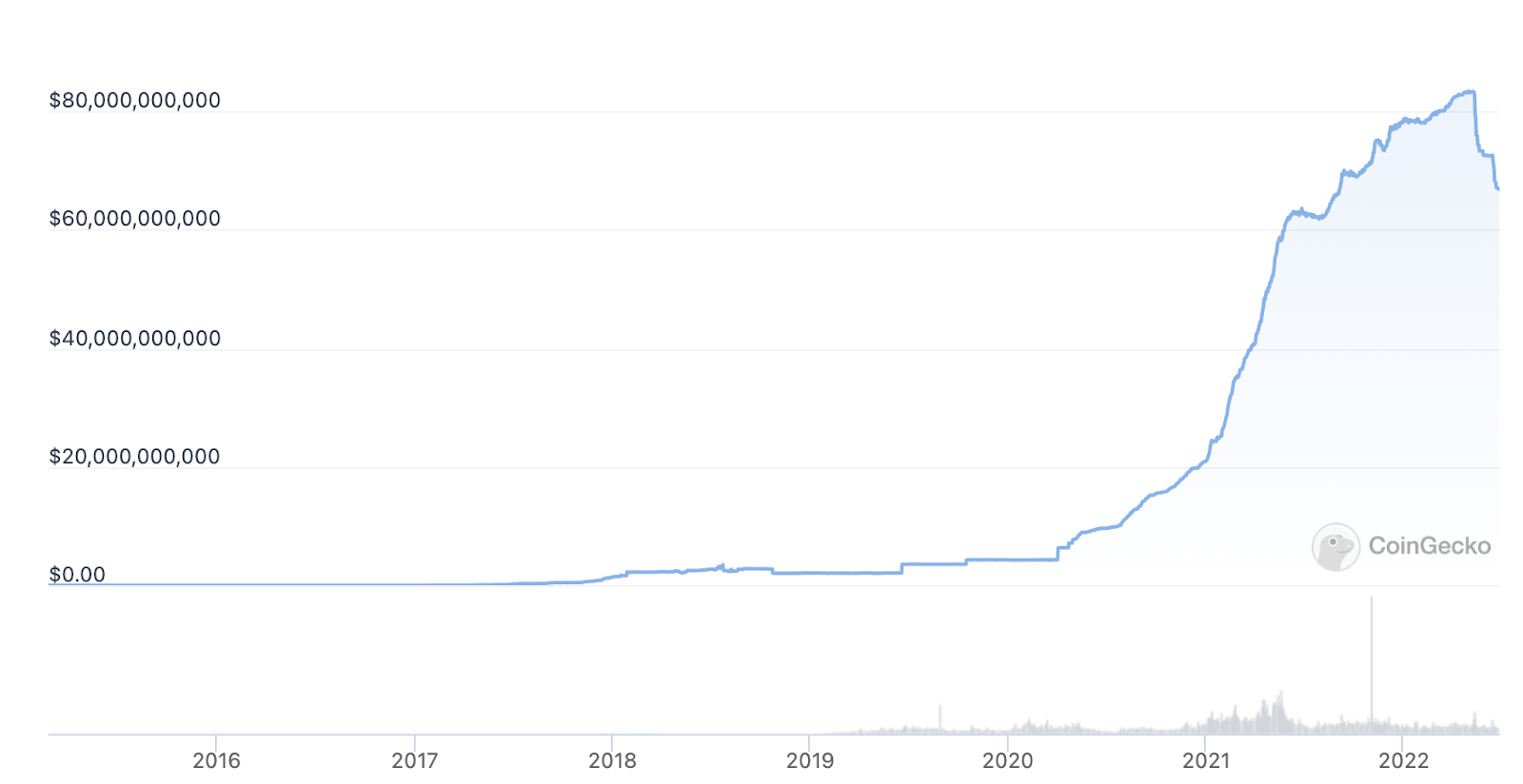
The issuance of tethers in March 2020, was 4.3 billion, but that’s when the Tether printer kicked into overdrive — minting tethers at a clip nobody had ever seen before. 

Tether minted 4.4 billion tethers in April 2020 — crypto’s version of an economic stimulus package. By May, Bitcoin reached $10,000, just in time for the halvening.  

Once the price of bitcoin goes up, though, there’s no way to turn off the Tether printing press. It has to keep printing. If the price of bitcoin goes down, people will sell, creating an exodus of real dollars from the system. So Tether kept printing, pushing the price of bitcoin ever skyward. 

In May, June, and July 2020, Tether issued a combined total of 3 billion tethers. In August, when the price of bitcoin reached $12,000, Tether issued another 2.6 billion tethers. In September, when bitcoin slid below $10,000, Tether issued another 2.2 billion tethers. 

By the end of 2020, Tether had reached a market cap of 21 billion. The printer kept going. In 2021, Tether pumped out 60 billion more tethers. By May 2022, Tether’s market cap had reached 83 billion. Bitcoin’s price peaks in April 2021 ($64,000) and November 2021 ($69,000) both coincided with an influx of tethers into the market. 

You can’t just redeem tethers. Only Tether’s big customers — it has about ten of them — can redeem. You can try to sell your tethers on an exchange. But you can’t just go up to Tether to redeem them for dollars. There were no redemptions of tethers, ever, until May and June 2022 — the present crash.

Curiously, Tether’s reserve as declared to New York in April 2019 contained $2.1 billion of actual money — cash and US Treasuries. But Tether’s reserve attestation as of March 31, 2021, still contained just $2.1 billion of cash and treasuries!

This suggests that the rest of the reserve over that time was made up of whatever worthless nonsense Tether could claim was a reserve asset — loans of tethers, cryptocurrencies, and dubious commercial paper credited at face value rather than being marked to market.

Dan Davies, in his essential book Lying for Money, marks this as the key flaw in frauds of all sorts: they have to keep growing so that later fraud will keep covering for earlier fraud. This works until the fraud explodes.

Tether marketcap, CoinGecko

GBTC’s ‘reflexive Ponzi’

Grayscale’s Bitcoin Trust (GBTC) played a huge role in keeping the price of bitcoin above water through 2020. It offered a lucrative arbitrage trade, an exploitable inefficiency in markets, that a lot of big players went all-in on.

GBTC was an attempt to wrap Bitcoin in an institutionally compatible shell. All through 2020 and into 2021, GBTC was trading at a premium to bitcoin on the secondary markets. Accredited investors would acquire GBTC at net asset value — some large proportion being in exchange for direct deposits of bitcoins, not purchases for cash, although all the accounting was stated in dollars. After a six-month lock-up, the accredited investors would sell the shares to the public at a 20 percent premium, sometimes more. Rinse, repeat, and that’s a 40 percent return in a year. 

GBTC functioned like a “reflexive Ponzi.” When Grayscale bought more bitcoin for the trust, that drove up the price of bitcoin, which pushed up the GBTC premium, which resulted in investors wanting more GBTC and Grayscale issuing more shares. 

Grayscale ran a national TV advertising campaign at the time, targeted at ordinary investors. The ads warned that disaster was imminent, inflation would eat your retirement, and bitcoin was better than gold — so you should buy bitcoin. Or, this shiny GBTC, which was implied to be just as good! [YouTube, 2019]

In a bull market, retail investors didn’t mind paying a premium — because the price of bitcoin kept going up. The market treated GBTC as if it was convertible back to bitcoins, even though it absolutely wasn’t. [Adventures in Capitalism]

Grayscale ultimately flooded the market with GBTC. When an actual bitcoin ETF became available in Canada, GBTC’s premium dried up. Since February 2021, GBTC has been trading below the price of bitcoin. As of March 2022, the trust holds 641,637 bitcoins. And they’re staying there indefinitely — leaving GBTC holders locked in on an underwater trade.

The rise of decentralized finance

Decentralized finance, or DeFi, didn’t directly pump the price of bitcoin in 2020. But DeFi was one of the stars of the 2021 bubble itself, and eventually caused the bubble’s disastrous explosion. All of the structures to let that happen were set up through 2020.

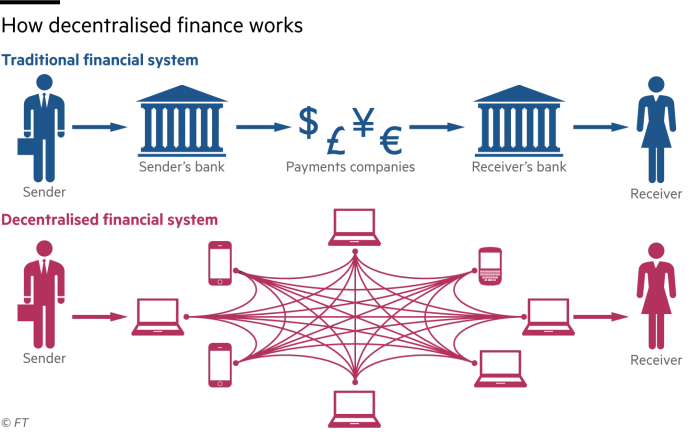
DeFi is an attempt to put traditional financial system transactions — loans, deposits, margin trading — on the blockchain. Regulated institutions are replaced with unknown and unregulated intermediaries, and everything is facilitated with smart contracts — small computer programs running on the blockchain — and stablecoins.

All through 2019 and 2020, DeFi was heavily promoted as offering remarkable interest rates. At a time of low inflation, this got coverage in the mainstream financial press. Here’s the diagram the Financial Times ran, depicting DeFi as a laundromat for money: [FT, paywalled, archive

The key to DeFi is decentralized exchanges, where you can trade any crypto asset that can be represented as an ERC-20 token — such as almost any ICO token — with any other ERC-20 token.

DeFi also lets you take illiquid tokens that nobody wants, do a trade, assign them a spurious price tag in dollars, then say they’re “worth” that much. This lets dead altcoins with no prospective buyers claim a price and a market cap, and attract attention they don’t warrant. If you put a dollar sign on things, then people take that price tag seriously — even when they shouldn’t.

You can also create a price for a token that you made up out of thin air yesterday and use DeFi to claim an instant millions-of-dollars market cap for it. 

This was the entire basis for the valuation of Terraform Labs’ UST and luna tokens — and people believed those “$18 billion” in UST were trustworthily backed by anything.

You can also use those tokens you created out of thin air as collateral for loans to acquire yet more assets. An unconstrained supply of financial assets means more opportunities for bubbles to grow, and more illiquid assets that you can dump for liquid assets (BTC, ETH, USDC) when things go wonky.

By September 2020, five hundred new DeFi tokens had been created in the previous month. DeFi hadn’t hit the mainstream yet — but it was already the hottest market in crypto. [Bloomberg]

The problem was that in 2020, to use DeFi you had to know your way around using the actual blockchain. Retail investors, and even most institutional investors, haven’t got the time for that sort of dysfunctional nonsense.

Retail was more attracted to the “CeFi” (centralized DeFi) investment firms, such as Celsius and 3AC, offering impossible interest rates. These existed in 2020 but didn’t gain popularity until the following year when the bubble had started properly.

A new grift: NFTs 

By late 2020, crypto promoters were searching for a new grift to lure in retail money, one that would have broader mainstream appeal. They soon found one. 

NFTs as we know them got started in 2017, with CurioCards, CryptoPunks, and CryptoKitties. NFT marketing had continued through the crypto winter — in the desperate hope that ordinary people might put their dollars into crypto collectibles.

The foundations of the early 2021 burst of art NFTs were laid in late 2020, when Vignesh Sundaresan, a.k.a. Metakovan, first started looking into promoting digital artists, such as Beeple — whose $69 million JPEG made international headlines for NFTs in March 2021, and officially kicked off the NFT boom. 

Late 2020 also saw the launch of NBA Top Shot, the only crypto collectible that ever got any interest from buyers other than crypto speculators. Top Shot traders were disappointed at how incredibly slow Dapper Labs was at letting them withdraw the money they’d made in trading — and became some of the first investors in the Bored Apes.

Coiner CEOs 

By late 2020, several big company CEOs started promoting the concept of bitcoin on the company dime. These included Jack Dorsey at Twitter, Dan Schulman at PayPal, and Michael Saylor at business software company MicroStrategy.

In October 2020, Saylor revealed his company had bought 17,732 bitcoins for an average of $10,000 per coin. Over the next 18 months, Microstrategy would plow through its cash reserves and take on debt to funnel more money into bitcoin, spending $4 billion in the process. Buying MSTR shares become the newest way for retail investors to bet on bitcoin. Saylor also put himself forward as bitcoin’s latest prophet and crazy god.

PayPal set up bitcoin trading in 2020, though only as a walled garden, where you couldn’t move coins in or out. Still, it made gambling on crypto more accessible to retail investors. 

Bitcoin miners start ‘hodling

By late 2020, we suspect there was very little actual cash in crypto. But bitcoin needed to continue its upward ascent. 

The biggest tip-off that the fresh outside dollars had stopped flowing was when bitcoin miners stopped selling their coins. Bitcoin miners mint 900 new bitcoins per day. They typically sell these to pay their energy costs — power companies don’t accept tether — and buy new mining equipment, which becomes obsolete every 18 months. At $20,000 per bitcoin, that would equate to $18 million, in actual dollars, getting pulled out of the bitcoin ecosystem every day.

In October 2020, Marathon Digital (MARA), one of the largest publicly traded miners, stopped selling its bitcoins. They took out loans, which allowed them to buy their equipment and hold their bitcoins. Marathon even bought additional bitcoins!  

Borrowing against mined bitcoins, and not selling them, reduced selling pressure on bitcoin’s price in dollars. US-based miners used this model heavily from July 2021 onward — taking low-interest loans from their crypto buddies, Galaxy Digital, DCG, and Silvergate Bank. Although, in 2022, the loans started running out and they had to start selling bitcoins.

This also set Marathon up for potential implosion when energy prices went up and the price of bitcoin dropped in 2022. Marathon is presently losing $10,000 on every bitcoin they mine. 

Easy money?

2020 was a weird year of market panics, bored day traders, and easy money — for some.

The Federal Reserve dealt with the pandemic panic by showering the markets with stimulus money. At the retail end, $817 billion was distributed in stimulus checks (Economic Impact Payments), $678 billion in extended unemployment, and $1.7 trillion to businesses, mostly as quickly-forgiven loans. [New York Times]

Bored day traders, stuck at home working their email jobs and unable to go out in the evening, got into trading stocks on Robinhood as the hot new mobile phone game. Car rental firm Hertz, a literally bankrupt company, whose stock was notionally worth zero, started going up just because Robinhood users thought it was a good deal. Instead of crypto becoming a more regular investment like stocks, the stonks* had turned into shitcoins.**

What isn’t clear is how much of this money found its way to the crypto market. At least some of it did. A study by the Federal Reserve Bank of Cleveland noted: “a significant increase in Bitcoin buy trades for the modal EIP amount of $1,200.” This increased BTC-USD trade volume by 3.8%! [Cleveland Fed]

But the trades only seemed to raise the price of bitcoin by 0.07%. And the dollars in question were only 0.02% of the money distributed in the EIP program.

* A cheap and nasty equity stock; the term comes from a meme image. [Know Your Meme]
** We are sorry to tell you that this is literally a technical term in crypto trading.

The final push over the line

A lot of channels into crypto were put into place in 2020. But the last step was to pump the price over the previous bubble peak of $20,000.

With that bitcoin number achieved, the press would cover the number going up — because “number go up” is the most interesting possible story in finance. That would lure in the precious retail dollars that hodlers needed to cash out.

The push started in late November, with deployments of tethers to the offshore exchanges. On December 18, 2020 — exactly three years after the previous high — bitcoin went over $20,000 again. And that’s when a year and a half of fun started.