Crypto collapse: Genesis vs. DCG, Celsius payouts failing, Terra-Luna extraditions, what 3AC did next, Craig Wright

Our latest is just out! This one is on David’s site. [David Gerard]

  • DCG objects to its own subsidiary’s actions in bankruptcy to sell off its GBTC and settle with New York
  • Celsius Network glitches paying out creditors
  • Zhu Su and Kyle Davies from Three Arrows Capital are at it again
  • Terra-Luna extraditions to South Korea and the US
  • Bakkt is broke
  • Coinbase’s 10-K shows the crypto retail trade is still dead
  • Craig Wright, we’re sorry to say

We also have half-cooked standalones on Tether and the state of bitcoin mining. Coming soonish!

Amy and David answer your questions — bitcoin mining, ETH staking, FTX, Tether, and more! 

  • By Amy Castor and David Gerard

We asked readers what they were curious about in crypto. We posted part one of our answers earlier this month. Now here’s part two! [Twitter; Bluesky

Sending us money will definitely help — here’s Amy’s Patreon, and here’s David’s.

Q: An update on the carbon footprint of the crypto industry for 2023, if this hasn’t been done by someone else already? Thanks [Thomas Endgame on Twitter]

The news is still dismal. The bitcoin network’s annual carbon footprint is a shocking 76.79 million tons of carbon dioxide, comparable to the entire country of Oman, according to Digiconomist. [Digiconomist, archive]

In terms of energy, bitcoin uses as much electricity as the country of Ukraine — 137.68 terawatt-hours annually. Energy consumption was highest in the first half of 2022 — 204 terawatt-hours per year — but started to go down in July, after the crypto collapse

The network currently produces 23.75 kilotons of e-waste per year, comparable to the entire Netherlands, and every bitcoin transaction uses enough water to fill a swimming pool.

This is why some of the good citizens of Texas are fighting back against the crypto mines there. 

Q: Who’ll be left holding bags when Tether collapses? [Julius Cobbett on Twitter]

Tethers (USDT) function as substitute dollars on offshore crypto exchanges that have no access to US dollar banking.

The biggest holders of tethers are arbitrageurs, such as Cumberland, who pass tethers along to secondary users in exchange for bitcoins and other crypto. [CoinTelegraph, 2020; Protos]

If all tethers were suddenly switched off tomorrow, that would be nearly 100 billion “dollars” in liquidity instantly sucked out of the market.  

Any secondary users stuck holding tether would find their virtual dollars suddenly worthless. Arbitrageurs would have nothing to buy and sell bitcoin with on offshore exchanges — they would have to switch over to a different stablecoin — and the price of bitcoin would likely take a serious hit.

We would expect to see a large number of bitcoin holders trying to dump their holdings on actual-dollar exchanges like Coinbase in a mad rush to get out of the market. It might look like a bunch of mice trying to squeeze out of a tiny hole. 

Q. We all know crypto is garbage, why does YAHOO finance continue to have the BTC ticker and other crypto related garbage up? I’d have thought by now it would be gone. [Barsoapguy on Twitter]

Sadly, with bitcoin ETFs and so on still all over the finance press, it’s a relevant number to put up. Even if they just pull the number from whatever CoinMarketCap says.

Q. In the bankruptcy of FTX, about 7B of the $8.7B said to be “lost” has been found, and with Crypto making a comeback all creditors may become whole or better. But SBF rots in prison for decades? And BK firms make over a billion in fees? [Bill Hochberg on Twitter]

There are two misconceptions here — one is that John Jay Ray and his team have found all the money and everything will be fine. The other is that Ray and his lawyers are gouging the creditors and nobody can stop them.

FTX got itself into trouble because it had stolen the customer assets, then inflated its balance sheets with worthless FTT tokens — its own illiquid supermarket loyalty card points. The FTT made up a third of its balance sheet. When FTX filed for bankruptcy in November 2022, it had a shortfall of $8.7 billion.

As we wrote at the time, FTX’s debts were real, but its assets were fake. The FTT was unsaleable garbage, not something that Ray and his team could turn into cash.

In August 2023, Ray estimated his team had recovered $7 billion — but that included spurious dollar values for trash crypto assets. A lot of it will be FTT and other worthless tokens that aren’t realistically convertible to cash in those quantities. 

In October 2023, FTX said it would refund up to 90% of “distributable assets” to creditors. That’s 90% of the amount of funds that FTX was able to recover — not 90% of the amount owed to creditors. [FTX]

Bitcoin has gone up in price since FTX fell over. The price of bitcoin was $17,000 when FTX filed for bankruptcy. Now it’s over $40,000. If FTX held onto its crypto holdings, instead of converting them into cash as soon as possible, they might have made some money. But bankruptcy lawyers typically don’t gamble on volatile markets. 

Bankruptcy professionals are super expensive. Ray’s team has so far cost about $200 million. That’s a lot of money, and many people questioned this — but even the independent fee examiner said, yep, that looked about right for the ridiculous mess Ray had to sort out here.

An appeals court has ordered the appointment of an independent examiner reporting to the US Trustee, paid for out of the bankruptcy estate, which will likely cost another $100 million or so.

Q: Eth staking and destaking? It was not possible to unstake at launch, does it work now? Are stakers happy? How scammy is the whole thing? There was some stuff about OFAC compliance for stakers too? I don’t know? I might use an explainer? [Laventeot on Twitter]

Ethereum proof of stake uses validators rather than miners like bitcoin does. Every validator has a chance at winning this moment’s ETH. If your block is the winner, you get the block reward, transaction fees, and all the MEV you can steal.

You can set up a validator at the cost of staking 32 ETH. When Ethereum moved to proof of stake in September 2022, this 32 ETH couldn’t be unstaked. But since Ethereum’s Shanghai upgrade in April 2023, it is now possible to unstake your staked ETH.

Unstaking has a queueing mechanism to avoid there being too much churn. So when there’s a big dump — such as when Celsius Network destaked 30,000 ETH recently to hand back to their bankruptcy creditors — it can take days or even weeks to process. [Nansen]

The staking process seems to work as advertised and the stakers are pleased with it.

The process closely resembles an unregistered security in the US — the Ethereum Foundation (incorporated in Switzerland) promotes that you put in your ETH and you get a return on it from the efforts of others.

Some exchanges offer staking as a service — this is probably okay if the customers are accredited or institutional, and an excellent way to accumulate cease and desist letters from the SEC and state securities regulators if the customers are retail.

Anyone moving money — or, in FinCEN’s terms, “value that substitutes for currency,” including “convertible virtual currencies” — as a business in the US is required to comply with sanctions law. This is usually assumed to mean not validating transactions for sanctioned blockchain addresses listed by OFAC. US-based validators would be very foolish to flout this.

OFAC compliance in transaction processing doesn’t directly relate to the economics of staking in itself — US bitcoin miners would similarly be liable under law for processing transactions for sanctioned entities, even if OFAC hasn’t called them up yet.

Q: maybe a check-in on the enterprise blockchain pitch decks? is the same dead horse still being beaten? [Stephen Farrugia on Twitter]

Enterprise blockchain has gone back into hibernation. Corporate interest in non-cryptocurrency blockchain goes up and down with the price of bitcoin — lots of interest in 2017 and 2018, almost none in 2019 and 2020, and a sudden burst of interest in 2021 as the number went up.

The problem with enterprise blockchain is that it’s a completely useless idea. A blockchain doesn’t actually work any better than using a conventional database in any situation where you have a trusted entity who’s responsible for the system. If you’re a business, that’ll be yourself. Just use Postgres.

The main remaining interest in enterprise blockchain is inside banks. We’ve had many reports of bank fintech research units infested with coiners trying to do something — anything — that they can say is “blockchain.” Société Générale’s completely useless euro stablecoin is one recent example.

Q. Something on the way that Bitcoin Magazine and BitMEX bought commercial places on the Peregrine Mission One so they could say they’d “gone to the moon” … and the spacecraft is going to miss the moon. [BiFuriosa on Bluesky]

Private companies have of late been offering to send personal items — cremated remains, time capsules, and even crypto — to the moon. Astrobotic, which owns Peregrin-1, is one of them. 

In May, BitMEX and Bitcoin Magazine announced they were going to send a physical bitcoin to the moon via Astrobotic — that is, a metal medallion with a bitcoin private key engraved onto it. They declared that this would mark a “defining moment for bitcoin as we explore the possibilities of Bitcoin beyond planet Earth.” [BitMEX, archive]

Peregrin-1 made it into space earlier this month — but it never managed to land on the moon. So when it burned up on re-entry to Earth’s atmosphere, everything onboard burned up with it, including the time capsules, the ashes of more than 200 people, and the bitcoin. [Gizmodo]

Dogecoin fans had earlier funded a similar effort to send a physical dogecoin to the moon in 2015, also via Astrobotic. As of 2023, they were still trying to get it sent up. If the physical dogecoin had been onboard, it would have met the same fate. [Twitter, archive]

Sadly, even the moon hates crypto. 

Q. Why are people still falling for this nonsense? [Peter Nimmo on Mastodon]

Dude, they can get rich for free! Maybe.

Thankfully, fewer people are falling for the nonsense. Retail trade is one-eighth of what it was in the 2021 bubble. Most of the dollars boosting the price of bitcoin since 2017 have been fake. 

By the end of 2017, a billion USDT was sloshing around in the crypto markets; today in 2024, we’re coming up to 100 billion USDT. Bitcoin’s price is largely manipulated.

Crypto media — CoinDesk, The Block, Decrypt, and others — play a major role in promoting the nonsense. These outlets, owned and/or financed by crypto companies, are the public relations machines for the crypto industry. The finance press treats these sites as specialist trade press rather than fundamentally a promotional mechanism.

Crypto has also put big money into lobbying efforts, so we see senators like Cynthia Lummis, Kirsten Gillibrand, and Rand Paul shamefully repeating the propaganda. 

Crypto skeptics are a smaller group who try to warn people of the dangers of investing in crypto. So it’s important to send money to us. Instead of bitcoins, we spend it on useful things like wine to get through all this guff.

Q. Once Crypto blows over what will we salt our popcorn with? [EamonnMR on Mastodon]

We don’t expect crypto to ever disappear completely. We do expect the number to eventually go down to the point where fewer people pay attention.

Meme stocks blew out even harder than crypto did. The remaining devotees are like QAnon for finance, posting to Reddit with their theories of how much they’ll surely get for their deactivated BBBY shares when the Mother Of All Short Squeezes finally descends.

Now that the well of dumb crypto money has dried up, venture capitalists are pivoting to AI as the next big thing. The tech is running out of steam, though. But the power consumption is likely to be even worse than bitcoin mining by 2027, and the AI grifters are using the same excuses for it as the bitcoin grifters. [Digiconomist]

Suckers are eternal. As long as money exists, fraud and get-rich schemes will be with us. And we’ll have something to write about.

Image: Hans at Pixabay, CC-0

Crypto collapse: Mt Gox payouts, Tether hooks up the feds, SEC says no to Coinbase, crypto media mergers

  • By Amy Castor and David Gerard

It’s not over until withdrawals are temporarily paused due to unusual market activity.

Jacob Silverman

Tightening Tether’s tethers

Tether’s been under some regulatory heat after the reports of how useful USDT is for financing terrorists and other sanctioned entities. Even Cynthia Lummis, the crypto-pumping senator from Wyoming, loudly declared that Tether had to be dealt with.

The US government isn’t entirely happy with Tether’s financial shenanigans. But they’re really unhappy about sanctions violations, especially with what’s going on now in the Middle East. 

So Tether has announced that it will now be freezing OFAC-sanctioned blockchain addresses — and it’s onboarded the US Secret Service and FBI onto Tether! [Tether, archive; letter, PDF, archive]

Tether doesn’t do anything voluntarily. We expect they were told that they would allow this or an extremely large hammer would come down upon them.

There’s more to Tether’s criminal use case than sanctions violation. The most jaw-dropping chapter in Zeke Faux’s excellent book Number Go Up (US, UK) is when he traced a direct message scammer to a human trafficking operation in Cambodia that favored tethers as its currency. South China Morning Post follows up on this with an in-depth report on how Cambodian organized crime uses tethers. [SCMP]

Credit rating firm S&P Global rated eight stablecoins for risk. Tether and Dai got the lowest marks. S&P notes in particular the lack of information on Tether’s reserves. [press release; S&P; Tether report, PDF]

At least some of the claimed Tether backing in treasuries is held in the US with Cantor Fitzgerald — exposing Tether to US touchability. This has been known since February 2023, and was proudly confirmed in December 2023 by Cantor CEO Howard Lutnick: “I hold their Treasuries, and they have a lot of Treasuries. I’m a big fan of Tethers.” [Ledger Insights; Forbes]

Cointelegraph had a fascinating story on a company called Exved using tethers for cross-border payments from Russia! Then they deleted it, for some reason. Exved was founded by Sergey Mendeleev, who also founded the OFAC-sanctioned crypto exchange Garantex, which was kicked out of Estonia. Exved is working with InDeFi Bank, another Mendeleev venture. We’re not so sure the new OFAC-compliant Tether will be 100% on board with this. [Cointelegraph, archive; Telegram, in Russian; Protos]

SEC answers Coinbase’s prayers: “No.”

In July 2022 — just after crypto crashed — Coinbase wrote to the SEC proposing new regulatory carveouts for crypto.

The SEC took its sweet time responding. Eventually, Coinbase sued in April 2023 with a writ of mandamus, demanding a bureaucratic response. The court told the SEC to get on with it, or at least supply a date by which it would answer.

Finally, the SEC has responded: “the Commission concludes that the requested rulemaking is currently unwarranted and denies the Petition.” The SEC thinks existing securities regulations cover crypto securities just fine, and there’s no reason for special rules for Coinbase. [SEC rejection, PDF; Coinbase letter to court, PDF; Gensler statement]

Coinbase general counsel Paul Grewal welcomed the opportunity to challenge Coinbase’s dumb and bad proposal being turned down. [Twitter, archive]

4 (continued)

Binance founder and former CEO Changpeng Zhao will not be returning home to Dubai anytime soon. US District Judge Richard Jones ordered CZ to remain in the US until his sentencing on February 24. He can travel within the US, but he cannot leave. [Order, PDF

After being busted hard, Binance is still behaving weird. At the FT Crypto and Digital Assets Summit in London, the exchange’s new CEO Richard Teng refused to answer even basic questions, like where Binance is headquartered and whether it’s had an audit. “Why do you feel so entitled to those answers?” Teng said when pushed. “Is there a need for us to share all of this information publicly? No.” [FT]

CZ and Binance have been trying to dismiss the SEC charges against them. This is mostly loud table pounding, wherein Binance claims that what the SEC argued were securities are not really securities. [Doc 190, PDF, Doc 191, PDF]

France was the first country in Europe to grant Binance regulatory approval. State-endorsed blockchain courses for the unemployed and NFT diplomas helped push the country’s most vulnerable into crypto. Since the collapse of FTX and Binance’s $4.3 billion fine for money laundering, French President Emmanuel Macron’s relationship with CZ has fallen under scrutiny. [FT, archive]

London law firm Slateford helped to cover up Binance’s crimes and attempted to intimidate media outlet Disruption Banking from writing about Binance’s sloppy compliance hiring practices. (Disruption Banking told Slateford to get knotted and didn’t hear from them again.) [Disruption Banking]

Binance is finally removing all trading pairs against Great British pounds. [Binance, archive]

FTX: The IRS wants its money

FTX filed a reorganization plan in mid-December. The plan is 80 pages and the disclosure statement is 138 pages, but there’s a notable lack of detail on what happens next. None of the talk of starting a new exchange has made it into the current plan — this appears to just be a liquidation.

The plan treats crypto claims as their value in cash at the time of the bankruptcy filing on November 11, 2022, back when bitcoin was at $17,000 — less than half of what it is now.

Creditors will vote on the plan in 2024. The court must approve the plan before it is implemented. [Bloomberg, archive; Plan, PDF; Disclosure statement, PDF]

The IRS is demanding $24 billion in unpaid taxes from the corpse of FTX. John Jay Ray wants to know how the IRS came up with that ludicrous number — the exchange never earned anything near those amounts. The IRS originally wanted $44 billion, but brought the number down. Judge John Dorsey has told the IRS to show its working. [Doc 4588, PDF; Bloomberg, paywalled]

Three Arrows Capital

Three Arrows Capital was the overleveraged crypto hedge fund that blew up in 2022 and took out everyone else in crypto who hadn’t already been wrecked by Terra-Luna. After months of dodging culpability, co-founder Zhu Su was finally arrested in Singapore in September as he was trying to skip the country. 

Zhu was released from jail and appeared before the Singapore High Court on December 13, where he had to explain to lawyers for the liquidator Teneo what happened when 3AC went broke. The information will be shared with creditors. [Bloomberg, archive]

A British Virgin Islands court froze $1.1 billion in assets of Zhu and his co-founder Kyle Davies and Davies’ wife Kelly Chen. [The Block]

Teneo expects a 46% recovery rate for 3AC creditors on $2.7 billion in claims. [The Block]

Crypto media in the new Ice Age

Crypto news outlet Decrypt has merged with “decentralized media firm” Rug Radio. No, we’d never heard of them either. The two firms will form a new holding company chaired by Josh Quittner. Decrypt had spun out from Consensys in May 2022, just before everything crashed. It’s reportedly been profitable since then — though crypto sites always say that. [Axios; Axios, 2022

Forkast News in Hong Kong has merged with NFT data provider CryptoSlam and fired most of its staff. Forkast was founded in 2018 by former Bloomberg News anchor Angie Lau; it shut down editorial operations on November 30. [The Block

Crypto news outlets ran seriously low on cash in 2019 and 2020, just before the crypto bubble, and they’re struggling again. We expect more merges and buyouts of top-tier (such as that is in crypto) and mid-tier crypto outlets. We predict news quality will decline further.

Amy recalls the old-style crypto media gravy train and eating in five-star restaurants every night in Scotland and London while embedded with Cardano in 2017. Thanks, Charles! Nocoining doesn’t pay nearly as well, but these days crypto media doesn’t either. There’s probably a book in those Cardano stories that nobody would ever read.

Regulatory clarity

The Financial Stability Oversight Council, which monitors domestic and international regulatory proposals, wants more US legislation to control crypto. FSOC’s 2023 annual report warns of dangers from:

crypto-asset price volatility, the market’s high use of leverage, the level of interconnectedness within the industry, operational risks, and the risk of runs on crypto-asset platforms and stablecoins. Vulnerabilities may also arise from token ownership concentration, cybersecurity risks, and the proliferation of platforms acting outside of or out of compliance with applicable laws and regulations.

Yeah, that about covers it. FSOC recommends (again) that “Congress pass legislation to provide for the regulation of stablecoins and of the spot market for crypto-assets that are not securities.” [Press release; annual report, PDF]

IOSCO, the body of international securities regulators, released its final report on how to regulate DeFi, to go with its November recommendations on crypto markets in general. IOSCO’s nine recommendations for DeFi haven’t changed from the draft version — treat these like the instruments they appear to be, and pay attention to the man behind the curtain. These are recommendations for national regulators, not rules, but look at the DeFi task force — this was led by the US SEC. [IOSCO press release, PDF; IOSCO report, PDF]

London-based neobank Revolut is suspending UK crypto services — you can no longer buy crypto with the app — citing a new raft of FCA regulations, which go into force on January 8. [CityAM; CoinDesk]

Crypto exchange KuCoin has settled with New York. The NY Attorney General charged KuCoin in March for violating securities laws by offering security tokens — including tether — while not registering with NYAG. KuCoin has agreed to pay a $22 million fine — $5.3 million going to the NYAG and $16.77 million to refund New York customers. KuCoin will also leave the state. [Stipulation and consent order, PDF; Twitter, archive

Montenegro plans to extradite Terraform Labs cofounder Do Kwon to either the US or South Korea, where he is wanted on charges related to the collapse of Terra’s stablecoin. Kwon was arrested in Montenegro in March. Originally it looked like Montenegro was going to pass him off to the US, but the case has been handed back to the High Court for review. [Bloomberg, archive; Sudovi, in Montenegrin]

Anatoly Legkodymov of the Bitzlato crypto exchange, a favorite of the darknet markets, has pleaded guilty in the US to unlicensed money transmission. Legkodymov was arrested in Miami back in January. He has agreed to shut down the exchange. [Press release]

The SEC posted a new investor alert on crypto securities with a very lengthy section on claims of proof of reserves and how misleading these can be. [Investor.gov; Twitter, archive

Santa Tibanne

It’s been nearly ten years, but Mt. Gox creditors are reportedly starting to receive repayments — small amounts in Japanese yen via PayPal. [Cointelegraph; Twitter, archive

Some payouts are apparently bitcoin payouts — with the creditors not receiving a proportionate share of the remaining bitcoins, but instead the yen value of the bitcoins when Mt. Gox collapsed in February 2014. This means a 100% recovery for creditors! — but much less actual money.

There are still 140,000 bitcoins from Mt. Gox waiting to be released. If payouts are made in bitcoins and not just yen, we expect that claimants will want to cash out as soon as possible. This could have adverse effects on the bitcoin price.

Trouble down t’ pit

In the Celsius Network bankruptcy, Judge Martin Glenn has approved the plan to start a “MiningCo” bitcoin miner with some of the bankruptcy estate. He says that “the MiningCo Transaction falls squarely within the terms of the confirmed Plan and does not constitute a modification.” [Doc 4171, PDF]

Bitcoin miners are racing to buy up more mining equipment before bitcoin issuance halves in April or May 2024. Here’s to the miners sending each other broke as fast as possible [FT, archive

Riot Platforms subsidiary Whinstone sent its private security to Rhodium Enterprise’s plant in Rockdale, Texas, to remove Rhodium employees and shut down their 125MW bitcoin mining facility. The two mining companies have been brawling over an energy agreement they had made before prices went up. [Bitcoin Magazine]

More good news for bitcoin

The UK is setting up a crypto hub! ’Cos that’s definitely what the UK needs, and not a working economy or something. [CoinDesk]

Liquid is a bitcoin sidechain set up by Blockstream at the end of 2018. It was intended for crypto exchange settlement, to work around the blockchain being unusably slow. It sees very little use — “On a typical day, there are more tweets about Liquid than there are transactions on its network.” [Protos

A16z, Coinbase, and the Winklevoss twins say they’ve raised $78 million as part of a new push to influence the 2024 elections. [Politico

Little-known fact: coiners can donate to the PAC in tethers. All they have to do is send them via an opaque Nevada trust structure to hide the origins of the funds. And this is perfectly legal! [FPPC, PDF, p. 85, “nonmonetary items”]

Ahead of the SEC’s deadline to rule on a bitcoin ETF, Barry Silbert, CEO of Digital Currency, has quietly stepped down from the board of DCG subsidiary and ETF applicant Grayscale and is no longer chairman, according to a recent SEC filing. Silbert will be replaced by Mark Shifke, the current DCG senior vice president of operations. US regulators are suing DCG over the Gemini Earn program co-run by its subsidiary Genesis. [Form 8-K]

Ordinals are an exciting new way to create NFTs on bitcoin! ’Cos who doesn’t want that? The bitcoin blockchain immediately clogged when it was actually used for stuff. Now TON, the blockchain that is totally not Telegram’s, no, no no, has ordinals — and it’s getting clogged too. [The Block]

Image: Mark Karpeles with aggrieved bitcoin trader outside Mt. Gox in Tokyo in 2014.

Crypto collapse: SEC brings regulatory clarity to Kraken and Celsius, stablecoins for the UK, crypto money laundering

  • By Amy Castor and David Gerard

Most of the deliberation time was spent saying “Wow, that was a lot of crime” “Just so much crime” “Maybe too much crime”

Allistair Hutton

Regulatory clarity for Kraken

The crypto industry demands regulatory clarity! So the SEC keeps stating the regulations as clearly as it possibly can. Isn’t that nice of them? On November 20, the SEC sued the Kraken crypto exchange.

The causes of action are very similar to those against Coinbase and Bittrex. Kraken deals in crypto securities and acts as an exchange, a broker, a dealer, and a clearing agency, all in the same company and without the proper registrations for each. The particular crypto securities in this case are ADA, ALGO, ATOM, FIL, FLOW, ICP, MANA, MATIC, NEAR, OMG, and SOL.

The SEC also alleges Kraken commingled customer assets with its operating accounts. Kraken’s own auditors said this created “a significant risk of loss” to customers and led to “material errors to Kraken’s financial statements for 2020 and 2021.”

The message the SEC is sending in this series of cases is that it just isn’t going to put up with crypto exchanges doing all the securities jobs in one company anymore, and they need to stop. [SEC press release; complaint, PDF]

The Financial Stability Board, which monitors the global financial system, thinks what the SEC is doing is very good and cool. Its new report “The Financial Stability Implications of Multifunction Crypto-asset Intermediaries” sets out precisely how and why crypto exchanges combining all these functions (an exchange, a broker, a dealer, and a clearing agency) “can exacerbate structural vulnerabilities in those markets.” It uses precisely what happened in the crypto collapse as its example. Risk to the actual economy is limited, says the FSB — though the biggest issue is how the exchanges wrecked the few banks willing to talk to them. [Press release; cover sheet; report, PDF]

It’s not just the SEC cracking down on crypto. The US government is generally sick of crypto nonsense and looking to shut it down. This is what we’ve spent the past year and a half advocating for as loudly as we possibly could.

IOSCO, the International Organization of Securities Commissions, released its final policy recommendations to securities regulators on crypto. In short: regulate the heck out of this stuff for what it clearly is — and don’t accept handwaving about technology. IOSCO will release a second part on DeFi before the end of 2023. [Press release; recommendations, PDF]

SEC trashes Celsius bankruptcy plan 

Judge Martin Glenn approved the Celsius NewCo plan on November 9, giving creditors fresh hope that all the nonsense they’d been trudging through since July 2022, when Celsius initially filed for Chapter 11, was finally coming to an end. But it was not to be. 

The original plan was that NewCo would be managed by Fahrenheit LLC, which won the bidding for Celsius’ assets in May. This business would focus on bitcoin mining and ether staking. [Doc 3972, PDF

Creditors would get shares in NewCo, which would trade on NASDAQ. NewCo could issue shares without registration — under an exemption in the bankruptcy code that would allow it to do the initial issuance without filing an S-1 form with the SEC. Creditors would also get back $2 billion in crypto in January 2024. 

But within hours of the court approving the deal, it fell afoul of the SEC — who would not approve the staking and lending portion of the business. [CoinDesk]

The SEC also wanted more details on the company’s assets and accounts for the “predecessor entity,” i.e., Celsius Networks. Unfortunately, Celsius’ pre-bankruptcy accounts are comical trash, somewhat documented in QuickBooks and some Google spreadsheets. This wasn’t quite good enough. [Doc 4050, PDF]

Celsius is now pivoting to “MiningCo,” a mining-only company with US Bitcoin as the manager and a board of directors. Fahrenheit members will not be part of the new entity.

Celsius’ lawyers argue that the “toggle” to mining-only is just fine, and they had this in their back pocket the entire time. Judge Glenn is not convinced: “This is not the deal that creditors voted on,” he said in a November 30 hearing. Celsius may have to seek a new creditor vote to get approval on the revised plan, putting them right back in the mud again. [Reuters, archive]

Blockchain Recovery Consortium (BRIC), who had been selected as a backup bidder in May if the Fahrenheit plan fell through, argued that Celsius should have gone with its backup bid, rather than pushing forward with this stripped-down “MiningCo” plan. 

A hearing on this mess will take place on December 21.

If the MiningCo plan is not approved, Celsius may be forced to liquidate in Chapter 7.

If this new plan does go through, creditors should count the cash and liquid cryptos they get in the settlement as their actual return — and treat their MiningCo shares as lottery tickets.

My beautiful launderette

Spain has arrested Alejandro Cao de Benós, a long-time Western agent of North Korea and founder of the Korean Friendship Association, on behalf of the US, for working with Virgil Griffith. [Reuters

Cao de Benós was indicted in April 2022, along with Christopher Emms, a UK citizen, for signing up Griffith to travel to North Korea in April 2019 to give a talk on crypto at the Pyongyang Blockchain and Cryptocurrency Conference, which the pair organized. Emms, a crypto entrepreneur, is still at large. [DOJ; FBI; FBI

We’re guessing the US wants a long discussion with Cao de Benós concerning all of North Korea’s other money laundering as well.

The US is currently working to extradite Cao de Benós from Spain, a process that can take months.

In the US, FinCEN wants to declare crypto mixing to be primarily about money laundering, for no better reason than money laundering is precisely what crypto mixing is primarily about. [FinCEN; Federal Register]

Court to Coin Center over their spirited defense of Tornado Cash: LOL, go away. [Doc 74, PDF]

Following “requests from its wealthy customers,” Ferrari is looking to sell cars to sanctioned Russians (ahem) unspecified entities in a currency-substitute that they have to hand. [Reuters, archive]

Now that’s effective altruism

Sam Bankman-Fried is in a cell, where he belongs. [DOJ statement]

But there was much more to FTX than one crook — or five crooks if you count the guilty pleas of Sam’s former fellow executives. The use case for crypto is crime, and FTX was a money laundering machine. Jacob Silverman and Molly White discuss Sam’s many, many as-yet-unindicted co-conspirators. [The Nation; Molly White]

If you ever need a moment of cheer in your life, imagine how Alex Mashinsky, the criminally charged founder and former CEO of Celsius Network, feels seeing Sam be sent to jail in less than five hours. (The amount of time jurors deliberated.) Mashinsy’s trial is scheduled for September 2024.

Over in the FTX bankruptcy, John Jay Ray is suing the Bybit exchange to recover $953 million. Bybit had a private line into FTX and successfully withdrew $327 million in the run on the exchange just before FTX declared bankruptcy in November 2022. [Complaint, PDF]

Stablecoins for the UK

The more foolishly ambitious parts of the UK government are still talking up crypto. So the Financial Conduct Authority has a new discussion paper on fiat-backed stablecoins for “consumers who wish to pay for their everyday shopping with stablecoins” — a category that does not presently exist. [Discussion paper, PDF]

So far, the plan is to allow UK-issued asset-backed “regulated stablecoins” supervised by the FCA. Overseas-issued “approved stablecoins,” with a UK “payment arranger” taking local responsibility, will come later.

The FCA will be requiring consumer protections, consumer right of redemption, protections in case an issuer fails, coin value stability despite market conditions, and ways to “mitigate the risks and harms that we have observed in the market, and those that arise from existing business practices” — i.e., all the crime.

Anti-money-laundering requirements will apply only on redemption — not on every transaction.

This initiative is not about our friends at Tether or USDC — though the FCA uses them as cautionary tales, particularly with USDC breaking its peg when Silicon Valley Bank went down.

Instead, the FCA seems to be setting a path for non-banks to issue their own asset-backed pounds — a regulated form of wildcat banking, with crypto as the excuse to even contemplate doing this weird thing. Or a privatized CBDC, if you want to be generous. The listed examples don’t even really need a blockchain.

There is nothing a regulated GBP stablecoin would do for ordinary UK consumers that they can’t already do with debit cards. But the FCA says that prospective issuers are already in the wings. Our psychic powers suggest these may be Conservative Party donors, given the present government’s recent track record of blatant kleptocracy.

CoinDesk spoke to Matthew Long, the FCA’s director of payments and digital assets, who confirmed that their intent is not to let rubbish through: “We’ve seen lots of things that we’re really concerned about and at the end of the day, the person this actually affects is the customer.” [CoinDesk]

Submit comments by January 22, 2024.

Bitfinex suffers hardly any data leakage to speak of

The Bitfinex crypto exchange apparently suffered a completely trivial wafer-thin leak of almost no customer information at all sometime in October. They announced this complete non-news at 21:30 UTC on Saturday November 4. [Bitfinex, archive]

How bad do you think Bitfinex’s customer data spill was? Clearly so very insignificant — a mere trifle! — that they couldn’t get away with just saying nothing at all to the very large and important customers with short tempers.

We’re sure it’s fine. “Bitfinex has a very close relationship with law enforcement,” and maybe it’ll get much closer.

More good news for bitcoin

CoinDesk has been sold in an all-cash deal to Bullish, the crypto exchange backed by Peter Thiel via Block.One — and not to the Vessenes consortium that was sniffing around the site in August. Terms were not disclosed. CoinDesk will operate as a totally independent entity, for sure! Bullish says it will inject lots of capital. [Press release; WSJ, archive]

Binance is finally killing its BUSD stablecoin as of December 15, 2023. The remaining BUSD balances will be converted to the totally trustworthy stablecoin FDUSD on December 31. You can redeem BUSD directly at Paxos up to February 2024 — if you can pass their anti-money laundering. [Binance, archive]

Binance had previously been trying to switch to Justin Sun’s TrueUSD. But TrueUSD was having problems in July 2023 — such as billions of pseudo-dollars being minted out of thin air. It turns out TrueUSD was hacked. The company waited a month to announce the hack, giving themselves plenty of time to furiously mint more TUSD tokens and send them to Huobi. [Twitter, archive; Twitter, archive; Protos]

Bankrupt crypto lender BlockFi is winding down at last. Payouts will be between 39.4% and 100%! … so, 39.4%. [Reuters, archive

Circle, the company behind the USDC stablecoin, reportedly wants to try going public again in 2024. Circle tried in 2021 to go public through a SPAC offering. But they failed to get SEC approval for the proposed merger with Concord Acquisition, and by early 2023 they had given up. [Bloomberg, archive; WSJ, paywalled]

OpenSea is laying off 50% of its staff, as all the air has been let out of the NFT balloon. When it laid off 20% of its employees last year, around 230 people remained. So now they’re down to about 100 employees. [Twitter, Nitter

The trial of crypto trader and alleged exploiter of Mango Markets Avi Eisenberg has been delayed until April 8, 2024. Eisenberg’s lawyers say they need additional time to prepare for the case. He is currently residing at MDC Brooklyn, also the temporary home of Sam Bankman-Fried. [CoinDesk]

Alex de Vries (Digiconomist) has a new report out on bitcoin’s water usage. Each transaction on the bitcoin blockchain uses 16,000 liters of water on average, about 6.2 million times more than a credit card swipe — and enough to fill a backyard swimming pool. [Cell]

We also suggested that someone should become the Digiconomist of AI power usage. It turns out that guy is Digiconomist! De Vries’ article “The growing energy footprint of artificial intelligence” was published in Joule in October. [Joule]

When you buy a nice house, make sure the previous owner wasn’t a crypto Ponzi scammer. Basketball player Shai Gilgeous-Alexander bought a house in Toronto previously owned by Aiden Pleterski, the guy who was kidnapped and tortured over three days by an extremely upset investor inquiring as to where his funds had gotten to. Further aggrieved investors are still showing up at the house — and so Gilgeous-Alexander wants to reverse the sale. [NYT, archive]

Image: Kraken founder Jesse Powell in a random tie he found out on a road somewhere.

Crypto collapse: Venture capital goes home, Coinbase, Tether backing, FTX sues Hollywood VCs, 3AC on the beach

  • By Amy Castor and David Gerard

“My survey of three card monte tables suggests they’ve always got at least one patron but you won’t see anyone playing at the big casinos which just shows the system is rigged.”

crossestman

Crypto’s not dead! Look, it’s still twitching

Crypto venture capital investments have gone full crypto collapse, from $21.6 billion in 2022 to just $0.5 billion so far in 2023. This Fortune article includes the funniest graph of the week: [Fortune, archive]

Investors are leaving the crypto sector without any plans to return. [Bloomberg

Crypto trading is at its lowest level since October 2020. The Block puts the volume for May 2023 at $424 billion. For comparison, May 2021 was $4.25 trillion and May 2022 was $1.4 trillion. [The Block]

Volume numbers are considerably less if you take into account that unregulated crypto exchanges are known for faking their volumes. Crypto trading is all but dead. We know this because exchanges run by normal finance guys don’t see any trading. [Bloomberg]

Traditional finance groups want to start their own crypto exchanges run in a non-clown-shoes manner. A nice ambition — but that was Gemini’s pitch and even they still had to resort to risky garbage. [FT

The Winklevoss twins marketed Gemini as an exchange that played by the rules — one that serious money people could trust. But after the failure of FTX and the Genesis bankruptcy — in which Gemini is the largest creditor — they lost that trust. Maybe they could pivot to AI? [Bloomberg

Crypto.com halted services for institutional traders in the US on June 21. The exchange cited “limited demand” as the reason. [news.bitcoin.com]

The rest of crypto is also desperate. Reddit founder Alexis Ohanian is still pushing play-to-earn games and touts Axie Infinity as a huge success. Gamers hate play-to-earn and think it’s vacuous horse hockey. [Twitter, archive]

Universe.xyz is the latest NFT market to shut down, taking all the images on the site with it. As more NFT markets shut down, your apes are in danger of going blank forever. [Twitter, archive]

TechMonitor asks: “Is crypto finally dead?” We should be so lucky. With quotes from David. [TechMonitor

Coinbase: We didn’t do it, nobody saw us, and it wasn’t even a thing

Coinbase has responded to the SEC’s complaint with 177 pages of chaff. [Doc 22, PDF]

Paragraph 2 makes the claim that in approving Coinbase’s original S-1, the SEC approved Coinbase’s business. Let’s quote again this line from the S-1, signed off by Brian Armstrong: [SEC]

Neither the Securities and Exchange Commission nor any other regulatory body has approved or disapproved of these securities or passed upon the accuracy or adequacy of this prospectus. Any representation to the contrary is a criminal offense.

Coinbase argues that Congress is looking into cryptos, therefore existing laws don’t matter. Paul Grewal, Coinbase’s general counsel, has told Bloomberg how Coinbase’s big hope is that new laws will save their backsides. This is correct — Rep McHenry’s new crypto markets bill is indeed Coinbase’s only hope. [Bloomberg]

Coinbase claims that with this complaint, the SEC is working well outside its remit and that its ideas about whether crypto tokens are securities are entirely novel. Never mind the SEC’s repeated wins in court whenever a crypto issuer is dumb enough to take the matter that far. [Doc 23, PDF; CoinDesk]

Earlier, Coinbase filed a writ of mandamus demanding that the SEC consider its proposal for new crypto regulations. The SEC says it’ll have something to report within 120 days. Judge Cheryl Ann Krause expects a decision on Coinbase’s proposal from the regulator by October 11. [Doc 30, PDF; Doc 32, PDF]  

Tether: Yes! We have no Chinese commercial paper

CoinDesk finally got access to documents from the New York Attorney General related to Tether’s reserves from March 31, 2021. [CoinDesk; CoinDesk, PDF; CoinDesk, PDF; CoinDesk, PDF; CoinDesk, PDF; Bloomberg]  

The NYAG claimed that Tether had been lying about its reserves — which it had been. Tether and Bitfinex settled with New York for $18.5 million in February 2021.

The settlement required Tether to publish a breakdown of its reserves quarterly for two years. But what the public got to see in May 2021 were two skimpy pie charts, showing where Tether had parked its alleged $41 billion in backing reserves at the time. [Tether, archive]

CoinDesk then filed a Freedom of Information request for the fully detailed version of Tether’s report to the NYAG on its reserves.

Tether fought the release of the documents for two years. In February, they lost in court and decided not to go ahead with an appeal. So the NYAG sent Coindesk the documents on June 15. New York also sent the same documents to Bloomberg and Decrypt.

In June and July 2022, Tether vigorously denied that it held money in Chinese commercial paper — loans to Chinese companies which most money market funds avoid. It also said in September 2021 that it had no debt or securities linked to Evergrande, a cash-strapped Chinese real estate company. [Tether, 2022; Tether, 2022; CoinDesk, 2021]

Bloomberg called out Tether’s wider claims of no involvement in Chinese commercial paper as nonsense. [Bloomberg, 2021]

It turns out that Tether did hold Chinese commercial paper in 2021, and quite a lot of it. It held securities issued from banks around the world — but mainly China, including debt issued by the Industrial & Commercial Bank of China, China Construction Bank, and Agricultural Bank of China. ChainArgos took a close look at the funds and put together a spreadsheet. [Google Docs]

The Tether press releases on the FOIed docs are a hoot. Lots of table pounding. [Tether, archive; Tether, archive]

We give CoinDesk a bit of stick from time to time. But we also read the site every day and follow the livewire feed. They get all the credit for doggedly pursuing this one.

FTX versus the venture capitalists to the stars

John Jay Ray’s team at FTX seems to have found some more truly fascinating documents. FTX is suing venture capital firm K5 Global, its managers, Michael Kives and Bryan Baum, and various related entities to recover the $700 million that Sam Bankman-Fried put into the firm.

Kives worked at Creative Artists Agency from 2003 to 2018 as a Hollywood talent agent. He left in 2018 to found K5.

In February 2022, SBF attended a dinner party at Kives’ house, with A-list celebrities, billionaires, and politicians. He was deeply impressed with Kives’ “infinite connections” and even contemplated that Kives could work with FTX on “electoral politics.”

Less than three weeks later, SBF signed a “term sheet” agreeing to give Kives and Baum $125 million each personally and to invest billions of dollars into K5 over three years: 

The Term Sheet was little more than a cursory list of investment ideas, and repeatedly stated that the actual “mechanics” of these very substantial investments would be later worked out “in the long form documents.” 

SBF wired $300 million to K5 the next day. No due diligence was done on any of the deals — including $214.5 million for a 38% stake in MBK Capital LP Series T, whose gross asset value was just $2.94 million as of March 2022.

K5 were very close advisors. Kives and Baum joined FTX’s internal Slack chat. SBF reserved a room for them in his Bahamas luxury apartment. In May, Alameda transferred another $200 million to K5.

Sam didn’t worry too much about the fine details. In an August 2022 internal document, he wrote that “Bryan is ~100% aligned with FTX,” that “FTX is aligned with Bryan too,” and that “if there are significant artificial up-downs between FTX and K5 as entities, I’m happy to just true it up with cash estimates.”

SBF wrote that he was:

… aligned with Bryan and K5, and treats $1 to it as $1 to FTX even though we only own 33%, because whatever, we can always true up cash if needed, but also, who cares … There are logistical, PR, regulatory, etc reasons to not just merge K5 100% into FTX but I and Bryan will both act how we would if they were merged.

… Is Bryan an FTX employee, or a random 3rd party? The answer, really, is neither. The answer is that it’s sorta complicated and liminal and unclear. Bryan lives in the uncanny valley.

FTX and Alameda employees flagged K5’s “pretty bizarre” expenses at the time, such as “over $777k in design expenses” that had been billed to Alameda.

FTX wants the $700 million back as having been avoidable transfers. It may want even more money, as Ray’s team suspects that more interesting details will come out in discovery. FTX also wants K5’s claims in the bankruptcy disallowed until this matter is resolved. [Adversary Case, PDF]

More news from Chapter 11

Cameron Winklevoss tweeted yet another open letter to Barry Silbert of Digital Currency Group on July 4, demanding back Gemini Earn customers’ money. Winklevoss accuses DCG of “fraudulent behavior” and wants them to do the “right thing” and hand over $1.465 billion of dollars, bitcoin, and ether. If Silbert doesn’t pay up, Winklevoss threatens to sue on Friday, July 7. CoinDesk, which is owned by DCG, couldn’t get a comment from their own proprietor on the story. [Twitter, archive; CoinDesk]

After the deal for Binance.US to buy Voyager Digital fell through, Voyager gave up trying to sell itself and is liquidating. Here’s the liquidation notice. [Doc 1459, PDF]  

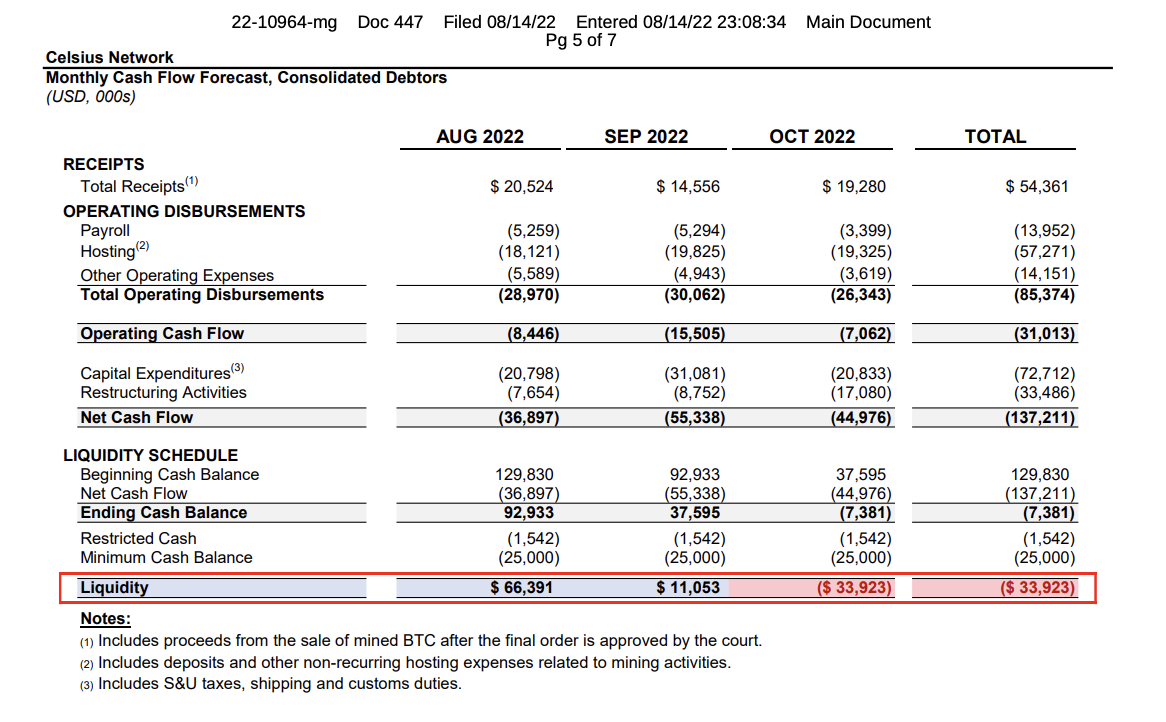
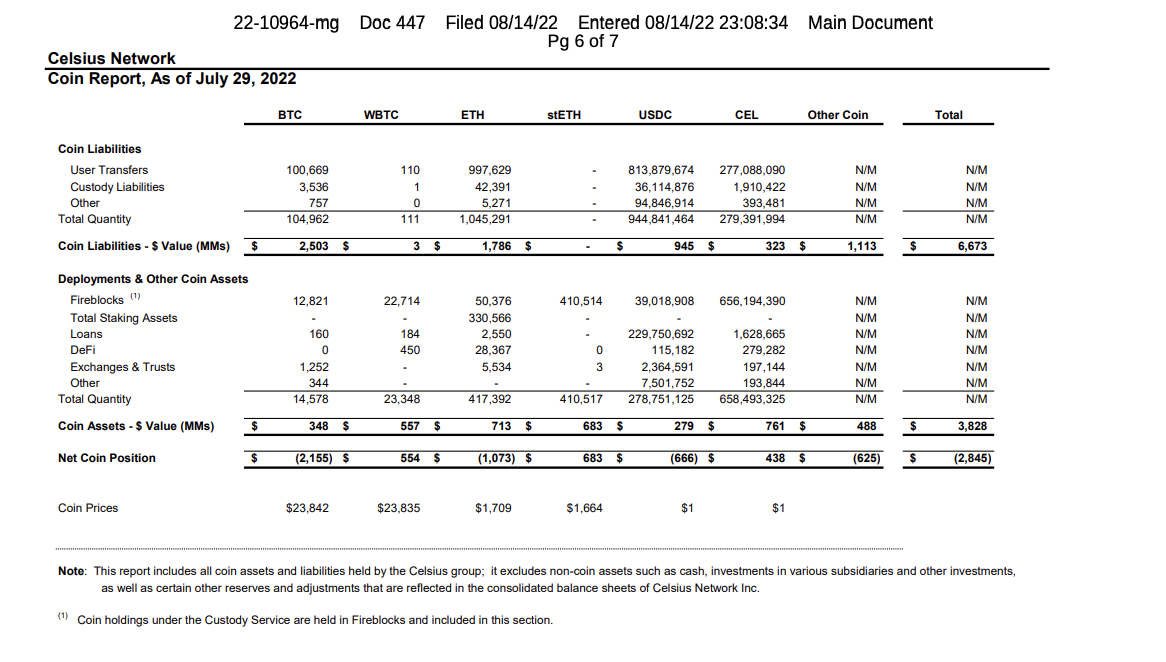
Celsius is finally converting its altcoins to BTC and ETH as it pursues its plan to relaunch with the auction-winning consortium Fahrenheit. [CoinDesk]  

If you have vastly too much time on your hands, here’s the full Celsius Network auction transcript — all 256 pages of it. [Doc 2748, PDF]

Customers of the bankrupt US branch of the Bittrex crypto exchange — which is being sued by the SEC — can withdraw those holdings that are clearly theirs … whatever that means. [CoinDesk]  

Three Arrows Capital: What Su and Kyle did next

Crypto was taken out in 2022 by a one-two punch of Terra-Luna collapsing in May and then crypto hedge fund Three Arrows Capital collapsing in June.

Other crypto firms had invested in Terra-Luna and 3AC because they paid the highest interest rates! Now, you might think that investment firms would know that high interest means high risk.

3AC’s two founders, Su Zhu and Kyle Davies, just shut their office door in Singapore in late May 2022 and skipped the country, leaving their staff to tell investors the bad news.

What did Zhu and Davies do next? They spent the summer traveling around Asia, went surfing, and played video games. Davies is currently in Dubai and Zhu is back living in Singapore. [NYT]

Zhu and Davies insist they must have done nothing wrong because no government has filed charges yet. Uh huh.

3AC’s creditors think Zhu and Davies have done one or two things wrong. Teneo, the liquidator trying to clean up the 3AC mess, wants the pair fined $10,000 a day for contempt, saying that Davies has failed to respond to a subpoena. [CoinDesk]

The pair are suing Mike Dudas, the original founder of crypto media outlet The Block, for defamation. In the US, LOL. They allege Dudas said nasty things about their new crypto venture OPNX, though the suit doesn’t say what allegedly defamatory claims Dudas made. We expect the 3AC boys to have some trouble demonstrating they have a reputation to malign. Stephen Palley is representing Dudas. [CoinDesk]

Regulatory clarity

In the UK, the Financial Services and Markets Bill has passed. One part of this gives the Treasury greater powers to regulate crypto, likely via the Financial Conduct Authority. We should expect more detailed regulations within a year. [CoinDesk]

This comes not before time. UK losses to crypto fraud increased more than 40% to surpass £300 million (USD$373 million), according to Action Fraud, the national reporting center for fraud and cybercrime. [FT

Europe’s MiCA is now law from the end of June 2023. It goes into application in one year for stablecoins and in 18 months for general crypto assets and virtual asset service providers. [EUR-Lex]  

The European Central Bank keeps talking about doing a CBDC. This is good news for crypto! Or maybe it isn’t: [ECB]

Policymakers should be wary of supporting an industry that has so far produced no societal benefits and is increasingly trying to integrate into the traditional financial system, both to acquire legitimacy as part of that system and to piggyback on it.

The CFTC Division of Clearing and Risk sent out a staff advisory to registered derivatives clearing organizations on May 30, reminding them of the risks associated with expanding the scope of their activities. It specifically addressed crypto. [CFTC]

When the CFTC points out that market shenanigans are illegal in crypto just like they are in regular commodities, keep in mind that Avi Eisenberg is finally going to trial for allegedly committing those precise market shenanigans in DeFi. These are real go-to-jail crimes. [Bloomberg; Schedule, PDF; Case docket]  

The Thailand SEC has banned crypto lending that pays returns to investors. It now also requires crypto trading firms to post the following warning: “Cryptocurrencies are high risk. Please study and understand the risks of cryptocurrencies thoroughly. because you may lose the entire amount invested.” [SEC Thailand, in Thai]

New York has settled with CoinEx after suing them in February for failing to register as a securities exchange. The company has to stop operating in the US — not just New York — return $1.1 million to investors, and pay $600,000 in penalties. [NYAG; Stipulation and consent, PDF]

The ETF trick will surely work this time

Guys, guys, the Blackrock and Fidelity bitcoin ETFs will change everything! They’re going to get surveillance of trading and market data from somewhere! This will surely answer all of the SEC’s previous objections to bitcoin ETFs! The market will be delighted!

… oh. The SEC has found these applications inadequate. [WSJ]  

Blackrock and Fidelity are going to try again with Coinbase as the exchange supplying market surveillance. [CoinDesk]  

But the trouble with monitoring at Coinbase is that Coinbase isn’t where the market is — the bitcoin market is at Binance. That’s where price discovery happens.

We expect these ETF applications to go no further than all the previous bitcoin ETF applications.

The good news for bitcoin continues its monotonous patter

Binance senior staff have been jumping ship. General counsel Han Ng, chief strategy officer Patrick Hillmann, and SVP for compliance Steven Christie all resigned this week. They specifically left over CZ’s response to the ongoing Department of Justice investigation. [Fortune]

Binance.US’s market share has dropped to 1%, down from a record 27% in April. Is Binance giving up on its US exchange? The market share nose-dived after the SEC sued Binance in June. [WSJ]  

Fortune favors the internal trading desk: Crypto.com has been caught trading directly against its own customers. Dirty Bubble spotted the job ads for a proprietary trading desk at the firm in November 2022, of course. [FT, archive; Twitter, archive]  

Russia is giving up on the idea of a unified state-run crypto exchange. Instead, it’s focusing on regulation for multiple exchanges. Russia is continuing to promote crypto as a way to evade sanctions for making international payments. When you’ve devastated your economy by embarking upon a very stupid war, that’s … a strategy? [Izvestia, Russian]

In crypto collapse news from the distant past, something’s happened in Quadriga! The government of British Columbia is seeking forfeiture of $600,000 in cash, gold bars, and Rolex watches that QuadrigaCX cofounder Michael Patryn has in a safe deposit box. The RCMP alleges the items are the proceeds of unlawful activity. [Vancouver Sun]

Crypto collapse: Fahrenheit buys Celsius, DCG may be broke, Hong Kong cracks down, Binance commingling, how Bitfinex was hacked

  • By Amy Castor and David Gerard

Temperature drop

Fahrenheit has officially won the bid for the bankrupt Celsius Network’s assets —  pending approval by the court, which is near-certain, and by regulators, which is less so. A $10 million deposit is due by Monday. [Doc 2713, PDF]

Fahrenheit is a consortium that includes VC firm Arrington Capital, miner US Bitcoin, investment firm Proof Group, former Algorand CEO Steven Kokinos, and Seasons Capital CEO Ravi Kaza.

The new deal is an adaptation of the previous NovaWulf proposal. A “NewCo” will be created to take ownership of Celsius’ remaining DeFi tokens, its loan portfolio, its venture capital investments, its bitcoin mining operation, and $500 million in “liquid cryptocurrency” (not specified, but presumably Celsius’ remaining BTC and ETH). US Bitcoin will manage Celsius’ bitcoin mining operation.

Holders of Earn claims, some holders of Convenience claims, Withhold claims, and Borrow claims will receive equity in NewCo, pro rata. NewCo will endeavor to get a public stock exchange listing for the equity. Earn claimants will also get a distribution of the liquid cryptocurrency and any proceeds from litigation.

If you’re a Celsius creditor, the plan contains lots of important details. Read it and discuss this with your fellow creditors.

As with the original NovaWulf proposal, we think this is a Hail Mary pass that can only work if number goes up. On the other hand, it’s doing something and not just liquidating what little remains. Also, Alex Mashinsky won’t be involved.

DCG: When your left pocket can’t pay your right pocket

In the Genesis bankruptcy, Genesis’ parent company Digital Currency Group missed a $630 million payment to Genesis due earlier this month. Note that that’s a payment from themselves to themselves, and they still failed to make it.

This failure to pay was noted by Gemini, which has a tremendous interest in getting that money so Gemini Earn investors can be paid back. Gemini Earn’s retail customers are the largest creditor of Genesis. [Gemini, archive of May 25, 2023]

Gemini Earn was an investment product where Gemini customers put their money into Genesis to earn unlikely interest rates. Gemini’s customers were not so happy at the prospect of their money being stuck in the Genesis bankruptcy for months or years.

So in February, the creditors worked out an “agreement in principle” — not, you’ll note, an actual deal — whereby they would get money back from DCG, as the owners of Genesis. [press release]

In April, the creditors got sick of DCG messing about and upped their demands. This led to a bizarre statement from DCG on May 9 that they were “in discussions with capital providers for growth capital and to refinance its outstanding intercompany obligations with Genesis.” They didn’t have the money to pay themselves. [CoinTelegraph]

Gemini also plans to file a reorganization plan of its own. This is likely why Genesis has filed asking for its exclusive right to make reorganization proposals to be extended to August 27. The court will hear this motion on June 5. [Doc 329, PDF]

Either DCG is trying extremely hard to screw over Genesis customers … or, despite all the millions and billions with dollar signs in front in their accounts, and “$200 million” a year in Grayscale management fees, DCG is broke — at least in actual money — and has been pretending not to be broke. And we’re pretty sure Gemini is pushing this point this hard because they can’t cover their customers either. Imaginary assets are great — until you have to pay up.

Binance is outraged at Reuters catching them out again

Reuters has caught Binance at it again. This time, Binance was commingling customer funds and company revenue on the order of billions of (actual) dollars in their Silvergate accounts in 2020 and 2021. Controls? What are controls? [Reuters]

Binance told Reuters that this was money being used to buy BUSD and this was “exactly the same thing as buying a product from Amazon,” per Brad Jaffe, Binance’s VP of communications since August 2022.

This explanation is at odds with Binance’s previous claims to customers that dollars they sent to Silvergate were “deposits” that they could “withdraw” as dollars. Jaffe said that “the term ‘deposit’ is a communication term, it’s not an indication of the technical treatment of the funds.” Oh, a communication term — you mean like when words mean things in a context?

Reuters didn’t find any misappropriation of customer funds in the documents they saw. But commingling is a massive red flag for incompetence (as it turned out to be with FTX) and fraud — such as moving money around to evade regulatory scrutiny. Reuters includes a complex diagram of the international flows of Binance’s cash in the report.

Binance PR person Patrick Hillmann dismissed the story as “1000 words of conspiracy theories” and said that Reuters was “making stuff up.” Though Hillmann never stated at any point that Binance hadn’t commingled funds at Silvergate. Hillmann also decried “the xenophobia behind consistently mentioning @cz_binance’s ethnicity without noting that he’s been Canadian since the age of 12” … which the Reuters story didn’t do at all. [Twitter, archive]

Hong Kong brings some regulatory clarity

The Hong Kong Securities And Futures Commission (SFC) has finished its consultation on virtual asset trading platforms opening to retail investors. The rules allow licensed exchanges to offer trading to the public in tokens that are highly liquid and are not securities.

The rules are strict — no securities, no lending, no earn programs, no staking, no pro trading, and no custody. Unlicensed crypto exchanges are not allowed to advertise. Hong Kong very much wants to avoid the sort of embarrassment that comes with a large exchange like FTX failing. 

Exchanges will be required to assess the failure risk of all tokens they offer trading in. Tokens are required to have a 12-month track record. Exchanges will need to get smart contract audits where appropriate. 98% of client assets must be in cold wallets (offline); hot wallets must not hold more than 2%.

Margin trading is not yet allowed even for professional investors, but the SFC will issue guidance on derivatives in the future.

The guidelines take effect June 1, which is when exchanges can begin to apply for a license. [SFC; Consultation Conclusions, PDF]

Regulatory clarity around the world

Japan will be enforcing FATF rules on crypto from June. This went through with no objections because Japan learned its lesson from Mt. Gox and regulated crypto exchanges early. [Japan Today]

FATF tells CoinDesk that it didn’t actually demand that Pakistan not legalize crypto. “Countries are permitted, but not required, to prohibit virtual assets and virtual asset service providers.” [CoinDesk]

The International Organization of Securities Commissions is putting together recommendations on crypto. Service providers need to address conflicts of interest, separation of functions, and accounting client assets, and this has to work across borders. Get your comments in by July 31. [IOSCO, PDF; recommendations, PDF]

Huobi gets kicked out of Malaysia for failure to register. Not registering is a violation of Malaysia’s Capital Markets and Services Act of 2007. The Securities Commission Malaysia said Huobi has to disable its website and mobile apps on platforms including the Apple Store and Google Play.  [Securities Commission Malaysia]  

The CFTC is talking about all the fraud in crypto, says it’s on good working terms with the SEC on these matters, and warns the crypto industry that it’s not going to be a soft touch. [Reuters

The SEC has changed the disclaimer that commissioners say before speeches — probably in response to William Hinman’s comments saying ether wasn’t a security being cited in the Ripple case. [blog post]

Molly White put up Rep. Sean Casten (D-IL) questions at May 18, 2023, stablecoin hearing, and it’s a lovely five minutes. This guy understands precisely how Web3 was fundamentally a venture capital-funded securities fraud. [YouTube]

Bitfinex: whoops, apocalypse

The Organized Crime and Corruption Reporting Project obtained an internal report on the August 2016 hack of the Bitfinex crypto exchange — the hack that led to the Tether printer going wild and the 2017 crypto bubble.

The report was commissioned by iFinex and prepared by Ledger Labs. It was never released, but OCCRP has obtained a draft.

Bitfinex kept transaction limits secured by three keys. It looks like someone made the mistake of putting two of the three keys on the same device. This is how the hacker was able to raise the global daily limit and drain the accounts.

One key was associated with a generic “admin” email address and another linked to “giancarlo,” which belonged to Bitfinex CFO Giancarlo Devasini. The report does not blame Devasini for the hack.

Ledger Labs thinks the hacker came in from an IP address in Poland. [OCCRP]

Tether’s issuance is up — but its usage is through the floor. The trading volume is at its lowest in four years. Most of the tether trading happens on Binance, which is where the majority of all trading volume happens, and where USDT is accepted as being worth a dollar. We mentioned last time that volume was down, but Kaiko has the numbers. [Kaiko]

More good news for bitcoin

Do Kwon’s bail has been scrapped. He’s back in jail in Montenegro, awaiting his local trial on charges of forging documents, specifically the ones he was using to try to get out of Montenegro to his next bolt-hole. [Reuters]  

Glassnode tells us that hodling has never been more popular! 68.1% of BTC hasn’t moved in the past year! Now, you might think that this is because most people who bought in during the bubble are still underwater. But “baghodler” isn’t yet a word. [Glassnode]

Shaquille O’Neal was finally served in the FTX class action suit against the exchange’s celebrity promoters — at the former FTX Arena. [Washington Post

Openfort is scraping up the very last of the Web3 gaming venture cash — they just got $3 million to do an online crypto wallet for blockchain games. You know, that gigantic current market that anyone has the slightest interest in. Openfort doesn’t appear to have a customer as yet. [VentureBeat]

Coinbase has a new TV ad! We know you lost all your money — but crypto is like the early Internet, really. [Youtube]

Solana is so thoroughly out of ideas that they’re adding a ChatGPT plugin. Presumably, it can write tweets for them. [The Block]

Crypto fans make up new justifications for the importance of their magic beans all the time. David Rosenthal takes us through a few. [DSHR Blog

Video: The problems with Crypto Currency. Max Silverman wanted to do an animation, so asked David for 90 seconds of audio. It came out great! [YouTube]

Crypto collapse: No cashing out from Binance US, Catherine Coley lawyers up, Voyager-Binance deal on hold, Celsius

  • By Amy Castor and David Gerard

“Unless they allow crypto crime, all the innovation in crime is going to go overseas, and we’ll fall behind in crime!”

Doctor Orrery

Binance: This is fine

Your actual money has been locked in Binance US since late March: [Binance.US, archive

“Due to recent developments in the banking industry, Binance.US is transitioning to new banking and payment service providers over the next several weeks. Some USD deposit services will be temporarily impacted during the transition. Apple Pay and Google Pay deposits are temporarily unavailable. Wire deposits and withdrawals are temporarily unavailable. For <5% of customers, Debit Card deposits are temporarily unavailable. We are working to restore all services as soon as possible.”

BUSD trading pairs on Binance US are also suspended, and fiat withdrawals for institutional clients are cut off as well. [Twitter

Catherine Coley has shown up alive and well! Coley was the CEO of Binance US until April 2021, when she abruptly left the company. Coley hasn’t said a word to the press or social media since — to the point where crypto people wondered what had happened to her. In the wake of the CFTC suit against Binance, Coley has finally surfaced. She’s hired Sullivan & Cromwell partner James McDonald, a former director of enforcement at the CFTC, for the suit. Coley appears to have started working with McDonald as early as January 2022. [Reuters]

The Australian Securities and Investments Commission (ASIC) is conducting a “targeted review” of Binance’s Australian operation. Oztures Trading misclassified about 500 Australian retail investors as wholesale operators and sold them derivatives that were only for sophisticated investors. [AFR]

“Crypto warning: AK-47s, crooks, and the exchange Aussies should avoid” — David was quoted by news.com.au on the CFTC charges against Binance. “Regulators should also kick the company out of the banking system, cryptocurrency expert David Gerard said.” This story came out exactly as David had hoped it would. (Written by the other guy who originally started Rocknerd. We’re all in the rock journalist to finance journalist pipeline.) [Daily Telegraph, archive]

Voyager’s Binance deal is on hold

Voyager Digital wanted to sell itself to Binance US. The plan included an exculpation clause — that Voyager, the Unsecured Creditors’ Committee, Binance, and any professionals were not “liable at any time for the violation of any applicable law, rule, or regulation governing the solicitation of acceptances or rejections of the Plan or such distributions made pursuant to the Plan.” They wanted this bankruptcy court to grant them broad criminal immunity.

The US government and various regulators objected, and the February 28 version of the plan explicitly carved government action out of the exculpation provision. But the exculpation crept back into the March 2 version of the plan. The government and the regulators objected again, leading to this appeal. This time they are asking that the provision be removed, or else that the whole deal be blocked — at which point Voyager can only go into liquidation.

Judge Jennifer Rearden concurs with the government that exculpation is meant to head off suits between stakeholders in the bankruptcy itself — it’s not there for courts to “prospectively immunize debtors and non-debtors from law enforcement and other actions undertaken by the Government.” As such, she considered the appeal plausible, so has granted the stay. That said, Judge Rearden is painfully aware that Voyager is a melting ice cube, so she wants the government brief by April 4 (today!) and the Voyager and UCC briefs by April 14.

We wonder just what snakes are lurking in the deal such that Voyager and Binance tried to sneak in such a weirdly broad exculpation after it was already knocked back once. [Order & opinion, PDF]

Celsius Network

With less than an hour to go before Celsius’s exclusive right to propose a plan lapsed, Kirkland & Ellis filed the Celsius chapter 11 plan for the NovaWulf deal, which we summarized previously. On April 12, Celsius will file the disclosure statement, which the court has to approve before creditors can vote on the plan. The disclosure statement lists Celsius’ assets, liabilities, and business affairs. [Doc 2358, PDF; Plan summary, PDF]

Shoba Pillay, the examiner in the Celsius bankruptcy, has filed nicely hyperlinked PDFs of her interim and final examiner reports. [Interim report, PDF; final report, PDF]

Pillay’s work is done now. She’s been officially discharged. [Doc 2364, PDF]

Based on the jaw-dropping criminality in the examiner’s reports, the Celsius Unsecured Creditors’ Committee filed a suit on February 14 against past Celsius executives to recover as much money from them as possible. The UCC has now filed a revised complaint. The new filing includes a redline against the previous version of the complaint, starting at page 139 of the PDF — it mainly adds two extra claims of misappropriation. [Doc 2349, PDF]

Good news for casinos

Matt Damon says his crypto.com ad at the 2022 Super Bowl was just because his water nonprofit was short of cash. If only there was a way to do good except by doing a ton of bad! [Gizmodo]

BaFin has lifted a finger and kicked Crypto.com out of Germany. The Singapore exchange was licensed in Malta and wanted to use that license in Germany. But Germany also required that they get a permit to advertise the investment offer, which Crypto.com didn’t bother doing. [The Paypers]

The Bittrex crypto exchange is leaving the US market. The only reason they give is that “regulatory requirements are often unclear and enforced without appropriate discussion or input, resulting in an uneven competitive landscape.” [Bittrex, archive; The Block

We suspect the regulations Bittrex has in mind are very clear, and they just couldn’t survive with a legal business model. Bittrex’s volume dropped below 1% of the US market in 2021 and didn’t recover. Last year, they paid $53 million to OFAC and FinCEN for sanctions violations. [Treasury, 2022]

FTX EU LTD (Cyprus) launched a new website for withdrawals. The exchange will be returning funds on account to customers, per Cyprus law. This does not cover all EU customers — just those who were dealing with this particular FTX entity. [PR Newswire; FTX EU]

Paxful, a peer-to-peer bitcoin trading platform, is suspending operations. Paxful claims “regulatory challenges for the industry”— but also that “we unfortunately have had some key staff departures.” Did they depart in a police van, maybe?  [Paxful, archive]

Lost all your money in a dodgy crypto company? Why not trade your bankruptcy claims on a new exchange run by the guys who lost all your money! Brought to you by the founders of the defunct Three Arrows Capital and the troubled CoinFLEX, OPNX is currently only doing spot trading in cryptos but promises to bring trading in bankruptcy claims some time soon. None of the proprietors are in any way on the run and hiding out from regulators, you understand — but they’re all just doing business strictly from Dubai for now. Your lack of funds is safe. [CoinDesk]

The usual good news for bitcoin 

The US government sold 9,861 BTC connected to Silk Road, the first darknet market, on March 14. It intends to sell another 41,490 BTC in four batches over the course of a year. Tether coincidentally printed 2 billion USDT the same day — though the government will only accept real money. [Court filing, PDF; Twitter]

A South Korean court has once again denied the prosecutor’s request to issue an arrest warrant for Terraform Labs co-founder Daniel Shin. This was the second attempt made by South Korean authorities to arrest Shin following the arrest of Do Kwon, Terraform’s other co-founder. [Cointelegraph]

The Seoul Southern District Prosecutor’s Office has confiscated 210 billion KRW ($160 million) in assets — primarily real estate — from eight people connected to Terraform Labs, including Shin and former Terraform vice president Kim Mo. [KBS, in Korean]

Justin Sun of Tron turns out not to be Grenada’s ambassador to the World Trade Organization — he was kicked out when the new administration came in June 2022. So for the past nine months, the “H. E.” in his Twitter name must just have stood for something other than “His Excellency.” After the local news story reporting this came out, Sun first told The Block that he was totally still the ambassador — then tweeted how his term was actually ending as of March 31, 2023, y’see. OK. [GBN; The Block; Twitter]

Crypto collapse: New Sam Bankman-Fried charges, New York targets CoinEx, Coinbase losses, Voyager, Celsius

  • By Amy Castor and David Gerard

“Sam Bankman-Fried walks into the courtroom. his pants split with a sound like thunder and guns and cocaine spill out all over the floor. he spins around and punches a security officer hard in the face sending him flying. he turns, sits down calmly on his chair and says, to thunderous applause from the fans gathered to hear his famous catchphrase, ‘OK your honour, here’s what I think happened’”

— Hammerite

Mycrimes.txt (2) (FINAL) (USE THIS ONE).docx.pdf

The criminal indictment against Sam Bankman-Fried has been updated, with a superseding indictment on February 23. [Superseding indictment, PDF]

The new charges are clearly informed by the cooperation of Sam’s former co-conspirators — and by his crime confession tours in the press and on Twitter.

The Federal Election Commission is now listed as a victim of Sam’s fraud, with allegations that SBF tried to buy influence over crypto regulation in Washington. 

The indictment details all the tricks that Sam (allegedly) pulled to influence both Democrats and Republicans, in concert with other FTX executives — and how he tried to conceal his influence.

Other new allegations include bank fraud. The act of misleading a bank in the course of business is a crime all by itself — such as when you accept money in the name of one entity (Alameda) for another entity (FTX), or when you set up a shell corporation (North Dimension) and lie to your bank (Silvergate) about what that shell does.

Sam also used Alameda to fill a $45 million hole in FTX US. He gave Alameda a $65 billion credit line, which allowed it unlimited access to customer funds on FTX. Customer and company funds were thoroughly commingled. 

The indictment doesn’t specify the cause of the hole in FTX US, but Sam has repeatedly claimed that FTX US was solvent. 

Sam ultimately controlled both FTX and Alameda, even after claiming to have stepped away from Alameda.

The indictment also lists billions of dollars worth of assets that have been forfeited, including multiple SBF accounts at Binance.

FTX and its subsidiaries was never a legitimate business. It was Sam’s piggy bank. 

New York goes after CoinEx

The New York Attorney General’s office is suing the CoinEx crypto exchange. The NYAG alleges that CoinEx sold securities and/or commodities, did not register with the CFTC or SEC, and misrepresented itself as registered. [Press release; Complaint, PDF; Affidavit of OAG Detective Brian Metz, PDF]

CoinEx, which is based in Hong Kong, has responded by barring all US citizens. You have until April 24 to get your cryptos off the exchange. [Twitter]

New York alleges that CoinEx offered to New York customers various cryptos that are securities — AMP, LUNA, RLY, and LBC  — while the exchange was not registered to deal in securities.

AMP is the token of Flexa, who want to use it to sell burritos. LBC is the token of video site LBRY, which the SEC recently had a slam-dunk win against in court, finding that it was absolutely the security it clearly was. Luna is the twin coin of TerraUSD, which crashed all of crypto last May.

New York says these tokens are all securities under New York’s Waldstein test: “any form of instrument used for the purpose of financing and promoting enterprises, and which is designed for investment, is a security.” They say the tokens are also securities under the federal Howey test — as LBC was recently shown to be.

It happens to be a violation of New York commercial law to call yourself an “exchange” if you offer trading in securities or commodities and you’re not registered with the CFTC or SEC.

CoinEx also failed to respond in any way to a previous NYAG subpoena — and, per General Business Law §353(1), failure to comply with a subpoena is prima facie proof that the subpoenaed entity “is or has been engaged in fraudulent practice.” 

New York wants CoinEx to block New York from its website, pay restitution, disgorgement, and costs, “and provide New York investors with the option to rescind their transactions.”

New York is bringing a “special proceeding” — it wants the court to rule on its filing. “A special proceeding goes right to the merits. The Court is required to make a summary determination upon all the pleadings, papers, and admissions to the extent that no triable issues of fact are raised.”

Why did New York go after CoinEx in particular? This complaint is detailed, but it also looks like a template. We suspect this may be the first of many such complaints against crypto platforms. CoinEx ignoring the subpoena probably annoyed New York a lot too.

The SEC previously called out each of the tokens on CoinEx that the NYAG names as securities:

  • In a July 2022 insider trading complaint against Coinbase, the SEC said AMP and RLY were securities. [Complaint, pdf
  • In Feb 2023, the SEC said LUNA was a security [Complaint, pdf]
  • In November 2022, the SEC won in court against LBRY on whether its LBC token was an unregistered security offering. [SEC]

Binance US has delisted AMP. But Coinbase still lists AMP and RLY. Gary Gensler has been saying for a while that he thinks nearly all crypto tokens are securities and that Coinbase should register with the SEC.

Coinbase posts another loss

Coinbase’s Q4 earnings report is out, as part of its 10-K annual report for the year ending December 31, 2022. Trading volumes are down even further, and they’re still losing money. [10-K]

As a public company, Coinbase has to put on a happy face for investors — but they’ve been bleeding money for a year now. Net loss for 2022 was $2.625 billion, per GAAP. The COIN stock price has gone down 70% in the past 12 months.

Coinbase would prefer you to look at non-GAAP “adjusted EBITDA,” which comes out to a loss of only $371.4 million. Their “adjusted EBITDA” excludes stock-based compensation expenses in particular. Yes, we’re sure your numbers look better if you exclude the bit where you have to pay your employees.

Coinbase makes its money from (1) BTC and ETH trading, and (2) their share of the interest on the USDC reserve. Also, the majority of their volume comes from a few large customers. So Coinbase would extremely much like to diversify.

CFO Alesia Haas said in the investor earnings call: “Our fourth quarter net revenue increased 5% quarter-over-quarter to $605 million. This was driven by strong growth in our subscription and services revenue.” She means that Q4 revenue was only up because of interest on USDC. [Coinbase, PDF]

Coinbase wants to list every token going — even as many of the hottest tokens are blitheringly obviously securities under the Howey test. Coinbase has spent the past several years helping their very good venture capital friends such as a16z dump their bags on retail.

Coinbase goes on at length about the amazing ambiguity in what constitutes a security under US law. Who can even know what might be deemed a security tomorrow? It is a mystery.

Sure, the Howey test is simple and broad, and sure the SEC has won every case it’s ever brought where it claimed a given crypto was a security. But do you feel lucky?

The 10-K even includes a list of tokens Coinbase trades that the SEC has already said are securities! Coinbase questions whether these tokens are really securities, and confidently asserts that “Despite the SEC being the principal federal securities law regulator in the United States, whether or not an asset is a security under federal securities laws is ultimately determined by a federal court.”

This is true. But it’s also true that the SEC has won every single time. And the consent orders in these cases — because almost nobody was stupid enough to take their case to trial — note that the tokens in question were always offerings of securities. It wasn’t a court finding that made the token a security.

But Coinbase is desperate to diversify and makes it clear that they really want to risk their backsides on this business line of maybe-securities that don’t even make them a lot of money.

The SEC shut down Coinbase’s Earn staking product in 2022 before it could be launched. Haas explained in the analyst call why Coinbase thinks its staking product isn’t a security: “we are passing on rewards directly from the protocol. We are not establishing an APY, we are not establishing the reward rate. That is established at the protocol level. And then we are passing that through and collecting a fixed commission on that amount.” We guess we’ll see if the SEC concurs. [Coinbase, PDF]

Coinbase literally lists Satoshi Nakamoto as a risk factor for its business:

“the identification of Satoshi Nakamoto, the pseudonymous person or persons who developed Bitcoin, or the transfer of Satoshi’s Bitcoins”

The FTX fallout continues

FTX Japan K.K. users are getting back 100% of their cryptos. Users in other jurisdictions are likely to get cents on the dollar, if that. This is because the US crypto lobby viciously fought any sensible regulation for years — but Japan locked crypto down hard after Mt. Gox exploded in 2014. Taste the freedom! [Bloomberg]

Galois Capital, a real-money hedge fund that thought they’d get into some crypto, shuts its doors after losing $40 million, half its assets, in the collapse of FTX. Whoops! [Twitter, FT, archive]

The Bank for International Settlements — the central bank for central banks — reports that the fall of FTX didn’t have much impact on the rest of the financial world: [BIS bulletin, PDF, Coindesk

“Nevertheless, despite crypto’s large user base and the substantial losses to many investors, the market turmoil in 2022 had little discernible impact on broader financial conditions outside the crypto universe, underlining the largely self-referential nature of crypto as an asset class.”

Regulatory clarity

Caitlin Long’s Custodia Bank was refused an account at the Kansas Fed. Custodia appealed the decision. The Federal Reserve Board has looked at Custodia’s appeal and told them to go away. [Federal Reserve]

We’ve mentioned previously that the Canadian Securities Administrators (CSA) is introducing new rules for crypto exchange registration in the wake of the collapse of FTX. The new regulations, which will apply in all provinces, have been released:

  • Customer cryptos will need to be segregated into an address per customer.
  • Exchanges cannot pledge or rehypothecate customer cryptos. Margin trading is forbidden.
  • Proprietary tokens — in-house supermarket loyalty card points, in the manner of FTT or BNB — require prior written consent and can’t be counted as an asset in your accounts.
  • No stablecoin dealing without prior written consent.

These apply to any exchange with Canadian customers, including non-Canadian exchanges. [Press release; OSC, PDF]

The Financial Action Task Force, the multi-country advisory group set up to combat money laundering, is not happy that its rules on crypto traceability, such as the travel rule, have not been implemented sufficiently widely. At the FATF Plenary on February 22-24, “delegates further agreed on an action plan to drive timely global implementation of FATF standards relating to virtual assets.” [FATF]

The International Monetary Fund has put out a paper, “Elements of Effective Policies for Crypto Assets,” with guidelines that any country that ever might want to hit up the IMF for a loan would be well advised to follow — “amid the failure of various exchanges and other actors within the crypto ecosystem, as well as the collapse of certain crypto assets. Doing nothing is untenable as crypto assets may continue to evolve despite the current downturn.” [Press release; paper, PDF]

Hong Kong’s Securities and Futures Commission is consulting on licensing requirements for crypto exchanges to be allowed to sell to retail customers. Hong Kong wants safe custody of customer cryptos — they’re not demanding third-party custodians, an arms-length subsidiary will be sufficient — KYC, cybersecurity, accounting and auditing, risk management, AML, and prevention of market misconduct. So, the very basic requirements of being a financial institution. Responses should be in by March 31. [SFC; SFC, PDF]

In the US, the SEC got a lot of stick for not going after crypto harder in the bubble. Then it came out that the Blockchain Eight group of representatives had written to Gary Gensler telling him to back off. Now the legislature has demanded action, and Gensler is delivering. Here’s how the Blockchain Eight got the opposite of what they wanted. [The American Prospect]

“Gensler also made clear that he has been grappling with the same question as many of the rest of us: What, exactly, is the point of crypto?” [Intelligencer]

John Naughton on the latest UK Treasury crypto consultation paper. “The second lesson is that permissionless blockchains can never be allowed within the financial services sector.” [Guardian]

Voyager Digital

97% of Voyager creditors have voted for Binance to buy Voyager Digital! We think it’s unlikely that regulators will let the deal go through, and Binance US doesn’t have the money to cover all those liabilities to Voyager customers — but hey, who knows? [CoinDesk]

FTX in Chapter 11 is suing Voyager Digital in Chapter 11 for the return of a loan that Alameda paid back to Voyager just before it went into bankruptcy protection. FTX, Voyager and both companies’ Unsecured Creditors’ Committees have come to a settlement! An ad-hoc group of Voyager creditors objects to the deal. [Doc 1048, PDF; Doc 1084, PDF]

The Voyager UCC has subpoenaed the ex-top brass of FTX for depositions — Caroline Ellison, Gary Wang, Sam Bankman-Fried, Sam Trabucco, and Daniel Friedberg. The notices to the court don’t detail what the UCC wants to ask — just that they are asking. Voyager’s link to FTX is the huge pile of FTT that the company counted as part of its assets. [e.g., Doc 1018, PDF]

SBF’s lawyers have already moved that the subpoena was deficient because it was handed to Sam’s mom Barbara Fried and not into Sam’s own hands personally. [Doc, PDF]

Celsius Network and your pension

Caisse de Dépôt et Placement du Québec (CDPQ) was the pension fund that invested USD$150 million into equity in Celsius Network. Executive vice-president and CTO Alexandre Synnett, who was the executive involved in the Celsius investment, “left the organization on his own volition about two weeks ago,” said CEO Charles Emond in the 2022 earnings call. CDPQ will not be touching crypto going forward. [BetaKit; The Logic, paywalled]

Other good news for bitcoin

Bitcoin miners are diversifying because mining is sucking as a business. Riot Blockchain has changed its name to Riot Platforms. [Coindesk]

Crypto firm Phoenix Community Capital and its founder Luke Sullivan, with links to various UK parliamentary groups, appears to have vanished. Some of the firm’s assets and its name appear to have been sold to a new company run by an individual called “Dan,” who has told investors it has no obligation towards them. [Guardian]

Data Finnovation, who took out BUSD, now looks into weird bridging on Tether. [Medium

Image: Coinbase CEO Brian Armstrong is being patted down with a makeup sponge as a big green screen looms behind him. Fortune

Crypto collapse: Binance USD shut down, Celsius insiders sued, Paxos, Voyager, FTX

  • By Amy Castor and David Gerard

“somethings are better left unsaid. Recommend no more news like these, for the sake of the people, our industry (and your business)”

— Changpeng Zhao, Binance

Binance USD shuts down — party like it’s 2008

Binance USD (BUSD) is a $16 billion stablecoin — an Ethereum ERC20 token — issued by New York-based Paxos. It’s backed by actual dollars in bank accounts.

There’s also a version of BUSD on the Binance BNB Blockchain, bridged from Ethereum. Sometimes the Binance-peg BUSD is fully backed by Paxos BUSD! Other times, it isn’t.

Both the SEC and the New York Department of Financial Services have acted against Paxos and its issuance of BUSD.

The NYDFS has told Paxos to cease issuing BUSD — so there will be no new BUSD after February 21. Paxos has told customers it will proceed with orderly redemptions, as long as they have proper KYC. In its consumer alert, the NYDFS wrote: [WSJ, paywalled; NYDFS; Paxos; PR Newswire]

DFS has ordered Paxos to cease minting Paxos-issued BUSD as a result of several unresolved issues related to Paxos’ oversight of its relationship with Binance in regard to Paxos-issued BUSD.

… It is important to note that the Department authorized Paxos to issue BUSD on the Ethereum blockchain. The Department has not authorized Binance-Peg BUSD on any blockchain, and Binance-Peg BUSD is not issued by Paxos.

The SEC has sent Paxos a Wells Notice alleging that BUSD is an unregistered security. Paxos issued a statement saying it disagrees and is prepared to “vigorously litigate if necessary.” Of course, Paxos is already stopping issuing new BUSD. [WSJ, paywalled; Paxos]

A Wells Notice is a heads-up that an enforcement action is very close to coming your way. Paxos can respond with a Wells Submission — where they try to convince the SEC not to sue them — but we doubt they will because any response would be public. More likely, Paxos will negotiate a settlement.

We don’t know the SEC’s precise issue with BUSD because Paxos hasn’t released the Wells Notice, and the SEC hasn’t filed a complaint yet. But we can make a few educated guesses:

  • Paxos-issued BUSD is not an “investment contract,” per the Howey test, because there is no expectation of profit. But an investment contract is only a subset of securities. Paxos BUSD is more akin to a “note” — a promise to pay a specified sum — which is presumptively a security, especially since it can be traded. The correct test for a note is the Reves Test. [Justia]
  • Dollar-backed stablecoins resemble unregistered money market funds. MMFs are also regulated by the SEC.
  • The SEC may not like Paxos’ relationship with Binance, who do all manner of security-like things with BUSD.  
  • The process of creating a liquid tradeable instrument from a less liquid one is called “securitization.” So Binance peg BUSD, as a more liquid form of Paxos BUSD, is likely a security.
  • The SEC may also be taking aim at Binance through Paxos. Binance auto-converts all other stablecoins  — and incoming actual dollars — to BUSD. So if you have 1 USDC on the Binance exchange, Binance will automatically convert that to 1 BUSD. This makes the BUSD more liquid.

Now that Paxos has stopped issuing BUSD, Binance will have to find another stablecoin to auto-convert to, probably Tether. Coincidentally, Tether just minted another billion USDT. [Twitter]

The BUSD price is still very close to $1. But the Binance exchange has had a surge in withdrawals — $831 million net outflows in 24 hours — and the price of Binance’s free-floating BNB token has crashed. [Coindesk; Twitter]

What does all this mean for Binance? The US has already cut off Binance’s banking by forcing Silvergate and Signature to cut ties with the exchange. Europe and other jurisdictions have done the same. Binance can’t get access to actual dollars, and now it can’t get access to dollars via BUSD either.

Frances Coppola and Dirty Bubble have excellent posts on Binance and its stablecoins. [Coppola Comment; Dirty Bubble]

Fox News reporter Eleanor Terrett posted a rumor on February 14 that the SEC had issued Wells notices to other US stablecoin companies including Circle — ordering them to cease and desist sales of unregistered securities. This turns out not to have been the case! As yet, anyway. [Twitter, archive; Twitter, Twitter]

Celsius and creditors sue the insiders

Based on the jaw-dropping criminality revealed in the examiner’s report, Celsius Network and the Unsecured Creditors’ Committee have filed suit against past executives of Celsius to recover as much money from them as possible. [Doc 2054, PDF]

Celsius and the UCC are suing co-founders Alex Mashinsky, Daniel Leon, and Hanoch “Nuke” Goldstein; former CFO Harumi Urata-Thompson; former general counsel Jeremie Beaudry; former head of trading Johannes Treutler; former vice-president of lending Aliza Landes, who is also Daniel Leon’s wife; and Kristine Mashinsky, wife of Alex.

The suit itself starts on page 25 of the PDF. Most of the complaint reiterates the events detailed in the examiner’s report. The claims are:

  • breach of fiduciary duty (Celsius was insolvent);
  • breach of fiduciary duty of loyalty (CEL price manipulations, KeyFi purchase, not avoiding conflicts of interest);
  • breach of the director’s duties to exercise independent judgment (multiple failures to act);
  • preferential and fraudulent transfers from July 2021 to May 2022 (insider withdrawals — full list in Exhibit A, PDF page 149).

The plaintiffs ask for actual and punitive damages.

Celsius: Hang on lads, I’ve got a great idea!

Meanwhile, Celsius has a recovery plan! We outlined the various recovery proposals previously. Celsius and the UCC have picked the NovaWulf plan — transfer substantially all assets and businesses to a NewCo, 100% owned by the creditors, and issue SEC-compliant “revenue share tokens.” NovaWulf will contribute $45 million to $55 million in actual cash and manage the company. [Doc 2066, PDF]

The shares will be tokens, but the share issuance has to pass SEC registration. It’s just an ordinary equity stock. But it’ll run on a blockchain, apparently.

“Earn” creditors with claims below $5,000 get liquid crypto (BTC, ETH, and USDC) up to about 70% of their claim.

Other Earn creditors will get liquid crypto and equity in NewCo, which will own illiquid crypto, mining, retail and institutional loans, and other assets. The NewCo will actively seek out new business.

The large Earn creditors will also get an interest in a “well-funded litigation trust” to “vigorously pursue designated litigation claims against certain former insiders of Celsius and other third parties.” (See above.)

Insider CEL claims get zero; outsider CEL claims get $0.20 per CEL.

NovaWulf Digital Management has previously provided services for bitcoin mining (TeraWulf and Marathon). For their $45 million, NovaWulf get … to manage NewCo? There are some Management Share Tokens in the plan.

We think this looks a bit speculative and hopeful. It’s not clear that it’s better than just liquidating. But at least it’s a plan? Celsius creditors large and small seem to be very receptive to hope right now.

FTX examiner denied; Sam’s sportsball shenanigans

In the FTX bankruptcy, Judge Michael Dorsey has denied the US Trustee’s motion to appoint an examiner. It would cost too much time and money: “I have no doubt that the appointment of an examiner would not be in the best interest of the creditors,” he said. “Every dollar spent in these cases on administrative expenses is one dollar less to the creditors.” He thinks John Jay Ray III is sufficiently independent of the previous management’s malfeasance to investigate what happened here just fine. [The Block]

In the FTX criminal case, Judge Lewis Kaplan has ordered the names of Sam Bankman-Fried’s two additional bail bond co-signers to be unsealed. Both are from Stanford. The signer for $200,000 is Andreas Paepcke, a senior research scientist at Stanford University. The signer for $500,000 is Larry Kramer, the former dean of Stanford Law School, and a close friend of Sam’s parents. Neither has had to put in any actual cash as yet. [Bloomberg]

Prosecutors are not happy that Sam has been using a VPN to access the internet. Sam’s lawyers say he used the VPN to access his NFL Game Pass subscription to watch the AFC and NFC championship games, as well as the Super Bowl. We flatly don’t believe that Sam has the faintest interest in any variety of sportsball. [Doc 66, PDF, Coindesk; Bloomberg]

FTX gave $400 million to obscure hedge fund Modulo Capital. The money is currently sitting in a JPMorgan account. JPMorgan was Modulo’s prime broker, handling its stocks and stock futures. In November, the holdings were converted to cash. It’s unclear why federal prosecutors haven’t seized the funds yet. [NYT]

Daniel Friedberg, the former FTX chief regulatory officer, was also a George Santos donor. Truly a fitting donor. [Seattle Times]

Patrick McHenry (R-NC) and Bill Huizenga (R-MI) from the House Financial Services Committee have questions for the SEC about the arrest of SBF. He was arrested the night before he was supposed to testify before the Committee, on charges that the SEC had a part in authorizing. “The timing of the charges and his arrest raise serious questions about the SEC’s process and cooperation with the Department of Justice.” Was the SEC conspiring to get Sam arrested? Huge if true. [Financial Services, PDF]

Voyager Special Committee [redacted]

In Voyager, the Special Committee of the Board of Directors of Voyager LLC has produced an Investigation Report, conducted by Quinn Emanuel Urquhart & Sullivan, which has been filed in redacted form. [Doc 1000, PDF]

Judge Michael Wiles let the company redact the document for privileged information and attorney-client work product, and the Voyager UCC was okay with this. So the executive summary states the report’s conclusion as:

Upon consideration of the factual record developed over the course of the Investigation and research and analysis of relevant legal theories, Quinn Emanuel has concluded [rest of paragraph redacted]

In summary: Voyager, and crypto itself, were both just too good and pretty for such fragile beauty to survive macroeconomic factors and “severe industry headwinds.” Also, a quarter of Voyager’s loan book was an entirely unsecured loan to 3AC. Blame them, they screwed everyone! It is not our fault that we were making blitheringly stupid loans while number was going up — our Risk Committee was only “kind of” formalized. It’s definitely not worth suing the directors or officers, okay?

The report’s entire “CONCLUSIONS AND RECOMMENDATIONS” section is redacted.

Furthermore, [redacted] [redacted] [redacted]

More good news for bitcoin

The trouble with an 18% interest rate is that anything offering those sort of returns in the real world is a Ponzi scheme, and the company offering 18% will go broke and you’ll lose all your money. Celsius and Voyager investors are discovering the other problem — you have to pay tax on that 18% interest, even if the company is in chapter 11 and you can’t get your money out. [Bloomberg]

The Bank of Lithuania has shut down another payment processor, Payrnet UAB — which used to issue credit cards for various crypto companies, including Crypto.com. [Twitter]

Paul Grewal, chief legal officer at Coinbase, argues that none of the prongs of the Howey test of whether a financial product is a security apply to Coinbase’s staking product, which takes money from customers and gives them a return on it. Oookay. [Coinbase, archive]

Every crypto ATM in the UK has been illegal since the FCA refused to license any of the operators in March 2022 and told them to shut down or else. Police, working with the FCA, are finally raiding the operators. [Guardian]

Image: Paxos hosted a party with synchronized swimmers at the Versace Mansion at Bitcoin 2022 in Miami. James Jackman for WSJ.

Celsius Network: Final report from the examiner — lies, incompetence and Ponzi schemes

We just wrote up the final examiner report for Celsius. This ended up being a 3,000-word post, mainly because the report was loaded with comedy gold. You can read our full analysis on David’s blog. [David Gerard]

Celsius was not just fraudulent. It was an utterly incompetent investment business. Here’s what we cover:

  • History of a scam, how Celsius started.
  • CEL and the flywheel — Celsius’s main business was pumping CEL.
  • Mashinsky knowingly and repeatedly lied to customers.
  • The examiner doesn’t outright say that Celsius operated as a Ponzi, but she demonstrates that it did.  
  • Mashinsky was a horrible investor. Celsius invested 30% of its assets in GBTC just a few months before GBTC started trading at a permanent discount to NAV. He totally missed the boat on that one. 
  • Celsius used Quickbooks for its accounting, just like FTX.
  • We fully expect Mashinsky to be indicted soon. 

Crypto collapse: Binance is not so fine, FTX Delaware vs FTX Bahamas, Celsius, Voyager, Gemini, Tether

due to a mistake in the internal reporting system, it didn’t tell him that he’d taken all the customers’ money and given it to his hedge fund to gamble with

— Qwertycoatl on SomethingAwful

When your auditor quits, that’s bad

Binance is broke. It’s got the same problem as the rest of crypto — the assets are imaginary, but the liabilities are real.

Remember the 2 billion BUSD bailout fund for distressed crypto enterprises that Binance announced in November? Bitfinex’ed suggested it was for a hole in Binance’s accounts — and now we’re seeing that Binance is sure behaving like there’s a huge hole in their books.

But Binance got an audit! Well, not an audit as such. But it was done by accountants who sometimes audit other things!

The “proof of reserves,” issued by Paris-based accounting firm Mazars, specifically disclaims being anything meaningful. But it makes sure to use the word “proof.”

The report didn’t address any of the tricky bits — it didn’t include non-crypto liabilities, it didn’t assess the effectiveness of internal financial controls, and it didn’t actually vouch for the numbers. Michael Burry: “The audit is essentially meaningless.” [Mazars, archive; WSJ; Twitter, archive

Mazars has been issuing these “proofs of reserves” for Crypto.com and Kucoin as well. But now Mazars has abruptly halted all work for crypto firms — and scrubbed all mention of such work from its website. This is Mazars running like hell to get as far away from the bomb as possible before it goes off. [Bloomberg]

Meanwhile, users have been taking their cryptos off Binance and going home. Binance outflows hit $6 billion in the week Mazars halted its work for crypto. [FT]

Binance cut off USDC withdrawals again, claiming a “wallet upgrade.” It just looks a bit like a “wallet inspector.” [Twitter

CZ went on CNBC Squawk Box to reassure everyone that everything is fine … though he didn’t seem as at ease as he usually does:

CZ: “We are financially okay.”

Rebecca Quick: “Can you have a 2.1 billion withdrawal?”

CZ: “We will let our lawyers handle that.”

CZ was asked why he wouldn’t engage a Big Four auditor to pick up where Mazars left off. CZ said most of these big firms “don’t even know how to audit crypto exchanges.” Andrew Ross Sorkin then pointed out that Coinbase has a Big Four auditor, Deloitte. Quick rolls her eyes at the end of CZ’s stumbling explanation (0:26 in the Twitter link). [YouTube; Twitter]

Why Binance may not have as much money as they want you to think

When FTX bought out Binance’s share in the company, Binance got paid $2.1 billion in funny money. CZ told Squawk Box that “it was all in FTT tokens, which are now worthless.” [Twitter]

70% of Binance’s reserves are in BUSD, Tether, and BNB — the last of which is their internal exchange token, akin to supermarket loyalty card points, in the style of FTX’s FTT.

The BNB token has crashed in the past week, from $290 to $240, according to Coingecko. 

Keep in mind that BUSD on Binance is internal magic beans, and absolutely not the same as Paxos dollar-backed BUSD. If Binance thinks it could get away with cashing in the bridged BUSD at Paxos, that’s $2 billion of actual US dollars Binance could secure for itself.

BUSD on Binance is on their own BNB blockchain, formerly known as Binance Smart Chain — a very hacked-up fork of the Geth software for Ethereum. The idea is to have a platform that runs the Ethereum Virtual Machine, lets you rug pull, and so on. This “blockchain” features transactions that seem to parachute assets into the system from space with no verifiable history. Data Finnovation digs into the weird bits. “It’s probably not fair to call this a ‘blockchain’ anymore.” [Twitter, archive]

And there’s still no verifiable evidence that tethers can actually be cashed in for dollars — even if you’re Binance.

Sounding smart doesn’t mean you are smart

Confidence men are called that because they can say the most outlandish things and not bat an eye. CZ has mostly come across in media as fundamentally being on the ball.

But remember that Sam Bankman-Fried projected being smart as well — until we got a look inside FTX, and saw how incredibly stupid every single smart guy in FTX really was. 

After Reuters published multiple reports of money laundering at Binance — including Binance letting Iran cash out bitcoins in violation of international sanctions — the U.S. Justice Department is “split” over charging Binance with money laundering. The split seems to be whether to charge them now or later: “Some of the at least half dozen federal prosecutors involved in the case believe the evidence already gathered justifies moving aggressively against the exchange and filing criminal charges against individual executives including founder Changpeng Zhao, said two sources.” The DoJ has discussed various plea deals with Binance’s lawyers. The investigation has been going on since 2018. [Reuters]

Binance was also slashing staff in late November. [Twitter, archive]

It’s only a matter of time before Binance starts freezing withdrawals — just like FTX, Voyager, Celsius, and so many other crypto exchanges in the last seven months.

Who can bail out Binance? Only Tether is left. Perhaps some new crypto exchange will pop up and achieve improbable volumes in a remarkably short time. There should be some Jane Street wunderkind on hand to front the operation.

Strange things in the Bahamas 

The FTX liquidation proceedings in the Bahamas are distinctly odd and in direct conflict with FTX’s Chapter 11 proceedings in the U.S. [Bloomberg]

FTX froze withdrawals on November 8. The Bahamas government placed FTX Digital Markets, FTX’s Bahamas subsidiary, into liquidation on November 10. And John Jay Ray III, who took over as CEO of FTX Trading, filed for Chapter 11 in the US on November 11.

The joint provisional liquidators (JPLs), the three men in charge of liquidating FTX Digital Market’s assets, now want dynamic access to FTX systems — they don’t want just lists of specific data, they want to be able to go fishing through the system themselves.

Ray, who cut the JPLs off from the system on November 12, is saying “no way.” He and his team are pissed because of all the pillaging of FTX that occurred after FTX froze withdrawals.

FTX objected to the Bahamas motion saying there was no urgency and the other side was being utterly uncooperative: [Objection, PDF]

“Debtors have made repeated overtures to JPLs and Commission to meet and those overtures were met with avoidance and obfuscation. The JPLs and the Commission have refused to provide responses to Debtors’ questions about the assets ‘secured’ by the Commission. Instead, the JPLs file baseless motions seeking extraordinary relief on an unnecessarily truncated timeframe.”

Ray thinks FTX cofounders Bankman-Fried and Gary Wang, the JPLs, and the Bahamas Securities Commission are all in cahoots. He told Congress: [Twitter, archive]

“The process in the Bahamian islands is not a transparent process. We have opened up the ability to share everything we have with the Bahamian government, similar to how we share with other liquidators around the world not only in this case but in other cases. It’s meant to be a very cooperative situation. The pushback that we’ve gotten is sort of extraordinary in the context of bankruptcy. It raises questions, it seems irregular to me, there are lots of questions on our part, and obviously, we’re investigating.”

James Bromley, one of FTX’s attorneys in the bankruptcy, has filed a declaration with rancorous correspondence between FTX and the Bahamas liquidators attached as exhibits. [Declaration, PDF]

Judge Michael Dorsey, who is presiding over the Chapter 11 proceedings in Delaware, told lawyers for the JPLs and Ray to try to find a middle ground. (His job is to be a referee, after all.) If they can’t work things out, they’ll be facing off in an evidentiary hearing tentatively scheduled for January 6, 2023. [Doc 197, PDF; Doc 203, PDF

So that you can understand FTX’s concerns, here’s a rundown of all the questionable stuff that’s happened so far:

On November 9, the day after FTX froze withdrawals, SBF told Bahamas attorney general Ryan Pinder that he would open withdrawals for Bahamian customers. Pinder previously worked at Deltec Bank — Tether’s banker since 2018 — but we’re sure that hasn’t influenced his decision-making, probably. [Doc 203, PDF]

From November 10 to 11, roughly 1,500 individuals, who claimed to be Bahamian residents, withdrew $100 million in crypto from FTX. Every other FTX customer in the world remained locked out of the system.

SBF said the Bahamas Securities Commission had told him to let the local customers in. The BSC denied this. [Twitter, archive]

SBF later told Tiffany Fong that he let the locals get their cryptos out because “you do not want to be in a country with a lot of angry people in it.” Could he have had in mind, not a mob, but particular individuals who might have had very robust opinions about not getting their cryptos back? [YouTube]

Separately from these withdrawals, at least two actors accessed FTX systems and withdrew another $477 million — hours after Ray filed for Chapter 11 on November 11. They also minted new FTT tokens. [Elliptic]

Ray and his lawyers say that SBF and Wang, who, acting on orders from the Bahamas Security Commission, minted FTT and transferred funds to a cold wallet under the control of the Commission. Ray still hasn’t figured out who the other actor was, but he’s working on it.

The JPLs have been tight-lipped as to what assets the Commission seized or how the assets were transferred.

There’s also the issue of the $256 million that FTX spent on 35 properties in the Bahamas — including land for a massive headquarters that never got built. The Bahamas regulators want to claim the properties back and they want the sale of the properties administered locally. Ray is likely to push back on this as well. [CNBC]

It’s hard to say for sure what’s going on here. We are beginning to suspect that FTX was a money-laundering chop shop, with some crypto businesses on the side. This would further suggest possible bribery of some local authorities. But the dots aren’t yet joined up.

Rats turn on each other

After four days, SBF has decided that Bahamas prisons aren’t so great, and he would rather be in a nice U.S. jail instead. [Reuters

Ryan Salame, co-chief executive of FTX Digital Markets, is the first FTX insider on record as spilling the beans on SBF. He told the Bahamas Security Commission on November 9 that FTX customer funds had been used to cover losses at Alameda Research. [Doc 225, PDF, page 34; FT, archive]

In 2021, Salame was a budding megadonor to U.S. Republican Party candidates — in step with SBF donating to Democratic candidates. Salame took out a $55 million loan from FTX, paid cash for a $4 million home in Maryland, and was buying up restaurants in Lenox, a town in Western Massachusetts. [NYT]

We’re not saying that’s what he used it for — but restaurants are notorious as a vehicle for laundering dubious cash.

Total donations by FTX to US politicians seem to be about $89 million when you trace all the darkish money as best as possible. [Institute for New Economic Thinking

$73 million of those political donations are at risk of being clawed back in the bankruptcy proceedings. [Bloomberg]

The correct regulator for crypto is the Department of Justice

Molly White live-tooted the Senate hearing on FTX and summarized it in her newsletter. [Mastodon; Substack

Here are all of the written testimonies. [Senate Housing Committee, PDFs

John Jay Ray III wants to sell FTX subsidiaries, starting with LedgerX, FTX Japan, and FTX Europe AG. [Doc 233, PDF]

FTX now has an official creditors’ committee of nine firms or individual investors, including crypto trading firm Wintermute. They still need to pick counsel, which should happen any day now. One of the first matters they will be weighing in on is a proposal to redact personal information rather than publishing a full list of creditors. [Doc 231, PDF]

When the Ontario Teachers’ Pension Plan invested in FTX, it asked the company a slew of questions related to their financial affairs — but received answers only to a few of them. OTPP put in $95 million anyway. [Globe and Mail, archive

How a crypto exchange can inveigle itself into the banking system — and how FTX seems to have done this with its Farmington equity purchase. Buy a bank, convert to a Federal Reserve member bank, notify the Fed that you’re going into digital assets and you’ve determined it’ll all be fine and you’re totally going to set up risk management. “If you’re lucky, your bank won’t be examined for a year or two. By then, you might have cranked up quite a dumpster fire.” [American Banker; Wall Street on Parade]

Canada has tightened crypto regulation even further in the wake of FTX. Client cryptos must be stored with a custodian and have no margin or leverage for Canadian customers. Non-Canadian platforms with Canadian customers will also be required to follow these rules. The Ontario Securities Commission had already refused FTX permission to operate in the province, but other provinces didn’t — and many Canadian FTX customers got caught up in the bankruptcy. [Leader Post]

Eliezer Yudkowsky, the AI risk guy who named “Effective Altruism,” advises his fellow Effective Altruists to take the FTX money and run. For the sake of charity, you understand. Others mention that clawbacks in bankruptcy exist — but ehh, it’ll probably be fine, right? [Effective Altruism forum, archive]

David spoke on CBC on Tuesday about FTX. It went pretty well. “TWO AND TWO MAKES FOUR! GRAVITY WORKS! MAGIC DOESN’T HAPPEN!” [Twitter; Yahoo News]

Celsius and Voyager

There’s no interesting news in the Celsius Network or Voyager Digital bankruptcies. Looking through the filings, it’s all procedural sports ball and not matters of real import. Everyone’s on holiday and nothing is going to happen until January. Perhaps Celsius won’t have run out of cash by then.

The next report of the examiner on Celsius was supposed to be out in December — but the court still hasn’t resolved the question of who investigates whether Celsius was Ponziing, which is the big bomb here.

Voyager is just sitting around and giving money to expensive bankruptcy professionals. Binance was talking about buying Voyager’s assets — but frankly, that’s a deal we suggest the creditors not take. They only just escaped being caught up in FTX’s bankruptcy.

Celsius has filed a motion to commence a $7.7 million clawback action against Voyager, as well as an extension of time to file a claim against Voyager’s estate. The Voyager Unsecured Creditors’ Committee is reviewing Celsius’ motion with the intention to object. [Twitter, archive]

Bankruptcy professionals will cost Celsius $115 million in the three months leading up to mid-February. [Doc 1676, PDF

Gemini

Crypto broker Genesis owes the Gemini exchange $900 million. Gemini has now formed a creditors’ committee to recoup the funds from Genesis and its parent DCG. [FT]

Did you know that 80% of the current market cap (613 million) of Gemini’s dollar stablecoin GUSD was printed in the weeks before the FTX collapse? Even odder, one unlabeled wallet appears to have minted 460 million GUSD. [Twitter, archive

On September 30, 2022, Gemini sought to incentivize GUSD adoption by increasing GUSD deposits to MakerDAO’s PSM (peg stability mechanism). MakerDAO was unimpressed. [The Defiant

Tether

Tether’s accountant, BDO Italia, is reconsidering whether it wants to do crypto attestations. “In common with several other professional service firms, we are currently evaluating our approach to this sector and the work we undertake for our clients.” Tether only hired them in August. [WSJ, paywalled]

In the lead-up to FTX going down, CZ from Binance was very upset that SBF appeared to be destabilizing Tether’s peg with … a mere $250,000 trade. We know this because there’s a secret chat group for the exchanges to conspire, er, sort out issues. SBF also put screenshots from these chats into the Congressional Record in his bizarre written testimony before the hearing, which he didn’t manage to attend. [WSJ; Forbes]

The secret ingredient is still crime. Police in China have arrested a gang who laundered $1.7 billion via crypto, including Tether — even after Beijing’s crackdown on crypto. [CNBC]

Other crypto firms who are fine

Three Arrows Capital (3AC)’s liquidator Teneo estimates 3AC’s assets at $1 billion as of July. That’s $37 million of actual money, $238 million in cryptos, $22 million in NFTs, and $502 million in venture and other investments. A lot of those “assets” are obviously imaginary. 3AC’s liabilities, which are extremely real, are over $3 billion. [The Block]

Grayscale wanted to turn GBTC into an exchange-traded bitcoin fund. The SEC said “LOL, no.” Grayscale sued claiming unequal treatment compared to the bitcoin futures ETFs, and even questioning whether the SEC had the right to decide against its ETF proposal. Now the SEC has written a 73-page response to Grayscale’s dumb lawsuit. [SEC, PDF]

Argo Blockchain Plc, a UK-incorporated bitcoin miner, has had trading in its shares suspended by the Financial Conduct Authority. The company is planning to file for bankruptcy. [Twitter; Bloomberg]

MicroStrategy is still going down the toilet. Bitcoin prices fell well below the “low watermark” for carrying value in Q3 2022. The company will likely face a new record digital-asset impairment charge in Q4. [Marketwatch

Dump on retail managed: Coinbase founder Brian Armstrong no longer holds any Coinbase stock. But he’s very bullish on crypto, he wants to make clear! [Protos

Image: Robyn Damianos for the Wall Street Journal

Celsius hearing, December 8: Selling GK8 to Galaxy Digital

  • By Amy Castor and David Gerard
  • It’ll take a lot of Patreon money to buy us apartments in the Bahamas, but you’ll never know if you don’t try! Here’s Amy’s, and here’s David’s. Give so we can point and laugh at SBF some more.

Celsius is bankrupt, with liabilities that are hugely greater than its assets. So they’re selling what can be sold — such as subsidiaries that are solvent going concerns.

Celsius bought Israeli crypto custody company GK8 in October 2021 for $115 million — $100 million in cash, and the rest in their own CEL tokens.

Now Celsius wants to sell GK8 to Mike Novogratz’s Galaxy Digital for $44 million, plus $100,000 assumed liabilities (debts that Galaxy will be responsible for). This is a huge loss — but Galaxy was the only qualified bidder. [Notice of successful bidder, PDF]

Galaxy wants GK8’s assets free and clear. The tricky bit is whether creditors in the bankruptcy have any claims against Celsius subsidiaries and affiliates. So the December 8 hearing was about this sale. [Amended agenda, PDF]

Judge Martin Glenn, who is overseeing the bankruptcy, was inclined to approve the sale — if the tricky details can be resolved.

This was a “hybrid hearing,” taking place both in the Southern District of New York courtroom and over Zoom. This hearing was on Thursday after a long, exhausting week of hours of hearings on Monday on Earn accounts and more hours of hearings on Wednesday on Custody and Withhold accounts.

Lawyers were dumping GK8 documents on Judge Glenn at the last minute on Wednesday, so he was up late the night before reading them — much to his displeasure. Everyone knows Celsius is running out of money. The holidays are coming up, and the mood was tense. The judge blew up at the lawyers more than once. 

Why does Galaxy Digital want GK8?

Galaxy Digital is Mike Novogratz’s crypto hedge fund. Galaxy is publicly traded on the Toronto Stock Exchange (GLXY.TO). Its stock is down 83% in the last year.

GK8 was founded in 2018 by two former Israeli government cybersecurity experts, Lior Lamesh and Shahar Shamai, the CEO and CTO of the company. Even though the firm has forty employees, these two pretty much are the company.

Celsius had planned to integrate GK8’s custody product into its own platform. But alas, Celsius filed for bankruptcy in July. So it started shopping for a buyer for GK8.

GK8 is a going concern — but it doesn’t seem ever to have made money. In fact, it needs funds to keep going.

We don’t understand what Galaxy wants GK8 for. This sale doesn’t make sense.

This could be an acquihire — Galaxy wants the founders, and the founders insist on bringing the company.

Or the sale could be Galaxy attempting to plug a hole in its books by buying a custody firm — if they account for assets in custody US-style, as company money with a liability, and not as customer money. (Now, you might think that resolving this would mean eventually stiffing the customers.)

But we’re speculating here. Maybe Novogratz will get a GK8 tattoo to go with his Terra-Luna tattoo?

We just know that Celsius needs to sell GK8 as soon as possible — and Galaxy Digital are a keen buyer, and GK8 would be very happy to go to Galaxy.

Do Celsius customers have a claim against GK8?

Do creditors have claims against just particular Celsius entities, or do they also have claims against Celsius subsidiaries and close affiliates? Such as ones the company wants to sell?

Celsius and the Unsecured Creditors’ Committee (UCC) both feel that Celsius’ terms of use — in all eight versions — made it clear that depositors were contracting with Celsius Network LLC and its affiliates. 

But Andrew LeBlanc from Milbank, for the preferred equity holders in Celsius, had a different interpretation of the terms of service: “there are limitations in the documents that exclude claims against affiliates.”  

Celsius, the UCC, and the preferred equity holders want the court to approve a briefing schedule that would allow them to clear a path for Celsius to come up with a reorganization plan. Here’s the briefing schedule. [Doc 1338, PDF]

Judge Martin Glenn said this is a gating issue — a blocker on a reorganization plan — and he wants it resolved sooner rather than later. He told the lawyers to gather their extrinsic evidence — evidence of contractual intent that isn’t written in the contract — so they can work out everything in a single hearing. 

“I don’t want this being prolonged. I think this is an important issue,” said the judge. He told Patrick Nash (Kirkland & Ellis), Andrew Zatz (White & Case), and LeBlanc to revise the briefing schedule accordingly.

Why the sale of GK8 assets is messy

Celsius will run out of cash by early 2023. It needs this GK8 sale to go through soon. Here’s the sale motion. [Doc 1615, PDF]

Dan Latona from Kirkland, for Celsius, told the court that the GK8 sale was a result of “hard-fought and arms-length negotiations between the debtors and potential bidders and their respective advisors.”

Judge Glenn cut him off immediately to point out that this wasn’t just Celsius and the advisors negotiating — GK8 insiders also heavily negotiated, insisting on employment contracts and transfer of all potential avoidance claims, so that Galaxy could buy GK8 assets clear of any reclamation rights. “I have real questions on whether this is an arms-length transaction,” he said.

An avoidance action is an action to undo (avoid) certain transactions that the debtor engaged in before the bankruptcy. These include clawbacks.

Centerview, an investment banking advisor, managed the marketing and bidding. The GK8 sale started as an equity sale but morphed into an asset sale. In his declaration, Centerview’s Ryan Keilty said: “During the second round, all prospective bidders indicated an asset sale was the only structure in which bidders were willing to bid.” [Doc 1622, PDF]

Keilty explained that Celsius would have preferred an equity sale, as “a path of least resistance” — but the bidders insisted on an asset sale, given the backdrop of potentially billions of dollars of exposure in customer-related claims. 

Galaxy’s bid was conditioned on retaining GK8 founders Lamesh and Shamai. In turn, Lamesh and Shamai were unwilling to continue with Galaxy without certainty as to their future. On December 2, the parties struck an agreement: Galaxy would pay $44 million in cash, plus $100,000 of assumed liabilities for GK8.

To complete the sale, Celsius filed Chapter 11 for the GK8 corporate entity. They want approval to appoint Celsius CEO Chris Ferraro as a foreign representative and to file recognition proceedings in Israel to seek enforcement of the sale order. Later in the hearing, Judge Glenn approved first-day motions for GK8.

The asset purchase agreement contemplates assuming all operational liabilities. “The purpose of the sale is to insulate the GK8 assets from the hang of potential Celsius account-related claims,” said Latona.

Avoidance claims

GK8 has forty employees. Judge Glenn was concerned that if any of them had crypto on Celsius and withdrew those assets within 90 days (if retail buyers), a year (if insiders), or even up to two years (in the case of fraudulent conveyance) before Celsius filed bankruptcy, it might raise so-called “avoidance issues.” 

Judge Glenn wanted to know if anyone had looked into potential avoidance claims. “If that analysis showed there were $50 million in claims for the individuals, the $44 million price tag just disappeared. You’re getting nothing.”

Latona for Celsius said was unlikely it would be $50 million in avoidance actions, but the judge pushed on this topic. “How do you know?”

The judge, who had only just read some of the GK8 filings — because they were all sprung on him the day before — went ballistic. “You’ve provided the court with zero analysis of the potential avoidance claims against any of these people. Maybe there aren’t any. But I don’t know whether you are proposing to transfer a valuable asset of the estate to Galaxy. And I am not approving a sale until I understand that, with evidence.” 

Latona stressed that the legal claims would have little if any value. Zatz for the UCC said that avoidance claims, if any, would remain property of the bankruptcy estate, and are not being transferred.

The judge was somewhat mollified by Latona and Zatz. But he still wanted one or more declarations along with a memorandum of law summarizing the analysis that Zatz provided about specific provisions of the purchase agreement — i.e., what potential claims are being transferred to Galaxy and what claims remain with Celsius. 

Shara Cornell for the US Trustee thought GK8 should have its own creditors’ committee. Cornell also noted that GK8 hadn’t filed schedules yet. Judge Glenn said he couldn’t imagine there being a separate creditors’ committee for GK8, and overruled her objections. 

Ron D’Aversa from Orrick, for Galaxy Digital, worried that Judge Glenn’s additional request for memorandums of law and declarations would delay the GK8 sale: “The timeline, the sequence, along with everything else in this agreement was painstakingly negotiated for months,” he told the court. 

Judge Glenn, who had already been doing double time reading Celsius bankruptcy filings all week, didn’t like being told he had to move faster. He ripped into D’Aversa: “You are not going to cram down unreasonable deadlines for me to act. So go back to your client and tell them that you can either negotiate now for a revised schedule or you can just blow up the deal. And that is too bad, as far as I am concerned, but don’t tell me that I have to act today or tomorrow or Monday, because it isn’t going to happen.”

Pro se creditor Simon Dixon asked if the GK8 deal could be settled in bitcoin, rather than dollars. Galaxy has an OTC (over-the-counter) trading desk, so in his mind, this made sense. “Any sale in bitcoin would be very beneficial to the estate” — that is, creditors could get their bitcoins back. The judge told Dixon that was not going to happen. 

Judge Glenn said he would withhold a ruling on the GK8 asset sale until he got memoranda of law and one or more declarations specifically addressing the issues regarding the avoidance claims. But he was “tentatively inclined to approve the sale of the GK8 assets.”

Latona and Zatz said they would both do a filing in support of the sale by Monday at 5 p.m. 

First-day motions and uncontested matters

Judge Glenn granted several administrative motions, including the motion allowing Celsius CEO Chris Ferarro to represent GK8 as a foreign entity in Israel. [Doc 1626, PDF; Doc 1628, PDF; Doc 1637, PDF

Celsius wants to repay a DeFi loan of $3.26 million loan in USDC and get back collateral (wrapped BTC and USDC) worth $7.5 million. The revised order just says that the judge has to rule that Earn is a property of the estate. [Doc 1360, PDF; Doc 1636, PDF]

The judge said that Celsius could go ahead and pay back the loans — but the collateral would have to be held in a separate wallet subject to the court’s determination on whether Earn assets are property of the estate, which he hadn’t ruled on yet.

What’s next?

An omnibus hearing in the Celsius bankruptcy is scheduled for December 20. We expect that issues in the sale of GK8 will be in that somewhere. Further omnibus hearings are scheduled for January 24, 2023, and February 15, 2023. [Doc 1393, PDF]

It’s important to keep in mind that this week’s hearings have been furious arguments over the alignment of the deck chairs on the Titanic. But the iceberg is still there. Celsius is flat broke. There’s no business. There are pennies left for creditors at best. Celsius is a shambling zombie. It should have been liquidated in July.

There’s also the much-anticipated final version of the Examiner’s Report, including the question of whether Celsius was operating a Ponzi. And there are still multiple state regulators looking to issue charges against Celsius, and possibly against founder Alex Mashinsky personally. The fun stuff should really get going in 2023.

Celsius hearing, December 7: Custody and Withhold accounts, and a partial ruling

I sat through the Celsius bankruptcy hearing on Wednesday to learn the fate of the Celsius Custody and Withhold accounts. I passed my notes along to David. Our coverage is on his blog. [David Gerard]

This hearing was very technical with lots of lawyer details and bankruptcy details But we think we have the issues explained.

The judge wants Celsius to open withdrawals for “pure” Custody accounts and for Custody accounts below $7,575 because these aren’t subject to preference claims — but everything else is!

Judge Martin Glenn is still mulling over the Withhold account situation. 

Phase II will be a doozy. That’s when the parties argue clawbacks on customer withdrawals in the 90 days before filing.

Image: Scrooge McDuck

Celsius hearings, December 5: Whose stablecoins are these? KERP bonuses, new deadline for restructuring plan

  • By Amy Castor and David Gerard
  • Send us money! Our work is funded via our Patreons — here’s Amy’s, and here’s David’s. Your monthly contributions help greatly!

The Celsius Network bankruptcy held two hearings on Monday, December 5. The first was to establish ownership of Earn accounts and see if Celsius can sell $18 million in stablecoins. The second was an omnibus hearing, dealing with multiple motions. Amy sat through six tedious hours of this, so you wouldn’t have to. [Agenda, PDF; Agenda, PDF]

A Chapter 11 bankruptcy generally has two outcomes: a bankruptcy sale (known as a “363 sale”) and the confirmation of a plan of reorganization. Celsius wants to find a buyer for this ransacked corpse. But first, they have to decide who owns what. They can only sell what’s theirs to sell. The morning hearing was bitter arguments about the spare change in the stiff’s pockets.

Celsius is burning cash at a furious rate. They have no idea how to even coherently propose an ongoing business. So they need to keep finding new ways to keep up the farce and pay tens of millions in advisor and professional fees per month.

The word “liquidation” came up a few times in the first hearing. This ice cube is melting fast.

Whose are the stablecoins?

Celsius wants permission to sell $18 million in stablecoins to pay for ongoing business operations. The stablecoins are held in Earn accounts — Celsius’ main product. You would deposit cryptos and be paid interest on them.

But do the stablecoins belong to the bankruptcy estate or do they belong to the individual Earn account holders? This is what Judge Martin Glenn needs to decide.

Celsius will be out of cash to pay ongoing bills — payroll, vendors, and expensive professionals for the bankruptcy — by late February or early March. The burn rate for Chapter 11 legal costs and professional fees is $15 million to $20 million per month. Celsius needs a cash injection by January or March 2023 the latest. [Doc 1328, PDF]

Interim CEO Chris Ferraro says that right now, the bitcoin mining business is cash positive (which surprises us) — but that too will need a cash infusion by March 2023. 

Celsius (the debtors) and the Unsecured Creditors’ Committee (UCC) think the stablecoins belong to the bankruptcy estate, which would give them the right to sell the coins for cash. But the account holders want their personal money back.

The stablecoins that Celsius wants to sell add up to $18,111,551. That’s 16,549,259 USDT, 1,119,089 NCDAI, 360,743 BUSD, and some shrapnel. Alvarez & Marsal’s Robert Campagna, Celsius’ restructuring advisor, admitted that the stablecoins buy them just a month of continued operations.

“If we sell $18 million now and have access to cash, we can always buy stablecoins again later,” said Campagna. LOL, like Celsius is going to have cash later. But anyway.

If Celsius is allowed to sell the stablecoins, the funds will not be used to cover the bitcoin mining operations. [Doc 1325, PDF]

So what happens after they burn through their stablecoins? Other sources of money include the settlement with Prime Trust, worth around $17 million — but Prime Trust will refund in crypto, not cash. Celsius also hopes for $44 million from the potential sale of Celsius’ custody solution GK8 to Galaxy Digital. GK8 is an Israeli firm that Celsius bought in November 2021 for $115 million. So they’ll take a 60% loss.

Other options to keep the business afloat include intercompany loans and debtor-in-possession financing — but those carry their own risks, Ferraro said. “They require us to post collateral and risk that coins would not be returned if the coins drop in value.” 

What company is going to lend money to Celsius? What collateral? What bank? What?

What did I just sign?

The terms of service for the Earn product changed a lot — in ways that contradicted what Celsius founder Alex Mashinsky had told customers.

Celsius updated its terms eight times between 2018 and September 2022, asking customers to accept changes each time by clicking a box. If they didn’t click on the box, they couldn’t access their coins.

Later versions of the terms, such as version six, more clearly asserted that Celsius owned the deposited cryptos — as is normal with any bank or investment firm, who then have a liability to the depositors. Even as Mashinsky said things that sounded like the investors owned their deposits.

Many small creditors objected that they weren’t aware of the important changes, or that they didn’t even agree to the changed terms.  

More than 90% of Earn account holders signed off on version six of the terms of service, per court filings. These customers held the majority of the coins in the Earn program.

Oren Blonstein, Celsius’ chief compliance officer, was called to the stand. Here are his original and supplementary declaration. [Doc 1327, PDF; Doc 1584, PDF]

Blonstein spent his time at Celsius administering the company’s compliance with the Bank Secrecy Act — money laundering law.

The state attorneys — Layla Milligan for Texas and Karen Cordry for multiple other states — went in hard on Blonstein.

Blonstein told Milligan that they tracked customer activity including acceptance of the terms of use.

This is an amazing interchange between Milligan and Blonstein (as quickly noted by Amy, please excuse errors):

Milligan: To your knowledge, was the business ever in compliance with money transmission laws? 

Blonstein: My understanding is based on a discussion with money transmission laws. 

Milligan: But you are not aware if the company was in compliance with state or federal securities laws?

Blonstein: Yes, correct. 

Cordry closely questioned Blonstein on how they flagged the change of terms — if the changes were ever called out to the customers. Judge Glenn asked Blonstein if the change of ownership in particular was brought to the customers’ attention.

Blonstein admits they didn’t flag the changes, but the customers had to tick the box and agree before they could proceed. Nor was the prior version of the terms available for a customer to compare them.

But Blonstein didn’t think any of this was a substantive issue: “I viewed the wording on the Earn program as you are giving coins to the company to use.”

The stablecoins will likely go to the estate

Despite the arguments over ownership of the stablecoins, Judge Glenn was leaning toward putting them into the bankruptcy estate — because that’s what the terms said, and that’s what you’d expect of an investment product.

Judge Glenn seemed skeptical of the terms meaning anything other than that Celsius owned the coins and had a liability to the depositor. “It was a lending platform, so they had to deploy the assets. There wasn’t a commitment to pay back specific assets.”

It wasn’t like Celsius would use the money to gamble in a “slot machine in Monte Carlo” — they’d use it to pay the bills, noted the judge.

He was also more comfortable if the stablecoins were converted to actual dollars anyway, given how crazy crypto is right now: “The dollars will frankly be safer than crypto.”

Shara Cornell for the US Trustee and Layla Milligan for Texas were not happy. Celsius had not complied with state regulations. The terms of service may have been an illegal contract, and thus void, Milligan argued. 

Judge Glenn responded that ownership of Earn cryptos had been a “gating issue” (an obstacle to recovery) ever since Celsius filed for bankruptcy in July 2022. “They didn’t only just spring this on anyone.”

Celsius had failed hard at compliance, but any buyer would have to comply with regulations — and if Celsius had broken securities laws, “you’ll get your pound of flesh against them,” he told Milligan.

Judge Glenn said that he wouldn’t rule on the stablecoins this week. But we think he’s going to let Celsius sell the coins. Matt Levine at Bloomberg concurred — because not having the money to pay back a liability is what “bankruptcy” means. [Bloomberg]

KERP motion

Celsius employees have been running away screaming. In early 2022, the company had over 900 employees. They are now down to 167 employees. Attrition is a real problem. 

In the afternoon omnibus hearing, Judge Glenn approved Celsius’ Key Employee Retention Plan (KERP) to give out up to $2.8 million in bonuses to 59 key employees, so they don’t quit. Previously, he had denied the motion because Celsius and their lawyers had blacked everything pertinent out. [Doc 1426, PDF; Bloomberg]

You can’t really say no to a KERP if a company is trying to stay a going concern. We know very well that Celsius is a shambling zombie — but while it’s in Chapter 11, the judge probably has to treat it otherwise. 

Celsius lawyers also need to look into who transferred crypto within 90 days of the bankruptcy filing. Those employees will not get bonuses.

Most of the KERP payments will be no more than $75,000. Salaries for the KERP employees range from $25,000 to $425,000.

Celsius will totally come up with a plan, honest

Next, Judge Glenn agreed to grant Celsius’ motion to extend exclusivity  — the exclusive right to come up with a new business plan — until February 15.  

After a Chapter 11 filing, you normally have 120 days to come up with a bankruptcy plan. Celsius still doesn’t have a plan. Judge Glenn said that this is not unusual for large companies. The court can extend the period of exclusivity, though the total period with extensions cannot exceed 18 months.

Once that exclusivity period is up, any party in the bankruptcy can introduce their own reorganization plan. There are already some plans being floated by Celsius creditors. More court time — and bankruptcy estate money — will then be spent discussing all the plans.

Kirkland’s Patrick Nash, appearing for Celsius, wanted to avoid such a free-for-all. Celsius is working to sell the GK8 custody business, and they are working with the UCC on a reorganization they can both agree on. The US Trustee also agreed on extending exclusivity. 

Judge Glenn concurred that lifting exclusivity now would lead to a free-for-all. He worried that a pile of new plans would be “a crushing load on my chambers.” Remember, he has to actually read all these hundreds of pages of legal filings.

The judge can see that Celsius is a melting ice cube and it’s just consuming money. But Celsius has to come up with something. He granted the motion.

For Celsius, this is just a game that they have to play to keep shambling forward and paying themselves from creditor funds. 

Celsius v. Stone et al. 

Jason Stone of KeyFi was Celsius’ DeFi trading guy. Stone is suing Celsius for non-payment. Celsius has countersued, calling Stone incompetent and a thief.

Later in the hearing, Judge Glenn denied a motion by KeyFi and Stone to dismiss Celsius’ counterclaims. [Doc 17, PDF]. 

Stone is being represented by Kyle Roche, formerly of Roche Freedman. He is now in his own practice. Roche is not an eloquent courtroom speaker. He rambles interminably, and Judge Glenn was getting noticeably annoyed at him.

Roche said that Celsius’s claim should be dismissed because the issue is a contractual dispute, and Stone was authorized to transfer the assets in dispute to KeyFi under an asset purchase agreement. Celsius argued that Stone was not a party to the cited APA.

Judge Glenn said he would be denying the motion for now. He told the parties to complete discovery before a scheduled January hearing on Celsius’ motion for a preliminary injunction in the dispute — and he didn’t want them dragging their feet.

Roche said he had collected 150,000 documents as part of discovery. Glenn asked when Roche would produce the documents. Roche said that he had been busy because his grandmother died.

Prime Trust

Judge Glenn approved the settlement with Prime Trust, returning $17 million in cryptos to Celsius that Prime had been holding since the two stopped doing business in June 2021. [Doc 20; PDF]  

Celsius gets cryptos, not the actual dollars it needs to pay the bankruptcy professionals — hence why they want to sell the stablecoins to pay the bills.

Next time

We’ll be writing up the December 7 hearing on who owns the Custody and Withhold accounts and the December 8 hearing on the GK8 sale. Send Amy money for eardrops! [Agenda, PDF; Agenda, PDF]

Crypto collapse: Celsius’s Interim Examiner Report

  • By Amy Castor and David Gerard
  • Our work here is funded via our Patreons — here’s Amy’s, and here’s David’s. Your monthly contributions help greatly with our coffee and ibuprofen budgets!

Shoba Pillay, the examiner in the Celsius bankruptcy, filed her first interim report on Saturday at 11:45 p.m. ET. [Report, PDF]

Appointed by the Office of the US Trustee — an arm of the Department of Justice — Pillay is here to work out precisely what on earth happened here. She is already conducting Rule 2004 investigations, which let her look into almost anything.

This interim report specifically examines Celsius’ crypto holdings, where they were and are stored, and the change from Earn accounts to Custody and Withhold accounts in April 2022, during which time Celsius was feeling the heat. 

Who owns what and under what terms is hugely contentious, with legal briefs flying back and forth: [Debtors’ brief, PDF; Unsecured Creditors’ brief, PDF; Custodial brief, PDF; Withhold brief, PDF]

This investigation revealed that Celsius reacted to the regulatory scrutiny by launching its Custody program without sufficient accounting and operational controls or technical infrastructure … As a result, customers now face uncertainty regarding which assets, if any, belonged to them as of the bankruptcy filing.

This isn’t the bomb under the Celsius bankruptcy that we have been waiting for — it’s just an interim report ordered by Judge Martin Glenn ahead of the Celsius Custody and Withhold hearings on December 7 and 8.

Nevertheless, it’s jam-packed with the sort of hilarity and horrors that you find when anyone looks inside how any crypto firm actually works. All crypto firms are Quadriga. It’s just that some haven’t exploded yet.

The current report is a window into the fraught issue of whose cryptos are in the Custody and Withhold accounts. It will help the court decide whether the depositors will get back 100% of what they put in or whether the cryptos go into the general bankruptcy estate.

The word “Ponzi” does not appear in this report. Whether the Examiner will look into possible Ponzi scheming by Celsius has yet to be determined. The Unsecured Creditors’ Committee — consisting of seven individuals representing the largest Celsius creditors, who are mostly from the crypto industry — wanted to look into this question themselves.

We think the task should be handed to the examiner, a neutral party — and many of the smaller retail investors concur. Also, we’re impressed by what a relentlessly thorough job the examiner did in this interim report.

Celsius hampered the examiner’s investigation as much as they thought they could get away with:

Documents or information responsive to certain requests were not received until days prior to the filing of this Interim Report, and some were not received at all, which may require the Examiner to further supplement the information contained in this Interim Report when she issues her Final Report.

… In addition, Celsius imposed limitations on interviews of its employee witnesses, including by requesting that the Examiner preview any topics to be covered during the interviews and limiting the time of many interviews to two hours. Further, Celsius claimed privilege over communications between Celsius and the regulators, further limiting her ability to obtain the full scope of relevant facts.

On page 19, the examiner cites one of Amy’s 2017 articles for CoinDesk to define what an ERC-20 token is. [CoinDesk]

Custody accounts

Earn was Celsius’ main product. You would deposit cryptos and be paid interest on them.

Regulators in multiple states had been lining up to shut down Celsius’ Earn product through 2021 and early 2022 — they thought it was the unregistered security that it obviously was. New Jersey in particular said that since Celsius was selling the product from their state, the New Jersey cease-and-desist order would take effect for the whole US. The SEC was also subpoenaing information from Celsius. BlockFi had already suffered cease-and-desists for its similar product.

Regulatory heat was a major factor in the creation of Custody and Withhold accounts. Yarden Noy, who headed regulation for Celsius, told Pillay: “Given the regulators, we came up with Custody.”

Celsius was working under the gun — they worried about having a month unable to accept fresh customer deposits — but they had to release Custody before the regulatory deadline or stop accepting any cryptos from retail US customers.

A lack of fresh cryptos coming in from new investors to pay out previous investors would be a serious issue if Celsius happened to be Ponzi-ing.

Celsius was short of developers. Celsius Engineering Director Steven Koprivica characterized the procedure as: “go back to blackboard, do the minimum of all minimums, this may be manual for the start, involve less developers, let’s discuss deadlines.” So everything about the Custody accounts ended up a mess.

Celsius was already tracking the company’s cryptos in the most advanced software known to cryptocurrency: a Google Sheets spreadsheet called the “Freeze Report.” This was an improvement over Celsius’ previous system, which was to just look at each blockchain address and check the balances by hand.

It wasn’t even clear precisely what the “Custody” product was. The accounts certainly weren’t “custody” in the sense that every other crypto custody firm uses the word — storing the keys for a customer’s large crypto holding securely. Different groups in Celsius had different understandings of what the accounts were supposed to do.

Celsius Custody launched on April 15, 2022. Celsius didn’t tell anyone about Custody ahead of its launch — they worried that customers would leave the platform, and they worried that regulators would give them a hard time about the Custody product itself.

Custody was run badly. Celsius didn’t have time to do anything properly. Rather than relying on software, Celsius used manual reconciliation and hoped to add a more robust process later.

Employees were told to tell customers: “Celsius continues to safeguard customer assets.” In fact, Celsius did not safeguard customer assets. Celsius represented each customer’s Custody account as separate — but in practice, they aggregated all of the crypto, lumping everything into one big pile and kept track of the amounts … shoddily.

Celsius had to manually reconcile the amount of crypto listed in each Custody account with the actual cryptos in the aggregate Custody wallet. This was entirely ad-hoc. On 16 dates, there were shortfalls; Celsius topped up the Custody wallet from the Main wallet as needed, and vice versa. (The report details every occasion in Schedule 2, and there’s a graph on page 12. This report is thorough.)

But the key point is that “the Custody wallets ran a substantial deficit relative to Celsius’s Custody liabilities.”

Custody had new terms of service that changed conditions in important ways, such as who owned the cryptos — but customers weren’t necessarily required to click their acceptance, or to read the terms before clicking. This has been a point of serious contention in the bankruptcy — many customers didn’t agree to the terms.

Withhold accounts

Earn customers who were in states where Celsius didn’t feel safe to offer Custody accounts were transferred to a new group, called “Withhold.” This was supposed to just be Celsius holding the coins for customers to then take out later.

Customers didn’t understand this:

Withhold customers expressed confusion about their accounts. For example, one user explained that he “discovered that [he] had a ‘Withhold Account’” only because it “appeared without explanation on the Celsius app.”

Celsius didn’t consider Withhold a product, so it didn’t create a Terms of Use for Withhold.  

But that didn’t stop Celsius from using cryptos in Withhold for revenue generation — loans, rehypothecation, and so on. Also, Celsius didn’t put Withhold funds into separate wallets per customer or even segregate Withhold accounts from their large general pool of cryptos.

The asteroid strikes

The Terra-Luna collapse blew a hole in the Celsius accounts: “In its May 2022 Board Minutes, Celsius reported that its ‘capital sits near zero.’”

Spooked customers withdrew $1.4 billion in crypto between May 9 and May 24, 2022. Cryptos on hand ran so low that Celsius could no longer honor withdrawals — despite CEO Alex Mashinsky’s frequent tweets of reassurance around this time.

Celsius paused all withdrawals on June 12, citing “extreme market conditions” — specifically, that customers wanted their money back.

Custody and Withhold balances increased after withdrawals were cut off — because customers could still deposit, and “customer assets were allocated to Custody when they attempted to withdraw their coins from Earn.”

What happens next?

Pillay’s report outlines the most contentious issues in the bankruptcy in detail — but it doesn’t point to any clear resolutions for them. Judge Glenn is going to have to untangle all of this himself.

The Examiner and the UCC have to resolve who will investigate the “so-called Ponzi schemes” by Celsius. There’s no clear date for this, but the next omnibus hearing is December 5.

The next interim Examiner’s report is due in the first half of December.

Other news in Celsius

Celsius now has an approved bar date. Creditor claims must be in by January 3, 2023. Government claims need to be in by January 10, 2023. [Order, PDF]

Celsius hasn’t put together any plausible business plan as yet. They are asking the court if they can have until March 31, 2023, an extra 141 days to come up with one. [Doc 1317, PDF]

Crypto collapse: J. Pierpont Moneygone — FTX rekt, bought by Binance

  • By Amy Castor and David Gerard
  • Send us money! Our work is funded by our Patreons — here’s Amy’s, and here’s David’s. Your monthly contributions help greatly!

The 2021–2022 crypto bubble made a lot of traders look like geniuses. Then the bubble popped, the tide went out, and the traders turned out to be hugely overleveraged formerly-lucky idiots.

Sociologists know that when a cult prophecy fails, most cultists exit the cult, and the remaining factions turn on each other.

Crypto watchers know that this can also be exceedingly funny.

Imaginary assets, real liabilities

Sam Bankman-Fried’s boosters compare him to the legendary banker J. P. Morgan. He’s spent the crypto collapse bailing out ailing companies to keep the entire market afloat.

Bankman-Fried runs three large crypto enterprises:

  1. Alameda Research, his crypto hedge fund;
  2. FTX, his unregulated offshore crypto casino that doesn’t allow US customers;
  3. FTX US, his exchange for US customers that purports to operate under US law and accepts actual dollars.

On November 2, Coindesk’s Ian Allison posted an explosive story on a partially leaked balance sheet for Alameda. [CoinDesk]

Of Alameda’s $14.6 billion in claimed assets, $5.8 billion is FTT — FTX’s internal exchange token. You can use FTT for cheaper trading fees and increased commissions. FTT is also traded outside FTX.

Allison also noted that $5.8 billion is actually 180% of the circulating supply of FTT!

Alameda’s liabilities are listed at $8 billion, most of which is $7.4 billion of loans — quite a bit of that from FTX.

Alameda is super cashed-up … if you account for FTX’s own FTT token at mark-to-market, and not what you could actually get for that much of their private illiquid altcoin.

To make matters worse, Dirty Bubble notes that a lot of Alameda’s other assets are crypto tokens from other Sam Bankman-Fried enterprises. [Dirty Bubble Media]

Alameda and FTX seem to have printed FTT, pumped its price using customer assets — FTX was quite open that it was the FTT market maker, and there’s no other real demand — and used the mark-to-market value of their illiquid made-up token as collateral for loans, or as evidence that pension funds should invest in crypto companies.

This works great while number is going up!

Regular readers will know that this sort of flywheel scheme is precisely what Celsius Network tried to run with their CEL token and Nexo with their NEXO token. Celsius is bankrupt, and regulators have noticed that Nexo is only solvent if you allow them this particular tricky bit of accounting.

Alameda CEO Caroline Ellison said the leaked balance sheet Coindesk got a hold of was “incomplete,” and there were $10 billion in assets not listed there. [Twitter, archive

The crypto world spent a few days wondering if Alameda was the next Three Arrows Capital.

CZ pulls the plug

Large flows of FTT were noticed on the blockchain on November 6. Binance CEO Changpeng Zhao confirmed that this was Binance selling off its FTT: [Twitter, archive]

“As part of Binance’s exit from FTX equity last year, Binance received roughly $2.1 billion USD equivalent in cash (BUSD and FTT). Due to recent revelations that have came to light, we have decided to liquidate any remaining FTT on our books.”

The remaining FTT that Binance sold was worth $530 million. [Bloomberg]

CZ was also annoyed at Bankman-Fried’s lobbying efforts for crypto regulation in Washington: “We won’t support people who lobby against other industry players behind their backs.” [Twitter, archive]

The crypto market is incredibly shaky. Alameda and FTX operate as separate corporations, but the market seems to think they’re closely entwined. Trouble at Alameda leads to worry about FTX.

So panicked holders, thinking Alameda might be insolvent, started withdrawing funds from FTX as fast as possible — and hardly deposited anything at all.

FTX paused all withdrawals on the Ethereum, Solana, and Tron blockchains around 11:37 a.m. UTC on November 8, according to Steven Zheng at The Block. [The Block]

Finally, just after 4 p.m. UTC, Bankman-Fried and CZ announced that Binance was buying FTX. Specifically, they have a non-binding letter of intent, pending due diligence. [Twitter, archive; Twitter, archive]

Essentially, CZ started a bank run on FTX, then swooped in to buy his competitor after breaking it. CZ did to Bankman-Fried what Bankman-Fried has been accused of doing to a string of others.

At present, this is only a letter of intent, not a done deal — CZ is making Bankman-Fried suffer. He could just let FTX go hang.

How screwed are FTX and Alameda?

CZ said FTX was in a “significant liquidity crunch.” This is the sort of “liquidity crunch” that everyone else calls “insolvency.” If it were just liquidity, FTX could have borrowed against its assets and found another way out of this. [Twitter, archive]

We don’t know for sure that Alameda was trading with FTX customer funds — but this sort of fractional reserve operation is the only not-entirely-fraudulent reason that FTX could have run out of customer funds in this way.

Bankman-Fried claimed on November 7 that “FTX has enough to cover all client holdings. We don’t invest client assets (even in treasuries).” This appears not to have been true, and he later deleted the tweet. [Twitter, archive]

If FTX couldn’t get its funds back from Alameda quickly, that would have then led to the liquidity crunch.

What about FTX US?

Bankman-Fried was quick to reassure customers that FTX US was not affected and that it was “fully backed 1:1, and operating normally.” So at least FTX US explicitly claims it isn’t playing the markets with your deposits. [Twitter, archive]  

FTX US is also attempting to buy the remains of the bankrupt Voyager Digital, a deal that we think is likely to go through.

The separation of customer funds and platforms is the whole point of FTX US versus FTX. It’s there to make Sam look good to regulators.

But it’s all Sam Bankman-Fried. It’s Sam’s left pocket versus his right pocket.

We think that if your paycheck goes into FTX US, you probably want to stop doing that immediately.

What happens next? It’s contagion time!

Alameda has likely been borrowing against the FTT it held — the FTT that is now crashing. (Earlier today, FTT was worth $19; as we post this, it’s trading at $4.60.)

Binance might rescue FTX, but it’s sure not going to rescue Alameda.

This means a series of margin calls by everyone who’s lent to Alameda. If Alameda defaults, those lenders will likely end up with worthless FTT.

BlockFi and Genesis have a pile of money in Alameda. BlockFi is or will be owned in some unspecified manner by FTX US, but that doesn’t make the books balance — there’s already a rumor of a 24-hour margin call by BlockFi against Alameda. [Twitter]

Remember that Three Arrows Capital collapsed when their UST turned out to be worthless. This then took out a pile of other crypto trading firms — most notably Celsius Network and Voyager Digital.

We’re left with two questions:

  1. Who is lending to Alameda?
  2. Who’s lending to those lenders — and risks going down in turn?

The crypto market is not happy. Bitcoin has been up and down like a yo-yo today, from $19,500 just before 4 p.m. UTC to a peak of $20,500 and a trough of $17,500.

We predict more market excitement to come — specifically, a possible Alameda collapse, a chain reaction of lender failures, and attempts to cover sudden balance-sheet holes, much as we saw after the Terra-Luna and Three Arrows collapses.

But Caroline Ellison from Alameda insists there’s another $10 billion behind the sofa or something. Maybe it’s all fine!

Image: FT Alphaville

Crypto collapse: 40 states chasing Celsius for possible securities fraud; Texas chasing Voyager and FTX for possible securities fraud

  • By Amy Castor and David Gerard

“Of all the offspring of Time, Error is the most ancient, and is so old and familiar an acquaintance, that Truth, when discovered, comes upon most of us like an intruder, and meets the intruder’s welcome.” 

~ Charles Mackay, Extraordinary Popular Delusions and the Madness of Crowds

Celsius: dodge the cops by diving down the drain

Celsius Network seems to be admitting the company’s dead and it’s not coming back. The debtor companies filed a motion on September 29 to sell off whatever assets remain.

The leading contender is, wait for it, Sam Bankman-Fried of FTX, who was previously noted to be sniffing around the gaping balance sheet hole called Celsius. [Bloomberg]

Here’s the filing to sell off everything, with its marvelous title in full: Debtors’ Motion Seeking Entry of an Order (I) Approving the Bidding Procedures in Connection with the Sale of Substantially All of the Debtors’ Assets, (II) Scheduling Certain Dates with Respect Thereto, (III) Approving the Form and Manner of Notice Thereof, (IV) Approving Contract Assumption and Assignment Procedures, and (V) Granting Related Relief. [Motion, PDF]

The filing asks to start a bidding process, in a conventional manner, for any remaining spare change to be found in the stiff’s pockets. Celsius would like bids to be put in by November 15, with a hearing to approve the winner around November 28. Celsius hopes to sell any remaining assets by December 20. The auction would be advertised in the New York Times and CoinDesk.  

This isn’t actually a bad idea. We’ve said repeatedly that taking Celsius out of everyone’s misery is the right move. Celsius is an ex-parrot. It is bereft of life. There’s no viable business here. In any ordinary bankruptcy, selling off whatever’s left would be the correct thing to do at this point.

But this isn’t an ordinary bankruptcy. Vermont’s filing sets out the issues. There have been shenanigans here, and Vermont doesn’t want those put aside before the examiner can report: [Objection, PDF]

“As of the Petition Date, at least 40 state securities regulators were engaged in a multistate investigation arising from, inter alia, concerns about potential unregistered securities activity, mismanagement, securities fraud, and market manipulation by Celsius and its principals. At least six of those states had taken regulatory enforcement action against Celsius as of the Petition date, and several more states have done so since then.”

Ownership of the “custody” and “withhold” accounts have yet to be resolved. Do the accounts belong in full to the named creditors or are they part of the general pool of assets? (See our list of Celsius account types.) And who owns the stablecoins?

If any of the assets constitute securities, Vermont wants those to be registered as offerings of securities. (Spoiler: many of them are likely to constitute securities, and none are registered.)

Also unresolved: Celsius insiders withdrew nearly $18 million in cryptos in the weeks before Celsius froze withdrawals on June 12.  

Texas, Alabama, Arkansas, California, the District of Columbia, Hawaii, Maine, Missouri, New York, North Dakota, and Oklahoma all concur with Vermont’s objections. The states want to see the examiner’s report before any sale goes forward. They also want to approve the bidders to verify that they are compliant with state regulations, or can become compliant in a timely manner. [Texas objection, PDF; Coordinating states’ objection, PDF]

The US Trustee also objects to the auction. As well as the above objections, the Trustee asks that a privacy ombudsman be appointed, as “customers of these Debtors have significant concerns regarding transparency and irregularities.” [Objection, PDF]

Some individual creditors object on the same grounds — e.g., Daniel Frishberg, who thinks the examiner’s report may show that Celsius was a Ponzi scheme. Immanuel Herrmann has objected on behalf of an unofficial “Steering Committee” of Earn, Loans, and CEL depositors — they don’t object to an asset sale but do feel this current proposal is rushed. [Frishberg objection, PDF; Herrmann objection, PDF]

The forlorn quest for your money

The US Trustee held a 341 creditors’ meeting on October 13. Celsius interim CEO Chris Ferraro responded to questions under oath — and Ferraro knows nothing, nothing! Most of his answers amounted to “I’ll have to follow up on that,” “I don’t know,” and “I need to consult with my lawyers.” [Reddit]

The next Celsius hearing is on October 20 at 10 am ET. There’s an omnibus hearing on November 1 at 11 a.m. ET.  Custody and withhold hearings are scheduled for December 7 and 8 at 9 a.m. ET. [Schedule, PDF]

Celsius has requested to set a “bar date,” the deadline for customers to submit proofs of claims, of December 13, 2022. [Motion, PDF]

If you agree with the schedules of assets and liabilities that Celsius filed earlier, you don’t need to file a claim. Go to page 92 to check your claim. [Schedule, PDF]

If you do need to file a claim, Celsius has submitted a form for approval with the bar date motion. 

An inspector calls

As soon as she was appointed examiner in the Celsius bankruptcy on September 29, Shoba Pillay, previously an assistant US attorney, set to work.

She has already spoken to the debtors. She has outlined the various documents she will be requesting and has set forth a plan on how to avoid duplicating work already done.

Pillay has also filed a “Rule 2004 Motion,” to collect almost anything she might need. This motion will be heard on October 20 and is sure to be granted. [Rule 2004 motion, PDF; Notice motion, PDF]

Federal Rule of Bankruptcy 2004 — that’s a rule number, not a year — allows tremendously broad discovery and deposition. A witness in a 2004 examination is not always entitled to attorney representation or cross-examination and has only a limited right to object to questions. 2004 exams are sometimes referred to as “fishing expeditions” — because they need to be, in order to do their job. [Cullen Dykman; Nolo]

Pillay has proposed a work plan: [Motion, PDF]

  • Interview 15 to 25 witnesses under Rule 2004.
  • Monitor investigations by governmental entities.
  • Hire professionals as needed. She’s already put forth a motion to retain as counsel Jenner & Block, the Chicago law firm where she serves as a partner.
  • Hire Huron Consulting Group as her forensic accounting and financial advisor. 
  • Ascertain if the scope of the investigation needs to be expanded.

Hosting services

Core Scientific provides hosting services to Celsius Mining. Core claims the bankrupt company owes them $5.4 million. They’re tired of subsidizing Celsius’ failing mining business. They want their money, or they want out of their contract before Celsius turns them into a dead parrot too.  

Celsius argues that Core breached their agreement by failing to deploy mining machines on time, and is unjustly trying to pass on power charges. They say Core is in violation of the automatic stay, which stops creditors from trying to collect debts until court bankruptcy proceedings are completed. They have called for a hearing on October 20 to ask the court to enforce the stay. [Filing, PDF; Coindesk; The Block]

Core responded saying that Celsius’ claims were “premised on the incorrect notion that Core Scientific must subsidize the Debtors’ money-losing mining business to the tune of millions of dollars a month.” 

Core says they have deployed all of the mining equipment Celsius gave them and are paying out of pocket to keep the machines running. They are seeking relief from the court to either terminate their contract or to get paid. They want to delay the hearing on October 20 and they are requesting a status conference. [Letter, PDF]

Celsius’s lawyers responded that Core’s request for a status conference is “unwarranted and premature.” We think Celsius is dragging this out for as long as they can run up a tab with Core that will never be paid. [Letter, PDF]

Cold, so cold

There’s a new tool that lets you search the Celsius creditor database with your name and find your coinage! You can use the leaderboard to find the top losers. [Celsiusnetworth; Gizmodo]

US federal prosecutors from the Southern District of New York subpoenaed Celsius days after it blocked withdrawals in June. The subpoena was issued by a grand jury. Federal grand juries are used by Department of Justice prosecutors to conduct criminal investigations and potentially issue indictments. [FT, archive

The SDNY subpoena is disclosed on p. 48 of this October 5 filing. Pages 48-50 list investigations by multiple state regulators. [Filing, PDF]

Celsius has filed its proposal for a key employee retention plan (KERP). They want to divvy up $2.96 million amongst 62 key non-insider employees — so as to keep them working on the dumb “Kelvin” plan to revive this dead parrot. Celsius currently has 275 employees in total. [Motion, PDF]

Alex Mashinsky, who recently stepped down as Celsius CEO, is dumping his CEL tokens for USDC dollar-equivalent stablecoins. [Twitter, Twitter

Celsius cofounder Daniel Leon, who also just stepped down, sold $11.5 million worth of CEL in 2020 and 2021. [FT]

Jason Stone of KeyFi, a.k.a. DeFi whale 0x_b1, used to manage Celsius’ investments. Stone sued Celsius in July, saying they hadn’t paid him and called Celsius a Ponzi scheme. Celsius countersued in August, claiming Stone was an incompetent thief. Anyway, Celsius has just updated their counterclaim. [Complaint, PDF

Voyager Digital, FTX, and Texas

In a Chapter 11 bankruptcy, the debtor has to file a disclosure statement with their bankruptcy plan. The statement needs to provide “adequate information” about the debtor’s financial affairs so creditors can make an informed decision when they go to vote on the bankruptcy plan. 

Voyager filed its first amended disclosure statement related to its second amended joint plan on October 5. The plan involves selling off all of its assets to FTX US. [Statement, PDF]

The US Trustee objected to Voyager’s disclosure statement. The plan doesn’t say it’s a liquidation plan, but the proposal is basically to liquidate Voyager. The plan also shields Voyager CEO Stephen Ehrlich and his assets from third-party claims. The Trustee wants clearer disclosure for creditors of precisely what this statement is. [Objection, PDF]  

The Texas State Securities Board objects to the sale of Voyager to FTX, “because, at this time, the Debtor and FTX are not in compliance with Texas law.” Texas thinks the plan “attempts to limit the Debtors’ liability for unlawful post-petition — but pre-sale closing — conduct for which state-regulatory fines and penalties may apply.” That is, they think the quick sale is an attempt to hide malfeasance. [Objection, PDF]

Specifically, Texas thinks FTX has been offering investment contracts that constitute unregistered securities to Texas residents. The affidavit from Joe Rotunda, Director of the TSSA Enforcement Division, details Texas’ ongoing case against Voyager since April 2022 for unlicensed offerings of securities — and then it gets stuck into FTX.

Rotunda states that the interest-bearing accounts offered by FTX US are likely unregistered securities. FTX US claims to be registered with FinCEN as a money transmitter — but it isn’t registered with Texas as a money transmitter. FTX Capital is registered with Texas as a broker-dealer, so that’s nice. 

The FTX trading app lets US customers use FTX non-US despite FTX Trading’s claims not to serve US customers, and despite Rotunda correctly entering his address as Austin, Texas. Rotunda transferred ether to a wallet on FTX. Rotunda is pretty sure the FTX (US or not) yield program is an investment contract and not a registered one.

Rotunda also confirms that “The Enforcement Division is now investigating FTX Trading, FTX US, and their principals, including Sam Bankman-Fried.” [Affidavit, PDF]

The lawyers want their money 

Bankruptcies are expensive. The professionals operating on behalf of Voyager Digital and Celsius Network have begun submitting their bills. 

Kirkland & Ellis in Voyager: $2,994,615.46 for July 5 to July 31. [Fee statement, PDF]

Kirkland & Ellis in Celsius: $2,570,322.67 for July 13 to July 31 July — yes, that’s only two and a half weeks. [Fee statement, PDF]

Akin Gump in Celsius: $741,898.56 for July 13 to Aug. 31. [Fee statement, PDF]

Alvarez & Marsal in Celsius: $2,961,249.80 for July 14 to Aug. 31. [Fee statement, PDF]

Other good news for crypto finance

South Korean crypto investment firm Blockwater Technologies defaulted on a loan from TrueFi, a decentralized lending protocol. TrueFi issued a “notice of default” to Blockwater on October 6 after Blockwater missed a payment on a loan of 3.4 million BUSD. TrueFi said the debt represents about 2% of its total outstanding value. Blockworks’ loan was “restructured” in August, and they paid back 654,000 BUSD at that time. TrueFi wants “a potential court-supervised administrative proceeding” —i.e., putting Blockwater into something like bankruptcy. [TrueFi blog; Bloomberg; Twitter]

Do Kwon is the founder of Terraform Labs, whose UST “stablecoin” collapsed in May, took the rest of crypto down with it, and started us on writing this newsletter series. Kwon talked to Laura Shin for her Unchained podcast on October 14 from a totally legitimate unknown location where he definitely isn’t on the run. The podcast comes out on October 18. [Twitter; Unchained]

Grayscale runs crypto investment funds, most notably GBTC, which Amy has dissected at length. Grayscale is now creating Grayscale Digital Infrastructure Opportunities, to buy up used bitcoin mining rigs from distressed mining companies. These will be used for mining by Foundry Digital, which is also owned by Grayscale owner Digital Currency Group. This will be made available as a fabulous investment opportunity to “accredited investors such as hedge funds and family offices at a minimum investment of $25,000.” [Bloomberg]

The Department of Justice has issued a new report on crypto crime: “The Role Of Law Enforcement In Detecting, Investigating, And Prosecuting Criminal Activity Related To Digital Assets.” This report was as required by President Biden’s March 2022 executive order on crypto. [DOJ, PDF]

Crypto collapse: Celsius reveals its creditor list, 3AC NFTs, Terra-Luna, Voyager

The latest crypto crash update is up!

David Gerard and I discuss:

  • Liquidate Celsius already. There’s no viable business here, and Mashinsky has taken all his money out. Krissy’s got her money, too.
  • Celsius filed its schedule of assets and liabilities, listing the names of every creditor and every transaction they made in the last 90 days.
  • Crypto is horrified. My name’s in a public record, omg!
  • Teneo got its hands on 3AC’s NFT collection. We can’t find our friend CryptoDickButt #1462 though!
  • South Korea is clipping Terraform Labs creator Do Kwon’s wings. No more passport. He says he’s not on the run anyway.
  • Voyager is pissed off at Wave Financial’s interview with CoinTelegraph. They’ve filed a very defensive letter with the court.

The full update is on David’s blog this time. Head on over there and read it! [David Gerard]

Image: They look smug here, yes?

Crypto collapse: States bust Nexo, Terra’s Do Kwon on the run, Celsius CEO resigns, FTX buying Voyager and eyeing Celsius, ETH miners screwed

David Gerard and I just published our latest news roundup and analysis on the ongoing crypto crash.

In this update, we cover:

  • A slew of state regulators drop the hammer on crypto lender Nexo.
  • Terra-Luna: Where in the world is Do Kwon?
  • After a two-week auction, FTX US emerges as the highest bidder for Voyager Digital’s assets. What is SBF buying other than a giant hole in Voyager’s balance sheet?
  • Under pressure from the UCC, Alex Mashinsky steps aside as CEO of Celsius.
  • The US Trustee appoints an examiner to investigate Celsius.
  • Celsius wants to sell off some stablecoins to fund its operations. Texas agencies object! They want the debtor to hold off until the examiner comes out with her report.
  • Crypto miners are unhappy. Good!

Head over to David’s blog to read the full post! [David Gerard]

Image: GPU crypto miners in Vietnam appear to be jet washing their old mining gear before putting the components up for sale.

Crypto collapse: Celsius, Voyager, SkyBridge — the liabilities are real, the assets are fake

“To the crowd there assembled, I was the realization of their dreams….The ‘wizard’ who could turn a pauper into a millionaire overnight!”

~ Charles Ponzi

Celsius Network

For years, Celsius founder Alex Mashinsky told people banks were the enemy, and Celsius was your friend. Now everyone is wondering where their money went. Here’s our summary of the current situation at Celsius:

  • The money is gone. There’s almost nothing left for creditors.
  • The lawyers are stripping the last shreds of meat off the bones. 
  • Celsius’ ludicrous plan to run a bitcoin mining operation to get out of debt is a way for execs to put off liquidation a bit longer while they fill their pockets. 
  • Insiders will keep paying themselves with the remaining funds for as long as they can get away with it.
  • An examiner report could lead to a liquidation, possibly more. Any party can file a motion to convert to a liquidation “for cause.” The sooner that happens, the better, as far as we’re concerned. It’s time to close the curtains on this clown show.
  • We can hope for criminal charges — but those would require something like solid evidence of a deliberate Ponzi scheme, which could well come from the examiner, once appointed. 
  • Both the Trustee and the judge have the power to refer a case to the Department of Justice. If the examiner finds evidence of federal crimes, the case will have already been made. 

Let’s review the four types of Celsius customers:

  • Earn: Celsius promised up to 18% APY if you gave them your crypto to invest in … secret things. Crypto deposited into Earn accounts became the property of Celsius. The Earn product resembled an unregistered securities offering. When you give someone your money and they do stuff with it to make more money, that’s an investment contract — a security.

    Not registering such an investment contract when offering it to the public is why BlockFi had to fork over $100 million to state regulators and the SEC, and why Coinbase ultimately had to abandon its Coinbase Lend product.
  • Borrow: Celsius let you take out loans against your crypto assets. Borrow customers were usually crypto gamblers borrowing USDC (casino chips) to play the DeFi markets. You paid interest monthly, and then paid the principal in one lump sum at the end. Similar to Earn, the crypto you put up as collateral became Celsius property.
  • Custody: Celsius launched a Custody solution on April 15, 2022 — 89 days before it filed for bankruptcy, making all of those funds subject to a 90-day clawback under the bankruptcy code.

    Custody was a response to state regulators casting an acerbic eye upon Celsius’ Earn product. “New transfers made by non-accredited investors in the United States will be held in their new Custody accounts and will not earn rewards,” Celsius said. [Celsius blog post, archive]

    Custody essentially served as storage wallets. In the bankruptcy proceedings, this has led to ongoing discussion on whether Custody account holders are secured creditors who will get their money back right away … or unsecured creditors, whose funds are now part of the bankruptcy estate. Judge Martin Glenn, who is preceding over the bankruptcy, says he hopes to resolve the matter sooner rather than later.
  • Withhold: If you lived in a US state where Celsius became unable to offer serviceable Custody accounts, you had to move your Earn funds to Withhold accounts, where they remained frozen. The Withhold group accounts for $14.5 million of the $12 billion in digital assets stuck on Celsius when it stopped withdrawals in June.

The big question now in the Celsius bankruptcy is how to classify creditors: who’s first in line to get their money back, and who’s last in line? This is why, in addition to the official Unsecured Creditors’ Committee (UCC), there are currently three ad-hoc groups, all vying to get the judge’s attention. 

Celsius believes that funds held in Earn and Borrow accounts are property of the bankruptcy estate, meaning those customers will have to wait until the lawyers finish to see what’s left. But Celsius wants to return money held in specific Custody and Withhold accounts to customers now. [Motion, PDF]

Celsius argues that $50 million of the $120 million in Custody and Withhold accounts should go back to customers, if they meet one of the following criteria: [Twitter]

  • The accounts are pure Custody or pure Withhold with funds that were transferred from an external wallet — not Earn or Borrow programs.
  • In instances where the Custody and Withhold accounts do contain funds transferred from the Earn or Borrow programs, they want customers to have their money back, if the transfers were less than $7,575, a specific legal threshold under the bankruptcy code clawback provision, 11 U.S. Code § 547(c)(9). This is an adjusted amount. [Twitter; LII; LII]

Much of the discussion at the third bankruptcy hearing on Sept. 1 centered around whether custody holders should be able to get their money back. [Coindesk]

During the hearing Judge Martin Glenn also emphasized: “Nobody is getting their money back if they remain anonymous. Let me make that clear.” [Twitter]

According to new financial docs, Celsius seems to have magically found $70 million “from the repayment of USD denominated loans.” Imagine that! The company originally forecasted it would run out of money by October, but now it has more runway. [Docket #674, PDF; Coindesk]  

Last month, the Trustee called for an independent examiner and filed a motion to show cause. [Motion, PDF] Creditors — the UCC and the ad-hoc groups — are worried that an examiner will drain more of their dwindling pool of funds.

David Adler, a lawyer with the firm McCarter & English, representing four Celsius borrowers, says an examiner will cost too much money. The group thinks the job can be done with a Chapter 11 Trustee. [response, PDF]

The Vermont Department of Financial Regulation says Celsius sure looked like a Ponzi scheme and is urging the court to appoint an examiner. Vermont is concerned about Celsius’ offerings of unregistered securities. “At a minimum, Celsius has been operating its business in violation of state securities laws. That improper practice alone warrants investigation by a neutral party.” Vermont also alleges that without Celsius’s holdings of its own native CEL token, the firm has been insolvent since at least February 2019. [FT; court filing, PDF]

Celsius has agreed to the Trustee hiring an examiner — as long as the examiner does not duplicate work already done by the UCC. Celsius says they’ve reached an agreement with the Trustee on this point. [response, PDF]

The next Celsius bankruptcy hearing is set for Sept. 14. There is also a hearing scheduled for Oct. 6 to discuss the custody account holders.

Meanwhile, Celsius has announced a Celsius-themed Monopoly game! It appears to be an unlicensed knockoff — not officially endorsed by Hasbro. This seems to have been in the works since well before the bankruptcy. [Web 3 Is Going Great]

Alex Mashinsky had a favorite slogan: “Unbank Yourself.” His wife Krissy is now selling a new T-shirt: “Unbankrupt Yourself.” [Twitter]

Daniel Leon, one of the founders of Celsius, says his 32,600 shares of Celsius stock are worthless. It looks like he wants to use them as a tax write-off. [Docket 719, PDF

Voyager Digital

On Aug. 30, the US Trustee held the first 341 creditors’ meeting for Voyager, where the Trustee and the creditors got to ask CEO Steven Ehrlich questions about the bankruptcy — under oath. The Trustee is an agent of the federal government. If you lie to the Trustee, it is like lying to the FBI — a federal crime. 

(We wrote about Celsius’ 341 meeting previously.)

Listening to creditors, it’s clear that they’re upset and confused as to why their crypto, including USDC, has become part of the bankruptcy estate. They thought the money was theirs and they could have it back at any time. It didn’t help that Voyager gave users the false impression that their money was FDIC insured.

Ehrlich kept referring the distraught creditors back to the customer agreement, which many had never read, or never fully understood.

Ehrlich noted during the meeting that Voyager is still staking crypto. He said the firm had filed a motion asking the court if it’s okay to stake even more. The court has allowed Voyager to continue staking pursuant to their ordinary business practices. The UCC oversees their staking. [Docket 247, PDF]

Staking is risky!

Some staking, such as proof-of-stake staking, doesn’t risk losing the coins in that currency. Once Ethereum switches to proof-of-stake and, perhaps several months later provides a way for you to withdraw your stake, there’s little risk when your ETH staking is denominated in ETH.

But most staking activity involves first moving your liquid crypto (such as ETH) into a company’s own crypto (such as CEL or UST), which is basically a self-assembled Ponzi scheme for staking. And a lot of “staking” is just lending to a DeFi structure, which means you’re at risk even when it’s denominated in that staked crypto.

Voyager says it got multiple bids to buy the company. The deadline for bids was Sept. 6 — extended from Aug. 26 — so now it’s headed to auction. The auction will be held on Sept. 13 at 10 a.m. ET in the New York offices of Voyager’s investment bank Moelis & Co. A court hearing to approve the results is scheduled for Sept. 29. [Bloomberg; court filing, PDF]

Sam Bankman-Fried’s FTX and Alameda disclosed a joint bid for Voyager in July. Voyager dismissed this as a lowball bid — but we think SBF is the one who is most interested in Voyager. Maybe they’ll up their offer in the auction?

What is there left to buy anyway? That’s what we want to know. Voyager is in much the same position as Celsius — its liabilities are real, but its assets are fake. What does FTX get if it buys Voyager?

The Georgia Department of Banking and Finance has a limited objection to the sale of Voyager. Voyager is a licensed money transmitter in the state of Georgia. If the auction is a success, the department is asking the court to stay the acquisition unless or until the new buyer is also licensed in the state as a money transmitter. We wonder how harshly that will limit the field of buyers. [limited objection, PDF

Bankruptcies are expensive. Quinn Emanuel, special counsel for Voyager, has submitted their first-month fee statement: $244,080. That’s for 196.7 hours of work. The lead lawyer ​​charges $2,130 an hour for his services. Voyager brought Quinn Emanuel on board in July to look into the possibility of insider trading at 3AC. [Doc 358, PDF; Bloomberg Law]

The next Voyager omnibus meeting is on Sept. 13 at 11 ET. The deadline for filing a proof of claims is Oct. 3. 

SkyBridge

FTX is paying an undisclosed sum for a 30% stake in Anthony Scaramucci’s SkyBridge, and SkyBridge will buy $40 million of crypto to hold “long-term.” Scaramucci is not giving up any of his own share of SkyBridge. [Bloomberg; FT]

SkyBridge used to be a general hedge fund then went hard into crypto. “We will remain a diversified asset management firm, while investing heavily in blockchain,” says Scaramucci.

The weird part of this is that SkyBridge is already an investor in FTX and FTX US. We’re reminded of how FTX “bailed out” Voyager, then it turned out that Voyager owed FTX a bundle.

Other stuff

Three Arrows Capital (3AC) withdrew 20,945 staked ether (worth about $33.3 million) from Curve and $12 million in various assets (wrapped ETH, wrapped bitcoin, and USDT) from Convex Finance. Nobody seems to know why they withdrew the funds. [The Block]

The Algorand Foundation has admitted it had $35 million (in USDC) exposure to collapsed crypto lender Hodlnaut. [Algorand blog]

Another class action has been brought against Terraform Labs. This one was brought by Matthew Albright. He is represented by Daniel Berger of Grant & Eisenhofer. The claim alleges Terraform violated the RICO act by artificially inflating the price of their coins and publishing misleading information following UST and luna’s collapses to cover up for an $80 million money laundering scheme. “UST amounted to a Ponzi scheme that was only sustained by the demand for UST created by Anchor’s excessive yields.” The proposed class is all individuals and entities who purchased UST and luna between May 1, 2019, and June 15, 2022. [Complaint, PDF]

From May: Chancers, the Korean crypto streamer who went to Terraform CEO Do Kwon’s house. [BBC

Crypto collapse: Celsius sues KeyFi, BlockFi’s FTX deal, Scaramucci’s SkyBridge, Voyager suit, 3AC going to jail?

David Gerard and I posted our latest episode of “Everything is going to hell in a handbasket.” This one is on David’s blog! [David Gerard]

In this update:

  • Celsius strikes back — Mashinsky is countersuing Jason Stone and KeyFi. This is what happens when two crypto firms do business on a handshake. (They don’t need a lawyer until they need lots of lawyers!)
  • How FTX saved BlockFi from being as utterly screwed as everyone else.
  • SkyBridge Capital — you can’t withdraw your money, but that’s okay because Anthony Scaramucci is coming out with a new fund!
  • Voyager pays the boys a little less than planned. Its KERP goes through but with smaller bonuses.
  • 3AC accuses Teneo of misleading the High Court of Singapore as to its corporate structure.
  • A bunch of crypto exchanges are treading water and/or closing their doors.
  • The crypto crash is a slow-motion train wreck. We keep writing about it, but what happens next? 

Crypto collapse: 3AC yacht ‘Much Wow’ back on the market, Celsius maybe-Ponzi, Voyager pays off the boys, Hodlnaut

“Crypto sceptics are a bit like the boy who cried wolf, except a villager gets eaten every damn time and the rest of them are still going ‘why did you cry wolf, FUDster?'”

— GunterWatanabe

Toot toot, I’m a boat

Everyone trusted Zhu Su and Kyle Davies at Three Arrows Capital (3AC). They knew what they were doing, right?

Only now, the pair have disappeared — and their fabulous yacht is back on the market. “The unclaimed yacht looms as a slightly ridiculous avatar of the hubris, greed, and recklessness of the firm’s 35-year-old co-founders.” [Intelligencer

Here’s the 3AC yacht in all its glory: the Much Wow. Yes, Zhu was into Dogecoin too. [Much Wow; Boat International, archive]

3AC talked like competent hedge fund guys — which straight away made them look a zillion times smarter than the rest of the crypto bros. But they weren’t good at this at all. They had no clue on how to hedge their bets. The 2021 crypto bubble saved 3AC’s backside — they could keep looking like geniuses a little longer.

3AC used a “spray and pay” strategy: invest in a whole pile of trashy minor altcoins, and hope for a return.

On May 26, 2022 — by which time 3AC had likely already abandoned their Singapore office and skipped the country — Davies tweeted that “it doesn’t matter specifically what a VC invests in, more fiat in the system is good for the industry.” This is correct, if you view crypto as a single unified scam casino. [Twitter]

Articles about the wider crypto collapse talk about 3AC a lot. This gives the impression that 3AC is fundamentally to blame.

3AC deserves a lot of the blame because they were greedy and stupid. But everyone else was also greedy and stupid. 

Terraform’s Anchor protocol paid 20% interest rates — the highest available. 3AC offered the next-highest interest rates available, by putting the money into UST/luna and skimming some off the top.

So everyone else put their money into Anchor and 3AC. Many of these were feeder funds, who skimmed a bit off the top themselves.

You can picture the crypto investment market as an inverted pyramid, where the point is UST/luna — a Ponzi box full of hot air. 3AC was the box above that. Everyone else is in a funnel down to those two. The bottom two Ponzi boxes collapsed, and the whole inverted pyramid came tumbling down with them.

Terraform was running the load-bearing Ponzi box; we put most of the blame on Do Kwon. But we also blame Terraform’s enablers — the rest of the crypto investment firms.

There’s a lot to blame 3AC for — the way that Zhu and Davies just kept going “this is fine” even as they knew it was going to hell. They were greedy fools.

But anyone who put their money into 3AC was also a greedy fool.

Voyage to the bottom of the sea

Voyager Digital’s official unsecured creditors’ committee (UCC) held a town hall on August 11. The meeting was led by UCC counsel Darren Azman and Chuck Gibbs at McDermott Will & Emery. Amy wrote up some notes. [YouTube; presentation]

Azman says: if you want to buy Voyager, hurry! The deadline to submit bids is August 26. Sam Bankman-Fried’s FTX has already submitted a bid. It may have been a low-ball bid, but SBF’s Alameda Research is a borrower from, lender to, and shareholder of Voyager. We expect FTX will want Voyager the most — if anyone really wants it at all. 

Azman and Gibbs say that Voyager is aiming to file a restructuring plan in October — and that creditors might get their money back as soon as November! What money there is, anyway.

This time frame would be welcome, but isn’t plausible — Mt. Gox (2014) and QuadrigaCX (2019) creditors are still waiting for their money years later.

Meanwhile, the boys gotta get paid. Voyager wants $1.9 million to pay bonuses to 38 employees as part of a “Key Employee Retention Plan.” (KERP). In a bankruptcy, KERP is a way to incentivize upper management to keep working throughout the bankruptcy — and not flee the sinking ship.

Voyager is also seeking to file under seal all pertinent information about KERP participants — their names, job titles, supervisors, salary, and proposed bonus. These folks are definitely not insiders, and Voyager can’t give you their names — but trust them.

When your ship is sinking, the last thing you want is people leaving with all your deep, dark secrets. Keep them happy — and quiet. 

The US Trustee objects to the sealing: “The payment of bonuses, let alone bonuses in such a significant sum to such a limited number of individuals under the circumstances that brought Voyager to this Court, should not be countenanced.” 

The UCC also objects — of Voyager’s 350 employees filed, only 12 have resigned so far. Nobody’s leaving. In fact, nobody’s been asked to leave.

Creditors are pissed that Voyager hasn’t bothered to reduce employee headcount at all, given the platform has been frozen since July 1. What are the employees doing, other than collecting paychecks? [motion, PDF; objection, PDF; objection, PDF; Coindesk]

Just days before Bernie Madoff was formally charged by the SEC, he wanted to distribute hundreds of millions of dollars in early bonuses to employees. We’re sure he was just being nice to them too. [National Post, 2008]

Celsius: When you’re in a hole, keep mining

Celsius submitted their Budget and Coin Report, reflecting the funds they were holding as of July 29. (They filed for bankruptcy on July 13.) The company plans to file similar reporting on a monthly basis throughout their bankruptcy. [Notice of filing and coin report, PDF

The report shows just how much money Celsius wants to set on fire. Over a three-month period from August through October, Celsius is allocating $14 million to payroll, $57.3 million to mining, and $33 million to restructuring costs. By the end of October, they’ll be operating hugely in the red.

Those negative numbers were the elephant in the room during Celsius’ second-day hearing on August 16. Amy summarized this hearing previously. Here’s the slide deck that Celsius lawyers from Kirkland & Ellis presented. [presentation, PDF]

Celsius has this mad idea that they can crypto-mine their way out of bankruptcy. First, they plowed customers’ money into stunningly risky investments. [Twitter thread] Now they want to feed the remaining customer funds into their money-gobbling bitcoin mining operation.

Celsius sought approval from the court to sell their mined bitcoin — so they could use the proceeds to fund Capex for their Texas mining operation. 

The US Trustee’s attorney, Shara Cornell, objected on the grounds that Celsius wasn’t being transparent about what bitcoin it planned to sell, or how much the mining business was expected to generate.

Despite those objections, Judge Martin Glenn approved the motion — though he had reservations: “At bottom, this is a business judgment decision that may turn out to be very wrong, but we will see.”

We think he should have had stronger reservations. Celsius says its mining will be profitable in January, but the numbers don’t add up. 

Celsius expects to generate 10,118 BTC this year and 15,000 BTC next year. Last year, they only mined 3,114 BTC, according to filings. The company has paid for 120,000 rigs, of which 49,000 are in operation.

Even if Celsius mines and sells 1,000 BTC per month, that’s only $2 million when their hosting costs are $19 million per month, with only half the rigs operational. This business simply isn’t viable. It’s just an attempt by Celsius CEO Alex Mashinsky to postpone his company’s liquidation.

Well, that was a huge arithmetic error. Sorry about that. We blame the intern. (i.e.,ourselves.)

A question of trust

Celsius also wanted to sell some de minimis assets. These turned out to be notes/bonds and equity in other crypto companies — but Celsius hadn’t bothered to mention that bit.

Cornell from the US Trustee said, “The motion makes it sound like the debtor is selling office furniture.” Judge Glenn said he had “no inkling the debtor was proposing to sell millions of dollars of equity or notes/investments in other crypto businesses.” He did not approve the motion.

US Trustee William Harrington has had enough of Mashinsky messing around. Days after the hearing, Harrington filed a motion requesting the court appoint an examiner to investigate what’s really going on inside Celsius and present their findings to the court. [motion, PDF

As grounds for hiring an examiner, the Trustee lists allegations of incompetence or gross mismanagement — including the offering of unregistered securities — significant transparency issues, and widespread mistrust in the debtors. 

Under US bankruptcy laws, an examiner can be appointed in any bankruptcy case if someone requests it and the court finds the company’s debts exceed $5 million. We have no doubt Judge Glenn will approve the request.

The language in the motion suggests that Mashinsky can’t be trusted. (We concur.) Among other things, it points out that Celsius owes $20 million in back taxes. Unpaid taxes are senior debt. The IRS gets first dibs on the remaining assets before the unsecured creditors.

The Celsius UCC is “concerned” about the Trustee hiring an examiner because “It will run up millions in costs.” [Twitter

We know for sure that it’ll be costly — the examiner in Lehman Brothers’ 2008 bankruptcy cost $100 million, up from a projected cost of only $23 million. The examiner for Enron was $90 million. So our guess is the examiner will probably cost creditors $25 million, if not more. 

The seven-member UCC feels it can conduct its own investigation and doesn’t need an examiner. The problem there is that the UCC is selected from a list of the largest Celsius creditors. These people represent companies that have a vested interest in the crypto space succeeding. They are not in any way neutral.

The P-word

A “341 meeting” was held on August 19 — a creditors’ meeting, named after section 341 of the Bankruptcy Code, where the debtor answers questions about their financial status under oath.[LII]

At the 341 meeting, Celsius CFO Chris Ferraro admitted that Celsius was paying old investors rather more money in rewards than they were actually getting in yield.

“In hindsight, we did not generate enough yield to support the return,” says Ferraro. He confirms Celsius was paying “over 100%” at times — 120% to 130% of the actual yield. There’s no transcript, but Kadhim Shubber from the Financial Times and Thomas Braziel from 507 Capital live-tweeted the call. [Twitter; Twitter]

If Celsius was paying this excess yield from incoming investor money … then that’s literally a Ponzi scheme. (A lawsuit filed against Celsius on July 7, also claimed Celsius was operated as a Ponzi.)

Ferraro said, “I don’t think it was that connected” — but he didn’t answer where else the money could have been coming from. It was just “hyper-growth mode,” see. [Twitter; Twitter]

A question of competence

Mashinsky is a good salesman — but he’s not so great at any other part of the job. In January, Mashinsky ordered Celsius’ in-house investment team to sell bitcoin worth hundreds of millions of dollars. A day later, Celsius had to repurchase it all at a loss. “He was ordering the traders to massively trade the book off of bad information,” said one of the traders. “He was slugging around huge chunks of bitcoin.” [FT, archive

Mashinsky is selling his $2.5 million home in Austin, Texas. He bought it only a year ago. [Twitter]

Canadian pension fund CDPQ has written off its CA $200 million investment in Celsius. “We arrived too soon in a sector which was in transition.” Whoever authorized the investment definitely wasn’t a foolish and greedy investor in a bubble, who didn’t look into the already-insolvent company at all. [La Presse, in French]

Elsewhere amongst the wreckage 

Last week, we talked about Coinbase’s horrific $1.2 billion Q2 loss. Frances Coppola took a deeper dive into the company’s 10-Q. She explains why Coinbase’s balance sheet has massively inflated. [Coppola Comment]

Genesis Trading CEO Michael Moro has quit, effective immediately — definitely a thing that happens all the time in healthy companies where things are going well. Moro “will continue to advise the company through the transition.” Genesis is also laying off 20% of its staff. The company had lent $2.36 billion to 3AC, and Genesis’ parent company DCG has made a claim against 3AC for $1.2 billion. [press release; The Block]

BlueBenx, a Brazilian crypto lending platform, has bitten the dust following a $32 million hack — or, its users think, a “hack.” Withdrawals have been halted, and employees have been laid off. [CoinTelegraph]

Hodlnaut has applied for creditor protection in Singapore. This is the equivalent of Chapter 11 in the US. They’re insolvent. [Hodlnaut announcement, archive; CoinDesk

In court filings, Hodlnaut formally admitted that they had lost money in the Terra-Luna crash via their Hong Kong entity. Hodlnaut had previously told customers they had no Anchor exposure. We knew they had, and wrote about it in our previous update. [Twitter; CryptoBriefing]

All deposits are part of the bankruptcy estate. If Hodlnaut is liquidated, even stablecoin depositors will only get a fraction of what they had on account at the company.

Hodlnaut is now facing a probe from the Attorney-General’s Chambers and the Singapore Police Force — “pending proceedings,” though they didn’t give any other details. About 40 out of the 50 employees the company had have been laid off. [Straits Times

Celsius second bankruptcy hearing — court approves setting more customer funds on fire

On August 14, Celsius filed a Budget and Coin Report, which put into full view the ongoing train wreck. The company is burning through piles of “cash,” while creditors watch in horror as their remaining hopes of recovering lost money go up in smoke before their eyes. [Docket 447

To generate 18% returns on its Earn product, Celsius dived head-first into some stunningly risky “investments” and lost $1.2 billion in customer funds, at least. The company filed for Chapter 11 on July 13. 

Now, Celsius founder Alex Mashinsky wants creditors to put their faith into another reckless gamble. The company is shifting its entire business model from crypto lending to bitcoin mining — with ludicrous plans to mine its way out of bankruptcy. 

Over a three-month period from August through October, Celsius is allocating $14 million to payroll, $57.3 million to mining,* and $33 million to restructuring costs. By the end of October, Celsius will be operating hugely in the red.

Bitcoin mining is a money-losing proposition, as David Gerard and I detailed in an earlier report. Celsius’ mining business, headquartered in Texas, is currently burning through $19 million of customer money per month. In July, they only mined 432 BTC, worth $8.6 million!

Celsius argues this is because its facilities aren’t fully operational yet — but the facilities will be fully operational if the court will allow them to keep throwing more money into the flames.

All Celsius and its lawyers need to do is to convince creditors — and the judge — that the business will be profitable one day in the fabulous future.    

On August 16, two days after filing its budget report, Celsius had its second-day bankruptcy hearing. The judge ultimately signed off on a motion allowing Celsius to sell mined bitcoin to fund its mining operations but withheld approving a motion authorizing the debtor to sell stocks and shares due to Celsius obfuscating what they were really selling. 

What follows are my notes and comments on the hearing. 

Second-Day Hearing

Judge Martin Glenn began the two-hour hearing by noting that the court has received hundreds of letters from Celsius customers. The letters are all being filed in the docket. “Some have raised important issues that will have to be addressed in this case,” he said.

Molly White has been pulling out excerpts of these letters, and they are indeed heart-wrenching. These are real people, some of whom have lost their life savings because they believed the promises of Celsius founder Alex Mashinsky. [Molly White]

Celsius’s lead lawyer at Kirkland & Ellis, Josh Sussberg, was the first to present at the hearing. Before delving into a nine-page PowerPoint, he took a moment to rant about the “relentless” and “inaccurate” media coverage surrounding the bankruptcy. Sussberg said he’s told Celsius “to take the repeated punches,” and not respond. [Celsius presentation]

Sussberg has clearly been in close talks with Mashinsky, who has a pattern of deflecting blame. When Celsius initially filed for bankruptcy, Mashinsky pinned his company’s failure on “misinformation” in the media and on social media for encouraging customers to withdraw $1 billion in funds over five days in May. Mashinsky’s new message is that the banks are lying, the media is lying, but you can trust me with your money, even though I just lost it all.  

Sussberg noted the elephant in the room: everyone knows that Celsius will run out of money by the end of October. He said that Celsius is working to expedite a restructuring plan that will lead to the company being liquid.  

Celsius is also trying to sell its business and its digital assets to a third party. “We have multiple offers outstanding with several more coming in,” said Sussberg. 

In addition to the official unsecured creditors’ committee, two ad-hoc creditors’ groups have formed. One is for custodial holders, represented by Togut, Segal & Segal. They have $180 million in claims. The other, represented by Troutman Pepper, is for withhold account holders. These were customers in states where Celsius was not licensed. When they tried to withdraw funds, the money went into holding accounts. They represent $14.5 million in claims. Kirkland has been in talks with both groups, Sussberg said. 

Celsius is not seeking to dollarize claims on the petition date. Instead, it wants to return crypto. In other words, Celsius is counting on the markets to rebound — i.e., bitcoin will moon again and everyone’s problems will be solved.  

Interestingly, the creditors also do not want to dollarize claims. Greg Pesce at White & Case, the lead lawyer for the creditors’ committee, said that they too want an in-kind recovery of coins. 

Pesce said the committee has begun its own investigation into Celsius in the hopes of recovering more money for creditors, as they believe they are the only ones able to fight for the customers’ interests. Their search will take them “across the globe, across the country, and across the blockchain.”  

In addition to the possibility of identifying potential insider trading, Pesce seems to be alluding to the Tether loan. Tether loaned Celsius $840 million in USDT backed by bitcoin, and then sold the bitcoin Celsius loaned as collateral just before Celsius filed for bankruptcy. Any attempts to retrieve that bitcoin will be a sideshow in and of itself.

Judge Glenn notes that Celsius’ Earn product attracted lots of government investigations into whether Celsius was selling unregistered securities. The Securities and Exchange Commission has been looking into Celsius since January. Celsius had already been thrown out of Alabama, New Jersey, Texas, and Kentucky for unregistered offerings of securities.

“Since the debtor business model was so heavily dependent on the so-called Earn accounts, and given the number of securities regulator investigations as to whether the debtors were engaged in the sale of unregistered securities, what is the business model going forward?” 

“That’s the $64,000 question,” Pesce responded.

Celsius had 1.7 million customers at the time it filed its petition. About 58,000 held crypto in Celsius’ custody accounts — they might get their crypto back first depending on whether they are deemed secured or unsecured creditors. 

Judge Glenn wants to resolve the custodial accounts sooner rather than later. But Celsius didn’t set up its custodial business until April 2022, and he wants to make sure custodial accounts weren’t a vehicle for insider trading: 

“I am certainly going to want to know whether there are insiders and employees with custodial accounts and whether any of them were able to transfer crypto assets from other accounts into the custodial accounts — and what did they know at the time they made the transfer? Were they contemplating that the business was trending negative and the best way for them to individually protect the value of their accounts was to try and transfer assets into custodial accounts?”

Judge Glenn previously ordered all versions of Celsius’ terms of service going back to 2018. He wanted to trace through all of the changes made over time to determine what is and what isn’t the property of the bankruptcy estate. “Little did I know there were going to be 1,100 pages of them,” he said.   

Bitcoin sell motion

After the presentations, the hearing moved on to the motions.  

Celsius wants to sell bitcoin generated by its mining business and use the cash to fund its mining operations. “We are still in the capital-intensive part of the business and also, importantly, we don’t have all of the mining rigs,” said Sussberg.  

US Trustee attorney Shara Cornell said the Trustee needs more information to form an opinion on the matter: “As of today, we still do not know what expenses are being paid or what bitcoin is being sold,” she said. “We know what the debtors expect to generate but we have no idea what it is going to cost to generate any of that.” 

Cornell said that the Trustee is considering hiring an examiner to address Celsius’ rampant transparency issues. She noted that Celsius said it planned to file a long-term mining plan. “Maybe what we need to do is put this motion on hold until we have more information.”

(Update: Just after I published this story, the Trustee entered a motion for the appointment of an examiner. This is a big deal!)

Surprisingly, Pesce said the creditors’ committee has not made a decision on the mining. Frankly. I was sort of expecting the creditors to push for a liquidation.  

Not all Celsius customers support the idea. 

If they raised a virtual hand during the Zoom hearing, creditors were allowed to speak. One creditor said: “We didn’t sign up to be part of the mining business. We signed up to be part of an exchange. As a fellow miner, I don’t see it being very profitable in the long run.” 

Judge Glenn approved a motion to allow Celsius to sell bitcoin generated from its mining business, but he clearly had reservations: “At bottom, this is a business judgment decision that may turn out to be very wrong, but we will see.” [Order 187]

Not so ‘de minimis’ after all

Celsius wants to sell assets that they claim are “de minimis” and “non-core” to the business to bring in more cash for operating expenses. It turns out these are notes/bonds and equity in other crypto companies, but Celsius never bothered to tell anyone. 

De minimus means too small to be taken into consideration. Debtors can sell assets free and clear of liens. But sales of bankruptcy estate property must be approved by the bankruptcy court.  

Prior to the hearing, the Trustee had objected to the motion, saying the debtor hadn’t provided enough information for the Trustee to evaluate the motion. [Docket 400]

Trustee attorney Shara Cornell told Judge Glenn: “The motion makes it sound like the debtor is selling office furniture or similar hard-type assets that they no longer need. One of our questions in objection had to do with whether or not that might be mining equipment. But what they are actually looking to sell are equities and stocks. And that, in our opinion, is not a de minimis.” 

Judge: “Did you find out what stock they were talking about?” Cornell: “No.” 

Judge Glenn declined to approve the de minimis sales motion and told Celsius to work it out further with the Trustee. Even he was surprised. 

“Certainly I had no inkling the debtor was proposing to sell millions of dollars of equity or notes/investments in other crypto businesses. Those were not what I would normally consider to be de minimis assets, so I want some better definition.”  

Celsius’ business model going forward is all predicated on number go up and making sure the boys get paid. I’m not sure how long this will drag on before the “restructuring” turns into a liquidation, and Celsius management is booted. Likely not before Celsius burns through the rest of their customers’ funds, pays as many of their friends as possible, and the bankruptcy attorneys make their millions. 

The next Celsius hearing is September 1. 

*Celsius calls running mining rigs “hosting.” 

If you like my work, consider supporting my writing by subscribing to my Patreon for $1, $5, $20, $50, or even $100 a month. 

​​

Crypto collapse: Coinbase’s billion-dollar bloodbath, Hodlnaut goes down, Celsius, Voyager, 3AC

It’s time for another episode of “all the money’s gone.” David and I are taking turns posting. This one is on his blog. [David Gerard]

In this episode, we cover:

  • Coinbase’s disastrous Q2 financials.  
  • Hodlnaut’s brave attempt to stay afloat before going under. 
  • More legal wrangling in the Celsius and Voyager bankruptcies.
  • Tether — a secured or unsecured Celsius creditor?
  • Other innocent victims of the CeFi fallout.

If you like our work, please do sign up for our Patreons — here’s Amy’s and here’s David’s.