The tale of a whale who took Solend’s money

DeFi stands for decentralized finance, but don’t let the “decentralized” part fool you. These protocols are almost always controlled by a central party who calls the shots.

When you hand them your money, they can do whatever they want with it, when they want. Offshore crypto exchanges exhibit similar behavior.

On Sunday, Solend, a “decentralized” lending platform on the Solana blockchain, passed a proposal that would give them permission to take over the account of a “whale” — a large holder — who posed a threat to the price of SOL, the native token of Solana. 

The whale had deposited a large amount of SOL into Solend in exchange for a “loan” of USDC and USDT, two popular stablecoins, and then disappeared. Make no mistake: this was an exit, not a loan. The whale essentially sold a huge amount of SOL for a two highly liquid assets — at a substantial discount, granted, but that amount of SOL would have crashed the market otherwise.

The problem was that if the price of SOL dropped below a certain point, the Solend platform would auto-liquidate his funds, selling off a large chunk on a decentralized exchange. This would create cascading liquidations across the books of the decentralized exchanges, potentially driving the price of SOL to zero. 

Solend Labs made a bad loan and overpaid for the SOL. To fix this, they came up with a solution: set up a sham DAO and conduct a sham vote to take over the whale’s account and sell the coins over the counter (OTC) to avoid crashing the market. “Code is law” only applies until the big boys might lose money.

How DeFi works

In October, Solend raised $6.5 million from Coinbase Ventures, Solana Ventures, and Alameda Research, among others. The following month, the firm raised another $26 million worth of USDC in an initial coin offering, selling its SLND token. Investors and insiders got a percentage of SLND. [Crunchbase; SLND distribution]

Solend is one of the largest DeFi lending protocols on Solana. You deposit assets as collateral and take out loans against those assets, generally in the form of stablecoins.  

This isn’t true lending. True lending involves giving money to people who don’t have money in exchange for illiquid collateral, such as a car or a house, or something that is liquid but the lender cannot or does not want to sell, such as controlling shares in a company. In contrast, DeFi lending is giving people money against collateral that is a larger amount of fungible money. Another crucial distinction is that with true lending, you keep possession of the home, car or stock; whereas, in DeFi lending, the lender takes possession of the collateral, which you then cannot use in any way, not even for POS staking.

Traders use DeFi lending platforms to leverage long or short positions. It’s a form of gambling. If your bet goes south, you lose your collateral. Everything in DeFi is done with smart contracts, which are just simple and dumb computer programs, so liquidations are automatic — unless they’re not. 

In the case of Solend, a whale took out a large margin position. They parked 5.7 million SOL (currently worth $170 million) onto the platform to withdraw $108 million in USDC and USDT. The whale then vanished, and would not pay down the loan or respond to tweets from Solend’s pseudonymous founder Rooter. [Tweet]

This is one of the reasons we’ve seen such a proliferation of stablecoins in 2021 — they are used in DeFi lending. Retailers (the public) buy stablecoins and stake them on DeFi platforms hoping to earn higher interest than they can from traditional banks. The market cap of USDC was 4 billion in early 2021. Today, it is 56 billion.

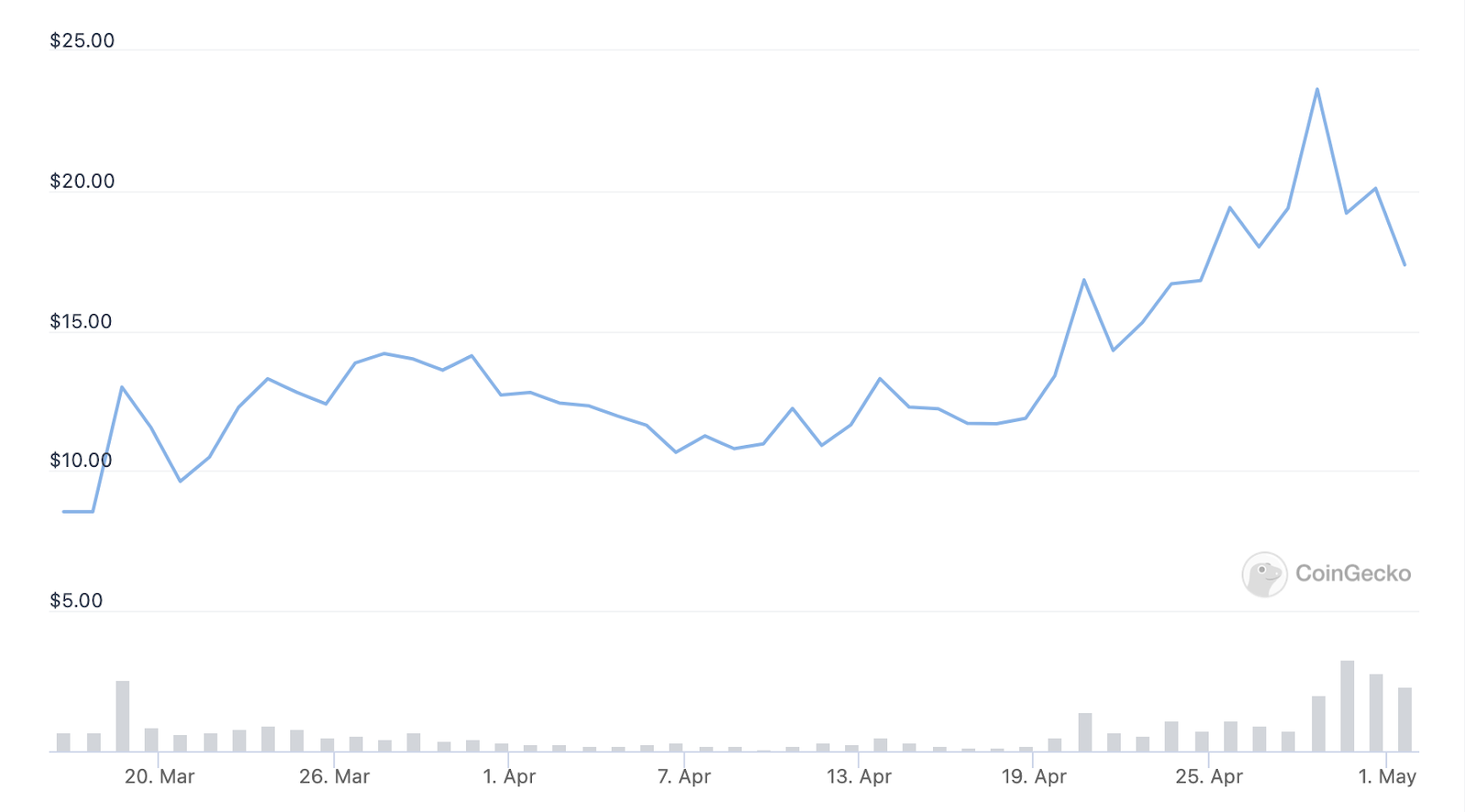
The whale’s position represented 95% of all Solana deposits on Solend and 88% of all USDC the platform had lent out. If Solana dropped to $22.30, the whale risked partial liquidation — about $21 million worth of SOL — even though they didn’t seem to care. And the retail stakers risked losing their USDC. 

SOL is currently trading at $35, according to Coin Gecko. It still has a way to fall, but in the current market, the value of all cryptos only seems to be going down. 

Let’s let the DAO decide

To get itself out of this sticky situation, Solend Labs spun up a decentralized autonomous organization. The purpose of a DAO is to allow the community to vote on proposals. Solend’s governance token is SLND. The more SLND you hold, the larger influence you have on a proposal passing. DAOs typically aren’t created on-demand, but this one was. 

On June 19, Solend put the first proposal to its DAO: “SLND1: Mitigate Risk From Whale.” [Proposal, Solend blog]

“DEX liquidity isn’t deep enough to handle a sale of this size and could cause cascading effects. Additionally, liquidators will be incentivized to spam the network to win very lucrative liquidations. This has been known to cause load issues for Solana in the past which would exacerbate the problems at hand.”

… It’d be difficult for the market to absorb such an impact since liquidators generally market sell on DEXes. In the worst case, Solend could end up with bad debt.”

That last line is misleading. Solend already had bad debt. It was simply trying to fumble its way out of a horrible situation of its own making.  

SLND holders could vote as follows:

Vote Yes: Enact special margin requirements for large whales that represent over 20% of borrows and grant emergency power to Solend Labs to temporarily take over the whale’s account so the liquidation can be executed OTC.

Vote No: Do nothing.”

One yea voter (a SLND whale) provided 1 million votes out of the 1.15 million votes in favor. In fact, they moved a million governance tokens into their account, voted, and moved them back out again — not the greatest example of corporate governance. Users had only six hours to vote, and the voting site was down for three hours during the voting. Solend claims the Solend core team did not vote. Just some random person who borrowed 98 percent voting power. [Twitter; Twitter]

The Solend community was livid and Solend was getting all kinds of bad press over the incident, so Solend submitted a second proposal to invalidate the first and start over: “SLND2: Invalidate SLND1 and Increase Voting Time. [Proposal; Solend blog]

“We propose to: Invalidate the last proposal, Increase governance voting time to 1 day, Work on a new proposal that does not involve emergency powers to take over an account.”

This second proposal was also passed, largely due to the same SLND whale. 

The ‘future of finance’

Solend is currently experiencing a bank run, as lenders rush to get their deposits off the platform. If the money is borrowed, Solend can’t pay it back. The whale has almost completely drained Solend of any actual value and left it filled with assets that cannot be sold. [Tweet; Reddit; Solend dashboard]

The Solend platform did exactly what it was designed to do — lend money. The problem was that Solend massively overpaid for SOL. Put simply: the whale had trouble offloading a huge amount of SOL, so he offloaded it onto Solend, and they, in turn, are struggling to offload the SOL. 

DAOs are corporate governance but with a concussion. Automated voting is a terrible idea. Being able to borrow an overwhelming number of votes just for the vote is extremely dumb. This is exactly what happed to Beanstalk. 

Crypto boosters and VCs, such as Andreessen Horowitz, have been promoting DeFi as “the future of finance” and the foundation of “Web3,” which is nothing more than a way for people to create money out of thin air in the form of tokens, and for investors to cash out by dumping those tokens on the public.

Retailers deposited their stablecoins on Solend in the hope of making high returns. What they got instead was a whale that took off to sea with all of their money.

Updated to include the bit about the bank run.

Additional reporting by David Gerard.

If you enjoyed this post, subscribe to my Patreon to support my work. You can subscribe for the cost of a cup of coffee per month.
Bitcoin fell below $20,000 — and why it has further to go

Bitcoin broke below $20,000 last night. I got a message on Signal while I was sleeping. 

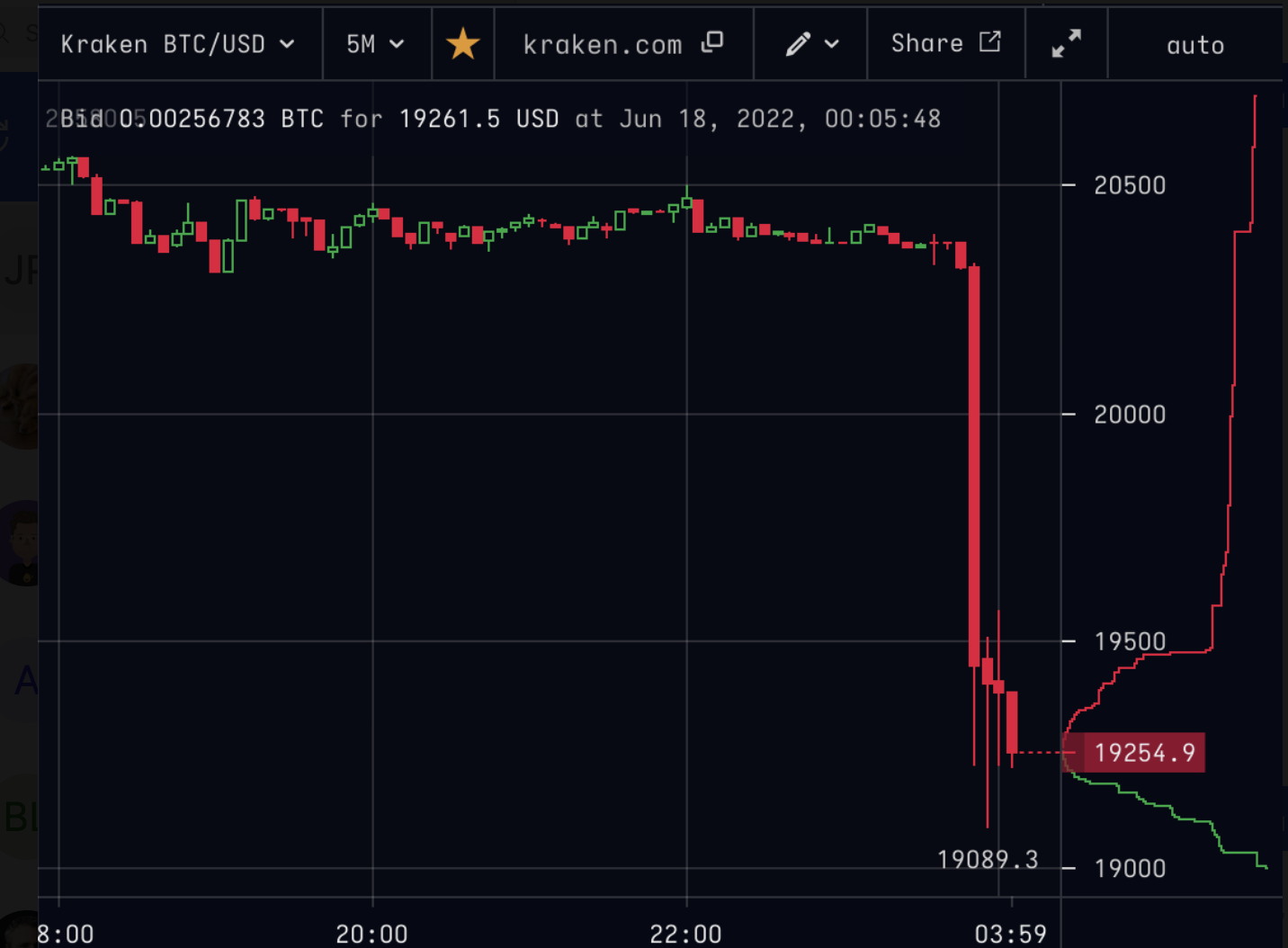
On June 18, 2022, at 6:51 UTC, the price of bitcoin fell from $20,377 to $19,245 on Kraken and then slipped to as low as $18,728 before catching its breath. As I write, it is now $19,174.

Ether also broke below $1,000. The buy wall was destroyed in a matter of seconds.

Bitcoin has now fallen below the previous all-time high it set on December 17, 2017 — officially marking the end of the crypto bubble. The party is over.

Two years ago, as bitcoin embarked on its incredible journey to $69,000 — a number it reached on November 9, 2021 — it was $10,000. At the start of 2020, bitcoin was trading even lower, at around $7,000.

Those numbers give you a sense of how much further bitcoin can fall. As dramatic as the run-up was to $69,000 when every bitcoin bro imagined bitcoin would shoot to the moon, the fall can be equally so, and that is what we are seeing now. 

Of course, everyone is asking, why did bitcoin plunge so quickly Saturday night? What pushed it below $20,000 so suddenly? Somebody is selling. Who needs to sell? 

Miners have to sell to pay their power bills. They mine 900 newly minted bitcoin per day. The bitcoin network consumes a country’s worth of energy. 

The miners have been borrowing money from their buddies, DCG and Galaxy, to cover business costs rather than selling since July 2021. But they can’t borrow any more dollars, so they’re dumping their coins. They also have to pay their credit bills when those loans come due. 

Who else is selling? Any number of crypto lenders, yield farms, and other decentralized finance firms that are running desperately low on liquidity — and there are many of them. 

Last month, Terra/Luna toppled over. This was DeFi’s Bear Stearns moment. Things seemed to settle down for a moment, but behind the scenes, a titanic shift had begun — the wrecking ball was in action. In the chain of reactions that followed, two other Ponzi schemes collapsed: Celsius and 3AC. Smaller outfits Finblox and Babel soon followed — and more are to come.

When investigators look back and piece together the causes of the crypto apocalypse of 2022, key factors will be huge VC money pouring into the space, the massive printing of Tethers — from 4 billion at the start of 2020 all the way to 83 billion earlier this year — and Grayscale’s Bitcoin Trust.

GBTC was an attempt to wrap Bitcoin in an institutionally compatible shell. As I wrote in “Welcome to Grayscale’s Hotel California,” GBTC’s arbitrage trade brought billions of dollars of real money into the crypto ecosystem.  

It also caused explosive growth in crypto leverage. Many of the firms that are collapsing now, looked to GBTC as a way to deliver ridiculously high returns. They would exchange their cash or bitcoin for shares of GBTC and after a 6-12 month lockup, sell those shares on the secondary market for a premium to retail investors. That premium averaged around 18% in 2020. 

It was a sure-fire way to make money until the premium dried up. GBTC has been trading below the price of bitcoin since February 2021.  

All through 2020 and into 2021, there was a massive retail inflow of cash chasing a “reflexive Ponzi” in the form of a GBTC arb situation. And all Ponzi schemes end the same way — they crash stupendously.

See also David Gerard’s post on the bubble pop.

Further reading: “The Latecomer’s Guide to Crypto Crashing,” by David Gerard and Amy Castor

If you like this post, consider subscribing to my Patreon account. You can support my writing for the cost of a cup of coffee per month — or more, if you are feeling generous!

Scam Economy podcast: Crypto Jenga: Celsius and the Latest Crypto Crash 

Earlier this week, David Gerard and I did a podcast together for Matt Binder’s Scam Economy. It just went up this evening. [Youtube; Apple Podcast; Google Podcast, Spotify]

The interview is based on a popular story that David and I recently co-wrote: “The Latecomer’s Guide to Crypto Crashing,” which has now been translated into German and French, and soon, possibly Italian.

It’s as if the entire crypto space has been held together by a giant lynchpin, someone pulled out the lynchpin, and now everything is tumbling to the ground.

UST crashed, Celsius followed, and more recently, Three Arrows Capital has failed to meet lender margin calls. Small crypto funds are next to fall, as David spelled in his recent story on yield farm platform Finblox.

The network effects that brought bitcoin to its heights from 2020 to 2021 are now working in reverse.

The early history of NFTs, part 4 — Game sprites on the blockchain: CryptoPunks

CryptoPunks was one of the earliest crypto collectibles on the Ethereum blockchain, following Curio Cards by six weeks. 

The launch on June 9, 2017, didn’t go as smoothly as planned. A horrible bug in the code meant buyers could take the seller’s Punk — and their money back too!

Larva Labs, the firm behind the project, was able to fix the problem, but it came back to haunt them years later in the form of V1 Punks. 

This is an early draft for our book, which David just posted over on his blog. [David Gerard]

The Latecomer’s Guide to Crypto Crashing — a quick map of where we are and what’s ahead

Since November 2021, when Bitcoin hit its all-time high of $69,000, the original cryptocurrency has lost 70 percent of its face value. And when Bitcoin falters, it takes everything else in crypto down with it. 

The entire crypto space has been a Jenga stack of interconnected time bombs for months now, getting ever more interdependent as the companies find new ways to prop each other up.

Which company blew out first was more a question of minor detail than the fact that a blow-out was obviously going to happen. The other blocks in the Jenga stack will have a hard time not following suit. 

Here’s a quick handy guide to the crypto crash — the systemic risks in play as of June 2022. When Bitcoin slips below $20,000, we’ll officially call that the end of the 2021 bubble.

Recent disasters

TerraUSD collapse — Since stablecoins — substitutes for dollars — are unregulated, we don’t know what’s backing them. In the case of TerraUSD (UST), which was supposed to represent $18 billion … nothing was backing it. UST crashed, and it brought down a cascade of other stuff. [David Gerard; Foreign Policy; Chainalysis Report]

Celsius crumbles — Celsius was the largest crypto lender in the space, promising ridiculously high yields from implausible sources. It was only a matter of time before this Ponzi collapsed. We wrote up the inevitable implosion of Celsius yesterday. [David Gerard]

Exchange layoffs — Coinbase, Gemini, Crypto.com, and BlockFi have all announced staff layoffs. Crypto exchanges make money from trades. In a bear market, fewer people are trading, so profits go downhill. Coinbase in particular had been living high on the hog, as if there would never be a tomorrow. Reality is a tough pill. [Bloomberg; Gemini; The Verge]

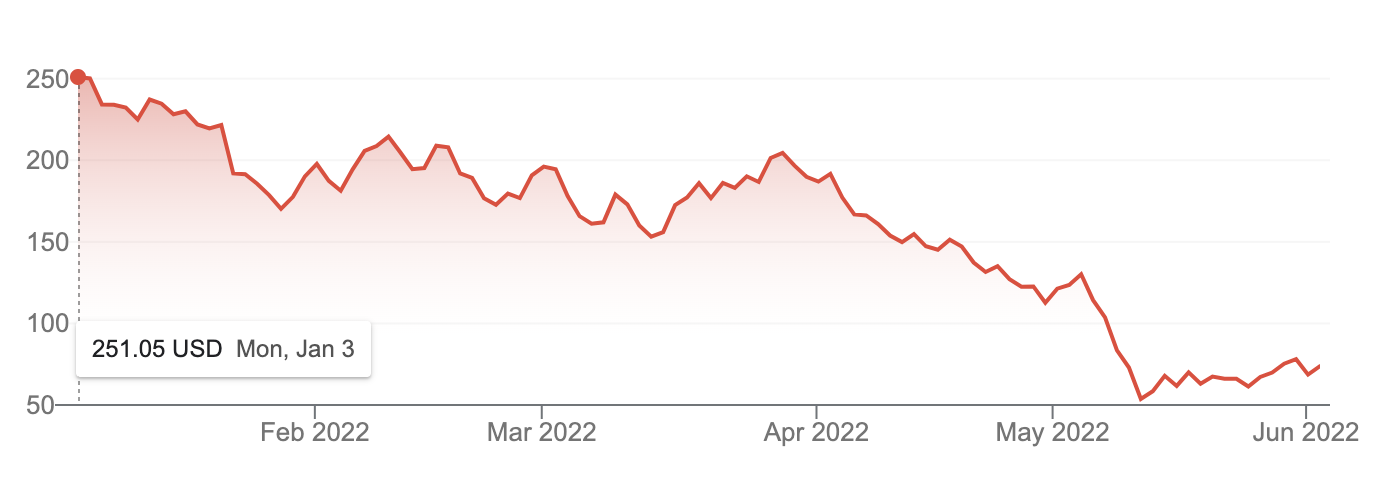
Stock prices down — Coinbase $COIN, now trading at $50 a share, has lost 80% of its value since the firm went public in June 2021. The company was overhyped and overvalued.

US crypto mining stocks are all down — Bitfarms ($BITF), Hut 8 Mining ($HUT), Bit Digital ($BTBT), Canaan ($CAN), and Riot Blockchain ($RIOT). Miners have been borrowing cash as fast as possible and are finding the loans hard to pay back because Bitcoin has gone down.

UnTethering

Crypto trading needs a dollar substitute — hence the rise of UST, even as its claims of algorithmic backing literally didn’t make sense. What are the other options?

Tether — We’ve been watching Tether, the most popular and widely used stablecoin, closely since 2017. Problems at Tether could bring down the entire crypto market house of cards.

Tether went into 2020 with an issuance of 4 billion USDT, and now there are 72 billion USDT sloshing around in the crypto markets. As of May 11, Tether claimed its reserve held $83 billion, but this has dropped by several billion alleged “dollars” in the past month. There’s no evidence that $10.5 billion in actual dollars was sent anywhere, or even “$10.5 billion” of cryptos.

Tether is deeply entwined with the entire crypto casino. Tether invests in many other crypto ventures — the company was a Celsius investor, for example. Tether also helped Sam Bankman-Fried’s FTX exchange launch, and FTX is a major tether customer.

Tether’s big problem is the acerbic glare of regulators and possible legal action from the Department of Justice. We keep expecting Tether will face the same fate as Liberty Reserve did. But we were saying that in 2017. Nate Anderson of Hindenburg Research said he fully expects Tether execs to end the year in handcuffs. 

Other stablecoins — Jeremy Allaire and Circle’s USDC (54 billion) claims to be backed by some actual dollars and US treasuries, and just a bit of mystery meat. Paxos’ USDP (1 billion) claims cash and treasuries. Paxos and Binance’s BUSD (18 billion) claims cash, treasuries, and money market funds.

None of these reserves have ever been audited — the companies publish snapshot attestations, but nobody looks into the provenance of the reserve. The holding companies try very hard to imply that the reserves have been audited in depth. Circle claims that Circle being audited counts as an audit of the USDC reserve. Of course, it doesn’t.

All of these stablecoins have a history of redemptions, which helps boost market confidence and gives the impression that these things are as good as dollars. They are not. 

Runs on the reserves could still cause issues — and regulators are leaning toward full bank-like regulation.

Sentiment

There’s no fundamental reason for any crypto to trade at any particular price. Investor sentiment is everything. When the market’s spooked, new problems enter the picture, such as: 

Loss of market confidence — Sentiment was visibly shaken by the Terra crash, and there’s no reason for it to return. It would take something remarkable to give the market fresh confidence that everything is going to work out just fine.

Regulation — The US Treasury and the Federal Reserve were keenly aware of the spectacular collapse of UST. Rumour has it that they’ve been calling around US banks, telling them to inspect anything touching crypto extra-closely. What keeps regulators awake at night is the fear of another 2008 financial crisis, and they’re absolutely not going to tolerate the crypto bozos causing such an event.

GBTC — Not enough has been said about Grayscale’s Bitcoin Trust, and how it has contributed to the rise and now the fall in the price of bitcoin. GBTC holds roughly 3.4 percent of the world’s bitcoin.  

All through 2020 and into 2021, shares in GBTC traded at a premium to bitcoin on secondary markets. This facilitated an arbitrage that drew billions of dollars worth of bitcoin into the trust. GBTC is now trading below NAV, and that arbitrage is gone. What pushed bitcoin up in price is now working in reverse.

Grayscale wants to convert GBTC into a bitcoin ETF. GBTC holders and all of crypto, really, are holding out hope for the SEC to approve a bitcoin ETF, which would bring desperately needed fresh cash into the crypto space. But the chances of this happening are slim to none.

The bitcoins are stuck in GBTC unless the fund is dissolved. Grayscale wouldn’t like to do this — but they might end up being pressured into it. [Amy Castor]

Whales breaking ranks — Monday’s price collapse looks very like one crypto whale decided to get out while there was any chance of getting some of the ever-dwindling actual dollars out from the cryptosystem. Expect the knives to be out. Who’s jumping next?

Crypto hedge funds and DeFi

Celsius operated as if it was a crypto hedge fund that was heavily into DeFi. The company had insinuated itself into everything — so its collapse caused major waves in crypto. What other companies are time bombs?

Three Arrows Capital — There’s some weird stuff happening at 3AC from blockchain evidence, and the company’s principals have stopped communicating on social media. 3AC is quite a large crypto holder, but it’s not clear how systemically intertwined they are with the rest of crypto. Perhaps they’ll be back tomorrow and it’ll all be fine. [Update: things aren’t looking good. 3AC fails to meet lender margin calls.] [Defiant; Coindesk; FT]

BlockFi — Another crypto lender promising hilariously high returns. 

Nexo — And another. Nexo offered to buy out Celsius’ loan book. But Nexo offers Ponzi-like interest rates with FOMO marketing as well, and no transparency as to how their interest rates are supposed to work out.

Swissborg — This crypto “wealth management company” has assets under management in the hundreds of millions of dollars (or “dollars”), according to Dirty Bubble Media. [Twitter thread]

Large holdings ready for release

Crypto holders have no chill whatsoever. When they need to dump their holding, they dump.

MicroStrategy — Michael Saylor’s software company has bet the farm on Bitcoin — and that bet is coming due. “Bitcoin needs to cut in half for around $21,000 before we’d have a margin call,” Phong Le, MicroStrategy’s president, said in early May. MicroStrategy’s Bitcoin stash is now worth $2.9 billion, translating to an unrealized loss of more than $1 billion. [Bloomberg]

Silvergate Bank — MicroStrategy has a $205 million loan with Silvergate Bank, collateralized with Bitcoin. Silvergate is the banker to the US crypto industry — nobody else will touch crypto. Silvergate is heavily invested in propping up the game of musical chairs. If Silvergate ever has to pull the plug, almost all of US crypto is screwed. [David Gerard]

Bitcoin miners — Electricity costs more, and Bitcoin is worth less. As the price of Bitcoin drops, miners find it harder to pay business expenses. Miners have been holding on to their coins because the market is too thin to sell the coins, and borrowing from their fellow crypto bros to pay the bills since July 2021. But some miners started selling in February 2022, and more are following. [Wired]

Mt. Gox — at some point, likely in 2022, the 140,000 bitcoins that remained in the Mt. Gox crypto exchange when it failed in 2014 are going to be distributed to creditors. Those bitcoins are going to hit the market immediately, bringing down the price of bitcoin even further.

Feature image by James Meickle, with apologies to XKCD and Karl Marx.

Don’t forget to subscribe to our Patreon accounts. Amy’s is here and David’s is here. We need your support for stories like this!

Celsius goes Fahrenheit 451, and number goes down

David Gerard and I have been having fun staying poor. 

I just helped him write a post about how the gig is finally up for Celsius, the largest crypto lender, along with the impact that is having on the price of bitcoin and the crypto space at large. 

We posted it on his website, so head on over there and take a look. 

Don’t forget to subscribe to our Patreon accounts. Mine is here and David’s is here. We need your support for projects like this!

The Week in Art Podcast: ‘Crypto Crash: What Now for NFTs?’

Ben Luke, podcast host for The Art Newspaper, interviewed me about NFTs. The podcast went up Thursday. [Apple Podcast; Google Podcast; Spotify]

We talked about the NFT crash as reported in the WSJ last month and its art world implications. Ben also asked me about a story that had been going around about a “landmark” decision in the UK, where a judge said NFTs were property. I told him it was a bit overblown.

As a follow up, I wrote a blog post: “No, a UK judge didn’t actually rule NFTs are property.” 

I have done a lot of writing for Artnet News. They are fabulous to work for. This was the first time I’ve done anything for The Art Newspaper. 

No, a UK judge didn’t actually rule that NFTs are property

Crypto boosters love to stretch the truth. 

Earlier this year, UK lawyer Rachael Muldoon, who specialized in NFTs and crypto, broadcast the news that a judge had recognized NFTs as property in a “landmark” decision. 

The decision was “unprecedented” her firm 36 Commercial wrote in an April 7 blog post: [36 Commercial, archive]

“This is believed to be the first case of its kind in the world. There have been several instances in recent years of the High Court freezing stolen cryptocurrency, however, this case is believed to be unprecedented, with the courts taking the step of freezing NFTs as a specific class of cryptoassets, distinct from cryptocurrency due to their non-fungible unique nature.” 

The Art Newspaper featured a story on this with comments from Muldoon. Other media followed with their own coverage. I wrote a story on this myself for Artnet News, although I was careful to use the word “reportedly.” [The Art Newspaper; Artnet]

I’ve been wanting to clarify that Muldoon’s claims are meaningless dribble. The trouble was, we didn’t have the transcript from the March 10 hearing. Nor did we have the transcript from the March 31 follow up hearing.  

All we had to go by was Muldoon’s comments on the matter along with a press release from the plaintiff Lavinia Osbourne. [Osbourne’s press release]

In the UK, draft judgments get circulated to the parties in advance on a confidential basis. The judge has to review and approve a transcript before it gets filed with the court. 

Muldoon said the judge would be signing the judgment in the second week of April, and it would soon be made public. However, weeks went by and no transcript. I sent Muldoon and Osbourne repeated emails and got no response. I even tweeted about their non response, and asked people for help tracking down the court filings. Finally, on Tuesday, Muldoon posted the filing via her LinkedIn account. Now, three months later, we have the transcript from the March 10 hearing. [Judgment; LinkedIn]

However, we still don’t have anything from the return date hearing that took place on March 31. 

“This is the only approved judgment I am in possession of and as you will appreciate, I am unable to share anything further owing to legal privilege,” Muldoon told me in an email. 

In other words, she wants us to believe that something super important happened, but she doesn’t want to share the details. 

Breaking down the case

The official case title is: Lavinia Osbourne v. persons unknown and OpenSea. The hearing took place before High Court Judge Mark Pelling in London.

Osbourne, the founder of Women in Blockchain Talks in the UK, claims that she had two NFTs from the Boss Beauties collection stolen from her Metamask wallet. [Tweet]

They were worth about $5,000 total.

Osbourne received the NFTs as a “gift” from a third-party on September 24, 2021. The NFTs were taken out of her wallet on January 17, and she discovered them missing on February 27. 

Although phishing scams are common in the NFT space, Osbourne doesn’t spell out exactly how she managed to get her NFTs stolen. Even the judge says they were taken “under circumstances that were a little unclear.” 

The NFTs ended up in two accounts in OpenSea — the “persons unknown.” [Boss Beauties 680, 691]

Osbourne wanted OpenSea to freeze the accounts, so she hired Muldoon to go before a judge and get an injunction and order OpenSea to release information on the account holders.

I don’t know what good this would do. OpenSea is an unregulated exchange. It isn’t required to KYC its customers, so there is no reason to believe anything of value would be gained from gathering the account information to begin with. It also doesn’t custody or control users’ NFTs.

In any case, the judge said it made sense to consider NFTs property. There is a clear distinction to be made here — Pelling did not say NFTs are property. In ruling that Osbourne could proceed against the alleged attackers, he simply said it makes sense to consider them as such: 

“There is clearly going to be an issue at some stage as to whether non-fungible tokens constitute property for the purposes of the law of England and Wales, but I am satisfied on the basis of the submissions made on behalf of the claimant that there is at least a realistically arguable case that such tokens are to be treated as property as a matter of English law.”

Jake Hardy, a banking and finance litigator in London, told me the threshold being applied is “a good arguable case,” not a balance of probabilities as it would be in a full judgment. “The judge is not saying that her case is proven to the civil standard, just that it is arguable.” 

Hardy pointed out something else: This was a “without notice hearing,” meaning OpenSea was not told that the March 10 hearing was taking place, nor did they get a say in the hearing.  

If the court had proceeded to get an order in place, then that order would have provided for a second hearing, in which OpenSea would have had the opportunity to present its side of the story.

There are still open questions about the outcome. Was an order proceeded with? Did OpenSea attend the return date hearing, and is there a judgment from that? 

I am told by a source, whose name I won’t reveal, that OpenSea complied with the disclosure order to hand over information on the account holders. And that Osbourne subsequently voluntarily dismissed OpenSea as a defendant in the case. 

Releasing OpenSea as a defendant would have happened anyway, said Harding. They were only there as respondents to the Bankers Trust application. There are any number of ways that might have been resolved after the judgment. OpenSea could have refused to cooperate, they could have provided the information, or they could have simply said they had no information to provide. 

“You just cannot tell how much benefit the Claimant got out of this judgment without more information,” he added.

Hot air

The claims in the blog post from 36 Commercial don’t match what the judge said. NFTs are just property; the judge did not distinguish them as a special kind of property. For the purposes of this case, they just need to be property that can be owned and misappropriated.

As I noted in my story for Artnet, in the US, the IRS already considers NFTs property. NFTs have all the attributes of property, as you can transfer them to another person. It absolutely makes sense to assume NFTs are property. 

NFTs are also already property in the UK, separate from the underlying asset. Fungible tokens, like bitcoin and ether, are property too. In the case of an NFT, you’ve just bought a crypto-token containing a link. I’m not sure what Muldoon’s novel claim here is. 

The bigger issue — what’s missing from the discussion — is that there is no law or ruling anywhere that links NFTs to their underlying assets. Owning an NFT doesn’t automatically convey copyright, usage rights, moral rights, or any other rights whatsoever. All of that has to be spelled out separately in a written contract. Nothing about this case in the UK changes any of that. 

Despite the praise she’s getting from crypto fans (her followers on LinkedIn), Muldoon’s claims about a “landmark” NFT decision are just silly nonsense. 

Additional reporting from David Gerard.

I have a Patreon account. If you like my work, become a subscriber!

Initial Game Offerings: a failed Initial Grifting Opportunity

David Gerard and I cowrote another story — this one on initial game offerings. Since we alternate posts, this one is on David’s blog. 

If you haven’t guessed, an IGO is a way to drum up funding for a blockchain game. The problem is, play-to-earn never took off. Axie Infinity was the only P2E game that saw any action.

Jackson Palmer mentioned the phrase in his interview with Crikey: “We’ve had ICOs, DAOs, now it’s NFTs. Now I’m seeing initial game offerings as the latest thing.”

The grift is always evolving.

The early history of NFTs, part 3: Curio Cards 

  • By Amy Castor and David Gerard
  • This is part three of the first draft of an early history chapter for our planned NFT book.
  • We welcome corrections and nitpicking, so pick away!
  • Don’t forget to subscribe to our Patreons. Amy’s is here and David’s is here. We need your support for projects like this!
  • As an incentive, we’ve put the full interview with Adam McBride, mentioned here, on our Patreons for subscribers. It’s a great 3,000-word historical rundown.

Curio Cards: the first art NFTs on Ethereum

After the 2017 crypto bubble popped, the early attempts at NFTs faded into obscurity. But many were rediscovered in the 2021 NFT craze.

Buyers would scour the Ethereum blockchain for old NFTs, pick them up for a song, and then, once the discovery was widely broadcast, flip them for a handsome profit. This often required extra coding to get the old NFTs’ smart contract code to work on the OpenSea NFT marketplace — but there was always a “community member” willing to put in the work.  

In early 2021, most people considered CryptoPunks to be the first Ethereum-based art NFTs as we know them — but then Curio Cards was unearthed. Curio Cards was originally launched on May 9, 2017 — predating CryptoPunks by six weeks. 

Etheria, which launched only a few months after Ethereum’s mainnet went live in 2015, predated Curio Cards. But Etheria was a virtual world, and its NFTs were for plots of virtual land — not art. Still, even Etheria land would resell for big money in 2021.

Curio is a 30-card series featuring work from seven artists: Cryptograffiti, Cryptopop, Daniel Friedman, Marisol Vengas, Phneep, Robek World, and Thoros of Myr. It’s actually a 31-card series if you count the misprinted card #17 — called “17b” — as part of the series.

Like all NFT projects, rarity was the big selling point. Curio Card created between 111 and 2,000 cards of each image, for a total of 29,700 cards. The images are of everyday objects, like apples and acorns, mixed in with the occasional corporate logo altered to mention bitcoin. 

The idea of Curio was to put artists’ work onto a blockchain and display it in an online art gallery, so the artists could sell their work without a middleman taking a cut of the profits — 100% of primary sales went to the artists. This didn’t add up to much, though. Before 2021, the cards only sold for between 25 cents and one dollar, and even that was a difficult sale to make at the time. 

Bitcoin street artist Cryptograffiti contributed three pieces to the collection. As an activist, he used to make stickers related to bitcoin and banking and roam around San Francisco sticking them on bank walls and ATMs to show his disdain for modern finance. Curio Card #12 is a 1990s MasterCard logo with the words “MineBitcoin” in place of “MasterCard.”

Now-famous NFT artist XCOPY, who was unknown at the time, missed being included in the collection by a hair.

“You could put in your Google form to be part of Curio Cards, and he got it in too late and was denied,” Adam McBride, an “NFT Archeologist” who spends countless hours per day researching early NFT projects, told us. “If XCOPY was part of the Curio Cards, it would have been a whole different story.” The collection would have been even more coveted today. 

The initial founders of Curio Cards were Thomas Hunt, a bitcoin Youtuber known for the Mad Bitcoins show, and software developer Travis Uhrig. The two met at a bitcoin meetup in San Francisco. Hunt’s love of baseball trading cards gave him the inspiration for putting art on the blockchain: “I thought, why not combine my love for cryptocurrency with my love for collecting and make something fun?” [Bitcoin.com]

Hunt and Uhrig brought in former child actor Rhett Creighton to help with developing the smart contract — the bits of computer code that would run on the blockchain. NFT coding standards, such as ERC-721 and ERC-1155, did not exist yet, so every detail had to be coded by hand, and each card manually put onto the Ethereum blockchain.

All three founders were big fans of Looney’s Rare Pepe project, which preceded Curio Cards. [Show me the Crypto]

As a kid, Creighton starred in Crocodile Dundee II. As an adult, he studied physics and nuclear engineering at MIT. Rhett Creighton was his stage name, a shortened version of his full name, John Everett Creighton IV. In 2017, he also used the name Everett Forth, before reverting to Rhett Creighton.

Creighton was known for his entrepreneurial spirit. He used Amazon’s Mechanical Turk, a crowdsourcing website for businesses to hire remotely located “crowd workers,” to game the initial allocation of the cryptocurrency Stellar. [Inside Bitcoins, Everett Forth]

Creighton also started his own cryptocurrencies. The privacy-enhanced cryptocurrency Zcash originally had a “founder’s reward” that paid a portion of all freshly-created crypto-coins to the developers. In November 2016, Creighton removed the founders’ reward — he considered it inequitable — and called the resulting cryptocurrency ZClassic. Unfortunately, without a founder’s reward, the developers had no way of making money, so the currency didn’t go anywhere. Creighton went on to launch another cryptocurrency, Whalecoin, in November 2017, based on Ethereum, with a 33% “development fund.” He quickly abandoned this also. He then started Bitcoin Private by forking ZClassic, and abandoned that as well.  

Creighton suggested that Curio make its own version of Ethereum for the cards. Uhrig pointed out this would leave his digital trading card idea “orphaned” on its own chain, so they stayed on the public Ethereum blockchain. [Start with NFTs]

Each card included a link to a copy of each image on IPFS in the contract. IPFS is a distributed file system that works a bit like BitTorrent — as long as there’s at least one copy out there to seed a particular file, you can access it. According to McBride, Curio Cards was the first to use IPFS, and the links were still active four years later when the cards were rediscovered. As with Rare Pepes, Curio cards ended up being a collection of individual fungible tokens, each tracked by its own smart contract with its own total supply. [Bitcoin.com]

Curio Cards had a detailed business plan, with complicated smart contract coding. The creators wanted to create “FOMO” — fear of missing out — to ramp up interest in the cards. When a card launched, it sold for 25 cents in ether. The price would incrementally go up to a dollar over the following days.  The first ten cards (at least) had a distribution of 100,000 — but after 2,000 were bought, the rest were automatically burned. For later cards, the artist chose how many were created. As a result, every card had multiple smart contracts.

The cards could only be bought on the Curio Cards website — there were no NFT standards and no NFT marketplaces. The smart contracts were linked as “vending machines” from the website. You can create an NFT collection today in fifteen minutes that works to the standards, and be sure they’ll work in an NFT marketplace.

As Creighton was creating the contract for card #17, something went wrong, so he had to reissue the card. The misprint became “17b.”

“I don’t think anyone knows exactly what happened with 17b, but it was briefly released,” McBride said. “One person who is actually in the Discord was able to get, I don’t know how many 17b’s, before they realized their mistake and turned off the contract.”

Hunt and Uhrig tried to run Curio Cards like a start-up business. “I believe blockchain-based collectibles will be very big in the future,” Hunt predicted in a 2017 interview. Uhrig’s role was to pitch the idea to venture capitalists. But the idea never caught on. Nobody cared, and Uhrig could barely give the virtual cards away on a Discord channel. “It was a fun thing at the time, but kinda failed in a lot of ways getting any traction,” he said in an interview.  

​​Curio Cards lay dormant until March 2021, when @DieAping on Twitter (whose account has since been deleted) uncovered the old Curio “vending machines” on Github. These were early versions of the Curio smart contracts, still with active Curio Card contracts in them — though the links on the website to the smart contracts had been removed. [Tweet]

“For a while, people were just doing OTC trades through the Curio Discord, and that is just kind of trusting people,” says McBride.

In 2021, whenever an old NFT project was unearthed, you had to move quickly to get the tokens onto OpenSea. Some code would quickly be written to serve as a “wrapper” to interface the existing contracts to OpenSea.

The first rushed third-party wrapper created to get Curio Cards to work on OpenSea had a fatal bug: when anxious Curio Card holders sent their tokens to the contract, the tokens became forever stuck — “permawrapped.” [FAQ: Wrapping Old Cards]

As a result, Card #26 became the rarest card — only 105 were still tradeable — and the biggest bottleneck to getting a full set.  

In October 2021, a complete set of 31 Curio cards, including the 17b misprint, sold for more than $1.2 million in ether at the Christie’s Post-War to Present auction. Taylor Gerring, an early contributor to the Ethereum project, was the buyer. 

Despite early frustrations, the project turned out to be a success after all. [Tweet]

Feature image: Curio Card #23, “The Barbarian” by Robek World, depicting Curio founder Rhett Creighton.

Coinbase freezes hiring, rescinds job offers: ‘Coinbase ghosted me’

Coinbase is losing money. Its stock is in the toilet. Now, the largest crypto exchange in the US says it’s extending its hiring freeze and rescinding job offers.

L.J. Brock, Coinbase’s chief people officer, shared the grim news in a blog post on Thursday. It’s been only two weeks since the San Francisco firm initially announced plans to pause hiring. Yesterday’s blog post signals just how dire things have become:

“In response to the current market conditions and ongoing business prioritization efforts, we will extend our hiring pause for both new and backfill roles for the foreseeable future and rescind a number of accepted offers.”

The announcement comes on the same day Gemini said it would be trimming 10% of its staff. In a blog post, co-founders Cameron and Tyler Winklevoss attributed the layoffs to “turbulent market conditions that are likely to persist for some time.” 

Coincidently, a CFTC lawsuit also dropped on Thursday claiming Gemini misled regulators to gain approval for a bitcoin futures product it was pursuing in 2017.

Coinbase is struggling to turn a profit. Last month, it posted a $430 million loss for Q1 2022 after missing analysts’ predictions on both profit and revenue for the quarter. The exchange said it was bleeding users. 

The company’s stock price (Nasdaq: COIN) is down more than 70% since the beginning of the year and is currently trading at $74 per share. It’s hard to imagine that COIN was as high as $343 in November 2021. 

The tumble in Coinbase’s stock price coincides with the crypto markets. Bitcoin has barely been able to keep its head above $30,000, after losing 60% of its value since its November record. The stock market is also suffering. The tech-heavy Nasdaq composite is down 22% since January.  

‘Coinbase ghosted me’

Leading up to 2022, Coinbase planned to triple its workforce. The firm hired 1,200 people in the first quarter and had 3,730 employees at the end of last year, according to its latest earnings report. Now, it’s not even calling some people back after extending job offers. 

I spoke with one person, whose name I won’t reveal, who said Coinbase offered him a job as a security engineer in January. The man, who is in his 30s and has a decade of experience at FAANG companies, told me he had a verbal offer from Coinbase after an interview panel. But then he was ghosted and never heard from them again. 

“I honestly was only interested in getting a competitive offer to better my negotiation at other places I was interviewing,” he told me in a private message. “So grateful Coinbase ghosted me.”

Otherwise, had he gotten the offer in writing, he might have seriously considered taking the job, even as a no-coiner. The comp in the verbal offer was tempting. 

Coinbase offered him a $280,000 base salary plus a 15% bonus and $600,000 annual equity, for total compensation of $920,000, he said.

“We don’t do a four-year program where you vest 25% each year. We don’t have a cliff either, so you start vesting immediately on a quarterly basis,” Coinbase told him.

The company has performance multipliers and suggested that potentially, he could make $1.5 million annually. 

Coinbase has a 2% 401(k) matching program. As an employee, he would get one month off per year along with unlimited paid time off. That’s in addition to four companywide weeks off.

In January, Coinbase proudly announced that the entire company would shut down for one week at the end of each quarter so employees could “recharge.” 

Oh, and there’s a $500 monthly wellness stipend, in case you want to join a gym or take yoga.

After the interview, the would-be employee got an email from the recruiter saying that things went great and they wanted to extend an offer. The recruiter asked if comp would be okay before they put the contract together.

And then, nothing. 

It was just as well, he told me. “Because the equity would have cut in half, and the company will look far worse after the coming collapse.”

Other would-be employees aren’t so relieved. On Blind, an anonymous app for the workforce, someone wrote: “I was supposed to start jun 6th. My offer has been rescinded. This feels like a nightmare that I can’t wait to wake up from.” 

“Dodged a bullet,” a Coinbase employee replied. 

Why rescinding job offers is bad

Rescinding job offers at the last minute is a nasty thing to do to people, especially if they’ve already submitted notice at their current job, told their landlord they are moving, or put their home up for sale. 

It can also blacken the offering company’s reputation. Word gets out, and you’ll have a much harder time convincing people to work for you in the future. It also makes Coinbase’s financial health look worse like they’ve somehow managed to run out of cash running a casino.

Meanwhile, Coinbase execs aren’t doing too bad for themselves. In 2020, including stock options and bonuses, CEO Brian Armstrong made $59 million, Chief Product Officer Surojit Chatterjee made $16 million, and Chief Legal Officer Paul Grewal made $18 million, according to SEC filings

Hacker News is outraged. Coinbase did in any hope of hiring competent non-hodlers.

Here’s what Blotto_Otter on Something Awful wrote: 

“When I read stuff like this, all I can think about is when I started in public accounting right in the middle of the 2007/2008 crash, and out of all the unpleasant stuff most accounting firms did during that time — layoffs, hiring freezes, salary freezes and cuts, benefit cuts — the one thing they did not do was revoke job offers from people who had already accepted offers. They did everything but that because they understood that that is the one thing that will make your name mud when it comes to recruiting new hires in the future.”

Also, Coinbase could potentially get sued for reneging on job offers, if it extended a no-caveat offer and the would-be employee can prove they suffered losses. National Law Review wrote about this in 2019.

In its blog post, Coinbase said it was extending its severance policy to individuals it offered jobs and would notify them by email. Blind posted a copy of the rescind email, along with another email Coinbase sent to new hires two weeks ago telling them it would not rescind job offers. What’s next? Layoffs?

It’s just a shame Coinbase doesn’t put its job offers on the blockchain.  

I need your support. Become a patron! Your contributions make a difference. 

Former OpenSea executive Nate Chastain arrested for insider trading of NFTs

As David Gerard and I were discussing our next book post via Zoom, we spotted the DOJ had just dropped a press release announcing the arrest of Nate Chastain in New York. 

The former OpenSea exec was allegedly caught with his hands in the cookie jar. He was charged with two counts: money laundering and wire fraud. How much of NFT trading is real anyway?

We wrote up a quick blog post, which David posted on his blog.

Bloomberg’s Matt Levine may have to create insider trading rule #13: don’t do it on a public blockchain.

Stay tuned for our next NFT history post, hopefully, this week. Looks like we’ll be doing an entire post just on Curio Cards, one of the early art NFT projects on Ethereum. 

If you like our work, become a patron. Your support makes a difference! [Amy’s Patreon; David’s Patreon]

Early history of NFTs, part 2: Monegraph, Spells of Genesis, Rare Pepes

  • The following is part two of a chapter on the early history of NFTs for a book by David Gerard and Amy Castor.
  • Part one is posted on David’s blog. We are alternating. We thought we’d only have two parts, but now it looks like we have three. Stay tuned for CryptoPunks and CryptoKitties!
  • We welcome and encourage corrections and nitpicking!
  • Don’t forget to sign up for our Patreon accounts! My Patreon is here and David’s is here. 

Monegraph: A template for future NFTs

The template for today’s art-based NFTs — though they wouldn’t be called “NFTs” for another three years — was something that was quickly coded in the middle of the night in May 2014.  

2014 was the peak of popularity for the microblogging site Tumblr. People were right-clicking artists’ work willy-nilly and re-posting images online with no attribution.

Tech entrepreneur Anil Dash teamed up with artist Kevin McCoy at Rhizome’s Seven on Seven Conference in New York City, an event that matched artists and technologists. The two had only met 48 hours prior.

They wanted to help artists protect their work, so they came up with an idea for recording images on the blockchain. Their project Monegraph, short for “monetized graphics,” was built on the early bitcoin clone Namecoin.

Dash and McCoy quickly figured out that blockchains aren’t designed to handle large chunks of data. So as a last-minute hack, the pair put a URL in the Namecoin blockchain record that pointed to an image elsewhere on the internet. It was never clear how exactly this would protect artists’ work.

To this day, however, NFTs still rely on the same shortcut. When someone buys an NFT, they’re not buying the actual digital artwork, they’re buying a link to it — but on a blockchain.

Dash called out this issue years later: “And worse, they’re buying a link that, in many cases, lives on the website of a new start-up that’s likely to fail within a few years. Decades from now, how will anyone verify whether the linked artwork is the original?” 

At the time, Dash and McCoy’s idea went unnoticed. But in June 2021, when NFTs were making headlines around the globe, McCoy put “Quantum,” the first NFT created on Monograph, up for auction at Sotheby’s.

“Quantum” is an animated GIF image of an octagon with flashing concentric circles. Sotheby’s talked “Quantum” up as a “seismic genesis work” comparable to pieces by Picasso, Malevich, and Duchamp. Shortly before the auction, Axios ran an article with the eye-grabbing headline “Exclusive: The first-ever NFT from 2014 is on sale for $7 million-plus.” 

McCoy and Sotheby’s ended up selling the iconic NFT for less than that, but still, an eye-watering $1,472,000. 

Well, sort of. What was sold at Sotheby’s wasn’t exactly the original NFT.

McCoy didn’t auction off the Namecoin NFT of “Quantum” that he minted in May 2014. Instead, a month before the auction, he minted a new NFT on the Ethereum blockchain — and sold that. He held the copyright since it was his art, but it wasn’t the original cryptographic token. 

This would later become a sticking point, especially as someone else had jumped in to claim ownership of the original NFT of “Quantum,” while McCoy wasn’t paying attention. 

Namecoin requires owners to reclaim the “Namecoins” in their wallets roughly every eight months. In McCoy’s case, he allowed his NFT of “Quantum” to languish for 6.5 years, having all but forgotten about it since he first created it.

Seeing that an early NFT was about to go for big money — potentially $7 million, according to the Axios story — a Canadian company called Free Holdings Inc. seized the opportunity and registered as the new owner on Namecoin. After the auction, Free Holdings filed a lawsuit against McCoy and Sotheby’s for the sale.

The trouble is that McCoy’s original token on the Namecoin blockchain included the text: “Title transfers to whoever controls this blockchain entry.”

As the complaint stated: “While the blockchain records are self-evident, such records cannot defend themselves in the face of concerted efforts by a formative artist and auction house to establish a false narrative concerning what is presumed to be the first NFT.”

Nobody knows who is behind Free Holdings, but he/she is associated with the Twitter account @EarlyNFT. According to the complaint, @EarlyNFT tried several times to virtually tap McCoy on the shoulder in the days leading up to the auction by reaching out on Twitter:

“Would you mind enabling PM for me, @mccoyspace? There’s a matter regarding your ‘Quantum’ I’d like to discuss with you,” @EarlyNFT said in a tweet. “Kevin, would you mind allowing me to send you a private message… This concerns your NFT artwork with Monegraph back in 2014,” And: “I’m in possession of Quantum NFT (the record is found here…. “

McCoy never responded to Free Holding’s shoulder taps and continued to proceed with the auction. 

Sotheby’s called the lawsuit “baseless” and vowed to vigorously defend itself. We contacted @EarlyNFT, who told us that his lawyer is still waiting to hear back from McCoy and Sotheby’s.

Even before the auction of “Quantum,” Dash was horrified that his dream had become “commercially exploitable hype.” He walked away from the space. Whereas McCoy went on to establish Monegraph as a company along with co-founder Carlos Mendez. In September 2021, Monegraph launched “Readymade NFT,” a platform for galleries, auction houses, and artists to run their own small NFT marketplaces.

Spells of Genesis: Trading cards on the blockchain

In popular games such as Magic: The Gathering and Pokemon, players trade physical cards for real money. What if they could trade tokens for pretend money instead? 

Shaban Shaame promoted his game Spells of Genesis as a “blockchain-based game.” In 2015, his company Everdreamsoft raised 930 bitcoin, worth $350,000 at the time, by selling its BitCrystals token on Counterparty.

Players who reached a certain level could mint in-game cards and “blockchainize” their cards, turning them into Counterparty NFTs. They could then trade the NFTs on the Spells of Genesis website for BitCrystal tokens. The cards featured fantasy-themed artwork based on moments in early bitcoin history, including a purple-robed Satoshi Nakamoto.

The digital cards lived on the Spells of Genesis website. Only the tokens exist on the blockchain. Players were not trading cards, they were trading tokens.  

The BitCrystals token saw an uptick in price when the Spells of Genesis mobile game launched in 2017. After that, crypto traders lost interest in the game, and Spells of Genesis collectibles faded into obscurity. In 2019, Shaame froze the development of the project. Spells of Genesis restarted on the Ethereum blockchain in 2020. 

In 2021, the game’s collectibles found their way onto OpenSea. Today Shaame claims Spells of Genesis was the first “play-to-earn” game. He says that “without blockchain it is not possible to pay people in gaming.”

Rare Pepes: Hate symbols on the blockchain

Illustrator Matt Furie created Pepe the Frog, a cartoon character that appeared in the strip “Boy’s Club” in 2005. The comics showed Pepe and his buddies eating pizza and playing dumb jokes on each other. In the comics, Pepe used the catchphrase, “Feels good man.”

Pepe became a popular meme on the message board 4chan’s /b/ board. The Washington Post described /b/ as “an unfathomable grab-bag of the random, the gross and the downright bizarre.”

Ahead of the 2016 election of President Donald Trump, Pepe was co-opted by neo-Nazis on 4chan’s /pol/ (Politically Incorrect) board. They posted images of Pepe next to the World Trade Center’s twin towers, stuck swastikas on him, and had him saying things like “Kill Jews, man” — to Furie’s horror. 

This version of the Pepe meme spread to other social media sites, such as Reddit and 8chan. Pepe became so widely associated with the white nationalist movement that in September 2016, the Anti-Defamation League added Furie’s beloved Pepe to their official list of hate symbols

Variations of Pepe depicting the frog as different public figures came to be known as “rare Pepes.” They often had watermarks such as “RARE PEPE DO NOT SAVE,” to indicate that the artist had not yet made the image available for public use.

In October 2016, bitcoiner Joe Looney launched the Rare Pepe Wallet, an online exchange where any meme creator could mint an NFT of their rare Pepe on Counterparty, and trade it for crypto — specifically, a new coin called Pepecash. Rare Pepes are listed in the Rare Pepe Directory.

When crypto fans reference the earliest NFTs, they often leave out Rare Pepes due to their associations with white nationalism. But that was, in fact, one of the earliest NFT collections to gain any traction.

Through 2017 and onward, Furie fought tirelessly to reclaim Pepe from the alt-right — including lawsuits against white nationalists trying to co-opt the character.

After digital artist Beeple made $69 million selling an NFT of his scrapbook on Christie’s in 2021, Furie figured he too could place a pail under the free money spigot. In April 2021, Furie listed his first authorized Pepe NFT on OpenSea: “Pepe the Frog NFT Genesis.” The buyer paid 420 ether for the NFT, netting Furie $1 million at the time.

Later that year, Furie founded the Pegz DAO, or “decentralized autonomous organization” — sort of like an online venture fund. 

Furie’s DAO issued several series of NFTs of Pepe and related characters. One release was of 99 Pepe NFTs titled “FEELSGOODMAN,” linked to an image of Pepe relaxing peacefully in a pond with his green bottom protruding above the water. The promotion stated: “99 will remain in the PegzDAO, and ONE is being auctioned here.”

The FEELSGOODMAN NFT was bought by a man named Halston Thayer for $537,000 in crypto. Two weeks later Furie gave away 46 NFTs for free to members of PegzDAO — all representing an image identical to the one Thayer paid all that crypto for.

Thayer is now suing Furie for cheapening his investment. Thayer claims that Furie “led Plaintiff and others to grossly overbid on the NFT.” Thayer maintains that Furie’s release of the other NFTs devalued Thayer’s NFT “to less than $30,000.00, hundreds of thousands of dollars less than what he paid for this purportedly ‘unique asset’” — a valuation that Thayer does not substantiate. He claims “conspiracy and wrongful conduct.”

Kara Swisher promotes crypto for your retirement, compares it to early internet

As a journalist, you have to decide whether you are going to report the truth — or toss your principles aside and take the money. In the years I’ve been covering crypto, I’ve seen too many people opt for the latter. 

Still, I almost fell over backward on Monday when long-time tech journalist and NYT opinion writer Kara Swisher compared crypto to the early days of the internet. Swisher has been writing about the Internet since the early 1990s — she knows better!

Swisher said this in the course of defending an advertisement on her podcast for a cryptocurrency IRA — from a company that offered to put your retirement money into Axie Infinity.

Also, what’s a “conflict of interest”?

Electricity was only discovered in 500 BC, it’s still early days

Comparing crypto to the internet is how crypto boosters typically respond to critics. 

Normal person: “This stuff doesn’t work. It’s been around for 13 years, and it’s still absolute crap.” 

Crypto booster: “Crypto is like the early days of the Internet, give it time!” 

In fact, crypto is not like the internet at all. The internet was useful for real work from its first days before it was even called the internet, and people recognized its power and potential at every step. There were no bros telling everyone within earshot that it would definitely not suck if you gave it another 13 years. [David Gerard]

Retire on your altcoin pile

Swisher previously wrote for The Wall Street Journal and The Washington Post. She is the co-founder of Recode, now owned by Vox Media. In 2018, Recode launched the Pivot podcast.  

Swisher cohosts Pivot semi-weekly with NYU business professor Scott Galloway, who has also written several books. They talk about tech, business, and politics. 

In a recent podcast, Galloway read an ad for one of their sponsors — crypto firm iTrust Capital — and encouraged listeners to put crypto into their Individual Retirement Account: [Podcast]

“By now, you’ve probably heard all about cryptocurrencies like bitcoin. You might even already be invested in them. But did you know, you could also invest in cryptocurrencies through your retirement account? That’s right. With iTrust Capital, you can buy and sell cryptocurrencies from a crypto IRA and get all the same tax advantages as a traditional IRA. iTrust Capital allows you to invest in over two dozen of the most popular cryptocurrencies and unlike the stock market, you can buy and sell 24 hours a day. The iTrust Capital platform is easy to use and it only takes a few minutes to set up your account. Setting up an IRA is free and iTrust fees are low. It’s time to start taking control of your financial future with iTrust Capital, you can get all the tax benefits of a retirement account while investing in crypto. Visit iTrust Capital/Pivot to start investing in today.” 

Alan Graham called the pair out on Twitter for promoting this kind of reprehensible garbage. Crypto is a speculative investment. It’s built on bad tech, it’s volatile as hell, and people often lose everything in hacks and rugpulls. This is not something you want to be advising people to invest in, especially for the long term.

Swisher got defensive: “Last time I checked people had choice and this offered a range of investments. Also crypto is by no means over. It’s like early internet. Sorry if that bothers you but it is so.” [Twitter, archive]

iTrust does offer a range of investments — a range of highly volatile, underwater investments. I’m not so sure you’ll be able to retire comfortably on Axie Infinity tokens. 

When Graham pointed out that crypto is 100% not like the Internet, Swisher attacked bitcoin critics: “The crypto fanboys are bad but the skeptics are overplaying it.” 

Conflicts of interest are so old-tech, it’s a new paradigm now

You may be utterly unsurprised to learn that Swisher is a bitcoin holder. 

On December 20, 2017, just as bitcoin was hitting the peak of the 2017 bubble, Swisher casually mentioned her bitcoins on a Recode Decode podcast — which she also hosts — with The Verge’s Casey Newton and Spark Capital General Partner Megan Quinn. Newton pointed out the Vox Media ethics policy didn’t allow journalists to hold cryptos. Swisher just shrugged it off and continued. [Recode/Decode – 43:13; transcript]

In a February 2021 tweet, Swisher admitted to owning 10 bitcoins — with a face value at the time, and again now, of about $300,000: “Whatever. I own 10 Bitcoin from a brick ago from when I was doing a story when it first started, so don’t lecture me.” [Tweet, archive]

Swisher said she forgot where she put her bitcoins — maybe in a box in a storage unit? “I have no idea if I threw it out or not.” [Tweet, archive]

We all know how easy it is to misplace $300,000. Who even keeps track of change that small?

The New York Times has a rule against writing about your own asset holdings. This hasn’t stopped Swisher from writing about bitcoin and other crypto assets in the paper, with no disclosure. [NYT editorial standards]

Scott Galloway is a professor of marketing and a long-time startup guy, who writes about investment and startups. David Gerard quoted Galloway in his book “Libra Shrugged.” Galloway has skewered crypto before and thinks Robinhood is exploitative trash.

Galloway said on Twitter that he “felt awkward” reading something with crypto and IRA in the same sentence. But not awkward enough not to take the money.

What is iTrust?

Irvine, California-based iTrust Capital wants people to invest their retirement funds in all manner of bottom-of-the-barrel shitcoins.

iTrust’s favored market is crypto investors who don’t want to pay a ton of capital gains tax on their holdings. [Traders Magazine]

The very first crypto that iTrust list on their website is AXS, the native token of the blockchain game Axie Infinity. North Korean hackers recently stole $600 million in ETH from the platform. Axie has yet to compensate users for their losses. The AXS token itself has gone through the floor.

​​iTrust Capital has raised $128 million in funding over four rounds. Left Lane Capital and Ledger Prime are the most recent investors. [Crunchbase]

The firm is doing business as M2 Trust, a charted trust company in Denver, Colorado. They are fiduciaries, but they hide behind iTrust’s brand and disclaim responsibility as a broker. It’s shady of them to be promoting cryptocurrency as fiduciaries. 

iTrust says on its website it will store your retirement funds at Coinbase Custody, who notified the SEC recently that they will ransack your retirement if the company runs out of money. Coinbase treats Coinbase Custody just like trading funds — not like someone else’s separate money. [Bloomberg]

Why putting your retirement money into crypto is bad

The Department of Labor has told fiduciaries that putting cryptos into 401(k) risked their licenses in March. This isn’t a 401(k), though, so the DoL doesn’t have a say in it. IRAs are personal, and it’s a lot easier to put any old crap into them, making them perfect targets for crypto. 

The SEC has also warned investors about the dangers of putting money in cryptocurrencies. 

As I wrote earlier, crypto-asset manager Grayscale has been telling investors to buy shares of GBTC, advertising the fund as a way to get exposure to bitcoin without having to buy bitcoin.

Many investors bought GBTC for their IRAs in 2020, because they trusted in GBTC’s television advertising. GBTC is currently trading at 30% below the face value of the bitcoins it’s supposed to represent. Quite a few of these investors have written to the SEC, begging them to make GBTC into a bitcoin ETF — so their retirement won’t be underwater. [SEC Comments]

Galloway and Swisher are encouraging investors to take huge risks with their future. This is shamelessly irresponsible. Galloway in particular should know better.

Additional reporting from David Gerard

If you enjoyed this story, become a patron! My Patreon account is here; David’s is here.

New QuadrigaCX documentary: ‘The Mysterious Disappearance of the Bitcoin Millionaire’

A new QuadrigaCX documentary is out, and I’m featured in it. “Rich and Shameless” is a seven-part documentary series — one new “true crime” story per week — streaming on TNT. [Warner Media press release]

Episode 4, which aired this week, is the Quadriga documentary: “The Mysterious Disappearance of the Bitcoin Millionaire.” [TNT]

The bitcoin millionaire is, of course, Gerald Cotten, the former Quadriga CEO, who died mysteriously in India just as his Ponzi was starting to crumble. 

Here’s one of the trailers for the 42-minute show. [Youtube]

Childhood friend Scott Geroux describes Cotten as a “ghost” in high school. Cotten kept to himself and didn’t really show his cards or what he was thinking. There were no pictures of him in the yearbooks, other than class pictures. He wasn’t in any clubs, didn’t do any sports, didn’t go to dances. 

I suspect that’s because good ol’ Gerry was running Ponzi schemes from a tender age on TalkGold, getting tips from his mentor Michael Patryn, the future cofounder of Quadriga.  

The production company for the film is RAW TV, the same production company behind “The Tinder Swindler.” RAW is based in the UK.

I did the filming for this on March 8, 2021. RAW staff didn’t travel to the U.S. for the film due to COVID. Instead, they hired film crews in various cities. I was interviewed by video from Los Angeles — where they rented an entire house. It was a long day of filming, but lots of fun. 

A16z’s ‘State of Crypto’ report: A rehash of bad crypto market pitches

It’s been a terrible few weeks for crypto. The markets are tumbling. A major stablecoin turns out to be unstable. And the media are all reporting that the NFT market has crashed. 

Now what? You are the biggest venture capitalist firm in the crypto and NFT space. You need to keep the public believing in this nonsense, so you can dump your heavy bags. What do you do? 

You double down and regurgitate the same tired lies and propaganda you have been spewing all along in the hopes you can reel in some fresh suckers in the process. 

Andreessen Horowitz (a16z) released its 2022 State of Crypto Report on Tuesday, along with 56 slides.

The report was cobbled together by general partner Chris Dixon, content creator Robert Hackett, a former Fortune journalist, and two number crunchers, Daren Matsuoka and Eddy Lazzarin, to lend an air of actual research to the study. 

A16z has funded more than 50 crypto startups. In the NFT space, it has backed over a dozen firms, including NFT marketplace OpenSea, play-to-earn game Axie Infinity (which recently suffered a $600 million hack), investor pool PleasrDAO, and Yuga Labs, the company behind the Bored Apes Yacht Club. 

The Silicon Valley VC world is making a fortune off of the securities fraud-as-a-business model. It works like this: A crypto project comes out with a really dumb idea. The dumb idea is powered by a token! The token is an unregistered securities offering. A16z gives the project money and gets a pile of the project’s shitcoins in return. After a lockup period, it blatantly dumps the coins on the public via Coinbase, where Marc Andreessen sits on the board, along with a16z general partner Katie Haun. If the token isn’t busted by the SEC, a16z makes a bundle; if the token is busted by the SEC, a16z get all their money back as the injured investor. David Gerard explains the process in detail.  

The report compiles standard talking points for crypto VCs. You often see these points mindlessly repeated in mainstream media. You can think of Silicon Valley VCs as a pump-and-dump group. When you see Chris Dixon, Katie Haun, Alex Ohanian, Ashton Kutcher, and Guy Oseary all tweeting the same things, it’s part of a coordinated pump-and-dump. 

Here are the five primary lies a16z makes in its report:

Lie #1: ‘We’re in the middle of the fourth price-innovation cycle’

The crypto markets are crashing, but you shouldn’t worry about this. “Pay no attention to Mr. Market,” Dixon and friends write. Crashing prices are a natural part of the “price innovation cycle.” The numbers will go up in due time! 

A16z wants you to believe that the roller coaster of crypto markets is driven by technical innovation, rather than things like GBTC’s reflexive Ponzi or tens of billions of dubiously backed tethers sloshing around on unregulated off-shore crypto exchanges. 

In reality, crypto markets are driven by a series of grifts designed to lure real money into the cryptoverse. In 2017, we had the ICO grift. After the SEC put its foot down, new grifts evolved, including DeFi, NFTs, fractionalized NFTs, DAOs and their governance tokens, and P2E games. 

These grifts exist for one purpose: to create the illusion that tokens have real value. They don’t. Their value is purely speculative. When you go to sell, the only money you make comes from new investors — and there is a finite supply of suckers in the world, which explains why the grifts keep evolving. 

Lie #2: ‘Web3 is much, much better for creators than Web2’

Web3 is a meaningless buzzword a16z loves to kick around. They’ve written entire papers on it. 

In the fantasy world of Web3, which only ever exists in the future, everything will run on blockchains, so you should buy tokens today because number will go up!

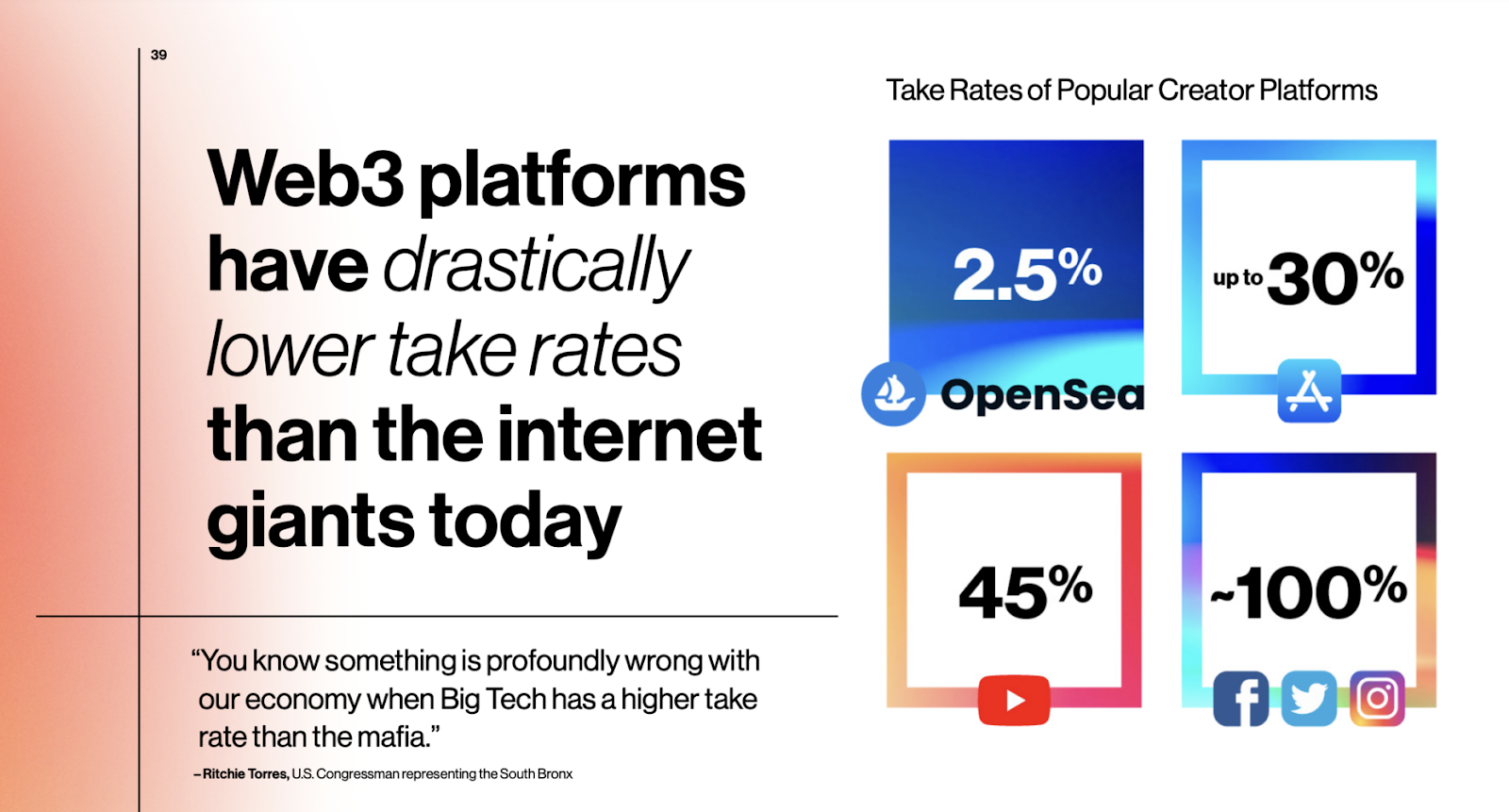
A16z argues that Web3 platforms, such as OpenSea have a lower “take rate” for creators than Facebook, Twitter, and Instagram. (A16z led a $100 million round in OpenSea last year. After a $300 million round in January, the platform is now valued at $13 billion.)  

OpenSea takes 2.5% of every transaction on its platform, as opposed to Facebook, Instagram, and Twitter, which take 100% of creator value, the VC firm argues. 

Some of these things don’t belong together.

Talk about comparing apples to oranges. These things aren’t the same! OpenSea is a marketplace where people buy and sell tokens. The others are social media platforms. Better comparisons? eBay charges sellers 2-12%, depending on the category. Bandcamp takes 15%, which is very low for a record shop. But also, these are just sales. OpenSea is a trading platform. Coinbase takes 0.6% commission on trades below $10,000. 

Dixon et al also claim that OpenSea is better for creators because it pays royalties. You can get a percentage of secondary sales going forward. 

This is the crux of how Yuga Labs has made untold millions. Every time a Bored Ape Yacht Club NFT sells on OpenSea, Yuga Labs pockets 2.5% of the sale price.  

Ironically, despite the fact that they are getting hysterically rich, Yuga Labs pulled the rug on the actual artist behind the monkey cartoons. Lead artist Seneca told reporters that her payment was “definitely not ideal.” In a now-deleted tweet, she wrote: “Bored Apes rugged me.”    

As for other artists getting rich on royalties on OpenSea, there is no secondary market for them to make money on. It’s mainly wash trades. 

Lie #3: ‘Crypto is having a real-world impact’

Crypto peddlers routinely talk about how crypto will help undeveloped countries. “Banking the unbanked” is a phrase that a16z uses regularly. “Crypto offers a shot at financial inclusion,” it says in its report. 

Truth: Crypto has completely failed as a payment system. It’s too slow, too volatile, and too irreversible — one fat finger mistake, and your money is gone forever. 

In El Salvador, Nayib Bukele, the country’s authoritarian president, passed a law making bitcoin legal tender. However, nobody in the country is actually using bitcoin for payments. Instead, they almost all use a wallet (Chivo wallet) that updates the balance in a central database. And they are not even using that! 

A16z lists other examples of how crypto is saving the world:

  • Flowcarbon ($GNT) is “revamping carbon credits.” Truth: Crypto traders have been searching the carbon market for older, cheaper offsets to buy and tokenize. Climate experts are specifically horrified by carbon credits on a blockchain. These tokens are akin to collateralized debt instruments.
  • Helium ($HNT) is the “first legitimate, decentralized challenge to entrenched telecom giants.” Truth: Helium is a utility token ICO scam where you mine HNT to pay for long-range/low-bandwidth wireless connectivity. To start mining, you have to buy $80 worth of gear from a Helium-approved vendor marked up to $600. Some miners report making less than $1 per day. A16z led a $111 million token token sale for Helium’s HNT in August 2021. (Update 7/30/2022: It turns out Helium has been lying all along about its partnership with Lime and Salesforce.)
  • Spruce ($SPR) is “enabling people to control their own identities, rather than ceding that power to online intermediaries, like Google and Meta, who profit off people’s information through their data-mining business models.” I’m sure everyone wants their identities stored on an immutable blockchain!

A16z also talks up DAOs (decentralized autonomous organizations), which are neither autonomous nor decentralized. As with the Apecoin DAO, decisions are made by those who hold the most $APE, meaning Yuga Labs and a16Z. (Yuga Labs recently raised $450 million in seed funding in a round led by a16z. VCs got $APE in return.)

Dixon also claims NFTs “grant people virtual property rights across profile pictures, artworks, music, in-game items, access passes, land in virtual worlds, and other digital goods.” 

This is simply false. NFTs don’t convey any rights at all. Copyrights and ownership rights are only passed along in a separate written contract — something that doesn’t need a blockchain.  

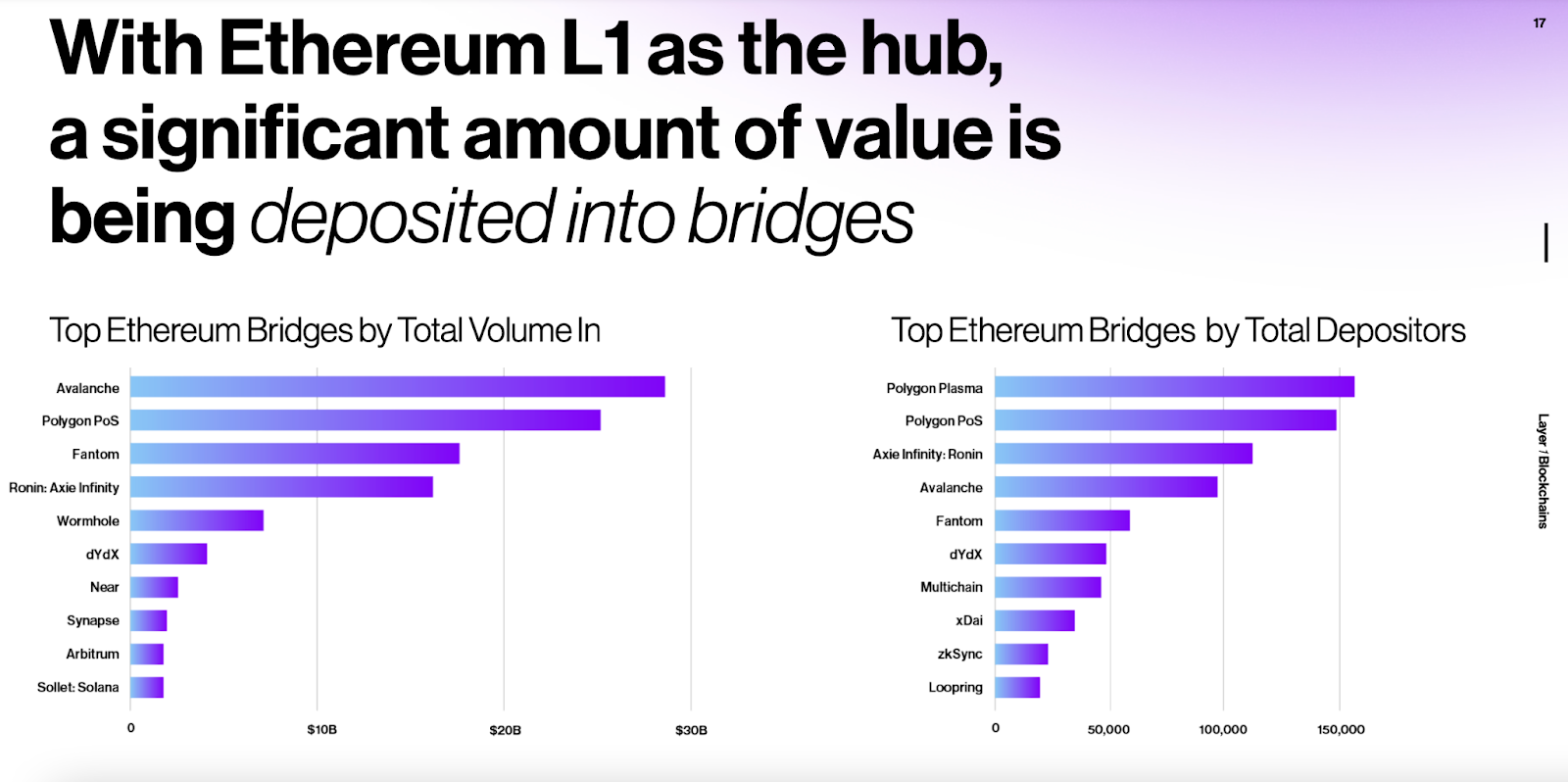
Lie #4: ‘Ethereum is the clear leader, but faces competition’

Web3 is built on the myth that the infrastructure exists to support a plethora of apps running on blockchains. A16z writes: “Ethereum dominates the Web3 conversation, but there are plenty of other blockchains now too. Developers of blockchains like Solana, Polygon, BNB Chain, Avalanche, and Fantom are angling for similar success.”

Reality: Ethereum can’t cope with any of this. In 2017, Ethereum slowed to a crawl when CryptoKitties, a game where people trade cartoon cats, became popular. Last month, when Bored Apes Yacht Club sold 55,000 NFTs representing plots of virtual land for its Otherside MMO, people ended up paying twice the cost of the land in gas fees, and the network became virtually unusable for other projects. 

Nicholas Weaver, a former researcher at the International Computer Science Institute at Berkeley and CEO at Skerry Technologies, estimates that Ethereum has 1/5000 of the compute power of a Raspberry Pi, a tiny hobbyist computer-in-a-matchbox.

Ethereum has a goal to move to a proof of stake consensus mechanism to solve these problems, but the move has been six months away for years now.   

As for these other blockchains, they are tiny projects that haven’t been tested at scale. Solana gets clogged regularly too, with shutdowns of the entire network.  

A16z writes that “with Ethereum L1 as the hub, a significant amount of value is deposited into bridges.” (Slide 17.) 

Truth: Ethereum doesn’t work, so games are resorting to bridges, which are being hacked in record numbers. The $600 million in ETH that was once on the Axie-Ronin Bridge is now in the hands of North Korea. Bridges are smart contract pinatas. 

Bridges are a honeypot for hackers.

Lie #5. ‘Yes, it’s still early’

Once again, a16Z falls back upon this B.S. argument of comparing Web3 to the internet: “We estimate there are somewhere between seven million and 50 million active Ethereum users today, based on various on-chain metrics…Analogizing to the early commercial internet, that puts us somewhere circa 1995 in terms of development.”

Crypto is 13 years old. At that age, the World Wide Web was in peak dot-com bubble, and adoption was limited by access to bandwidth, not by lack of interest or usefulness.  

I doubt any actual investors will read a16z’s State of Crypto report. It’s a string of excuses to feed the media in the hope they can keep the music playing a bit longer. At some point, I predict that most of the shitcoins that a16z is peddling will trade close to their real value, which is nothing. And Web3 will become widely recognized for what it is — a joke. 

I need your support! If you like my work, please consider subscribing to my Patreon account for $5, $20, or $50 a month. Your contributions really make a difference.

The NFT market hasn’t crashed — it was never not crashed

I wrote a story this week on the NFT market for Artnet News. You can read it here. As always, there’s more to say on the subject!

After Paul Vigna at the WSJ announced that the NFT market is “collapsing,” dozens of other media outlets have been rushing to write their own stories on how the NFT market is crashing. 

Fortune’s headline read: “The NFT bubble is showing clear signs of bursting.” Decrypt wrote: “Bored Ape Yacht Club, Other Ethereum NFT Prices Plummet as Crypto Market Crashes.” And the LA Times reported that NFTs are crashing along with SPACs, meme stocks, and other risky investments.

Vigna pulled his data from Nonfungible.com. Gauthier Zuppinger, the COO of Nonfungible.com, told me the data Vigna looked at was incomplete, “insofar as it came from the front end of our site, which was in the process of synchronizing data from Axie Infinity.” A popular P2E game, Axie-Infinity represents a large volume of active NFT wallets and transactions. To be fair, Zuppinger sent me this to show me the market isn’t quite as terrible as the WSJ reported.

However, if you look at what’s on Nonfungible’s site, which is clearly what Vigna was looking at, things look bleak. Aside from an uptick in NFT sales on April 30 when Bored Ape Yacht Club held its Otherside land sale, things have been slipping downhill since the beginning of the year.

Admittedly, the data on the NFT market is confusing. Some of the reports on Dune Analytics and DappRadar make it look like the market still has a fighting chance. Blockchain analytics firm Chainalysis published a report on May 5 on how NFT transaction activity has been “stabilizing.” 

NFTs are illiquid assets. It’s not easy to find a new sucker everyday willing to pay millions of dollars for a JPEG — not even a JPEG, but a token on a blockchain that points to a JPEG.

This is why we see situations like the one on Feb. 8, when a seller going by @0x650d on Twitter decided to “hodl” his collection of 104 CryptoPunks at the last minute. The collection was supposed to fetch $30 million at Sotheby’s — but there were no buyers.  

If you accept that the NFT market is crashing, you have to accept that the NFT market ever existed at all. 

The problem with NFT data is that most of it is coming from the NFT platforms themselves. There’s no way to confirm if what they are reporting is real. And there is good reason to suspect the secondary market doesn’t exist at all — it’s just wash trading, meaning the same money is going back and forth between the same people, to pump up the prices. 

Most of the activity on LooksRare, a marketplace that launched in January and went on to challenge power player OpenSea, turned out to be fake. In February, Chainalysis reported “significant” wash trading on NFT platforms. Their findings made international news. On May 4, the first day that Coinbase opened its NFT marketplace to the public, the platform had barely any users. This was after Coinbase boasted that 4 million were on the waitlist.

If you accept the NFT market is real, you have to be willing to accept that there are people on the planet who are willing to plunk down $350,000 for a Bored Ape NFT so they can go to a Yacht Club party in New York and a warehouse party in Brooklyn. 

You have to accept that Jimmy Fallon, Paris Hilton, Madonna, and dozens of other celebs believe that monkey JPEGs are a good investment — and they weren’t gifted these pricey tokens by friends in the entertainment industry, who also happen to be heavily invested in NFT projects. 

If you are still not convinced the NFT markets are fake, let me step you back to March 11, 2021, when all this nonsense first began, when an otherwise unknown artist named Beeple sold an NFT linked to a collage of his scrapbook at Christie’s for $69 million. It turned out that Metakovan, aka Vignesh Sundaresan, the person behind the purchase, had been pumping Beeple NFTs for months. 

Not only that, but the sale itself was a wash trade. Metakovan fractionalized a collection of previously purchased Beeple NFTs with a fungible B20 token and used the Christie’s auction to pump up the price of B20 and make millions.

“From the day the Christie’s auction began, on Feb. 25, to the close of the auction on March 11, the price of one B.20 token grew from $8.28 to $18.57,” the Washington Post wrote at the time. “The value of Metakovan’s stake in B.20 ― about 5 million tokens, according to his blog post — grew by about $51 million over that period.”

Monty Python’s John Cleese recognized the market was a joke early on. After Beeple’s “Everydays” sold, Cleese tried to sell an NFT of a scribbled drawing of the Brooklyn Bridge for $69.3 million. “I have a bridge to sell you,” he said. And yes, someone did buy that bridge — someone on OpenSea going by the pseudonym “JeffBezosForeskin” bought it for 17 ETH. He still owns it, likely because if he tried to sell it, he would get nothing. 

Crypto is crashing. Bitcoin — which is now fighting to stay above $30,000 — is down 60% since its November record. If crypto is crashing, NFTs should not be “stabilizing.” They should be writhing on the ground, gasping their last breath. 

But that won’t happen because the paramedics will soon arrive in the form of large backers. VCs, like A16z, who heavily invested in the NFT market wanted you to believe that NFTs were going to safeguard artists’ work. They told us we’d all use our NFTs in the metaverse. Reddit co-founder Alexis Ohanian, a member of the APE DAO Foundation, said a year ago: “the rise of NFTs and trading card boom is going to be HUGE for women’s sports.” His wife, tennis star Serena Williams, is one of the many celebs who mysteriously acquired a Bored Ape NFT. 

These investors will keep pumping these assets, they will keep tweeting about how stellar NFTs are, and they will fight to keep this market breathing, even if it means throwing good money after bad. 

NFTs will seemingly rise from the ashes, probably in the form of MMO games, more virtual land sales, or stories about groups of unfortunate people benefitting from NFTs. And then, predictably, NFTs will die again and ultimately return to their real value, which is nothing. 

If you enjoy my work, you can support my writing by subscribing to my Patreon account for $5, $20, or even $50 a month. 

Why is bitcoin dropping in price?

As I write this at 9 pm ET, on May 5, the price of bitcoin is $36,300. It slid from $39,000 Thursday to below $36,000 at one point, causing a disturbance in the force.  

There were two sharp drops — at 15:00 UTC precisely and 19:00 UTC precisely, with attempts to walk the price back up both times. The last thing you want is to kick off a panic, so there will always be whales in the background trying to lift bitcoin back up when it falters. 

After starting the year at $46,700, bitcoin saw a January sell-off, which pushed the price down to $35,000. Apart from that, the world’s most popular crypto has been trading in a range of around $40,000 — a far cry from its record of $68,990 in November 2021. 

Why did it slip Thursday? Because bitcoin mirrors the stock market, mainly tech stocks. 

On Wednesday, Fed Chairman Jerome Powell said there may be .5% rate increases over the summer, but that officials weren’t considering a .75% increase.  

The momentary glee pushed stocks up on Wednesday, but those gains were erased on Thursday when the Federal Reserve raised its target federal funds rate by half a point — the second increase by the central bank this year.

Stocks tumbled. The Dow Jones fell 3.1%. The S&P 500 fell 3.6%, and the tech-heavy Nasdaq slid 5% — its biggest drop since June 2020.

Bitcoin is down 27% since the beginning of the year — and 47% since it’s November all-time high. Tech stocks have also done poorly this year. Google’s parent company Alphabet lost 20% of its share price, Microsoft is down 17%, and Meta has fallen 34% since the start of the year. 

Are the good times coming to an end? 

Over the last two years, the stock and crypto markets have been able to turn a blind eye to the reality of the pandemic because there was plenty of money flowing into the game to keep things going. 

Stimulus bills approved by Congress beginning in 2020 unleashed the biggest flood of federal money into the US economy ever. Roughly $5 trillion went to households, shops, restaurants, airlines, hospitals, local governments, schools, and other institutions. 

Stimulus checks ($1,200 in April 2020, $600 in December 2020, and $1,400 in March 2021) helped fuel a stock-buying spree — and a crypto buying spree. 

Starting in 2022, government programs meant to invigorate the economy during the pandemic ended. Now, reality is settling in. Americans are starting to think hard about the future. They are taking a good long look at their bank accounts and their budgets. 

The longer the Russia-Ukraine war goes on, the bigger its economic costs will be — and the war is looking like it will drag out for possibly years. 

Inflation is at its highest level since the 1980s, reaching 8.5% in March from a year ago. When I go to the grocery store, I can see the prices going up weekly. Avocados at Trader Joe’s are $2.29! 

Rising food prices are terrifying to a lot of people. Gas prices in parts of the country (California, Nevada) are over $5. It takes a lot of money to fill up the tanks in the SUVs Americans love. 

People are moving away from risky investments — like crypto — and fleeing to safety. They want to make sure they can weather inflation and any future slowdown in the economy. 

So they are putting their money into things like I Bonds right now. Just go to Treasury Direct. You can put $10,000 per year in I Bonds and they are paying 9.62%. That’s a lot safer than bitcoin. 

Of course, it’s not just rising interest rates that are rattling the crypto markets. Bitcoin needs fresh cash to keep prices buoyed, and it’s not clear where that next batch of fresh cash is going to come from. 

I wrote earlier about Grayscale’s Hotel California. The Grayscale Bitcoin Trust (GBTC) arb opportunity that pushed bitcoin to new heights in 2020 and early 2021 has dried up.  

Between January 2020 and mid-February 2021, bitcoin climbed from $7,000 to $56,000. GBTC is now trading at 25% below net asset value, and Grayscale stopped issuing new shares in March 2021. 

Grayscale is pushing for the SEC to convert GBTC into a spot bitcoin ETF to open the gates for more cash to flow into the cryptoverse. But it is doubtful that will happen. 

The SEC has rejected every spot bitcoin ETF to date, and — as I’m sure the commission will recognize — Grayscale can redeem those shares on its own at NAV if it wants.  

And then there’s Tether. On March 11, 2020, when the WHO declared COVID-19 a pandemic, causing a massive sell-off in stocks and crypto, Tether’s market cap was $5 billion. Today, 83 billion tethers are underpinning the price of bitcoin. What’s underpinning tethers?

It’s widely accepted amongst crypto critics that Tether is a fraud. Hindenburg’s Nate Anderson predicted that Tether’s two public faces would end 2022 in handcuffs. 

If you include the 48 billion USDC sloshing around in the crypto markets, I suspect insiders can pump the price of BTC past $50,000 anytime they want with stablecoins — but they don’t because there would not be enough cash in the system to keep up with withdrawals.

The same network effects that pushed bitcoin to its highs can unravel. At some point, people will want to sell their bitcoin for cash — not tethers or USDC. That means someone has to be on the other side of the deal ready to hand over real dollars. 

I don’t think the Big Crash is happening now, but the bitcoin sell-off on Thursday was an indication of just how wobbly things have become. All the conditions are ripe for a collapse in the crypto markets. It’s just a matter of time. 

If you like my work, consider supporting my writing by subscribing to my Patreon account for as little as $5, $20, or $50 a month. 

NFT news: BAYC breaks Ethereum, OpenSea accepts APE, NFTs are like Papyrus

  • If you like my work, consider supporting me on Patreon. I post on my blog so I can say what I want to say, but I depend on Patreon support to keep me going. 
  • David Gerard and I are still plugging away on our NFT book. We have everything we need to write the darn thing, but we keep falling down rabbit holes!
  • Do you have inside info on an NFT project? My Twitter DMs are open. You can also contact me here.

Yuga Labs had their massive land NFT sale for their Otherside MMO, which doesn’t even exist yet. The sale, on April 30, was a mess for anyone trying to buy, but a complete success for Yuga, which netted $320 million in APE. Ethereum became unusable for other projects during the sale. [Amy Castor]

Yuga Labs say they have refunded everyone for failed transactions — but those who paid ridiculous gas fees for transactions that did go through are stuck with the cost. [Tweet]

In total, Yuga spent 90.57 ETH ($265,000) on roughly 640 refunds. The largest individual refund was 2.6 ETH ($7,500). [Etherscan]

On Reddit, u/Atariconcarne has the perfect analogy: “It is like paying for your cheeseburger combo with a credit card and the guy with the paper hat at the register saying ‘Your 5 bucks transaction fee wasn’t enough. Want to try again for 10?’” [Reddit]

Ethereum doesn’t work, sure, but this is also what happens when you change plans at the last moment and upload crap to the blockchain. Yuga Labs’ smart contract had no optimizations for gas fees. [Tweet

If Yuga Labs can’t pull off a land auction without putting buyers through hell, how are they going to create an MMO? I expect Otherside to work at least as well as Axie-Infinity, which netted the DPRK $600 million. Bridges are the smart contract pinata!  

Burn it with fire!

Speaking of Axie, the Ronin hackers are laundering their funds through Tornado Cash. Nicholas Weaver argues that Tornado Cash needs to be sanctioned to prevent the DPRK from profiting from the theft. Let’s hope someone from OFAC reads his post and takes action. [Lawfare]

$450 million of WETH in users’ Ronin wallets is still unbacked. After VCs put in $150 million to stabilize the situation, we haven’t heard anything from Sky Mavis on how they are going to fix this yet. In March, they promised all users would be refunded.  

Axie-Infinity resembles a multi-level-marketing scheme. u/ale23arg on Reddit talks about how he earns income as a scholar: “im a manager in the US as well i peaked at about 22 scholars and now im holding around 12….” [Reddit]

Bored and empty

Bored & Hungry, the Bored Ape-themed burger pop-up in Long Beach, Calif., was only planning on being open for 90 days. Now, much to the horror of their neighbors, they have officially announced: “We are here to stay.” [Amy Castor, Instagram

The Chronicle’s Cesar Hernandez visited Bored & Hungry for a bite. “What’s most infuriating to me is that this restaurant model inspires the same hollow dread as some ghost kitchens. It’s a soulless attempt to capture the zeitgeist, combining pop culture with food trends.”

Whilst there, he asked one of the cashiers what he knew about NFTs: “He looked at me with a puzzled expression. ‘Not much, I just got hired to work here.'” [Chronicle]

While the pop-up opened with long lines, that’s apparently no longer the case. “I drive by this every day, and it’s almost completely empty,” Michael Narciso, who lives in the area, tweeted.

The NFT market is flatlining!

The Wall Street Journal’s Paul Vigna reports that “the NFT market is collapsing,” with daily average sales down 92% from a peak in September, according to data from NonFungible. [WSJ]

Believe me, I wish the NFT market would collapse, but it’s important to take these reports with a grain of salt — VCs are still pumping huge money into the space. They have investments to cash out on! 

To prove his point, Vigna pointed to a Snoop Dogg curated NFT that sold in April for $32,000 in ETH. It’s now up for $25.5 million ETH, and the highest current bid is for $210, he said.

This isn’t a great example, said Molly White. The original $32,000 sale was WAY higher than most resales of NFTs from this collection. Weird, but “less weird if we assume the original minter is wash trading.” [Twitter thread]

Enuff with celebs promoting NFTs

Last month, Tonight Show Host Jimmy Fallon, who also owns a Bored Ape NFT, tweeted about Moonbirds. He also changed his Twitter profile photo to a Moonbird owl — previously, it was a Bored Ape. Nobody will say if Fallon received a free Moonbird or not. [Buzzfeed]

Fallon isn’t alone. There is a long list of celebs mysteriously acquiring high-value NFTs and giving fans the (false) impression that they purchased these as an investment. A more likely scenario: they received the NFTs as gifts in exchange for promoting the projects. This is wrong and bad on many levels.

“Withholding such material information is illegal, and both the company and the influencer are on the hook for such deception,” Bonnie Patten, the executive director of consumer advocacy group Truth In Advertising, told BuzzFeed.

How are dozens of celebs acquiring Bored Ape NFTs? Are they getting them as gifts, without saying they are getting them as gifts? Because if that’s what’s happening, it’s a real sleazeball way of promoting the project. [Amy Castor]

Other stuff

Reddit co-founder Alex Ohanian, who owns a pile of APE and sits on the APE DAO foundation, compares NFTs to papyrus and the Gutenberg Bible. We only need to wait a few thousand years for NFTs to reach their full potential. The quote tweets on this are just fantastic. [Tweet]

OpenSea has started accepting APE. Why? Because the NFT marketplace is backed by a people (Coinbase, Creative Artists Agency, a16z, Ashton Kutcher) who stand to make a lot of money on APE. No surprise here. [Decrypt]

A few weeks ago, David Gerard wrote a popular story on how VCs cash out on the securities-fraud-as-a-business model. Everyone should read this — and then read it again. [David Gerard]

Apecoin shoots up 19% after Elon Musk provides a practical demonstration of how stupid NFTs are. (Hint: he changes his twitter profile pic to a collage of Bored Apes.) [CNBC] 

Asked on Reddit what the difference is between Zuck’s Metaverse and the old Second Life, u/AnimalFarmKeeper responds: “Second Life was as the name suggests an adjunct to the real lives of people. The Metaverse is largely touted as a place for those with no life.” [Reddit]

Last month, Zackxbt posted a leaked list of NFT and crypto shills. Vice reached out to the shills to learn more. Some get paid pretty well! Ashley Duncan is “earning more than she’s ever made in her life, pulling in more in two months than she used to make in an entire year by creating NFT projects, performing occasional consulting work, and pumping crypto.” [Vice]

Policy expert Elizabeth Renieris went on nonprofit ACT-IAC’s The Buzz podcast to dispel myths about Web3 for the government technology community. [The Buzz]

Coinbase opened up its NFT marketplace beta to the public, but so far, it’s hardly seeing the mad rush of users that was expected after bragging about all those early signups. [Bloomberg]

Kraken also wants to get in on the gold rush. It’s launching an NFT marketplace with zero gas fees. [Decrypt]

Me in the news 

I wrote a story for Artnet News on DAOs and the art market. Art dealers are seriously concerned about selling work to DAOs — their biggest fear is that the project will destroy the work and turn it into an NFT, so it only lives in the virtual world. [Artnet News, paywalled]

In another story for Artnet News, I spoke with several lawyers to get their feedback on a UK judge reportedly announcing that NFTs are property. Hint: Yes, NFTs are property. But there is nothing here that says if you own a token, you also own the thing the token points to. [Artnet News, paywalled]

Yuga Lab’s Otherside land sale turns into a giant gas war

Yuga Labs launched a land sale for its upcoming metaverse project Otherside Saturday night, which quickly morphed into a gas war — and broke Ethereum. 

As part of their psychedelic-fueled business plans, Yuga Labs offered 55,000 NFTs called “Otherdeeds” for 305 APE each ($5,800, at the time). Apecoin was the only crypto accepted for the minting.  

The sale, which started on April 30, at 9 p.m ET, immediately became a land grab for the rich. People paid between 1.3 ETH to 1.9 ETH ($3,500 to $5,500), on average, just to get their transactions to go through. Some even paid 5 ETH ($13,500) and higher — double the cost of the land itself.

The high fees lasted several hours, making Ethereum virtually unusable for any other projects. [Reddit]

By the time the sale was over, Yuga Labs netted 16.7 million APE ($310 million), helping to recentralize a coin they can then claim is decentralized. All of the APE acquired in the sale are locked up for one year. 

Gas fees

Ethereum — a “world computer” — ambles along at 15 transactions per second. You have to pay a fee, called “gas,” to Ethereum miners to process transactions. 

When transaction volumes are high, miners get to selectively process only transactions paying the highest gas fees. The higher the gas fee you are willing to pay, the better your chance of having a miner include your transaction in the next block on the blockchain.  

If you happen to pay too low a gas fee, your transaction will fail, and you lose your gas money. The Otherdeed mint saw lots of failed transactions. [Dune]

What happened?

Originally, Yuga Labs were going to do a Dutch auction. 

In a Dutch auction, also known as a descending price auction, you determine the price of something after you collect all of the bids. Bidders indicate how much they are willing to pay for an item and the number of items they want to purchase at that price. If there are insufficient bids to sell all of the items, you lower the price until you find a price that works for everyone. 

The phrase dates back to the 17th century when Dutch auctions were used to sell fresh flowers in Amsterdam.

However, Yuga Labs decided to scratch that plan at the last minute because — “Dutch auctions are bullshit.” [Otherside blog post]

Instead, they opted to sell the land to pre-approved KYC’d wallets for a flat price of 305 APE.

There were concerns from the beginning about a gas war erupting. Yuga Labs assured everyone that everything would be fine, because they were going to do the sale in waves, initially limiting the number of mints to two per wallet “to ensure as broad a distribution as possible and dramatically soften the potential for a massive gas war.”

The plan failed, and the mint consumed over $177 million in gas fees. Only those with enough ETH on hand got the land. So much for wide distribution. [Etherscan] 

Demand for NFTs was so high that even Etherscan crashed, said Yuga Labs. [Twitter]

Yuga Lab’s smart contract had no gas optimizations at all. They waited until the last minute, and then uploaded poorly written crap to the Ethereum blockchain.

Yuga Labs say they’re sorry for the whole mess, and they promise to do better next time. [Twitter]

They also said that they will refund any failed transaction fees. [Twitter]

Yuga Labs’ business acumen consists of finding a reliable pool of suckers who they squeeze regularly for more money. Their business acumen does not extend to any form of technical competence or even how to run an auction. But it does exactly the job it is supposed to do: it gets them their money. In that sense, the land mint was a success. 

In collectors’ hurry to mint the metaverse land NFTs, some inevitably fell victim to phishing sites. Crypto sleuth Zachxbt found scammer wallets that netted $6.2 million in stolen NFTs. [Twitter]

What’s next? 

Otherside, a massively multiplayer online (MMO) game that Yuga Labs is working on with partner Animoca Brands, doesn’t even exist yet. At this point, they just have a website with a trailer with The Doors’ “Break on Through” playing in the background.  

Yuga Labs is now talking about developing their own blockchain to alleviate network congestion problems in the future. 

Ethereum doesn’t work for the job it’s intended to do, even though a16z, Yuga Lab’s backer, keeps talking up Web3 as the future of the internet. 

As a result, blockchain game developers often resort to creating their own blockchains. Dapper Labs eventually moved CryptoKitties over to a new blockchain called Flow, after the game caused Ethereum to slow to a crawl in 2017. 

Axie Infinity, another popular game, created a new blockchain called Ronin. However, they had to create a bridge so that Ethereum tokens, in the form of WETH, could be used on Ronin. The result was a $600 million hack. Bridges are a risky proposition. David Gerard calls them smart contract Pinatas. 

In addition to the 55,000 Otherdeeds it sold on Saturday, Yuga Labs plans to airdrop another 45,000 land parcel NFTs to Bored Ape and Mutant Ape holders, as well as Yuga Labs and other project developers. Another 100,000 parcels are expected to be awarded later to certain Otherdeed NFT holders, according to the Otherside website. [Otherside FAQ]

If you missed out on buying an Otherdeed NFT on Saturday, several are currently being flipped on OpenSea for a floor price of 6.5 ETH ($17,000).

APE, which was trading as high as $26 before the land sale, has tumbled to $17. 

(Update: In an earlier version of this story, I said Yuga would refund gas fees for Otherdeed purchases. They will only refund failed transaction fees.)

If you like my work, consider supporting my writing by subscribing to my Patreon account for as little as $5 or even $20 a month. Your support does make a difference. 

GBTC investors are spamming the SEC 

The Securities and Exchange Commission is being inundated by thousands of comments solicited by Grayscale to support the conversion of their Grayscale Bitcoin Trust (GBTC) into a spot bitcoin ETF. [Comments on NYSE Arca Rulemaking]

As part of the filing, the SEC provides a comment period of 240 days. NYSE Arca filed the application on October 19, 2021, so the last day for comments is June 16. 

Bitcoin skeptics refer to GBTC as the Bitcoin Roach Motel or Hotel California, a place you can check in but never leave because once bitcoin goes into the trust, it has no obvious way of getting out. I covered the details of how the trust works in an earlier blog post. [Amy Castor]

GBTC is currently trading at 25% below the price of bitcoin. Grayscale argues that converting it to a spot bitcoin ETF will allow GBTC to trade in line with its underlying asset. 

In truth, Grayscale can redeem shares and return investors their money, but it stands to make hundreds of millions of dollars more with an ETF, so you should definitely spam the SEC instead!

Grayscale has encouraged spamming the commission through a massive ad campaign at Amtrak stations. Grayscale CEO Michael Sonnenshein is going around giving press interviews, pointing out how mean and evil the SEC is for never having approved a spot bitcoin ETF in the past. 

On its website, Grayscale offers a link that opens up directly to a ready-made email, making it mindlessly easy to spam the SEC in a few simple clicks. 

Jorge Stolfi, a computer scientist in Brazil, has been reading through the SEC comments one by one and posting his thoughts on Twitter.  

Nearly 4,000 comments have been submitted so far, and 98% of them are positive in that they support converting GBTC to a bitcoin ETF. Some of the names look suspiciously made up.

Thousands of the comments are copies of the same Grayscale spam message, and many don’t even bother to edit the “[YOUR NAME HERE]” placeholders.

Many of the comments parrot Sonnenshein’s remarks to the press about how the SEC has approved a bitcoin futures ETF; therefore, it should also approve a spot. (This is nonsense. The former is an actual bet on dollars. Nobody touches BTC at any point in the process.)

Hopefully, the SEC will read the spam comments and understand them for what they are: clear evidence that thousands of GBTC investors do not understand the nature of bitcoin, and that GBTC should not be converted to an ETF for the sake of those same investors.

In reading through the comments something else becomes alarmingly clear — many retail investors are stuck with GBTC in their retirement accounts. Thanks to a television ad campaign that Grayscale ran in 2020, many falsely believed that bitcoin was a hedge against inflation, rather than an incredible risky and volatile asset.  

Amongst the positive comments, Coinbase submitted a ridiculously long (27 pages) letter trying to demonstrate that the bitcoin market cannot be manipulated. They somehow forgot to mention the 83 billion tethers currently sloshing around in the crypto markets. [SEC Comment 

Last year, Coinbase settled charges with the CFTC that one of its own employees was wash trading the vast majority of a certain coin’s volume on their own exchange, and they apparently weren’t aware of it until much later. I’m sure they have a lot of credibility on this subject!

Voices against the GBTC conversion

There are a few powerful letters to the SEC against the conversion. These are definitely worth a read for anyone who wants to get a better understanding of how GBTC works.  

Writing on behalf of a client, Ropes & Gray Attorney David Hennes does a fantastic job underscoring how Grayscale is royally screwing over GBTC holders. [SEC Comment

As Hennes points out, Grayscale bought $700 million worth of its own GBTC shares at a discount and is authorized to buy back $1.2 billion. 

If GBTC converts to an ETF, Grayscale would then be authorized to sell the corresponding bitcoins at the market price, thus making some $200 million to $350 million in profit at the expense of those who sold them the shares at discount. 

Since Grayscale is no longer issuing shares of GBTC, it can redeem GBTC at net asset value without running afoul of Regulation M, as it had in the past. However, it chooses not to because it is collecting a 2% management fee on $25 billion in BTC assets held in the trust.  

“The SEC should thus deny the conversion of GBTC into an ETF unless and until Grayscale first (a) initiates a redemption program for GBTC that complies with Regulation M; and (b) agrees to distribute to GBTC’s other shareholders on a pro-rata basis any and all gains resulting from any Grayscale purchases of GBTC shares at a discount and corresponding sales of GBTC shares on an undiscounted basis,” wrote Hennes.

Computer scientist David Rosenthal, who gave a popular lecture at Stanford warning about the hazards of crypto, says all of the reasons the SEC had for rejecting previous bitcoin spot ETFs — and there have been close to a dozen of them — are still valid. 

“The constant pressure to approve a spot Bitcoin ETF exists because Bitcoin is a negative-sum game. Bitcoin whales need to increase the flow of dollars in so as to have dollars to withdraw. The SEC should not pander to them.” [SEC Comment] 

Rosenthal also comments on my Grayscale story in his blog. [DSHR blog]

Along that same vein, David Golumbia, author of “The Politics of Bitcoin,” warns “manipulators in the crypto space need a constant inflow of real dollars to prop up their manipulation so that they can continue to dump their tokens into the hands of ever more unsuspecting consumers. That they are obviously engaged in selling their own tokens for a profit while bullying others into buying at the same time is only one of many tactics they use that are illegal in well-ordered markets.” [SEC Comment]

In his own submission, Stolfi states that bitcoin is a tool of crime. It allows dark markets to exist and flourish. It has taken the place of the now-defunct criminal bank Liberty Reserve. And it functions as a natural Ponzi. [SEC comment]

“Bitcoin does not provide any benefits for society; on the contrary, it has caused enormous damage; and this balance cannot ever improve, because the technology is inherently wasteful, impractical, illegal, and insecure.”  

Someone going by “Concerned Citizen of the Word” noted that “It’s just a matter of time before the Bitcoin bubble pops due to any of many reasons, and a lot of people, especially Americans, are going to lose massively.” [SEC comment]

If you are similarly disturbed by Grayscale’s campaign of misinformation, I encourage you to write to the SEC and make your own voice heard — with original commentary, which I’m sure they would appreciate. You can submit your comments here.  

If you like my work, consider supporting my writing by subscribing to my Patreon account for $5 or $20 a month. Every little bit helps.

Bored Ape Yacht Club: Unanswered Questions

I’m working on a chapter on Bored Ape Yacht Club for the NFT book that David Gerard and I are painfully slogging away on. It’s like dredging through a swamp full of stupid.  

Anyway, I’ve come across a series of unanswered questions that I need help answering. If you know anything, my DMs are open. I will update this document accordingly if I come up with more unanswered questions — which I’m sure I will. 

Why do we know so little about Yuga Labs’ founders? 

I can find almost nothing on Yuga Labs’ core founders, Wylie Aronow and Greg Solano, who operate under the pseudonyms Gordon Goner and Gargamel. 

Wylie Aronow and Greg Solano, founders of Yuga Labs

How is it these two have made it into their 30s with almost no Web presence? It just doesn’t make sense — unless, they never held down real jobs before. 

Their LinkedIn profiles, here and here, are blank.  

Most of what we do know about them comes from an interview they did with Rolling Stone, in an article published on November 1. This three months before Buzzfeed revealed their real names. (They weren’t doxxed; their names were clearly listed on public business records.)

Both grew up in Miami. They claim they met in a dive bar in their 20s and bonded over a heated discussion on David Foster Wallace. Apparently, they are somewhat literary, so this is likely true. 

While he was living in Chicago for a stint, Aronow was featured in the Chicago Tribune’s “Readers of the Week” in November 2014. 

Solano has some poetry reviews on ZYZZYVA, circa 2013 and 2014, but that’s all I can find on the two in terms of their literary obsessions.  

In the Rolling Stone interview, Aronow refers to his “gambling problem days,” and says he was a high-school dropout. He admits he never had a real job.  

On the other hand, Solano claims he did go to college and grad school. He previously worked as a writer and editor. His roommate from college was mining bitcoin in 2010, he said. 

Aronow and Solano became crypto traders during the crypto bubble/ICO period of 2017. 

If Solano went to college, where did he earn his degree? Where did he go to grad school? Inquiring minds want to know. 

Were the pair involved in any earlier crypto projects, like maybe a token offering? If so, did they use other pseudonyms?

What about Yuga Labs’ other two founders? 

Aronow and Solano hired two developers — Sass and Emperor Tomato Ketchup — who were also part of the founding team.

The two software engineers “doxxed” themselves in early February right after the Buzzfeed story came out on Aronow and Solano. They revealed their first names — Zeshan and Kerem — but not their surnames.  

Their full names are Zeshan Ali and Karem Atalay, as listed on Form D filed with the Security and Exchange Commission on March 22. 

Form D is a notice of an exempt offering of securities. These filings are specifically for the purpose of fully informing the public. Aronow and Solano’s names are also on the Form.   

The filing was so Yuga could sell shares in the company to accredited investors, such as A16z, and raise $450 million. It’s not clear that these shares were related to Apecoin.*  

Who did Aronow and Solano know? Early connections? 

Bored Ape Yacht Club has followed what appears to be a planned and well-strategized trajectory from launching an NFT project to getting a fungible token (APE) listed on Coinbase.  

The key to NFT collections is keeping holders holding, so they don’t sell their NFTs and go off to invest in other NFT collections, of which there are many. You want to keep the floor price up. 

This is usually done by airdropping holders more NFTs, which they can flip on OpenSea, and inviting them to networking events, where they can pitch their own NFT projects, etc.  

In their Rolling Stone interview, Aronow and Solano used words like “Web3” and “metaverse” and spoke about giving their NFTs real-world utility. This is investor speak. 

I suspect Solano and Aronow knew someone who advised them early on. What connections did they have? Who did they speak to before launching their project?

How are celebrities acquiring Bored Ape NFTs? 

Bored Ape Yacht Club has benefited from a number of high-profile celebrity endorsements. 

Celebs have been buying up Bored Ape NFTs, announcing their purchases on social media, and switching their Twitter profile pics to Bored Apes. 

Eminem, Jimmy Fallon, Stephen Curry, Post Malone, Lil Baby, Paris Hilton, and Madonna currently own Bored Ape NFTs, along with about a dozen other Hollywood influencers. 

Did these celebs pay full price for their Bored Apes? Is someone gifting NFTs to them for the purpose of promoting the project? 

Crypto payments company Moonpay has played a role in onboarding many celebs. Who is sending Moonpay ETH or cash to buy the BAYC NFTs?

The Federal Trade Commission has social media guidelines for influencers. If you endorse a product through social media, you have to make it obvious that you have a material connection with the brand. How is Yuga Labs getting around this? 

*Update, April 27: In an earlier version of this story, I said the Form D was related to distribution of Apecoin. It could just be equity in the company.

If you like my work, consider supporting my writing by subscribing to my Patreon account for as little as $5 or $20 a month. Every little bit helps!

After a guilty plea, Reggie Fowler faces up to 90 years in prison 

It was an unhappy day for Reginald Fowler, the man I’ve been following since his indictment on April 30, 2019. 

The ex-NFL co-owner went before a Manhattan judge today in a Zoom call from his home in Chandler, Arizona, to plead guilty to five counts: bank fraud, conspiracy to commit bank fraud, operating a money transmitter business, conspiracy to operate a money transmitter business, and wire fraud. 

In 2018, Fowler found himself in a new career. He was moving money for crypto exchanges on behalf of Crypto Capital, a Panamanian shadow bank. At the time, traditional banks wanted little to do with crypto exchanges due to the money laundering risks they posed. 

The fifth count, added later in a superseding indictment, involved Fowler defrauding a new football league called the Alliance of American Football by giving them $25 million that belonged not to him, but to the customers of the cryptocurrency exchanges he was holding money for.

Fowler was 23 minutes late for the hearing. He had a terrible time calling in. When he finally did log into the call, he had himself inadvertently muted. His lawyer Ed Sapone kept making excuses while federal prosecutors waited. 

Once Fowler was audible, Judge Andrew Carter read through the charges, making sure that he understood each and every one of them. And then finally: “How do you plead?” 

“Guilty your honor.”

The judge then proceeded to run through the statutory penalties: a combined 40 years for counts one and two, a combined 10 years for counts three and four, and 30 years for count five. 

Fowler, who is 63 years old, also faces a government forfeiture. Over a period of 10 months in 2018, he processed $750 million in crypto transactions in various currencies, nearly $600 million in US dollars, according to a DoJ press release.  

Fowler’s voice sounded muffled. At times he stuttered. He read from a prepared script at the end, trying to tell the judge and prosecutors his version of events, though he was almost impossible to hear and the court reporter kept asking him to repeat himself. 

“This has been a long and difficult road. I wanted to accept responsibility in the right way,” he said. “I am deeply sorry, and I plan to make full amends.” 

Fowler said he knew nothing about cryptocurrency when he opened the bank accounts under false pretenses, telling the banks that the accounts were for his real estate business. 

“I did not know they were dealing with digital assets,” he said, speaking of Crypto Capital. “My understanding was that all the money was lawfully clean money.”  

It is hard to understand what Fowler was going for. Perhaps hoping for leniency from the judge? If he had accepted a plea deal offered to him in January 2020, he would have faced a much lighter sentence, perhaps only five years. Instead, he bulked in front of the judge. Soon after, he lost his initial legal team, after neglecting to pay them.

Even if Fowler had gone to trial, it would have been up to the US government to find him guilty of all charges. He may have stood a better chance. But also, he would have had to endure press coverage, and the media picking apart his every word. 

His trial, originally scheduled for February, was set for May 16. Last week, his lawyer wrote to the judge and said that Fowler wanted to change his plea to guilty. 

Fowler’s sentencing is scheduled for August 30 at 2 p.m. ET.

If you like my work, consider supporting my writing by subscribing to my Patreon account for as little as $5 or even $20 a month. 

Reggie Fowler, Bitfinex/Tether’s alleged US money man, to plead guilty

In another last-minute twist, Reggie Fowler, the man at the center of hundreds of millions of dollars in missing Bitfinex-Tether money, is going to forgo a trial and enter an open plea to charges next week. His trial was scheduled to begin in May.

Fowler is charged with bank fraud, money laundering, and running an unlicensed money transmitting business. An open plea leaves the defendant’s sentence in the hands of the court, with no agreement from the prosecutor.

Fowler’s lawyer, Edward Sapone, filed a letter with a Manhattan court on April 21, asking Judge Andrew Carter to schedule a Rule 11 change of plea hearing. Fowler, who lives in Arizona, is hoping for a virtual hearing due to COVID, so he won’t have to get on a plane.  

The former football player allegedly ran a shadow banking service for Crypto Capital, a payment processor that crypto exchange Bitfinex was using to skirt the traditional banking system. Before his indictment on April 30, 2019, Fowler’s accounts were frozen by the Department of Justice.

This isn’t the first time Fowler has attempted to plead guilty. He came very close to a plea deal on January 17, 2020, but backed out in front of the judge at the very last moment.  

Had he accepted that deal, he would have likely spent five years in prison with three years of supervised release and paid a fine of up to $250,000.

But the deal, which required Fowler to forfeit $371 million held in some 50-odd bank accounts, fell apart at the last minute. Nobody was sure of the exact amount in the bank accounts and Fowler would have been on the hook for the difference.

On Feb. 20, 2020, the government followed up with a superseding indictment against Fowler, adding wire fraud to existing charges of bank fraud and illegal money transfer. 

According to federal prosecutors, from June 2018 to February 2019, Fowler obtained money through “false and fraudulent pretenses” to fund a professional sports league in connection with his ownership stake in the league. 

As it turned out, Fowler had invested $25 million in the Alliance of American Football — an attempt to form a new football league — shortly before his arrest in 2019.

Sapone has been Fowler’s lawyer since April 2021, when Fowler’s prior defense team withdrew from the case due to nonpayment. Fowler owed them $600,000.

Going to trial is a huge cost, which is why Fowler’s previous legal team stepped down when they did. They did not want to do all that work and risk not getting paid — for any of it. 

Sapone is stuck with the case. He cannot step down, as Judge Carter gave him fair warning when he took Fowler on as a client: “You are going into this with your eyes wide open.”

However, I do wonder if part of the reason Fowler is seeking an open plea has something to do with money. You would have to be a fool of a lawyer not to get paid upfront.

I have also heard that Fowler is strongly averse to media coverage, and journalists would have been all over the trial. He wouldn’t have liked that.

If you are just getting up to speed on all of this, the New York Attorney General charged Bitfinex and Tether with fraud in April 2019, claiming that Bitfinex covered up the fact that it had lost access to $850 million put in the trust of Crypto Capital, without so much as even a written contract.

The companies had to pay an $18.5 million fine as a result. They also can no longer operate in the state of New York, and Tether has to release public attestations on a regular basis. 

If you like my work, consider supporting my writing by subscribing to my Patreon account for as little as $5 a month. Every little bit helps!

Would you like fries with your Mutant Ape?

In Long Beach, California, there is a pop-up hamburger joint that is getting a lot of media attention because it’s got pictures of Bored Apes throughout. 

The restaurant, called “Bored & Hungry,” is operated by Andy Nguyen, who spent $267,000 (in crypto) on a Bored Ape NFT in March. He also holds two Mutant Ape NFTs, which cost him another $140,000 in ETH.

Nguyen has set out to prove that putting giant movie cutouts of slimy mutant apes inside a hamburger joint is proof that NFTs — tokens on a blockchain that point to JPEGs on a server somewhere — work in the real world. 

If you are lost on the logic here, don’t worry, you are not alone. 

Bored & Hungry is located at 2405 E. 7th Street, between Cherry and Obispo. It opened to the public on April 9, and it’s scheduled to stay open for 90 days.

Along with three cutouts of Bored Apes, a window facing a patio is painted with a gigantic Mutant Ape dripping with green slime — perfect to go with your meal. The floor is painted green, to resemble slime. Chips and burgers are served in colorful packaging with cartoon apes on them.

LA Times Food Editor Lucas Kwan Peterson describes it best:

“It feels more like a kiosk at Disneyland than a restaurant, and like some paint has been quickly slapped onto the previous Louisiana Famous Fried Chicken. A couple of movie theater-style cutouts of Mutant Apes have been trotted out onto the floor for photo opportunities.” 

The “grand opening” was complete with a ribbon-cutting, loud music, lines down the block, and a dozen “content creators” racing about, conducting interviews, and filming everything possible. You can see some of the camera action here. 

Bored & Hungry offers a simplistic In-N-Out-style menu. Yet, while a basic burger at In-N-Out costs $3.50, Bored & Hungry burgers start at $13.

The food, based on Nguyen’s existing meat and vegetarian burger concepts, doesn’t quite live up to the price tag, according to some Yelp reviewers. 

“Burned burger. Burned a hole in my pocket,” Robin W. wrote. 

Ernesto Z. described the French fries as the “frozen ones just deep-fried and topped off with salt and pepper.”

“I live near it and it’s awful,” Michael Narciso said in a tweet. The apes look terrible on the outside and burgers are triple the price of a better-tasting burger down the street.” 

Proof that NFTs (don’t) work!

The popup is intended as proof that NFTs are “more than just a JPEG.” As such, NFTs work as you might expect, meaning they didn’t work at all. 

If you own a Bored Ape, you got a free meal, but you had to present a paper ticket as proof. What about the NFT you spent hundreds of thousands of dollars on? Never mind that, you need a paper ticket. 

Bored & Hungry accepts payment in Apecoin or Ethereum, but almost nobody pays with crypto because, what a hassle, and it’s easier to use a credit card, the LA Times said. 

Cryptocurrency never functioned as money. Its value is based on speculation, people buying and selling. The same goes for NFTs. That’s it, that’s all they are good for.  

Unless that is, you are shilling your own NFT project. In that case, owning a Bored Ape token is a signal to other investors that you’re a success. You’ll be surprised to learn that Nguyen also has his own NFT project that he’s working on. It’s called Food Fighters Universe — “an NFT collection that will connect food and Web3,” according to the press release.

Search for utility 

When Yuga Labs launched Bored Ape Yacht Club in April 2021, the big deal was that holders had IP rights to their cartoon apes, meaning you could print your ape on T-shirts and hoodies and sell those on eBay. You can also put your Bored Ape on a beer can and a bag of weed. 

Bored & Hungry is proof that you can print a Bored Ape on hamburger wrappings. You still need a paper ticket or credit card to pay for the food. Nobody is talking about business expenses — I mean, you could lose money selling burgers this way. Nguyen is already $400,000 in the hole.

Bored & Hungry isn’t about selling hamburgers — it’s about promoting the Bored Apes brand to convince you that NFTs aren’t complete garbage, which they are. Like everything else behind Yuga Lab’s Bored Ape Yacht Club, it’s a publicity stunt.

Since day one, Yuga Labs has been pitching the idea that Bored Ape Yacht Club NFTs offer real-world utility. It’s a ticket to culture. It’s a ticket to a warehouse party in Brooklyn. You are part of a community. You can draw dick pictures on a virtual bathroom wall, one pixel at a time. 

If you’re amazed at the amount of hype behind Bored Ape Yacht Club, remember, the project is backed by A16z and Madonna manager Guy Oseary, who Yuga hired to represent them. Insiders are waiting to cash out on their ApeCoin once their shares are unlocked. 

I suspect we’ll be seeing lots of new ideas coming from Bored Ape Yacht Club promoters in the next year. Until investors can dump their bags on the public via Coinbase, events like this one are crucial to keeping Bored Apes in the public eye. 

Nguyen told LA Times that he is considering keeping his popup open beyond 90 days. If that’s the case, I’m curious to find out how long the lines are in June. I suspect people will tire of green slime decor and $13 hamburgers pretty quick. 

[Update: Bored & Hungry has officially announced on Instagram, “We are here to stay.”]

Update: June 24, 2022 – Bored & Hungry stops accepting $APE during the crypto crash. The LA Times writes: “Crypto skeptics have long warned that someone would get left holding the bag when the hype cycle played itself out. Better that bag should contain a burger and fries than nothing at all.” [LA Times]

Did you enjoy this story? Consider supporting my work by subscribing to my Patreon account for as little as $5 a month. It’s the cost of a cup of coffee! Every little bit counts.