Silvergate settles with SEC, DFPI, and Federal Reserve over FTX money laundering

  • By Amy Castor and David Gerard

Life as a crypto firm can be divided up into before Silvergate and after Silvergate — it’s hard to overstate how much it revolutionized banking for blockchain companies. Sam Bankman-Fried

Silvergate Bank, of La Jolla, California, was the main US dollar bank for crypto exchanges from 2017 to 2022. The Silvergate Exchange Network (SEN) operated 24/7 — not just during normal banking hours — and was essential to US dollar crypto and inter-exchange liquidity. By 2021, 58% of Silvergate deposits were from crypto firms.

After crypto crashed in May 2022, Silvergate got broker and broker. FTX crashed in November 2022, and panicked Silvergate customers withdrew $8.1 billion. The bank had to unload assets, realizing ghastly losses. In March 2023, Silvergate finally announced it would be unwinding.

The assorted regulators promptly dived in to work out what on earth had happened here. They’re finally applying penalties. Also, they’re all still extremely annoyed about FTX.

The SEC rap sheet

The SEC is suing Silvergate for making false or misleading claims to investors — the bank’s holding company, Silvergate Capital Corporation, was publicly traded (NYSE:SI) — about Silvergate’s anti-money-laundering compliance on the SEN. [Press release; Complaint, PDF; Docket]

The complaint also names former CEO Alan Lane, former COO Kathleen Fraher, and former CFO Antonio Martino as defendants.

Silvergate has agreed to pay the SEC $50 million in civil penalties for misleading investors post-FTX.

Lane and Fraher also agreed to settlements — $1 million and $250,000 respectively — and a five-year ban on serving as officers or directors of a public company. 

Martino was accused of lying to investors about the bank’s solvency. He maintains his innocence. He has not agreed to settlements and plans to challenge the SEC in court. [Bloomberg, archive]

The Fed and DFPI rap sheet

The Federal Reserve and California’s Department of Financial Protection and Innovation (DFPI) have also brought state and federal charges against Silvergate. [DFPI; Consent order, PDF]

The only detail in the consent order of the Fed and DFPI’s concern is regarding Silvergate’s SEN:

An investigation by the Department identified deficiencies with respect to Silvergate’s monitoring of internal transactions.

Silvergate has agreed to pay $63 million to settle — $20 million to the DFPI and $43 million to the Federal Reserve Board. The $50 million SEC fine will be offset by this settlement — if Silvergate pays these penalties, it won’t have to pay the SEC as well.

What happens in the SEN stays in the SEN

Crypto firms flocked to Silvergate for its Silvergate Exchange Network. Unlike bank wires, SEN let crypto exchanges move dollars between exchanges at all hours of the day, including nights and weekends.

From 2017 to 2021, deposits from crypto customers grew from $770 million to $14.1 billion. Between April 2021 and September 2022, SEN processed more than $1 trillion of transactions.

Silvergate claimed in its original 2019 S-1 filing that it had “proprietary compliance capabilities,” which constituted “policies, procedures and controls designed to specifically address the digital currency industry.”

Before April 2021, Silvergate had an automated monitoring system (ATMS-A) that was part manual. The system would trigger an alert for suspicious activity, and the bank’s compliance staff would review and track transactions on a spreadsheet.

But in April 2021, the bank switched to a new system, ATMS-B, that was fully automated. ATMS-B just … didn’t bother checking transactions on the SEN!

The coverage assessment concluded that ATMS-B had not been monitoring SEN transactions “as expected because [ATMS-B] does not consider internal transfers as risky activity within any financial crime typologies.”

SEN was a speakeasy, a money laundromat. Just what FTX and the wider crypto bubble needed!

Silvergate’s previous BSA compliance officer warned Fraher repeatedly that the Federal Reserve Board would likely be unsatisfied with the bank’s AML monitoring system, or lack thereof. The Fed and the DFPI told Lane and Fraher that Silvergate’s AML monitoring was indeed inadequate.

In its 2021 SEC 10-K filing, the bank touted “the enhanced procedures” of its compliance program. The same statements were repeated in its 2022 10-Q — even though Silvergate’s SEN hadn’t had automated monitoring in 15 months. 

Silvergate and FTX

FTX declared bankruptcy on November 11, 2022. Rumor had it that FTX had been laundering customer money via Silvergate — which it indeed had — and a bank run ensued.

Just after FTX collapsed, a Silvergate compliance staff analysis found 300 suspicious transactions by FTX-related entities from January 2022 until November 2022:

Most troubling to the BSA staff was the trend of funds that flowed from FTX’s custodial accounts — which held FTX customer funds — to a series of non-custodial FTX-related entities’ accounts, followed by transfers of these funds to other third parties — either through the SEN or to accounts external to the Bank. 

Despite knowing that FTX alone had run up $9 billion in suspicious transfers, Lane continued to assure the public that everything was just fine and Silvergate had a robust AML system. On November 30, 2022, he told CNBC Squawk on the Street:

Again, we built this business compliance first. We satisfy all the regulatory requirements. And we have also, in the past, we have offboarded customers if we see activity that is inconsistent and if they can’t correct it or can’t explain it, then we offboard those customers. 

On December 5, 2022, Lane posted a letter, which Fraher approved, on Twitter and LinkedIn, stating:

Silvergate conducted significant due diligence on FTX and its related entities including Alameda Research, both during the onboarding process and through ongoing monitoring, in accordance with our risk management policies and procedures and the requirements outlined above.

All of these claims were false. What’s more, the SEC says Lane and Fraher knew the claims were false.

Senators Elizabeth Warren, John Kennedy, and Roger Marshall issued a public letter demanding a better explanation of Silvergate’s role in FTX. 

Silvergate’s CEO Alan Lane replied that the bank monitored transactions for every account and had “conducted significant due diligence on FTX and its related entities, including Alameda Research, both during the on-boarding process and through ongoing monitoring, in accordance with our risk management policies and procedures.” 

All of these claims were false too.

Whoops, liquidity!

On September 30, 2022, Silvergate had approximately $12 billion in deposits. By December 31, 2022, deposits had dropped to $3.9 billion.

By the end of 2022, the regulators told Silvergate it needed sufficient cash to cover its crypto asset customers’ deposits. Silvergate borrowed $4.3 billion from the Federal Home Loan Bank of San Francisco (FHLB).

Silvergate also issued brokered certificates of deposit (BCDs). By December 31, 2022, Silvergate reported $2.4 billion in BCD liabilities.

But interest rates were going up. This pushed many of Silvergate’s securities into an unrealized loss position. From September 30 to December 31, Silvergate’s securities holdings plummeted from $11.4 billion to just $5.7 billion. 

Borrowing to cover debts

We wrote before about how Silvergate was unable to file its 2022 10-K on time and that its auditor had refused to sign off on the Q4 2022 accounts. This complaint fills in some of the gaps.

The SEC says that Martino understated Silvergate’s losses and misrepresented that the bank remained well-capitalized at the end of 2022. According to the complaint, he “engaged in a fraudulent scheme to mislead investors about the bank’s dire financial condition.” 

Martino knew that the bank had borrowed billions of dollars in 2022 via BCDs, which were due in January and February 2023.

Martino approved a January 17, 2023, earnings release stating that Silvergate expected to sell $1.7 billion of securities in Q1 2023 — of which it had already sold $1.5 billion. This would leave just $200 million more to sell by March 31. But Silvergate sold another $1 billion in that quarter — because there was no other viable source of funding to cover the previous quarter’s BCDs.

The SEC alleges that the earnings release “falsely reported” how the $1.7 billion was calculated, understated losses on the sales, and overstated a leverage metric. It also alleges that Martino made “false or misleading” statements on Silvergate’s Q4 2022 earnings call, falsified financial statements, and failed to maintain accounting controls.

What does this mean?

The SEC suit is about lying to investors. The Federal Reserve and the California DFPI action is about money laundering. But it’s all really about FTX.

The message for other banks is: don’t pull any more SEN-like arrangements without close monitoring. Don’t set up a money laundromat for your high rollers. Don’t let in customers like FTX. Beware of crypto.

You might have thought Silvergate was already scorched earth — but with a sufficiently awful public disaster, there’s always room for more scorching.

Also, don’t lie to your investors. Remember: everything is securities fraud.

FTX: John Jay Ray files second interim report, sues Daniel Friedberg

  • By Amy Castor and David Gerard

Me: [turning to guy at gas station] so the polycule was mostly in the dark about the fraud. SBF had back door access
Guy: [pulling out taser from under seat] is that right

Ed Zitron

“Attorney-1” was a bad boy

John Jay Ray III, the CEO of FTX in bankruptcy, has released a second interim report detailing how FTX skirted bank secrecy laws and commingled funds — and how an FTX lawyer, “Attorney-1,” served as Sam Bankman-Fried’s fix-it and hatchet man. [Report, PDF]

(We covered the first interim report, which came out in April, here.)  

“Attorney-1” is very obviously Daniel Friedberg, who was FTX’s compliance officer and Alameda’s general counsel. A day after Ray released the interim report, FTX filed suit against Friedberg, alleging malfeasance in the course of his duties. The complaint details many of the same incidents in the report. [WSJ; redacted complaint, PDF]

In 2008, Friedberg was a colleague of Stuart Hoegner at Ultimate Bet, where the pair helped cover up a multi-million-dollar scandal in which the site cheated its players. Hoegner now works for Tether, a dubious stablecoin issuer

SBF hiring Friedberg should have been the first clue that FTX.com was a massive fraud. 

Friedberg resigned around the time the FTX Group filed for bankruptcy. Weeks later, he met with the FBI, the DOJ, and the SEC and told them he wanted to cooperate with any investigations.

There’s an interesting line in the interim report:

The Debtors have identified on Attorney-1’s hard drive a final copy of the false written testimony that Bankman-Fried provided to Congress.

FTX has access to the hard drive from Friedberg’s computer. Did Friedberg just leave the evidence behind when he quit FTX? Or did he willingly hand over his laptop to FBI agents? This hard drive seems to have had all sorts of interesting documents on it.

Friedberg hasn’t been charged with any crimes as yet — but based on Ray’s report and the ensuing lawsuit, we wouldn’t be surprised if there’s a sealed indictment out there waiting for him.

Following the money

FTX owes $8.7 billion in customer funds — over $6.4 billion of which is cash and stablecoins. According to Ray, Friedberg lent a helping hand when FTX executives “used commingled customer and corporate funds for speculative trading, venture investments, and the purchase of luxury properties, as well as for political and other donations designed to enhance their own power and influence.”

Ray details what he found about various FTX accounts and the flows of cash in and out of them. Tracking money flows was “extraordinarily challenging”:

… from the inception of the FTX.com exchange, the FTX Group commingled customer deposits and corporate funds, and misused them with abandon … Commingling and misuse occurred at their direction, and by their design.

Ray and his team have recovered $7 billion in “liquid assets” so far, which is astounding — though we’re not sure how liquid the crypto component of that will be in practice, or how much is unsaleable FTT tokens.

The report does not include FTX in Japan, Cyprus, or Singapore — areas where funds were properly segregated by law. It also does not address FTX.US, which Ray says is still under investigation. 

No, no, it’s research 

FTX lied to banks — a lot. Alameda Research had “research” in its name so that it could get bank accounts without immediately being flagged for enhanced due diligence as a money services business. FTX couldn’t get banking, so they used Alameda bank accounts to receive customer cash, right from the start. 

But banks started asking inconvenient questions. When “Bank-1” — likely either Signature or Silvergate — asked why FTX was sending money to Alameda, an Alameda employee told them that “customers occasionally confuse FTX and Alameda” but that all wires through the account were to settle trades with Alameda.

This was false. In just 2020, one of Alameda’s accounts received more than $250 million in deposits from FTX customers and more than $4 billion from other Alameda accounts that were funded in part by customer deposits, says the report.

When banks started rejecting wires to Alameda accounts, FTX set up North Dimension so it could continue to funnel money to FTX. Friedberg and SBF told “Bank-1” that North Dimension was a crypto trading firm with substantial operations. In fact, it was an empty shell with no employees or operations.

Friedberg also engaged his old law firm to create a fake corporate register for North Dimension for the bank: “Specifically, after Bank-1 asked for a copy of the register, Attorney-1 directed a law firm to create a register.”

Time travel by document

In 2021, FTX Trading Ltd was planning to go public. As part of the paperwork for that, it needed an audited financial statement.

The problem was that from April 2019 when FTX.com first launched until the end of August 2020, FTX.com customers had been sending cash deposits to Alameda bank accounts. FTX needed to cover up the fact that they were just using Alameda to move customer and company funds around without any agreement to do so.

So in January 2021, Friedberg had his old law firm draft a “cash management agreement” to explain why Alameda held FTX cash. Friedberg created from this a fake “Payment Agent Agreement.”

FTX usually signed documents with DocuSign to provide an electronic record. In this case, to avoid a DocuSign timestamp, SBF wet-signed the document on behalf of Alameda and FTX on April 16, 2021 — backdated to 2019 “for the sole purpose of providing it to an external auditor.”

How did Ray’s team know the document was backdated? They found the original document file on Friedberg’s hard drive:

While metadata reflects that Attorney-1 created the Payment Agent Agreement on April 12, 2021, and that the executed version was last modified on April 16, 2021, the agreement purports to have an “Effective Date” of June 1, 2019 —nearly two years earlier.

The IPO never happened — but the fake document did help the FTX companies get more funding from “potential investors in connection with its $400 million Series C financing that closed in January 2022.”

Sam the philanthropist

SBF was famous for his Effective Altruism. He used FTX funds by preference:

The Debtors have been able to identify certain transactions that appear clearly to have been funded in part with commingled customer deposits. These include political and “charitable” donations, venture investments and acquisitions, and the purchase of luxury real estate for senior FTX Group employees in the Bahamas.

Sam’s charitable donations got a bit esoteric. The FTX Foundation gave one guy $300,000 to “Write a book about how to figure out what humans’ utility function is” — a question that LessWrong rationalist philosophy needs to answer so as to construct the perfect superintelligence to rule over us all. And that hopefully won’t turn out to be Roko’s basilisk. [LessWrong, PDF, 2004]

The Foundation gave someone else $400,000 to make YouTube videos to promote LessWrong rationalism and Effective Altruism.

Closer to home, the Foundation gave $20 million to the Guarding Against Pandemics PAC, which was run by Sam’s younger brother Gabe Bankman-Fried.

FTX sues Friedberg

Friedberg’s malfeasance was egregious enough that FTX  is suing him for “damages caused by breaches of fiduciary duties, legal malpractice, and other wrongdoing, and to recover fraudulent transfers.” 

The suit also alleges Friedberg paid off whistleblowers rather than deal with the compliance issues they raised.

Friedberg worked at FTX from 2017 until its collapse in 2022, the last 22 months of that as general counsel at Alameda and chief compliance officer at FTX. Joe Bankman, SBF’s father, pushed Sam to hire Friedberg and keep him “in the loop … so we have one person on top of everything.”

FTX paid Friedberg millions of dollars in salary and bonuses, and tens of millions in crypto — a $300,000 salary at FTX.US, a $1.4 million signing bonus, an 8% equity stake in FTX.US, and a $3 million payment from Alameda. 

Plaintiffs want compensatory damages to be determined at trial, disgorgement of all of Friedberg’s compensation including the cryptos, punitive damages, and attorney’s fees.

Chief noncompliance officer

Friedberg’s putative job as chief compliance officer was to make sure the proper checks and balances were in place to prevent fraud, commingling of funds, and other wrongdoings. Per the complaint, he didn’t do any of that. Instead, “Friedberg actively participated in and facilitated such misconduct.”

Money was funneled to FTX insiders and booked as “personal loans” — which were never repaid, and which there was never any serious discussion of paying — “despite Friedberg’s false statement to the outside accountants that interest was paid quarterly on the loans.”  Friedberg was involved in more than $2 billion in such “loans.”

Friedberg also encouraged the use of Signal for corporate messaging, preferably set to make messages disappear.

Ray is still appalled at how bad FTX’s accounting was:

Those entities that did produce financial statements used QuickBooks, Google documents, Slack communications, Excel spreadsheets, and other inadequate means for measuring the level of assets and liabilities held by the FTX Group. Entries in QuickBooks were often made months after transactions occurred, rendering real-time financial reporting and risk management impossible.

Hush money

Friedberg served as SBF’s fixer. He paid off whistleblowers and “retained” whistleblowers’ attorneys — that is, he paid them off too. 

In November 2019, FTX and Alameda were hit with a class action lawsuit that accused the companies and their executives of racketeering and market manipulation. [Docket; Decrypt, 2019]

The lawsuit doesn’t name “Plaintiff’s Attorney-1” — but this is clearly Pavel Pogodin, who set up Bitcoin Manipulation Abatement for the sole purpose of filing crypto class actions.

Alameda said at the time: “The troll has no evidence of any wrongdoing, and will not further discover any — because there was no wrongdoing to discover evidence of.” [Medium, 2019]

Nevertheless, Friedberg took the suit seriously enough that he paid Pogodin off. (The details are redacted.) The suit was dismissed in December 2019.

As a California Bar member of flawless repute, Pogodin is happy to be paid not to do anything. He sent a letter in January 2022 threatening further possible action against FTX. Friedberg offered him “$1.6 million and $50,000 paid on a monthly basis.”

In sum, Friedberg arranged for the FTX Group to pay Plaintiffs’ Attorney-1 $3,320,000 through July 2022. Upon information and belief, Plaintiffs’ Attorney-1 provided no actual legal services to the FTX Group after signing the engagement letter.

An FTX.US employee on a $200,000 salary was fired after less than two months. She sent a demand letter in December 2021 claiming that “Alameda [was] nothing more than an extension of FTX, used to bolster investor confidence in FTX projects, and in turn drive up the prices of projects FTX had developed or invested in itself” and let employees insider-trade.

Friedberg gave this employee an “extraordinary settlement” (redacted in the filing) — and made a $12 million deal to retain Whistleblower-1’s attorney. Their only work for FTX was a three-page memo.

In early 2022, an attorney working at FTX for less than three months discovered that Alameda owned North Dimension. He flagged to Friedberg that North Dimension accounts were being used to fund FTX customer withdrawals and that Alameda didn’t have the proper money transmitter licenses.

Friedberg promptly fired him. The complaint details how the attorney was paid a large (redacted) severance package.

Other FTX news

John Ray’s team has so far racked up $200 million in fees — and the fee examiner thinks this is quite reasonable. Gotta pay the undertaker: [Bloomberg; summary report, PDF

Without question, the fees incurred to date are remarkable, but so is the professionals’ performance. The Fee Examiner has been struck by the creativity, professionalism, and personal sacrifice of the Retained Professionals who sprung into action in November to begin transforming a smoldering heap of wreckage into a functioning Chapter 11 debtor-in-possession.

Over in the criminal case, SBF moved to dismiss 10 of the 13 charges against him. Judge Lewis Kaplan has told SBF to get knotted: “The Court has considered all of the arguments of the parties. To the extent not addressed herein, the arguments are either moot or without merit.” [Doc 136, PDF; Doc 148, PDF; Doc 149, PDF; NYT; Doc 167, PDF

Sam wants to blame his troubles on Fenwick & West, the law firm used by FTX and Alameda, who apparently told him that all the hamfistedly obvious crimes he did were all totally legal. The DoJ and FTX objected, and Judge Kaplan has again told Sam to get knotted: “Neither Fenwick nor the FTX Debtors are part of the ‘prosecution team,’ and the government has no obligation to produce materials that are not within its possession, custody, or control.” [Bloomberg; Doc 150, PDF; Doc 151, PDF; Doc 151-1, PDF; Doc 156, PDF; Doc 159, PDF; Doc 166, PDF]

Over at Lightcone, who build and run LessWrong and the Effective Altruism Forum: “Funding is quite tight since the collapse of FTX.” They’re asking the users for $3 million to $6 million over the next year. [LessWrong]

Crypto collapse: Signature Bank blows up, US crypto frantically looks for banking

  • By Amy Castor and David Gerard

“In five years a number of banks will not be around because of blockchain technology.”

~ Joseph DePaolo, CEO, Signature Bank, 2018

All my banks gone

Crypto gets its wish — freedom from the corrupt and filthy fiat currency system! Silvergate and Signature, the two main crypto banks in the US, are gone.

After Silicon Valley Bank collapsed on Friday, March 10, US regulators worried about Signature’s concentration of large deposits that exceeded the FDIC insurance limit. Signature’s customers noticed too. They pulled billions of dollars in deposits from Signature later that same day. 

(Morning Brew has a good video explaining the process.) [Twitter, video]

New York regulators shut down Signature on Sunday, March 12. Shareholders are wiped out — but all depositors, even those with deposits above the FDIC $250,000 threshold, will be made whole. [Federal Reserve; NYDFS; FDIC]

The New York Department of Financial Services took control of Signature Bank pursuant to Section 606 of the New York Banking Law. Frances Coppola suspects the NYDFS acted under clauses (b), (c), and (d): the bank was conducting its business in an unauthorized or unsafe manner, it was in an unsound or unsafe condition to transact its business, and it could not with safety and expediency continue business. [FindLaw; Twitter]

Signature had 40 branches, total assets of $110.36 billion, and total deposits of $88.59 billion as of the end of 2022 — making this the third-largest bank collapse in US history.

Leading up to the announcement, President Biden met on Sunday afternoon with Treasury Secretary Janet Yellen, Federal Reserve Vice Chair Lael Brainard, and White House economist Jared Bernstein. Biden directed them to act, and the measures were announced just after 6 pm. [FT]

The closure came as a surprise even to the bank’s management — who only found out just before the public announcement. They were all fired. [Bloomberg

USDC can buy that for a dollar

After a weekend pause, Coinbase began allowing USDC redemptions again on Monday, and USDC has recovered its dollar peg. [Twitter]

Circle says no USDC reserves were held at Signature — but the company was dependent on Signature’s real-time payment rail, Signet. This left Circle scrambling at the last moment to set up new banking. Now Circle will be relying on BNY Mellon and a new partner: Cross River Bank. [Twitter, archive; Twitter, archive]

Cross River, based in Fort Lee, NJ, is another “crypto first” bank. We’re sure this will work out great. [Techcrunch, 2022]

Both Silvergate and Signature ran inter-exchange settlement systems specifically for crypto exchanges — SEN at Silvergate and Signet at Signature. These allowed exchanges to move money between each other at any time of day or night.

One guy told CoinDesk that Signet was still up and running in some capacity on Monday. Though Circle tried it and couldn’t use it. [CoinDesk]

Coinbase had about $240 million in corporate cash in Signature, but it expects to recover the funds fully. [Twitter, archive]

Paxos said it held $250 million of its stablecoin backing reserves at Silvergate, and that it “holds private deposit insurance well in excess of our cash balance and FDIC per-account limits.”[Twitter]

Freed from the lead weight of the legacy bankster system

With the closure of Silvergate and now Signature, crypto has been effectively shut out of the US banking system.

Exchanges, stablecoin issuers, and crypto hedge funds are all frantically hunting around for new banking — even looking outside the US. [Bloomberg]

Crypto companies are eyeing up other banks and payment processors, including Mercury, Brex, MVB, Western Alliance, Synapse, and Customers Bank — the last of which presently holds some of the reserves for the USDC and Paxos stablecoins. Or maybe JPMorgan Chase will take their calls. [The Block]

What happens next

These FDIC interventions are a warning cannonball shot to every other bank in the US. Straighten up your books and don’t specialize in bad customer bases — or the FDIC will swoop in, shoot you through the head, and sell your organs.

Crypto is one such customer base. Crypto customers were already strongly correlated with money laundering and crime — and now crypto correlates with hot money that flows in and out by billions a day. That’s a hazardous kind of customer for any bank to specialize in.

This is terrible news for crypto. Losing your banking rails is the worst thing that can happen to a crypto firm. Unless the crypto industry can find reliable US dollar payment rails that regulators will put up with, crypto in the US is dead as a financial product.

A few small banks will step in to pick up where Silvergate and Signature left off. But we greatly doubt the US is going to let these banks replace Silvergate and Signature.

Good thing crypto is uncensorable and unstoppable and doesn’t need banking.

More good news for bitcoin

It isn’t just a liquidity problem — Coinbase has removed all Binance USD trading pairs. The only place you can turn BUSD into dollars is now Paxos itself, BUSD’s issuer. This requires you to pass KYC and AML to US standards. Quite a lot of Binance traders can’t do that — so they’re buying BTC on Binance and moving that off instead. This makes number go up, so it’s definitely good news for bitcoin. [CoinDesk]

Paysafe, Binance’s UK payments processor, has cut them off, effective May 22 this year. “We have concluded that the UK regulatory environment in relation to crypto is too challenging to offer this service at this time and so this is a prudent decision on our part taken in an abundance of caution.” Ya don’t say. [Bloomberg]

HMRC in the UK has required Coinbase to provide information on all users who received a payout of more than £5,000 in the 2021 tax year. HMRC required the same of Coinbase in 2020. If you made money on Coinbase in the UK in the bubble, you may want to double-check if you need to correct your 2021–2022 tax return. These statist jackboots aren’t going to pay for themselves. [circumstances.run; Twitter, 2020]

The US Department of Justice is probing the collapse of Terra-Luna. [WSJ]

Kyle Davies from Three Arrows Capital has a very particular understanding of 3AC’s part in the crypto collapse. “If you think about, why are people angry? It has nothing to do with me actually. They’re angry that the market went down. In terms of us, we have no regulatory action anywhere, no lawsuits at all. There’s just nothing, so I know they’re clearly not mad at anything. They’re mad because the supercycle didn’t happen maybe, I don’t know. Something like that,” Davies said from his new desk in a non-extradition country. [CoinDesk]

Crypto collapse: Silvergate implosion continues, Signature Bank, Tether lied to banks, Voyager, Celsius

  • By Amy Castor and David Gerard

“I like the Bernie Madoff test: does this have a higher return than Bernie Madoff promised? If so, it’s probably a scam!”

— HappyHippo

Media stardom

Amy wrote about why Bitcoin would rather continue contributing to the destruction of the planet than switch to proof of stake. [MIT Technology Review]

Amy was also quoted in Cointelegraph talking about stablecoins, mostly BUSD. [Cointelegraph]

David did a fun podcast with C. Edward Kelso back in November, about FTX exploding and the ongoing forest fires in the world of pretend nerd money. He also did a video in November with El Podcast. [Anchor.fm; YouTube]

Silvergate’s goose continues cooking

What’s next for crypto’s favorite bank? Will a team of FDIC agents storm Silvergate? The market is expecting an unfriendly resolution. The bank’s stock (NYSE:SI) is 95% down on its one-year price and is still being heavily shorted.

We wrote up Silvergate’s current problems on Thursday. One of the many ways that Silvergate screwed itself over was by putting cash deposits into long-term treasuries. When their panicky crypto customers needed their money, Silvergate had to sell bonds at a loss of $1 billion in Q4 2022. If they had just bought one-month T-bills, they would have been better off — but those don’t pay as much interest. 

Silvergate has paid back its $4.3 billion loan from FHLB-SF, though. [American Banker]

What we still don’t know is who pressured Silvergate to pay back the loan immediately. It’s utterly unclear why they had to liquidate a chunk of mildly underwater securities to pay off FHLB-SF instead of rolling over the advances.

How did Silvergate end up in this situation in the first place? Greed. A banking charter is a literal license to print money. But that wasn’t enough for them. So Silvergate CEO Alan Lane, who joined the bank in 2008, got into cryptocurrency because crypto was an under-served customer base. But Silvergate didn’t stop to ask themselves why it was under-served. Anyway, look at all this free money!

Worse than that, Silvergate de-diversified — they got rid of those tawdry and tedious retail deposits and mortgages that the bank had focused on since the 1980s. This left them at the mercy of the sector crashing, or one large customer collapsing.

Frances Coppola said: “The problem is not the business model, it’s the customers. If your customers are volatile, you’re at risk of runs. And if your customers are fraudsters, you’re at risk of lawsuits.” [Twitter]

On Friday afternoon, Silvergate made a “risk-based decision” to shut down its inter-crypto-exchange payments network, the Silvergate Exchange Network (SEN). [Silvergate website, archive]

This was a major part of Silvergate’s business. The SEN allowed real-time transfers of real money, any time of day or night, which crypto companies loved. It helped Silvergate attract billions of dollars in deposits from crypto exchanges and stablecoin issuers.

Signature Bank’s similar Signet platform is still up and running, for some reason. 

Moody’s just downgraded Silvergate’s credit rating for borrowing from B3 to Ca. This is Moody’s second-lowest grade: “highly speculative and are likely in, or very near, default, with some prospect of recovery in principal and interest.” [Bloomberg; Moody’s, PDF]

MicroStrategy has a loan to pay off to Silvergate — or its successor — by Q1 2025. “For anyone wondering, the loan wouldn’t accelerate b/c of SI insolvency or bankruptcy,” says MicroStrategy. [Twitter]

The MicroStrategy loan is not delinquent — and it has nothing to do with Silvergate’s present crisis. But this loan, and similar loans to bitcoin miners, are part of the thinking that got Silvergate here. If you’re making loans secured by bitcoins at bubble prices, then you’re an idiot.

Signature Bank, crypto’s tiny lifeboat 

There were two banks critical to US crypto. Silvergate on the West Coast and Signature Bank in New York. With the potential collapse of Silvergate, that means $750 billion per year in USD transfers between crypto exchanges is gone. Now it’s all on Signature.

Signature Bank’s 10-K for 2022 is out. [Business Wire; 10-K, PDF

Crypto was one-quarter of deposits to Signature in Q3 2022. When FTX crashed in November, crypto companies were caught short and had to withdraw their dollars in a hurry.

Signature could weather this rush because they were diversified, unlike Silvergate. They then claimed in December, and later in their 10-K, that they were totally trying to get out of crypto anyway. The January letter from the Fed, the FDIC, and the OCC warning banks to stay away from crypto probably helped push this opinion along.

(We wonder slightly where all these crypto exchanges are going to get US dollar banking now. If you have any thoughts, let us know!) 

In 2022, Signature’s deposits declined $17.54 billion or 16.5% to 88.59 billion. Most of that ($12.39 billion) was crypto deposits leaving the bank. At the end of last year, the bank’s crypto asset deposits totaled $17.79 billion, or 20% of its deposits. 

Unlike Silvergate, Signature doesn’t lend money to the crypto industry, nor do they have loans secured with crypto. Their relationship with crypto clients is only US dollar deposits and their Signet platform.

But Signature’s stock price (NASDAQ:SBNY) is being dragged down with Silvergate’s. SBNY is 64% down on its one-year price. 

Tether (again)

The Wall Street Journal got hold of some Tether emails. Tether “intermediaries” used faked companies and shell accounts in 2018 to skirt the Bank Secrecy Act and move money for terrorists. Oops. [WSJ]

One of those intermediaries was a major USDT trader in China. On a list of several accounts created for use by Tether and Bitfinex, another account was in Turkey and was allegedly used to launder money raised by Hamas. 

Elsewhere, the sentencing of Tether/Bitfinex US money mule Reggie Fowler has been adjourned again. It’s now scheduled for April 20 at 3:30 p.m. ET. [Twitter]

Voyager Digital: a terminally stupid loan to the cool kids at 3AC

Voyager Digital went broke because a single unsecured loan to Three Arrows Capital was over a quarter of their loan book, and then 3AC went bust. The Unsecured Creditors’ Committee has prepared a report on Voyager’s loan practices in general, but especially that one fatally stupid loan. [Committee Report, PDF

Voyager’s rewards program was run at a substantial loss — it was “primarily implemented as a marketing tool.” So Voyager implemented the lending program to fund its rewards program.

Evan Psarapoulos, Voyager’s chief commercial offer, told Ryan Whooley, the company’s treasury director “we have to beef up the team and onboard/lend to riskier borrowers.”

So Voyager ran a super risky lending program. Just in 2022, 3AC, Celsius, and Alameda Research each borrowed more than 25% of Voyager’s total assets at various times. If 3AC hadn’t taken down Voyager, it would have been someone else.

Voyager’s risk committee met through 2022, though Voyager executives didn’t believe the committee had the power to overturn decisions by Psarapoulos or CEO Steve Ehrlich.

Various borrowers sent varying amounts of information to be able to borrow from Voyager. Genesis sent audited financials. Galaxy sent unaudited financials. Celsus and BitGo sent balance sheets. Wintermute sent income statements.

But 3AC sent only a single-sentence statement of their net asset value and had a half-hour phone call with Voyager. Here is the complete text of the letter from 3AC that let them borrow a quarter of Voyager’s assets:

AUM Letter PRIVATE & CONFIDENTIAL

Three Arrows Capital Ltd. (the “Company”)

1-January-2022

To Whom It May Concern,

We confirm the following for Three Arrows Capital Ltd as at 1-January-2022 in millions of USD.

NAV 3,729
On behalf of Three Arrows Capital Ltd.

[signed]

Kyle Davies

Director

Voyager sought out a relationship with 3AC in particular because of “the prestige that 3AC had at the time in the industry.” So 3AC could set its terms. It only wanted to borrow without providing collateral, and, incredibly, it refused to provide audited financial statements.

Psarapoulos figured 3AC was safe because Genesis had lent to 3AC and Voyager thought Genesis’ diligence process was robust. Ehrlich said refusing to provide financials was “not uncommon for hedge funds.”

Voyager’s first loan to 3AC was on March 8, 2022. Two months later, Terra-Luna collapsed.

Tim Lo from 3AC told Voyager in May that 3AC had lost only $100 million in the Terra-Luna collapse. But on June 14, 2022, Lo told Psarapoulos that 3AC directors Zhu Su and Kyle Davies had disappeared, and things were “in bad shape.”

Voyager recalled all its loans. 3AC returned no assets. On June 24, 2022, Voyager issued a notice of default. 3AC entered liquidation on June 27. Voyager filed for Chapter 11 on July 6.

In other Voyager bankruptcy news, Judge Michael Wiles said the SEC had asked him to “stop everybody in their tracks” with its claims that Voyager’s internal VGX token may have been a security. The SEC needs to explain its claim and how to address its concerns. [Reuters]

The Department of Justice, the FTC, New Jersey, and Texas object to wording in Voyager’s latest proposed confirmation order that might purport to restrict government action against Voyager. [Doc 1134, PDF; Doc 1135, PDF; Doc 1136, PDF]

Celsius Network

NovaWulf put in a bid to start a new Celsius company with actual lines of business and issue shares to Celsius creditors. This is now the official Stalking Horse bid. NovaWulf hopes to get the new company up and running by June 2023. We think the plan is a hope-fueled bet on crypto bubbling again, but it’s this or liquidation. [Doc 2150, PDF; Doc 2151, PDF]

Celsius, the UCC, and the Custody ad-hoc group want the court to let them put to creditors a settlement that would get Custody holders “72.5% of their eligible Custody Assets on the effective date of the Debtors’ Plan.” [Doc 2148, PDF]

A 60-day stay, with further discovery, has been agreed upon in the KeyFi v. Celsius suit and countersuit. [Stay order, PDF]

Celsius is moving to compensate cooperating witnesses for their time and effort — both their past help to the examiner and further help Celsius may need going forward — in the cause of recovering money for creditors. [Doc 2147, PDF]

Silvergate, banker to the crypto world, is going down

Things have been going downhill for Silvergate ever since FTX blew up in November. The latest red flag: Sivergate missed the deadline for its annual 10-K filing.

Silvergate’s crypto customers withdrew $8.1 billion in November when FTX collapsed. The bank was technically solvent — it had loans as assets on its books, such as its bitcoin-secured loans — but it didn’t have the cash to give the customers their money back.

So Silvergate started rapidly selling assets, taking a big hit in the process. It also borrowed in the wholesale market as well, including a $4.3 billion advance from the Federal Home Loan Bank of San Francisco.

Now it has to pay that money back.

Bank failures in the US are rare. But when a bank does fail, the FDIC moves quickly to protect depositors. We would be unsurprised if a team of FDIC agents was to quietly descend on the La Jolla bank in the near future.

Our full write-up is over on David’s blog. [David Gerard]

Crypto collapse: DCG’s problem is Grayscale, FTX Bahamas agreement, DeFi trading arrest, Silvergate Bank, Huobi, Binance

  • By Amy Castor and David Gerard

Oh, what a tangled web we weave, when first we practice to deceive!

— Sir Walter Scott, 1808

DCG: Congratulations, you played yourself

The Department of Justice’s Eastern District of New York and the SEC are looking into money flows between Barry Silbert’s Digital Currency Group and its lending subsidiary Genesis, and what investors were told about the transfers. [Bloomberg]

DCG has been playing all the same games as the rest of crypto — trying to create the illusion of money where there is no money, to keep the party going a little bit longer.

Genesis should have declared insolvency in June when Three Arrows Capital (3AC) blew a $2.4 billion hole in its accounts — but DCG purchased 3AC’s defaulted loan from Genesis and financed the purchase with a promissory note of $1.1 billion, to be paid back over 10 years.

That is: DCG and Genesis counted an internal IOU as money, to claim Genesis was still solvent.

The catch with the promissory note is that if the 10-year loan is “callable” — meaning DCG would have to pay Genesis the full amount immediately in the event of a liquidation or bankruptcy — then it could give Genesis creditors a claim on DCG itself, and take all of DCG down with it.

“The Promissory Note is like a noose wrapped tight around the neck of DCG. If Genesis goes over the cliff, it drags DCG with it,” said Ram Ahluwalia, the co-founder of Lumida, an investment advisory firm that focuses on crypto. [Twitter]

In a letter to shareholders in November, Silbert disclosed that DCG borrowed another $575 million from Genesis — due in May 2023. The funds were used for “investment opportunities” and buying back shares of DCG stock from outside investors. [Twitter]

A creditor committee that includes crypto exchange Gemini presented Genesis and DCG with a plan to recover the assets. Silbert had until January 8 to respond. Cameron Winklevoss threatened that “time is running out.” [Twitter; Twitter]

We think Gemini will try to force Genesis into involuntary chapter 11 — they just need three creditors to file a petition with the bankruptcy court. The judge then holds a hearing and decides if the matter will go through. [11 U.S. Code, section 303]

Gemini Earn, Genesis, GBTC, and 3AC

As is usual in crypto, DCG screwed itself by greed. DCG also owns Grayscale, which operates the Grayscale Bitcoin Trust (GBTC) — DCG’s cash cow. Grayscale collects a whopping 2% annual fee on its assets under management — currently, 633,000 BTC.

GBTC traded above the face value of the bitcoins in the fund up to early 2021 — then it dropped below net asset value (NAV).

Genesis took the crypto it got from Gemini Earn customers and lent those funds out to institutional investors and crypto hedge funds — such as Three Arrows Capital.

3AC was one of the biggest investors in GBTC, taking advantage of a lucrative arbitrage opportunity. They would borrow bitcoins from Genesis and swap those for GBTC shares at NAV from Grayscale. After a six-month lockup, 3AC could dump the shares on retail for a handsome profit. Rinse and repeat, and when GBTC was trading at 20% above NAV, they could make a 40% profit a year that way

This GBTC arb played a big role in keeping the price of bitcoin above water in 2020, setting the stage for the 2021 bitcoin bubble.

At the end of 2020, 3AC was the largest holder of GBTC with a position worth $1 billion at the time. After February 2021, the GBTC premium dried up, and GBTC began trading on secondary markets at a steep discount to NAV. 

3AC had hoped the discount would be reversed when the SEC approved Grayscale converting its bitcoin trust to an ETF. But the SEC rejected the application, and the GBTC discount continued to widen. [Bloomberg]

When 3AC defaulted on its $2.4 billion loan to Genesis, Genesis seized the collateral backing the loan, including 17.4 million shares of GBTC, and filed a $1.1 billion claim against 3AC — a claim that is now on DCG’s books. [Coindesk; Affidavit Russell Crumpler, PDF]

Class action against Gemini Earn

Gemini partnered with Genesis for their Earn program. After Genesis lost $175 million in FTX in November, it froze withdrawals. Gemini Earn froze withdrawals in turn. Now Gemini Earn customers are out $900 million.

In an effort to get those funds back, three Gemini Earn customers are seeking class arbitration against Genesis and DCG.  

Gemini and Genesis had a “master digital asset loan agreement,” which Gemini Earn customers entered into — when you became an Earn customer, you agreed you were lending money to Genesis.

The complaint alleges that Genesis breached this agreement by hiding its insolvency through a “sham transaction,” whereby DCG “bought” the right to collect a $2.3 billion debt owed to Genesis by 3AC with the aforementioned $1.1 billion promissory note. The plaintiffs also claim that the Genesis loan agreement created an unregistered sale of securities. [Press release; Complaint, PDF; Master Digital Asset Loan Agreement]

The master loan agreement states that: “Each Party represents and warrants that it is not insolvent and is not subject to any bankruptcy or insolvency proceedings under any applicable laws.”

This is why Silbert keeps insisting that Genesis has a liquidity issue and not a solvency issue — even as those are functionally identical in crypto. If Genesis was found to be insolvent and took customer funds in, it would be in violation of that contract. (As well as promptly calling that promissory note from DCG.)

Amidst all of this, Larry Summers, the former US Treasury Secretary and World Bank Chief Economist, has quietly left DCG — going so far as to remove all mention of DCG from his own website. Summers joined DCG as a senior advisor in 2016, a year after the company’s founding. [Protos]

Silvergate Bank

Moody’s has downgraded Silvergate Bank’s long-term deposit rating to Ba1 from Baa2 after the crypto bank announced that its customers — who are almost entirely crypto firms now — withdrew $8 billion in deposits in Q4 2022: [Moody’s

The negative outlook reflects Moody’s view that the bank’s profitability over the near term will be weak along with the risk of further declines in deposits from crypto currency centric firms further pressuring profitability. In addition, the negative outlook reflects the increasing regulatory and legal risks that the firm is currently facing.

Silvergate’s other customers are worried about the bank’s solvency and about the regulatory heat coming its way. Silvergate was key to FTX/Alameda having access to actual money — they helped funnel money to FTX from accounts in the name of Alameda and of Alameda’s dubious subsidiary, North Dimensions. 

If Silvergate are found to be complicit in FTX’s fraud, they will be fined. But if there was money laundering and sanctions busting, they could be shut down. They will at the very least be fined. We would guess some individuals will also get a bar from being bankers. Here’s a list of enforcement actions on Federal Reserve member banks. [Federal Reserve]

Silvergate’s 8-K SEC filings this year are full of bad news. We noted Silvergate’s layoffs and writing off its Diem investment last time. [SEC 8-K; SEC 8-K; SEC 10-Q]

FTX

After a series of knock-down-drag-out filings — and the hilarious revelations of how FTX Digital Markets (FTX DM) was functionally Sam Bankman-Fried’s Bahamas partying fund — the US and Bahamas bankruptcies are working together now. John Jay Ray III and his team met in Miami with the joint provisional liquidators (JPLs) handling the FTX DM liquidation, and they’ve reached an agreement. [press release; agreement, PDF]

The Bahamas JPLs will handle everything to do with FTX DM, and the US administrators will handle everything to do with all the other FTX companies. The JPLs will handle the Bahamas real estate and the cryptos being held by the Securities Commission of the Bahamas. (This doesn’t mean that the Bahamas will handle the disbursement of the crypto they have under their control — only that FTX is fine with them holding the funds for now.) The parties will share information. FTX DM’s chapter 15 foreign entity bankruptcy in the SDNY will continue.

We suspect it was clear the US side would win in court, and the Bahamas liquidators realized they weren’t being paid enough to damage their reputations this way. The agreement is subject to approval by the courts in the US and the Bahamas, but it would be surprising for them not to allow it.

The Department of Justice has put out a call for victims of “Samuel Bankman-Fried, a/k/a ‘SBF.’” That’s his rapper name now. [Justice]  

Huobi’s real-time meltdown

Huobi has always been a dodgy crypto exchange — even before it was run by Justin Sun from Tron. Huobi has $2.6 billion in reserves, and 40% of that is its own HT token. If you don’t count its own internal supermarket loyalty card points, Huobi is insolvent. [Twitter]

Huobi is desperately searching its pockets for spare change. On December 30, Wu Blockchain reported that Huobi was canceling year-end bonuses and planning to slash half its staff of 1,200 people and cut the salaries of senior employees. Sun denied the rumors. [Twitter; South China Morning Post; Twitter

Other unofficial reports from small accounts on Twitter said that Huobi was offering to pay its employees in stablecoins — USDC and tethers — instead of actual-money yuan. If they objected, they would lose their jobs. [Twitter

Employees revolted at being paid in magic beans — so Sun cut off internal communications. On January 4, Bitrun said that “all communication and feedback channels with employees” had been blocked. [Twitter

Here’s the unofficial details on how Huobi is treating its employees. Those who quit because they’re getting paid in tethers get no severance pay either. This is what a doomed company does. [Twitter]  

After initially denying Huobi was cutting staff, Sun finally admitted that Huobi was indeed laying off 20% of its employees in the first quarter of 2023 — after rumors swirled that half of all employees would be let go. [FT]

Huobi users rushed to get their funds off of the exchange. Blockchain analytics platform Nansen noted a wave of withdrawals on January 5 and 6. Following the withdrawals, Peckshield reported a wallet associated with Tron moved $100 million in stablecoins — USDC and tethers — into Huobi. [Twitter, Twitter]

In a lengthy Twitter thread, Sun assures you that your funds are totally safe. We fully expect the exchange to blow up at any moment. [Twitter]

Binance

US prosecutors for the Western District of Washington in Seattle are sending subpoenas to hedge funds for records of their dealings with Binance. John Ghose, formerly a Justice Department prosecutor who specialized in crypto and now a lawyer at compliance vendor VeraSafe, thinks this is about money laundering. [Washington Post]

We noted previously that “BUSD” on Binance is not the BUSD issued by Paxos, which claims to be backed by actual dollars in Silvergate Bank. Binance “BUSD” is a stablecoin-of-a stablecoin, maintained internally. This is the sort of arrangement that’s fine until it isn’t.

It turns out that Binance has been issuing uncollateralised “BUSD” on its own BNB blockchain. Data Finnovation looked at the Ethereum and BNB blockchains and saw that Binance has a history of minting fake “BUSD” internally on BNB. At some points in 2021, there were $500 million to $1 billion of fake dollars circulating on BNB. They’re caught up now, though — so that’s all fine, right? [Medium]

Dirty Bubble thinks Binance US isn’t meaningfully separate from Binance.com, if you look at how the cryptos flow. But that shouldn’t be news to anyone here. [Dirty Bubble]

Reuters is still on the Binance beat. Here’s a special report on Binance’s accounts, as far as can be told. Reuters calls Binance’s books a “black box.” Private companies don’t have to disclose their financials, especially if they’re operating outside all effective regulation — but even Binance’s former CFO, Wei Zhou, didn’t have full access to the company’s accounting records in the three years he was there. We’ve noted previously how regulators have a heck of a time getting the most basic information out of Binance. [Reuters

John Hyatt from Forbes notes how Binance is spending tens or hundreds of thousands of dollars sponsoring Politico’s Playbook newsletter to reach politicians and bureaucrats. Worked great for FTX! [Twitter thread]

DeFi: Go directly to jail

Discussions of crime on the blockchain hardly ever point out that almost all of what goes on in DeFi was always just straight-up illegal under US law.

Pretty much every token was always an unregistered security. The sort of market manipulations that are standard practice in the DeFi trash fire have been illegal under Dodd-Frank since 2010. And that’s before we get to the rugpulls, hacks, and “hacks.”

The authorities are finally moving in. Every DeFi trader should consider themselves on notice.

Hotshot DeFi trader Avraham “Avi” Eisenberg was arrested in Puerto Rico on December 27 on a Department of Justice (Southern District of New York) indictment for commodities fraud and commodities manipulation in the $110 million trade that took out Mango Markets. [indictment, PDF; case docket]

Mango Markets is a decentralized exchange that runs on Solana. Users can lend, borrow, swap, and trade on margin. The exchange is overseen by a DAO, made up of people who hold MNGO — the native token of the exchange.

On October 11, someone drained the project of $110 million by manipulating the platform’s price oracle. After others had traced it to him, Avi Eisenberg came forward and explained the trade.

Eisenberg sold MNGO perpetual futures from one account he controlled to another account also under his control. He then bought large amounts of MNGO, which had the effect of increasing the value of his large holding of MNGO perpetuals. He then borrowed against these holdings and withdrew $110 million in assorted cryptocurrencies. 

This also rendered the Mango platform insolvent. Eisenberg himself explained that the insurance fund in place was “insufficient to cover all liquidations.” He gave back some of his trading profits. [Twitter; Bloomberg]

Eisenberg tweeted: [Twitter, archive]

I believe all of our actions were legal open market actions, using the protocol as designed, even if the development team did not fully anticipate all the consequences of setting parameters the way they are.

Eisenberg’s lawyer will likely explain his client’s erroneous legal reasoning to him.

Eisenberg wasn’t just arrested, he was denied bail as a flight risk — he has significant ties outside the US, he already left the US for two months just after the alleged offense, he likely has crypto stashed away somewhere, the charge carries a heavy penalty, and his background could not be checked. (Compare Sam Bankman-Fried’s release on bail.) [Order of detention pending trial, PDF]

It’s not clear why prosecutors went after Eisenberg in particular. We’d guess the CFTC and DoJ were looking for someone to make an example of. The bit where Eisenberg tweeted a complete confession probably helped, much as SBF’s confession tour of the press helped get him indicted.

What Eisenberg did to Mango was not remarkable at all. DeFi traders pull this nonsense all the time. Perhaps you don’t think DeFi trading shenanigans should be crimes, and that’s nice for you that you think that.

As Avi tweeted on October 19: “What are you gonna do, arrest me?” [Twitter, archive]

Bitcoin mining in the crypto crash — the mining companies’ creative accounting

  • By Amy Castor and David Gerard
  • If you like our work, please do sign up for our Patreons — here’s Amy’s, and here’s David’s.

Bitcoin mining is a highly lucrative business as long as the price of bitcoin keeps going up — and as long as investors believe it will keep going up.

When the price crashes — and the price of bitcoin has halved since the start of the year — crypto miners face margin calls, they have to dump their bitcoins, and reality comes knocking.  

In this post, we outline some of the biggest problems facing North American bitcoin miners:

  • Miners are nothing like as profitable as they report to the public stock markets that they are.
  • Miners don’t want to sell their freshly mined bitcoins, as this would risk crashing the price of bitcoin — so instead, they borrow against the bitcoins, and against their rigs, too!  
  • This business model only works if number goes up forever.
  • Number doesn’t go up forever.

During the bitcoin bubble of 2021, miners wanted to lure in naïve investors from the capital markets who thought that crypto mining companies were a great way to get exposure to bitcoin — without the risk of actually touching a bitcoin. The miners would hold their bitcoins, subsidize their business with debt, and you could just buy their stock!

So the bitcoin miners promoted themselves as enthusiastic bitcoin “to the moon” boys — in the hope of luring in other prospective moon boys. Buy now and watch your profits soar! Number can’t go down!

The cunning plan

Bitcoin miners used to be ruthless economic agents, in it for the money. They knew how volatile crypto was, so they sold their coins as soon as they mined them to cover power bills and other business expenses.

As some point, miners’ business model changed from selling bitcoin to holding bitcoin — and borrowing against it.

This model doesn’t make any sense unless you first assume that the number will never go down, and that the bitcoin bubble will never burst — even though bubbles always burst. 

The change started in mid-2021 when bitcoin miners were kicked out of China. Most eventually settled in the US and Canada — because these countries had the world’s next-cheapest reliable electricity. 

The US is now the world’s largest bitcoin mining hub, making up about 37% of the global hash rate. [CBECI]

North American miners filed to become publicly-traded companies. Marathon Digital Holdings (MARA) and Riot Blockchain (RIOT) were the first to be listed on Nasdaq. Other miners soon followed. [Investopedia; Compass Mining]

Going public gave the miners access to the mainstream capital markets, investors, and new lines of credit — way more financial resources than they’d ever had before.

The miners marketed themselves to capital markets as massive bitcoin enthusiasts. Get in, this is the magical future! Here’s Whit Gibbs from Compass Mining in January 2022: [CoinDesk]

“With ample access to funding and investors pouring in money, miners didn’t have to sell their bitcoin to fund operational costs, said Compass Mining’s CEO Whit Gibbs. ‘And since miners are incredibly bullish on bitcoin, this allows them to do what they want to do naturally, which is to speculate on bitcoin’s positive price appreciation,’ he added.”

Miners spent mid-2021 onward racking up debt to finance the construction of facilities, buy mining equipment, and pay their executives enormous salaries.

The companies’ operating expenses were paid for by borrowing against their freshly-mined bitcoins. Some loans even used mining rigs as the collateral.

The miners also did accounting tricks, such as depreciating mining rigs over five years — and not the 15 months they should have — to make the companies look like better investments. Meanwhile, their executives were paid well beyond the carrying capacity of the companies.

In 2021, outgoing Marathon CEO Merrick Okamoto earned a shocking $220 million — although most of that was awarded in stock. Riot Blockchain’s top five execs collectively were paid $90 million the same year with a net loss. [SEC; SEC] ​​

Riot Blockchain failed its say-on-pay shareholder vote on executive compensation for 2021. It’s an advisory vote that the company doesn’t have to act on — but it’s an embarrassing thing to have to admit publicly to failing. Thankfully, coiners have no capacity for embarrassment. [SEC]

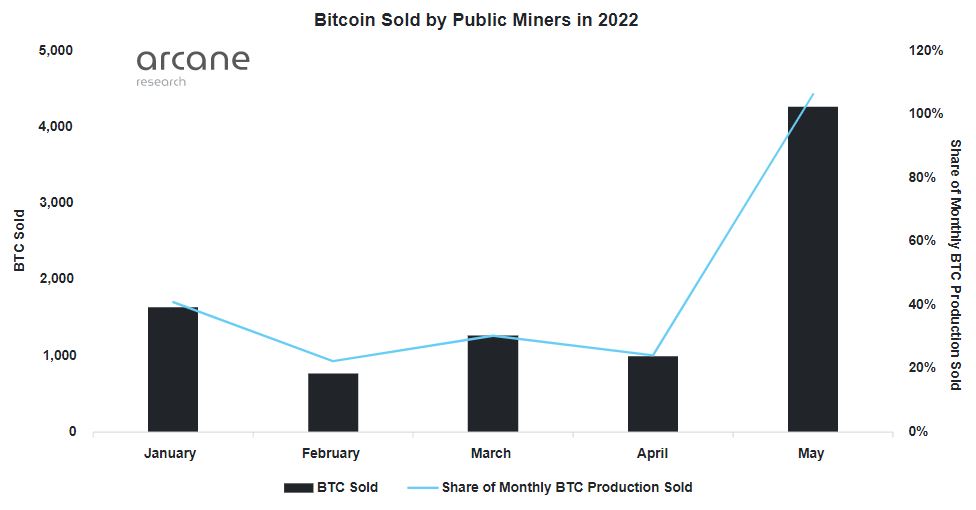
Bitcoins sold by publicly traded mining companies, January to May 2022. [graph]

Bitcoin loans

While the price of bitcoin was going up through 2021, mining saw profit margins as high as 90%. Bitcoin hit $64,000 in April 2021 and $69,000 in November 2021. [Bloomberg, archive]

Margins on mining were especially good in 2021 because the supply of state-of-the art mining rigs was constrained due to the worldwide chip shortage. If everyone could get rigs, the margins would go away. 

But by 2022, when bitcoin lost 70% of its price from its November high, it was a different story.

Miners need actual money to pay their operating expenses. Energy can account for as much as 90-95% of a miner’s overheads. Power companies don’t take bitcoins or tethers. But the crypto trading system was running low on naïve retail suckers to supply fresh dollars. [Reuters

So the miners needed to do their part in propping up the price of bitcoin. Their solution was to avoid selling their bitcoins, and instead to hold them and use them as collateral against low-interest loans. 

Marathon had started the fashion of borrowing against mined bitcoins as early as October 2020 — and the other mining companies soon followed the same plan.

Mainstream financial institutions didn’t really get into lending to bitcoin miners. The main lenders to miners were their fellow crypto companies: Galaxy Digital, NYDIG, BlockFi, Foundry Networks, Silvergate Bank [SEC], Celsius Network, and Babel Finance. (Note that Celsius is bankrupt, and Babel has suspended withdrawals.)

In fact, Marathon just entered a new $100 million revolving loan with Silvergate to add to their existing $100 million line of credit from Silvergate. This is while Marathon has thousands of mining rigs lying idle, waiting on a deal for cheap electricity. [SEC; CoinDesk]

Bitcoin miners are also trying to hedge against the downturn by betting against the bitcoin price going back up. Marathon has been selling call options at, say, $50,000. If bitcoin doesn’t hit this price, those options expire worthless. [Bloomberg]

Miners did deals with politicians and the power industry to get cheap electricity in Texas, as low as 2.5c/kWh — the sort of prices that miners were paying in China. [Bloomberg; press release]

But the Texas grid is notoriously unreliable — and can’t fall back on the other two continental US national grids. With 2022’s summer heat, electricity usage went up significantly, and ERCOT has told miners to switch off from time to time. [Bloomberg; Washington Post; The Verge]

Some miners, such as Riot, made money from credits for not using power in this time. [press release]

Margin calls

Borrowed money, one day, needs to be paid back. When the collateral dropped in value, miners’ loans got margin-called. They had to dump some of their vast holdings.

Miners started dumping big time in June 2022, some selling all their mined bitcoins and some of their “stockpile.” Bitfarms dumped 3,000 coins — half its stockpile — in mid-June. A month later, miners collectively sold 14,000 bitcoins, with a face value of roughly $300 million, in a single 24-hour period — when the CeFi crash was in full swing. [Reuters; Bloomberg; Cryptoslate]

Compass Mining — which sells people mining machines that are then hosted in third-party facilities — posted a list of publicly-listed miners in North America who were selling off their stashes. [Compass Mining

Arcane Research’s Jaran Mellerud analyzed the cash flows and balance sheets of public miners. Marathon was the weakest: “Marathon has 6.2 times higher remaining machine payments in 2022 than their accumulated current operating cash flow accumulated out the year. This will drain them of liquidity.” He thinks Marathon will be forced to sell off their bitcoin stockpile as well. [Tweet thread; Arcane report]

Some loans even used mining hardware as collateral. But mining rigs are even worse collateral than bitcoins. The price of mining rigs on the second-hand market is extremely sensitive to the price of bitcoin — and those loans are now undercollateralized.

As of June 2022, almost $4 billion in loans to bitcoin miners are coming under stress, posing a risk to crypto lenders, as many of the rigs posed as collateral have halved in value. [Bloomberg, archive]

Miners still hold huge piles of unsaleable bitcoins. CryptoQuant says that miners’ holdings have been increasing. As of July 2022, miners held 1,856,000 BTC. [CoinTelegraph]

Mining accounting

Bitcoin miners are not as profitable as they’ve been reporting.

Paul Butler points out that bitcoin mining companies are using questionable accounting methods. [blog post]

When you buy capital equipment with a lifetime longer than your financial year, you can allocate the cost of the purchase over its expected useful lifetime, rather than all in one hit. This is called depreciation.

Publicly-traded mining companies typically depreciate their assets over five years — but the equipment is good for about fourteen to fifteen months, and it’s most profitable in its first nine months. Bitcoin miners play on their “success” in the early years to raise capital to buy additional mining rigs.

The excessively long depreciation on mining rigs is a way to hide that the miners’ real costs are much higher than they’re reporting. The miners are not putting away money for future equipment. This is as well as overpaying their executives. 

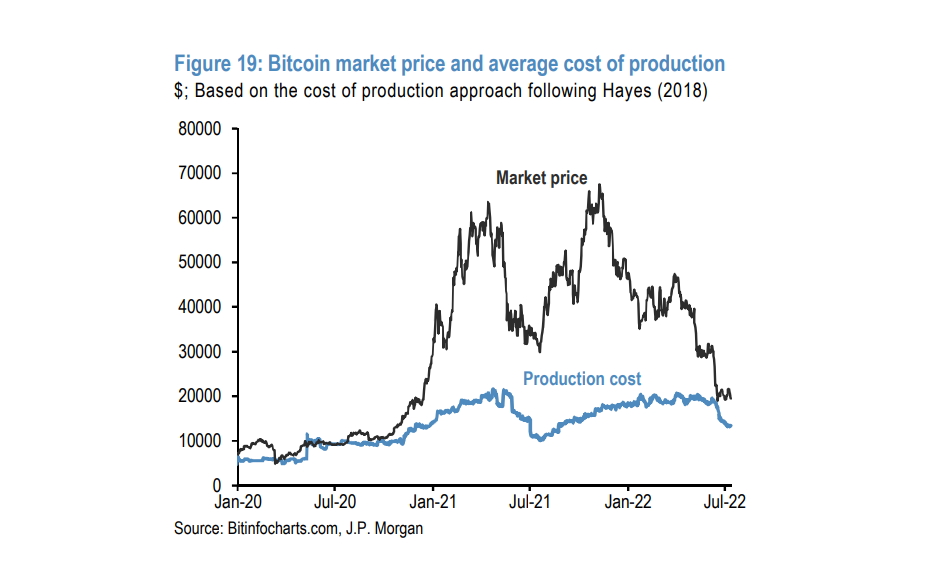
Cost of mining versus cost of bitcoin [Bloomberg]

Tick … tock. Next block?

In a bubble, you can sell mined bitcoins for far more than the cost of the electricity to play Extreme Bingo trying to guess a winning hash.

You can even run old mining rigs that might otherwise be scrapped. Old rigs might spend $30,000 to mine a bitcoin — but that’s fine if you can then sell that bitcoin for $40,000.

So what happens when the bitcoin price drops too low for mining to be profitable?

We’re seeing this now. Miners are taking inefficient hardware offline, causing visible drops in the hash rate charts since May 2022. In November 2018, the price of bitcoin dropped below $3,800 and a lot of miners threw out all their old equipment. The hash rate dipped noticeably.

The real trouble starts when bitcoin falls below $15,000. (As we write this, bitcoin is around $23,000.) Break-even for the most efficient machines is somewhere between $9,000 and $11,000, based on an electricity cost of 5c/kWh. In June 2022, JPMorgan put the cost of mining at $13,000 per bitcoin. [Bloomberg]

If the price drops too low, will the bitcoin blockchain stop ticking along? Probably not — bitcoin really doesn’t need much mining to keep running.

There was a slowdown on the bitcoin (BTC) blockchain in late 2017, when bitcoin cash (BCH) — a fork of not just the bitcoin software, but also its full transaction history — was trying to compete to become the official version of bitcoin. Large miners such as Bitmain switched a large proportion of their mining pools to the BCH chain.

The BTC chain took an hour between blocks at times in November 2017 — about 15% of the previous hash power.

Hardly anyone noticed — they were too busy having fun on the exchanges, which is where the action was in the 2017 bubble. Nobody really cares about the blockchain itself.

Bitcoin mining is green, actually

LOL, no it isn’t.

Proof-of-work mining has long been cryptocurrency’s biggest public relations battle, especially since Elon Musk — formerly the avatar of energy transition — bought bitcoins for Tesla in February 2021.

The general public thinks of crypto as nerd money for nerds to rip each other off. But when the public hear about proof-of-work crypto mining, and how it consumes an entire country’s worth of electricity, they get angry.

So it’s extremely important for the crypto industry to pretend as hard as possible that bitcoin mining isn’t as stupidly and egregiously wasteful as it obviously is — so that they’re allowed to keep mining at all.

The Bitcoin Mining Council claims that bitcoin uses 0.16% of all the electricity in the world. The BMC also claims that 58.4% of bitcoin mining energy use is from sustainable sources, based on claims by its members. [BMC, PDF]

Neither of these numbers is true — and BMC doesn’t show its working. Sources that do show their working — and don’t have a financial interest in fudging their numbers — put the sustainable energy percentage at 25.1%, and the percentage of the world’s electricity consumption over 0.5%. [Joule, paywalled; Digiconomist]

We’re also boggling that the BMC calls 0.16% of all the electricity in the world “negligible” — for the most inefficient payment network in human history. Even Christmas tree lights are more useful to humanity.

You’d almost think that coiners will say any bizarre and egregious nonsense if only it lets them keep trading their magic beans.

What happens next?

Number goes down, loans get margin-called, and the mining companies go broke because of a market downturn.

We expect the mining companies to blame everyone else they possibly can — the CeFi companies for crashing the market, bitcoin for just refusing to go up forever. They have to, really.

Bitcoin mining stocks are already down — MARA is down 58% year-to-date, RIOT is down 75%, and Core Scientific (CORZ) is down 74% since the beginning of the year. Meanwhile, crypto stock short sellers were up 126% as of June. [Reuters]

This scheme was never a sustainable business model. But none of these guys are long-term planners. So we don’t expect they had a coherent exit plan either.

The crypto companies who lent dollars to the miners should have been sufficiently capable of joined-up thinking to realize this was never a sustainable business model. Somehow, they didn’t. 

But then, for an example of the forward thinking skills of crypto guys, we remind you that Michael Novogratz of Galaxy Digital — one of the big lenders to miners — got a Terra-Luna tattoo in January 2022. [Twitter]

Those loans are never getting paid off. The mining rigs are near-worthless, and the bitcoins held as collateral can’t be dumped without taking the market down even further. The lenders get to take a bath on this one.

The bitcoins will likely be dumped, putting more sell pressure on the price of bitcoin.

Along with the rest of the crypto collapse, this is thankfully isolated within crypto. The only “real” financial institution involved is Silvergate, and they have almost no non-crypto customers these days. Any hit to Silvergate is unlikely to be contagious.

Of course, the investors can always sue the bankrupt corpses of the mining companies.