Crypto collapse: Terra Luna, 3AC’s Singapore liquidation, Celsius, Voyager 

“Lotta stadiums getting renamed in the next few years”

Ben McKenzie
Daniel Shin and Do Kwon while number was going up. Source: Terraform Labs

TerraUSD

Centralized finance (CeFi) is centralized DeFi — investment firms that played the DeFi markets. CeFi was where a lot of the money in DeFi came from.

CeFi looked like an industry of separate institutions — but it turned out to be a few companies all investing in each other. The chart of who invested in who would look like an inverted pyramid resting on a single point — Terraform Labs’ Anchor protocol.

Anchor offered 20% interest rates on holdings of dollar-equivalent stablecoin Terraform USD (UST), the interest being paid in UST. You could get UST by buying Terraform’s luna token from exchanges like Crypto.com or KuCoin. (Crypto.com Arena used to be Staples Center in Los Angeles.)

All the other CeFi firms just put their money into Anchor at 20%, then offered slightly lower interest to their own investors and skimmed the difference. Terraform made its money by dumping luna on these UST buyers.

UST and luna were both tokens that Terraform made up one day — neither had any reason to be worth anything. Everyone in DeFi knew how rickety UST/luna was for months — they just went along with it while it made them money. A truly fiat currency.

The party ended on May 9, when UST and luna imploded, setting off a cascade of insolvencies across cryptoland. We’re still seeing the fallout.

Crypto hedge fund Three Arrows Capital (3AC) went into liquidation as it was heavily invested in UST and luna. Firms that had big loans to 3AC, such as Voyager, Celsius, and BlockFi, had to file bankruptcy or seek bailouts from other crypto firms. Even crypto exchanges had been playing the CeFi markets with customer funds, and many had to close their doors.

Thousands of South Koreans also lost money when UST and luna collapsed. Terraform Labs founders Daniel Shin and Do Kwon are stuck in South Korea for now, while investigators look into the incident.

On Wednesday, July 20, investigators from the Seoul Southern District Prosecutors Office raided seven crypto exchanges, including Upbit, Bithumb, and Coinone. They’re looking for clues as to whether Terraform intentionally caused the collapse. They also raided some exchange executives’ homes and the home of Daniel Shin. [Yonhap News; Donga News, in Korean]

Elsewhere, South Korean prosecutors have discovered a shell company called “Flexi Corporation” that Kwon allegedly used to launder large sums of money out of Terra and into his own private accounts via over-the-counter trades. How can this be? Kwon said he only took a small salary from Terraform. [KBS, in Korean; Twitter

Three Arrows Capital 

UST and luna went under, and pulled crypto hedge fund Three Arrows Capital down with them.

The Terra collapse completely nuked 3AC. Their exposure was about $600 million. (This is triple what co-founders Su Zhu and Kyle Davies had claimed in mid-June.) [Fortune]

Zhu and Davies are in now hiding. Nobody knows where they are. They told Bloomberg they were headed to Dubai. [Bloomberg, archive]

The pair knew immediately that they were screwed. But on May 11, when investors asked if 3AC had survived the Terra collapse, 3AC told them everything was fine — and kept taking in money! 

3AC had abandoned its Singapore office by late May — they just locked the door and skipped the country — and they finally admitted there were problems only in mid-June.

But Zhu and Davies have been telling the public — especially their creditors — how they lost money too, how they fear for their lives, and how they are so overwhelmed that they can’t turn over banking information just yet, but they’ll get to that soon, for sure.

The two old school buddies say they were shocked by how quickly things unraveled. “What we failed to realize was that luna was capable of falling to effective zero in a matter of days.”

Never mind that the instability of UST/luna was obvious to outside observers, that UST/luna worked exactly the same way as the Titan/Iron pair that collapsed in 2021, and that these guys were supposed to be a crypto hedge fund with alleged competence, and not the drooling crypto degen brainlet rubes they appear to have been trading like.

Zhu and Davies never planned for number go down, and had just been piling leverage on leverage. “We positioned ourselves for a kind of market that didn’t end up happening,” Zhu told Bloomberg. Never mind that a “hedge fund” is named for the act of hedging your speculations, and not just assuming you’re a genius because there’s a bubble going on.

Teneo is the firm handling 3AC’s liquidation, and they are moving quickly. They filed Chapter 15 in the US on July 1. Shortly after, they also filed for recognition of 3AC’s British Virgin Islands liquidation with the Singapore high court. 

Someone leaked Teneo’s 1,157-page Singapore filing earlier this week. The comprehensive document is a gem — it gives us a full update on the bankruptcy proceedings up to July 9. Teneo’s Christopher Farmer and Russell Crumpler left no rock unturned. [Filing, archive]

We recommend reading at least the first 35 pages — it tells the story of Ponzi borrowing, multiple defaults, ghosting creditors and liquidators, and doing deals with some lenders while cutting out others. The rest of the filing is exhibits, other court filings, and affidavits of furious creditors.

3AC’s biggest creditor is Barry Silbert’s Digital Currency Group, the parent company of Genesis Trading, which had a $2.4 billion partially collateralized loan to 3AC. DCG is now stuck with up to $1.1 billion in losses. [The Block]

Other large creditors include Voyager Digital ($687 million), Blockchain.com ($302.6 million, up from the originally claimed $270 million), and Deribit ($80.6 million).  

Kyle Davies’ wife, Chen Kaili Kelly, filed a claim for $65.7 million, and Zhu Su himself submitted a $5 million claim. We have no idea how 3AC was structured to allow an owner and a cofounder to be a listed creditor in a bankruptcy.

Zhu and Davies reportedly made a $50 million down payment on a yacht — with borrowed money, while they defaulted on their lenders. (We’re definitely feeling the Quadriga vibes with this one.) They wanted it to be bigger than any of the yachts owned by Singapore’s billionaires, and ready for pick-up in Italy. Zhu told Bloomberg that the yacht story was a “smear.”

Tai Ping Shan Capital, an over-the-counter desk in the BVI, claimed it operated independently of 3AC, but it turns out to have tight connections. On June 14, 3AC transferred $30.7 million in USDC and $900,000 in USDT to TPS. It’s unclear where those funds subsequently went. [Coindesk]

Good news! In a supplemental Chapter 15 filing, Teneo says it’s recovered $40 million of assets! The bad news is that this is a drop in the bucket. Creditors have so far submitted $2.8 billion in claims, and there’s plenty more coming. [Court filing]

3AC creditors have picked a creditor committee consisting of the largest creditors: Voyager, DCG, CoinList, Blockchain.com, and Matrixport. The committee will work closely with Teneo to “maximize the value of the assets available for distribution.” [The Block

Blockchain.com is struggling to survive in the aftermath. It just laid off 25 percent of staff. [CNBC

In addition to owning CryptoDickButt #1462, 3AC had also started a $100 million NFT fund with pseudonymous NFT trader Vincent Van Dough. They supplied the funding, while Van Dough curated the art. (We mentioned CryptoDickButt last time, and we’re shocked that some of you thought we were just making that up. You should know by now that crypto is always stupider.)

The fund, called “Starry Night Capital” planned to launch a physical gallery in a “major city” by the end of 2021. [The Block, 2021]

The Defiant noted on June 17 that the Starry Night portfolio had been aggregated into a single Ethereum address, probably controlled by Zhu, Davies, and Van Dough. Teneo has noticed and is concerned. [The Defiant]

Celsius

Celsius promised 18% returns on your crypto. When too many people tried to pull their money out at once, Celsius paused withdrawals on June 21 and filed for bankruptcy on July 13. We covered the bankruptcy filing and CEO Alex Mashinsky’s declaration in our last post. 

Celsius admits to a $1.2 billion hole in its balance sheet. Others think the assets are fake and the liabilities are very real, which would put the hole at $4 billion to $5 billion.

Mashinsky says that Celsius’ losses include $15.8 million from investments in UST and luna, along with $40.6 million in loans to 3AC. He also said that Celsius lost 35,000 ether tokens in 2021 due to an incident involving a staking provider that “misplaced” the keys to its tokens. Oops!

Celsius held its first bankruptcy hearing on July 18. SDNY Judge Martin Glenn is presiding over the case. Kadhim Shubber from the Financial Times live-tweeted the hearing, which took place over Zoom. Here’s a copy of the presentation Celsius gave to the judge on Monday. [Stretto; Twitter thread]

Celsius’ lawyer Patrick Nash told the judge there won’t be a liquidation. Celsius has a recovery plan: to HODL — and mine bitcoins! That’s right, Celsius wants to mine their way out of bankruptcy. Nash says the plan is to mine 10,000 bitcoins in 2022.

How did Celsius end up in bankruptcy? You might think it had something to do with Celsius making horrible investments and losing everyone’s money, but no! As Nash explained, Celsius was driven to insolvency by unfounded Terra/luna fears, worries about Coinbase’s bankruptcy risk factor disclosure in May, and a bank run that knocked over an otherwise well-run business.

Former Celsius employees tell a different story. Celsius compliance and financial crimes director Timothy Cradle spoke of the company’s “sloppiness and mismanagement.” [Coindesk

Cradle also told CNBC that Celsius execs “were absolutely trading the token [CEL] to manipulate the price.” A former HR employee said she was told not to do a background check on Yarom Shelem, the former Celsius CFO who was arrested in Israel for fraud. [CNBC]

Celsius creditors have been filing claims since July 18. [Twitter] The letters make for some disturbing reading. Molly White has been posting excerpts on Twitter. It’s a reminder that Celsius investors were ordinary people lured in by Mashinsky’s false promises. [Twitter thread]

Québec pension fund CDPQ also has some questions to answer. CDPQ invested $150 million in Celsius in October 2021 as part of a $400 million funding round co-led by WestCap Investment Partners LLC. “We understand that our investment in Celsius raises a number of questions.” [Bloomberg

Celsius’ next bankruptcy hearing is August 10.

Voyager

Crypto broker Voyager said its secret sauce was “low-risk investments.” Yet it loaned out three-quarters of its assets under management to 3AC.

In June, the firm signed an agreement with Sam Bankman-Fried’s Alameda Ventures for a revolving line of credit so it could keep the music playing a bit longer. But on July 1, Voyager Digital filed Chapter 11 bankruptcy.

Coffeezilla points out that Voyager is trying to sell people on this “Chapter 11 bankruptcy reorg,” and hides the fact that under bankruptcy law, a company that describes itself as a broker cannot file Chapter 11. They should be required to liquidate under SIPA. (Securities Investor Protection Act) [Youtube; Twitter]

The CEO of of crypto media outlet Benzinga will be on the unsecured creditor committee in the Voyager bankruptcy. Jason Raznick is among the largest unsecured creditors for Voyager. [Inside Bitcoins]

Voyager’s next bankruptcy hearing is on August 4. It has $350 million of customer money in an omnibus account at Metropolitan, and it keeps reassuring everyone that they’ll get their money soon! It just has to work things out with the judge first. [Voyager blog; archive]

In the meantime, Bankman-Fried proposed a partial bailout. Under his proposal, Voyager customers would have the opportunity to open new accounts at FTX with a cash balance funded by their bankruptcy claim. They would be able to withdraw the cash, or use it to purchase crypto on FTX. [FTX press release; FT, archive]

Other CeFi firms that are definitely robust and doing fine 

Vauld is a Singapore-domiciled crypto lender that serves mainly customers in India. It stopped withdrawals on July 4 and owes $402 million in crypto to its customers. 

After suspending withdrawals and laying off 30% of its staff, Vauld filed for protection against creditors in Singapore on July 8. [WSJ]

A Singaporean moratorium order is similar to Chapter 11 in the US. It allows Vauld to avoid a complete cessation of operations and liquidation of assets, while it tries to get its act together. 

Vauld later disclosed they were short $70 million, partly from exposure to UST/luna. Vauld issued a statement on July 11. Vauld and Nexo are still discussing an acquisition of Vauld. [Vauld blog, archive]

BlockFi released its Q2 2022 transparency report. The report showed it had $1.8 billion in open loans from retail and institutional investors by the end of June and $600 million in “net exposure.” [BlockFi blog, archive; Decrypt]
Who had Voyager Digital next in the DeFi dead pool?

  • By Amy Castor and David Gerard
  • Become a patron and support our work — Amy’s Patreon is here; David’s is here.

In our last episode, Voyager Digital was looking shaky. Voyager had a massive hole in its balance sheet, courtesy of Three Arrows Capital (3AC), which had imploded. Voyager had maxed out its line of credit from Alameda for the month — it could only withdraw $75 million in credit for each 30-day rolling period. 

On Friday, July 1, Voyager announced it was “temporarily suspending trading, deposits, withdrawals and loyalty rewards.” [Voyager, archive; WSJ]

How screwed is Voyager? Three-quarters of their assets — about $600 to $700 million in BTC and USDC owed by 3AC — are missing. [Press release; Yahoo Finance]

How screwed are Voyager’s customers? “Your debit card will stop working … exploring strategic alternatives,” the crypto broker said. “We are in discussions with various parties regarding additional liquidity and the go-forward strategy for the company.” [Voyager blog, archive]

Whoever had Voyager Digital next in the DeFi dead pool: you may now claim your 100 trillion luna.

Voyager’s business

Voyager is — or was — a crypto investment firm. You deposited dollars or crypto into Voyager, and you earned up to 12% interest on your deposits via their Earn program. The company claimed 3.5 million customers. 

It also had a mobile app that allowed you to trade 100 different cryptocurrencies commission-free. [Voyager, archive]

Voyager was a “CeFi” company, or centralized DeFi — an investment firm that played the DeFi markets.

It also offered a debit card. Customers deposited dollars, which were immediately converted to the USDC stablecoin, which Voyager paid a yield of up to 9% on. “Earn like crypto, spend like cash.” [Voyager, archive]

Voyager very much wanted its customers to treat the company like their bank — and deposit their money. It encouraged customers to directly deposit their paychecks into their Voyager debit card account.

It’s not a bank, though. We’ll see in a moment why that turned out to be important.

The company offered “even greater rewards” if you owned their VGX token! This was aimed squarely at the cryptocurrency audience: “When it comes to your crypto, every satoshi counts.” With VGX you could get up to a 12% yield! [Voyager; archive]

Voyager is listed on the Toronto Stock Exchange. However, its services were only available to Americans — not Canadians. [Voyager terms of use; archive]

At the end of March 2022, Voyager got cease-and-desist letters and orders to show cause from the states of New Jersey, Alabama, Oklahoma, Texas, Kentucky, Vermont, and Washington — who considered Voyager’s yield platform to be an unregistered offering of securities. [CoinDesk; press release]

Voyager’s liabilities

Here is Voyager’s press release for their Q3 2022 numbers, released on May 16. (Voyager’s financial year is July to June, so January to March is Q3.) The headline announced that revenue was up — $102 million! [Voyager, archive]

But the numbers show that year-over-year losses were also way up — Voyager had operating losses of $43 million. The company was burning money to pump up revenue and user numbers. Voyager promoted both these numbers to investors in June 2022 without mentioning the losses that were getting it there. [Voyager, archive]

The Q3 2022 numbers were announced when UST and luna had gone to zero, and Terraform’s Anchor protocol had collapsed. Voyager CFO Evan Psaropoulos said on the quarter’s earnings call: [Seeking Alpha]

“It is important to note with recent news related to UST and LUNA, that Voyager does not have UST listed on the platform and has not placed any access in any DeFi lending protocols such as the Anchor platform.”

But it turned out that Voyager was heavily exposed to UST, luna, and Anchor — via their largest debtor, Three Arrows Capital. The guys at 3AC knew they were in terminal trouble, but hadn’t told anyone yet — including their creditor, Voyager.

In the Q3 2022 earnings call, voyager CEO Steve Ehrlich said:

“We also spoke to all of our counterparties on lending and verified that there were no issues. In the past, we’ve had questions from investors about one counterparty. And as of today, we have no exposure to that counterparty.

… the people we lend to are some of the biggest names in the industry. As we stated, too, we had conversations and verified there was no contagion with them, had conversations with every single one of them. And since we limit who we lend to, to these parties, we’re really comfortable we did not have to call anything in and we had zero issues with any of our borrowers.”

Which counterparty could that have been?

Voyager released new financials yesterday afternoon, July 1, as part of its announcement that it was suspending withdrawals, detailing the 3AC-shaped hole in their numbers.

Is Voyager FDIC insured? No, but they’d like you to think so

If you had dollars on deposit with Voyager, you should assume they’re gone and not coming back.

Voyager tried very hard to imply in the large print that customer deposits were insured up to $250,000 by the Federal Deposit Insurance Corporation (FDIC) if something happened to Voyager — and only admitted in the small print that they weren’t. Voyager tweeted on November 12, 2020: [Twitter; archive]

“Have you heard? USD held with Voyager is FDIC insured up to $250K. Our customers’ security is our top priority. Start growing your crypto portfolio today.”

But your dollars had already been converted into USDC. Voyager then used the USDC, a liability to you, as collateral for loans it took out elsewhere. The user agreement explicitly allows this: [Voyager, archive]

“Consent to Rehypothecate. Customer grants Voyager the right, subject to applicable law, without further notice to Customer, to hold Cryptocurrency held in Customer’s Account in Voyager’s name or in another name, and to pledge, repledge, hypothecate, rehypothecate, sell, lend, stake, arrange for staking, or otherwise transfer or use any amount of such Cryptocurrency, separately or together with other property, with all attendant rights of ownership, and for any period of time and without retaining a like amount of Cryptocurrency, and to use or invest such Cryptocurrency at Customer’s sole risk.”

Your dollars were transformed into Voyager’s USDC the moment you deposited.

Voyager has an omnibus account with Metropolitan Commercial Bank, where it deposited its customers’ dollars. An omnibus account is a single holding account for money from multiple investors. Voyager acts as the money manager of the omnibus account — and maintains full control of the money.

Pass-through FDIC insurance, which would cover the customers and not just Voyager, is a bit tricky. You have to meet several requirements. Fundamentally, the funds need to be a liability of the bank, e.g., Metropolitan, not the account holder, e.g., Voyager. [FDIC; Seward & Kissel LL]  

If Metropolitan failed, the FDIC insurance would cover Voyager up to $250,000. But Voyager’s customers were not FDIC insured. And Metropolitan is doing just fine. 

Voyager repeatedly and consistently led customers to believe their US dollar deposits were safe if Voyager failed.

Usually, Voyager just tried to imply that customer deposits were directly FDIC-insured — and then detailed in the fine print how this wasn’t the case. Occasionally, Voyager slipped up and claimed this directly, such as in this blog post of December 18, 2019: [Medium, archive]

“Through our strategic relationships with our banking partners, all customers’ USD held with Voyager is now FDIC insured. That means that in the rare event your USD funds are compromised due to the company or our banking partner’s failure, you are guaranteed a full reimbursement (up to $250,000). We’re excited to offer our customers an extra level of security, so they can feel more comfortable holding their USD with Voyager.” [emphasis ours]

Let’s say that again: “you are guaranteed a full reimbursement”

This claim was simply not true.

Metropolitan Bank has issued a statement on Voyager and FDIC insurance — we expect they’ve been getting a lot of calls from Voyager customers: [Metropolitan, archive]

“FDIC insurance coverage is available only to protect against the failure of Metropolitan Commercial Bank. FDIC insurance does not protect against the failure of Voyager, any act or omission of Voyager or its employees, or the loss in value of cryptocurrency or other assets.”

Several Voyager customers on Reddit were very confused about all of this. Many were trying to figure out how to file an insurance claim to get their cash back. Others were learning for the first time that their dollar deposits were not, in fact, safe. [Reddit; Reddit

Reddit user DannyDaemonic called up the FDIC: [Reddit]

“I called the FDIC earlier and they said Voyager Digital LLC was not a bank and was not FDIC insured. They said for future reference, LLCs cannot be banks, ever. So when you see “LLC,” any claim of FDIC insurance is false. They did confirm that Metropolitan Bank is FDIC Insured but just because Voyager Digital stated “each Customer is a customer of the Bank” doesn’t mean they were funding those accounts. It just means if Metropolitan Bank failed, any holdings Voyager Digital placed under your name there would be safe. But since it’s only Metropolitan Bank that’s FDIC insured, Voyager Digital failing wouldn’t trigger the FDIC insurance.

I imagine Voyager is allowed to withdrawal from those accounts to pay debt or make investments. It’s also possible, if Voyager Digital is insolvent, that they haven’t even been depositing cash into the Metropolitan Bank for quite some time.

It doesn’t look good.”

The precise law that Voyager seems to be playing fast and loose with is 18 USC 709 — “False Advertising or Misuse of Names to Indicate Federal Agency”: [Onecle]

“… or falsely advertises or otherwise represents by any device whatsoever the extent to which or the manner in which the deposit liabilities of an insured bank or banks are insured by the Federal Deposit Insurance Corporation…”

As of March 31, Voyager claimed to have $175 million in cash. At present, it’s not clear they have any cash. They said they had $355 million in cash “held for customers” as of June 30, per their press release. However, they haven’t spelled out liabilities, including “cash owed to customers.” What really matters to customers is the balance held at Metropolitan, and we don’t know what that is.

At this point, Voyager either needs to get another loan from FTX or declare bankruptcy.

If Voyager does need cash, they’ll have to sell their bitcoins and ether — driving down the prices of those. 

The purpose of CeFi is to mis-sell investments

The CeFi lenders who are collapsing right now, such as Voyager and Celsius, are in the business of packaging up extreme risk as a shiny product — so that they can mis-sell these to the public as retail-suitable investments.

DeFi is a bunch of wires on a lab bench — not a finished product. CeFi puts a shiny box around the breadboarded system held together with clips and lumps of explosive.

The CeFi companies then lie to their customers that the remarkable interest rates on offer can exist without a jaw-dropping amount of hidden risk.

The very stupid and very crypto thing is when their fellow crypto institutions think “this is fine!” and do things like putting all their money into 3AC, which put all its money into Anchor.

It’s supposed to be retail — and not institutional traders — that sees a 5%, 10%, or 20% interest rate and stops thinking of anything but the big number. Perhaps crypto companies need to be legally restricted to retail-friendly investments? Or we could send some of these guys to jail for fraud, that works too.

How 2020 set the stage for the 2021 bitcoin bubble

  • By Amy Castor and David Gerard
  • Be sure to subscribe to our Patreon accounts — Amy’s is here; David’s is here.

We often get asked by reporters: “Why are crypto markets crashing?” The short answer is because there’s no money left, and no more coming in. The long answer is more complicated.

Bitcoin peaked at $64,000 in April 2021 and again at $69,000 in November 2021. Many of the network effects that drove the price of bitcoin to those heights were put into place in 2020.

The same network effects are now working in reverse. Markets take the stairway up and the elevator down.

The 2017 bubble was fueled by the ICO boom and actual outside dollars entering the crypto economy. Bitcoin topped out just below $20,000 in December 2017.

The crash that followed over the next 12 months was like air being slowly let out of a balloon — much like the 2014 deflation after Bitcoin’s prior 2013 peak. ICO and enterprise blockchain promoters tried to keep going through 2018 like everything was fine, but the party was clearly over.

In contrast, the 2022 crash is like a wave of explosive dominoes all crashing down in rapid succession. How did we get here?

A long, cold crypto winter

Let’s start in early 2020. It was the crypto winter. Bitcoin’s price had spent two years bobbling up and down from infusions of tethers, and traders on BitMEX rigging the price to burn margin traders. (And, allegedly, BitMEX itself burning its margin traders.) [Medium, 2018]

But the dizzying price rises were peculiarly bloodless. There was little evidence of fresh outside dollars from retail investors — the ordinary people. The press would write how bitcoin had just hit $13,000 — but they’d also call people like us, and we’d tell them about Tether.

Throughout 2019 and into 2020, crypto pumpers were desperately trying scheme after scheme — initial coin offerings, initial exchange offerings, bitcoin futures, selling to pension funds — to lure in precious actual dollars and get the party re-started.

Then Corona-chan knocked on the door.

Act I, Scene I: Pandemic Panic

On March 13, 2020, the US government declared a pandemic emergency. The panic drove down stocks and crypto. Investors sold everything and flew to the safest, hardest form of money they could find: the US dollar! Bitcoin dropped from $7,250 to $3,858 over the course of that day.

It was an edge-of-the-cliff moment for bitcoin. Any further drop could force liquidations and create a ripple effect across dozens more crypto projects. For bitcoin miners, the price of bitcoin was now below the cost of mining.

Worse, only two months away was the bitcoin “halvening” — an every-four-year event when the number of bitcoins granted in each freshly-mined block halves. If bitcoin dropped too low in price, the miners wouldn’t be able to pay their enormous power bills. The crypto industry desperately needed to push bitcoin’s price back before May.

Tether spins up the printing press

Tether, launched in 2014, is an offshore crypto company that issues a dubiously backed stablecoin of the same name. Tether works like an I.O.U. — Tether supposedly takes in dollars and issues a tether for each dollar held in reserve. Since Tether has never had an audit, nobody knows for sure what’s backing tethers. The company has an extensive history of shenanigans — see Amy’s Tether timeline.

The issuance of tethers in March 2020, was 4.3 billion, but that’s when the Tether printer kicked into overdrive — minting tethers at a clip nobody had ever seen before. 

Tether minted 4.4 billion tethers in April 2020 — crypto’s version of an economic stimulus package. By May, Bitcoin reached $10,000, just in time for the halvening.  

Once the price of bitcoin goes up, though, there’s no way to turn off the Tether printing press. It has to keep printing. If the price of bitcoin goes down, people will sell, creating an exodus of real dollars from the system. So Tether kept printing, pushing the price of bitcoin ever skyward. 

In May, June, and July 2020, Tether issued a combined total of 3 billion tethers. In August, when the price of bitcoin reached $12,000, Tether issued another 2.6 billion tethers. In September, when bitcoin slid below $10,000, Tether issued another 2.2 billion tethers. 

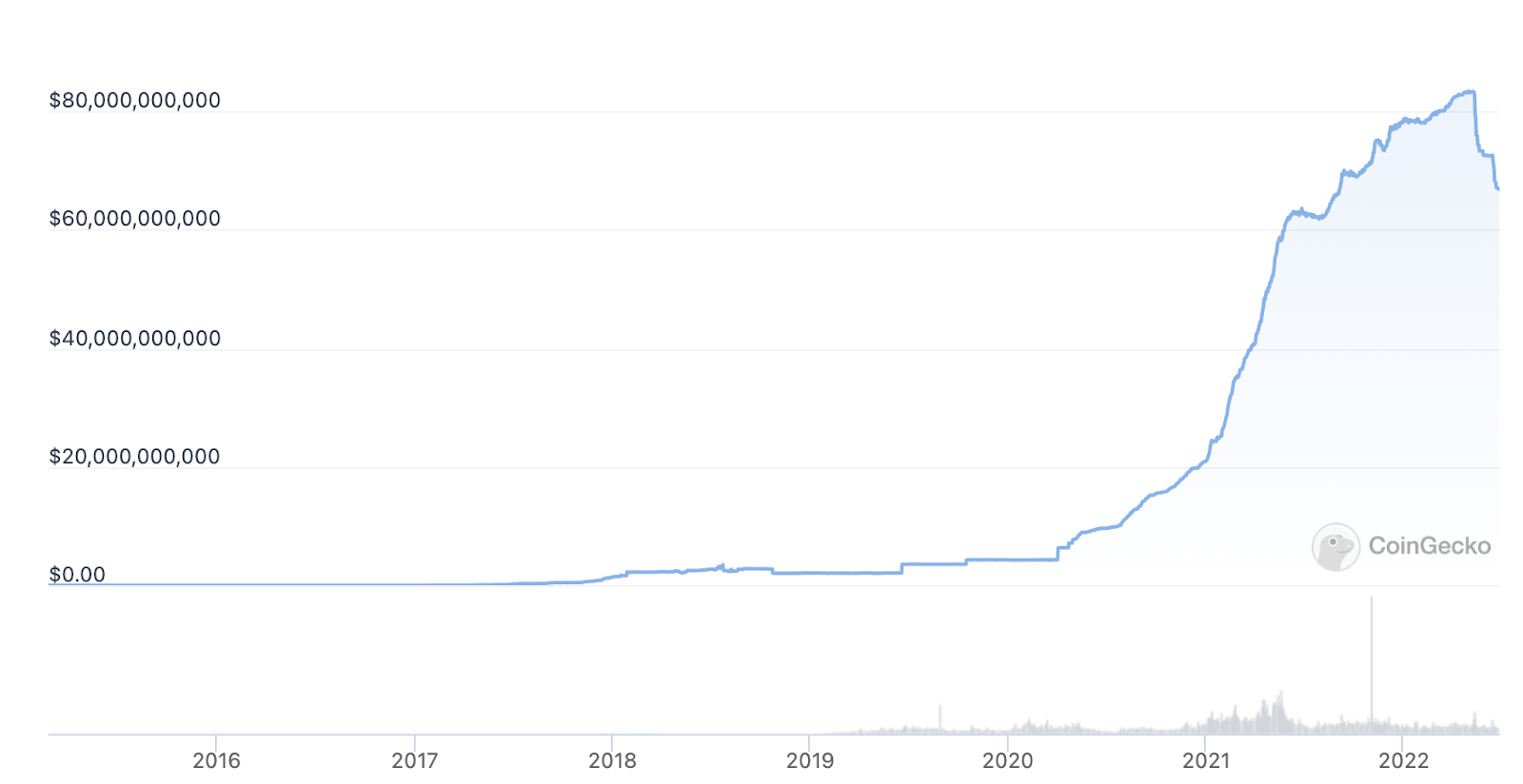
By the end of 2020, Tether had reached a market cap of 21 billion. The printer kept going. In 2021, Tether pumped out 60 billion more tethers. By May 2022, Tether’s market cap had reached 83 billion. Bitcoin’s price peaks in April 2021 ($64,000) and November 2021 ($69,000) both coincided with an influx of tethers into the market. 

You can’t just redeem tethers. Only Tether’s big customers — it has about ten of them — can redeem. You can try to sell your tethers on an exchange. But you can’t just go up to Tether to redeem them for dollars. There were no redemptions of tethers, ever, until May and June 2022 — the present crash.

Curiously, Tether’s reserve as declared to New York in April 2019 contained $2.1 billion of actual money — cash and US Treasuries. But Tether’s reserve attestation as of March 31, 2021, still contained just $2.1 billion of cash and treasuries!

This suggests that the rest of the reserve over that time was made up of whatever worthless nonsense Tether could claim was a reserve asset — loans of tethers, cryptocurrencies, and dubious commercial paper credited at face value rather than being marked to market.

Dan Davies, in his essential book Lying for Money, marks this as the key flaw in frauds of all sorts: they have to keep growing so that later fraud will keep covering for earlier fraud. This works until the fraud explodes.

Tether marketcap, CoinGecko

GBTC’s ‘reflexive Ponzi’

Grayscale’s Bitcoin Trust (GBTC) played a huge role in keeping the price of bitcoin above water through 2020. It offered a lucrative arbitrage trade, an exploitable inefficiency in markets, that a lot of big players went all-in on.

GBTC was an attempt to wrap Bitcoin in an institutionally compatible shell. All through 2020 and into 2021, GBTC was trading at a premium to bitcoin on the secondary markets. Accredited investors would acquire GBTC at net asset value — some large proportion being in exchange for direct deposits of bitcoins, not purchases for cash, although all the accounting was stated in dollars. After a six-month lock-up, the accredited investors would sell the shares to the public at a 20 percent premium, sometimes more. Rinse, repeat, and that’s a 40 percent return in a year. 

GBTC functioned like a “reflexive Ponzi.” When Grayscale bought more bitcoin for the trust, that drove up the price of bitcoin, which pushed up the GBTC premium, which resulted in investors wanting more GBTC and Grayscale issuing more shares. 

Grayscale ran a national TV advertising campaign at the time, targeted at ordinary investors. The ads warned that disaster was imminent, inflation would eat your retirement, and bitcoin was better than gold — so you should buy bitcoin. Or, this shiny GBTC, which was implied to be just as good! [YouTube, 2019]

In a bull market, retail investors didn’t mind paying a premium — because the price of bitcoin kept going up. The market treated GBTC as if it was convertible back to bitcoins, even though it absolutely wasn’t. [Adventures in Capitalism]

Grayscale ultimately flooded the market with GBTC. When an actual bitcoin ETF became available in Canada, GBTC’s premium dried up. Since February 2021, GBTC has been trading below the price of bitcoin. As of March 2022, the trust holds 641,637 bitcoins. And they’re staying there indefinitely — leaving GBTC holders locked in on an underwater trade.

The rise of decentralized finance

Decentralized finance, or DeFi, didn’t directly pump the price of bitcoin in 2020. But DeFi was one of the stars of the 2021 bubble itself, and eventually caused the bubble’s disastrous explosion. All of the structures to let that happen were set up through 2020.

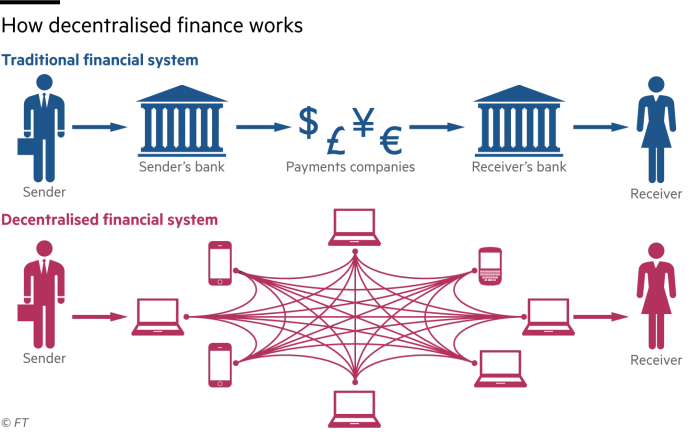
DeFi is an attempt to put traditional financial system transactions — loans, deposits, margin trading — on the blockchain. Regulated institutions are replaced with unknown and unregulated intermediaries, and everything is facilitated with smart contracts — small computer programs running on the blockchain — and stablecoins.

All through 2019 and 2020, DeFi was heavily promoted as offering remarkable interest rates. At a time of low inflation, this got coverage in the mainstream financial press. Here’s the diagram the Financial Times ran, depicting DeFi as a laundromat for money: [FT, paywalled, archive

The key to DeFi is decentralized exchanges, where you can trade any crypto asset that can be represented as an ERC-20 token — such as almost any ICO token — with any other ERC-20 token.

DeFi also lets you take illiquid tokens that nobody wants, do a trade, assign them a spurious price tag in dollars, then say they’re “worth” that much. This lets dead altcoins with no prospective buyers claim a price and a market cap, and attract attention they don’t warrant. If you put a dollar sign on things, then people take that price tag seriously — even when they shouldn’t.

You can also create a price for a token that you made up out of thin air yesterday and use DeFi to claim an instant millions-of-dollars market cap for it. 

This was the entire basis for the valuation of Terraform Labs’ UST and luna tokens — and people believed those “$18 billion” in UST were trustworthily backed by anything.

You can also use those tokens you created out of thin air as collateral for loans to acquire yet more assets. An unconstrained supply of financial assets means more opportunities for bubbles to grow, and more illiquid assets that you can dump for liquid assets (BTC, ETH, USDC) when things go wonky.

By September 2020, five hundred new DeFi tokens had been created in the previous month. DeFi hadn’t hit the mainstream yet — but it was already the hottest market in crypto. [Bloomberg]

The problem was that in 2020, to use DeFi you had to know your way around using the actual blockchain. Retail investors, and even most institutional investors, haven’t got the time for that sort of dysfunctional nonsense.

Retail was more attracted to the “CeFi” (centralized DeFi) investment firms, such as Celsius and 3AC, offering impossible interest rates. These existed in 2020 but didn’t gain popularity until the following year when the bubble had started properly.

A new grift: NFTs 

By late 2020, crypto promoters were searching for a new grift to lure in retail money, one that would have broader mainstream appeal. They soon found one. 

NFTs as we know them got started in 2017, with CurioCards, CryptoPunks, and CryptoKitties. NFT marketing had continued through the crypto winter — in the desperate hope that ordinary people might put their dollars into crypto collectibles.

The foundations of the early 2021 burst of art NFTs were laid in late 2020, when Vignesh Sundaresan, a.k.a. Metakovan, first started looking into promoting digital artists, such as Beeple — whose $69 million JPEG made international headlines for NFTs in March 2021, and officially kicked off the NFT boom. 

Late 2020 also saw the launch of NBA Top Shot, the only crypto collectible that ever got any interest from buyers other than crypto speculators. Top Shot traders were disappointed at how incredibly slow Dapper Labs was at letting them withdraw the money they’d made in trading — and became some of the first investors in the Bored Apes.

Coiner CEOs 

By late 2020, several big company CEOs started promoting the concept of bitcoin on the company dime. These included Jack Dorsey at Twitter, Dan Schulman at PayPal, and Michael Saylor at business software company MicroStrategy.

In October 2020, Saylor revealed his company had bought 17,732 bitcoins for an average of $10,000 per coin. Over the next 18 months, Microstrategy would plow through its cash reserves and take on debt to funnel more money into bitcoin, spending $4 billion in the process. Buying MSTR shares become the newest way for retail investors to bet on bitcoin. Saylor also put himself forward as bitcoin’s latest prophet and crazy god.

PayPal set up bitcoin trading in 2020, though only as a walled garden, where you couldn’t move coins in or out. Still, it made gambling on crypto more accessible to retail investors. 

Bitcoin miners start ‘hodling

By late 2020, we suspect there was very little actual cash in crypto. But bitcoin needed to continue its upward ascent. 

The biggest tip-off that the fresh outside dollars had stopped flowing was when bitcoin miners stopped selling their coins. Bitcoin miners mint 900 new bitcoins per day. They typically sell these to pay their energy costs — power companies don’t accept tether — and buy new mining equipment, which becomes obsolete every 18 months. At $20,000 per bitcoin, that would equate to $18 million, in actual dollars, getting pulled out of the bitcoin ecosystem every day.

In October 2020, Marathon Digital (MARA), one of the largest publicly traded miners, stopped selling its bitcoins. They took out loans, which allowed them to buy their equipment and hold their bitcoins. Marathon even bought additional bitcoins!  

Borrowing against mined bitcoins, and not selling them, reduced selling pressure on bitcoin’s price in dollars. US-based miners used this model heavily from July 2021 onward — taking low-interest loans from their crypto buddies, Galaxy Digital, DCG, and Silvergate Bank. Although, in 2022, the loans started running out and they had to start selling bitcoins.

This also set Marathon up for potential implosion when energy prices went up and the price of bitcoin dropped in 2022. Marathon is presently losing $10,000 on every bitcoin they mine. 

Easy money?

2020 was a weird year of market panics, bored day traders, and easy money — for some.

The Federal Reserve dealt with the pandemic panic by showering the markets with stimulus money. At the retail end, $817 billion was distributed in stimulus checks (Economic Impact Payments), $678 billion in extended unemployment, and $1.7 trillion to businesses, mostly as quickly-forgiven loans. [New York Times]

Bored day traders, stuck at home working their email jobs and unable to go out in the evening, got into trading stocks on Robinhood as the hot new mobile phone game. Car rental firm Hertz, a literally bankrupt company, whose stock was notionally worth zero, started going up just because Robinhood users thought it was a good deal. Instead of crypto becoming a more regular investment like stocks, the stonks* had turned into shitcoins.**

What isn’t clear is how much of this money found its way to the crypto market. At least some of it did. A study by the Federal Reserve Bank of Cleveland noted: “a significant increase in Bitcoin buy trades for the modal EIP amount of $1,200.” This increased BTC-USD trade volume by 3.8%! [Cleveland Fed]

But the trades only seemed to raise the price of bitcoin by 0.07%. And the dollars in question were only 0.02% of the money distributed in the EIP program.

* A cheap and nasty equity stock; the term comes from a meme image. [Know Your Meme]
** We are sorry to tell you that this is literally a technical term in crypto trading.

The final push over the line

A lot of channels into crypto were put into place in 2020. But the last step was to pump the price over the previous bubble peak of $20,000.

With that bitcoin number achieved, the press would cover the number going up — because “number go up” is the most interesting possible story in finance. That would lure in the precious retail dollars that hodlers needed to cash out.

The push started in late November, with deployments of tethers to the offshore exchanges. On December 18, 2020 — exactly three years after the previous high — bitcoin went over $20,000 again. And that’s when a year and a half of fun started.