SEC sues Binance, part 2: asset freeze, securities, Coley and Brooks, Gensler’s alleged COI

Part 2 of SEC sues Binance is over on David’s blog.

In this episode:

  • Binance responds to the SEC’s proposed Temporary Restraining Order
  • Catherine Coley and Brian Brooks: What we did on our holidays
  • A review of the alleged securities listed on Binance.US
  • BNB, BUSD, BNB Vault, and Simple Earn — securities promoted by Binance
  • Gensler and the alleged conflict of interest.

SEC sues Binance, part 1: the complaint, Binance US asset freeze, Tai Chi plan, sock puppet CEOs, weird cash flows

  • By Amy Castor and David Gerard

“Every single one of these news updates from the slow motion implosion of the great fake tech money pyramid scheme is like reading headlines that say: ‘Man confused as to why his clothing caught fire after dousing self with kerosene.’ Every one.”

A Shiny Blue Thing

CZ: “4”
SEC: “Fore!”

A day before the SEC sued Coinbase, the agency also filed a suit against Binance, the world’s largest offshore crypto casino, and its affiliate Binance.US. Binance founder Changpeng Zhao, better known as “CZ,” was also named in the suit. 

CZ tweeted “4,” which means he is dismissing the complaint as “FUD, fake news, attacks, etc.” If you have a single-digit shorthand for this sort of thing, you may already be in trouble. [Twitter, archive; Twitter, archive]

The 136-page complaint, filed in the District of Columbia on June 5, outlines 13 charges. Unlike the Coinbase suit, this one alleges fraud. The complaint comes with nearly 100 exhibits, some of which are incendiary. [Press release, Complaint, PDF; Docket]

CZ has his hands full these days. The US Department of Justice is currently investigating Binance over money laundering. In March, the CFTC filed its own enforcement action against Binance and CZ — which Binance has until July 27 to respond to. [CFTC docket]

The SEC complaint covers some of what’s in the CFTC complaint. But there’s a pile of new stuff. This is a huge amount to cover, so we’ll be doing it over a few posts.

The SEC complaint

The lawsuit is against Binance Holdings Limited, BAM Trading Services Inc., BAM Management US Holdings Inc., and Changpeng Zhao. (BAM Trading runs Binance.US; BAM Management is a holding company that owns BAM Trading.) Summons were served to listed company addresses and to an address for CZ in Malta. [defendant list, PDF]

The SEC comes out of the gate loud:

This case arises from Defendants’ blatant disregard of the federal securities laws and the investor and market protections these laws provide.

Among the accusations:

  • Binance and BAM Trading both operated as unregistered securities exchanges, broker-dealers, and clearing agencies, while raking in $11.6 billion in revenue. 
  • Binance’s own BNB and BUSD tokens are securities, as are 10 other tokens listed for trading on Binance.US.
  • Binance lending products (Simple Earn and BNB Vault) and Binance.US staking products are also securities.
  • CZ claimed BAM operated separately from its offshore parent and had its own leadership. In practice, he firmly controlled BAM and the US platform’s customer assets.
  • Binance secretly enabled US-based high-value “VIP” customers to trade on its non-US platform. 
  • BAM defrauded company investors of $200 million by lying to them about non-existent controls against abusive trading on the platform.
  • CZ funneled customer funds to Sigma Chain, a trading entity that he owned.
  • Sigma Chain inflated the trading volume on the US site through wash trading — because the Binance trading engine let anyone trade with themselves.
  • Binance and CZ commingled billions in customer funds on Binance.US and sent them to market maker Merit Peak, also owned by CZ.

The SEC wants Binance and BAM permanently enjoined from doing any of this ever again, disgorgement of ill-gotten gains with interest, civil money penalties, and equitable relief.

The SEC has also sought to freeze customer assets on Binance.US — specifically to protect US customers from CZ and Binance.com. 

Tai Chi: A plan to evade regulation

CZ launched Binance in July 2017 to rapid popularity. He evaded accountability from the start, moving his headquarters from China to Japan to Malta.

Per the complaint, CZ denies that Binance has an office at all: “Wherever I sit is the Binance office. Wherever I meet somebody is going to be the Binance office.”

A month after launching in China, Binance revealed that the US and China together made up nearly half of its customer base. [Binance, archive]

But how to keep the ball rolling? Crypto trading was banned in China in 2019. It continued online through foreign exchanges until September 2021, when China declared all cryptocurrency transactions illegal.

CZ needed US customers — especially “VIP” ones — but not US regulation. So, starting in 2018, he worked on how to surreptitiously evade US securities laws. As his chief compliance officer Samuel Lim admitted: “we do not want [Binance].com to be regulated ever.” [Doc 17-5, PDF]

The trouble was, as Lim put it to fellow Binance employee Alvin Bro: “we are operating as a fking unlicensed securities exchange in the USA bro.”

Lim was keenly aware of the hazards of US law enforcement:

there is no fking way in hell i am signing off as the cco for the ofac shit

theres a certain point where money is totally useless, and that is making a declaration to the USA that you are clean

when shanghai is totally cowboy

there is no fking way we are clean

i have zero visibility on our VIP clients

ZERO

the strategy of bnb is to survive for 2 years and f off

and in this 2 yrs try ur bestest to not land in jail

An unnamed “consultant” who ran “a crypto asset trading firm in the United States” suggested options to CZ and his team. One option was low-risk: settle the regulators’ concerns in an orderly manner. But if they went that route, they might be shut out of the US market entirely for months or years. The second option was risker, but more profitable: create a separate US entity that would head off the regulators.

The consultant suggested engaging with the SEC on how to comply but “with no expectation of success and solely to pause potential enforcement actions.” The new entity would “become the target of all built-up enforcement tensions” and “reveal, retard, and resolve built-up enforcement tensions.”

The new entity would also give Binance better access to US dollars without Binance.com needing its own banking relationships.

Binance would still need to insulate the new entity from US enforcement: “Key Binance personnel continue to operate from non-US locations to avoid enforcement risk” and “Cryptocurrency wallets and key servers continue to be hosted at non-US locations to avoid asset forfeiture.”

This was the “Tai Chi plan,” first reported in Forbes in October 2020. Binance filed a defamation suit against Forbes for this report, though they withdrew it a few months later. Binance then tried to buy equity in Forbes in a SPAC deal that later fell through — though this didn’t hold Forbes back from going in hard against Binance. The SEC complaint includes the original Tai Chi documents. [Forbes, 2020; Doc 17-2, PDF; Doc 17-3, PDF]

CZ opted to go ahead with the Tai Chi plan. Binance.US launched in July 2019, run by a separate entity, BAM Trading. Binance announced it would begin restricting US customers from transacting on Binance.com and they should use the US site instead.

CZ’s sockpuppets

Binance.US was a supposedly independent US affiliate of Binance.com, run by BAM Trading, incorporated in Delaware. In practice, CZ reportedly ran BAM himself with an iron hand.

Catherine Coley and Brian Books — “BAM CEO A” and “BAM CEO B” in the complaint — sang like birds to the SEC. Brooks detailed to the SEC how CZ was not merely the chairman of BAM, but exercised CEO-level close control.

Even BAM’s accountants cautioned their client that the lack of information around money movements “makes it very difficult to ensure the Company is fully collateralized at specific points in time.”

Only two people — CZ and another person, Guangying Chen, who nobody seems to admit much about — controlled all of the flows of cash and cryptos.

Coley and her team were extremely unhappy after reading the Forbes article on the Tai Chi plan:

As BAM CEO A [Coley] explained to the Binance CFO shortly after the article was released, BAM Trading employees “lost a lot of trust with the article” and “the entire team feels like they’ve been duped into being a puppet.”

The SEC wants to freeze Binance.US funds

The SEC was very concerned about the status of Binance.US customer funds all through early 2023 and couldn’t get straight answers out of BAM or Binance.com as to where the funds were held and who controlled the purse strings.

On June 6, the SEC filed a motion seeking an emergency temporary restraining order and preliminary injunction against Binance and BAM. Customer assets at Binance.US are largely controlled by non-US entities, and Binance has allegedly siphoned a pile of cash out of BAM. Motions like this are what the SEC does when it suspects huge fraud.

The SEC specifically wants to let Binance.US customers withdraw their funds, but not allow Binance to transfer money outside the US. [SEC press release; Doc 4, PDF; Memorandum of law, PDF]

A hearing on the matter is set for Tuesday, June 13 at 2:00pm. It’s expected that Judge Amy Berman will rule on the day as to whether to put the TRO into place.

Where’s the US money?

The SEC’s investigation into Binance and Binance.US started on August 17, 2020 — before Forbes told the world about the Tai Chi plan. [Doc 12, PDF]

The first SEC contact with BAM was a December 17, 2020, subpoena for documentation of BAM’s control of Binance.US crypto assets.

The SEC requested more information in September 2022. BAM finally answered in February 2023, but “its answers were not reassuring.”

BAM had a “wallet custody agreement” such that Binance would custody Binance.US crypto — the part of the Tai Chi plan where the crypto would be held outside the US. BAM told the SEC that the wallet custody agreement “was never operationalized.”

The SEC sent Binance Holdings Limited (Binance.com) a Wells notice, indicating that an enforcement action was imminent, on February 21. BHL responded on March 15 that “BHL does not, and has not, served as the custodian of the digital assets on Binance.US.” [Doc 19-13, PDF]

But the SEC already knew this was not true — based on information it had gotten from Signature Bank, conversations with former BHL and BAM employees, and reports to BAM from BAM’s auditor Armanino. 

In the two weeks leading up to filing the June 5 complaint, the SEC was still trying to resolve the custody issue — with “numerous written and oral exchanges concerning custody of Binance.US Platform customers’ assets and, more importantly, who is in ultimate control of those assets.” [Doc 19-15, PDF; Doc 19-16, PDF]

BAM now “disputes its own auditor’s conclusion of past Binance custody over customer assets” (emphasis SEC’s) and “admits that Zhao and Binance continue to possess substantial control over at least some of BAM Trading’s crypto assets.”

BHL and CZ have not been helpful:

Zhao’s attorneys have continued to maintain that Zhao is not subject to the jurisdiction of the United States — despite setting up a crypto trading platform in the United States that has made hundreds of millions from trading with U.S. customers, and despite his beneficial ownership of accounts held at banks in the United States through which billions of dollars flowed to some of his foreign domiciled companies like Merit Peak and Sigma Chain.

As recently as June 4, BHL was begging the SEC not to freeze BAM assets. [Doc 19-14, PDF]

The Binance money funnel

Binance is a network of shell companies. These entities hypothetically have different roles, but in practice, money flows between them in vast amounts — mostly via transfers between the entities’ accounts at Silvergate Bank, and some at Signature. We know this because Silvergate, Signature, and FedWire told the SEC all about it. [Doc 21, PDF]

How much money are we talking about? Sachin Verma, an SEC forensic accountant, says:

At times the amounts being credited and debited during a single month amounts to movement of more than a billion dollars.

… On January 1, 2023, eight Binance/Zhao-owned companies had $58.7 million on deposit. During that same time frame, $840 million was deposited into, and $899 million was withdrawn, from those accounts

Binance could and did transfer funds without BAM’s knowledge. At one point, while she was CEO, Coley had to ask where $1.5 billion in daily transfers was coming from — neither she nor her team had the access needed to verify them. 

Coley also had to ask why on earth $17 million in BUSD was moving from Merit Peak (Binance) to Sigma Chain (Binance) via BAM, and where Merit Peak got the money from. [Doc 19-2, PDF]

The billions of dollars flowed in from Binance.US customers, through the various Binance companies’ checking accounts, into a Merit Peak account, to Paxos Singapore (for $21.6 billion of BUSD between 2019 and 2021), and out to … somewhere:

Binance Holdings Limited and Binance Capital Management show large deposits and withdrawals from and to Signature accounts for some Zhao-owned companies, and hundreds of millions of dollars have been transferred.

Per the SEC’s request to freeze Binance.US assets:

During 2022, a U.S. bank account for Swipewallet (beneficially owned by Zhao) sent $1.5 billion offshore in foreign exchange, or “FX,” wires … Between January and March 2023, multiple Binance accounts wired more than $162 million offshore for further credit of a foreign account belonging to the company beneficially owned by the Binance Back Office Manager.

That manager was Guangying Chen.

CZ ran billions of dollars through Silvergate every month. None of it ever stayed in one place for long — all the accounts were just checking accounts where money sat for a moment before being shuffled under another shell.

Unlike Sam Bankman-Fried, CZ seems from all this to have had the good sense to stash away billions of dollars in actual money. He also purchased a home in Dubai in 2021 — a coincidentally non-extradition jurisdiction. 

Where did the money end up? Where’s CZ keeping the dollars? Following the money trail is confusing — which appears to be the point.

It’s not clear whether Silvergate filed suspicious activity reports on all these dubious transfers. They certainly should have.

__________________

Also read:

SEC sues Binance, part 2

SEC sues Binance, part 3

News: Craig Wright loses $100M, Kickstarter goes blockchain, Neo-Nazis get rich on Bitcoin

The price of Bitcoin is now around $49,000, down from an all-time-high of nearly $69,000 a month ago. So much for “store of value.”

As for the top stablecoins, which have become the lifeblood of the crypto industry, there are now 77 billion tethers in circulation and 41 billion USDC in circulation. To offer some perspective, at the beginning of 2021, there were only 21 billion tethers and 4 billion USDC in existence. It’s understandable why regulators are getting nervous. 

I apologize to my followers. I haven’t been writing as much in recent months, mainly due to goings-on in my personal life and not having a permanent residence since COVID struck. All that is changing. I’m hoping to find the time and the focus to get back into it again, so this newsletter is as much an effort to bring myself up to speed — as you. 

Here’s what happened in the past week. 

Another crypto hearing

Crypto execs went to Capitol Hill to defend crypto on Dec. 8. The House Financial Services Committee, led by Rep. Maxine Waters (D. Calif.), called the hearing — titled “Digital Assets and the Future of Finance: Understanding the Challenges and Benefits of Financial Innovation in the United States”— to explore how the government should reign in the industry.  

Crypto doesn’t want to be reigned in, so throughout the hearing, six crypto bigwigs pushed the same, tired propaganda: the world needs stablecoins, W3 (the new pump term for crypto as a way to make it look innovative and avoid regulations) is a real thing, and crypto will bank the unbanked. You can listen to the hearing here and on Youtube. The NYT did a nice job covering the highlights. 

During the hearing, Brian Brooks, a former top banking regulator under Trump who now heads bitcoin miner Bitfury, basically gave it away that the market is controlled by a few big actors — not nebulous market forces. (Financial Times)

Craig Wright loses $100 million

Despite claims that he is the inventor of bitcoin, Craig Wright (who critics call “Fake Satoshi”) has never been able to prove it. Since 2018, Wright has been entangled in a lawsuit with the brother of his ex-friend over 1.1 million bitcoin mined in the early days of bitcoin by the real Satoshi. That trial, which should really be part of a Netflix series, has finally come to an end. 

A Florida federal jury ruled that Wright does not owe half of 1.1 million bitcoins to the family of David Kleiman. Wright says he feels “completely vindicated.” However, the jury did find Wright liable for conversion (the illegal taking of property, in this case intellectual property), and ordered him to pay $100 million in compensatory damages to the joint venture between the two men. Since Wright has bragged that his family is one of the richest in the world, this should be no problem for him. (Gizmodo)

Kickstarter goes blockchain

Crowdfunding platform Kickstarter is switching to the blockchain, much to the horror of its user base. 

Kickstarter, which launched in 2009, never realized the kind of big money its investors fantasized about, and the company has been treading water in recent years. In 2020, during the economic downturn, Kickstarter laid off 40% of its workforce. (Bloomberg)

Gizmodo writes: “How this will actually work, beyond Kickstarter being able to yell ‘blockchain’ like a spell to summon investors or maybe getting a cut of every project that runs on the resulting protocol, is unclear.” 

Neo-Nazis win big on bitcoin

Bitcoin’s surge was a boon for white supremacists. The Southern Poverty Law Center identified 600 crypto addresses used by white supremacists and far-right extremists, including many high-profile personalities, who profited by soliciting donations in bitcoin. (NBC News)

Credit cards and payment platforms, such PayPal and Stripe, have cracked down on right-wing extremists, making crypto an easier route for fundraising.

“The estimated tens of millions of dollars’ worth of value extreme far-right figures generated represents a sum that would almost certainly be unavailable to them without cryptocurrency, and it gave them a chance to live comfortable lives while promoting hate and authoritarianism,” SPLC said in its report.

Gerald Cotten’s widow wrote a book

Jennifer Robertson, the widow of Gerald Cotten, the deceased CEO of failed Canadian crypto exchange Quadriga, has a book coming out. “Bitcoin Widow: Love, Betrayal and the Missing Millions,” tells the story of a young woman who simply fell in love with the wrong guy.

Robertson has claimed in court documents that she knew nothing of her husband’s illicit activities, despite the fact that Cotten was funneling Quadriga customers’ money into her real estate business, so she could buy millions of dollars worth of property. She also waited a month to tell unsuspecting Quadriga customers, who kept sending their funds to Quadriga, that Cotten was dead.

Published by HarperCollins, the book comes out in mid-January. You can pre-order it on Amazon.

AWS outage

How decentralized is decentralized finance? Answer: Not very. An outage at Amazon Web Services’ key US-East-1 cloud region illustrated the point when it knocked out customers globally, including Alexa, Ring, Disney Plus, and countless others, on Dec. 6. (Data Center Dynamics; Vice)

The outage also brought hours-long operational disruptions to decentralized exchange dYdX and centralized exchanges Binance US and Coinbase. Dydx, which runs on smart contracts on the Ethereum blockchain, is the fourth largest DeFi exchange by volume, according to Coinmarketcap.

“Unfortunately, there are still some parts of the exchange that rely on centralized services (AWS in this case). We are deeply committed to fully decentralizing and this remains one of our top priorities as we continue to iterate on the protocol. We apologize for this outage,” dydx tweeted.

WhatsApp enables Novi

Messaging service WhatsApp is piloting Novi in the US, allowing a select group of individuals to send and receive money within a WhatsApp chat without paying fees.

Novi is Facebook’s (now Meta’s) digital wallet. The Novi wallet can only handle stablecoins, so it won’t be sending actual dollars. And it won’t be sending Diem, formerly Libra, Facebook’s long-planned cryptocurrency, either. Instead, it will be sending the Pax dollar stablecoin (USDP). (Novi announcement; Techcrunch)

A few other things . . .

Crypto has a giant PR machine that comes in the form of several media outlets — owned and paid for by actual crypto companies — who spin out continual propaganda. In the case of Coindesk, it is owned by Digital Currency Group, a seed investor in over a hundred crypto firms.

Anyway, Coindesk finally said the quiet bit aloud on Twitter: “Yes, it’s a Ponzi scheme but who cares?”

Keanu Reeve’s laugh in response to NFTs on the Verge is priceless.

News: Tether printer on hold, China’s crypto crackdown, the world hates Binance, El Salvador’s Chivo wallet

In case you missed my tweet, I ended up sick at the end of June. I was chatting with a friend over Zoom when he noticed that I was tilting over in my chair. Was I drunk? No. Should he call an ambulance? I’m fine.

I ended up in the ER the next day on IV fluids and hooked to monitors. Turns out I had Anaplasmosis from a tick bite. Doxycycline did the trick, and I was on my feet again within 48 hours. 

Apparently, this is the price you pay for walking blissfully unaware through grassy fields and woodsy trails. 

I mentioned earlier I was writing a book on NFTs. While I did a lot of research on the subject, I’m putting the book on hold for now. My concern is, who would read it? NFTs seem to have been a fad, slipping out of fashion. 

If you are interested in the topic, check out my recent notes on NFTs and money laundering. I also wrote for Business Insider on how Metakovan was pumping Beeple NFTs months before he bought Beeple’s $69.3 million NFT at Christie’s. 

I think we can all admit that the art behind almost every NFT is absolute garbage, which the author of this blog post does a fine job of pointing out. 

China’s crackdown on crypto

The People’s Bank of China has hated crypto since 2017, when it initially kicked the crypto exchanges out. 

In recent months, the country has gone after crypto with a renewed vengeance, banning FIs from providing services to crypto firms and forcing bitcoin miners in the country to take their hardware offline. 

Up until recently, most of the world’s bitcoin mining (~ 65% to 75%) took place in China. The country’s crackdown on mining caused more than 50% of the bitcoin hashrate to drop since May.

The hashrate dropped faster than bitcoin’s difficulty algorithm could keep up. Every 2,016 blocks, the difficulty adjusts to account for how many miners are on the network. 

On July 3, bitcoin experienced a record 27.94% drop in mining difficulty, according to BTC.com, meaning now, bitcoin miners will have an easier time finding blocks. (CNBC)

Beijing even told companies they are no longer allowed to provide venues, commercial displays, or even ads for crypto-related businesses. On Tuesday, the PBoC said it had ordered the shutdown of Beijing Qudao Cultural Development, a company that makes software for crypto exchanges. (Reuters)

Why does China loathe crypto? Some people say the PBoC is trying to make way for China’s CBDC, but I doubt that has anything to do with it. The most likely reason is the country wants to stem capital outflows. According to a Chainalysis report last August, $50 billion in crypto assets moved from China to other regions in a 12-month period. 

Why has Tether stopped printing?

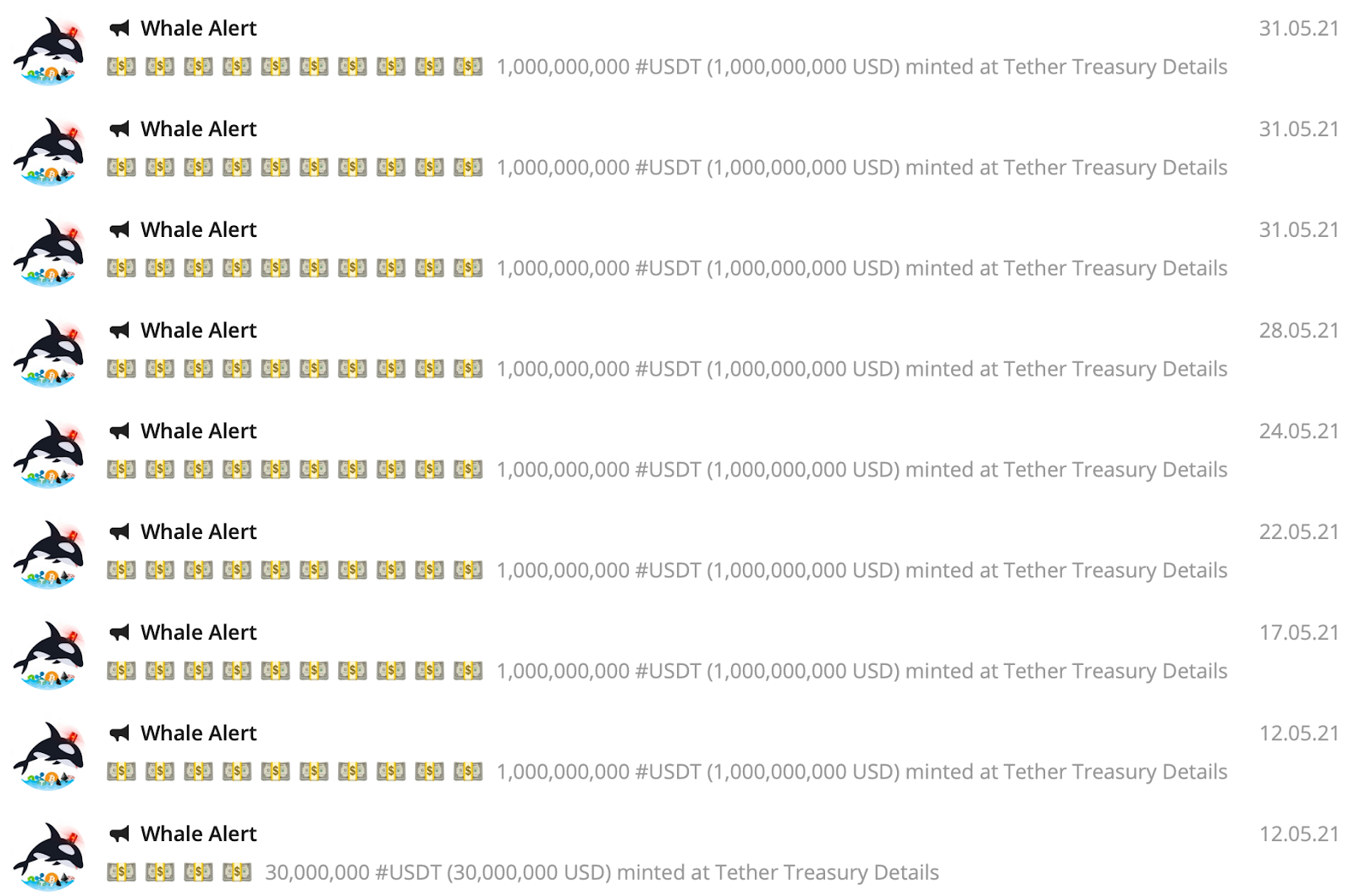
Tether is currently at 62.7 billion tethers, and it’s been stuck there for more than a month. Tether had several big prints at the end of May and now, crickets all through June and into July. The printer has totally stopped. 

Nobody is really clear on why Tether has put its printing presses on hold, but the timing seems to correlate with China’s crackdown on crypto.  

We have three theories for why Tether stopped printing

Theory #1 — Less demand

The China crackdown has created a reduced demand for tethers. When bitcoin’s hash rate dropped precipitously, so did the number of newly minted BTC per day — at one point it was down to 350 new BTC per day, as opposed to the 900 BTC per day the network should be producing.

Binance and OKex have mining pools, so bitcoin miners can mint bitcoin directly to their own exchange accounts. Since there is no way to cash out directly, miners convert BTC to tethers (USDT). And then convert USDT to RMB on unregulated over-the-counter platforms, such as Huobi and CoinCola.

With the exodus of miners from China, there was less demand for tethers. 

Theory #2 — Chinese junk debt

Another theory floating around is that Tether may have been getting Chinese junk debt to issue tethers, and now that is no longer possible due to the risks. 

Tether’s latest composition report showed that 50% of the assets backing USDT were unspecified commercial paper. In the US commercial paper market, that would place Tether among the likes of fund managers like Vanguard and BlackRock, which seems unlikely. (FT)

So maybe it’s holding Chinese paper?

“If Tether is holding Chinese commercial paper, the issuer can default on those debts with impunity. What is Tether going to do? Sue in Chinese courts?,” Tether whistleblower Bitfinexed said in a tweet.

He revealed in a DM that the info comes from a “reliable source.”

Theory #3 — USDC is picking up the slack

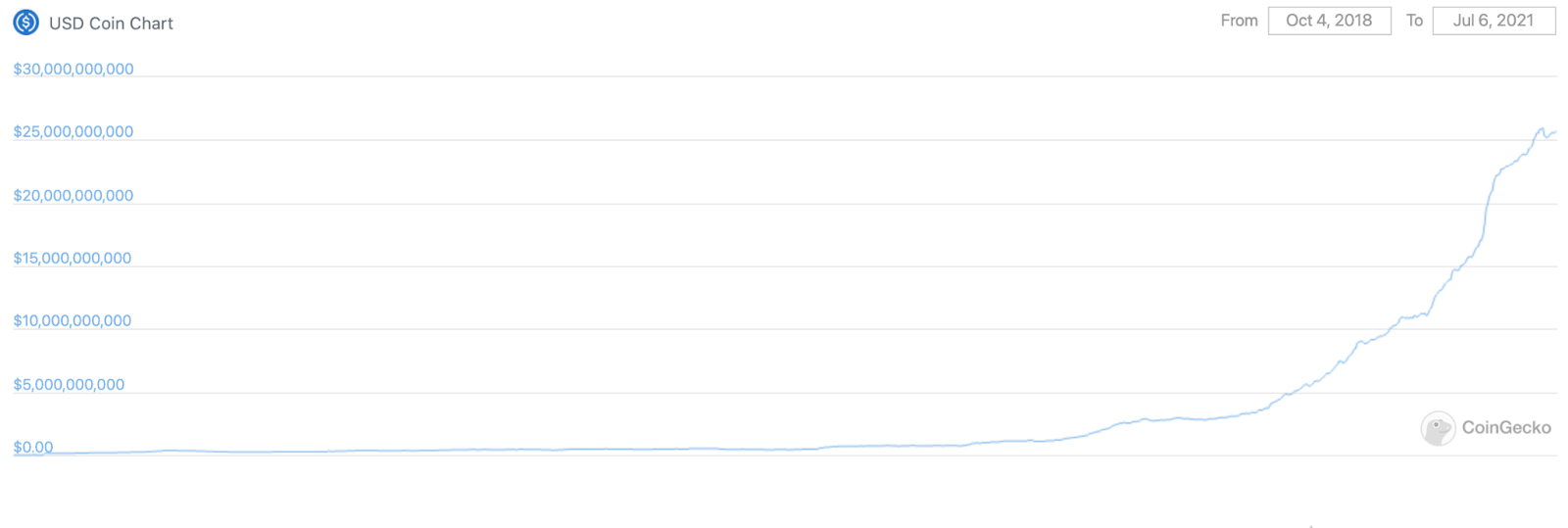
While the tether printer stopped, the USDC printer appears to have picked up speed, issuing 10 million USDC since May 8. 

As of July 5, there are 25.5 billion USDC stablecoins in circulation, so maybe USDC is stepping into Tether’s shoes?

In other news, Tether is working hard to shine up its tarnished image. The company is hiring a Reputation Manager, to “advocate for the company in social media spaces, engaging in dialogues and answering questions where appropriate.” 

If you want to fight the FUD spread by salty nocoiners like myself, this job could be for you. (Teether, archive)

Binance vs the world

The UK, Singapore, Japan, Germany, Canada and now the Cayman Islands are all moving against Binance, the world’s largest crypto exchange. I wrote a blog post detailing Binance’s pariah status. 

The bad news keeps getting worse. Following the FCA banning Binance in the UK on June 26, Barclays says it is blocking customers from using their debit and credit cards to make payments to Binance. (They will let you take money out, but they won’t let you put money in.)

Binance “talks a big game on anti-money laundering and know-your-customer” rules, but was “resistant to throwing human resources at compliance issues,” an executive at a payments company that helped connect Binance to the broader financial market before cutting ties with the group, told the (FT)

And worse still — on Tuesday, Binance told its customers that it will temporarily disable deposits via SEPA bank transfers. Binance said the move was due to “events beyond our control.” (FT)

Binance founder CZ says it’s all FUD.

Binance’s organizational structure

Binance has a lot secrets. The company refuses to say where its headquarters is located. And it’s tight-lipped about its organizational structure, too. 

On May 1, Brian Brooks, former Coinbase chief legal officer and former acting head of the Comptroller of the Currency, took over as CEO of Binance.US, replacing Catherine Coley. (WSJ)

In a Coindesk interview in April, he said he reports to the board of directors, yet he wouldn’t name who was on the board. 

Coindesk: “Brian, what is the reporting structure with Binance US. Who do you report to?”

Brooks: “I have a board of directors, which I will be a member of, and I will report to that board.” 

Coindesk: “Who else is on the board?”

Brooks: “The board is obviously the founder of the company and another person. It’s a private company, so we don’t necessarily go into the governance structure…”

Later when Coindesk asks him where Binance.com is located, Brooks dances around that question as well. He did say, however, that Binance keeps its US customer data separate from Binance.com. 

Binance.US also just brought onboard Manuel Alvarez, a former commissioner at the California Department of Financial Protection and Innovation, as its new chief administrative officer. (Coindesk)

FATF releases 12-month review 

The Financial Action Task Force, a Paris-based global anti-money laundering watchdog, published its second 12-month review of its revised standards for virtual assets and virtual asset service providers, or VASPs

VASPs include crypto exchanges, bitcoin ATM operators, wallet custodians, and hedge funds. 

When the FATF published its guidance in 2019, it recommended full AML data collection by VASPs — and Rule 16, also known as the “travel rule.” 

The travel rule requires VASPs to disclose certain customer data and include that data with a funds transfer, so that the info “travels” down the funds transfer chain.  

Of FATF’s 128 reporting jurisdictions, 58 have implemented the revised FATF standards. The other 70 have not. And the majority of jurisdictions have yet to implement the travel rule.

“These gaps in implementation mean that there is not yet a global regime to prevent the misuse of virtual assets and VASPs for money laundering or terrorist financing,” the FATF said. 

The FAFT plans to publish its revised guidance by November 2021 with a focus on accelerating the implementation of the travel rule as a priority. (Forkfast)

Kaseya ransomware  

The REvil ransomware operation is behind a massive attack centering on Kaseya, a company that develops software for managed service providers. MSPs provide outsourced IT services to small and medium-sized businesses that can’t afford their own IT department. 

Between 800 and 1,500 businesses have been compromised by the global ransomware attack, including schools in New Zealand and supermarkets in Sweden. 

The REvil gang has offered to decrypt all victims for $70 million in Monero (XMR), a cryptocurrency that is harder to track than bitcoin. The immediate ransom demand is $45,000 worth of XMR, rising to $90,000 after a week.

Nicholas Weaver, a researcher at the International Computer Science Institute in Berkeley, wrote a story for Lawfare breaking down the Kaseya ransomware attack. 

He also wrote an earlier story for Lawfare titled “The Ransomware Problem Is a Bitcoin Problem,” where he explains why getting rid of crypto is a great idea. “The ransomware gangs can’t use normal banking. Even the most blatantly corrupt bank would consider processing ransomware payments as an existential risk.”

El Salvador, bitcoin and Bitcoin Beach

Who is the San Diego surfer who brought bitcoin to El Zonte? A white evangelist named Michael Peterson. I wrote about him and his Bitcoin Beach project at length in a recent blog post. 

Peterson read my story. He says it’s full of “glaring inaccuracies” and “plagiarized pieces of other bad reporting.” When asked to substantiate his defamatory accusations, he never replied back. 

Does he use these same bully tactics to get people in El Zonte to use bitcoin? 

David Gerard wrote up a detailed blog post explaining the latest developments on bitcoin and El Salvador. 

Here are some notes, if you want to catch up quick:

  • Nayib Bukele, El Salvador’s president, has announced a government wallet — the Chivo wallet — that will be available for download in September. (Youtube)
  • The Chivo (slang for “cool”) wallet will hold both USD and bitcoin balances. 
  • Salvadorans who sign up for the mobile app will get $30 in bitcoin, but they have to spend it. They can’t sell their BTC for cash — which makes you wonder if Bukele is simply planning to issue new dollars under the guise of bitcoin. (I also recommend you read Gerard’s piece in Foreign Policy on this topic)
  • The technical details of the Chivo wallet are totally unclear. Is Jack Mallers, the CEO of Zap and the remittance app Strike, going to develop the wallet? We don’t know.  
  • Originally, Mallers said Strike was using tether for remittances. (My blog post.) Now, he says Strike is no longer using tethers, and the folks in El Salvador receiving remittances on his app will receive actual dollars. (What Bitcoin Did)
  • How will this happen? Mallers said in his What Bitcoin Did interview that his company has local banking relationships in ES, but we don’t know what banks, where. 
  • Here is a direct quote from the transcript of the interview: “So, I was like, ‘Well, fuck, I don’t know then how I’m going to pull this off!’ So, what I did is, we built Tether into Strike, which was the equivalent of the Chase bank account in America, and it at least gave us some MBP basic functionality, where I can go and just observe and listen and see how people used it and see if it was helpful. But now, we’re already integrating with the top five banks in the country.”
  • Mallers tends to be long on plans and short on details. When the media reaches out to him with questions — like Decrypt did when they learned Zap is not licensed to operate in most US states — he generally just ignores them. 
  • Despite what Mallers keeps claiming, sending remittances via Western Union from the US  to El Salvador isn’t really that costly, to begin with. Steve Hanke, Nicholas Hanlon, and Mihir Chakravarthi point this out in their paper: “Bukele’s bitcoin blunder.”
  • Jack Maller’s company Zap (the parent company of Strike) got $14.9 million in fresh funding in March from “Venture Series – unknown,” on top of a $3.5 million seed round a year prior. Nobody seems to know who is behind the funding. (Crunchbase)
  • Athena, the company that Bukele ordered 1,000 new bitcoin ATMs from, installed a new bitcoin ATM machine — the country’s third installed machine! — in La Gran Vía shopping center. They had a ribbon-cutting ceremony and everything.
  • Unfortunately, the machine was located in front of an upscale department store owned by the Simán family, Bukele’s arch enemy. Worried that the ATM would draw foot traffic to his rival’s business, Bukele had the machine relocated next to the toilets, where it sits unplugged. (Twitter) 
  • The US State Department named 14 El Salvadorans, many associated with the Bukele regime, as corrupt or undemocratic actors. (US State report)

Robinhood’s planned listing

Robinhood had plans to go public in June, but the SEC has some questions about its cryptocurrency business, according to Bloomberg.

The company also agreed to pay FINRA $70 million to settle allegations that the brokerage caused customers “widespread and significant” harm on multiple different fronts over the past few years.

Specifically, FINRA’s investigation found that millions of customers received false or misleading information from Robinhood on a variety of issues, including how much money customers had in their accounts, whether they could place trades on margin and more.

In its SEC S-1 filing, which dropped on July 1,  Robinhood notes that a “substantial portion of the recent growth in our net revenues earned from cryptocurrency transactions is attributable to transactions in Dogecoin. If demand for transactions in Dogecoin declines and is not replaced by new demand for other cryptocurrencies available for trading on our platform, our business, financial condition and results of operations could be adversely affected.”

Robinhood currently supports seven different cryptos. When you trade crypto on Robinhood, you don’t ever hold the keys to your own crypto. Robinhood itself buys the actual crypto and maintains custody, so you can’t move your coins onto or off the platform. You’re stuck in there.

Bitcoin mining turns NY lake into a hot tub

The Greenidge Generation Bitcoin mining plant, owned by private equity firm Atlas Holdings, sits on the shores of beautiful Seneca Lake in New York. 

The tagline on its website reads, “Green Power for Generations to Come.”  

The firm uses lake water to cool its 8,000 computers used to mine bitcoin within the gas-fired plant. Greenidge’s current permit allows it to take in 139 million gallons of water and discharge 135 million gallons daily, at temperatures as high as 108 degrees Fahrenheit in the summer and 86 degrees in winter.  

Locals want the mining facility gone. They have been staging protests. They claim the plant is polluting the air and heating the lake, thanks to its use of fossil fuels.

“The lake is so warm you feel like you’re in a hot tub,” said one nearby resident. (NBC) (Arstechnica)

RSA Conference’s blockchain moment

Over the weekend, the RSA Conference gave infosec and computer science Twitter a bit of a shock when it suggested replacing the entire internet with — a blockchain. 

The tweet quickly disappeared, but not before being archived. The blockchain is immutable! I wrote about the event in a blog post.

(Updated on July 8 to note that Brian Brooks replaced Catherine Coley as CEO of Binance.US.)

If you like my work, please subscribe to my Patreon account for as little as $5 a month.