Amy and David answer your questions — bitcoin mining, ETH staking, FTX, Tether, and more! 

  • By Amy Castor and David Gerard

We asked readers what they were curious about in crypto. We posted part one of our answers earlier this month. Now here’s part two! [Twitter; Bluesky

Sending us money will definitely help — here’s Amy’s Patreon, and here’s David’s.

Q: An update on the carbon footprint of the crypto industry for 2023, if this hasn’t been done by someone else already? Thanks [Thomas Endgame on Twitter]

The news is still dismal. The bitcoin network’s annual carbon footprint is a shocking 76.79 million tons of carbon dioxide, comparable to the entire country of Oman, according to Digiconomist. [Digiconomist, archive]

In terms of energy, bitcoin uses as much electricity as the country of Ukraine — 137.68 terawatt-hours annually. Energy consumption was highest in the first half of 2022 — 204 terawatt-hours per year — but started to go down in July, after the crypto collapse

The network currently produces 23.75 kilotons of e-waste per year, comparable to the entire Netherlands, and every bitcoin transaction uses enough water to fill a swimming pool.

This is why some of the good citizens of Texas are fighting back against the crypto mines there. 

Q: Who’ll be left holding bags when Tether collapses? [Julius Cobbett on Twitter]

Tethers (USDT) function as substitute dollars on offshore crypto exchanges that have no access to US dollar banking.

The biggest holders of tethers are arbitrageurs, such as Cumberland, who pass tethers along to secondary users in exchange for bitcoins and other crypto. [CoinTelegraph, 2020; Protos]

If all tethers were suddenly switched off tomorrow, that would be nearly 100 billion “dollars” in liquidity instantly sucked out of the market.  

Any secondary users stuck holding tether would find their virtual dollars suddenly worthless. Arbitrageurs would have nothing to buy and sell bitcoin with on offshore exchanges — they would have to switch over to a different stablecoin — and the price of bitcoin would likely take a serious hit.

We would expect to see a large number of bitcoin holders trying to dump their holdings on actual-dollar exchanges like Coinbase in a mad rush to get out of the market. It might look like a bunch of mice trying to squeeze out of a tiny hole. 

Q. We all know crypto is garbage, why does YAHOO finance continue to have the BTC ticker and other crypto related garbage up? I’d have thought by now it would be gone. [Barsoapguy on Twitter]

Sadly, with bitcoin ETFs and so on still all over the finance press, it’s a relevant number to put up. Even if they just pull the number from whatever CoinMarketCap says.

Q. In the bankruptcy of FTX, about 7B of the $8.7B said to be “lost” has been found, and with Crypto making a comeback all creditors may become whole or better. But SBF rots in prison for decades? And BK firms make over a billion in fees? [Bill Hochberg on Twitter]

There are two misconceptions here — one is that John Jay Ray and his team have found all the money and everything will be fine. The other is that Ray and his lawyers are gouging the creditors and nobody can stop them.

FTX got itself into trouble because it had stolen the customer assets, then inflated its balance sheets with worthless FTT tokens — its own illiquid supermarket loyalty card points. The FTT made up a third of its balance sheet. When FTX filed for bankruptcy in November 2022, it had a shortfall of $8.7 billion.

As we wrote at the time, FTX’s debts were real, but its assets were fake. The FTT was unsaleable garbage, not something that Ray and his team could turn into cash.

In August 2023, Ray estimated his team had recovered $7 billion — but that included spurious dollar values for trash crypto assets. A lot of it will be FTT and other worthless tokens that aren’t realistically convertible to cash in those quantities. 

In October 2023, FTX said it would refund up to 90% of “distributable assets” to creditors. That’s 90% of the amount of funds that FTX was able to recover — not 90% of the amount owed to creditors. [FTX]

Bitcoin has gone up in price since FTX fell over. The price of bitcoin was $17,000 when FTX filed for bankruptcy. Now it’s over $40,000. If FTX held onto its crypto holdings, instead of converting them into cash as soon as possible, they might have made some money. But bankruptcy lawyers typically don’t gamble on volatile markets. 

Bankruptcy professionals are super expensive. Ray’s team has so far cost about $200 million. That’s a lot of money, and many people questioned this — but even the independent fee examiner said, yep, that looked about right for the ridiculous mess Ray had to sort out here.

An appeals court has ordered the appointment of an independent examiner reporting to the US Trustee, paid for out of the bankruptcy estate, which will likely cost another $100 million or so.

Q: Eth staking and destaking? It was not possible to unstake at launch, does it work now? Are stakers happy? How scammy is the whole thing? There was some stuff about OFAC compliance for stakers too? I don’t know? I might use an explainer? [Laventeot on Twitter]

Ethereum proof of stake uses validators rather than miners like bitcoin does. Every validator has a chance at winning this moment’s ETH. If your block is the winner, you get the block reward, transaction fees, and all the MEV you can steal.

You can set up a validator at the cost of staking 32 ETH. When Ethereum moved to proof of stake in September 2022, this 32 ETH couldn’t be unstaked. But since Ethereum’s Shanghai upgrade in April 2023, it is now possible to unstake your staked ETH.

Unstaking has a queueing mechanism to avoid there being too much churn. So when there’s a big dump — such as when Celsius Network destaked 30,000 ETH recently to hand back to their bankruptcy creditors — it can take days or even weeks to process. [Nansen]

The staking process seems to work as advertised and the stakers are pleased with it.

The process closely resembles an unregistered security in the US — the Ethereum Foundation (incorporated in Switzerland) promotes that you put in your ETH and you get a return on it from the efforts of others.

Some exchanges offer staking as a service — this is probably okay if the customers are accredited or institutional, and an excellent way to accumulate cease and desist letters from the SEC and state securities regulators if the customers are retail.

Anyone moving money — or, in FinCEN’s terms, “value that substitutes for currency,” including “convertible virtual currencies” — as a business in the US is required to comply with sanctions law. This is usually assumed to mean not validating transactions for sanctioned blockchain addresses listed by OFAC. US-based validators would be very foolish to flout this.

OFAC compliance in transaction processing doesn’t directly relate to the economics of staking in itself — US bitcoin miners would similarly be liable under law for processing transactions for sanctioned entities, even if OFAC hasn’t called them up yet.

Q: maybe a check-in on the enterprise blockchain pitch decks? is the same dead horse still being beaten? [Stephen Farrugia on Twitter]

Enterprise blockchain has gone back into hibernation. Corporate interest in non-cryptocurrency blockchain goes up and down with the price of bitcoin — lots of interest in 2017 and 2018, almost none in 2019 and 2020, and a sudden burst of interest in 2021 as the number went up.

The problem with enterprise blockchain is that it’s a completely useless idea. A blockchain doesn’t actually work any better than using a conventional database in any situation where you have a trusted entity who’s responsible for the system. If you’re a business, that’ll be yourself. Just use Postgres.

The main remaining interest in enterprise blockchain is inside banks. We’ve had many reports of bank fintech research units infested with coiners trying to do something — anything — that they can say is “blockchain.” Société Générale’s completely useless euro stablecoin is one recent example.

Q. Something on the way that Bitcoin Magazine and BitMEX bought commercial places on the Peregrine Mission One so they could say they’d “gone to the moon” … and the spacecraft is going to miss the moon. [BiFuriosa on Bluesky]

Private companies have of late been offering to send personal items — cremated remains, time capsules, and even crypto — to the moon. Astrobotic, which owns Peregrin-1, is one of them. 

In May, BitMEX and Bitcoin Magazine announced they were going to send a physical bitcoin to the moon via Astrobotic — that is, a metal medallion with a bitcoin private key engraved onto it. They declared that this would mark a “defining moment for bitcoin as we explore the possibilities of Bitcoin beyond planet Earth.” [BitMEX, archive]

Peregrin-1 made it into space earlier this month — but it never managed to land on the moon. So when it burned up on re-entry to Earth’s atmosphere, everything onboard burned up with it, including the time capsules, the ashes of more than 200 people, and the bitcoin. [Gizmodo]

Dogecoin fans had earlier funded a similar effort to send a physical dogecoin to the moon in 2015, also via Astrobotic. As of 2023, they were still trying to get it sent up. If the physical dogecoin had been onboard, it would have met the same fate. [Twitter, archive]

Sadly, even the moon hates crypto. 

Q. Why are people still falling for this nonsense? [Peter Nimmo on Mastodon]

Dude, they can get rich for free! Maybe.

Thankfully, fewer people are falling for the nonsense. Retail trade is one-eighth of what it was in the 2021 bubble. Most of the dollars boosting the price of bitcoin since 2017 have been fake. 

By the end of 2017, a billion USDT was sloshing around in the crypto markets; today in 2024, we’re coming up to 100 billion USDT. Bitcoin’s price is largely manipulated.

Crypto media — CoinDesk, The Block, Decrypt, and others — play a major role in promoting the nonsense. These outlets, owned and/or financed by crypto companies, are the public relations machines for the crypto industry. The finance press treats these sites as specialist trade press rather than fundamentally a promotional mechanism.

Crypto has also put big money into lobbying efforts, so we see senators like Cynthia Lummis, Kirsten Gillibrand, and Rand Paul shamefully repeating the propaganda. 

Crypto skeptics are a smaller group who try to warn people of the dangers of investing in crypto. So it’s important to send money to us. Instead of bitcoins, we spend it on useful things like wine to get through all this guff.

Q. Once Crypto blows over what will we salt our popcorn with? [EamonnMR on Mastodon]

We don’t expect crypto to ever disappear completely. We do expect the number to eventually go down to the point where fewer people pay attention.

Meme stocks blew out even harder than crypto did. The remaining devotees are like QAnon for finance, posting to Reddit with their theories of how much they’ll surely get for their deactivated BBBY shares when the Mother Of All Short Squeezes finally descends.

Now that the well of dumb crypto money has dried up, venture capitalists are pivoting to AI as the next big thing. The tech is running out of steam, though. But the power consumption is likely to be even worse than bitcoin mining by 2027, and the AI grifters are using the same excuses for it as the bitcoin grifters. [Digiconomist]

Suckers are eternal. As long as money exists, fraud and get-rich schemes will be with us. And we’ll have something to write about.

Image: Hans at Pixabay, CC-0

Bitcoin mining in the crypto crash — the mining companies’ creative accounting

  • By Amy Castor and David Gerard
  • If you like our work, please do sign up for our Patreons — here’s Amy’s, and here’s David’s.

Bitcoin mining is a highly lucrative business as long as the price of bitcoin keeps going up — and as long as investors believe it will keep going up.

When the price crashes — and the price of bitcoin has halved since the start of the year — crypto miners face margin calls, they have to dump their bitcoins, and reality comes knocking.  

In this post, we outline some of the biggest problems facing North American bitcoin miners:

  • Miners are nothing like as profitable as they report to the public stock markets that they are.
  • Miners don’t want to sell their freshly mined bitcoins, as this would risk crashing the price of bitcoin — so instead, they borrow against the bitcoins, and against their rigs, too!  
  • This business model only works if number goes up forever.
  • Number doesn’t go up forever.

During the bitcoin bubble of 2021, miners wanted to lure in naïve investors from the capital markets who thought that crypto mining companies were a great way to get exposure to bitcoin — without the risk of actually touching a bitcoin. The miners would hold their bitcoins, subsidize their business with debt, and you could just buy their stock!

So the bitcoin miners promoted themselves as enthusiastic bitcoin “to the moon” boys — in the hope of luring in other prospective moon boys. Buy now and watch your profits soar! Number can’t go down!

The cunning plan

Bitcoin miners used to be ruthless economic agents, in it for the money. They knew how volatile crypto was, so they sold their coins as soon as they mined them to cover power bills and other business expenses.

As some point, miners’ business model changed from selling bitcoin to holding bitcoin — and borrowing against it.

This model doesn’t make any sense unless you first assume that the number will never go down, and that the bitcoin bubble will never burst — even though bubbles always burst. 

The change started in mid-2021 when bitcoin miners were kicked out of China. Most eventually settled in the US and Canada — because these countries had the world’s next-cheapest reliable electricity. 

The US is now the world’s largest bitcoin mining hub, making up about 37% of the global hash rate. [CBECI]

North American miners filed to become publicly-traded companies. Marathon Digital Holdings (MARA) and Riot Blockchain (RIOT) were the first to be listed on Nasdaq. Other miners soon followed. [Investopedia; Compass Mining]

Going public gave the miners access to the mainstream capital markets, investors, and new lines of credit — way more financial resources than they’d ever had before.

The miners marketed themselves to capital markets as massive bitcoin enthusiasts. Get in, this is the magical future! Here’s Whit Gibbs from Compass Mining in January 2022: [CoinDesk]

“With ample access to funding and investors pouring in money, miners didn’t have to sell their bitcoin to fund operational costs, said Compass Mining’s CEO Whit Gibbs. ‘And since miners are incredibly bullish on bitcoin, this allows them to do what they want to do naturally, which is to speculate on bitcoin’s positive price appreciation,’ he added.”

Miners spent mid-2021 onward racking up debt to finance the construction of facilities, buy mining equipment, and pay their executives enormous salaries.

The companies’ operating expenses were paid for by borrowing against their freshly-mined bitcoins. Some loans even used mining rigs as the collateral.

The miners also did accounting tricks, such as depreciating mining rigs over five years — and not the 15 months they should have — to make the companies look like better investments. Meanwhile, their executives were paid well beyond the carrying capacity of the companies.

In 2021, outgoing Marathon CEO Merrick Okamoto earned a shocking $220 million — although most of that was awarded in stock. Riot Blockchain’s top five execs collectively were paid $90 million the same year with a net loss. [SEC; SEC] ​​

Riot Blockchain failed its say-on-pay shareholder vote on executive compensation for 2021. It’s an advisory vote that the company doesn’t have to act on — but it’s an embarrassing thing to have to admit publicly to failing. Thankfully, coiners have no capacity for embarrassment. [SEC]

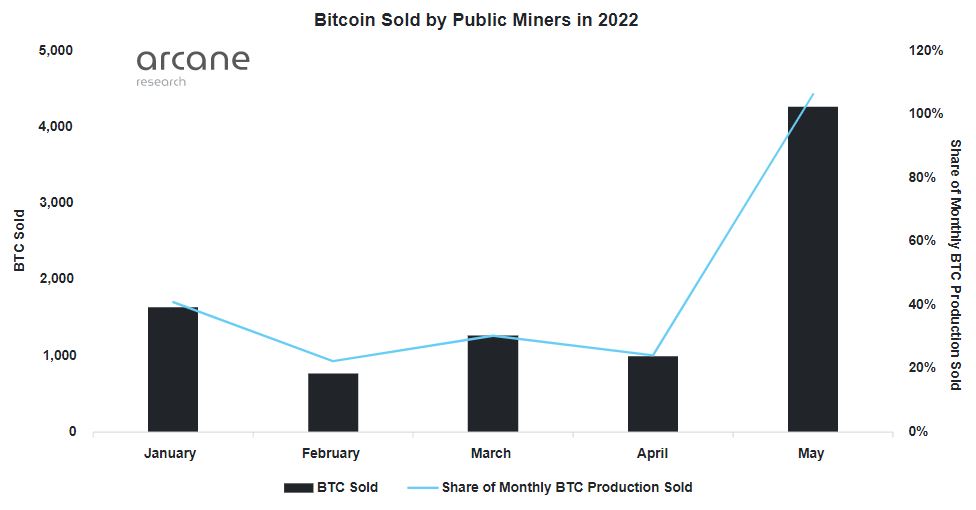
Bitcoins sold by publicly traded mining companies, January to May 2022. [graph]

Bitcoin loans

While the price of bitcoin was going up through 2021, mining saw profit margins as high as 90%. Bitcoin hit $64,000 in April 2021 and $69,000 in November 2021. [Bloomberg, archive]

Margins on mining were especially good in 2021 because the supply of state-of-the art mining rigs was constrained due to the worldwide chip shortage. If everyone could get rigs, the margins would go away. 

But by 2022, when bitcoin lost 70% of its price from its November high, it was a different story.

Miners need actual money to pay their operating expenses. Energy can account for as much as 90-95% of a miner’s overheads. Power companies don’t take bitcoins or tethers. But the crypto trading system was running low on naïve retail suckers to supply fresh dollars. [Reuters

So the miners needed to do their part in propping up the price of bitcoin. Their solution was to avoid selling their bitcoins, and instead to hold them and use them as collateral against low-interest loans. 

Marathon had started the fashion of borrowing against mined bitcoins as early as October 2020 — and the other mining companies soon followed the same plan.

Mainstream financial institutions didn’t really get into lending to bitcoin miners. The main lenders to miners were their fellow crypto companies: Galaxy Digital, NYDIG, BlockFi, Foundry Networks, Silvergate Bank [SEC], Celsius Network, and Babel Finance. (Note that Celsius is bankrupt, and Babel has suspended withdrawals.)

In fact, Marathon just entered a new $100 million revolving loan with Silvergate to add to their existing $100 million line of credit from Silvergate. This is while Marathon has thousands of mining rigs lying idle, waiting on a deal for cheap electricity. [SEC; CoinDesk]

Bitcoin miners are also trying to hedge against the downturn by betting against the bitcoin price going back up. Marathon has been selling call options at, say, $50,000. If bitcoin doesn’t hit this price, those options expire worthless. [Bloomberg]

Miners did deals with politicians and the power industry to get cheap electricity in Texas, as low as 2.5c/kWh — the sort of prices that miners were paying in China. [Bloomberg; press release]

But the Texas grid is notoriously unreliable — and can’t fall back on the other two continental US national grids. With 2022’s summer heat, electricity usage went up significantly, and ERCOT has told miners to switch off from time to time. [Bloomberg; Washington Post; The Verge]

Some miners, such as Riot, made money from credits for not using power in this time. [press release]

Margin calls

Borrowed money, one day, needs to be paid back. When the collateral dropped in value, miners’ loans got margin-called. They had to dump some of their vast holdings.

Miners started dumping big time in June 2022, some selling all their mined bitcoins and some of their “stockpile.” Bitfarms dumped 3,000 coins — half its stockpile — in mid-June. A month later, miners collectively sold 14,000 bitcoins, with a face value of roughly $300 million, in a single 24-hour period — when the CeFi crash was in full swing. [Reuters; Bloomberg; Cryptoslate]

Compass Mining — which sells people mining machines that are then hosted in third-party facilities — posted a list of publicly-listed miners in North America who were selling off their stashes. [Compass Mining

Arcane Research’s Jaran Mellerud analyzed the cash flows and balance sheets of public miners. Marathon was the weakest: “Marathon has 6.2 times higher remaining machine payments in 2022 than their accumulated current operating cash flow accumulated out the year. This will drain them of liquidity.” He thinks Marathon will be forced to sell off their bitcoin stockpile as well. [Tweet thread; Arcane report]

Some loans even used mining hardware as collateral. But mining rigs are even worse collateral than bitcoins. The price of mining rigs on the second-hand market is extremely sensitive to the price of bitcoin — and those loans are now undercollateralized.

As of June 2022, almost $4 billion in loans to bitcoin miners are coming under stress, posing a risk to crypto lenders, as many of the rigs posed as collateral have halved in value. [Bloomberg, archive]

Miners still hold huge piles of unsaleable bitcoins. CryptoQuant says that miners’ holdings have been increasing. As of July 2022, miners held 1,856,000 BTC. [CoinTelegraph]

Mining accounting

Bitcoin miners are not as profitable as they’ve been reporting.

Paul Butler points out that bitcoin mining companies are using questionable accounting methods. [blog post]

When you buy capital equipment with a lifetime longer than your financial year, you can allocate the cost of the purchase over its expected useful lifetime, rather than all in one hit. This is called depreciation.

Publicly-traded mining companies typically depreciate their assets over five years — but the equipment is good for about fourteen to fifteen months, and it’s most profitable in its first nine months. Bitcoin miners play on their “success” in the early years to raise capital to buy additional mining rigs.

The excessively long depreciation on mining rigs is a way to hide that the miners’ real costs are much higher than they’re reporting. The miners are not putting away money for future equipment. This is as well as overpaying their executives. 

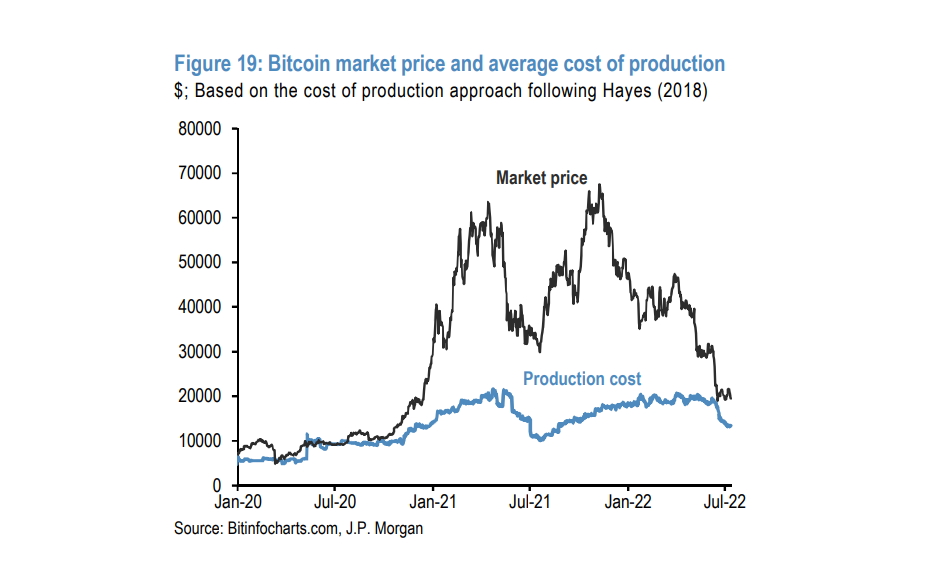
Cost of mining versus cost of bitcoin [Bloomberg]

Tick … tock. Next block?

In a bubble, you can sell mined bitcoins for far more than the cost of the electricity to play Extreme Bingo trying to guess a winning hash.

You can even run old mining rigs that might otherwise be scrapped. Old rigs might spend $30,000 to mine a bitcoin — but that’s fine if you can then sell that bitcoin for $40,000.

So what happens when the bitcoin price drops too low for mining to be profitable?

We’re seeing this now. Miners are taking inefficient hardware offline, causing visible drops in the hash rate charts since May 2022. In November 2018, the price of bitcoin dropped below $3,800 and a lot of miners threw out all their old equipment. The hash rate dipped noticeably.

The real trouble starts when bitcoin falls below $15,000. (As we write this, bitcoin is around $23,000.) Break-even for the most efficient machines is somewhere between $9,000 and $11,000, based on an electricity cost of 5c/kWh. In June 2022, JPMorgan put the cost of mining at $13,000 per bitcoin. [Bloomberg]

If the price drops too low, will the bitcoin blockchain stop ticking along? Probably not — bitcoin really doesn’t need much mining to keep running.

There was a slowdown on the bitcoin (BTC) blockchain in late 2017, when bitcoin cash (BCH) — a fork of not just the bitcoin software, but also its full transaction history — was trying to compete to become the official version of bitcoin. Large miners such as Bitmain switched a large proportion of their mining pools to the BCH chain.

The BTC chain took an hour between blocks at times in November 2017 — about 15% of the previous hash power.

Hardly anyone noticed — they were too busy having fun on the exchanges, which is where the action was in the 2017 bubble. Nobody really cares about the blockchain itself.

Bitcoin mining is green, actually

LOL, no it isn’t.

Proof-of-work mining has long been cryptocurrency’s biggest public relations battle, especially since Elon Musk — formerly the avatar of energy transition — bought bitcoins for Tesla in February 2021.

The general public thinks of crypto as nerd money for nerds to rip each other off. But when the public hear about proof-of-work crypto mining, and how it consumes an entire country’s worth of electricity, they get angry.

So it’s extremely important for the crypto industry to pretend as hard as possible that bitcoin mining isn’t as stupidly and egregiously wasteful as it obviously is — so that they’re allowed to keep mining at all.

The Bitcoin Mining Council claims that bitcoin uses 0.16% of all the electricity in the world. The BMC also claims that 58.4% of bitcoin mining energy use is from sustainable sources, based on claims by its members. [BMC, PDF]

Neither of these numbers is true — and BMC doesn’t show its working. Sources that do show their working — and don’t have a financial interest in fudging their numbers — put the sustainable energy percentage at 25.1%, and the percentage of the world’s electricity consumption over 0.5%. [Joule, paywalled; Digiconomist]

We’re also boggling that the BMC calls 0.16% of all the electricity in the world “negligible” — for the most inefficient payment network in human history. Even Christmas tree lights are more useful to humanity.

You’d almost think that coiners will say any bizarre and egregious nonsense if only it lets them keep trading their magic beans.

What happens next?

Number goes down, loans get margin-called, and the mining companies go broke because of a market downturn.

We expect the mining companies to blame everyone else they possibly can — the CeFi companies for crashing the market, bitcoin for just refusing to go up forever. They have to, really.

Bitcoin mining stocks are already down — MARA is down 58% year-to-date, RIOT is down 75%, and Core Scientific (CORZ) is down 74% since the beginning of the year. Meanwhile, crypto stock short sellers were up 126% as of June. [Reuters]

This scheme was never a sustainable business model. But none of these guys are long-term planners. So we don’t expect they had a coherent exit plan either.

The crypto companies who lent dollars to the miners should have been sufficiently capable of joined-up thinking to realize this was never a sustainable business model. Somehow, they didn’t. 

But then, for an example of the forward thinking skills of crypto guys, we remind you that Michael Novogratz of Galaxy Digital — one of the big lenders to miners — got a Terra-Luna tattoo in January 2022. [Twitter]

Those loans are never getting paid off. The mining rigs are near-worthless, and the bitcoins held as collateral can’t be dumped without taking the market down even further. The lenders get to take a bath on this one.

The bitcoins will likely be dumped, putting more sell pressure on the price of bitcoin.

Along with the rest of the crypto collapse, this is thankfully isolated within crypto. The only “real” financial institution involved is Silvergate, and they have almost no non-crypto customers these days. Any hit to Silvergate is unlikely to be contagious.

Of course, the investors can always sue the bankrupt corpses of the mining companies.

Proof of work—the reason behind Bitcoin’s horrendous energy consumption

Any company that supports bitcoin is making one thing clear: they don’t care about the environment. At a time when global warming is a real threat to the planet, bitcoin is one of the worst offenders. 

The global network of computers that “mine” bitcoin consumes an entire country’s worth of energy in their race to win the next block on the blockchain—and get the 6.25 bitcoin block reward, currently worth $300,000. 

Since PayPal, Square, MicroStrategy, and Tesla got onto the game—and started shilling bitcoin on social media—the price of bitcoin has soared to new heights. And the higher the bitcoin price, the greater the lure for people to invest in warehouses full of power-hungry rigs to mine bitcoin for profit.

Digiconomist’s Bitcoin Energy Consumption Index, run by Alex de Vries, a blockchain specialist at Big Four accounting firm PwC, estimates bitcoin’s energy consumption to be 79 terawatt-hours of electricity per year, on par with the entire country of Chile. Per his index, bitcoin also emits 37 megatons of carbon dioxide per year, comparable to that of New Zealand.  

Researchers at the University of Cambridge Judge Business School figure bitcoin’s power consumption to be even higher. According to their Cambridge Bitcoin Electricity Consumption Index, bitcoin consumes 124 terawatt-hours of electricity a year, bringing it inline with countries like Argentina and Norway.

In October, just before PayPal announced it would allow users to buy and sell bitcoin via their digital wallets, bitcoin’s power consumption was 75 terawatt-hours per year, according to the CBECI. Since then, bitcoin’s price climbed from $10,000 to upwards of $50,000, increasing its energy consumption by 40 percent the process.

In 2018, all of the world’s data centers consumed 205 terawatt-hours of electricity, or 1% of all of the world’s electricity. Bitcoin accounts for half of that.

Can the world’s power grids tolerate this added demand for electricity in the midst of global warming? In the U.S., we are already seeing the impact of extreme weather on our power grids—millions in Texas shivering in cold, dark homes this week. And rolling black outs in California last year. In Iran last month, authorities blamed massive blackouts on bitcoin mining.

Coal powered  

And bitcoin’s energy consumption isn’t green either—though bitcoiners like to say that it is. Bitcoin miners are tuned to profits. That means the fastest rigs and the cheapest energy available, mostly in the form of fossil fuels. 

“Coal is fueling bitcoin,” Christian Stoll, an energy researcher at the Technical University of Munich, told Wired magazine a few years ago.  

In a paper published in Joule in June 2019, Stoll and his researchers examined bitcoin mining based on where miners are located and the types of rigs they use. Two-thirds of all bitcoin mining is centered in China, 17% is in Europe, and 15% in North America, the researchers found. 

In China, bitcoin’s mining is spread throughout the country’s sprawling western provinces, Sichuan and Yunnan, and also in the north, in Xinjiang and Mongolia. In the Sichuan province, where about 58% of the world’s bitcoin mining takes place, miners take advantage of cheap hydroelectric power—but only during the rainy season, which lasts about six months. 

Bitcoin is a 24/7 business, however, and when green energy isn’t available—and the price of bitcoin is high enough to reap a profit in the dry season—the miners in Sichuan turn to coal, the country’s most abundant energy source. Sixty-five percent of China’s electricity comes from coal. Bitcoin miners in the Xinjiang province and inner Mongolia also rely heavily on coal-fired electricity. 

Even when bitcoin uses clean energy, that pushes the use of dirty energy elsewhere. A few years ago, HyperBlock, a bitcoin mine in Missoula County, Montana, struck a deal with a nearby dam for cheap renewable power. They thought they were doing it right, until county officials noted that if energy from the dam went to bitcoin mining, the county as a whole would end up using more coal.

That was the end of that. In April 2019, Missoula required all future mines to purchase or build their own renewable power. And soon after the price of bitcoin crashed in March 2020—slipping down to below $5,000—HyperBlock declared bankruptcy because it could not pay its power bills.

Bitcoin mining and proof of work

Why is bitcoin so inefficient? It turns out that the system uses copious amounts energy not by accident but by design.

Satoshi Nakomoto, bitcoin’s pseudonymous creator, had to figure out a way to solve the double-spend problem. We don’t have this problem with paper money. But with digital money, someone could copy the file and use it to spend the funds over and over, rendering the currency useless. 

In a centralized system, a trusted third-party, like a bank, checks the digital money you spend against a central ledger to make sure there’s no funny business going on. But bitcoin’s ledger (the blockchain) is decentralized, which makes the double-spend problem harder to solve.  

The solution Satoshi came up with was a clever hack that involves bitcoin mining and proof-of-work. In bitcoin, mining is the process of adding new transactions to the blockchain, and proof-of-work secures the network so transactions can’t be reversed. You would need more than half of all the computing power on the bitcoin network to double-spend a bitcoin. 

It wasn’t a perfect solution, but Satoshi solved what computer scientists had long thought was unsolvable: how to build a decentralized payment system. The irony is, unless you are collecting payments for ransomware, bitcoin has proven unusable as a payment system. No merchant wants to risk their profit margin on bitcoin’s volatility.

Today, bitcoin functions mainly as a speculative investment, getting scooped up by retailers and venture capitalists—and now big companies and hedge funds—in the hopes the price will go ever skyward.  

Winning the lottery

Bitcoin miners have their eyes feasted on the bitcoin block reward.

Every 10 minutes, the bitcoin network adds a new block to the blockchain, minting 900 new bitcoins a day in the process. That block reward is reduced by half every four years. Prior to May 2020, the bitcoin block reward was 12.5 bitcoins—double what it is now—and the network produced 1,800 new bitcoins per day. And around February 2024,* the block reward will be 3.125 bitcoins.

When you request a transaction on the bitcoin blockchain, your transaction goes into the bitcoin mempool, a waiting area for unconfirmed bitcoin transactions. Miners select transactions from the pool—usually the ones with the highest transaction fees—and package those into a block ready to process as the next block in the blockchain.

Any server can produce a “candidate block,” but if it were too easy to do, the network would be spammed. So there had to be a financial cost to creating a block, hence the work. 

In the case of bitcoin, that work involves solving a hash puzzle; the cost is computing time and electricity. The hash puzzle is very difficult to solve, but easy for peers in the bitcoin network to verify, so they can prove you did the work and the block is valid.

Some people refer to this puzzle as a complex math problem, but it’s really not. Working out a hash is easy, but in bitcoin, working out a hash that meets certain conditions is tricky. Finding the solution is a bit like winning a lottery.

Solving the hash puzzle

A hash is a fixed-length output calculated from a piece of data. Whether you hash Herman Wouk’s “War and Remembrance” or a grocery store list, the resultant hash will always be the same length. And you will always get the same hash for the same string. But if even one letter changes in “War and Remembrance,” the resultant hash will be different.

Bitcoin uses the hashcash proof-of-work, originally developed by cryptographer Adam Back in 1997 as a way to prevent email spam and denial-of-service attacks, and the SHA-256 hashing function, which has been around since 2001.

When you hash a bitcoin block, you also track the hash of the previous block—which “chains” a block to the one before it, and so on down the line to the first bitcoin block ever created—and a random number called a nonce. The idea is to produce a hash that is lower than the numeric value of the network target. (This target changes periodically to adjust the mining difficulty, thereby assuring only one block gets created every 10 minutes.)

When you mine bitcoin, you repeatedly hash the block while incrementing the nonce. Each time you change the nonce, you also change the value of the resultant hash. The number of hashes that a miner makes per second is called the hash rate; the higher your hash rate, the better your chance of solving the puzzle. A single bitcoin mining rig can make up to 14 trillion guesses per second.

If you discover a hash value that is small enough before anyone else does, you win! Your block is then transmitted to the rest of the network, and the other nodes begin work on the next block using the hash of the accepted block. 

Powerful computers

As bitcoin went up in value over the years, miners found faster and faster ways to win the bitcoin lottery. When bitcoin was first introduced in 2009, you could mine bitcoin with the CPU on your own personal computer.

Those days are a distant memory. As bitcoin mining became more profitable, miners switched to graphic processing units (GPUs). And in 2011, they migrated to field-programmable gate arrays (FPGAs). But starting in 2013, the field was taken over by application-specific integrated circuit equipment (ASIC) rigs—which is the only way to make a profit mining bitcoin these days. 

Over the past decade, bitcoin miners have set up thousands of warehouses of computer hardware dedicated to performing trial-and-error computations in a race against each other to win the block reward.

The result is a massively inefficient coal-powered monster that consumes the same amount of energy as a country (Argentina) with 45 million people, all in the name of “number go up,”

*This is an approximation. The next bitcoin halvening event could happen before or after this date.

If you like my work, please support my writing by subscribing to my Patreon account. Every little bit helps!