Crypto collapse: Mt Gox payouts, Tether hooks up the feds, SEC says no to Coinbase, crypto media mergers

  • By Amy Castor and David Gerard

It’s not over until withdrawals are temporarily paused due to unusual market activity.

Jacob Silverman

Tightening Tether’s tethers

Tether’s been under some regulatory heat after the reports of how useful USDT is for financing terrorists and other sanctioned entities. Even Cynthia Lummis, the crypto-pumping senator from Wyoming, loudly declared that Tether had to be dealt with.

The US government isn’t entirely happy with Tether’s financial shenanigans. But they’re really unhappy about sanctions violations, especially with what’s going on now in the Middle East. 

So Tether has announced that it will now be freezing OFAC-sanctioned blockchain addresses — and it’s onboarded the US Secret Service and FBI onto Tether! [Tether, archive; letter, PDF, archive]

Tether doesn’t do anything voluntarily. We expect they were told that they would allow this or an extremely large hammer would come down upon them.

There’s more to Tether’s criminal use case than sanctions violation. The most jaw-dropping chapter in Zeke Faux’s excellent book Number Go Up (US, UK) is when he traced a direct message scammer to a human trafficking operation in Cambodia that favored tethers as its currency. South China Morning Post follows up on this with an in-depth report on how Cambodian organized crime uses tethers. [SCMP]

Credit rating firm S&P Global rated eight stablecoins for risk. Tether and Dai got the lowest marks. S&P notes in particular the lack of information on Tether’s reserves. [press release; S&P; Tether report, PDF]

At least some of the claimed Tether backing in treasuries is held in the US with Cantor Fitzgerald — exposing Tether to US touchability. This has been known since February 2023, and was proudly confirmed in December 2023 by Cantor CEO Howard Lutnick: “I hold their Treasuries, and they have a lot of Treasuries. I’m a big fan of Tethers.” [Ledger Insights; Forbes]

Cointelegraph had a fascinating story on a company called Exved using tethers for cross-border payments from Russia! Then they deleted it, for some reason. Exved was founded by Sergey Mendeleev, who also founded the OFAC-sanctioned crypto exchange Garantex, which was kicked out of Estonia. Exved is working with InDeFi Bank, another Mendeleev venture. We’re not so sure the new OFAC-compliant Tether will be 100% on board with this. [Cointelegraph, archive; Telegram, in Russian; Protos]

SEC answers Coinbase’s prayers: “No.”

In July 2022 — just after crypto crashed — Coinbase wrote to the SEC proposing new regulatory carveouts for crypto.

The SEC took its sweet time responding. Eventually, Coinbase sued in April 2023 with a writ of mandamus, demanding a bureaucratic response. The court told the SEC to get on with it, or at least supply a date by which it would answer.

Finally, the SEC has responded: “the Commission concludes that the requested rulemaking is currently unwarranted and denies the Petition.” The SEC thinks existing securities regulations cover crypto securities just fine, and there’s no reason for special rules for Coinbase. [SEC rejection, PDF; Coinbase letter to court, PDF; Gensler statement]

Coinbase general counsel Paul Grewal welcomed the opportunity to challenge Coinbase’s dumb and bad proposal being turned down. [Twitter, archive]

4 (continued)

Binance founder and former CEO Changpeng Zhao will not be returning home to Dubai anytime soon. US District Judge Richard Jones ordered CZ to remain in the US until his sentencing on February 24. He can travel within the US, but he cannot leave. [Order, PDF

After being busted hard, Binance is still behaving weird. At the FT Crypto and Digital Assets Summit in London, the exchange’s new CEO Richard Teng refused to answer even basic questions, like where Binance is headquartered and whether it’s had an audit. “Why do you feel so entitled to those answers?” Teng said when pushed. “Is there a need for us to share all of this information publicly? No.” [FT]

CZ and Binance have been trying to dismiss the SEC charges against them. This is mostly loud table pounding, wherein Binance claims that what the SEC argued were securities are not really securities. [Doc 190, PDF, Doc 191, PDF]

France was the first country in Europe to grant Binance regulatory approval. State-endorsed blockchain courses for the unemployed and NFT diplomas helped push the country’s most vulnerable into crypto. Since the collapse of FTX and Binance’s $4.3 billion fine for money laundering, French President Emmanuel Macron’s relationship with CZ has fallen under scrutiny. [FT, archive]

London law firm Slateford helped to cover up Binance’s crimes and attempted to intimidate media outlet Disruption Banking from writing about Binance’s sloppy compliance hiring practices. (Disruption Banking told Slateford to get knotted and didn’t hear from them again.) [Disruption Banking]

Binance is finally removing all trading pairs against Great British pounds. [Binance, archive]

FTX: The IRS wants its money

FTX filed a reorganization plan in mid-December. The plan is 80 pages and the disclosure statement is 138 pages, but there’s a notable lack of detail on what happens next. None of the talk of starting a new exchange has made it into the current plan — this appears to just be a liquidation.

The plan treats crypto claims as their value in cash at the time of the bankruptcy filing on November 11, 2022, back when bitcoin was at $17,000 — less than half of what it is now.

Creditors will vote on the plan in 2024. The court must approve the plan before it is implemented. [Bloomberg, archive; Plan, PDF; Disclosure statement, PDF]

The IRS is demanding $24 billion in unpaid taxes from the corpse of FTX. John Jay Ray wants to know how the IRS came up with that ludicrous number — the exchange never earned anything near those amounts. The IRS originally wanted $44 billion, but brought the number down. Judge John Dorsey has told the IRS to show its working. [Doc 4588, PDF; Bloomberg, paywalled]

Three Arrows Capital

Three Arrows Capital was the overleveraged crypto hedge fund that blew up in 2022 and took out everyone else in crypto who hadn’t already been wrecked by Terra-Luna. After months of dodging culpability, co-founder Zhu Su was finally arrested in Singapore in September as he was trying to skip the country. 

Zhu was released from jail and appeared before the Singapore High Court on December 13, where he had to explain to lawyers for the liquidator Teneo what happened when 3AC went broke. The information will be shared with creditors. [Bloomberg, archive]

A British Virgin Islands court froze $1.1 billion in assets of Zhu and his co-founder Kyle Davies and Davies’ wife Kelly Chen. [The Block]

Teneo expects a 46% recovery rate for 3AC creditors on $2.7 billion in claims. [The Block]

Crypto media in the new Ice Age

Crypto news outlet Decrypt has merged with “decentralized media firm” Rug Radio. No, we’d never heard of them either. The two firms will form a new holding company chaired by Josh Quittner. Decrypt had spun out from Consensys in May 2022, just before everything crashed. It’s reportedly been profitable since then — though crypto sites always say that. [Axios; Axios, 2022

Forkast News in Hong Kong has merged with NFT data provider CryptoSlam and fired most of its staff. Forkast was founded in 2018 by former Bloomberg News anchor Angie Lau; it shut down editorial operations on November 30. [The Block

Crypto news outlets ran seriously low on cash in 2019 and 2020, just before the crypto bubble, and they’re struggling again. We expect more merges and buyouts of top-tier (such as that is in crypto) and mid-tier crypto outlets. We predict news quality will decline further.

Amy recalls the old-style crypto media gravy train and eating in five-star restaurants every night in Scotland and London while embedded with Cardano in 2017. Thanks, Charles! Nocoining doesn’t pay nearly as well, but these days crypto media doesn’t either. There’s probably a book in those Cardano stories that nobody would ever read.

Regulatory clarity

The Financial Stability Oversight Council, which monitors domestic and international regulatory proposals, wants more US legislation to control crypto. FSOC’s 2023 annual report warns of dangers from:

crypto-asset price volatility, the market’s high use of leverage, the level of interconnectedness within the industry, operational risks, and the risk of runs on crypto-asset platforms and stablecoins. Vulnerabilities may also arise from token ownership concentration, cybersecurity risks, and the proliferation of platforms acting outside of or out of compliance with applicable laws and regulations.

Yeah, that about covers it. FSOC recommends (again) that “Congress pass legislation to provide for the regulation of stablecoins and of the spot market for crypto-assets that are not securities.” [Press release; annual report, PDF]

IOSCO, the body of international securities regulators, released its final report on how to regulate DeFi, to go with its November recommendations on crypto markets in general. IOSCO’s nine recommendations for DeFi haven’t changed from the draft version — treat these like the instruments they appear to be, and pay attention to the man behind the curtain. These are recommendations for national regulators, not rules, but look at the DeFi task force — this was led by the US SEC. [IOSCO press release, PDF; IOSCO report, PDF]

London-based neobank Revolut is suspending UK crypto services — you can no longer buy crypto with the app — citing a new raft of FCA regulations, which go into force on January 8. [CityAM; CoinDesk]

Crypto exchange KuCoin has settled with New York. The NY Attorney General charged KuCoin in March for violating securities laws by offering security tokens — including tether — while not registering with NYAG. KuCoin has agreed to pay a $22 million fine — $5.3 million going to the NYAG and $16.77 million to refund New York customers. KuCoin will also leave the state. [Stipulation and consent order, PDF; Twitter, archive

Montenegro plans to extradite Terraform Labs cofounder Do Kwon to either the US or South Korea, where he is wanted on charges related to the collapse of Terra’s stablecoin. Kwon was arrested in Montenegro in March. Originally it looked like Montenegro was going to pass him off to the US, but the case has been handed back to the High Court for review. [Bloomberg, archive; Sudovi, in Montenegrin]

Anatoly Legkodymov of the Bitzlato crypto exchange, a favorite of the darknet markets, has pleaded guilty in the US to unlicensed money transmission. Legkodymov was arrested in Miami back in January. He has agreed to shut down the exchange. [Press release]

The SEC posted a new investor alert on crypto securities with a very lengthy section on claims of proof of reserves and how misleading these can be. [Investor.gov; Twitter, archive

Santa Tibanne

It’s been nearly ten years, but Mt. Gox creditors are reportedly starting to receive repayments — small amounts in Japanese yen via PayPal. [Cointelegraph; Twitter, archive

Some payouts are apparently bitcoin payouts — with the creditors not receiving a proportionate share of the remaining bitcoins, but instead the yen value of the bitcoins when Mt. Gox collapsed in February 2014. This means a 100% recovery for creditors! — but much less actual money.

There are still 140,000 bitcoins from Mt. Gox waiting to be released. If payouts are made in bitcoins and not just yen, we expect that claimants will want to cash out as soon as possible. This could have adverse effects on the bitcoin price.

Trouble down t’ pit

In the Celsius Network bankruptcy, Judge Martin Glenn has approved the plan to start a “MiningCo” bitcoin miner with some of the bankruptcy estate. He says that “the MiningCo Transaction falls squarely within the terms of the confirmed Plan and does not constitute a modification.” [Doc 4171, PDF]

Bitcoin miners are racing to buy up more mining equipment before bitcoin issuance halves in April or May 2024. Here’s to the miners sending each other broke as fast as possible [FT, archive

Riot Platforms subsidiary Whinstone sent its private security to Rhodium Enterprise’s plant in Rockdale, Texas, to remove Rhodium employees and shut down their 125MW bitcoin mining facility. The two mining companies have been brawling over an energy agreement they had made before prices went up. [Bitcoin Magazine]

More good news for bitcoin

The UK is setting up a crypto hub! ’Cos that’s definitely what the UK needs, and not a working economy or something. [CoinDesk]

Liquid is a bitcoin sidechain set up by Blockstream at the end of 2018. It was intended for crypto exchange settlement, to work around the blockchain being unusably slow. It sees very little use — “On a typical day, there are more tweets about Liquid than there are transactions on its network.” [Protos

A16z, Coinbase, and the Winklevoss twins say they’ve raised $78 million as part of a new push to influence the 2024 elections. [Politico

Little-known fact: coiners can donate to the PAC in tethers. All they have to do is send them via an opaque Nevada trust structure to hide the origins of the funds. And this is perfectly legal! [FPPC, PDF, p. 85, “nonmonetary items”]

Ahead of the SEC’s deadline to rule on a bitcoin ETF, Barry Silbert, CEO of Digital Currency, has quietly stepped down from the board of DCG subsidiary and ETF applicant Grayscale and is no longer chairman, according to a recent SEC filing. Silbert will be replaced by Mark Shifke, the current DCG senior vice president of operations. US regulators are suing DCG over the Gemini Earn program co-run by its subsidiary Genesis. [Form 8-K]

Ordinals are an exciting new way to create NFTs on bitcoin! ’Cos who doesn’t want that? The bitcoin blockchain immediately clogged when it was actually used for stuff. Now TON, the blockchain that is totally not Telegram’s, no, no no, has ordinals — and it’s getting clogged too. [The Block]

Image: Mark Karpeles with aggrieved bitcoin trader outside Mt. Gox in Tokyo in 2014.
New York vs DCG/Genesis and Gemini: Kids, kids, you’re both ugly

  • By Amy Castor and David Gerard

  • Send us money! Here’s Amy’s Patreon, and here’s David’s. Sign up today!
  • If you like this article, please forward it to just one other person. Thank you!

The New York Attorney General is suing crypto investment fund Genesis, its parent company Digital Currency Group (DCG), and the Gemini crypto exchange for defrauding customers of Gemini’s Earn investment product. [Press release; complaint, PDF]

Earn put investors’ money into Genesis — where it evaporated.

The lawsuit also charges former Genesis CEO Soichiro (a.k.a. Michael) Moro and DCG founder and CEO Barry Silbert for trying to conceal $1.1 billion in crypto losses with an incredibly dubious promissory note.

New York is asking the court to stop all three companies’ business in “securities or commodities” in the state. That’s all but a death sentence — bitcoin is a commodity in the US.

The SEC was already suing both Gemini and Genesis over the Gemini Earn product because it looked an awful lot like a securities offering. Separately, Gemini sued DCG in July 2023 — and just last week, Gemini also sued Genesis to reclaim missing funds. [Adversary complaint, PDF]

What happened?

Three Arrows Capital (3AC) crashed on June 13, 2022, and blew a gaping hole in Genesis’ loan book. DCG scribbled an IOU to shuffle an imaginary $1.1 billion of value into Genesis reserves.

This financial styrofoam filler didn’t save Genesis, which ultimately halted all withdrawals on November 16, 2022, just days after FTX/Alameda declared bankruptcy. Genesis filed for chapter 11 bankruptcy on January 19, 2023.

The NYAG says that Genesis and Gemini defrauded more than 230,000 Earn investors of more than $1 billion total, including at least 29,000 New Yorkers. New York says that thousands more lost money because of DCG’s actions.

The NYAG claims that:

  • Genesis and Gemini lied to investors about Earn and Genesis’ credit-worthiness;
  • Genesis lied to Gemini that it was solvent;
  • DCG and Gemini lied to the public, including investors, about the promissory note;
  • Earn is an unregistered security under New York’s Martin Act.

This is a complaint we recommend you read. We all knew some of what went on between Genesis, DCG, and Gemini, but this suit goes into great detail about what happened behind the scenes.

This is a civil complaint, not a criminal indictment — but the NYAG describes several crimes being committed, particularly by DCG, Genesis, Moro, and Silbert.

How Earn worked

Gemini, owned by Tyler and Cameron Winklevoss, and Genesis Capital, a subsidiary of DCG, partnered to launch the Gemini Earn program in February 2021 — just as bitcoin’s number was going up really fast. Crypto was a hot product!

Gemini and Genesis marketed Earn to the public as a “high-yield investment program” — which is just coincidentally a common marketing term used by Ponzi schemes. 

Earn promised to pay up to 8% yield. Ordinary investors could deposit their crypto via the Gemini exchange. You could get your money back anytime!

Earn was a pass-through fund to Genesis. Retailers put their crypto in Earn. Gemini then handed the funds off to Genesis, who then lent the money to institutional investors, notably crypto hedge fund 3AC in Singapore. Genesis was substantially a 3AC feeder fund — of which there were many.

When Earn investors wanted to withdraw their funds, Genesis had five days to return the principal and the interest, minus Gemini’s agent fee.

Gemini earned more than $22 million in agent fees for running Earn, plus more than $10 million in commissions when investors bought crypto on Gemini to put into Earn.

Paper thin

3AC was Genesis’ second largest borrower. 3AC had borrowed $1 billion of crypto at 8% to 15% interest, secured by $500 million of illiquid crypto tokens.

Genesis hadn’t received audited financial statements from 3AC since July 2020. But with interest rates like that, why worry — it’ll be fine, right?

It wasn’t fine. 3AC fell over on June 13, 2022, losing Genesis $1 billion. Babel Finance, another Genesis borrower, fell over on June 17, losing Genesis another $100 million — because in June 2022, everyone was falling over.

Genesis was $1.1 billion in the red — it didn’t have the funds to pay back Earn investors. Between mid-June and July 2022, Silbert and other DCG officers met with Genesis management to work out how to fill the hole in Genesis’ balance sheets — and what to tell counterparties such as Gemini.

One problem was that some of the collateral for 3AC’s loan was GBTC shares, issued by another DCG subsidiary, Grayscale — which Genesis couldn’t sell, due to restrictions on sales of stock by “affiliates” of the issuing company.

Silbert told the board of DCG that Genesis was anticipating a run on the bank if word got out. So DCG began casting about for financing. Silbert also suggested to the DCG board on June 14, 2022, that they “jettison” Genesis.

But DCG and Genesis decided instead to act like everything was fine. On June 15, Genesis told everyone its “business is operating normally.” Two days later, Genesis CEO Michael Moro posted in a tweet reviewed and edited by DCG: “We have shed the risk and moved on.” [Twitter, archive; Twitter, archive]

Everything was not fine. The 3AC hole meant that Genesis’ loss exceeded its total equity, and Genesis couldn’t pay out Earn investors. Genesis hadn’t “shed the risk and moved on” — it still had the gaping hole in its balance sheet. It was not “operating normally” — it was floundering in a panic.

Genesis was unable to find anyone to lend them the money they needed, so they had to find a way to paper the hole before the end of the quarter.

The solution: DCG would make a loan from its right pocket to its left pocket and count the loan as an asset.

(When Tether and Bitfinex tried to pull the exact same trick a few years earlier, the NYAG fined them $18.5 million and kicked them out of the state.)

So on June 30 — the last day of Q2 2022 — DCG gave its wholly-owned subsidiary Genesis a promissory note for $1.1 billion. DCG would pay it back in ten years at 1% interest.

Both Silbert and Moro signed off on the IOU. The note was, of course, not secured by anything.

DCG never sent Genesis a penny — the note was only ever meant to be a $1.1 billion accounting entry so that Genesis and DCG could tell the world that Genesis was “well-capitalized” and that DCG had “absorbed the losses” and “assumed certain liabilities of Genesis.”

None of this was true. DCG wasn’t obligated to pay anything on the note for 10 years. And Genesis was still out $1.1 billion of actual funds.

Michael Patchen, Genesis’ newly appointed chief risk officer, said in internal documents that the promissory note “wreaks havoc on our balance sheet impacting everything we do.” 

Genesis directed staff not to disclose the promissory note to Genesis’ creditors, such as Gemini. Many Genesis staff didn’t even know about the promissory note until months later.

DCG’s piggy bank

DCG made Genesis’ problems even worse by treating Genesis like its own personal piggy bank. 

In early 2022, DCG “borrowed” more than $800 million from Genesis in four separate loans. When $100 million of this came due in July, DCG forced Genesis to extend the maturity date — and DCG still hasn’t paid a penny of it to date.

A DCG executive told a Genesis managing director on July 25, 2022, that DCG “literally [did not] have the money right now” to repay the loan. Genesis had no choice — the managing director replied: “it sounds like we don’t have much room to push back, so we will do what DCG needs us to do.” DCG also dictated the interest rate for this loan.

Around June 18, 2022, DCG borrowed 18,697 BTC (worth $355 million at the time) from Genesis. It partially paid this back on November 10, 2022 — with $250 million worth of GBTC! — but this still left Genesis with no cash to pay back its own creditors. And it still couldn’t liquidate the GBTC. 

It’s hard to consider the deals between Genesis, DCG, and Grayscale as anything like arm’s length — it was a single conglomerate’s internal paper-shuffling.

On November 2, CoinDesk reported that FTX, one of the largest crypto exchanges, was inflating its balance sheet with worthless FTT tokens. The report brought FTX tumbling down, and FTX filed for bankruptcy on November 11, 2022.

Around November 12, 2022, Genesis sought an emergency loan of $750 million to $1 billion from a third party due to a “liquidity crunch.” Its efforts were unsuccessful. On November 16, Genesis halted redemptions.

If you owe Gemini a billion dollars, then Gemini has a problem

Gemini Earn investors were supposed to be able to get their funds back at any time. This meant that those funds had to be highly liquid. Gemini told investors it was monitoring the financial situation at Genesis. 

Gemini absolutely failed to do this. They lied to investors, and they hid material information. 

Gemini got regular financial reports from Genesis. Gemini’s internal risk analyses showed that Genesis’ loan book was undercollateralized for Earn’s entire operating existence. But Gemini told Earn customers that Genesis had more than enough money to cover their loans.

Starting in 2021, Genesis’ financial situation went from bad to worse. In February 2022, after analyzing Genesis’ Q3 2021 financials, Gemini internally rated Genesis capital as CCC-grade — speculative junk — with a high chance of default.

Gemini also found out that Genesis had a massive loan to Alameda — secured by FTT tokens! The same illiquid FTX internal supermarket loyalty card points that were discovered by Ian Allison at CoinDesk to make up about one-third of Alameda’s alleged reserves.

Even after Genesis recalled $2 billion in loans from Alameda, the crypto lender was still full of loans to affiliates, including its own parent company DCG. 

In June 2022, the crypto markets crashed and burned. But Gemini continued to reassure investors that it was safe to feed money to Genesis via Earn.

This was apparently fine when it came to someone else’s money, but according to the complaint: 

During this same period, Gemini risk management personnel withdrew their own investments from Earn. A Gemini Senior Risk Associate working on Earn withdrew his entire remaining Earn investment — totaling over $4,000 — between June 26, 2022, and September 5, 2022.

Likewise, Gemini’s Chief Operations Officer [Noah Perlman], who also sat on Gemini’s Enterprise Risk Management Committee, withdrew his entire remaining Earn investment — totaling more than $100,000 — on June 16 and June 17, 2022.  

This was when DCG tried to paper over the hole in Genesis’ balance sheet with a $1.1 billion IOU.

Gemini realized things weren’t good at Genesis, but it’s not clear that they realized how bad they were — not helped by Genesis lying to Gemini about their true condition.

From June to November 2022, Genesis would send Gemini false statements on their financial condition — for instance, saying that the DCG promissory note could be converted to actual cash within a year, when in fact, it was a 10-year note. 

Gemini didn’t tell investors that Genesis was in trouble. Instead, they thought they’d “educate clients on the potential losses” and “properly set clients’ expectations.”

When the Gemini board was advised of Genesis’ financial state in July 2022, one board member compared Genesis debt-to-equity ratio to Lehman Brothers before it collapsed.

Gemini tried and failed to extricate itself from Genesis. They just could not get the funds back. But they knew that Genesis operated as a closely controlled sockpuppet of DCG, and they wanted Silbert to make good on Genesis’ debt. 

As things at Genesis got worse, Gemini worked out how to break the news to Earn creditors.

On September 2, 2022, Gemini finally decided to terminate Earn. On October 13, Genesis formally terminated the Earn agreements and demanded the return of all investor funds. 

On October 20, 2022, Silbert met with Cameron Winklevoss of Gemini. Silbert said that Gemini was Genesis’ largest and most important source of capital — meaning that Genesis could not redeem Earn investors’ funds without Genesis declaring bankruptcy.

Gemini quietly granted Genesis multiple extensions to return investor funds.

On October 28, 2022, Silbert finally let Genesis tell Gemini the true terms of the promissory note — just two weeks before Gemini cut off withdrawals.

For some reason neither we nor the NYAG can fathom, Gemini cointinued to take investors’ money and put it into Earn right up to the end!

Customer service

Gemini didn’t do anything so upsetting for Earn investors as to tell them about Genesis’ unfortunate condition — even as Gemini’s own staff closed out their positions in Earn.

One customer wrote to Gemini on June 16, 2022, three days after 3AC collapsed, asking if any of their funds were with 3AC. Gemini didn’t answer the question, but replied with vague reassurances about Genesis’ trustworthiness.

Another wrote on June 27, 2022: “with other exchanges like Celsius and Blockfi I am concerned about Gemini. Does Gemini have any similar vulnerabilities? … liquidity vulnerabilities? … risky investments/loans that would risk my assets or cause Gemini to halt withdrawals?”

Gemini responded: “Gemini is partnering with accredited third party borrowers including Genesis, who are vetted through a risk management framework which reviews our partners’ collateralization management process.”

This investor was sufficiently reassured to send in another $1,000.

A third customer wrote on July 24, 2022, asking specifically if Gemini was involved in any of the “drama” around 3AC and if it impacted Earn. Gemini said they weren’t involved in anything regarding 3AC — even as the 3AC crash had in fact blown out Earn.

The consequences

The NYAG is asking the court that all three companies be permanently banned from dealing in “securities or commodities” in New York — e.g., bitcoin.

Some of the press coverage noted this provision — but didn’t notice that it would be a near death sentence for a crypto business. DCG’s profitable Grayscale business would have to leave New York or be sold off. Gemini would be kicked out of the state.

New York is also seeking restitution for the victims and disgorgement of ill-gotten gains.

Also, they all get fined $2,000 each. It’s possible that bit of the General Business Law could do with an update.

Foreign Policy: The Crypto Dominos Are Still Falling

I just wrote my first story for Foreign Policy. [Foreign Policy]

After the highs of 2021, cryptocurrency crashed to the ground in 2022. One by one, multiple large crypto firms toppled, dragging many minor firms down along with them in a small-scale replay of the 2008 financial crisis. 

Now, another large domino, Barry Silbert’s Digital Currency Group, may be about to topple. The crypto conglomerate had managed to survive a remarkably long time with a relatively clean legal record. But on January 19, Genesis, a major part of DCG, filed for bankruptcy

The fall of the once-acclaimed DCG could be the final nail in the coffin of crypto’s credibility. It could also lead to a systemic collapse in crypto, as DCG is one of the biggest investors in the space.  

Crypto collapse: DCG’s problem is Grayscale, FTX Bahamas agreement, DeFi trading arrest, Silvergate Bank, Huobi, Binance

  • By Amy Castor and David Gerard

Oh, what a tangled web we weave, when first we practice to deceive!

— Sir Walter Scott, 1808

DCG: Congratulations, you played yourself

The Department of Justice’s Eastern District of New York and the SEC are looking into money flows between Barry Silbert’s Digital Currency Group and its lending subsidiary Genesis, and what investors were told about the transfers. [Bloomberg]

DCG has been playing all the same games as the rest of crypto — trying to create the illusion of money where there is no money, to keep the party going a little bit longer.

Genesis should have declared insolvency in June when Three Arrows Capital (3AC) blew a $2.4 billion hole in its accounts — but DCG purchased 3AC’s defaulted loan from Genesis and financed the purchase with a promissory note of $1.1 billion, to be paid back over 10 years.

That is: DCG and Genesis counted an internal IOU as money, to claim Genesis was still solvent.

The catch with the promissory note is that if the 10-year loan is “callable” — meaning DCG would have to pay Genesis the full amount immediately in the event of a liquidation or bankruptcy — then it could give Genesis creditors a claim on DCG itself, and take all of DCG down with it.

“The Promissory Note is like a noose wrapped tight around the neck of DCG. If Genesis goes over the cliff, it drags DCG with it,” said Ram Ahluwalia, the co-founder of Lumida, an investment advisory firm that focuses on crypto. [Twitter]

In a letter to shareholders in November, Silbert disclosed that DCG borrowed another $575 million from Genesis — due in May 2023. The funds were used for “investment opportunities” and buying back shares of DCG stock from outside investors. [Twitter]

A creditor committee that includes crypto exchange Gemini presented Genesis and DCG with a plan to recover the assets. Silbert had until January 8 to respond. Cameron Winklevoss threatened that “time is running out.” [Twitter; Twitter]

We think Gemini will try to force Genesis into involuntary chapter 11 — they just need three creditors to file a petition with the bankruptcy court. The judge then holds a hearing and decides if the matter will go through. [11 U.S. Code, section 303]

Gemini Earn, Genesis, GBTC, and 3AC

As is usual in crypto, DCG screwed itself by greed. DCG also owns Grayscale, which operates the Grayscale Bitcoin Trust (GBTC) — DCG’s cash cow. Grayscale collects a whopping 2% annual fee on its assets under management — currently, 633,000 BTC.

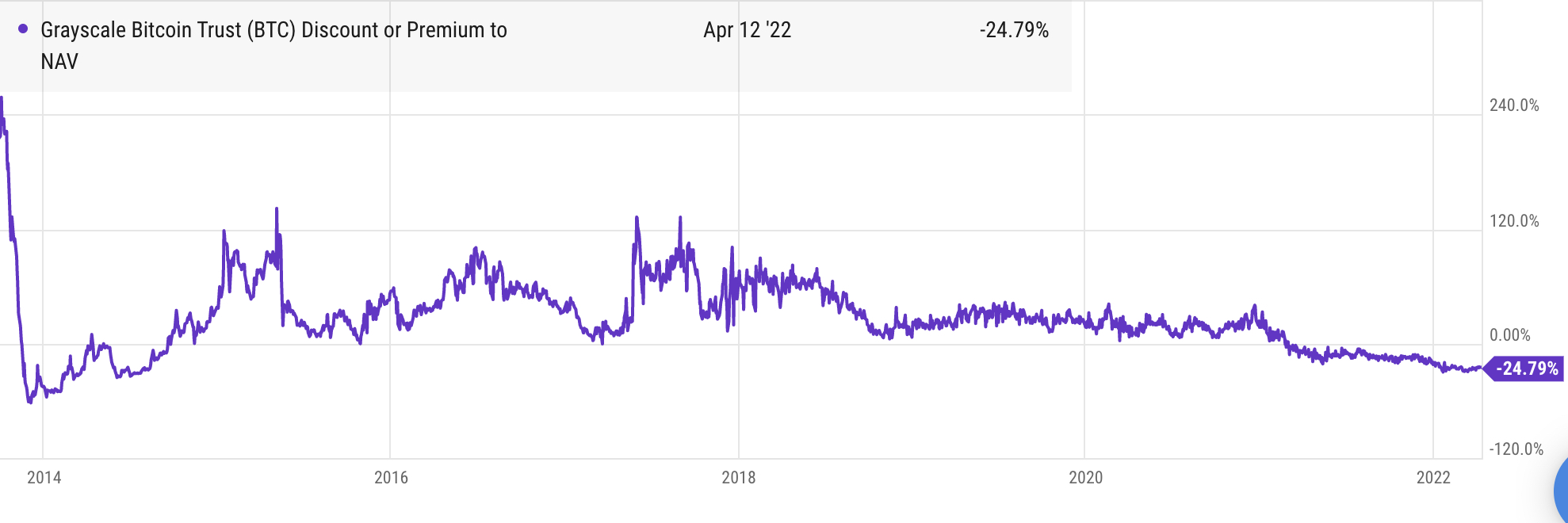
GBTC traded above the face value of the bitcoins in the fund up to early 2021 — then it dropped below net asset value (NAV).

Genesis took the crypto it got from Gemini Earn customers and lent those funds out to institutional investors and crypto hedge funds — such as Three Arrows Capital.

3AC was one of the biggest investors in GBTC, taking advantage of a lucrative arbitrage opportunity. They would borrow bitcoins from Genesis and swap those for GBTC shares at NAV from Grayscale. After a six-month lockup, 3AC could dump the shares on retail for a handsome profit. Rinse and repeat, and when GBTC was trading at 20% above NAV, they could make a 40% profit a year that way

This GBTC arb played a big role in keeping the price of bitcoin above water in 2020, setting the stage for the 2021 bitcoin bubble.

At the end of 2020, 3AC was the largest holder of GBTC with a position worth $1 billion at the time. After February 2021, the GBTC premium dried up, and GBTC began trading on secondary markets at a steep discount to NAV. 

3AC had hoped the discount would be reversed when the SEC approved Grayscale converting its bitcoin trust to an ETF. But the SEC rejected the application, and the GBTC discount continued to widen. [Bloomberg]

When 3AC defaulted on its $2.4 billion loan to Genesis, Genesis seized the collateral backing the loan, including 17.4 million shares of GBTC, and filed a $1.1 billion claim against 3AC — a claim that is now on DCG’s books. [Coindesk; Affidavit Russell Crumpler, PDF]

Class action against Gemini Earn

Gemini partnered with Genesis for their Earn program. After Genesis lost $175 million in FTX in November, it froze withdrawals. Gemini Earn froze withdrawals in turn. Now Gemini Earn customers are out $900 million.

In an effort to get those funds back, three Gemini Earn customers are seeking class arbitration against Genesis and DCG.  

Gemini and Genesis had a “master digital asset loan agreement,” which Gemini Earn customers entered into — when you became an Earn customer, you agreed you were lending money to Genesis.

The complaint alleges that Genesis breached this agreement by hiding its insolvency through a “sham transaction,” whereby DCG “bought” the right to collect a $2.3 billion debt owed to Genesis by 3AC with the aforementioned $1.1 billion promissory note. The plaintiffs also claim that the Genesis loan agreement created an unregistered sale of securities. [Press release; Complaint, PDF; Master Digital Asset Loan Agreement]

The master loan agreement states that: “Each Party represents and warrants that it is not insolvent and is not subject to any bankruptcy or insolvency proceedings under any applicable laws.”

This is why Silbert keeps insisting that Genesis has a liquidity issue and not a solvency issue — even as those are functionally identical in crypto. If Genesis was found to be insolvent and took customer funds in, it would be in violation of that contract. (As well as promptly calling that promissory note from DCG.)

Amidst all of this, Larry Summers, the former US Treasury Secretary and World Bank Chief Economist, has quietly left DCG — going so far as to remove all mention of DCG from his own website. Summers joined DCG as a senior advisor in 2016, a year after the company’s founding. [Protos]

Silvergate Bank

Moody’s has downgraded Silvergate Bank’s long-term deposit rating to Ba1 from Baa2 after the crypto bank announced that its customers — who are almost entirely crypto firms now — withdrew $8 billion in deposits in Q4 2022: [Moody’s

The negative outlook reflects Moody’s view that the bank’s profitability over the near term will be weak along with the risk of further declines in deposits from crypto currency centric firms further pressuring profitability. In addition, the negative outlook reflects the increasing regulatory and legal risks that the firm is currently facing.

Silvergate’s other customers are worried about the bank’s solvency and about the regulatory heat coming its way. Silvergate was key to FTX/Alameda having access to actual money — they helped funnel money to FTX from accounts in the name of Alameda and of Alameda’s dubious subsidiary, North Dimensions. 

If Silvergate are found to be complicit in FTX’s fraud, they will be fined. But if there was money laundering and sanctions busting, they could be shut down. They will at the very least be fined. We would guess some individuals will also get a bar from being bankers. Here’s a list of enforcement actions on Federal Reserve member banks. [Federal Reserve]

Silvergate’s 8-K SEC filings this year are full of bad news. We noted Silvergate’s layoffs and writing off its Diem investment last time. [SEC 8-K; SEC 8-K; SEC 10-Q]

FTX

After a series of knock-down-drag-out filings — and the hilarious revelations of how FTX Digital Markets (FTX DM) was functionally Sam Bankman-Fried’s Bahamas partying fund — the US and Bahamas bankruptcies are working together now. John Jay Ray III and his team met in Miami with the joint provisional liquidators (JPLs) handling the FTX DM liquidation, and they’ve reached an agreement. [press release; agreement, PDF]

The Bahamas JPLs will handle everything to do with FTX DM, and the US administrators will handle everything to do with all the other FTX companies. The JPLs will handle the Bahamas real estate and the cryptos being held by the Securities Commission of the Bahamas. (This doesn’t mean that the Bahamas will handle the disbursement of the crypto they have under their control — only that FTX is fine with them holding the funds for now.) The parties will share information. FTX DM’s chapter 15 foreign entity bankruptcy in the SDNY will continue.

We suspect it was clear the US side would win in court, and the Bahamas liquidators realized they weren’t being paid enough to damage their reputations this way. The agreement is subject to approval by the courts in the US and the Bahamas, but it would be surprising for them not to allow it.

The Department of Justice has put out a call for victims of “Samuel Bankman-Fried, a/k/a ‘SBF.’” That’s his rapper name now. [Justice]  

Huobi’s real-time meltdown

Huobi has always been a dodgy crypto exchange — even before it was run by Justin Sun from Tron. Huobi has $2.6 billion in reserves, and 40% of that is its own HT token. If you don’t count its own internal supermarket loyalty card points, Huobi is insolvent. [Twitter]

Huobi is desperately searching its pockets for spare change. On December 30, Wu Blockchain reported that Huobi was canceling year-end bonuses and planning to slash half its staff of 1,200 people and cut the salaries of senior employees. Sun denied the rumors. [Twitter; South China Morning Post; Twitter

Other unofficial reports from small accounts on Twitter said that Huobi was offering to pay its employees in stablecoins — USDC and tethers — instead of actual-money yuan. If they objected, they would lose their jobs. [Twitter

Employees revolted at being paid in magic beans — so Sun cut off internal communications. On January 4, Bitrun said that “all communication and feedback channels with employees” had been blocked. [Twitter

Here’s the unofficial details on how Huobi is treating its employees. Those who quit because they’re getting paid in tethers get no severance pay either. This is what a doomed company does. [Twitter]  

After initially denying Huobi was cutting staff, Sun finally admitted that Huobi was indeed laying off 20% of its employees in the first quarter of 2023 — after rumors swirled that half of all employees would be let go. [FT]

Huobi users rushed to get their funds off of the exchange. Blockchain analytics platform Nansen noted a wave of withdrawals on January 5 and 6. Following the withdrawals, Peckshield reported a wallet associated with Tron moved $100 million in stablecoins — USDC and tethers — into Huobi. [Twitter, Twitter]

In a lengthy Twitter thread, Sun assures you that your funds are totally safe. We fully expect the exchange to blow up at any moment. [Twitter]

Binance

US prosecutors for the Western District of Washington in Seattle are sending subpoenas to hedge funds for records of their dealings with Binance. John Ghose, formerly a Justice Department prosecutor who specialized in crypto and now a lawyer at compliance vendor VeraSafe, thinks this is about money laundering. [Washington Post]

We noted previously that “BUSD” on Binance is not the BUSD issued by Paxos, which claims to be backed by actual dollars in Silvergate Bank. Binance “BUSD” is a stablecoin-of-a stablecoin, maintained internally. This is the sort of arrangement that’s fine until it isn’t.

It turns out that Binance has been issuing uncollateralised “BUSD” on its own BNB blockchain. Data Finnovation looked at the Ethereum and BNB blockchains and saw that Binance has a history of minting fake “BUSD” internally on BNB. At some points in 2021, there were $500 million to $1 billion of fake dollars circulating on BNB. They’re caught up now, though — so that’s all fine, right? [Medium]

Dirty Bubble thinks Binance US isn’t meaningfully separate from Binance.com, if you look at how the cryptos flow. But that shouldn’t be news to anyone here. [Dirty Bubble]

Reuters is still on the Binance beat. Here’s a special report on Binance’s accounts, as far as can be told. Reuters calls Binance’s books a “black box.” Private companies don’t have to disclose their financials, especially if they’re operating outside all effective regulation — but even Binance’s former CFO, Wei Zhou, didn’t have full access to the company’s accounting records in the three years he was there. We’ve noted previously how regulators have a heck of a time getting the most basic information out of Binance. [Reuters

John Hyatt from Forbes notes how Binance is spending tens or hundreds of thousands of dollars sponsoring Politico’s Playbook newsletter to reach politicians and bureaucrats. Worked great for FTX! [Twitter thread]

DeFi: Go directly to jail

Discussions of crime on the blockchain hardly ever point out that almost all of what goes on in DeFi was always just straight-up illegal under US law.

Pretty much every token was always an unregistered security. The sort of market manipulations that are standard practice in the DeFi trash fire have been illegal under Dodd-Frank since 2010. And that’s before we get to the rugpulls, hacks, and “hacks.”

The authorities are finally moving in. Every DeFi trader should consider themselves on notice.

Hotshot DeFi trader Avraham “Avi” Eisenberg was arrested in Puerto Rico on December 27 on a Department of Justice (Southern District of New York) indictment for commodities fraud and commodities manipulation in the $110 million trade that took out Mango Markets. [indictment, PDF; case docket]

Mango Markets is a decentralized exchange that runs on Solana. Users can lend, borrow, swap, and trade on margin. The exchange is overseen by a DAO, made up of people who hold MNGO — the native token of the exchange.

On October 11, someone drained the project of $110 million by manipulating the platform’s price oracle. After others had traced it to him, Avi Eisenberg came forward and explained the trade.

Eisenberg sold MNGO perpetual futures from one account he controlled to another account also under his control. He then bought large amounts of MNGO, which had the effect of increasing the value of his large holding of MNGO perpetuals. He then borrowed against these holdings and withdrew $110 million in assorted cryptocurrencies. 

This also rendered the Mango platform insolvent. Eisenberg himself explained that the insurance fund in place was “insufficient to cover all liquidations.” He gave back some of his trading profits. [Twitter; Bloomberg]

Eisenberg tweeted: [Twitter, archive]

I believe all of our actions were legal open market actions, using the protocol as designed, even if the development team did not fully anticipate all the consequences of setting parameters the way they are.

Eisenberg’s lawyer will likely explain his client’s erroneous legal reasoning to him.

Eisenberg wasn’t just arrested, he was denied bail as a flight risk — he has significant ties outside the US, he already left the US for two months just after the alleged offense, he likely has crypto stashed away somewhere, the charge carries a heavy penalty, and his background could not be checked. (Compare Sam Bankman-Fried’s release on bail.) [Order of detention pending trial, PDF]

It’s not clear why prosecutors went after Eisenberg in particular. We’d guess the CFTC and DoJ were looking for someone to make an example of. The bit where Eisenberg tweeted a complete confession probably helped, much as SBF’s confession tour of the press helped get him indicted.

What Eisenberg did to Mango was not remarkable at all. DeFi traders pull this nonsense all the time. Perhaps you don’t think DeFi trading shenanigans should be crimes, and that’s nice for you that you think that.

As Avi tweeted on October 19: “What are you gonna do, arrest me?” [Twitter, archive]

Welcome to Grayscale’s Hotel California 

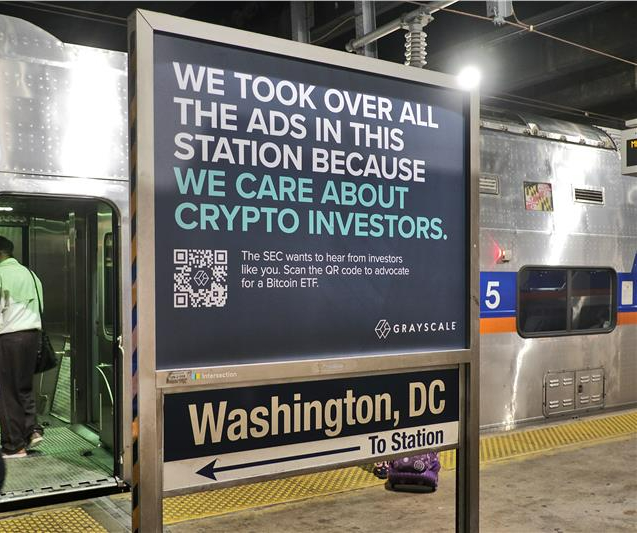
If you happen to be taking Amtrak and pass through Penn Station or Union Station, you will notice something unusual: every available ad space has been taken up by Grayscale. 

“We care about crypto investors,” the crypto asset manager says in its ads. Grayscale is urging the public to write to the Securities and Exchange Commission and convince them to approve the first spot bitcoin ETF in the U.S.

Grayscale wants to convert its Grayscale Bitcoin Trust (GBTC) into a bitcoin ETF after flooding the market with shares. GBTC is trading 25% below its net asset value, and investors are rightfully pissed off. Grayscale wants them to be upset with the SEC, but the regulator isn’t really to blame. If anything, the SEC should have warned the public about GBTC years ago. 

Over the last eight years, Grayscale has been telling investors to buy shares of GBTC, advertising the fund as a way to get exposure to bitcoin without having to buy bitcoin.  

Accredited investors plowed dollars (or maybe bitcoins) into the fund all through 2020, looking to take advantage of an arbitrage opportunity. They could buy in at NAV, and after a 6 to 12-month lockup, sell on the open market for a premium. All through 2020, that premium was around 18%, on average.

Everybody was happy until February 2021, when the Purpose bitcoin ETF launched in Canada. Unlike GBTC, which trades over-the-counter, Purpose trades on the Toronto Stock Exchange, close to NAV. At 1%, its management fees are half that of GBTC. Within a month of trading, Purpose quickly absorbed more than $1 billion worth of assets. 

Demand for GBTC dropped off and its premium evaporated. Currently, 653,919 bitcoins (worth a face value of $26 billion) are stuck in an illiquid vehicle. Welcome to Grayscale’s Hotel California. 

The plan all along, Grayscale claims, has been to convert GBTC into a bitcoin ETF. On October 19, 2021, NYSE Arca filed Form 19b-4 with the SEC. The regulator has until early July to respond. 

In all probability, the SEC will reject the application, just as it has every single spot bitcoin ETF application put before it to date. 

Bitcoin’s price is largely determined by wash-trades, whales controlling the market, and manipulation with tethers. SEC Chair Gary Gensler knows this. He taught a course in blockchain and money at MIT Sloan before his appointment by the Biden administration. 

This is Grayscale’s second time around. It applied for a bitcoin ETF in 2016, but withdrew the application during the 2017 bitcoin bubble because “the regulatory environment for digital assets had not advanced to the point where such a product could successfully be brought to market.” Meanwhile, the trust’s assets under management grew as did Grayscale’s profits.

Closed-end fund

“Inflation is rising, we need to diversify!” a panicked woman tells her son over the phone in the middle of the night. “I’m buying crypto!” She hangs up. Her son rolls over in bed. The scene is from a series of TV commercials Grayscale ran in 2020 to convince the public that GBTC was a sound investment.  

Digital Currency Group is the parent company of Grayscale. Both firms were founded by Barry Silbert. DCG is invested in hundreds of crypto firms. It owns crypto outlet CoinDesk, which essentially functions as a PR machine for the entire crypto industry. 

Initially called the “Bitcoin Investment Trust,” GBTC launched in September 2013. It was promoted as an investment vehicle that would allow hedge funds and institutional investors to gain exposure to bitcoin, without having to deal with custody. Coinbase has been the custodian of the fund since 2019 when it bought Xapo, the previous custodian. 

Legally, GBTC is a grantor trust, meaning it functions like a closed-end fund. Unlike a typical ETF, there is no mechanism to redeem the underlying asset. The SEC specifically stopped Grayscale from doing this in 2016. Grayscale can create new shares, but it can’t destroy shares to adjust for demand. Grayscale only takes bitcoin out to pay its whopping 2% annual fees, which currently amount to $200 million per year.

​​In contrast, an ETF trades like a stock on a national securities exchange, like NYSE Arca or Nasdaq. An ETF has a built-in creation and redemption mechanism that allows the shares to trade at NAV via arbitrage. Authorized participants (essentially, broker-dealers, like banks and trading firms) issue new shares when the ETF trades at a premium and redeem shares when they trade at a discount, making a profit on the spread. 

How it all works 

Grayscale periodically invites rich investors to pledge money into the fund in private placements at its discretion. The minimum investment is $50,000. Grayscale uses the cash to buy bitcoin and issues shares of GBTC in kind. 

Investors can also pledge bitcoin directly — a great advantage if you happen to be a large holder who wants to unload your BTC without crashing the market. (More on this later.)

After a lockup period, investors can sell their GBTC on the open markets. Anyone can buy and sell GBTC on OTC Markets Group, the main over-the-counter marketplace, or via a brokerage account, like Schwab or Fidelity.  

Up until early last year, GBTC has typically always traded at a premium on the open market. That premium occasionally soared to over 100%. During the 2017 bitcoin bubble, GBTC traded as high as 130% above NAV.

Why would anyone pay the premium? Many institutional investors can’t buy bitcoin directly for compliance reasons. And there are a lot of individuals who don’t want the headache of figuring out how to set up a bitcoin wallet. GBTC was initially the only option for getting exposure to BTC, without having to buy BTC, at least until bitcoin futures came along. However, bitcoin futures contracts came with their own risks, costs, and headaches. GBTC was easier.  

In early 2020, GBTC became an SEC reporting company. This allowed investors who purchased shares in the trust’s private placement to sell their shares in 6 months instead of the previous 12 months. You could now make more money faster!

Unsurprisingly, the trust went into overdrive in 2020. Starting in January 2020 up to Feb. 23, 2021, Grayscale filed 35 reports with the SEC indicating that it sold additional shares to accredited investors, according to Morning Star’s Bobby Blue.  

The trust’s holdings doubled from roughly 261,000 BTC in January 2020 to 544,000 BTC by mid-December 2020, per Arcane Research.

Red flags

Harris Kupperman, who operates a hedge fund, explained in a November 2020 blog post how GBTC’s arbitrage opportunity created a “reflexive Ponzi,” responsible for sending the price of bitcoin hyperbolic.

There were several versions of the arb. You could borrow money through a prime broker. You could use futures to hedge your bet. You could recycle your capital twice a year. 

Every version involved Grayscale purchasing more bitcoin, thus increasing demand, widening the spread in the premium, and pushing the price of bitcoin ever higher. Between January 2020 and February 19, 2021, the price of BTC climbed from $7,000 to $56,000. 

“When the spread is 26% wide and liquid to the tune of hundreds of millions per week, you can bet the biggest guys in finance are all over it,” Kupperman said. “As you can imagine, everyone big is putting on some version of this trade.” 

Kupperman wasn’t the only person to raise alerts about the fund, which mainly benefited wealthy investors. As soon as GBTC launched, skeptics voiced their concerns. 

“You can put a nice wrapper around a turd, and present it in a very well-manicured product to investors that you say is safe,” Barry Ritholtz, a wealth manager and founder of The Big Picture blog, told Verge. “But at the end of the day, it’s still crap.”

In September 2017, Citron Research called GBTC “the widow maker” and “the most dangerous way to own bitcoin.” Citron’s Andrew Left accurately predicted GBTC’s collapse:

“Citron believes that as new methods become available for investors to gain exposure to bitcoin — including traditional ETFs — that money will move to these regulated instruments and out of the uncertain waters of GBTC, which we believe can fall by 50% easily.”

Who holds GBTC?

The press has repeatedly credited Grayscale as a massive buyer of bitcoins, and evidence of institutional money entering the cryptoverse. This may not be the case.

Even though Grayscale states its holdings in dollars, it accepts deposits of bitcoins. A whale, or a good friend of Grayscale, can trade in their BTC for shares of GBTC, which they can flip six months later at well above the actual price of bitcoin.  

The last time Grayscale broke out the numbers in Q3 2019, they said that the majority of deposited value into their family of trusts was in crypto, not dollars: 

“Nearly 80% of inflows in 3Q19 were associated with contributions of digital assets into the Grayscale family of products ‘in-kind’ in exchange for shares, an acceleration of the recent trend, up from 71% in 2Q19.”

Grayscale stopped breaking out the percentage of crypto deposits into its trusts after 2019, and just stated everything in dollars. They may want to break out the numbers again, as this is something the SEC might be interested in. 

Crypto lender BlockFi’s reliance on the GBTC arbitrage is well known as the source of their high bitcoin interest offering. Customers loan BlockFi their bitcoin, and BlockFi invests it into Grayscale’s trust. By the end of October 2020, a filing with the SEC revealed BlockFi had a 5% stake in all GBTC shares.  

Here’s the problem: Now that GBTC prices are below the price of bitcoin, BlockFi won’t have enough cash to buy back the bitcoins that customers lent to them. BlockFi already had to pay a $100 million fine for allegedly selling unregistered securities in 2021. 

As of September 2021, 47 mutual funds and SMAs held GBTC, according to Morning Star. Cathie Wood’s ArkInvest is one of the largest holders of GBTC. Along with Morgan Stanley, which held more than 13 million shares at the end of 2021.

Such a lovely place

Grayscale was happy to take investor money during the bitcoin bull runs of 2017 and 2020-21 and saturate the market with shares of GBTC. Anyone sitting on GBTC now is forced to take their losses, or hold out in the hopes Grayscale will do something to fix this. 

Investors, many of whom are regular folks with GBTC in their IRAs, have every reason to be upset. Meanwhile, Grayscale is pointing the finger at the SEC as the reason we can’t have nice things.

Michael Sonnenshein, Grayscale’s chief executive, told Bloomberg he would even consider suing the regulator if Grayscale’s application to convert GBTC into a bitcoin ETF is denied. 

Sonnenshein argues that because the SEC has approved bitcoin futures ETFs, it should also approve a bitcoin spot ETF.  

This makes absolutely no sense. The two investment vehicles are totally different animals. 

A bitcoin futures ETF indexes a bitcoin futures contract on the CME. It is a bet in dollars, paid in dollars. Nobody touches an actual bitcoin at any point. In contrast, Grayscale’s spot bitcoin ETF application represents an investment that is backed by bitcoins — not derivatives tied to it.

A spot bitcoin ETF is good for bitcoin, because it means more actual cash flowing into the cryptoverse. Crypto promoters are pushing hard for this. Bitcoin is a negative-sum game that relies on new supplies of fresh cash to keep it going.  

But what happens if the SEC doesn’t approve Grayscale’s application?  

Grayscale can issue more buybacks. In the fall of 2021, DCG began buying back over $1 billion worth of GBTC. In March 2022, it announced another $250 million in buybacks for Grayscale trusts. The effort had little impact. GBTC continued to trade well below the price of bitcoin.

As Morning Star points out, Grayscale has the power to make this right. It can redeem shares at NAV and simply return investors their cash or bitcoin. That is, if Grayscale really does care about crypto investors.

Grayscale offered a redemption program before 2016. However, the SEC issued a cease and desist order because the repurchases took place at the same time the trust was issuing new shares, in violation of Regulation M.

The situation is different now. Grayscale stopped issuing new shares in March 2021. That leaves the door open for it to pursue a redemption program and bring GBTC closer inline with the price of bitcoin.

I doubt this will ever happen. Grayscale is sitting on a cash cow. As long as it can redirect investor anger at the SEC, why change?

“There is no obligation to convert to an ETF,” David Fauchier, a fund manager at London’s Nickel Digital Asset, told me in a tweet. “If things stay as they are, they will print money into perpetuity basically, it’s a FANTASTIC business if BTC doesn’t zero.”

Fed by stimulus money, tethers, and a new grift in the form of NFTs, the price of bitcoin reached a record of nearly $69,000 in November 2021. Bitcoiners rah-rahed the moment.

However, the same network effects that brought BTC to its heights are working in reverse and can just as easily bring it back down again. At its current price of $40,000, amidst 8.5% inflation, bitcoin is not proving itself to be the inflation hedge Grayscale hyped it up to be. 

It’s worth noting, that Barry Silbert left Grayscale in August 2021. Incidentally, Jeff Skilling jumped ship at Enron in August 2001, shortly before disaster hit, for some reason.  

Submit your comments!

I encourage anyone reading this to submit your comments to the SEC regarding Grayscale’s application for a spot bitcoin ETF. Jorge Stolfi, a computer scientist in Brazil, has provided an excellent example, and so has David Rosenthal, also a computer scientist. You can submit your own comments here.  

Did you enjoy this story? Consider supporting my work by subscribing to my Patreon account for as little as $5 a month. It’s the cost of a cup of coffee! Or, if you’re feeling generous, you can buy me a pound of coffee beans.

News: Tether extends doc deadline, resumes printing; GBTC’s premium melts away; Ken Kurson pardoned

We are three-quarters of the way through the first month of the new year. We have a new president in the Whitehouse, and people are getting vaccinated—a glimmer of hope at the end of a long dark tunnel. I’m doing some volunteer work for VaccinateCA, making calls to pharmacies. (I saw @patio11 tweeting about the project and wanted to contribute.)

Maybe toward the end of 2021, we’ll see more in-person crypto conferences, but for now, it looks like Coindesk’s big money-maker Consensus will be virtual again—only $50 to register compared to $2,500 for the real thing in past years. Currently, bitcoin is trading at around $32,000 after climbing to an all-time high of nearly $42,000 earlier this month, and Tether is closing in on $25 billion worth of tethers.

A reminder that I have a Patreon account. If you find my work useful, informative, entertaining, please become a subscriber for as little as $5 a month. I could certainly use the support.

Tether needs 30 more days, restarts presses

Jan. 15, the big document deadline day for Bitfinex/Tether in the NY AG fraud investigation, came and went. On Tuesday, after a three-day weekend, Tether’s law firm requested a 30-day extension to give them more time to turn over documents. The request was on behalf of all parties, so NYAG was apparently okay with this.

We won’t get another status update until mid-February. Until then, Tether has agreed to maintain the status quo, meaning the injunction is still in effect, and Bitfinex cannot dip into Tether’s reserves. (Court filing)

For now, it’s back to business as usual. After what appeared to be a short reprieve, Tether is once again printing tethers with abandon. (On Jan. 19, Tether printed another 400 million USDT.) They literally can’t stop, won’t stop, because they are too deep into the game.

In lieu of an audit, which would put this whole matter of “Are tethers backed?” to rest, Tether continues to recruit reporters, bank execs, and other gullible parties to profess to the world that tethers are fully backed. Meet the next actor in this ongoing charade: Gregory Pepin, Deltec Bank’s deputy CEO. Deltec is an offshore bank in the Bahamas where Tether has been doing its banking since 2018

“Every tether is backed by a reserve and their reserve is more than what is in circulation,” Pepin told Laura Shin on the Unchained Podcast. “We can see it firsthand, so I can confirm that,” he said, while repeatedly dismissing the anonymous “Bit Short” article,” mentioned in my last newsletter, as FUD.

Tethers are fully backed, but backed with what? Before they were called tethers, realcoins were supported by “one-to-one fully auditable stores of dollars,” according to a July 2014 article in the Independent Investor. “The bearer of these realcoins will have the first right to redeem them for subsequent U.S. currency.”

A reasonable assumption at this juncture is that tethers are backed by loans to third parties, bitcoins, equity in an offshore bank, a pile of shit coins, and increasingly fewer real dollars.

So far, we’ve heard from Stuart Hoegner, Paulo Ardoino, and a reporter from The Block, all talking up Tether lately, while the triad—Phil Potter, J.L. van der Velde, and Giancarlo Devasini—have slid off into the hills. (Granted, Potter claims he stepped down a while back.)

Tether invests in Fleet

Tether has invested $1 million of its customer’s money into an ICO. Game publisher Exordium, the company behind Infinite Fleet—a name perhaps borrowed from a popular saline enema product—has launched a public security token offering. It is unclear if Tether invested USDT or real dollars, but public participants can put in euro, BTC, or USDT, according to a company press release. (Decrypt, Infinite Fleet)

Infinite Fleet is Samson Mow’s blockchain game. Coincidentally, Mow is the chief strategy officer at Blockstream, a company responsible for a huge chunk of Bitcoin’s source code. Bitfinex is also a Blockstream investor. These types of incestuous relationships help explain why so many Bitcoin-related company execs are so fiercely defensive of Tether.

Is Tether partnering with startup exchanges?

There is reason to suspect Tether is partnering with startup exchanges by giving them USDT. Over the past year, all kinds of smaller exchanges have been announcing sizable tether giveaways. Alex Dreyfus, CEO and founder of Chiliz, for instance, said he was preparing for a 100,000 USDT giveaway. He also admitted he is a client of Tether and Deltec Bank.

Do a search for “USDT” and “giveaway” on Twitter and plenty will come up. Kucoin is one example. (Binance, an established Tether customer, is also giving away tethers.)

GBTC’s premium melts away

Here is something that hasn’t gotten enough attention. Grayscale Investments has played a role in fueling the bitcoin bubble. By convincing institutional investors they could buy into GBTC at net asset value and sell on secondary markets at a 20% to 30% premium after a six-month lock-up, it has created a self-reinforcing market dynamic.

Accredited investors looking to take advantage of an arbitrage opportunity, bought into GBTC, pushing up GBTC assets under management, which was then used to promote the idea that institutional investors, dominated by hedge funds, were scooping up bitcoin products. All this, in turn, lured more retail suckers into the market. “Look, all the big companies are rushing in! This must be a safe bet!”

But now that premium has dried up as fewer retailers are showing an interest in bitcoin, given the price has dropped by $10,000 in recent weeks. GBTC was recently trading at just 2.8% over NAV, leaving accredited investors stuck with GBTC in an illiquid market. (Bloomberg, Trolly’s thread)

Meanwhile, it looks like Barry Silbert has left the chatroom. He stepped down as CEO two weeks ago.

Just like that, Kurson off the hook

Surprise, surprise. Former Ripple board member Ken Kurson was one of the 74 people Donald Trump pardoned at the last minute on Jan. 19. Kurson is also the co-founder of crypto rag Modern Consensus, where I worked for an intolerable six weeks. It’s just unbelievable this guy, who was criminally charged with cyberstalking, got a pardon. (Full list of pardons, NBC)

While many of Trump’s pardons went to political pals—including Steve Bannon, another pro-bitcoin guy—Kurson’s was an obvious favor to Jared Kushner, whose father, Charles, also received a pardon. Kurson’s pardon stands out, in part, because of the risk it poses to some of the women he stalked and harassed. (The Daily Beast, paywalled) 

“Suffice it to say, what he was actually arrested for was part of an ongoing pattern of abuse, revenge, & sociopathy,” Deborah Copaken, a contributing writer at the Atlantic, said on Twitter. She worked for Kurson in the past, wrote about the experience, and helped the FBI with their investigation. “All jokes aside, I am worried about my own safety. @FBI – How do you protect those who helped you but who are now totally exposed because of a presidential pardon?”

Other newsworthy bits

“How can $24 billion worth of tethers move a $650 billion bitcoin market cap?” The is an insufferably dumb question, and I explain why in a recent blog post. (My Blog)

David Gerard wrote about the history of wildcat banks and early “stablecoins” with excerpts from an 1839 Michigan Bank Commissioner report. (Gerard’s blog)

Craig Wright is at it again. He is now claiming the Bitcoin white paper and Bitcoin.com are his. He is trying to force Bitcoin.org to take down the white paper, which they now refuse to do. (Coindesk)

Balaji Srinivasan outdid himself on Twitter when he compared bitcoin, one of the world’s biggest energy hogs, to a battery, setting off the “bitcoin is a battery” meme.

Stephen Diehl, a programmer, compares crypto to a “giant smoldering Chernobyl sitting at the heart of Silicon Valley which a lot of investors would prefer you remain quiet about.” His thread went viral.

Gary Gensler is officially named for SEC chair. (NYT) We can expect greater crypto oversight from him. (Bloomberg)

Meanwhile, Allison Herren Lee was sworn in as SEC acting chair until Gensler takes over. (SEC, Decrypt)

MicroStrategy bought another 314 bitcoins for $10 million cash. Saylor’s company now holds 70,784 bitcoins acquired at an aggregate $1.135 billion. (SEC Filing, Coindesk)

Circle has surpassed $5 billion worth of its USDC stablecoin. They produce regular monthly attestations. But as Frances Coppola points out, if Circle/Centre were a bank, they would have to produce actual audited accounts.

Updated on Jan 24 with more info on Kurson’s pardon and a quote from Deborah Copaken. Also added the bit about Craig Wright.