Welcome to Grayscale’s Hotel California 

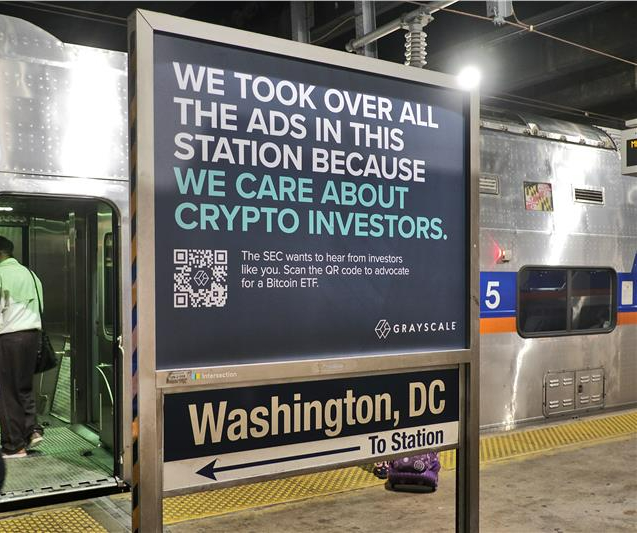
If you happen to be taking Amtrak and pass through Penn Station or Union Station, you will notice something unusual: every available ad space has been taken up by Grayscale. 

“We care about crypto investors,” the crypto asset manager says in its ads. Grayscale is urging the public to write to the Securities and Exchange Commission and convince them to approve the first spot bitcoin ETF in the U.S.
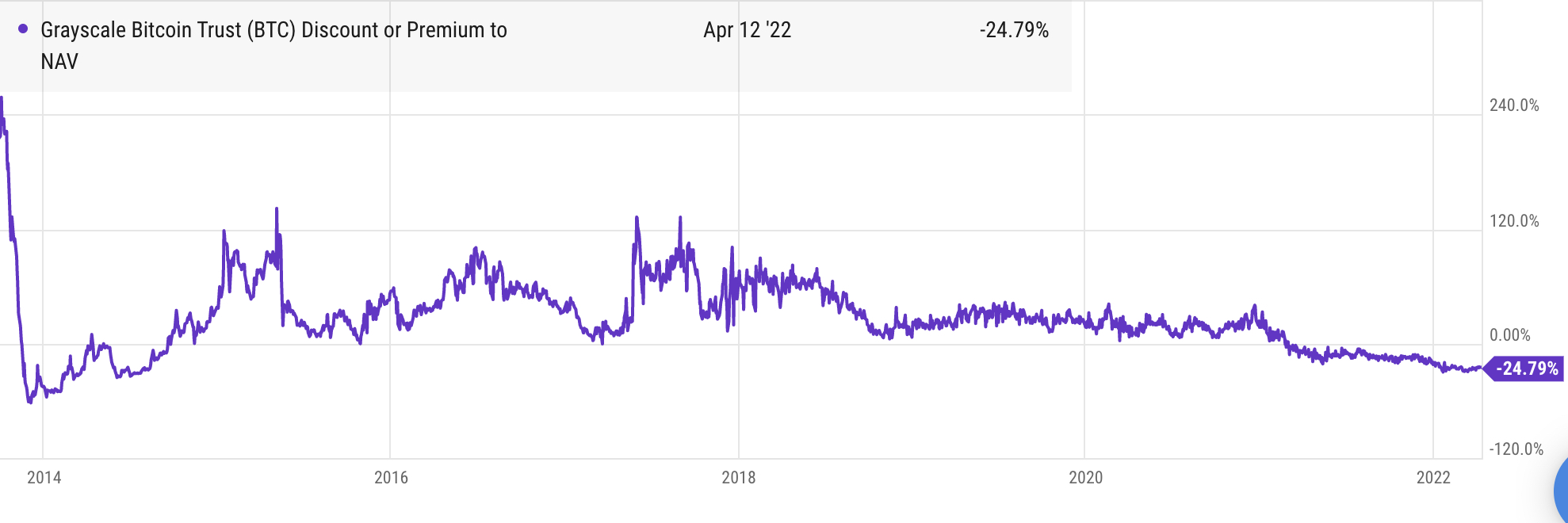
Grayscale wants to convert its Grayscale Bitcoin Trust (GBTC) into a bitcoin ETF after flooding the market with shares. GBTC is trading 25% below its net asset value, and investors are rightfully pissed off. Grayscale wants them to be upset with the SEC, but the regulator isn’t really to blame. If anything, the SEC should have warned the public about GBTC years ago. 

Over the last eight years, Grayscale has been telling investors to buy shares of GBTC, advertising the fund as a way to get exposure to bitcoin without having to buy bitcoin.  

Accredited investors plowed dollars (or maybe bitcoins) into the fund all through 2020, looking to take advantage of an arbitrage opportunity. They could buy in at NAV, and after a 6 to 12-month lockup, sell on the open market for a premium. All through 2020, that premium was around 18%, on average.

Everybody was happy until February 2021, when the Purpose bitcoin ETF launched in Canada. Unlike GBTC, which trades over-the-counter, Purpose trades on the Toronto Stock Exchange, close to NAV. At 1%, its management fees are half that of GBTC. Within a month of trading, Purpose quickly absorbed more than $1 billion worth of assets. 

Demand for GBTC dropped off and its premium evaporated. Currently, 653,919 bitcoins (worth a face value of $26 billion) are stuck in an illiquid vehicle. Welcome to Grayscale’s Hotel California. 

The plan all along, Grayscale claims, has been to convert GBTC into a bitcoin ETF. On October 19, 2021, NYSE Arca filed Form 19b-4 with the SEC. The regulator has until early July to respond. 

In all probability, the SEC will reject the application, just as it has every single spot bitcoin ETF application put before it to date. 

Bitcoin’s price is largely determined by wash-trades, whales controlling the market, and manipulation with tethers. SEC Chair Gary Gensler knows this. He taught a course in blockchain and money at MIT Sloan before his appointment by the Biden administration. 

This is Grayscale’s second time around. It applied for a bitcoin ETF in 2016, but withdrew the application during the 2017 bitcoin bubble because “the regulatory environment for digital assets had not advanced to the point where such a product could successfully be brought to market.” Meanwhile, the trust’s assets under management grew as did Grayscale’s profits.

Closed-end fund

“Inflation is rising, we need to diversify!” a panicked woman tells her son over the phone in the middle of the night. “I’m buying crypto!” She hangs up. Her son rolls over in bed. The scene is from a series of TV commercials Grayscale ran in 2020 to convince the public that GBTC was a sound investment.  

Digital Currency Group is the parent company of Grayscale. Both firms were founded by Barry Silbert. DCG is invested in hundreds of crypto firms. It owns crypto outlet CoinDesk, which essentially functions as a PR machine for the entire crypto industry. 

Initially called the “Bitcoin Investment Trust,” GBTC launched in September 2013. It was promoted as an investment vehicle that would allow hedge funds and institutional investors to gain exposure to bitcoin, without having to deal with custody. Coinbase has been the custodian of the fund since 2019 when it bought Xapo, the previous custodian. 

Legally, GBTC is a grantor trust, meaning it functions like a closed-end fund. Unlike a typical ETF, there is no mechanism to redeem the underlying asset. The SEC specifically stopped Grayscale from doing this in 2016. Grayscale can create new shares, but it can’t destroy shares to adjust for demand. Grayscale only takes bitcoin out to pay its whopping 2% annual fees, which currently amount to $200 million per year.

​​In contrast, an ETF trades like a stock on a national securities exchange, like NYSE Arca or Nasdaq. An ETF has a built-in creation and redemption mechanism that allows the shares to trade at NAV via arbitrage. Authorized participants (essentially, broker-dealers, like banks and trading firms) issue new shares when the ETF trades at a premium and redeem shares when they trade at a discount, making a profit on the spread. 

How it all works 

Grayscale periodically invites rich investors to pledge money into the fund in private placements at its discretion. The minimum investment is $50,000. Grayscale uses the cash to buy bitcoin and issues shares of GBTC in kind. 

Investors can also pledge bitcoin directly — a great advantage if you happen to be a large holder who wants to unload your BTC without crashing the market. (More on this later.)

After a lockup period, investors can sell their GBTC on the open markets. Anyone can buy and sell GBTC on OTC Markets Group, the main over-the-counter marketplace, or via a brokerage account, like Schwab or Fidelity.  

Up until early last year, GBTC has typically always traded at a premium on the open market. That premium occasionally soared to over 100%. During the 2017 bitcoin bubble, GBTC traded as high as 130% above NAV.
Why would anyone pay the premium? Many institutional investors can’t buy bitcoin directly for compliance reasons. And there are a lot of individuals who don’t want the headache of figuring out how to set up a bitcoin wallet. GBTC was initially the only option for getting exposure to BTC, without having to buy BTC, at least until bitcoin futures came along. However, bitcoin futures contracts came with their own risks, costs, and headaches. GBTC was easier.  

In early 2020, GBTC became an SEC reporting company. This allowed investors who purchased shares in the trust’s private placement to sell their shares in 6 months instead of the previous 12 months. You could now make more money faster!

Unsurprisingly, the trust went into overdrive in 2020. Starting in January 2020 up to Feb. 23, 2021, Grayscale filed 35 reports with the SEC indicating that it sold additional shares to accredited investors, according to Morning Star’s Bobby Blue.  

The trust’s holdings doubled from roughly 261,000 BTC in January 2020 to 544,000 BTC by mid-December 2020, per Arcane Research.

Red flags

Harris Kupperman, who operates a hedge fund, explained in a November 2020 blog post how GBTC’s arbitrage opportunity created a “reflexive Ponzi,” responsible for sending the price of bitcoin hyperbolic.

There were several versions of the arb. You could borrow money through a prime broker. You could use futures to hedge your bet. You could recycle your capital twice a year. 

Every version involved Grayscale purchasing more bitcoin, thus increasing demand, widening the spread in the premium, and pushing the price of bitcoin ever higher. Between January 2020 and February 19, 2021, the price of BTC climbed from $7,000 to $56,000. 

“When the spread is 26% wide and liquid to the tune of hundreds of millions per week, you can bet the biggest guys in finance are all over it,” Kupperman said. “As you can imagine, everyone big is putting on some version of this trade.” 

Kupperman wasn’t the only person to raise alerts about the fund, which mainly benefited wealthy investors. As soon as GBTC launched, skeptics voiced their concerns. 

“You can put a nice wrapper around a turd, and present it in a very well-manicured product to investors that you say is safe,” Barry Ritholtz, a wealth manager and founder of The Big Picture blog, told Verge. “But at the end of the day, it’s still crap.”

In September 2017, Citron Research called GBTC “the widow maker” and “the most dangerous way to own bitcoin.” Citron’s Andrew Left accurately predicted GBTC’s collapse:

“Citron believes that as new methods become available for investors to gain exposure to bitcoin — including traditional ETFs — that money will move to these regulated instruments and out of the uncertain waters of GBTC, which we believe can fall by 50% easily.”

Who holds GBTC?

The press has repeatedly credited Grayscale as a massive buyer of bitcoins, and evidence of institutional money entering the cryptoverse. This may not be the case.

Even though Grayscale states its holdings in dollars, it accepts deposits of bitcoins. A whale, or a good friend of Grayscale, can trade in their BTC for shares of GBTC, which they can flip six months later at well above the actual price of bitcoin.  

The last time Grayscale broke out the numbers in Q3 2019, they said that the majority of deposited value into their family of trusts was in crypto, not dollars: 

“Nearly 80% of inflows in 3Q19 were associated with contributions of digital assets into the Grayscale family of products ‘in-kind’ in exchange for shares, an acceleration of the recent trend, up from 71% in 2Q19.”

Grayscale stopped breaking out the percentage of crypto deposits into its trusts after 2019, and just stated everything in dollars. They may want to break out the numbers again, as this is something the SEC might be interested in. 

Crypto lender BlockFi’s reliance on the GBTC arbitrage is well known as the source of their high bitcoin interest offering. Customers loan BlockFi their bitcoin, and BlockFi invests it into Grayscale’s trust. By the end of October 2020, a filing with the SEC revealed BlockFi had a 5% stake in all GBTC shares.  

Here’s the problem: Now that GBTC prices are below the price of bitcoin, BlockFi won’t have enough cash to buy back the bitcoins that customers lent to them. BlockFi already had to pay a $100 million fine for allegedly selling unregistered securities in 2021. 

As of September 2021, 47 mutual funds and SMAs held GBTC, according to Morning Star. Cathie Wood’s ArkInvest is one of the largest holders of GBTC. Along with Morgan Stanley, which held more than 13 million shares at the end of 2021.

Such a lovely place

Grayscale was happy to take investor money during the bitcoin bull runs of 2017 and 2020-21 and saturate the market with shares of GBTC. Anyone sitting on GBTC now is forced to take their losses, or hold out in the hopes Grayscale will do something to fix this. 

Investors, many of whom are regular folks with GBTC in their IRAs, have every reason to be upset. Meanwhile, Grayscale is pointing the finger at the SEC as the reason we can’t have nice things.

Michael Sonnenshein, Grayscale’s chief executive, told Bloomberg he would even consider suing the regulator if Grayscale’s application to convert GBTC into a bitcoin ETF is denied. 

Sonnenshein argues that because the SEC has approved bitcoin futures ETFs, it should also approve a bitcoin spot ETF.  

This makes absolutely no sense. The two investment vehicles are totally different animals. 

A bitcoin futures ETF indexes a bitcoin futures contract on the CME. It is a bet in dollars, paid in dollars. Nobody touches an actual bitcoin at any point. In contrast, Grayscale’s spot bitcoin ETF application represents an investment that is backed by bitcoins — not derivatives tied to it.

A spot bitcoin ETF is good for bitcoin, because it means more actual cash flowing into the cryptoverse. Crypto promoters are pushing hard for this. Bitcoin is a negative-sum game that relies on new supplies of fresh cash to keep it going.  

But what happens if the SEC doesn’t approve Grayscale’s application?  

Grayscale can issue more buybacks. In the fall of 2021, DCG began buying back over $1 billion worth of GBTC. In March 2022, it announced another $250 million in buybacks for Grayscale trusts. The effort had little impact. GBTC continued to trade well below the price of bitcoin.

As Morning Star points out, Grayscale has the power to make this right. It can redeem shares at NAV and simply return investors their cash or bitcoin. That is, if Grayscale really does care about crypto investors.

Grayscale offered a redemption program before 2016. However, the SEC issued a cease and desist order because the repurchases took place at the same time the trust was issuing new shares, in violation of Regulation M.

The situation is different now. Grayscale stopped issuing new shares in March 2021. That leaves the door open for it to pursue a redemption program and bring GBTC closer inline with the price of bitcoin.

I doubt this will ever happen. Grayscale is sitting on a cash cow. As long as it can redirect investor anger at the SEC, why change?

“There is no obligation to convert to an ETF,” David Fauchier, a fund manager at London’s Nickel Digital Asset, told me in a tweet. “If things stay as they are, they will print money into perpetuity basically, it’s a FANTASTIC business if BTC doesn’t zero.”

Fed by stimulus money, tethers, and a new grift in the form of NFTs, the price of bitcoin reached a record of nearly $69,000 in November 2021. Bitcoiners rah-rahed the moment.

However, the same network effects that brought BTC to its heights are working in reverse and can just as easily bring it back down again. At its current price of $40,000, amidst 8.5% inflation, bitcoin is not proving itself to be the inflation hedge Grayscale hyped it up to be. 

It’s worth noting, that Barry Silbert left Grayscale in August 2021. Incidentally, Jeff Skilling jumped ship at Enron in August 2001, shortly before disaster hit, for some reason.  

Submit your comments!

I encourage anyone reading this to submit your comments to the SEC regarding Grayscale’s application for a spot bitcoin ETF. Jorge Stolfi, a computer scientist in Brazil, has provided an excellent example, and so has David Rosenthal, also a computer scientist. You can submit your own comments here.  

Did you enjoy this story? Consider supporting my work by subscribing to my Patreon account for as little as $5 a month. It’s the cost of a cup of coffee! Or, if you’re feeling generous, you can buy me a pound of coffee beans.

Cash App’s dangerous new feature — bet your paycheck on bitcoin

Volatility, the frequency with which you experience big wins and losses, is one of the hallmarks of gambling. One day you win big, the next, you could lose your shirt. It’s what makes gambling so attractive to addicts. 

It’s why you see people in Las Vegas sitting next to slot machines, zoned out, feeding their coins in one by one. They are waiting for that jackpot. It doesn’t matter if the game is rigged or if most people lose most of the time. Someone wins big sometimes, and it could be them. 

At least with slot machines, you’re only putting in one coin at a time. 

Cash App, a mobile payment service, just introduced a new feature that will allow you to funnel your entire paycheck directly into bitcoin. It’s called “Get Paid in Bitcoin.”

If you receive your paycheck through Cash App’s direct deposit feature, you can opt to receive all or a portion of your salary in bitcoin. 

In other words, you can send 100% of your hard-earned cash directly into a naturally occurring Ponzi scheme.  

Instead of paying rent, or tucking money away into your 401K, you can gamble on the erratic price movements of bitcoin. When you can’t pay your rent because the crypto markets took a tumble, you can tell your landlady you lost everything in the decentralized casino. 

Over 8 million people, many of whom recently learned they were victims of a data breach, use Cash App’s investing product to buy stock and bitcoin.

Cash App isn’t breaking new ground. Crypto exchange Coinbase has a direct deposit feature that allows you to have your paycheck deposited into Coinbase and get paid in crypto. Other companies, including Strike and BitPay, also offer some form of crypto payroll, invoicing, or benefits.

What it is doing is contributing to a dangerous trend that has been developing over the past few years, where companies are making it increasingly easy for people to gamble their livelihoods on crypto. 

Play to lose

Bitcoin is a negative-sum game. Stocks pay dividends and have buybacks. In contrast, money is continually taken out of bitcoin by miners, who generate 900 new bitcoins per day. They sell these coins for cash — or borrow against them — to pay their monstrous power bills. That money will never come back to investors.  

The only money that comes out of bitcoin is from new traders putting money into the system. Bitcoin’s price is completely fictitious and wildly unpredictable. 

After setting a record of $69,000 in November, bitcoin lost half its value by the end of January. It’s now trading at $43,000, meaning anyone who bought at the high, believing that bitcoin was headed for the moon, lost the better part of their investment. 

After converting a $750,000 paycheck into bitcoin in November, NFL player Odell Beckham Jr. suffered a major loss in salary when the price fell months later. At least, he could afford the loss. Not everybody can. 

Meet the missionary

Cash App is operated by Block, the company founded and headed by Jack Dorsey, who stepped down as CEO of Twitter last year to focus on his growing crypto obsession. 

Dorsey is a missionary who preaches the gospel of bitcoin to his six million Twitter followers. He is known for bizarre tweets like: “#Bitcoin will unite a deeply divided country. (and eventually: world).” In March 2021, he sold an NFT of his first tweet for $2.9 million, in crypto. Proceeds went to a charity.

It’s hard to know if Dorsey, whose net worth is $7.5 billion, according to Forbes, believes his own sermons or if he is a grifter, looking for suckers whose pockets he can purge to feed his own hubris. 

Dorsey’s company is sitting on a large stash of bitcoin. In October 2020, Block bought 4,709 bitcoin. Four months later, the company purchased another 3,318 BTC, for a total spend of $220 million. 

In early 2021, Block announced that it was going to start a bitcoin mining system. 

Dorsey is deep into crypto, so naturally, he wants you to become deep into crypto too, whether or not you can afford the risk.

Low on cash

Cash App’s new feature is timely.  There are signs that the cryptoverse is running desperately low on real money. 

Bitcoin miners are stockpiling bitcoin — while companies like investment management firm Galaxy Digital and VC firm Digital Currency Group lend them cash, so they can pay their power bills and keep their businesses afloat.

A Mt Gox settlement is about to hit the market soon. When those creditors get their 141,686 bitcoin after waiting for eight long years, a good guess is many will be anxious to sell. Where will the cash come from to buy their $6 billion worth of BTC?

The Grayscale Bitcoin Trust (GBTC), which owns 3.5% of the world’s bitcoin, is trading 25% below the value of its underlying asset.  

Luring fresh cash into the system is a priority for crypto boosters, which is why Grayscale is pushing so desperately for the Securities and Exchange Commission to approve its application for a spot bitcoin ETF. 

Unlike cash-settled bitcoin futures, spot bitcoin ETFs are designed to buy and hold bitcoin directly, injecting much-needed U.S. dollars into the crypto universe. 

Bitcoin doesn’t work as a payment system. Nobody uses bitcoin to buy anything other than drugs or pay for ransomware. The market has long been manipulated by tethers, a dubiously backed stablecoin, but cash is the lifeblood of crypto. Insiders need real money, so they can dump their coins. And miners need it to pay their electric bills.

Preying on the vulnerable

Bitcoin has gotten progressively easier for people to buy, which means a larger share of the public is exposed when the market goes south. 

In November 2020, payment giant PayPal announced that all account holders in the U.S. would be able to buy and sell crypto including bitcoin through its platform. PayPal has 400 million users.

In April 2021, Venmo (owned by PayPal) announced that its customers will be able to buy, sell, and trade as little as $1 worth of crypto. Venmo has more than 70 million customers.

It’s worth noting that PayPal and Venmo don’t actually allow users to buy bitcoin. You can’t make deposits or withdrawals on the platform. You can only “buy” bitcoin from the company, sell it to the company, or trade it with other users within the app. 

In other words, these companies have become online casinos, where people can bet real money on the future price of bitcoin.

Stock trading app Robinhood allows users to buy and trade cryptocurrency, a feature it started adding in early 2018. 

If you don’t want to purchase bitcoin on an app on your smartphone, there are 33,000 bitcoin ATMs and tellers throughout the U.S. that will gladly accept your cash for BTC, as long as you don’t mind paying the high fees.  

You can also go on Coinbase and buy crypto with money taken directly out of your bank account. Or you can pay with a debit card, PayPal, Apple Pay, or Google Pay. 

If you are a compulsive gambler, addicted to bigger and bigger risks, you can mainline bitcoin by signing up for Cash Apps’ Get Paid in Bitcoin. 

Systems that make it easy to buy bitcoin prey upon society’s most vulnerable — those who can least afford the risk and those who don’t understand that the game is rigged.

When the crypto markets crash — and it is no longer an “if” but a “when” — people are going to get hurt. Features that allow people to invest their paychecks in crypto are an irresponsible abomination.

If you like my work, consider supporting my writing by subscribing to my Patreon account for as little as $5 a month. 

The Art Angle: ‘The Whole Bored Ape Yacht Club Phenomenon, Explained’

I was recently interviewed by Artnet News Editor Julia Halperin on Yuga Lab’s Bored Ape Yacht Club project for an Art Angle podcast. We talked about how Yuga Labs got its start, the launch of BAYC, and how Yuga is currently transforming itself into a gaming company. 

One thing I keep stressing is the importance of fungible tokens like Apecoin in these NFT projects. They allow investors and insiders to sell to the general public, while BAYC itself becomes just a publicity stunt. 

It’s very difficult to find buyers outside of the crypto universe for a $250,000 NFT. You are much better off creating an ERC20 token and getting it listed on Coinbase — which is exactly what Yuga Labs did in conjunction with its backer a16z.

In any case, it was a delight speaking with Julia. She asked a lot of good questions.

You can listen to the podcast on iTunes and on Spotify. The podcast was based on a related story I wrote on BAYC for Artnet News last month.

News: Axie Infinity hacked, Germany takes down Hydra, SEC rejects Cathie Wood’s spot bitcoin ETF application

  • If you like my work, consider subscribing to my Patreon for as little as $5/month. Your support makes a huge difference. 
  • I’m available for freelance journalism projects. You can reach me here or DM me on Twitter. 
  • If you want to receive these blog posts as soon I publish them, send me your email. 

About that Axie-Ronin hack

On March 23, a hacker stole an eye-watering $625 million in crypto from the Ronin network, the blockchain powering the popular play-two-earn game Axie Infinity.

Six days later, the hack was discovered. Where was Axie cofounder Jeff Jiho Zirlin on that day? He was at a party in Los Angeles caught off guard by the press. (CNN Business)

“Shortly after his first interview, which was on the record and recorded, Zirlin asked if CNN could run his answers by his PR team before publishing. CNN declined the request.”

Axie originally ran on Ethereum. But since Ethereum is too sluggish and costly to use, it now runs on Ronin. How do you get your ETH onto Ronin? The Ronin Bridge. 

In the world of DeFi, a bridge lets you use crypto from a different blockchain.

The Ronin bridge locks up ETH, the native crypto of Ethereum, and issues a token on the Ronin sidechain that represents ETH called wrapped ETH, or WETH.  

Molly White wrote a post describing how everything works. A bridge is like a casino where you trade in your actual money for casino chips. Someone robbed the money and now you’re stuck with worthless chips. (Blog post)

Bridges are a honeypot for hackers. Qubit Bridge, Wormhole Bridge, Meter.io Bridge, and Poly Network Bridge have all suffered similar fates.

Why does this keep happening? David Gerard says DeFi is akin to a piñata. “You whack it in the right spot, and a pile of crypto falls out.” (Blog post) 

Ed Zitron points out that the real ones suffering from the Ronin hack are not the investors, the developers, or those in power, but regular folks who needed the money. (Substack)

The hackers are now in the process of cleaning their ill-gotten ETH. After a six-day head start, they sent $70 million in ETH through privacy mixer Tornado Cash. (Decrypt)

Venture capitalists need P2E

Venture capitalists are betting big on play-to-earn games, like Axie. A hack this size should put Axie and its developer Sky Mavis out of business, however, this is crypto.

Axie is backed by a16z. The Silicon Valley VC firm also has a big stake in Yuga Labs, which is transforming itself into a P2E gaming company as I type. Even though its founders have zero experience in gaming. I predict someone will bail Axie out with magic beans shortly. (My blog post)

In fact, Sky Mavis just raised $150 million in a funding round led by Binance, a leading Tether exchange, with help from the usual suspects, including a16z. (Substack)

Gensler wants Coinbase to register with the SEC

The SEC is weighing a path forward for Coinbase, and other crypto exchanges, so they can register with the agency. (FT)

Coinbase is not registered as a securities broker-dealer, even though the majority of tokens that it lists resemble securities. SEC Chair Gary Gensler has been urging Coinbase to submit to SEC oversight for months.

In speaking at Penn Law, Gensler said that he’s asked his staff to work with the CFTC to find ways to “register and regulate platforms where the trading of securities and non-securities is intertwined.” (Prepared remarks)

Crypto exchanges trade both crypto commodities and crypto securities, so Gensler wants to get the CFTC involved as well. 

Since crypto exchanges also custody crypto assets and act as market makers, he also wants to see if it makes sense to separate custody and market-making. 

Gensler’s comments come just weeks after Yuga Labs launched Apecoin, which resembles an unregistered securities offering. The same day Apecoin launched, it was listed on Coinbase.

SEC rejects yet another bitcoin ETF 

The SEC rejected an application for a spot bitcoin ETF led by Cathie Wood of Ark Invest. (SEC form S-1, SEC order, Decrypt)

The regulator rejected the application for all of the same reasons it has rejected every spot bitcoin ETF application put before it in the past: fraud, manipulation, wash trading, manipulative activity involving Tether, and so on.

At this point, the SEC is simply copying and pasting text.

Grayscale is clinging on to hope. The asset manager is so desperate to get its application for a spot bitcoin ETF approved that it is threatening to sue the SEC. (Bloomberg)

It’s also running a targeted ad campaign — taking over the entire advertising space between two mass transit hubs and their Amtrak trains for three months, so bitcoiners will drown the SEC in comment letters. (Business Insider)

The SEC’s deadline to rule on Grayscale’s application to convert its $30 billion GBTC into a physically-backed ETF is July 6. 

GBTC is now trading at 25% below NAV, meaning that investors, who are subject to a six-month lockup period, are losing money compared to those buying BTC directly. In addition, the fund has an investment minimum of $50,000 and an annual management fee of 2%. 

Grayscale CEO Michael Sonnenshein says the SEC has created an unfair playing field and forced investors into a futures-based bitcoin. 

There is a good reason why the SEC will allow a bitcoin futures contract and not a spot bitcoin ETF. Doomberg wrote a great post explaining it, which I highly recommend reading. (Doomberg Substack)

It comes down to this: Bitcoin futures are settled in cash, and the direct flow of dollars never enters the crypto ecosystem. In contrast, bitcoin spot ETFs are designed to buy and hold bitcoin directly, injecting much-needed U.S. dollars into the crypto universe. 

The bitcoiners need a bitcoin spot ETF because utility companies don’t accept tethers, and miners need to pay their power bills. Galaxy and DCG are propping up the U.S. miners. They’ve been lending U.S. miners money so they don’t have to sell their “stockpile” of freshly mined BTC.

Germany takes down Hydra

German federal police — known as the BKA — shut down Hydra, the largest Russian darknet market for selling drugs and money laundering. 

Working with U.S. law enforcement, BKA seized Hydra’s servers in Germany, along with 543 BTC ($25 million). (BKA statement, US Dpt. of Treasury press release) 

In conjunction with the shutdown of Hydra, the DOJ announced criminal charges against Dmitry Olegovich Pavlov, the site’s alleged operator.

Since it launched in 2015, Hydra facilitated more than $5 billion in transactions for 17 million customers. The site was written in Russian and most of its drug-related business was with sellers in Russia, Ukraine, Belarus, Kazakhstan, and surrounding countries. (Elliptic)

Hydra was more than just a drug market. It offered a mixing service to launder dirty crypto and exchange it for rubles, taking in $200 million in stolen crypto in 2021 and early 2022 alone. 

Vendors on Hydra even sold bundles of rubles for bitcoin, buried in dead drops for customers to dig up. (Wired)

Hydra was also used to launder funds from the 2016 Bitfinex exchange hack

The BBC has a story on how the police sting began with a tip-off and led to finding the “bullet-proof” hosting company in Germany. (BBC)

Elsewhere in crypto

Bitcoin miner Riot Blockchain produced 511 BTC in March and holds 6,062 BTC. Why are they holding? Coindesk didn’t bother asking. (Coindesk)

HIVE Blockchain released its March 2022 mining figures. It produced 278.6 BTC and over 2,400 ETH. As of April 3, 2022, HIVE is sitting on 2,568 BTC and 16,196 ETH. (Yahoo Finance)

I guess miners figure bitcoin will go up in price forever. Or may there is just nobody left to sell it to?

Crypto hacks in the first quarter of 2022 have amounted to $1.2 billion in crypto — that’s up nearly 700% from the same period last year. Web3 is going great. (Techcrunch) 

Buzzfeed did an in-depth story on Worldcoin, a bizarre crypto project that involves scanning the retinas of people in Africa and elsewhere in the global south in return for crypto. But with Worldcoin’s token yet to launch, participants feel robbed. (Buzzfeed)

Worldcoin is backed by Y Combinator President Sam Altman, a16z, and Khosla Ventures. It’s raised $100 million in funding so far.  

After purchasing 9.2% of the social media giant, Elon Musk has become the largest shareholder of Twitter. He also got a Twitter board seat. (NYT)

MicroStrategy purchased another 4,167 BTC for $190 million. It took out a loan against its bitcoin holdings to buy more bitcoin. What could possibly go wrong? Michael Saylor’s company now holds a total of 129,218 bitcoins. (SEC form 8-K, Bloomberg)

Federal prosecutors in Miami seized $34 million worth of crypto in one of the largest crypto forfeiture actions ever filed by the U.S. (DOJ press release, Miami Herald) 

After the horrible Kevin Roose story, the New York Times interviewed crypto critic Dan Olson to get his views on crypto. This is worth a listen. The transcript is also available. (Ezra Klein show, transcript)

Crypto investor Katie Haun has raised $1.5 billion for her new firm Huan Ventures after leaving a16z last year. (Wired)

Crypto asset funds are seeing surging assets under management. A16z’s crypto-focused funds are worth around $9 billion.(Cointelegraph)

While the SEC drags its feet to enforce securities laws, which are clear and have been in existence since the 1930s to protect investors, the powers-that-be are gathering more money to invest in token projects. 

Axie-Ronin hackers and the crypto laundromat — will they succeed in cleaning 174,000 ETH?

Axie Infinity, a popular play-to-earn game, suffered a breach, losing $625 million in crypto — 173,600 ETH and 25.5 million USDC, a popular stablecoin.

It’s the biggest hack ever in the GameFi sphere and a bit of a public relations problem for P2E promoters, such as VC firm Andreessen Horowitz (a16z), who ambitiously describes P2E as “the future of games and really, the Web as we know it.”

The hack took place on Ronin, the Ethereum sidechain that Axie runs on. Ronin uses proof of authority, a modified version of proof of stake, where it only has nine validator nodes, all officially whitelisted — so it’s not even decentralized. 

Via a backdoor, the hacker got a hold of four nodes that were controlled by the game’s Vietnamese developer Sky Mavis, and a fifth node controlled by the Axie DAO.

Because Sky Mavis wants to distance itself from Axie Infinity and in-game tokens, like AXS and SLP (smooth love potion), it created a decentralized autonomous organization. 

Once the hacker controlled the majority of nodes, they were able to forge transactions, and simply remove the money from the Ronin bridge, without a hitch.

Axie said in a tweet that the hack was the result of social engineering combined with human error from December 2021, but did not elaborate. Axie promised to add new validators to the network to make it more decentralized. 

Social engineering suggests something along the lines of a phishing scam. 

This is different from other recent bridge attacks, like Wormhole, wherein the attack was a result of a vulnerability in the smart contract. 

Six days to run for the hills

Ronin reported the hack on March 29 — but according to a Ronin blog post, the theft occurred six days earlier. Sky Mavis unwittingly discovered the breach after a user reported having trouble withdrawing funds from the network. 

How on earth do you lose hundreds of millions of dollars in crypto and nobody notices for nearly a week? Axie developers not only left the door open, but they also neglected to turn on the security cameras!  

All eyes are on the stolen crypto, as internet sleuths watch to see how the hackers will pull off the next part of this massive heist: laundering the funds. Clean crypto is always worth more than dirty crypto.

As soon as you convert stolen crypto to cash in your bank account, you risk revealing your identity. (Recall the two individuals recently nabbed after trying to launder bitcoin stolen from Bitfinex in 2016.)

Stablecoins can be frozen by the issuer — in this case, Circle. So the Ronin hacker laundered them quickly as possible, sending the ill-gotten USDC to decentralized exchanges Uniswap, and 1inch, and swapping it for ether. 

Most of the stolen ETH remains in the attacker’s wallet, but so far, the Axie-Ronin hacker has sent 3,750 ETH ($12 million) to Huobi and 1,220 ETH ($4 million) to FTX, according to Dirty Bubble Media. Funds were also sent to Binance and Crypto.com. 

Tornado Cash 

Once centralized exchanges realize where the funds are coming from, they can freeze accounts and even route the money back to Ronin — if they want to, and if the funds haven’t already been chain swapped away. 

Chain swapping, or chain hopping, involves sending the funds to an exchange, swapping them for another crypto, and then quickly moving those funds to another exchange. Many offshore exchanges have lax KYC controls.

Still, why didn’t the hackers use a mixer like Tornado Cash to scramble up the ETH instead? 

A mixer takes funds from different users and jumbles them all together, making it difficult to track the movement of funds on a blockchain. 

Tornado Cash works as a series of pools, each for a different value. You deposit coins in a pool, and sometime later, you can withdraw an equal number of coins.

The problem is, once you send crypto to a mixer, you have to wait for deposits and withdrawals from other users to achieve any real anonymity. That takes time.

And, since pretty much all of the big flows are identified as dirty, any large withdrawal is likely to be dirty as well. Also, exchanges may be reluctant to touch crypto coming out of a mixer, believing it’s all just tainted money.

“Exchanges are probably starting to get wise and just blocking Tornado Cash for non-KYC accounts because it is just SO cesspool even for them,” Nicholas Weaver, a researcher at the International Computer Science Institute in Berkeley, told me. 

Binance, which integrated the Ronin wallet in September, said that as of Tuesday, it has suspended all deposits and withdrawals on Axie Infinity’s Ronin network, and it is on the lookout for unusual transactions — but again, the hackers were already ahead of the game, so it’s unclear what good this does.

(Update, April 4: The Ronin hacker is now routing funds through Tornado Cash, according to an address associated with the hack — a combined total of 2,000 ETH, or roughly $6.9 million.)

Refunding the money

Sky Mavis needs to find a way to refund Axie players, many of whom are now sitting on unbacked WETH — the ERC20 token that represents the ETH on the Ronin network.  

If the game developer can’t refund players, it may have to retire the game or face insolvency, putting the entire P2E space to shame. Right now, the firm has no idea how it is going to come up with the money. 

“We are fully committed to reimbursing our players as soon as possible,” Aleksander Leonard Larsen, Sky Mavis COO, told Bloomberg. “We’re still working on a solution, that is an ongoing discussion.”

The stolen funds include the deposits of players and speculators and the Axie Infinity Treasury, used to create a base revenue for the AXS token. Of the ETH stolen, 56,000 belonged to the Axie Infinity Treasury, Bloomberg said.   

The real losers

Play-to-earn games are exploitive. They promise users the ability to earn money while playing. But to play, you have to first purchase expensive NFTs, which not everyone can afford. 

In the case of Axie Infinity, that means purchasing three Axies — cartoon monsters that live on the Ethereum blockchain as ERC721 tokens — at a cost of up to a thousand dollars. Players pay because they see it as an income opportunity. 

In the Philippines, many players resort to borrowing Axies, and becoming indentured servants, playing for weeks on end just to recoup their initial investment. Playing the game becomes a mindless slog for those trying to earn a living wage, so they can buy food and keep a roof over their heads. The game itself functions as a pyramid scheme. 

Many of these players sold their in-game NFTs for ETH, which they hoped to turn into cash. Only now, the WETH in their Ronin wallets is worth nothing because there is no ETH to cover it, and they have nothing to show for all the days, weeks, and months of endless game playing. They are the real losers in all of this. 

As for the P2E boosters, Axie Infinity is too important to fail. In December, Sky Mavis closed a $152-million Series B led by FTX and a16z. That was on top of a $7.5 round six months earlier with contributions from billionaire investor Mark Cuban.

A16z-backed Yuga Labs, the firm behind the popular Bored Apes Yacht Club, is also making moves into the P2E space. Its APE token will serve as the in-game currency for Animoca Brand’s Benji Bananas. The firm also recently dropped hints of another game called Otherside, where virtual land will be sold as NFTs.  

Unless the Ronin hacker has a change of heart and returns the money, it looks like a superhero may have to step in to save the day. In the world of crypto, more often than not, that means pulling more money out of thin air in the form of tokens. 

If you like my work, consider supporting my writing by subscribing to my Patreon account for as little as $5 a month. 

The gorilla in the room: Yuga Labs investors pretend to care about the planet. They don’t.

Yuga Labs, the startup behind the popular Bored Apes Yacht Club project, finally got its long-rumored investment from venture capitalist firm Andreessen Horowitz. It now has plenty of funds to transition into a game company — and create the illusion that its newly launched Apecoin is something other than an unregistered securities offering. 

Apecoin, an ERC20 token that lives on Ethereum, is a path to liquidity from Bored Ape Yacht Club NFTs, of which many more are soon to come in the form of virtual land. “Blue-chip” NFTs are too expensive for the average Joe, and you can’t buy a fraction of an NFT, the way you can a fungible token.

As with the Bored Ape NFTs, Apecoin has zero intrinsic value. The money you get when you cash out comes from new investors buying in. Unlike virtual land or ERC20 tokens, the supply of suckers in the world is finite. Eventually, the tokens will crash in value and retailers will get stuck holding the bag.

After acquiring the IP for CryptoPunks and Meebits, Yuga Labs now controls three of the most popular NFT collections. All three live on Ethereum, a proof of work blockchain that consumes a country’s worth of energy. Each transaction on Ethereum is equivalent to the power consumption of an average U.S. household over nine days, according to Digiconomist. 

Destroying the planet, one NFT at a time

Other participants in Yuga Labs’ $450 million round, which valued the company at $4 billion, include Animoca Brands, The Sandbox, LionTree, Sound Ventures, FTX, and MoonPay.  

Animoca Brands is the Hong Kong-based outfit behind the play-to-earn game Benji Bananas, which plans to incorporate Apecoin — an attempt to give the token utility and avoid regulatory scrutiny. P2E games have received criticism for being digital sweatshops. Players, often in poor areas of the world, are required to purchase an NFT, worth several months’ salary, to start “earning” tokens they then have to sell to recoup their initial investment in the game.  

The Sandbox, a subsidiary of Animoca, is the creator of a play-to-earn game that sells virtual land as NFTs. The company bills itself as “one of the pillars of the open crypto metaverse.” As of September, The Sandbox — ‘The’ is part of its name — owned 31 different BAYC NFTs. 

According to a leaked pitched deck, Yuga Labs plans to create a gaming metaverse and raise another $455 million selling virtual land NFTs. In a recent tweet, Yuga Labs hinted at a new project called “Otherside,” which will accept APE and launch in April. Yuga Labs can create as much virtual land as they want, so maybe they’ll create virtual forests for their virtual primates? 

In the real world, the one we all live in, great apes are running out of natural habitat. Gorillas, chimpanzees, and bonobos are already endangered or critically endangered. A combination of the climate crisis and the destruction of their natural habitats is threatening their very existence as a species. 

By promoting Web3 and Ethereum-based tokens, Yuga Labs is speeding the demise of these creatures. To compensate for this evil, Yuga is throwing chimps a banana by donating 1% of the Apecoin supply of 1 billion to the Jane Goodall Legacy Foundation. (I wrote to Jane Goodall to see how she feels about this. If I get a response, I’ll post the comments here.)

Investment bank LionTree is headed by Aryeh Bourkoff, who told investors in his 2021 year-end letter that climate change is something we should all care about: “Widening our gaze, as the market chases growth, the climate crisis is reminding us that infinite growth on a finite planet is irrational and that we must commit to a long-term outlook guided by purpose rather than short-term gains.” 

Bourkoff appears blind to the hypocrisy of backing an NFT project — or maybe he cares more about the money. Investing in tokens that resemble securities is a lucrative business. Just ask Marc Andreessen, who recently bought a $44.5 million house in Malibu down the street from the $177 million home he bought in October. Forbes estimates his net worth at $1.7 billion.

Sound Ventures is a fund controlled by Guy Oseary and actor-turned investor Ashton Kutcher, who also pretends to care about the planet.

Kutcher was a founding member of World War Zero, an American coalition launched by John Kerry in 2019 to fight the climate crisis. He and his wife bought a Hummer EV, and they live in a Los Angeles home powered entirely by solar energy.

“Ashton and Mila are concerned about the quality of the soil, the purity of the food they eat, and the water they drink. The ideals of sustainability and regenerative farming aren’t just abstract concepts to them,” the house designer told Architectural Digest.

Crypto exchange FTX is one of Tether’s biggest customers. (If you are not familiar with Tether, its web of lies, and the role it plays in the crypto economy, read my Tether timeline.) The company’s answer to the climate problem is to purchase carbon credits.

Finally, MoonPay is the company behind all the strange celebrity purchases of Bored Ape NFTs, where nobody is quite sure if the celebrities are buying the NFTs themselves, or if they are playing a part in promoting the project, without fully disclosing their motives.

MoonPay’s response to Ethereum’s waste is a similar greenwashing. It claims the media exaggerates the impact of crypto mining on the world and points out that Ethereum has plans to transition to a more energy-efficient proof of stake. Ethereum has talked about shifting to a proof of stake system since 2014. It has yet to make the big move.

These are the backers of Yuga Labs, full of contradictions. On one side of their mouths, they talk about saving the planet or they preach exploitive play-to-earn games as a way for players to “own their digital assets.” (They don’t, the assets are stored in central servers.) And on the other side, they promote Web3 and the metaverse, fuzzy marketing terms that point to ways to justify the creation of new tokens.

It all gets a little tough to stomach when you read reports that climate change is already worse than expected and see actual images of an ice shelf the size of Los Angeles collapsing in Antarctica. 

Another celeb joins the circus

On Thursday night, Madonna announced on social media that she now owns a bored Bored Ape NFT. It’s not clear if she bought the token — or if the token was gifted to her by a certain someone who is using her celebrity status to promote Bored Ape Yacht Club.

The material girl’s manager, Oseary, has known her since he was 17 years old. He’s probably been talking her ear off about Bored Apes since October when he signed a deal to represent Yuga Labs. Now he owns a chunk of the company via Sound Ventures as well. 

Oseary has a history of tapping into his celebrity connections to shill cryptocurrency. He also has a history of investing in alleged unregistered security offerings. 

He and Kutcher previously invested in Ripple. In 2018, they donated $4 million in XRP, the token widely associated with Ripple, to “save the gorillas” on the Ellen Degeneres show. Degeneres has a wildlife fund.  

Two years later, the Securities and Exchange Commission charged Ripple and two of its execs for conducting a $1.3 billion unregistered securities offering. The firm is still battling the lawsuit in court.

History repeated?

Yuga Labs likely never contacted the SEC before launching APE — and there is good reason for that. If they had, the regulator probably would have told them, “No, don’t do this.” So they went ahead and did it anyway, figuring they could get away with it, or worst-case scenario, pay a multi-million-dollar fine years later.

The APE DAO or decentralized autonomous organization, which supposedly launched Apecoin, is not a legal entity. It is also neither decentralized nor autonomous. The Ape Foundation — the committee that enforces decisions made by the DAO — is registered in the Cayman Islands. 

The Ape Foundations’ five members get paid $125,000 in Apecoin for their six-month terms. The Apecoin community votes on whether they get reinstated. Votes are weighted by how many Apecoin you own. Since Yuga Labs and its investors hold the majority of Apecoin, ultimately, they decide who gets reinstated and what proposals get passed.

Reddit founder Alexis Ohanian serves on the Apecoin Foundation. (The other four members are Amy Wu, who leads a venture fund at FTX; Maaria Bajwa, a venture investor at Sound Ventures; Yat Siu, the cofounder of Animoca Brands, and Dean Steinbeck, cofounder of Horizen Labs, one of the companies that partnered with Yuga Labs in developing Apecoin.) 

Like all the others, Ohanian also talks a big story when it comes to combatting climate change. He recently launched the 776 Foundation, a fellowship that will give $20 million to young people over the next decade to work on climate solutions.

People who care about the planet, don’t back massive NFT projects. They just don’t. Every NFT transaction on Ethereum comes at a destructive cost to the environment.

Bored Ape Yacht Club is about creating perceived value where there is none to pump tokens. Not only do retail investors risk losing money, but the project itself is contributing to our last remaining chances at escaping climate disaster — all in the hopes of making a few grifters rich.   

If you like my work, consider supporting my writing by subscribing to my Patreon account for as little as $5 a month, or more! Every little bit helps.

News: Yuga Labs goes APE, Meebits insider trading, ConsenSys raises another $450M to focus on Web3 buzzword

  • Send me your email address, and I’ll send you these blog posts as soon as they go up. 
  • Support my work by becoming a patron. You can buy me the equivalent of a cup of coffee for $5 a month — or a bag of premium coffee beans, if you like. Every little bit helps!
  • I’ve been focusing on NFTs lately. I can’t cover every bit of funny business in this space, but if you see something, DM me on Twitter, or contact me here. 

BAYC: Money for nothing

Yuga Labs finally launched its Apecoin — oops, sorry, not Yuga, but the Apecoin DAO launched APE. On March 17, the same day the coin launched, it was listed on all the major crypto exchanges in the U.S., including Coinbase, Kraken, and Gemini. (My blog post)

Apecoin has a fixed supply of 1 billion. So far, about 130 million Apecoins have entered circulation, according to CoinGecko. Today, Apecoin is up to $11, and 40% of the volume is on Binance trading against two stablecoins with dubious backing — USDT (35%) and BUSD (5%).

Soon after Apecoin launched, Bored Ape Yacht Club NFT holders took to Twitter, proclaiming how rich they had become overnight. Each bored ape holder got ~10,094 APE tokens, valued anywhere between $80,000 to $200,000.

It’s the same Ponzi promotion story we have heard since bitcoin launched in 2009 — buy this token and you will get rich for free. Everyone who holds Apecoin now wants you to buy APE, so the value goes up, and they can cash out. That value right now is being artificially pumped by tethers.

Hundreds of millions of dollars worth of Apecoin also went to Yuga Labs founders, Yuga Labs itself, contributors to the project, and to the newly formed Ape DAO. Just like that, everyone is rich.

What about Andreessen Horowitz (a16z)? How many Apecoins were they allotted? We may never be privy to the details.

“A spokesperson for Yuga said Andreessen received coins in exchange for assisting with ‘overall DAO governance design’……Yuga and Andreessen both declined to comment on the potential financing.” (FT)

Apecoin serves as a governance token, giving holders voting rights in the newly formed Ape DAO. Big holders, like Yuga Labs and a16z, have a greater say in the future of BAYC. This is the problem with the Ape DAO — it’s centralized decision-making. (Bloomberg)

Someone figured out a clever way to make $1.1 million by “borrowing” another person’s bored apes just long enough to claim Apecoin. (The block; Web3 is going just great)

Benji Bananas, the play-to-earn game that Yuga Labs is using via Animoca Brands to give Apecoin some utility so the SEC doesn’t sue its issuers, was bad and exploitative from the get-go. (Twitter)

The Block got a hold of Yuga Labs’ pitch deck. According to the deck, Yuga Labs hopes to make $455 million in 2022 through virtual land sales. It’s aiming to build a gaming metaverse called MetaRPG, compatible with a host of NFTs, powered by Apecoin. (The Block; Pitch Deck)

Yes, that’s right. Yuga’s next project is selling make-believe land. You can buy the land with APE.

Bored Ape Yacht Club NFTs along with Apecoin are inherently worthless. The BAYC project doesn’t offer a service; it doesn’t manufacture a product. Its business model is based on filling a balloon with hot air and getting high-profile celebs to shill its product on prime-time TV.

Sure, holding a bored ape NFT will gain you entrance into a warehouse party — but they don’t even work properly for that. NFTs literally, don’t work for anything they are intended to do.  

Insiders acquire Meebits

​​On March 11, Yuga Labs announced it acquired the IP for CryptoPunks and Meebits collections from Larva Labs. It’s giving the NFT holders the IP, so they can create derivative products, like hoodies, T-shirts, and other merch. (Press release; Techcrunch) 

Yuga also got 423 Punks and 1,711 Meebits in the deal. The terms were undisclosed, so we don’t know how much they paid Larva Labs.

The floor price of Meebits doubled after the announcement, climbing to 6.134 ETH ($15,800).

Insiders took the opportunity to buy Meebits in advance and make some easy money.

Lesley Silverman, the head of digital assets at United Talent Agency, formally representing Larva Labs, is one of those people. She bought two Meebits in the days prior to the announcement. (Twitter)

All told, 14 Ethereum addresses, with no previous history of mainstream NFT collection purchases, quietly acquired 159 Meebits between March 5 and March 11. The top address purchased 24 Meebits at once on March 5. (Bloomberg)

Insider trading in the securities business is illegal and comes with harsh consequences, but NFTs are not regulated, so people get away with this stuff, literally, all of the time.

Smile for the camera

Yuga Labs and its partner Animoca Brands want bored ape holders to submit a government-issued ID and have their photos taken to confirm their real identities, so they can register for a mystery project. Bored ape holders are pissed off, some thinking they were going to be turned over to the IRS. (Cointelegraph)

The irony is that this all happened only a month after Yuga Lab’s founders made a big to-do about Buzzfeed revealing their true identities. They responded by directing an onslaught of anger and harassment from the crypto community toward Buzzfeed reporter Katie Notopoulos.

Coinbase class-action

Apecoin resembles a security, like a stock or bond, but that didn’t stop Coinbase from listing it asap.

​​SEC Chair Gary Gensler has already stated that Coinbase lists dozens of tokens that may be securities. According to securities laws, exchanges that list securities must register with the SEC as a securities exchange or a broker-dealer. Coinbase has not registered as either.

A recent class-action against Coinbase alleges that 79 tokens the exchange lists meet the definition of securities, but plaintiffs were not warned of the risks. The claim, filed by three Coinbase users, asks for monetary relief and an injunction enjoining Coinbase from offering the tokens without having to register with the SEC. (Complaint; Cointelegraph)

I think you should leave

Time magazine wrote a lengthy profile on Ethereum founder Vitalik Buterin, calling him the “prince of crypto.” Buterin is concerned about what Ethereum has morphed into.

“Buterin worries about the dangers to overeager investors, the soaring transaction fees, and the shameless displays of wealth that have come to dominate public perception of crypto.” (Time)

It’s funny Buterin should have these feelings.

Ethereum was literally designed for all of these things. It fueled the ICO bubble of 2017. Most ICO tokens live on the Ethereum blockchain, just as most NFT tokens today are bought and sold on Ethereum. And Ethereum’s proof-of-work consumes the energy of a small country.

Buterin is the guy in the hotdog suit in a sketch from the comedy series “I think you should leave.”

In the sketch, a hot-dog-shaped car has crashed through the window of a menswear shop. Everyone is looking around to see who is responsible. Suddenly a man in a hot-dog costume appears out of nowhere and says, “Yeah, whoever did this, just confess. We promise we won’t be mad!”

Never forget, Vitalik created Ethereum because World of Warcraft nerfed his favorite warlock

VCs shovel more millions into ConsenSys

Joe Lubin’s ConsenSys got another $450 million round of funding with a $7 billion valuation. This comes just four months after its Series C that raised $200 million and valued it at $3 billion.

The company has more than doubled in value, thanks to the venture capitalists.

Lubin is one of the cofounders of Ethereum who struck it rich in Ethereum’s early crowdfunding sale.

ConsenSys invested in ICO projects throughout 2017 — mostly hilariously bad ideas like Civil. When none of these projects had any hope of making it, and some like Airfox and Paragon, had to pay hefty fees to the SEC for securities violations, ConsenSys went through a “strategic transformation.” It cut staff and converted its failing portfolio business into a separate company called ConsenSys Mesh, effectively pushing the ugly mess off into the corner.

Nowadays, Lubin is busy hyping software like Infrura and Metamask to build Web3.

Stephen Dhiel explains why Web3 is “bullshit.”

The latest round will “accelerate the global adoption” of Infura and ConsenSys’s efforts to “drive NFT adoption for artists, content creators, brands, intellectual property owners, game publishers, and sports leagues.” (ConsenSys blog; Decrypt)

Anyone who thinks NFTs are going to crash soon has little understanding of how much money VCs are shoveling into this space. This money will keep the space propped up long enough for investors and insiders to cash out, just like they did with ICO tokens.

Elsewhere in cryptoland

Vice did a story on nocoiners — bitcoin skeptics, as we call ourselves. It has some good content, but also a misleading flaw: it makes it seem that nocoiners are insignificant because the “nocoiner industry” moves a tiny amount of money compared to the crypto industry. (Vice)

NYT reporter Kevin Roose wrote a lengthy story explaining crypto to the masses. Don’t be fooled. This is a piece of crypto boosterism, where Roose continually tries to convince the reader that he is a “crypto moderate.” The story is especially pernicious because of its “reasonable” tone. (New York Times)

Vice reporter Edward Ongweso went to the first SXSW post-covid, only to find out it was overtaken by crypto-mania and NFT nonsense, like 3D anthropomorphic rabbits plastered everywhere, “which I gathered were somehow related to crypto though it wasn’t clear how.” (Vice)

Mark Zuckerberg says that in the coming months you’ll be able to mint NFTs within Instagram. “I would hope that, you know, the clothing that your avatar is wearing in the metaverse, you know, can be basically minted as an NFT and you can take it between your different places,” he said. (Engadget)

There is no actual metaverse. Zuckerberg is lying. Metaverse is a meaningless marketing term used by companies in an effort to separate people from their money.

“Zuckerberg created this conversation to distract from his problems and made fertile ground for truly evil people to profit,” Ed Zitron wrote in a blog post last month.

Jorge Stolfi, a computer science professor in Brazil, says Web3 is nothing more than a new way to frame cypherpunk’s utopia: “The cypherpunks are a bunch of ‘socially challenged’ nerds who dream of building a society on the internet that is totally beyond the reach of governments. That the cops cannot monitor, regulate, or control.” (Reddit: here and here)

The CFTC is looking into Binance to see if the exchange permitted U.S. residents to buy and sell derivatives traded on its platform. (Bloomberg)

Also, Binance has stopped serving residents of Ontario, this time for real. (Binance Letter of Undertaking and Acknowledgment; OSC press release)

Münecat just came out with a brilliant video (100 minutes) explaining Web 3.0. Picture this: The year is 2063, and the global currency is Moosecoin. (Youtube)

Wikipedia editor and software engineer Molly White did a podcast with “Scam Economy” talking about her “Web3 is going just great” project. (Youtube)

If you haven’t read it yet, this Verge article on Tron CEO Justin Sun is an amazing piece of reporting. Sun has a huge tolerance for risk. The story also explains what happened with Poloniex, the crypto exchange that Circle bought in early 2018 for $400 million and spun out for a $156 million loss. (Verge)

Me in the news

I recently wrote a story on BAYC for Artnet News, and one on Ethereum’s move to POS for MIT Tech Review. I did a podcast for Artist’s Well and made some minor updates to my “Bitcoin Widow” review.

Podcast: I was interviewed by Alan Keane for ‘Artist’s Well.’ We talked about NFTs

Earlier this week, I was interviewed by artist Alan Keane for a podcast. He edited the recording and posted it on Youtube today. Keane runs a weekly arts program via Zoom in Ireland. He has a large following of professional artists.

Several of them had been asking him about NFTs, so he found me on the internet, and roped me into an interview. I explained what an NFT is — basically a crypto token on a blockchain that points to an image on a website somewhere. It doesn’t contain any actual art, and if the link pointing to the JPEG goes bad, the NFT becomes worthless.

In other words, NFTs are nothing more than a gimmick to get artists to feed their hard-earned cash into the crypto ecosystem, and more often than not, they get nothing in return.

I also tried to capture the importance that fungible tokens play in helping NFT promoters cash out on NFTs. This was, of course, just a few days before Bored Ape Yacht Club announced their Apecoin, which I wrote about yesterday on my blog.

The volume on my end is a little low in this interview, so I may need to adjust my microphone next time. I’m open to ideas and suggestions!

If you like my work, consider supporting my writing by subscribing to my Patreon account for as little as $5 a month, or more! Every little bit helps.

Bored Apes Yacht Club launches Apecoin. It looks like an unregistered penny stock offering  

The Bored Ape Yacht Club project now has a fungible token called Apecoin (APE), which officially launched today.

The announcement came from Apecoin itself, in the form of a Tweet thread and a post on the new APEcoin website. 

Yuga Labs, the startup behind Bored Apes Yacht Club, is trying to distance itself from its own coin — much in the same way that Ripple tried to distance itself from XRP.  

Apecoin is like a ventriloquist’s dummy on the lap of Yuga Labs. The dummy is doing all the talking, and we are supposed to pretend that we don’t see Yuga Lab’s lips moving. 

Yuga Labs developed its Ethereum-based ERC20 token with help from blockchain developer Horizen Labs, blockchain game company Animoca Brands, and law firm Fenwick & West.  

The goal here is to create a new magic bean that can be sold for real money, without having to register that magic bean with the Securities and Exchange Commission. Yuga Labs founders think all they have to do is make sure the coin is “decentralized” and has some sort of utility, outside of “number go up.”

Yuga Labs is calling its coin “a token for culture, gaming, and commerce.” Culture is a completely meaningless word here. And I’m not sure what commerce means either. I’m guessing it means you will be able to buy things, potentially even bored ape NFTs, with the token.

There will be 1 billion Apecoins, and 150 million will be airdropped to holders of bored ape or mutant ape NFTs. They can claim their coins on Apecoin.com for up to 90 days. 

Also, starting today, the coin will be listed on several major exchanges: Coinbase, FTX, Kraken, and Gemini, according to a tweet by Guy Oseary, who represents Yuga Labs in the entertainment sector. APE will also be listed on OKX, Binance, and Binance US.

Coins tend to shoot up in price as soon as they get listed on Coinbase, the largest crypto exchange in the U.S. 

It’s decentralized, see?

Speaking through Apecoin, Yuga Labs also announced an Apecoin DAO, or decentralized autonomous organization. If you own APE, you are a member of a DAO, and you get to weigh in on important decision-making, probably things like what bands will play at the next warehouse party.

I won’t go into all the details, but if you are interested, an Apecoin forum addresses how the DAO works. 

In 2018, Bill Hinman, who was then the director of the SEC’s Division of Corporation Finance, stated that ether (ETH), the native crypto of Ethereum, was not a security because it was sufficiently decentralized. Ever since that time, token projects have been trying to copy Ethereum, and come out with something that is decentralized, even as the SEC tried to walk back how significant this statement was when Ripple tried to use it in the XRP case. 

However centralized the actual operations are, “decentralized” only ever meant “you can’t sue me, bro.”

DAOs are supposed to be decentralized, but they never are. Similarly, the Apecoin DAO will have its own central gatekeeper: the Ape Foundation.  

The Ape Foundation is based in the Cayman Islands, and it maintains the Apecoin.com website and the Apecoin Twitter account.

Members include Alexis Ohanian, founder of Reddit; Amy Wu, who leads a venture fund at crypto exchange FTX; Maaria Bajwa, a venture investor at Sound Ventures; Yat Siu, cofounder of Animoca Brands, and Dean Steinbeck, cofounder of Horizen Labs. 

All of these members own one or more bored ape NFTs. Advisors and contributors in token projects are generally paid in magic beans, so I suspect they got plenty of APE for their efforts, too.

Anyone who was around the crypto space in 2016 remembers the earliest DAO — called “The DAO.” After the project stupendously crashed and burned, the SEC came out with an investigative report, saying the DAO’s tokens were securities. Still, that hasn’t stopped thousands of DAOs from launching this year. There is even a website now that tracks DAOs.

In 2017, we had initial coin offerings. In 2022, DAO governance tokens are stepping in to take their place — and they resemble offerings of securities in all the same way ICO tokens do. 

Play-to-earn

Yuga Labs knows it is not enough for Apecoin to simply be a governance token. It needs more utility than that, so the coin will be incorporated in a game app — and that’s where Animoca Brands comes in. 

The game developer converted its mobile game Benji Bananas to play-to-earn for the occasion. By playing Benji Bananas you earn tokens that can be swapped for ApeCoin starting in Q2 2022. The game is available on the App Store and Google Play.

Benji Bananas is an action game, where you make Benji the monkey swing from vine to vine through the jungle, collecting bananas. If you want to play, you have to first buy a Benji Pass, which is an NFT. Animoca offers more details in a Medium post. 

Play-to-earn games have been criticized as a growing cancer in the gaming space, where they transform games into a grinding, difficult slog. They are known to target vulnerable populations in countries like the Philippines, where people use the game as a way to earn a living. If players lose money or the in-game token drops in value, they risk sinking ever deeper into debt, having to take out loans from other players to stay in the game.

Somehow, I don’t think a banana game will be the biggest use case for Apecoins. Like most ERC20 tokens, the biggest use case will be speculating on its price: buying APE and hoping it goes up in value.

One for you, three for me

Yuga is creating 1 billion APE. A portion will be unlocked over a period of four years, starting on March 17, 2022. The distribution looks like this: 

  • 470 million to the DAO treasury 
  • 150 million to bored/mutant ape holders 
  • 150 million to Yuga Labs 
  • 140 million to launch contributors
  • 80 million to Yuga Labs founders  
  • 10 million to charity 

Notice how many APE Yuga Labs is setting aside for itself, and for all its contributors. The firm is happy to distance itself from the Apecoin project, but not the piles of APE it is getting.

A few weeks ago, the Financial Times wrote that Andreessen Horowitz (a16z) was in investment talks with Yuga Labs, which was seeking to sell a multi-million dollar stake in a new funding round. 

We don’t know yet if that deal has gone through, but I suspect if and when it does, a16z will get a large allotment of Apecoin. The venture capital firm has two directors sitting on Coinbase’s board, so they likely played a key role in getting the token listed. (Note how a16z’s shitcoin bag gets listed on Coinbase routinely.)

This is a win-win deal for a16z. If the SEC steps in and deems Apecoin an unregistered security, which I can totally see happening, a16z is not assuming any risk. Yuga Labs is taking on all of the risks. A16z simply gets tokens they can dump on the general population — a quick return on their investment. 

The founders of Yuga Labs imagine they can create a token out of thin air, pay themselves 80 million APE — and another 150 million for their company — and regulators are going to sit back and not blink an eye.

I would be curious to know if Yuga Labs even reached out to the SEC before launching APE.

In 2019, the SEC published a framework for analyzing whether a digital asset is an investment contract and, therefore, a security. The “not a security” path for most tokens is a fraught one. 

We’ve already seen several ICO projects pay the price of selling unregistered securities. Telegram had to return $1.2 billion to investors and pay $18.5 million in penalties. Block.one had to pay a $24 million penalty. Similarly, these companies also argued their tokens were decentralized and had utility. 

Yuga Labs is unwilling to learn lessons from the past. They think they know better. And a16z encourages this stuff directly because they know the game is rigged in their favor.

If you like my work, please consider supporting my writing by subscribing to my Patreon account for as little as $5 a month or more. Every little bit helps.

Artnet News: ‘The Creators of Bored Ape Yacht Club Want to Become the Amazon of the NFT Space. Can They Pull It Off?’

My latest story on the Bored Apes Yacht Club was published in Artnet News today. It’s paywalled but worth subscribing to Artnet News if you want to read it!

I spent a few weeks working on this nearly 2,000-word story, and Artnet News editor Julia Halperin really helped me pull it together. We had the story ready to go on Friday when suddenly, Yuga Labs announced they had just acquired the IP to CryptoPunks and Meebits from Larva Labs. So of course, that meant lots of last-minute editing along with a new headline.

Usually, you make big announcements at the beginning or middle of the week, not when people are clearing off their desks and getting geared up for the weekend. 

But then the floor price of Bored Apes was dropping, slipping below $200,000 in ETH—and Yuga Labs needed to act quickly. 

Yuga Labs is giving Punk and Meebits owners the IP for their avatars, so they can create derivatives and hopefully further the branding and marketing of the project.

They’ll probably also get to attend yacht parties and warehouse concerts, and benefit from all of the other perks and freebies, like NFT airdrops.

Token projects have been promising real-world utility since the ICO era of 2017, and NFT projects are no different. The goal is to somehow justify the insane prices of these things. 

When NFTs became “the next big thing” in early 2021, many people started asking: “What good are these? All they do is point to a JPEG on the internet. I can copy and download that JPEG myself.”

In response to the criticism, many NFT projects now promise utility, and BAYC is no different. Owning a bored ape is a key to a club. It’s culture. It’s a digital identity, or whatever Yuga Labs can think of next.

Ultimately, it’s about marketing. High-value NFTs are illiquid. It’s very difficult to find a 1:1 buyer for a $200,000 bored ape, outside of celebrities. So the goal is to keep bored apes in the public eye and to keep bored ape holders from selling off their NFTs.

In the meantime, Yuga is working on a fungible token that will likely “democratize” their high-priced NFTs. All the better for a16z, if they proceed with reported plans to invest millions into the project.

The Silicon Valley VC firm could potentially get ERC20 tokens in return for their investment, and see quick returns if the coin lists on Coinbase. A16z has two directors sitting on the Coinbase board.

A fungible token combines the best of both worlds — the scarcity of a collectible NFT with the liquidy of an ERC20 token. But it’s complicated, you see. Too often these things resemble securities offerings.

Yuga Labs knows the big money is temporary. Until they work out the legalities of a fungible token, they need to do everything possible to keep the price of Bored Apes Yacht Club tokens up. 

So far, the plan is working. Soon after the announcement on Friday, the floor price of Bored Apes went up again. As of today, the cheapest bored ape NFT is $227,000 (90 ETH), according to CryptoSlam.

My first story in MIT Tech Review with added ramblings on Web3 and Ethereum’s Beacon Chain

I just wrote my first story for MIT Tech Review. 

It is an explainer piece on Ethereum’s move to proof of stake. What follows are notes from the story — along with additional ramblings and quotes from your favorite crypto skeptics.

When NFTs became a big thing in 2021, that drew a lot of attention to Ethereum, where most NFTs are traded. It also brought a lot of attention to the environmental horrors of proof of work.

Bitcoin and Ethereum both rely on proof of work to add new blocks to the chain. Together, they consume as much electricity as the entire country of Italy, according to Digiconomist

Meanwhile, venture capitalists are shoveling cash at companies building Web3 — a supposedly new iteration of the internet where apps will run on permissionless blockchains, mainly Ethereum. 

The problem is that permissionless blockchains — those that are open to the public and depend on a cryptocurrency to incentivize miners and maintain their security — are incredibly inefficient. They are sluggish. They can’t handle much data, and they don’t scale.

Case in point: CryptoKitties slowed the entire Ethereum network to a crawl in 2017. 

In his article “The Web3 Fraud” Nicholas Weaver, a researcher at the International Computer Science Institute at Berkeley, explains that Web3 is “a technological edifice that is beyond useless as anyone who attempts to deploy a real application will quickly discover.”

Andreessen Horowitz (a16z), one of Silicon Valley’s top venture capital firms, is a big promoter of Web3. It has invested heavily in at least a dozen platforms that support NFTs alone, among them: Dapper Labs, OpenSea, Manifold, and soon, possibly, Bored Ape Yacht Club. Ethereum is crucial to a16z’s Web3 story.

Clearly, that story needs something more to support it. It needs a rocket-boosted ETH 2.0.

Scaling to the moon

In a proof of stake system, validators replace miners. Instead of investing in expensive ASIC systems that eventually end up in landfills, you invest in the native coins of the system.

Ethereum Foundation, the nonprofit behind Ethereum, says its proof of stake will consume 99.95% less electricity than proof of work. Ethereum currently handles roughly 15 transactions per second. Its founder Vitalik Buterin said ETH 2.0 could potentially handle a whopping 100,000 transactions per second. That would beat out Visa, which claims 65,000 transactions per second.

Ethereum was supposed to be a proof of stake blockchain from the start, according to its whitepaper. But in 2014, Buterin concluded that developing a proof of stake algorithm was non-trivial. So Ethereum settled for proof of work instead, while it went to work developing a proof of stake algorithm. Ethereum’s switch to proof of stake has been six months away for years. 

Now, supposedly, the big moment is soon to arrive.

Ethereum is currently testing a proof of stake blockchain called the Beacon Chain. This will be the heart of ETH 2.0. So far, 9.7 million ETH ($25 billion) is staked on the Beacon Chain. To become a validator, you have to lock up 32 ETH. If you don’t have that much ETH on hand, you can join a staking pool.

In an upcoming event called “The Merge,” which was supposed to happen in Q1 2022 but got pushed to to Q2 2022 in October, Ethereum will combine the Beacon Chain with the Ethereum Mainnet.  

After The Merge takes place, the next step is sharding — splitting the Ethereum chain up into 64 separate chains, so the network can scale. Sharding won’t happen until 2023. This is where the network reaches toward that theoretical number of 100,000 transactions per second.

Critics, however, doubt sharding will be any more efficient than a single chain. 

Jorge Stolfi, a computer science professor at the State University of Campinas in Brazil, told me: “Almost every transaction will require updating two shards in an ‘atomic’ way (either both are updated or neither is updated). That will be the job of the central (Beacon) chain. I doubt very much that they can do that more efficiently than the current single-chain scheme.”

Ethereum, a centralized system

Scaling isn’t the only issue at hand in Ethereum’s move to proof of stake.

Proof of work’s decentralization suffers from economies of scale. Large mining operations are better able to maximize profits while lowering costs. This resulted in five mining operations controlling more than half of Bitcoin’s hash rate in 2020.

Like proof of work, proof of stake will naturally tend toward centralization.

Those who have the deepest pockets and stake the most coins will have the best chances of “winning the lottery,” thus reaping newly minted coins in the form of the block reward.

The big staking validators are already getting themselves into position. US crypto exchanges Coinbase and Kraken hold 78,000 out of 296,000 validators on the Beacon Chain.

A16z is also getting in on the action. It invested $70 million into staking provider Lido and is using Lido to stake an undisclosed portion of its venture arm’s ETH holdings on the Beacon Chain.

Proof of work and proof of stake both aim to get rid of a central gatekeeper, but that comes at a huge cost. One wastes electricity; the other wastes coins, which get locked up and pulled out of circulation.

“Whatever Sybil defense they use, economics forces successful permissionless blockchains to centralize; there is no justification for wasting resources in a doomed attempt at decentralization,” David Rosenthal said in a recent blog post. Rosenthal is known for co-creating Stanford University’s LOCKSS technology for the distributed preservation of digital content. 

The one advantage of proof of stake that we can count on? At least it won’t destroy the planet.

If you like my work, please consider supporting my writing by subscribing to my Patreon account for as little as $5 a month — or more, if you are feeling generous!

News: DoJ locates Bitfinex’s stolen BTC, BlockFi fined $100M, Forbes sells out to Binance

The DOJ found 119,754 bitcoins stolen from crypto exchange Bitfinex in a hack in 2016. Federal officials were able to seize 94,643.29 BTC ($3.6 billion). The rest is still out there. (Washington Post)

On Jan. 31, those funds were spotted moving out of the hacker’s wallet, but nobody realized at the time it was the feds moving the funds. Most people assumed it was the hackers themselves!

Heather Morgan, 31, and Ilya Lichtenstein, 34, were charged with trying to launder the bitcoins. They were arrested in NYC, where they live. (DoJ press release, Complaint, Statement of facts)

Lichtenstein is Russian-American. Morgan is a U.S. citizen, who grew up in California. We don’t know if the pair were behind the actual theft, but they probably were given the majority of the coins were in the same wallet as when they left Bitfinex.  

David Gerard describes the 2016 hack in Chapter 8 of his book “Attack of the 50-foot Blockchain,” as told to him by Phil Potter. He summarized it on Twitter

Morgan is a rapper with loads of embarrassing videos online. (Vice)

She had an active TikTok account featuring her rap moves.

@realrazzlekhan

How a #nyc $PACE Pımp starts their #holographic day in #manhattan 🧞‍♀️ #grwm #winterfit

♬ Island In The Sun – Weezer

Morgan was also a prolific Forbes contributor, which should surprise nobody. (Forbes)

And she gave a talk at NYC Salon on how to social engineer your way into anything. (Youtube)

The couple sat on those coins from August 2016 to January 2017, before trying to launder some of them. Almost all of the BTC they moved went through AlphaBay, which they used as a mixer. The feds were able to spot this because they seized AlphaBay in July 2017. 

This arrest underscores how difficult it is to actually launder bitcoin. All of the transactions are traceable. Even when you are sitting on piles of BTC, as these two allegedly were, it is really difficult to cash out.  

A judge ruled the pair could be released on bonds — $5 million for Lichtenstein; $3 million for Morgan. But the government, which originally asked for a $100 million bond, ordered a review of the detention order, saying the couple have the means to flee — $330 million in BTC have yet to be found. Also, Russia has no extradition treaty with the U.S. (Stay of release)

It’s not clear what will happen to the recovered funds at this point, but likely they will be held up by the U.S. government for a long time to come. (Decrypt)

Bitfinex is absolutely convinced it will receive the recovered funds. It wants to use 80% of them to “burn” one of its shitcoins — LEO. (Bitfinex blog)

Naturally, LEO saw a surge in value after the announcement. (Defiant)

Bitfinex is the sister company of Tether. The 2016 hack set off a string of calamities for the two firms. Rather than claim insolvency, Bitfinex gave its customers a 36% haircut, repaid them in BFX tokens, and then lost its banking. Thus began a prolific printing of tethers, telling lies and other nonsense that has continued to this day. Also, it was Bitfinex’s reliance on third-party payment processors after it lost its banking that led to all the problems with Crypto Capital, some missing $850 million in funds, and the NYAG telling Tether to take its business out of New York. I detail most of this in my timeline.

Bitfinex never really paid its customers back for the 36% haircut. Ultimately, all of those customers were paid back in tethers, so why should Bitfinex get that money?

BlockFi to pay $100M

Crypto lender BlockFi is paying $50 million to the SEC and $50 million to various state regulators to settle claims that it illegally offered high-yielding crypto lending products, say sources. (Bloomberg)

It’s clear as mud how BlockFi is able to offer the rates it does. “Executives at BlockFi have said they are able to pay such high yields to customers because institutional investors will pay them even more to borrow the deposits. But the companies don’t provide a detailed accounting of how the funds are used or in what circumstances investors could lose their cryptocurrency,” writes Bloomberg.

Crypto lending programs are obviously securities subject to SEC regulation. BlockFi was funding its crypto lending operations and proprietary trading through the sale of unregistered securities. The SEC similarly warned Coinbase against launching “Lend.” And the regulator is currently looking into Celsius, Voyager Digital, and Gemini Trust regarding crypto yield products.

I didn’t realize this earlier, but apparently BlockFi is one of the largest holders of GBTC, buying it for the premium. GBTC is now trading at -24% of NAV, according to Ycharts.

BlockFi says funds are SAFU. (Tweet)

Forbes is taking Binance money 

Update: On June 21, 2022, Forbes announced the termination of the SPAC transaction. The transaction never closed due to the termination of the deal. [Forbes]
__________

Forbes, the publication that featured alleged bitcoin money launderer Heather Morgan as a contributor, is now taking $200 million from Binance, the crypto exchange that has been thus far kicked out of every corner of the world for blatantly ignoring laws and regulations. ​​(CNBC)

The funds will help Forbes follow through on its plan to merge with a special purpose acquisition company (SPAC) in the first quarter. Forbes is owned mainly by Chinese Firm Integrated Whale Media, which bought a controlling stake from the Forbes family in 2014.

This will make Binance one of the biggest owners of Forbes after its listing. Binance will also have two director positions on Forbes’ board of executives. Binance tried to sue Forbes in 2020 for defamation, but the suit was quietly dropped.

If you are looking for an unbiased crypto news source in the future, you probably want to look elsewhere. 

More ‘Bitcoin Widow’ Reviews

The Toronoto Star has a review of Jennifer Robertson’s “Bitcoin Widow.” This one is worth reading:

“Does she have regrets? I kept waiting to hear them and she comes closest in the final few pages (after chapters of what does seem like a Kafkaesque nightmare in both legal and emotional terms). ‘I regret every moment of every day of the terrible year that followed Gerry’s death,’ is what she confesses. A weaselly mea culpa that reminded me of when people, often on reality shows, apologize by saying, ‘I am sorry you feel that way.’”

The Sun also has a review of the book. It’s mostly just… a review of the book. Nice photos of Jen and Gerry though. 

If you missed my review earlier, it’s here

Another day, another blockchain bridge hack 

On Feb. 5, a loophole in the Meter Passport smart contract allowed an attacker to siphon 1,391 ETH ($4.2 million) and 2.74 wrapped Bitcoin ($83,000) from the Meter Passport blockchain bridge. 

Blockchain bridges allow you to conveniently spend crypto from one blockchain — such as ETH or, in this case, BTC — on another blockchain. 

@ishwinder explains the hack in layman’s terms. (Twitter)

This is one of three recent hacks on blockchain bridges lately! On Feb. 3, we had the Wormhole exploit, with $320 million in funds stolen. And on Jan. 17, Qubit was hacked for $80 million in crypto. 

What does this tell you about blockchain bridges? 

Meter urged its users not to trade any meterBNB, which are currently unbacked, and said that they were “working on compensating funds to all affected users.” (Twitter)

What’s new in crypto regulations?

The U.S. Department of Treasury released a report: “Study of the Facilitation of Money Laundering and Terror Finance Through the Trade in Works of Art.” The report was mandated by Congress in the AML Act of 2020. It specifically mentions NFTs. (Press release, Study, Blockchain Law Center)

According to the report, NFTs are vulnerable to money laundering because “NFT platforms range in structure, ownership, and operation, and no single platform operates the same way or has the same standards or due diligence protocols.”

The report specified that NFTs used for payment or investment may fall under the virtual asset definition, and some NFT platforms may qualify as virtual asset service providers (VASPs), depending on the characteristics of the NFTs that they offer.

The report makes it clear that the Treasury department is carefully monitoring digital art assets, including NFTs, and the online marketplaces where they are traded. (JDSupra)

Grayscale wants to turn its Grayscale Bitcoin Trust (GBTC) into an exchange-traded fund. The SEC is seeking advice from the public about whether ETFs tied to Bitcoin’s spot price could be a vehicle for fraud. The SEC has denied six similar applications since November, including those from VanEck, WisdomTree and SkyBridge Capital. (SEC notice, Coindesk)

Only licensed banks should be allowed to issue stablecoins, according to Jean Nellie Liang, the under secretary for domestic finance at the Department of the Treasury. She appeared before the House of Representatives Committee on Financial Services to reaffirm the PWG’s November report on stablecoins. (Liang’s written testimony, Bloomberg)

Time is running out for crypto firms to be approved for the UK’s anti-money laundering register before the end of March. Ninety-six applicants are still waiting for a decision on their application. Without approval before a March 31 deadline, the future of these crypto firms’ UK operations — including exchanges, wallets and other businesses — hangs on a limb. (The Block)

Crypto shilling at the Super Bowl, and other NFT news

It’s Super Bowl weekend. Expect to see a massive amount of marketing dollars go toward shilling crypto and NFTs. Crypto.com, FTX, and Binance are among the major advertisers. (Hollywood Reporter) (NYT)

Bored Apes are also rumored to appear at the Super Bowl, in some shape or form. (Bloomberg)

Twitter accounts that have been speaking out against NFTs are being reported by bots, their accounts suspended and/or locked. This happened to @NFTEthics and @interlunations. (Twitter)

Sotheby’s is planning to auction off a set of 104 CryptoPunks on Feb. 23. The set is expected to bring $20 million to $30 million in crypto. The original buyer was 0x650d, who scooped them all up in July 2021. Here is the Etherscan confirming his purchase. (Artnet News

He bought them for $7 million because he “chose wealth.” (Twitter)

Following the news of the Sotheby’s auction, the celebrity shilling begins. German-American model Heidi Klum just announced on Twitter she owns a Punk. (Tweet)

Who paid for her Punk? That’s not exactly clear. Mike Burgersburg (not his real name, obviously) has tracked down links between Bitclout investor Reade Seiff and Klum’s Punk. (Dirty Bubble)

Burgersburg also says whoever is funding Reese Witherspoon’s NFT purchases probably has a financial interest in promoting the WOW project. (Dirty Bubble)

In addition to proper FTC disclosure requirements, fans and retail buyers deserve more transparency about how these deals are made and who’s providing the money to pump up these assets. 

John Reed Stark was chief of the SEC office of internet enforcement for 11 years. He has a few things to say about NFTs: Market manipulation of NFTs appears not only rampant and tolerated, but also encouraged. Fraud not only rewarded, but also taught. (Linkedin)

The counterfeit NFT problem is getting worse. Bots are scraping artists’ online galleries, or even keyword searches on Google Images, and then creating collections with auto-generated texts. Those listings have proliferated on OpenSea. (Verge)

Sotheby’s made headlines last year when it sold Kevin McCoy’s Quantum NFT (2014) for $1.47 million. Now, that sale is in the headlines once more, this time for a lawsuit being filed against McCoy and the auction house by a holdings company whose owner claims he owns Quantum. (Artnews)

Indie game platform itch.io has come out strongly against NFTs: “NFTs are a scam. If you think they are legitimately useful for anything other than the exploitation of creators, financial scams, and the destruction of the planet the we ask that [you] please reevaluate your life choices.”(Twitter, PC Gamer)

YouTube is launching new creator tools to expand monetization, including allowing creators to sell content as NFTs so fans can “own” videos. (NBC News)

The Alfa Romeo Tonale SUV is the “first car on the market” to come with an NFT digital certificate that the automaker says will increase the car’s residual value. How? Technical details are thin. (Verge)

A group supporting WikiLeaks founder Julian Assange raised $50 million in ETH by selling an NFT of a clock to a DAO (called AssangeDAO) set up to support his legal bills. The NFT, titled “Clock,” is a joint creation by Assange and digital artist Pak. AssangeDAO contributors receive $JUSTICE. (Wired)

Other newsworthy bits

David Rosenthal’s talk at Stanford is a summary of everything that is wrong with crypto and blockchain technology. This is a great read. (DSHR blog)

Vice interviewed Dan Olsen, whose Youtube video on NFTs went viral. “I’ve been keeping my thumb on what’s going on in crypto. By and large, it’s been the story of the evolution of fraud.” (Vice)

The BBC published and then took unpublished a story about a “self-made crypto millionaire giving back” without mentioning his scam coin. (archive)(missing story)

“City Coins — free, magical money for your city! Maybe” (David Gerard)

Fais Khan’s part II of his work explaining how VCs cash out on tokens: “The Unstoppable Grift: How Coinbase and Binance Helped Turned Web3 into Venture3.” (Fais Khan)

The U.S. government’s system for spotting money laundering has received a surge of suspicious activity reports from a set of San Francisco financial companies that includes some of the world’s leading crypto exchanges. (FT, Dynamics Securities Analytics report)

Mark Zuckerberg is lying about the Metaverse. The CEO of one of the most valuable companies in the world is shoving $10 billion into a concept he cannot describe. (Ed Zitron)

The Russian government will treat bitcoin and digital assets as currency. The proposal includes subjecting crypto transactions (not just within exchanges) to AML/KYC rules, which, being technically impossible to execute, should be equivalent to a ban…(Blockworks)

If you like my work, please consider supporting my writing by subscribing to my Patreon account for $5 or $20 (or even more!) a month. Every little bit helps.  

NEWS: Wormhole hit by exploit, BAYC and its tangled celebrity web, HitPiece’s dirty dealings 

Software is inherently unforgiving. Stupid mistakes render stupid consequences. Recently, this led to one of the largest thefts in a DeFi protocol.

Wormhole, a bridge for connecting Ethereum and Solana and other DeFi blockchains, was hit by a hacker, who stole $326 million in cryptocurrency.

An exploit in the code allowed the attacker to mint 120,000 wETH (wrapped ether) on the Solana blockchain out of thin air. The hacker then exchanged 93,750 wETH for ETH on Ethereum and the rest for SOL, the native token of Solana, and USDC. (Elliptic, Cointelegraph)

Cross-chain bridges allow you to stake crypto (generally, ETH) so you can spend it like the native crypto on another blockchain. In the case of Wormhole, wrapped ETH, an ERC-20 token that represents ETH one-to-one, serves as a sort of I.O.U. The hack resulted in Wormhole sitting on lots of unbacked wETH. 

Wormhole developers offered the hacker a $10 million bug bounty for the return of the funds. Why the hacker would want to relinquish $326 million for $10 million, I’m not sure.

Security researcher Sam Sun explained how the thief carried out the heist: “Wormhole didn’t properly validate all input accounts, which allowed the attacker to spoof guardian signatures and mint 120,000 ETH on Solana, of which they bridged 93,750 back to Ethereum.” (Twitter)

How did the hacker even know about this vulnerability? According to DedmundFitzgrld: “The fix was pushed to GitHub a couple weeks ago but not deployed. So the attacker found the exploit by scanning the commits to GitHub. The vulnerability was out there for all to see.” (Twitter)

Jump, a high-frequency trading group with crypto ambitions, stepped in to save the day. The Chicago-based firm somehow came up with the funds to replace all of the 120,000 ETH. Apparently, it had a spare $326 million sitting around? (Twitter, Fortune)

What do we know about Jump? Last August, it bought Certus One, which helped develop the Wormhole bridge. Jump also executes some crypto orders for Robinhood. 

Jump holds a heavy bag of Solano tokens. It can’t risk a lack of confidence in the market, so it likely borrowed a pile of ETH to fix the problem. Who did it borrow the funds from? One guess: Tether, who last year issued the firm $1.1 billion in USDT, according to one analysis

Qubit also hacked

Days before Wormhole was hacked, Qubit Finance was breached for $80 million in crypto. Similar to Wormhole, Qubit operates a bridge between Ethereum and the Binance Smart Chain network.

In this case, the hacker was able to exploit a security flaw in Qubit’s smart contract code that let them send in a deposit of 0 ETH and withdraw almost $80 million in Binance Coin in return. (Verge)

Qubit has been trying to convince the bank robbers to return the money. They started by offering a bounty of $250,000, and eventually upped it to $2 million — still, a piddling amount compared to what the hackers stole.  

Now, they are resorting to threats:

“If you don’t come forward to claim the generous bounty and return the funds, you will face lasting consequences that vastly outweigh the benefits of holding onto funds that you can’t readily access,” Qubit said in a tweet.

Bored Ape founders revealed

Buzzfeed just identified the two main founders of BAYC — Greg Solano, a 32-year-old writer and editor, and Wylie Aronow, a 35-year-old originally from Florida. The pair don’t have any dark pasts, as far as anyone knows. (Buzzfeed)

“These 2 amazing partners of mine,” Guy Oseary tweeted with a pic of them at Apefest. Oseary is the music industry veteran who represents them. He also represents NFT project World of Women. And he is a buddy of Jimmy Fallon, so that explains a few things.

Oseary says the founders were “doxxed against their will,” which is a bizarre statement given you are talking about the founders of a multi-billion-dollar enterprise.

As Buzzfeed puts it: “This reveals a unique problem with the idea of a billion-dollar company run by an unknown person: How do you hold them accountable if you don’t know who they are?”

A16z mulls buying a chunk of BAYC

Yuga Labs, the startup behind Bored Apes Yacht Club, is in talks with Andreessen-Horowitz (a16z), who is considering buying a major stake in the startup, which would value it at $5 billion. (FT

I’m losing count of all of the NFT projects a16z is funneling money into — over a dozen, for sure. The VC firm is a major force behind the frothy NFT market. 

Celebrities are shilling Bored Apes left and right to the point where it is downright nauseating and rumor has it the Bored Apes will make an appearance in the Super Bowl halftime show on Feb. 13.

The problem with investing in high-value NFTs is they are not easy to dump on retail. You have to find that special buyer with loads of disposable ETH. Fungible tokens, on the other hand, are much more liquid — especially if you can get them listed on Coinbase

This is why DAOs (with their ERC-20 governance tokens) and fractionalized NFTs are becoming the thing. It’s like the 2017 initial coin offering craze all over again. Only now we’re talking about Web3 and “democratizing” companies and JPEGs.

Sometime soon, expect Yuga Labs to issue an ERC-20 token with a huge pre-mine for investors. The token will likely represent its NFTs in some way or else give holders special access to future Yuga Lab NFTs — something like that. Bored Apes have been heavily pumped, so at this point, it’s just a matter of creating a fungible token to lure in suckers at a much greater scale. At the end of the day, it is all about creating the illusion of exclusivity or having access to something special.

Yuga Labs has talked about issuing ERC-20 tokens in the past, saying the plan was to work with law firm Fenwick and West and Horizon Labs — issuers of the ZEN token, which is already listed on Coinbase. So this is nothing new. It’s been in the works all along.

What a tangled Web we weave

We’ve been wondering a lot about why celebs are hyping Bored Apes. Who is talking them into this? What’s the deal? 

Max Read did the smart thing — he followed the money trail, and mapped out the celebrity NFT complex. Jimmy Fallon (who was shilling his Bored Ape on National TV) is represented by talent and sports agency Creative Artists Agency. Lo and behold, CAA is an investor in OpenSea and recently signed a deal to represent the NFT collector 0xb1, who owns NFTs from Bored Ape Yacht Club and World of Women. There’s more. Lots more. Take a look at the map. (Substack)

Last week Justin Beiber bought a Bored Ape NFT for $1.3 million (500 ETH), as one of several purchases he made on OpenSea within a short period. As Dirty Bubble Media explains, all of the NFTs were gifted. They were bought by the InBetweeners project, a collection of NFTs owned by artist Gianpiero D’Alessandro, who has designed merchandise for Bieber, Snoop Dogg, and others. 

Bieber never disclosed any financial relationship between himself and the inBetweeners project. As Dirty Bubble points out, this is a big no-no, according to FTC rules. (Substack)

Gwyneth Paltrow also has a Bored Ape, thanks again to MoonPay Concierge. Every time someone buys a Bored Ape via MoonPay, they seemingly have to announce it on social media. (Twitter)

HitPiece and its shady founder

A new project called HitPiece appeared out of nowhere and started scraping Spotify and “staking” songs as NFTs — without the artists’ permission. 

Naturally, artists found out and started hurling obscenities at the project via social media. 

“Yo a bunch of industrial scene acts (including me) have NFTs for sale on the site hitpiece.com I did not put it online and I assume you probably didn’t either, fucked up,” Choke Chain tweeted.

“Each HitPiece NFT is a One of One NFT for each unique song recording. Members build their Hitlist of their favorite songs, get on leaderboards, and receive in real life value such as access and experiences with Artists,” Hitpiece said on its website. (NNE)

The brains — or lack of brains — behind HitPiece turns out to be music industry guy, Rory Felton, who has a history of shady dealings. (Twitter thread) 

Felton launched HitPiece in December along with music exec and former rapper Michael Barrin (aka “MC Serch”), and venture capitalists Ryan Singer and Blake Modersitzki. (Festival News)

Anyhow, Hitpiece.com has been taken down. If you go to the website, all you get now is a message that says, “We Started The Conversation And We’re Listening,” whatever that means. (archive)

Gamers hate NFTs!

Gamers want nothing to do with NFTs. They see NFTs as a cash grab and forcefully push back on any game company’s efforts to incorporate NFTs in anything.

Clueless to that trend, GameStop has teamed with Immutable X to launch an NFT marketplace. They’re also creating a $100 million fund for grants to build on the platforms. While Gamestonk investors might think this is great, it should thoroughly piss of GameStop customers. (Verge)

Team17, the outfit behind the many Worms games, pulled the plug on its MegaWorms NFT project (they wanted to create NFTs of all the Worms games characters) only 24 hours after announcing the project, due to extreme backlash from customers, fans, and teamsters. (IGN)

Notice the editor’s note on the IGN story: “The subject of NFTs is currently a very controversial topic in the gaming community. IGN urges community members to be respectful when engaging in conversation around this subject and does not endorse harassment of any kind.

Electronic Arts, another game publisher, is also backtracking from earlier NFT enthusiasm. (Eurogamer

Other NFT news

Nike sues online sneaker reseller StockX for selling NFTs of Nike shoes. (Reuters) 

How did OpenSea take over the NFT trade and become a multibillion dollar company? (Hint: they got lots of help from a16z.) (Verge)

One of the founders of Larva Labs, the project behind CryptoPunks, sold all of his v1 Punks for 260 ETH. In response, Larva Labs released an official statement saying the v1 Punks are worthless, because the project re-released all the Punks in 2017 to fix a bug.

The NFT community feels differently. They are saying that v1 Punks are the originals! What’s on the blockchain, stays on the blockchain. (NFT evening)

Coachella is selling lifetime festival passes for the first time — but you have to buy an NFT to get one. The music festival launched an NFT marketplace built by FTX US, with three collections of NFTs going on sale on Feb. 4th. (Verge)

This is part of a trend, I mentioned before. NFTs are being used to give people special access to clubs, events, restaurants, breweries, and whatnot. Wanna be part of the exclusive group? Buy our NFTs.

Tampa Bay Buccaneers quarterback Tom Brady is retiring after 22 seasons with the NFL. His business ventures, including NFT platform Autograph, will keep him busy moving forward. (Fortune)

Last year, a16z-backed Meta4 Capital created a new fund to invest up to $100 million in NFTs. In a twitter thread, Meta4Capital justifies spending money on “historically significant” or “iconic” NFTs, as if any of this means anything. It doesn’t. At the end of the day, an NFT is just a number in a database.

A racist project called “Meta Slave” offered NFTs made from photographs of Black people (all algorithmically-generated). After a swift backlash, the project rebranded to also feature “white, Asian, etc.” NFTs. The project’s Twitter and Instagram accounts have been deactivated. The collection has also been removed from OpenSea where the NFTs were being auctioned. (Vice)

Artist bayneko airdropped NFTs of microscope pictures of SARS-COV-2 to all 96,186 users of NFT platform Hic et Nunc (HEN) who hold at least one NFT. The NFT description read: “Your wallet has been infected by SARS-CoV-2, the virus responsible for COVID-19… in an act symbolic of the invasive and ubiquitous nature of the virus and its psychological effects.” (Twitter thread)

Elsewhere in cryptoland

Quote of the day: “So much dumb stuff happens in crypto, and if you are a smart intermediary that dumb stuff is your profit margin. Crypto markets are lightly regulated and brutally Darwinian, and every day the smart find exciting new ways to take money from the dumb. The returns to smart are very high.” ~ Matt Levine (Bloomberg)

On that note, another day, another rug pull. Realux promised to democratize real estate at a “very low cost in a very easy way” using a complex system of tokens backed by real estate investments. After collecting everyone’s money, the project shut down and its creators vanished. (Motherboard)

Riot Blockchain, a large crypto miner located just outside of Austin shut down ahead of a cold blast. Bitcoin miners have been drawn to Texas because of the state’s cheap electricity. They’ve been lobbying Governor Greg Abbott to make things even easier for them. (Bloomberg)

How Facebook’s Diem died. A post mortem. (Washington Post)

Jeremy Allaire’s Circle, the company behind USDC, is running ads in everything. (Twitter)

The IRS is coming for you. Intuit CEO Sasan Goodarzi warned that Americans who invested in crypto or NFTs, and actively traded equities on commission-free websites, could be dumbfounded when they learn how much they own in taxes because “they were in essence gambling with their money.” (Bloomberg)

In a podcast, Sohale Mortazavi talks about his piece for Jacobin that went viral: “Cryptocurrency Is a Giant Ponzi Scheme.” (Youtube)

The CEO of US-based crypto exchange Cryptsy, Paul Vernon, was indicted on 17 counts, including tax evasion, wire fraud, money laundering, computer fraud, tampering with records, documents, and other objects, and destruction of records in a federal investigation. (IRS

This has been a long time coming. Cryptsy shut down in 2016, after announcing 13,000 BTC and 30,000 LTC were stolen two years prior. It was later discovered that “Big Vern” stole the money.

According to the indictment: “Between May 2013 through May 2015, Vernon used his control over Cryptsy’s accounts, known as wallets, to steal over one million dollars from Cryptsy’s cryptocurrency wallets. Once Vernon stole his customers’ funds from Cryptsy’s wallets, he deposited the funds into a personal cryptocurrency wallet and then transferred the same funds into his personal bank account.”

Sam Bankman’s FTX got a $400 billion funding round, valuing the company at $32 billion, as investors, including Softbank and Canada’s Ontario Teachers’ Pension Plan, hog piled into the madness. (I mentioned earlier that the exchange’s US arm also got a $400 million round.) (Bloomberg)

Taylor Monohan’s MyCrypto joined the Metamask team. ConsenSys acquired MyCrypto for an undisclosed sum and plans to merge MyCrypto with the MetaMask wallet. (Taylor appeared in the QuadrigaCX documentary “Dead Man’s Switch” along with me and David Gerard.) (Coindesk)

On the subject of QuadrigaCX — my review of Jennifer Robertson’s “Bitcoin Widow” was reprinted and is getting lots of attention. (Saltwire)

Steven Kimber, the Halifax author who helped author “Bitcoin Widow,” was interviewed on CBC radio about the book. He spent 50 hours listening to Robertson, he said. (CBC radio)

Douglas Johnston, a Winnipeg lawyer and writer, also reviewed “Bitcoin Widow.” His review was more critical than others. “This is autobiography, so it’s told in the first person. But Robertson puts herself at the forefront of far too much of the narrative.” (Winnipeg Free Press)

Also on the subject of Quadriga, Michael Patryn, the fraudster who was recently voted off his latest Ponzi scheme Wonderland, has been laundering his crypto. According to his wallet, he has been sending thousands of ETH through mixer Tornado Cash(Coindesk, Etherscan)

Crypto risks destabilizing emerging markets, says the International Monetary Fund. (FT)

Binance builds a $1 million insurance fund. (Bloomberg)

El Salvador’s Chivo wallet keeps breaking. (The Block)

Silvergate Bank is paying $50 million in cash and 1,221,217 shares to buy Facebook Diem’s “intellectual property.” Silvergate wants to do a stablecoin running on the Diem blockchain. (press release, CNBC)

USDC, the second biggest stablecoin next to Tether, crossed 50 billion in circulation. (Circle)

Meanwhile, Tether is still sitting at 78 billion USDT. No new prints in 2022 yet. (Tether)

Bitcoin has climbed back to $41,500 despite no new Tether prints. (It was down to as low as $34,000 recently.) Retailers who bought BTC for $69,000 in November are still hurting.

Corey Doctorow on the great crypto crash event looming in the future: “If you think Coinbase is looking shaky and take your money out, you’d better hope they last for at least three more months, or you might have to give the money back to the bankruptcy trustees.” (Twitter thread)

Australian billionaire Andrew Forrest launched a criminal case against Facebook, alleging the company failed to prevent scam ads that used his image, and breached Australian AML laws over the spread of crypto fraud. (BBC)

The search for a crypto use case continues. (One Zero)

If you like my work, please consider supporting my writing by subscribing to my Patreon account for $5 or $20 (or even more!) a month. Every little bit helps.  

News: Chaos in Wonderland, celebs shilling Bored Apes, how VCs get rich on Web3

It’s the end of January 2022, and everything in crypto land keeps getting nuttier. The news is filled with so much crypto and NFT stuff, I can barely keep up anymore.

BTC is at $38,000, after losing nearly half its value since its all-time-high of $69,000 in November. Tether has yet to save the day. It is still hanging around 78 billion, with no recent prints. 

Shares of crypto exchange Bakkt (BKKT) are down 90% since the company went public on NYSE in October. Shares in Coinbase (COIN) are also at a low, down 50% since its debut in April 2020. (Bloomberg)

The VCs and insiders have already made their money. It’s the retailers getting burnt once again. Paul Krugman calls crypto the new subprime. (NYT)

Things are not so wonderland in Wonderland

It’s been a tough few weeks for Wonderland. The drop in crypto set off “cascading liquidations” in the DeFi project after its TIME token sunk to record lows.

Wonderland’s founder Daniele Sestagalli and its chief developer “Sifu” also suffered liquidations — $15 million and $1.6 million respectively. (Crypto Briefing)

Following the calamity, Sifu — aka 0xSifu — was doxxed. Lo and behold, it’s Michael Patryn, the fraudster who helped launch QuadrigaCX. Patryn’s been watching over Wonderland’s treasury. Don’t worry. Your funds are SIFU! I wrote about this, as did David Gerard. (My blog post, David Gerard

The Wonderland DAO voted Sifu out of the project. Now they are considering winding down the whole big silly mess. Once you’ve been uncovered, best to move on to another Ponzi. (The Block)

What’s up with celebs and BAYC?

Jimmy Fallon was hyping his Bored Ape Yacht Club NFT on national TV, along with Paris Hilton, who also owns a Bored Ape Yacht Club NFT. (LA Times)

In case you were wondering, Fallon and many other celebs get their Bored Apes via MoonPay.

Justin Bieber also recently purchased a Bored Ape, for $1.3 million. (Benzinga)

It looks like Bieber didn’t buy that Bored Ape himself. All of the ETH in his wallet came from a single transfer of 916 ETH from the @inBetweenersNFT project. (Twitter thread)

We’ve lost a bunch of celebs to NFTs — Tom Brady, Serena Williams, Edward Snowden, Tony Hawk, Matt Damon, William Shatner, and more. (Gizmodo)

The founders of BAYC are so far a mystery. Nobody knows who they are.

A blog post has been circulating suggesting that the BAYC was started by a bunch of Nazis. There are a lot of ugly things about BAYC, but this is not one of them. 

“That blog post trying to argue that the bored ape nfts are a Nazi project is the kind of thing no serious researcher of the far right should be sharing at face value. Getting bad QAnon-ish vibes from parts of the theory argued there,” Jared Holt said. Holt knows his Nazis, so I’ll take his word for this. He studies extremism at the Atlantic Council’s Digital Forensic Research Lab. (Twitter)

Twitter launches hex PFPs

Twitter will allow you to display your NFT in your profile pic in a hexagon — if you subscribe to Twitter Blue for $3 a month, you have an iOS device, and you use a supported wallet (Argent, Coinbase Wallet, Ledger Live, MetaMask, Rainbow, or Trust Wallet). (Twitter

The good news? You can easily mass-mute everyone with a hex-profile on Twitter. (PC Gamer)

For some reason, the Twitter PFP feature works with any NFT in a collection, not just verified ones. Justin Taylor, Twitter’s head of consumer marketing, encourages people to use unverified NFTs — plagiarize someone else’s work just to create an NFT and get a hex badge! (Twitter)

YouTube wants to capitalize on NFTs, too. It’s exploring new opportunities for revenue. YouTube’s CEO says she is looking to Web3 “as a source of inspiration,” noting crypto, DAOs and NFTs. (CEO’s letter, Verge)

OpenSea will refund, ask them

OpenSea is reimbursing users who lost money via an loophole on the platform. Hackers were buying NFTs previously listed for much less even though those listings didn’t appear active to the seller — if the seller neglected to delete the listing. The hackers then flipped the NFTs for huge profits.

OpenSea has so far reimbursed $1.8 million. However, many NFTs are still vulnerable, leaving the door open for bad actors, including one account named “opensee_​will_​refund_​ask_​them.” (Twitter)

On Jan. 27, OpenSea announced limits on free NFT minting — a feature that let you create NFTs without a gas fee, which you only had to pay if you sold the NFT — then reversed the decision hours later, after revealing that nearly all of the items created through the feature were either spam or plagiarized. (Vice)

Elsewhere in NFT land

MetaMask admitted last week that it neglected to patch an IP leakage issue that has been “widely known for a long time.” The issue exists in many wallets and NFT marketplaces, including MetaMask and OpenSea. (Alex Lupascu explains why this is so dangerous in a blog post.) Some researchers are now creating NFTs that grab a viewer’s IP and display it back to them, just to illustrate how NFT marketplaces like OpenSea allow attackers to load custom code when someone simply views an NFT listing. (Verge)

Neil Turkewitz interviewed “Bor,” a member of activist group @NFTtheft. The group hears from a lot of artists who claim they’ve made “life changing” money selling NFTs. But an inspection of those artist’s accounts on NFT marketplaces tells a different story. “Many times, they’ve only made a single sale. Most of the time, they haven’t sold any NFTs yet.” (blog post)

Another day, another NFT rug pull. Blockverse was a planned NFT Minecraft project, with access restricted to those who owned a particular NFT. The initial supply of 10,000 NFTs, priced at 0.05 ETH, sold out in minutes. A few days later, the founders deleted their website, Discord server, and game server, and took off with all the money. (PC Gamer)

Someone just came up with the idea of selling NFTs of colors. Why? Because you can. Behold the Color Museum, another example of how ridiculous some of these NFT projects have become. (Twitter thread)

LooksRare is a new NFT platform. It’s doing gangbusters! In fact, it’s the biggest rival to top NFT marketplace OpenSea. There’s just one thing — all of the buyers and sellers are the same people. CryptoSlam identified $8 billion sales on the platform that were wash trades. (Decrypt)

A German museum lost two CryptoPunk NFTs, worth $400,000 in crypto. Last spring, while trying to move them to another wallet, a cut-and-paste error sent the Punks to the wrong wallet address. Oops!(The Art Newspaper)

Melania Trump’s NFT auction didn’t go as planned. The sale came in under 30% of its starting bid, due to a crash in SOL, the token of the Solano blockchain. Sad! (NYT)

A disturbing trend is developing in the NFT world, wherein promoters seek to destroy physical art, so items only exist in the digital world. New Zealand auction house Webb’s is selling two NFTs of historic photos along with the glass negatives. If you buy the NFT, you get the glass negative along with a hammer to smash the artifact. (Webb’s auction portal, Newshub)

A French surgeon faces legal action after he tried to sell an NFT of an X-ray without the patient’s consent. The patient was shot in the November 2015 Paris attacks. The image was up for sale on OpenSea for $2,800. (Guardian)

Game developers have zero interest in NFTs, according to a survey by the Game Developers Conference. The comments at the end of the article are gold: “Burn ‘em to the ground. Ban everyone involved in them. I work at an NFT company currently and am quitting to get away from it.” (Kotako)

Crypto NFTs are rife with fraud. “We’re just seeing mountains and mountains of fraud in this area,” a special agent at the IRS’s criminal investigation division, said. (Bloomberg)

How VCs cash out on Web3

Fais Kahn wrote a blog post a few weeks ago on how VCs dump their shitcoins on retail by getting the coins listed on Coinbase. A16z is a Coinbase backer and holds a seat on the company’s board. Coinbase also has its own investment arm — Coinbase Ventures. Kahn’s post has gotten some attention! 

As a follow up, Ed Zitron wrote “Crypto, Web3 and The Big Nothing.” Most startups fail, and a liquidity event, if it does happen, can take years. “What Web3 allows founders to do is create companies that might do something and immediately capitalize on those promises. Instead of having to provide a service to users, you incentivize them by involving some sort of token — fungible or otherwise — that will theoretically increase in value as the company grows and does the thing it theoretically might do.”

Also referencing Kahn’s work, the FT wrote: “The Coinbase model, profit from companies it lists.” The FT did its own research. It found 20 tokens that Coinbase listed while holding an investment in a related project. Of those 20 projects, Coinbase disclosed only 12 as holdings on Coinbase Ventures.

“In the securities world, conflicts of interest have to be identified, disclosed and managed,” Tyler Gellasch, executive director of Healthy Markets, an investor focused nonprofit, told FT. “In crypto, it seems to be a free-for-all.”

Regulations

The SEC is taking a look into Celsius Network, Voyager Digital and Gemini Trust, companies with high-yield product offerings. These firms offer rates on tokens of 3% to as high as 18%. The question is whether these tokens are securities. The answer is, probably. (Bloomberg)

Alexis Goldstein has joined the Consumer Financial Protections Bureau, a federal agency created in the wake of the 2008 financial crisis. In her previous position as financial policy director at the anti-monopoly organization Open Markets Institute, she has been a vocal critic of crypto. (Read her Senate Banking Committee testimony on stablecoins if you haven’t already. It’s full of good info.) (Bloomberg)

Other news worth noting

Jennifer Robertson is getting criticized for “Bitcoin Widow.” Folks keep asking how she could have been so oblivious to Gerald Cotten’s shenanigans. Stephen Kimber, her ghostwriter, wrote an an entire article defending her. He points the finger back at Quadriga investors — the ones who actually lost money and are still waiting, three years later, to get a tiny portion of it back. “And yet no one asks them what the hell they were thinking, trusting this scam artist with their life savings?” (Halifax Examiner

FTX US gets a $400 million Series A with an $8 billion evaluation. Paradigm, Temasek, Multicoin Capital, and SoftBank led the round. The crypto exchange plans to use the funds to “accelerate its growth,” so it can leave Coinbase in the dust. (CNBC

Bermuda-based FTX also announced a $400 million Series C round, valuing the company at $32 billion. Existing investors included Japan’s SoftBank and Canada’s Ontario Teachers’ Pension Plan. FTX is one of Tether’s biggest customers. (FT)

The International Monetary Fund wants El Salvador to remove bitcoin’s status as a legal tender, dissolve the $150 million trust fund it created when it made BTC legal tender, and eliminate the $30 incentive for people to start using the digital wallet Chivo. It suggested there could be benefits to Chivo, but only if it uses actual dollars, not BTC.

The IMF warned President Nayib Bukele of the risks crypto poses — money laundering, corruption, etc. — and stressed that it would be difficult to get a loan from the institution. (IMF, Bloomberg 

Facebook Diem is having a fire sale, so it can return some money back to Diem’s investors. The project is officially dead. It’s just a matter of getting rid of the body. (Bloomberg, David Gerard)

Tether’s new accounting firm is the same as the old one. Moore Cayman is now operating under the MHA Cayman name. Also, the firm’s parent, MacIntyre Hudson, is under investigation in the U.K. (MHA announcement, Coindesk)

Texas Governor Greg Abbott thinks bitcoin miners can save the energy grid. (Decrypt)

In her latest blogpost, “Abuse and harassment on the blockchain.” Molly White says that in order to responsibly develop new technologies, we need to ask: “How will this be used for evil?” (Molly White)

Frances Coppola has returned to writing again after a break. She has taken a look at the Bitcoin ETF applications the SEC keeps rejecting. The problem isn’t the applications, it’s the market. (blog post)

This is fascinating. Ponzi schemer Stefan Qin was interviewed days before heading off to prison. The 24-year-old ran a crypto hedge fund until it imploded in late 2020 and lived in a posh $24,000/month NYC apartment — with extra bedrooms for all the sugar babies. (Youtube)

If you like my work, please consider supporting my writing by subscribing to my Patreon account for $5 or $20 (or even more!) a month. Every little bit helps.  

QuadrigaCX cofounder Michael Patryn resurfaces — as 0xSifu, treasury manager of Wonderland 

Michael Patryn, the early cofounder of failed crypto exchange QuadrigaCX, has returned to crypto. A convicted felon, Patryn slid out of public view after Quadriga CEO Gerald Cotten died in India, and all the news came out about Cotten running Quadriga like a Ponzi. 

In Patryn’s latest incarnation, he is 0xSifu, cofounder and treasury manager of Wonderland (TIME token), a DeFi protocol that runs on the Avalanche network.

ZachXBT posted the news in a Twitter thread early today:

“This needs to be shared. @0xSifu is the Co-founder of QuadrigaCX, Michael Patryn. If you are unfamiliar that is the Canadian exchange that collapsed in 2019 after the founder Gerald Cotten disappeared with $169m. I have confirmed this with Daniele over messages.”

Daniele Sestagalli is the founder of Wonderland, who fully admitted to keeping 0xSifu’s true identity hidden from the rest of the group for a month.

Sestagalli posted a response to the doxxing in a Twitter thread, saying he felt Patryn — who he called a friend and “part of my family” — deserved a second chance:

“Today allegations about our team member @0xSifu will circulate. I want everyone to know that I was aware of this and decided that the past of an individual doesn’t determine their future. I choose to value the time we spent together without knowing his past more than anything.”

Sestagalli also issued an official statement on Mirror.xyz, reiterating that he believes in second chances. And reassuring everyone all the funds are safe, even though a convicted fraudster is watching over them. TIME’s treasury balance, as of Jan. 27, is nearly $680 million.

“I found out about this 1 month ago, I am of the opinion of giving second chances, as I have mentioned on Twitter. I’ve seen the community very divided about my choice of maintaining him as the treasury manager after finding out who he was and his past,” he said.

He added that Patryn will step down from his position at Wonderland. And there will be a vote as to whether or not he rejoins the team. “Wonderland has the say to who manages its treasury not me or the rest of the wonderland team,” said Sestagalli.

Of course, it wasn’t until now, they were working with full information.

Wonderland is a fork of OlympusDAO, an obvious Ponzi, as pointed out by Coindesk, who literally wrote: “Yes, it’s a Ponzi scheme. But who cares?” The project promised an annual yield of 7,000%. Compare that to Wonderland, which is currently offering crypto lenders 83,000% APY.

In addition to Wonderland, Sestagalli is behind Popsicle Finance and Abracadabra. He also headed the now-defunct Zulu Republic. Members of the collective, call themselves, “Frog Nation.”

Sestagalli doesn’t like to tell people who his is or talk about his background. When asked about himself at a 2021 conference, he replied, “I’m a frog. I identify as a frog.” You can see him speaking here.

Who is Michael Patryn?

Patryn is former convicted felon Omar Dhanani, who legally changed his name to cover up his criminal past. Patryn left Quadriga in early 2016, after he and Cotten allegedly had a quarrel and split ways. 

Prior to founding Quadriga, Patryn was one of 28 people arrested in connection to operating an identity theft ring called Shadowcrew. He pled guilty and was sentenced to 18 months in a US federal prison. Upon his release, he was sent back to Canada, where he went right back to doing what he had been doing all along — moving money. 

Operating as a type of middle man, Patryn ran several exchangers for early digital currencies, such as E-Gold and Liberty Reserve, both widely popular among underground economies. 

Five years older than Cotten, Patryn was Cotten’s mentor, his big brother, and the controlling mind behind QuadrigaCX. The two had connections that went back to their early days on TalkGold, when Cotten was just settling into his career as a con man, running small time Ponzi’s and disappearing before they went bust. He died just as QuadrigaCX, a gold mine for the small-time con, was losing its wheels.

It should be of no surprise to anyone that Patryn has resurfaced again, or that he has found a trusting partner such as Sestagalli to kick off another business with.  

Patryn is a one-trick pony. He’s not clever enough to reinvent himself, and his hubris makes it impossible for him to simply disappear and go and enjoy a quiet life somewhere. 

MyCrypto founder Taylor Monohan, who was in the QuadrigaCX documentary Dead Man’s Switch, tagged Patryn’s wallet in 2019, after she herself lost money on QuadrigaCX. The wallet has remained active and shows transactions totaling 20 ETH to 0xSifu’s address, as Monohan points out on Twitter.

0xSifu’s wallet currently has $70 million worth of crypto in it. It’s been apparently offloading funds all day. Earlier, it held over $450 million worth of various coins.

If you like my work, please consider supporting my writing by subscribing to my Patreon account for as little as $5 a month. 

News: Jennifer Robertson speaks (QuadrigaCX), BTC tumbles, Crypto.com hacked, SEC shoots down another Bitcoin ETF

“Bitcoin Widow” went on sale this week. Jennifer Robertson was busy giving interviews to promote her book. It’s the first time we’ve gotten to see her live and hear her voice.   

Robertson was married to Gerald Cotten, who ran QuadrigaCX like a Ponzi. He mysteriously died in India just before things fell apart. Robertson was clever enough to go to college and start a business, but somehow remained completely clueless when it came to her partner’s shenanigans. The lavish vacations, the houses, and private plane trips were nice, though. 

Globe and Mail interviewed Robertson. Actually, they interviewed the journalists who interviewed her. You still get to hear a little of Jen’s voice. The interview is pretty dry. No tough questions. (Globe and Mail) 

The National, CBC’s flagship current affairs program, was a lot tougher. As politely as possible, they asked why she wouldn’t simply allow Cotten’s body to be exhumed and checked to make sure it’s really him. I make an appearance on the show. (YouTube)

Matt Galloway on The Current spoke with Robertson at length. (The Current)

Galloway: “Did you ever ask why hundred dollar bills were scattered around your house?” 

Robertson:  “It was kind of a Gerry thing.”

As a follow-up to Galloway’s interview, CBC On The Coast interviewed me about QuadrigaCX and asked me what I thought about the book. Worth a listen! (CBC, My review of the book

BTC keeps falling

Bitcoin is down to $35,000 from its November record of nearly $70,000. The sell-off has outpaced that of the U.S. stock market. David Gerard opines his thoughts on what is driving down the price. (blog post)

He notes the crypto miners are holding on to their bitcoin. If they sell, they know they will crash the markets, so they’ve got to sit tight on their piles of BTC.

There are still $78 billion tethers out there. Tether hasn’t minted any new tethers in 2022, for some reason. And the Tether transparency page has a new look and feel. 

The Grayscale Bitcoin Trust is now trading at 28% below NAV, its lowest ever. (YCharts)

MicroStrategy stock is dropping in tandem with the price of BTC. MSTR tumbled nearly 18% this week. (And the SEC doesn’t care much for the company’s crypto accounting methods, either.) (CNBC)

Another exchange hack

Fortune favors the brave, or does it? Maybe not.

Crypto.com, the fourth largest crypto exchange, was hacked on Jan. 17 in a 2FA compromise. All told, the thieves got away with $34 million in crypto — 4,836 ETH, 443 BTC, and about $66,000 in another crypto. All funds are SAFU.

The hack was confirmed by Crypto.com CEO Kris Marszalek, but otherwise, the company has been murky on the details, noting “suspicious activities,” and referring to the event as an “incident.” (Crypto.com announcement, Techcrunch)

Crypto derivatives trading platform BitMEX aspires to become a “regulated crypto powerhouse” in Europe. Its European arm BXM Operations AG wants to purchase Bankhaus von der Heydt, a bank in Munich. BaFin, Germany’s financial watchdog, has yet to approve the transaction. The purchase price is undisclosed. (Bitmex blog, Decrypt)

Last summer, BitMEX agreed to a $100 million settlement with FinCEN and the CFTC. Regulators accused the Seychelles-based exchange of failing to maintain a compliant AML program.  

In an effort to clean up its image, BitMEX has hired former Coinbase managing director ​​Marcus Hughes as its chief risk officer. (Bitmex blog, WSJ)

Everybody still despises Binance.

Armed with fake credentials, journalist Hary Clynch went undercover to interview for a top position at Binance. Naturally, he was offered the job. Part two of his three-part story is up. (Disruption Banking)

In her latest blog post, Carol Alexander, professor of finance at Sussex, provides visual proof that price manipulation bots on Binance caused massive liquidations on July 25-26, 2021. (blog post

In public, Binance CEO CZ welcomes regulatory oversight and boasts about his sparkly AML program. Behind the scenes, he withholds information about finances and corporate structure from regulators, according to a report in Reuters.

Everything is “FUD,” says CZ. (Twitter)

Regulations

The SEC shot down a spot market Bitcoin ETF from First Trust Advisors and SkyBridge. The ETF didn’t meet “the requirement that the rules of a national securities exchange be ‘designed to prevent fraudulent and manipulative acts and practices’ and ‘to protect investors and the public interest,’” the regulator said.

In other words, all the things that the SEC previously objected to—wash trading, whale manipulation, mining manipulation, manipulative activity involving Tether, fraud and manipulation on exchanges, and so on—were never addressed in the proposal. (SEC, p. 15; Decrypt)

Meanwhile, in Europe, regulators are clamping down on crypto advertising.

Spain’s market regulator issued a mandate that ads for crypto assets must carry a warning that investors risk losing all their money. (Bloomberg)

In Singapore, the city-state is getting rid of bitcoin ATMs as it moves to dramatically limit consumer marketing of crypto. (Bloomberg)

In Italy, Consob, the country’s financial services regulator, has warned of risks linked to an increasing number of financially illiterate Italians investing in crypto. (FT)

And in the UK, the Treasury wants to bring advertising for the crypto industry under the same standards as other types of financial products. (Official statement, FT)  

Bitcoin miners running out of places to go

The bitcoin network consumes vast amounts of energy, mainly fossil fuels. As countries in Eastern Europe struggle to rein in electricity use in the coldest months of winter, they want the miners out. 

The Bank of Russia is doing all it can to pull the plug on crypto and make bitcoin mining and crypto trading illegal. (Bloomberg)

In Kosovo, where the government has temporarily banned bitcoin mining, miners are now rushing to get out of the business, selling their mining equipment at bargain-basement prices. (Guardian

And in the Ukraine, authorities bust another crypto mining farm illegally stealing power from the grid. (SSU)

NFTs and more NFTs

Every celebrity and big business wants to get into the NFT market, it seems.

Gamers won’t have it. They don’t like NFTs because they’re already familiar with broadly similar exploitative paid weapons, skins, loot, etc. When their favorite online games announce plans to incorporate NFTs, gamers push back. (NYT)

If only consumers would push back on this nonsense with a similar passion as gamers.

Dan Davies, author of “Lying for Money,” says gamers are more aware than most of AML compliance issues. He pointed out that Tencent shut down its online version of Call of Duty, after discovering the platform was being widely abused by criminals. (Twitter)

Scammers set up a new server at the URL previously used by Ozzy Osbourne’s NFT project, stealing over a hundred thousand dollars in ETH. (The Verge)

Flyfish Club is an exclusive NFT restaurant in New York City. When it opens in 2023, you can only enter if you buy an NFT. You still have to pay for your food in dirt fiat, because they won’t accept crypto in the establishment. Parent company Crypto VC Group has raised $14 million selling Flyfish tokens, which are being flipped on OpenSea. (Fortune

What would you expect from an NFT restaurant? Stephen Colbert investigates. (YouTube)

I see a new trend developing, and the SEC is not going to like it. BrewDAO just announced it wants to start a brewery. (Twitter)

Coinbase is teaming with Mastercard, so you can purchase NFTs with your credit card on its soon-to-launch NFT marketplace. (Coinbase blog, CNBC)

Walmart is considering creating its own crypto and selling NFTs. Of course, it is. (Bloomberg)

Meta wants to profit on NFTs as well. Facebook and Instagram are prepping a feature that will allow users to display their NFTs on their profiles. Meta is also working on a prototype for minting NFTs. (FT)

After spending $3 million on a rare Dune book, SpiceDAO is still looking for a way to justify the expense. It failed to negotiate IP rights. Now it wants to develop an entirely independent animated series. (Twitter)

RatDAO, which wants to accumulate blue-chip art, says it’s bought an unsigned Banksy print. Most DAOs I’ve looked at tend to focus on NFTs. (Twitter)

Cryptoland’s plans to buy a $12 million Fijian island have fallen through. The real estate agent selling Nananu-i-cake said the contract to sell it to Cryptoland’s backers fell through and the island is back on the market. Here is the listing, in case you’re interested. (Guardian)

One Jan. 18, Cryptoland founders Max Olivier and Helena López did an AMA. Molly White uploaded it to YouTube. It’s hysterical if you can stand to listen. If not, Molly has threaded the highlights.

Wikipedia editors have voted not to classify NFTs as art, sparking outrage in the crypto community. Beeple and Pak will not be included on its list of the most expensive art sales by living artists. (Artnet)

A women-led NFT project, Famed Lady Squad, is actually being led by guys, the same guys who are behind a bunch of failed NFT projects. (Input magazine

Other interesting bits

President Nayib Bukele, thinking Moody’s had downgraded El Salvador’s credit rating, said he “DGAF.” It turns out, Moody’s had not downgraded his country’s credit rating. Moody’s has rated El Salvador Caa1, a very high credit risk, since a downgrade in July. (Bloomberg)

Crypto media outlet CoinDesk is offering employees an equivalent of stock in its parent company DCG, which has its hands in hundreds of crypto companies. David Gerard notes that DCG has a history of pressuring CoinDesk employees to pump company interests. (Blog post) 

VC firm A16z wants more money for crypto investments. It’s seeking another $4.5 billion—more than double than what it raised less than a year ago. VCs are fueling the boom in everything crypto. (FT

MetaMask founder Dan Finlay acknowledges they’ve failed to remedy an IP address leak vulnerability that’s been “widely known for a long time.” (Twitter)

A flood of crypto rich are moving to Puerto Rico for the tax breaks, driving up real estate prices and making the natives unhappy (CNBC)

Ethereum founder Vitalik Buterin and Elon Musk exchange tweets about synthetic wombs. (Twitter)

Dan Olsen posted a two-hour YouTube video explaining NFTs and the problems with blockchain in general. The video is going viral. (YouTube)

Martin Walker explains Web 3.0 in a 20-minute interview. (YouTube)

Crypto promoters often tell us it’s still “early days.” Molly White says the nauseating phrase sounds like it’s coming from people with too much money sunk into a pyramid scheme. (blog post)

Stephen Diehl has a great take on Web3, if you haven’t read it yet. (blog post)

Cryptocurrency is a giant Ponzi scheme. (Jacobin

Fais Khan illustrates that Coinbase Ventures-backed coins tend to underperform bitcoin after an initial pop on crypto exchange Coinbase—when the VCs cash out. (blog post)

Laura Shin’s book “Cryptopians” is coming out next month. It’s nearly 500 pages long. Public Affairs is the publisher. If you don’t have the time to read it, Patrick McGinty, who teaches in the English Department at Slippery Rock University, wrote up a great review. (Baffler)

If you like my work, consider supporting my writing by subscribing to my Patreon account for as little as $5 a month. If you are feeling generous, you can always subscribe for more.

News: Signal goes worldwide with payments, IRS sets sights on NFTs, Bukele’s bad bets on BTC

Encrypted messaging app Signal made its new payments feature, which uses MobileCoin (MOB), available to the world in mid-November. Signal made no big announcement at the time, but the stories are coming out now. (Wired)

I wrote about MobileCoin back in April 2020 — and so did David Gerard — when Signal first announced the feature. MobileCoin was a side hustle for Signal creator Moxie Marlinspike. He was an advisor to the project and then got Signal to integrate the token.

I suspect Marlinspike was paid in MOB — advisors to crypto projects typically are paid in shitcoins — and is now looking to dump his bags. (My blog; David Gerard

Other messaging apps, like Whatsapp and Facebook, have payments built in. What sets Signal apart is it wants to combine end-to-end encryption in messaging and a cryptocurrency with privacy features designed to make any transactions anonymous.

That has Signal employees worried. They’re concerned anonymous payments will attract criminals and thus draw regulator scrutiny, ruining everything that’s good about Signal. Signal supporters warned Signal this was a terrible idea. Signal went ahead with its plans anyway. (Verge)

Anyone can use MobileCoin via the Signal mobile app to make payments — the directions are here. The problem is getting MOB to put in your wallet. MOB is listed on Bitfinex and FTX, but it’s not available to U.S. consumers. You would have to use a VPN to get around that. 

Marlinspike wrote a blog post about Web3 that’s gotten a lot of attention. (Fortune)

The story is good; he blasts Web3. However, in it, he says he was “never particularly drawn” to crypto. That’s not quite accurate. He simply put his crypto into his messaging app.

On Jan. 11, only a few days after word of Signal’s shitcoin hit the whirling blades of the fan, Marlinspike  stepped down as CEO of Signal — with no notice and no replacement. Executive chairman Brian Acton will serve as acting CEO until someone new is found. (Moxie’s blog post)

Signal, which was introduced in 2014, gets its support via donations. With 40 million active users, the project is now poised to transition into a sustainable and profitable model, so it will be telling to see who steps in to take over.

In the meantime, Signal supporters are losing confidence in the app.  

Nicholas Weaver, an infosec expert and staff researcher at UC Berkeley, says that even by shitcoin standards, MobileCoin is “high on the fraud factor.” (Twitter Thread).​​

MobileCoin’s primary privacy mechanism is that the ledger runs inside the SGX enclave (a separate and encrypted region on the Intel chip for code and data), which means privacy rests entirely on the hardware — not the blockchain. You have to trust the nodes in the system. 

Marlinspike is a cryptographer and a computer security researcher. He should know better.

“Put bluntly, the only way as a security professional you would endorse this as a valid ‘privacy coin,’ let alone push it out to your huge user base, is if you were faced with a dump-truck full of money,” Weaver said. “I hope Moxie’s dump-truck was suitably large.”

Day trading is hard

El Salvador President Nayib Bukele has been day trading public bitcoin, and he is not very good at it. Bloomberg says he is probably losing money. (Bloomberg)

The country is about $1 billion in debt already. It doesn’t help that bitcoin took a nosedive recently, losing 40% of its value since its early November high of $69,000.

I know of someone else who gambled away other people’s money: Gerald Cotten, the CEO of failed Canadian crypto exchange QuadrigaCX. The exchange carried the seeds of its demise for two years before the Ponzi was exposed. Cotten died mysteriously in India just before things fell apart.

I don’t see Bukele disappearing, so who will he blame when things fall apart? Probably his adoring bitcoin supporters.

We know Bukele doesn’t like the press. Turns out he has been spying on them. Since mid-2020, dozens of journalists in El Salvador have been subjected to phone hacks using Pegasus software, according to Citizen Lab and Access Now. Pegasus is the spyware developed by Israeli company NSO Group for governments. It can infect phones running either iOS or Android. (Project Torogoz, Reuters)

If you can get past the bitcoin boosterism, this story in Bitcoin Magazine by Anita Posch has a wealth of information in it about Bukele’s plans for bitcoin in El Salvador. 

I wrote before about “volcano bonds” — bonds Bukele is using to lure $1 billion from outside investors he will use to buy more bitcoin and build a crypto metropolis. Bitcoin City is set to go near the Conchagua volcano, so geothermal energy can power the city. It is uncertain whether the volcano is even active. “I was told that the volcano is dead, and there is no geothermal energy left to be used,” said Posch.  

We don’t hear much from Strike CEO Jack Maller on El Salvador anymore. Rumor has it, the reason he didn’t build the government’s official Chivo wallet is because he wanted $300 million for the job, and because Algorand or Cardano or Koibanx paid the government $20 million to get the contract.

Mallers is now boasting about how Strike is going to save the poor in Argentina. “Today, we use the world’s open monetary network, bitcoin, to give hope to the people of Argentina,” he tweeted. Only he left out the part where it only works with tethers, not bitcoin. (Decrypt)  

NFTs collectors, the IRS wants your money

The NFT market ballooned to $44 billion in 2021, and the IRS is on the case. It wants its cut of the profits.

It’s not clear if NFTs are taxed as regular capital gains or as “collectibles,” which means you will have to pay slightly more — but that doesn’t mean you should put off filing. (Bloomberg)

Media outfit Dirt raised money selling NFTs. Now it wants to incorporate those NFTs into a DAO, so members can vote on the editorial process. What could possibly go wrong? (Verge)

CityDAO bought 40 acres of land in Wyoming for a blockchain city. The group is offering citizenship and governance tokens in exchange for the purchase of a “land NFT,” which gives you rights to a plot of land. Everything was going swimmingly until the project’s Discord server was hacked and members’ funds were stolen. So far investors have lost 29.67 ETH, worth about $92,000. (Vice)

The news industry is struggling. The Associated Press has found a solution: It is launching a marketplace for selling NFTs of its photojournalism. (Press release; Verge)

Arthur Suszko was into Beanie Babies as a kid and began collecting them again as an adult. His current project is to create NFTs of his Beanie Babies. “It’s a merger of my childhood dreams and modern passions coming together,” he said. (Vox)

The Seattle NFT Museum is charging $175 to $200 a ticket for opening weekend, for those who want to “explore the future of art,” ensuring only the most gullible will walk through its doors. (Eventbrite)

Did you read about the woman selling fart jars as NFTs? It turns out the farts-in-a-jar story was just a big publicity stunt. The entire thing appears to be made up. (Input Mag)

CZ wants to give it all away

Binance CEO Changpeng Zhao (aka “CZ”) has a net worth of $96 billion. This is impressive given that his company does not even have an official headquarters. (Bloomberg)

That’s okay because CZ told the AP he is giving it all away. When you are constantly on the move dodging regulators, it’s nearly impossible to buy a mansion and settle down anyway. 

CZ said the only coin he holds is Binance Coin because he doesn’t like a conflict of interest and he doesn’t want to do anything unethical. Binance never does anything unethical. (AP)

An undercover journalist applied for a job at Binance under a fake name with fake credentials. Four interviews later, he was offered the senior role in Binance’s futures business. (Disruption Banking)

Elsewhere in the news

Crypto venture capital firm Paradigm is investing in Citadel Securities. Sequoia Capital and Paradigm will invest a total of $1.15 billion in the stock trading giant at a valuation of about $22 billion. 

Citadel handles 27% of the shares that are traded in the U.S. stock market. A large part of that comes from processing trades for online brokerages such as Robinhood. (Press release, WSJ)

Citadel does not trade crypto. CEO Ken Griffin has been dismissive of crypto in the past — “I don’t see the economic underpinning of cryptocurrencies,” he told CNBC. But something changed his mind, probably the money.

After banning crypto mining in the country in an effort to deal with its energy crisis, Kosovo police seized hundreds of crypto miners. One crypto-miner admitted to paying 170 euros ($193) per month for electricity and getting 2,400 euros ($2,700) per month in profit. (Kosovo police, Balkan Insight)

Metamask is a popular browser plugin that serves as an Ethereum wallet. Matthew Green, a cryptographer and computer scientist, took a casual look at its code. He came back with “an uncomfortable feeling about the complexity and quality of MetaMask’s (current) crypto code, and some unhappy feelings about its dependency structure.” (Blog post)

Tesla now accepts dogecoin for accessories. It takes up to six hours for a transaction to go through. You cannot cancel an order. You cannot return or exchange an item bought with dogecoin. All purchases made with dogecoin are final. The future of finance! (Tesla website, Verge)

The disclaimer from Tesla’s merch store is worth a read. “..if you enter an amount MORE than the Dogecoin price, we might not be able to return the extra amount.”

Block (formerly Square) CEO Jack Dorsey is pissed off at Craig Wright’s legal nonsense. He is leading a legal defense fund for bitcoin developers, according to an email he sent to the bitcoin developers list. The fund’s first task will be to assist developers facing a lawsuit from Tulip Trading Limited, the firm associated with Wright. (Email, NYT)

Last year, Wright filed a lawsuit against bitcoin core developers after losing a pile of bitcoin in a hack, saying they refused to help him recover the lost coins. 

Dorsey manages a bitcoin exchange, a bitcoin development fund, a bitcoin L2 project — and now a legal defense fund. Bitcoin is decentralized. 

Cryptoland is a dream project to turn a private Fijian island into a libertarian utopia. After software engineer and Wikipedia editor Molly White made fun of them on Twitter, Cryptoland sent a cease and desist letter to her for making fun of them on Twitter. (Twitter)

They also sent a “cease and decease.” (Twitter)

After getting a lot of bad press, Cryptoland is fighting back! (FT)

As part of that, Cryptoland took down its cringe-worthy video. However, the Internet is decentralized. Someone uploaded a copy to Peertube. There is also an extended version if you really enjoy torture.

Celsius Network is a crypto lending and borrowing platform, whose former CFO was arrested last year. Network data shows CEO and founder Alex Mashinsky and his wife Krissy have sold approximately 20 million CEL since October 2020, netting at least $60 million. (blog post)

How Matt Damon thought we’d react to his crypto.com commercial. (Youtube)

Jamie Zawinski, the creator of Mozilla, who makes the Firefox web browser, wrote “Today on Sick Sad World: How The Cryptobros Have Fallen.”

Dave Troy, the creator of Mailstrom, has a great thread on the awful history of cryptocurrency. (Twitter)

(Updated on Jan. 17 to include how much money investors lost on CityDAO.)

If you like my work, please consider supporting my writing by subscribing to my Patreon account for as little as $5 a month. 

News: ‘Dead Man’s Switch’ streaming in US, Kazakhstan switches off the internet, volcano bonds, 6-hour rug pull 

Dead Man’s Switch: a crypto mystery, a film about failed Canadian crypto exchange QuadrigaCX, is out in the U.S. You can now stream it on the Discovery Channel

I’m in the film, along with fellow bitcoin skeptic David Gerard. You can read the reviews in the New York Times, the New York Post, and the Wall Street Journal. My picture is in the WSJ!  

I wrote a review of Jennifer Robertson’s book “Bitcoin Widow.” She was married to Quadriga CEO Gerald Cotten. Her book comes out Jan. 18, near the three-year anniversary of when she announced Cotten’s death to stunned investors—a month after he died! David Gerard also wrote a scathing review of the book, which you can find here

A new year has begun. I wrote up my crypto predictions for 2022. Like several other skeptics, I thought bitcoin would crash months ago. I still think it will crash. All the conditions are ripe for a crash. It’s just taking a little longer than we anticipated. 

Kazakhstan switched off the Internet

Amid anti-government protests, Kazakhstan—the world’s second biggest bitcoin mining hub next to the U.S.—switched off the Internet on Jan. 5. (Netblocks)

A few hours after the blackout, bitcoin saw a 12% drop in its hashrate. The incident shed light on how much bitcoin is being produced using fossil fuels. (Fortune)

Kazakhstan’s energy system has been struggling to keep up with increased crypto mining in the country, driven by the rise in bitcoin’s price and a rush of miners to its borders after China banned bitcoin mining last year. The electricity in Kazakhstan is some of the world’s dirtiest—70% coal-powered.

Countries that once welcomed crypto miners with open arms now want them gone because of the strain they put on their power networks. (Fortune)

After suffering blackouts, Kosovo recently banned crypto mining. Last month, Kosovo’s largest coal-fired plant closed due to technical issues, forcing it to import 40% of its electricity at higher prices. If it’s going to survive this energy crisis, the miners need to go. (BBC

Elsewhere, Iran is putting another moratorium on bitcoin mining. Argentina also recently went after bitcoin mining companies following blackouts. (La Politica Online, Spanish)

Volcano bonds

El Salvador, which adopted bitcoin as a national currency last year, is creating roughly 20 bills to serve as a legal framework to issue $1 billion bitcoin bonds, aka “volcano bonds.” 

Alejandro Zelaya, the country’s minister of finance, told El Mundo that the bills will cover regulations about issuing securities as cryptocurrency to ensure the viability of the bonds, which President Nayib Bukele originally proposed in November. (El Mundo, Spanish; Reuters)

Half of the $1 billion raised by the bond issuance will go toward buying BTC and half will be used to fund Bitcoin City, a crypto utopia at the base of a volcano. The idea is that the city will harness the geothermal power generated by the volcano for its electricity—ergo the term “volcano bonds.”  

Blockstream, the company responsible for a huge chunk of bitcoin’s code, along with iFinex—the parent company of stablecoin issuer Tether and crypto exchange Bitfinex—are partnering with El Salvador to create the volcano bonds. The bonds will be issued on Blockstream’s Liquid Network. Bitfinex will be the book runner for the bonds.  

Not only will Bukele destroy what is left of El Salvador’s economy with his insane plan, but he will attract hordes of scammers to the country. Bukele is, at this point, trading public bitcoin on his phone, and bragging about it on Twitter. David Gerard has a full update. (DG’s blog)

Binance up to its old tricks 

We learned a lot about Binance in 2021. Looks like nothing has changed.

Binance does not have a securities registration in Ontario. Yet, incredibly, after promising the Ontario Securities Commissions (OSC) that it would stop allowing Ontario residents to use its platform after Dec. 31, the crypto exchange turned around and told its users not to worry.

“As a result of ongoing and positive cooperation with Canadian regulators, there is no need for Ontario users to close their accounts by December 31, 2021,” Binance said in a letter to its users. It turned out Binance hadn’t spoken to any OSC staff at all. (Bloomberg)

Understandably, the OSC was pissed off. “This is unacceptable,” the regulator said in a statement. “Crypto asset platforms that have or will be applying for registration with securities regulators should be aware that misrepresenting their registration status raises concerns about the fitness of the firm and its principals for registration.” (OSC statement)

Binance blamed its actions on a “miscommunication.”  

In India, Binance-owned crypto exchange WazirX was busted for tax evasion. The goods and services tax authority in Mumbai says the exchange dodged paying Rs 40.5 crore ($5.4 million) in GTS.

WazirX lets you trade bitcoin in two ways: using Indian rupees or WRX, its native crypto. If a trader sells bitcoin for WRX instead of rupees, they pay lower fees. 

Binance figured it only had to pay GST on commission earned in rupees but could skip out on paying taxes on commission earned in WRX. A GST of 18% was applicable on these coins. At the end of the day, WazirX ended up handing over Rs 49.2 crore ($6.6 million), including penalties and interest. 

Zanmai Labs Pvt., which manages WazirX, told the media it was a mistake. The tax code was ambiguous. (India’s press information bureau, The Economic Times)

Samsung’s ‘groundbreaking’ new TV feature: NFT support  

You can now display your Bored Ape NFT on your 65” TV. Your guests will be so impressed. 

Samsung is offering extensive support for NFTs as part of its 2022 TV lineup—“the world’s first TV screen-based NFT explorer and marketplace aggregator, a groundbreaking platform that lets you browse, purchase, and display your favorite art—all in one place.” Basically it’s offering support for JPGs. What will technology think of next? (Press release, ArsTechnica)

The electronics maker has also opened up a metaverse store in Decentraland, an Ethereum-based virtual world, based on its flagship store in New York. (Press release, Decrypt)

The comments in the ArsTechnica coverage are gold. In response to the NFT TVs, one reader said:  

“Thank Christ. It’s really a colossal pain in the ass to display my NFTs now.

First I have to fire up Twitter and spend like 20 minutes laughing at the last guy who got scammed into transferring his token to some Nigerian prince.

Then I have to wade through the hundreds of good samaritans who are thoughtfully pasting my man’s lost ape into replies.

I have to find just the right one to save to my camera roll.

Then I have to wait like hours for my Canadian lingerie model friends to come over so we can talk about investment opportunities and that guy in Starbucks who made such a biting observation about student loan forgiveness that the whole place clapped.

Then I have to freaking cast my camera roll to the TV so that everyone there can really see and understand the rare variations in my apes. Which, really, is all I need a TV for in the first place.”

Six-hour rug pull

On Dec. 31, a new token called $YEAR was airdropped. It was set up as a “year in review” of your Ethereum transaction history. It quickly morphed into a painful lesson for investors. 

$YEAR came from a Twitter account called EtherWrapped. Users could connect their wallets and view a history of ETH and ETH NFT transactions over 2021. Then, EtherWrapped would hand out a token reward based on the user’s history. Several folks on Twitter warned that it was a honeypot.

The creator wasted no time. Six hours later, he pulled the rug on the project, draining 30 ETH from the $YEAR liquidity pool, and sending the token’s value to zero. Ladies and gentlemen, the future of finance!

Twitter user @meows.eth posted a thread explaining how the rug pull took place. (NFT Evening, Twitter)

Matt Damon is making everyone ill

Actor Matt Damon has hit peak cringe. The actor appeared in a Jan. 2 NFL Super Bowl ad—tagline “fortune favors the brave”—for Crypto.com, a crypto exchange and NFT marketplace. (Youtube)

In the ad, he struts about equating some of the greatest human accomplishments with buying shitcoins and NFTs of bored apes. His performance has sparked a backlash online. 

FT’s Jemima Kelly says “there is something grotesque about seeing a man whose net worth was recently valued at $170m shilling for a platform that is already making so much money that it can afford to spend $700m rebranding Los Angeles’ Staples Center as the Crypto.com Arena.” (FT)

Tim Draper still supports Elizabeth Holmes

A jury convicted Elizabeth Holmes of fraud on Jan. 4. As Bloomberg’s Matt Levine puts it: “Theranos raised a lot of money from investors who did not do too much due diligence, because the world was awash in money and investors got careless; that is much, much, much, much more true now, and Theranos looks a little quaint.” (NYT, Bloomberg)

Tim Draper—aka ”Bitcoin tie guy”—proves once again he is completely delusional. He is still supporting Holmes, even after she was convicted. He told Fortune: “This verdict makes me concerned that the spirit of entrepreneurship in America is in jeopardy.” (Fortune)

Unsurprisingly, Draper also supports President Bukele’s bitcoin efforts in El Salvador. “This is a great video from President @nayibbukele of El Salvador. He is a fresh face of visionary global politics speaking plainly and clearly about #bitcoin and #health at a time when most governments are flailing,” he tweeted, pointing to Bukele’s latest ad campaign. (Twitter)

Also in the news

Bitcoin is decentralized. Just 0.01% of bitcoin holders control 27% of the currency in circulation (WSJ)

Coinbase CEO Brian Armstrong spent $133 million on a Bel-Air eyesore. This is what happens when you have wads of money and no taste (WSJ)

In a last ditch effort to save “The One,” a Los Angeles real estate monstrosity he has spent over a decade creating, Nile Niami wants to launch “The One Coin.” I’m sure it is totally not a security. (LA Times)

Mozilla, the nonprofit behind the Firefox web browser, has paused accepting crypto donations following a backlash, triggered in part by a Mozilla founder Jamie Zawinski. (The Verge)

“Hi, I’m sure that whoever runs this account has no idea who I am, but I founded @mozilla and I’m here to say fuck you and fuck this. Everyone involved in the project should be witheringly ashamed of this decision to partner with planet-incinerating Ponzi grifters,” Zawinski tweeted.

If you like my work, please consider supporting my writing by subscribing to my Patreon account for as little as $5 a month. 

Crypto predictions for 2022: A bitcoin crash is coming—eventually. Regulators will kill stablecoins, soon NFTs

I wrote a prediction piece last year, wherein I spoke to several nocoiner luminaries to get their predictions for 2021. I also gave my own predictions. Were we right? Did any of our predictions hold true?

Well, yes, we were spot on. All our predictions were 100% correct!

We predicted 2021 would be a year of comedy gold. It was! Where to begin? El Salvador adopted bitcoin as a national currency. You can’t get any dumber than that—or maybe you can. How about Bitcoin Volcano bonds? Or Elon Musk sending the bitcoin price falling when he tweeted a broken heart emoji?

Several of us also predicted bitcoin would collapse in value. Bitcoin has not suffered a stupendous crash yet, but the conditions are ripe for a crash—loose regulatory oversight and a lack of real dollars in the system. It’s just taking a little longer than we thought. 

Bitcoin started 2021 at $32,000. It went on to set a new record high of $69,000 in November 2021. It’s now below $50,000—already a 30% drop in price. The higher it goes, the farther it has to fall. The question is not if crypto will plunge, but when.  

Nicholas Weaver, a researcher at the International Computer Science Institute in Berkeley, who has been following Bitcoin since 2012, told me he expected the crypto markets to collapse six months ago. 

“I’m surprised the [bitcoin] mining hasn’t collapsed yet, but I think it’s being propped up by mining companies HODLing and going into debt on power bills.” Bitcoin miners mint 900 new bitcoins per day and they have to sell those for cash to pay their monstrous electricity bills.

Weaver added: “I think the huge hype with Crypto.com, Robinhood, and the others IS drawing in some retail suckers, just not enough.”

Robinhood, the popular stock trading app, starting shifting into crypto in 2020. In an attempt to become a household name, Singapore crypto exchange Crypto.com plastered its name on L.A.’s Staples Center. The media attention helps lure more real dollars into the crypto ecosystem.

Carol Alexander, professor of finance at Sussex University, told CNBC that she expects bitcoin to collapse to as low as $10,000 in 2022. As far as she’s concerned, bitcoin “has no fundamental value.” It’s not a real investment, just a “toy.”

To keep the game going a little bit longer, coiners will need to come up with a new way to lure dumb money into the crypto markets. How will they do this in 2022?

In 2017, initial coin offerings were the answer. In 2021, NFTs lured in the dumb money. David Gerard, author of “Attack of the 50-foot Blockchain,” predicts “there will be some attempt to invent a new form of crypto magic bean that’s more blitheringly stupid than NFTs, but I’m at a loss as to what it could be.”

Changing tides

Jorge Stolfi, a computer science professor at the State University of Campinas in Brazil, is reluctant to make bitcoin price predictions but he thinks change is definitely in the air. “If 2022 doesn’t see a massive crash plus regulations, enforcement, etc then I will be really shocked,” he said in a private chat. 

Stolfi pointed out that critics are less restrained now. In the past, they would tell you to “be careful.” Now they are outright calling bitcoin a Ponzi. Headlines tell the story. A recent opinion piece in the FT carried the headline: “Why bitcoin is worse than a Madoff-style Ponzi scheme.” On CNBC: “‘Black Swan’ author calls bitcoin a ‘gimmick’ and a ‘game,’ says it resembles a Ponzi scheme.” And a June 2021 headline in Vice read: “President of the Minneapolis Federal Reserve Called DOGE a Ponzi Scheme.”

Stablecoins

Stablecoins spun completely out of control in 2021. The supply grew 388%, driven by decentralized finance (DeFi) and derivative trading, according to research by The Block

In early 2021, there were 21 billion tethers sloshing around in the crypto markets. Twelve months later, that number quadrupled to 78 billion. Tether is now shamelessly moving tethers in 1 billion and 2 billion batches. And where are Tether’s two remaining principles—CEO Jean-Louis van der Velde and CFO Giancarlo Devasini? Nowhere to be seen is where. They disappeared from the public eye long ago. I suspect we won’t see them again until the U.S. DOJ catches up to them. 

Growth in the second most popular stablecoin was even more staggering in 2021. Circle’s USDC went from 4 billion to 42 billion. In July 2021, Circle shocked everyone when it announced plans to go public via a SPAC, thereby sidestepping the financial scrutiny of an IPO.

We haven’t heard any news on that SPAC since, even though the merger was supposed to close in Q4 2021. My guess is the heat is excessive.

Both Tether and Circle claim that their stablecoins are fully backed by reserves, but the big question is — how carefully are these reserves audited? Some of those reserve assets, like commercial paper, are riskier to convert to cash. Regulators are worried that stablecoins could fuel digital-era “bank runs” if a large number of investors rush to redeem them.

The Biden administration said in 2021 that it wants to regulate stablecoin issuers the same way as banks. SEC Commission Chairman Gary Gensler likened stablecoins to “poker chips at the casino.”

I predict stablecoin companies will continue to feel the pressure from regulators in 2022, and eventually, it will become impossible for them to stay in business. They are becoming too big of a risk.

NFTs — another regulatory loophole to be closed

In 2021, NFTs became dinner table talk after a Beeple piece sold for $69.3 million in crypto at a Christie’s auction. It turned out, the person behind the sale was the former operator of a shady cryptocurrency exchange in Canada, who partnered with Beeple on plans to fractionalize the NFT with a B20 token. He actually gave Beeple 2% of the B20 supply and kept 60% for himself.

Out of seemingly nowhere, NFTs have now become a $40 billion market.  

The initial coin offering market was huge in 2017, until regulators gave fair warning that most ICO tokens were unregistered securities. I predict the regulatory noose will tighten on the NFT market as well. Regulators are already warning that fractionalized NFTs resemble illegal securities. 

If NFT marketplaces are deemed art dealers, they could fall under the bank secrecy act, which means platforms will have to ID their customers and submit suspicious activity reports to the government. 

In short, 2022 will be a year that regulations put a stranglehold on crypto. Until then, expect more comedy gold and corruption in El Salvador, where President Nayib Bukele is now trading bitcoin on his phone and tweeting about it.

I’m back! And I’m blogging again. If you like my work, please consider supporting my writing by subscribing to my Patreon account for as little as $5 a month. 

Review: ‘Bitcoin Widow,’ by Jennifer Robertson (QuadrigaCX)

In January 2019, QuadrigaCX, the largest cryptocurrency exchange in Canada, went belly up after its founder, Gerald Cotten, died under bizarre circumstances in India. Roughly $200 million (Canadian) in customer funds disappeared along with him. 

Investigations revealed that Cotten had been running Quadriga like a Ponzi, treating customer deposits like his own personal slush fund. The timing of his death was peculiar, as the clock was ticking on his Ponzi. Cotten was struggling to keep up with customer withdrawals. Instead of getting caught and going to jail, he died and went to heaven. Although some still think he faked his demise.

Six months prior to his death, Cotten wed Jennifer Robertson, a woman he met four years earlier. Weeks before he died, he signed a detailed will leaving everything to her. When Quadriga’s customers realized they had been duped, they had questions — lots of questions — and some of those question were directed at Robertson, the person closest to Cotten when he passed.

During Quadriga’s bankruptcy hearings, Robertson refused interviews with the press. Little was known about her. Now she has a book: “Bitcoin Widow: Love, Betrayal and the Missing Millions.” The 330-page memoir comes out Jan. 18 and is available on Amazon (USCanadaUK). HarperCollins Canada is the publisher.

Robertson did not pen the memoir alone. Instead, she enlisted the help of Canadian journalist Stephen Kimber. Here he is a year ago talking about the project. Kimber actually did a pretty good job piecing all of this together, but despite his professionalism, the book is still a slog. I don’t recommend it.

Robertson lacks the depth and introspection you might expect from someone who was “betrayed.” She also lacks empathy. The book is mostly about her feeling wronged by the press—e.g. me. She treats the 76,000 Quadriga customers who Cotten hurt only as an afterthought. 

Here is what she wants us to believe: She wants us to believe that Cotten is really dead. (Jilted investors at one point wanted his body exhumed to prove this wasn’t a massive exit scam.) She wants us to believe she truly loved Cotton, who she describes as her “soul mate.” She also wants us to believe she had no inkling of the massive fraud that her partner was committing — and that she was benefiting from.

“The possibility that Gerry had committed fraud never even crossed my mind,” she writes.

The book contains mostly what we already know from court documents and investigations. It also includes details most readers could probably care less about, such as she lost her virginity in tenth grade, her mother worked at a post office, and she is obsessed with the number eight. Coincidentally, the first chapter opens on December 8, 2018. 

On that day, Robertson and Cotten are on their honeymoon in Jaipur, India. After they check into the opulent Oberoi Rajvilas hotel for $800 (Canadian) a night, Cotten, age 30, who was diagnosed with Crohn’s before the pair met, has come down with a horrendous bellyache. 

All told, 2018 was the year Quadriga started losing its wheels. In January, the Canadian Imperial Bank of Commerce (CIBC) froze $30 million (Canadian) in Quadriga funds. On top of that, as the price of bitcoin plummeted, more and more people were exiting their positions and trying to get their cash off of the exchange. Little did they know, hardly any cash, or any crypto, was left.

Robertson gets Cotten into the upscale Fortis hospital where his condition worsens. The following day, he goes into cardiac twice times. Doctors revive him. When he goes into cardiac arrest a third time, he dies. She is with him throughout the entire event and is tasked with getting his body back to Halifax, where they were living before things fell apart. A closed-casket funeral is held and Cotten’s body is put into the frozen earth. His body was severely swollen, too swollen for public viewing, Robertson says.

The book jumps back and forth in time as Robertson relives the trauma of losing the alleged love of her life. I have to admit, it is difficult picturing Cotten as a catch outside of all of his money, as charming as many people said he was. Looking at the Youtube videos he posted, he appears immature. Here he is holding his brother Brad upside-down in 2012. “Have you ever tried drinking water upside down?” Brad says, the two of them in fits of giggles. This is the man child Robertson fell in love with.

Anyway, as Robertson recounts her life, she takes us through her on-again-off-again relationship with Jacob Forgeron, who she met in 10th grade and later married. The marriage ends in divorce, and soon after, she meets Cotten on Tinder, a popular dating app. They are both 26.

Cotten founded Quadriga in late 2013 with business partner Michael Patryn, who turns out to be ex-con Omar Dhanani, who spent 18 months behind bars in the US, before being sent back to Canada. Robertson claims she never actually met Patryn and had no notion of his shady past — or that Cotten and Patryn went way back

“Even though they were business partners at Quadriga, for instance, I never met Michael Patryn face to face, or anyone else connected to the company that was at the centre of Gerry’s work life,” she writes.

The entire book is like this — Robertson presenting shocking facts about Cotten and Quadriga and her putting a spit and shine on it to polish up her reputation. Essentially, she denies knowing anything about the inner workings of the business. The book title should have been: “I Know Nothing!”

Cotten and Robertson lived together starting in May 2015. They already had their pet name, calling each other “Booboo.” Up until that time, she made her living mainly as a bartender and waiting tables. She worked full-time in human resources for Porter Airlines but quit when she met Cotten, returning to waitressing and bartending on the side.

Quadriga could not get banking — banks don’t like dealing with crypto companies due to the high risk of money laundering. To get around that, Robertson describes how Cotten hired freelancers and had them set up bank accounts, so they could process funds on behalf of Quadriga. 

She herself set up Robertson Consulting Nova to process money for Cotten. “Gerry would deposit money destined for clients into my corporate account and then send me lists of their names and email addresses and the amount I was to send each of them. I’d either send the funds by wire or e-transfer.”

Robertson earned an extra $1,000 (Canadian) a month this way — but oddly, it didn’t seem to trigger any alarm bells for her. She stopped processing payments, she said, after they moved from Toronto to Halifax, where they bought their first home together in 2016.

By then Quadriga was using “commercial payment processors” — her term for shadow banks that basically set up a network of bank accounts to funnel money to and from Quadriga customers. She said she knew nothing of Quadriga’s clients beyond what she needed to know to send them money. 

Cash is another way to get around banks and Cotten dealt with lots of it. “Gerry continued to deal in cash over all the time we were together, but the piles grew bigger and bigger,” Robertson said. Cotten was doing business with Adam O’Brien who ran a Bitcoin ATM company in Canada. Cotten supplied O’Brien with crypto, and O’Brien, in turn, brought Cotten suitcases full of bills from the sale of bitcoin — $20 million (Canadian) in total, enough to raise most people’s eyebrows, but not Robertson’s.

“I understood from Gerry that cryptocurrency was still new, so old-school, conventional bankers were often suspicious of it. That was one reason why Gerry said he worked so hard to verify the bona fides of his customers,” she wrote.

The bona fides of his customers? Bitcoin ATMs are essentially nothing more than street-corner money laundering machines. They charge high transaction fees, which criminals don’t mind paying for the simple reason that bitcoin ATMs generally don’t require identity checks up to certain amounts, particularly in Canada, up until recently. 

When Robertson was searching for new employment, Gerry suggested they take up their newfound wealth and invest in real estate. Robertson set up Robertson Nova, her residential property management company (not to be confused with her payment processing business), and started buying up real estate. Eventually, the pair owned 16 rental properties to the tune of $7.5 million (Canadian). Robertson brought in her stepfather Tom Beazley to help manage the properties and got herself a personal assistant named Tanya Reid, who would drink beer with her and listen to her woes when needed.

Beazley and Reid were doing most of the heavy lifting for Robertson’s company — which she called a “financial success.” Reid also became the couple’s errand girl. “In the end, Tanya became a primary personal assistant for Gerry, picking up laundry and running errands, while Gerry continued to run the business as he always had — alone, from inside his laptop,” Robertson wrote in her book.

She tells us she didn’t care about the money. However, she clearly didn’t mind spending it either. The book details countless vacations she took with Cotten — a cruise around South America, a wedding celebration in a castle in Scotland for the extended family, a mini-honeymoon in Amsterdam, another cruise around the Baltic Sea, another one to the Galapagos, and so on. The couple bought a yacht, a small island, a vacation home, and even chartered a private plane. The entire relationship was one big vacation.

It’s a wonder that Cotten, who ran Quadriga as a one-man show from his laptop after 2016 when Patryn supposedly stepped away, got any real work done at all. Actually, we now know he wasn’t actually working so much as spending and gambling away other people’s money.

It is also a wonder that Robertson, who talks at length about her curiosity for the world, had no curiosity whatsoever about Cotten’s business or the piles of cash coming in and going out of their home. At one point, she describes delivering “multiple thousands of dollars of cash” to Cotten, so that he could mail the money to his customers.

After Cotten died, Robertson’s fantasy world came apart at the seams, and she was hounded by journalists. She was shocked and offended by the innuendo and suspicions. I’m the only journalist she specifically calls out in the book by name: “Amy Castor, a freelance journalist, who ‘focuses on cryptocurrencies and financial fraud,’ would later add more fuel to this fire when she described me as ‘moving aggressively to protect her newly acquired assets.’” 

That statement was absolutely true, by the way. Even before the accountants, judges, and lawyers moved in to clean up the mess that was Quadriga, Robertson was moving property into her own name to protect it from creditors. In the end, she had to hand over nearly everything to Ernst and Young, the court-appointed monitor and bankruptcy trustee. Initially, she proposed to keep $5 million (Canadian) — money that never would have ended up in her name had Cotten not stolen millions from his customers. 

She also wanted to keep her engagement band, worth $80,000 (Canadian). Here is her reasoning for finally opting to give it up without a fight: “In practical terms, selling it would put the smallest of dents in the huge losses [Quadriga investors] already suffered. But symbolically, taking that ring off my finger offered a small measure of vengeance for all that Gerry had done to harm them.” 

What Robertson doesn’t seem to understand is that none of that money was hers, to begin with. In the end, she was allowed to keep her wedding band, $90,000 (Canadian) in cash, her $20,000 (Canadian) retirement fund, her Jeep Cherokee, and some other personal belongings.  

She mourned dead Gerry by writing to him: “Oh, sweetheart, I only now understand just how much stress you were under . . . I am so sorry. This must have been awful for you.”

It’s a shame she never wrote any such heartfelt letters to Quadriga customers. One of them even lost his entire life savings. Did she understand how much stress he was under?

At one point, during the court proceedings that followed Quadriga’s shuttering, Robertson went to Aruba to escape the pressure and tried to commit suicide by swallowing too many Ativan. She managed to save herself by calling an ambulance. This is the first I’ve heard of her suicide attempt.

Robertson is now moving on with her life. She moved into a cabin owned by her family, taught English online for a bit, and went back to school. She had two relationships after Cotten, and neither of them ended well because she “still had feelings for Gerry.” I’ve heard from a source that she is now in yet another relationship and is heavily pregnant. Cotten has been dead for three years now.

If you have been following the Quadriga saga, you won’t find much new in “Bitcoin Widow.” Robertson is a hard person to feel sympathy for. She is getting on with her life, sure, but there are still 76,000 Quadriga customers waiting for the bankruptcy courts to return a fraction of their losses. They are struggling to get on with their lives too.

After chatting with David Gerard online, what we both can’t seem to figure out is why Robertson wrote this book, to begin with. She is not being sued, the money is long gone, and all of this is old news. David posted his own review of the book here.

March 9, 2022: This article has been updated to correct a few inaccuracies noted by Jennifer Roberton. Cotten went into cardiac arrest three times, not two times. Cotten and Robertson took a cruise around South America, not South Africa. Also, they never took a cruise to Australia. They booked a cruise to Australia but never made it because Cotten died in India. Robertson wants us to know that she did not work “mainly” as a bartender and waitress. She was an “HR professional.” (While it is true she had a few HR jobs, she was always happy to leave those jobs when the opportunity for travel and leisure presented itself. She quit her full-time post in the HR department of Porter Airlines when she met Cotten, saying in the book, she returned to bartending and waitressing on the side.) Finally, Robertson did not at one time deliver cash directly to Quadriga customers, as I misstated earlier. She delivered cash to Cotten, who then mailed it to Quadriga customers.

If you like my work, please consider supporting my writing by subscribing to my Patreon account for as little as $5 a month. 

News: Craig Wright loses $100M, Kickstarter goes blockchain, Neo-Nazis get rich on Bitcoin

The price of Bitcoin is now around $49,000, down from an all-time-high of nearly $69,000 a month ago. So much for “store of value.”

As for the top stablecoins, which have become the lifeblood of the crypto industry, there are now 77 billion tethers in circulation and 41 billion USDC in circulation. To offer some perspective, at the beginning of 2021, there were only 21 billion tethers and 4 billion USDC in existence. It’s understandable why regulators are getting nervous. 

I apologize to my followers. I haven’t been writing as much in recent months, mainly due to goings-on in my personal life and not having a permanent residence since COVID struck. All that is changing. I’m hoping to find the time and the focus to get back into it again, so this newsletter is as much an effort to bring myself up to speed — as you. 

Here’s what happened in the past week. 

Another crypto hearing

Crypto execs went to Capitol Hill to defend crypto on Dec. 8. The House Financial Services Committee, led by Rep. Maxine Waters (D. Calif.), called the hearing — titled “Digital Assets and the Future of Finance: Understanding the Challenges and Benefits of Financial Innovation in the United States”— to explore how the government should reign in the industry.  

Crypto doesn’t want to be reigned in, so throughout the hearing, six crypto bigwigs pushed the same, tired propaganda: the world needs stablecoins, W3 (the new pump term for crypto as a way to make it look innovative and avoid regulations) is a real thing, and crypto will bank the unbanked. You can listen to the hearing here and on Youtube. The NYT did a nice job covering the highlights. 

During the hearing, Brian Brooks, a former top banking regulator under Trump who now heads bitcoin miner Bitfury, basically gave it away that the market is controlled by a few big actors — not nebulous market forces. (Financial Times)

Craig Wright loses $100 million

Despite claims that he is the inventor of bitcoin, Craig Wright (who critics call “Fake Satoshi”) has never been able to prove it. Since 2018, Wright has been entangled in a lawsuit with the brother of his ex-friend over 1.1 million bitcoin mined in the early days of bitcoin by the real Satoshi. That trial, which should really be part of a Netflix series, has finally come to an end. 

A Florida federal jury ruled that Wright does not owe half of 1.1 million bitcoins to the family of David Kleiman. Wright says he feels “completely vindicated.” However, the jury did find Wright liable for conversion (the illegal taking of property, in this case intellectual property), and ordered him to pay $100 million in compensatory damages to the joint venture between the two men. Since Wright has bragged that his family is one of the richest in the world, this should be no problem for him. (Gizmodo)

Kickstarter goes blockchain

Crowdfunding platform Kickstarter is switching to the blockchain, much to the horror of its user base. 

Kickstarter, which launched in 2009, never realized the kind of big money its investors fantasized about, and the company has been treading water in recent years. In 2020, during the economic downturn, Kickstarter laid off 40% of its workforce. (Bloomberg)

Gizmodo writes: “How this will actually work, beyond Kickstarter being able to yell ‘blockchain’ like a spell to summon investors or maybe getting a cut of every project that runs on the resulting protocol, is unclear.” 

Neo-Nazis win big on bitcoin

Bitcoin’s surge was a boon for white supremacists. The Southern Poverty Law Center identified 600 crypto addresses used by white supremacists and far-right extremists, including many high-profile personalities, who profited by soliciting donations in bitcoin. (NBC News)

Credit cards and payment platforms, such PayPal and Stripe, have cracked down on right-wing extremists, making crypto an easier route for fundraising.

“The estimated tens of millions of dollars’ worth of value extreme far-right figures generated represents a sum that would almost certainly be unavailable to them without cryptocurrency, and it gave them a chance to live comfortable lives while promoting hate and authoritarianism,” SPLC said in its report.

Gerald Cotten’s widow wrote a book

Jennifer Robertson, the widow of Gerald Cotten, the deceased CEO of failed Canadian crypto exchange Quadriga, has a book coming out. “Bitcoin Widow: Love, Betrayal and the Missing Millions,” tells the story of a young woman who simply fell in love with the wrong guy.

Robertson has claimed in court documents that she knew nothing of her husband’s illicit activities, despite the fact that Cotten was funneling Quadriga customers’ money into her real estate business, so she could buy millions of dollars worth of property. She also waited a month to tell unsuspecting Quadriga customers, who kept sending their funds to Quadriga, that Cotten was dead.

Published by HarperCollins, the book comes out in mid-January. You can pre-order it on Amazon.

AWS outage

How decentralized is decentralized finance? Answer: Not very. An outage at Amazon Web Services’ key US-East-1 cloud region illustrated the point when it knocked out customers globally, including Alexa, Ring, Disney Plus, and countless others, on Dec. 6. (Data Center Dynamics; Vice)

The outage also brought hours-long operational disruptions to decentralized exchange dYdX and centralized exchanges Binance US and Coinbase. Dydx, which runs on smart contracts on the Ethereum blockchain, is the fourth largest DeFi exchange by volume, according to Coinmarketcap.

“Unfortunately, there are still some parts of the exchange that rely on centralized services (AWS in this case). We are deeply committed to fully decentralizing and this remains one of our top priorities as we continue to iterate on the protocol. We apologize for this outage,” dydx tweeted.

WhatsApp enables Novi

Messaging service WhatsApp is piloting Novi in the US, allowing a select group of individuals to send and receive money within a WhatsApp chat without paying fees.

Novi is Facebook’s (now Meta’s) digital wallet. The Novi wallet can only handle stablecoins, so it won’t be sending actual dollars. And it won’t be sending Diem, formerly Libra, Facebook’s long-planned cryptocurrency, either. Instead, it will be sending the Pax dollar stablecoin (USDP). (Novi announcement; Techcrunch)

A few other things . . .

Crypto has a giant PR machine that comes in the form of several media outlets — owned and paid for by actual crypto companies — who spin out continual propaganda. In the case of Coindesk, it is owned by Digital Currency Group, a seed investor in over a hundred crypto firms.

Anyway, Coindesk finally said the quiet bit aloud on Twitter: “Yes, it’s a Ponzi scheme but who cares?”

Keanu Reeve’s laugh in response to NFTs on the Verge is priceless.

Poloniex gets busted by SEC for $10M, and Circle pays — again

Sometimes you make a bad business decision, and you keep paying for it. And for Circle — the company behind the USDC stablecoin — that bad decision was Poloniex, the crypto exchange it bought in February 2018 for $400 million.  

The Securities and Exchange Commission announced in a press release on Monday that Poloniex agreed to pay $10 million to settle charges that it operated an unregistered securities exchange. Poloniex neither admits or denies the claims by agreeing to the settlement. 

Circle, which plans to go public via a special-purpose acquisition company merger, will cover the cost of the settlement, adding to the $156.8 million it already lost when it sold Poloniex in October 2019 — only 18 months after buying the troubled exchange. 

According to the SEC, Poloniex allowed users to trade digital assets that were unregistered securities from July 2017 through November 2019, though it didn’t specify exactly which tokens were securities. 

Exchanges that sell securities have to register with the SEC or apply for an exemption, according to Section 5 of the Security and Exchange Act of 1934. 

Although Circle had plans to turn Poloniex into a regulated exchange, those plans never materialized. Instead, Circle ended up paying for Poloniex’s mistakes.

History of Polo

Poloniex launched in January 2014. In its early days, it operated out of Somerville, Massachusetts, not far from Circle headquarters in Boston. 

The exchange started off allowing users to trade bitcoin for a number of “promising” altcoins — such as Namecoin, Memorycoin, Klondikecoin, Earthcoin, and the like — as you can see from this 2014 web archive. 

In March 2014, Poloniex lost 12.3% of its bitcoin supply (97 BTC), worth around $48,000 at the time, when it was hacked, leaving the company insolvent.  

“I take full responsibility; I will be donating some of my own money, and I will not be taking profit before the debt is paid,” Poloniex then-owner Tristan D’Agosta said on BitcoinTalk, writing under the username Busoni.

By July 2014, D’Agosta said he had paid back the debt, thanks to the popularity of Monero, a privacy coin known for its use in money laundering, darknet markets, ransomware, and cryptojacking. 

Later, the exchange allowed users to trade altcoins against Ether and increasingly Tether — a stablecoin with dubious backing. 

Since Poloniex was never able to get proper banking, it remained a crypto-to-crypto exchange. If you wanted to exit into fiat, you had to move your BTC or ETH to a banked crypto exchange, such as Kraken or Coinbase.

All through the initial coin offering craze and bitcoin bull market of 2017, Poloniex cashed in, listing a slew of ICO tokens in the same manner that it had previously listed all those altcoins. 

Circle knew the SEC was breathing down Polo’s neck when it opted to purchase the exchange.

According to Circle’s consolidated December 31, 2020, and 2019, financial statements, which were part of its SPAC filing, the SEC had filed a complaint against Poloniex in December 2017 related to “the trading of cryptocurrencies that may be characterized as securities.” Circle set aside $10.4 million to pay for the settlement. 

In July 2017, the SEC released its infamous DAO Report, effectively saying that most ICOs were investment contracts. The report also warned crypto exchanges that they needed to register with the SEC as a national exchange or apply for an exemption — if they were going to list these tokens. 

At that time, Poloniex should have delisted every single one of its ICO tokens. Instead, the exchange put profits ahead of common sense. 

“Poloniex chose increased profits over compliance with the federal securities laws by including digital asset securities on its unregistered exchange,” Kristina Littman, chief of the SEC enforcement cyber unit, said in a statement.  

Big plans

Circle purchased Polo with pie-in-the-sky plans. A few months after the purchase, Circle would get $110 million in funding led by Bitmain, a Chinese crypto mining company, to launch USDC. Eventually, the stablecoin business would become more attractive. 

Jeremy Allaire and Sean Neville, Circle’s co-founders, described turning Poloniex into a marketplace for “tokens which represent everything of value,” including physical goods, real estate and even creative productions. 

The timing of the purchase was terrible. In February 2018, Bitcoin had lost half of its value since reaching nearly $20,000 in December 2017. Retailers were selling their bitcoin and getting out of the crypto markets. And Poloniex was left with a backlog of 140,000 open customer tickets to deal with.

Circle figured that if it could transform Poloniex into a respectable alternative trading system — a type of exchange that would qualify for an exemption — the SEC would not push charges. 

According to a leaked slide from a Circle presentation, the SEC told Circle that it would “not pursue any enforcement action for prior activity” at Poloniex as long as Circle turns it into a regulated exchange. 

Only the ATS never happened. Instead, Circle moved most of Poloniex’s international operations offshore to Bermuda in July 2019, so that it could sidestep US regulations. 

Around the same time, Poloniex announced a partnership with payment processor Simplex in mid-2019 that allowed users in 80 countries to fund their accounts with cash and have their money automatically “tokenized” into USDC.  

Meanwhile, throughout 2019, Poloniex’s problems kept adding up.

Circle received subpoenas from the US Treasury Department’s Office of Foreign Assets Control (OFAC) and an Iranian government agency looking into Poloniex registered accounts and transactions that may have violated sanctions. According to its SPAC filings, Circle estimated the penalty would be between $1.1 million to $2.8 million.

Several Poloniex investors lost money in May 2019 when CLAM token suffered a flash crash, causing substantial numbers of margin loans to default. The exchange had to socialize $14 million in losses, opening itself up to class-action lawsuits. 

Circle estimated it would have to pay $1.3 million for two settlements, according to its filings. The company says “the remaining prospective claims are not probable of being successful at the current time and will continue to monitor developments around these claims and other claims made by affected lenders.”

Enough is enough

In October 2019, Circle decided to spin off Poloniex to a new entity — Seychelles-based Polo Digital Assets Ltd — backed by an Asian investment group. Tron CEO Justin Sun led the consortium with plans to invest $100 million into the exchange. 

Why did Circle sell Polo? It is likely the crypto downturn of 2018 made operating the exchange too costly. And I’m guessing it was a lot more work to turn Polo into a regulated exchange than Circle anticipated, given all Polo’s previous mishaps. 

Neville stepped down from Circle after the sale. He didn’t give an explicit reason why, but he told Coindesk that the company’s recent sale of Polo was one of several factors that made “the time appropriate for me to transition.” 

After that, Circle decided to put all of its energy into its USDC stablecoin, of which there are now 26.7 billion in circulation. 

Fluffy Pony and the irresistible cookie jar

What a shock. You step off a plane on a quick stopover on your way to Mexico and you are greeted by US Marshals. There you are, packed and ready for the beach, sunshine, and cocktails, and instead you are hauled off to jail for evading justice. Surely a misunderstanding!

Riccardo Spagni — aka @fluffypony — was arrested in Nashville on July 21, when a private charter plane he was flying from New York to Los Cabos stopped to refuel. US Marshals brought him in on extradition charges on behalf of South Africa, where he was living up until March 21. Here is the executed warrant.

“​​I have been held in contempt of court and [am] currently awaiting extradition. I am hoping to resolve this misunderstanding within a short while. In the meantime my business affairs will continue under the leadership of my partners,” Spagni communicated through his wife’s Twitter account Monday.

At issue — Spagni, who is 38, apparently did not show up for court appearances in South Africa on May 24 and April 19. After the second missed court appearance, a warrant was issued for his arrest, and the wheels of hunting him down sprung into motion. As it turns out, the US signed an extradition treaty with South Africa in 1999. 

Spagni, who enjoys the good life, is best known as the former lead maintainer of Monero (XMR) — a privacy coin that’s a favorite among ransomware hackers and money launderers. He stepped away from that job in late 2019 to co-found Tari, a Monero sidechain for “privacy-focused open source projects.”

Spagni is charged with invoice fraud. Between October 2009 to June 2011, when he worked as an IT manager at Cape Cookies — a cookie company with about 150 employees — he submitted fake invoices to the firm to the tune of nearly $100,000, according to documents filed with a Tennessee district court. He could face up to 15 years.*

US attorneys argue that Spagni should be detained without bail because he is a flight risk. After all, he already pulled a no-show for two court appearances in South Africa.

“Now that he is aware that South Africa seeks his extradition from the United States, he has strong incentive to disappear, whether to a third country or to an underground location within the United States,” the government said. 

On top of that, Spagni has the means to run off in style. He holds a lot of crypto, and his other assets include two homes in upstate New York and a ridiculously expensive watch, prosecutors argue. A photo of him wearing that watch has been floating around Twitter. 

Someone using a ProtonMail account tipped off Magistrate Judge Alistair Newbern about Spagni’s activities and assets. The judge obviously felt the information was pertinent, because she included the email as evidence on Aug. 3, the same day she received it.

The sender points out that Spagni attended the crowded Bitcoin Miami conference on June 4-5, 2021. A photo in Decrypt shows him standing unmasked alongside Paris Hilton and Dan Held, marketing director at crypto exchange Kraken, at Story nightclub in Miami.  

The conference was a COVID hotspot. Bitcoiners are famous for being anti-vaxxers and several attendees reported coming down with symptoms of the disease soon after. 

As we see later, Spagni uses his fear of catching COVID as an excuse for not showing up to things, like court appearances, but somehow it didn’t deter him from going to a virus laden bitcoin conference.

In addition to the $800,000 Richard Mille watch he owns, the email notes that Spagni owns another $750,000 watch and has a car collection that includes a 458 Ferrari Spider, valued at $260,000, as well as a Lamborghini.

The original email contained links — likely some sort of proof that Spagni owns these objects — but the links don’t come through in the court filing. (If I find them, I’ll add them later.)

Spagni’s defense team

Spagni has hired notable crypto lawyer Brian Klein — the same lawyer hired by former Ethereum developer Virgil Griffith, who was recently taken back into custody for violating his bail restrictions. Klein works out of Los Angeles for his firm Waymaker. Spagni is also represented by Bone McAllester Norton in Nashville. 

His defense team — four attorneys total — submitted a 20-page response to the government’s motion for detention ahead of Spagni’s extradition hearing. A video hearing on Spagni’s pre-trial detention will be held on Aug. 5. 

So, what was Spagni thinking when he left South Africa on March 21? He knew he had a court appearance coming up. He had already rescheduled the appearance several times. At first, the court hearing was set for June 18, 2020. His counsel then delayed it to October 7, 2020, and then again to March 24, 2021, using Spagni’s fear of catching COVID as an excuse, according to court docs.

Spagni, as his current defense team points out, is grossly overweight and has asthma, factors that put him at greater risk of becoming seriously ill if he catches the virus.

Meanwhile, in the midst of rescheduling his court appearances, he was preparing to emigrate to the US under an O-1 Visa for Individuals with Extraordinary Ability or Achievement, which he obtained in October 2020. 

These visas generally go to people who show huge talent in business or the arts with some sort of national or international notoriety. Apparently, developing a crypto used for money laundering counts as an “extraordinary achievement.” I had no idea.

In any event, Spagni and his wife were in Bermuda on March 30 with plans to head to the US when Spagni got notice of his April 19 court appointment in South Africa. So what did he do? Instead of turning around and going back to his home country, he continued onward, entering the US on April 14.  

For some reason — and it is not clear how he came to this conclusion — Spagni presumed he could attend the proceedings in South Africa remotely, making it okay, in his mind, for him to leave the country.

Spagni and his wife were “deathly afraid of making an immediate return trip that would have doubled their exposure to COVID-19 and potentially jeopardized their emigration to the United States,” his defense team writes.

His lawyers go on to say that the courts in South Africa had Spagni’s telephone number, email, and his secretary’s telephone number, yet none of these avenues of contact were tried before the April 19, 2021, warrant was issued.

In contrast, federal prosecutors claim that “South African authorities attempted to locate SPAGNI at his home address and through contacts with his friends and family, but to no avail. Further investigation revealed that SPAGNI had fled South Africa.”

Did he forget to inform the courts he was leaving the country? Once they saw his house was empty, where they obliged to politely call him to see if there was perhaps a … misunderstanding?

Special circumstances

Spagni’s defense team lists three “special circumstances” for why Spagni should be let out on bail.

Special circumstance #1: his health. Currently, Spagni is being detained in Kentucky. “Every day Spagni is detained, he is in life-threatening danger,” his counsel said.

They continue:

“Because of Spagni’s very real concerns about COVID-19, he is permitted to stay in solitary confinement for 24 hours of the day in order to lower the risk of COVID-19 transmission to himself. This is no easy choice for Spagni, given that it means he is in constant isolation and has not even seen sunlight in over a week.” 

I must admit, it is truly impressive that Spagni was able to overcome this level of abject terror to make it to Bitcoin Miami. I don’t think I could have done it. 

Special circumstance #2, defense argues, is that Spagni has a high probability of defeating his extradition because the case is old and the bank records needed to prove his guilt were lost in a fire in 2009. 

“In other words, South African authorities have no means to prove that Spagni was the recipient or beneficiary of the allegedly fraudulent proceeds. Beyond that, the case is severely dated and any witness testimony at this juncture, especially given the lack of corroborating paper records, is likely to be unreliable.”

While all that may be true, Spagni is not on trial in the US. When it comes to his extradition hearing, the Secretary of the State determines whether to surrender a fugitive. There only needs to be enough evidence to sustain the charge under the provisions of the treaty.

The third and final special circumstance they give is that the nature of the case and how it has been handled favor bail.

“The prosecution against Spagni has stopped, started, and meandered for over a decade and the decision to issue a warrant for Spagni’s arrest is vexing considering that the government has delayed the matter for a period of years because it was not prepared to proceed forward with trial as scheduled, but Spagni’s failure to attend a court session in person during a pandemic when he was unvaccinated and located in a different part of the world was considered grounds for an arrest warrant (and extradition).”

While Spagni’s defense team will zero in on Spagni’s COVID angst, prosecutors are going to focus on the fact that he is a flight risk. He knew he had unfinished business in South Africa. Yet, he delayed his court appearances several times, all the while making plans to leave the country and relocate to the US. 

Getting arrested while you’re en route to Mexico doesn’t look good either. And the fact that Spagni recently attended a packed bitcoin conference where nobody was wearing a mask will not help his cause. But who knows? Maybe with Klein’s support, he’ll see the sunshine again — albeit while wearing an ankle bracelet.

*He could face up to 15 years, not 20, as stated earlier.

(Updated Aug. 4 to clarify that Spagni missed two court dates, May 24 and April 19, 2021, and that he left South Africa, bound for Bermuda and then the US, on March 21.

If you like my work, please consider supporting my writing by subscribing to my Patreon account for as little as $5 a month. 

News: EU to make BTC traceable, Circle’s stab at transparency, DoJ probes Tether for bank fraud

If you are not signed up for my blog already, sign up! To do this, click the three little lines on the top left of my website, scroll down and enter your email. This way, you’ll be sure to get all my blog posts hot off the press. 

If you want to contribute to my work, please subscribe to my Patreon. I’ve got 86 wonderful patrons at the moment for a total of $866 a month. It’s not a living (yet), but it pays for the extras. I’d love to get that over $1,000 soon!

Regulation

It’s time for Bitcoin to put on its big-boy pants. If you want to be real money, it turns out, you have to follow real money rules.

In light of that, the European Commission, the EU’s executive body, wants to apply FATF’s travel rule to crypto to make transactions more traceable. The rule, which already applies to real money transfers, will require all transfers of crypto assets to be accompanied by full details of both the sender and the receiver. 

“Crypto assets are increasingly used for money laundering and other criminal purposes,” the European Commission VP said in a press conference. “We’ll now bring crypto assets fully in scope of EU AML rules. (Press release; BBC)

In my last newsletter, I touched on a new stablecoin academic paper — “Taming Wildcat Stablecoins.” I’m bringing it up again because of the paper’s political importance, which is getting overlooked right now.  

The paper describes Tether as an equity instrument akin to a money-market fund and all other stablecoins as debt instruments. This appears to be an intentful regulatory distinction. I’m guessing it will come up again when the hammer falls on stablecoins — particularly Tether. Read the paper!

A bipartisan infrastructure bill agreed on by Senators and President Biden proposes to raise $28 billion from crypto investors by applying stricter IRS reporting requirements to exchanges and other parties. (Bloomberg)

CFTC Commissioner Dan Berkowitz spoke about decentralized finance at DACOM DeFI 2021. He has talked about DeFi platforms in the past. But this time, he said the contracts themselves are illegal. (Youtube)

“If you have a system where you take out the intermediary and you just have a bunch of people trading contracts, those contracts are still in violation of the Commodity and Exchange Act,” he said. “It’s not just the intermediaries that are regulated — it’s the instruments themselves and the people that are using them.”

On June 27, the Senate Banking Committee held a hearing called “Cryptocurrencies: What are they good for?” If you don’t have time to listen to the whole thing, Alexis Goldstein, senior policy analyst at nonprofit coalition Americans for Financial Reform, recaps the important bits in a Twitter thread.

Sen. Elizabeth Warren is concerned about the risk crypto poses to the financial system. In a letter to Treasury Secretary Janet Yellen, she suggested Yellen tap the Financial Stability Oversight Council — a panel of top regulators that the Treasury secretary chairs — to “act with urgency.” Warren cited stablecoins, DeFi, exposure to hedge funds, and risk to banks. (Politico)

Tether’s criminal probe

The big news: The US Justice Department is investigating Tether for bank fraud. It looks like the DoJ may have leaked a target letter to Bloomberg. (If you’re not sure what that is, here is a sample target letter.)

I wrote a blog post explaining Tether’s banking history. David Gerard and I also did a podcast on the topic for “When the Music Stops.” 

Why would the DoJ leak a target letter? Because they are giving the public a heads up on what is to come. Fifty percent of all bitcoin is still traded against tethers and this could have a potentially big impact on the market. In other words: Get your funds off Tether exchanges now. 

The Tether printer is still paused, as it has been since the end of May/early June. There are currently 62 billion USDT in circulation, with Tether having burned another 200 million USDT in the last week. 

We don’t know why Tether stopped printing. But the timing corresponds with China’s crackdown on crypto and all the stuff going on with Binance. It’s also possible Tether knew the DoJ was onto them.

Tether says that its reserves consist mostly of commercial paper, which would make it one of the largest commercial paper holders in the world. Is it Chinese commercial paper? Tether won’t say, but if it is, that could pose a problem for Tether as Chinese regulators want real estate developers — major issuers of CP — to start disclosing more details of CP issuance on a monthly basis. (CNBC)

In their infinite wisdom, Tether execs — CTO Paolo Ardoino and General Counsel Stuart Hoegner — decided it would be a good idea to go on CNBC to be interviewed by Deirdre Bosa. (Youtube)

Naturally, Bosa asked them about their commercial paper. 

“We don’t disclose our commercial partners, so that is quite important,” Ardoino said. “Given our portfolio composition in commercial paper, we believe that it is quite important to respect the privacy of the banking partners that we work with.” 

Privacy of banking partners? Just about every money-market fund out there lists all of its holdings by size and issuer and CUSIP — a unique code assigned to most financial instruments.  

“Everything in this interview melted my brain,” says Bloomberg’s Matt Levine. 

Circle releases a new attestation

Circle released its May attestation with additional transparency around its USDC stablecoin. The Boston firm is trying to go public via a SPAC. 

In the past, Circle’s attestations pointed vaguely to “approved investments.” Now it has released a full breakdown of its investments, sort of. (Doomberg)

Sure, it’s a step toward greater transparency, but why doesn’t Circle just go ahead and release its Q1 financials? If everything is on the up and up, that would seem like the simplest way to remove any doubt about USDC’s backing. 

Frances Coppola, who worked in banking for over a dozen years, thinks Circle is commingling funds. (Twitter thread)

Binance loses another wheel

The wheels keep falling off the Binance bus. UK bank NatWest has joined Santander and Barclays in cutting off payments to the crypto exchange. (Coindesk)

The bad news follows the UK’s Financial Conduct Authority issuing a consumer warning about Binance on June 26, which Binance played down as no big deal.  

In the UK, crypto businesses are required to register with the FCA. Binance Markets Ltd., the company’s UK arm, applied but withdrew its application on May 17 after intensive engagements with the FCA who had concerns with the exchange’s AML safeguards and lack of a headquarters. 

Hedge funds are also backing away from the ticking time bomb that is Binance. Tyr Capital has significantly reduced its exposure, along with ARK36. (FT)

Binance changed its withdrawal limit from 2 BTC to just 0.06 BTC for all users without KYC. The change goes into effect for new users right away and existing users on Aug. 4. (Binance website; archive)

Either Binance is making a greater effort to comply with AML rules — or they are insolvent. I’m going to go with #2. 

Meanwhile, CZ is pretending everything is fine, so people don’t move all their funds off the exchange in a panic, causing the entire house of cards to collapse, like Mt Gox in 2014. 

CZ talks a big game about making Binance compliant, but that is all it is and all that it’s ever been — talk. Along those lines, he is now discussing taking Binance US public via an IPO. (Cointelegraph)

He also says he wants to hire a new CEO as the exchange tries to comply with regulations.(Coindesk)

If you still have money on Binance, get it off now. Otherwise, #SFYL.

A world of hell for BlockFi

New Jersey-based crypto lending firm BlockFi is getting into all sorts of trouble over its high-yield BlockFi Interest Accounts, or BIAs, which look a lot like unregistered securities.

You send crypto to BlockFi and they issue you BIAs, which earn 7.5% interest. You get paid monthly, and the incentive is to just keep rolling the funds back into BIAs, because look how rich you are — on paper!

The New Jersey Bureau of Securities issued a summary cease and desist order to BlockFi ordering the company to stop offering BIAs to customers in NJ. Originally, the order was set to hit on July 22, but it has been delayed to Sept. 2, according to BlockFi. 

In a press release on July 21, the Alabama Securities Commission said it has issued a show of cause to the firm. The order gives BlockFi 28 days to explain why they should not be directed to cease and desist from selling unregistered securities in Alabama. 

Following that, the Texas State Securities Board said in a notice of hearing on July 22 that the BIA is a security under state law. A hearing is set for Oct. 13. Texas also claims BlockFi violated the state laws by selling securities without being registered as a dealer or agent. 

Vermont also issued a show of cause order on July 22.

Meanwhile, BlockFi CEO Zac Prince has spun this like a bunch of good news. “We’ve said time and again that the key to our industry’s success is appropriate regulation. Ultimately, we see this as an opportunity for BlockFi to help define the regulatory environment for our ecosystem,” he said in a blog post.

Virgil Griffith taken into custody

Virgil Griffith, the former Ethereum developer who got himself into hot water by going to DPRK and giving a talk on crypto, has got himself into more hot water. 

Griffith, who has been living with his parents since his indictment, violated his bail conditions by trying to access his crypto on Coinbase. The judge thinks he is a flight risk, so he’s put Griffith behind bars to await trial in September. 

Since his arrest in November 2019, Griffith’s $100,000 in ETH has grown to $1 million in ETH. He had his mother reach out to Coinbase on his behalf. Griffith is a smart guy, who apparently does dumb things. 

“Though the defendant is a bright well-educated man, his method of circumvention of the Order was neither clever nor effective,” the judge said. (Court filing)

Other newsworthy bits

MicroStrategy just posted a $299 million loss for Q2 after betting the house on Bitcoin. But like any crazed degenerate gambler, Michael Saylor plans to keep buying more bitcoin. (Press release; Forbes)

El Salvador’s President Nayib Bukele is pioneering hustle bro populism. Bukele distracted from his self-coup when he announced bitcoin soon after. (FP)

El Faro got a copy of the presentation Cardano gave to the El Salvador government. This is somewhere between hilarious and tragic. Bukele and his regime want to implement their colón-dollar stablecoin by Sept. 7, yet they literally have no plan for how to make it happen, so they are fishing for anything. (Leaked presentation)

Coinbase is the target of a class-action. The lead plaintiff, Brandon Leidel, claims he lost money investing in COIN when the price of the shares fell right after all the VCs cashed out. (Complaint; Law360, paywalled)

Dfinity has been hit with a class-action claiming the company sold its Internet Computer Project (ICP) tokens as an unregistered security. The suit targets Olaf Carlson-Wee’s crypto hedge fund Polychain Capital, venture capital firm Andreessen Horowitz, and Dfinity’s founder Dominic Williams as the “controlling defendants.” (Complaint; Decrypt)

DeFi exchange Uniswap is blocking 100 tokens from its website — including tokenized stocks and some derivatives. The move came right after the CFTC commissioner said contracts were illegal on DeFi. (Alexis Goldstein)

Paxos’ General Counsel takes aim at Tether and USDC, claiming that the two stablecoins it issues — Paxos Standard and BUSD — are both regulated, while Tether and USDC are not. It also claims Paxos Standard and BUSD are are backed by 96% cash or cash equivalents. (Paxos blog post; The Block)

Multilevel-marketing schemes are a predatory wealth transfer from low-information people recruited into the scheme directly to the company upper ranks’ pockets. Stephen Dhiel writes about unintentional scams. (Blog post) 

Bitcoin’s gold rush was always an illusion. Millions of people have bought into the idea that crypto could make them rich, fast. But these booms are fake. Really good story in the New Statesmen.

Podcast: ‘Target Letter, Tether’ (Amy Castor and David Gerard)

I did a podcast for “When the Music Stops” with fellow crypto skeptic David Gerard, where we discuss the Justice Department’s criminal probe into Tether. You can also listen to the podcast on Spotify and Apple Podcasts.

David and I talk about what the DoJ probe means, why they may have leaked the info to Bloomberg, and take a guess as to when Tether may have gotten a “target letter” from federal prosecutors. (Hint: probably about the time that Tether stopped printing.)

Aviv Milner is the host. He has been doing a number of interviews with crypto skeptics, and I highly recommend perusing his other podcasts as well.

If you want more details on Tether’s banking history, read my blog post — “The DoJ’s probe into Tether — what we know” — which relates to much of what we talk about in the podcast.

If you like my work, please subscribe to my Patreon for as little as $5 a month. Your support keeps me going.