Stealing money is not easy. So why go to all the effort if you’re not serious?
Earlier this month, Ethereum Classic fell victim to a 51% attack when someone got hold of the majority of the network’s computing power and used it to double spend coins, stealing $1 million in funds. Now the hacker has returned some of the money.
Gate.io, which originally lost $271,000 worth of ETC said the hacker returned $100,000 worth. And YoBit reported it got back $61,000 of $65,000 worth of stolen ETC.
“We still don’t know the reason [for the return],” Gate.io said in a blog post on January 10. “If the attacker didn’t run it for profit, he might be a white hacker who wanted to remind people the risks in blockchain consensus and hashing power security.”
Can somebody explain to me why a bank robber would return some — not all, just some — of the stolen money? Feeling guilty? Had a change of heart? Just wanted to do something nice? I mean, you go to all that effort. https://t.co/RykBzMDRO6
If you are a crypto exchange, you’re probably not seeing the profits you did back in the crypto heydays of 2017 and early 2018. So how do you make up for that? One option is to start listing lots of questionable coins. Another is to set the stage for the long-hoped-for influx of institution money.
Along those lines, Bittrex announced an over-the-counter (OTC) desk on January 14. The service handles trades of $250,000 or greater for the nearly 200 coins already offered by the exchange. In doing so, Bittrex joins other U.S.-based exchanges in launching OTC trading desks, including Coinbase and Poloniex.
Ethereum’s Constantinople upgrade has been delayed yet again. Shortly before the scheduled January 17 release, smart contract audit firm ChainSecurity found vulnerabilities in one of five ethereum improvement proposals (EIP). ChainSecurity describes the vulnerability in detail here. Ethereum core developers are now weighing late February as a time to move ahead with the upgrade—sans the buggy EIP.
A new twist has emerged in the saga of QuadrigaCX, one of the largest crypto exchanges in Canada. The saga began in January 2018 when the Canadian Imperial Bank of Commerce froze about $22 million in US dollars in an account opened by Quadriga’s payment processor. The majority of the frozen funds were released in December, but customers still aren’t getting their money.
Now, after waiting more than a month to post the news, Quadriga says that its CEO and founder Gerald Cotten is dead. Usually, when the CEO of a company dies, that is something you want to tell people right away.
The announcement (archive) on the company’s website appears to come from Cotten’s wife, Jennifer Robertson, who explains that Cotten went to India to build an orphanage for needy children. While there, he died of complications to Crohn’s disease.
“Gerry cared deeply about honesty and transparency — values he lived by in both his professional and personal life. He was hardworking and passionate, with an unwavering commitment to his customers, employees, and family,” Robertson wrote. [Emphasis mine.]
Several of Quadriga’s customers went to Reddit asking for proof of Cotten’s death. Some wondered how Cotten found time to travel to India when his company was in the midst of major litigation.
Binance, one of the world’s largest crypto exchanges by trading volume, has launched a fiat-to-crypto exchange in Jersey. A tiny 5-by-9-mile island in the English Channel, Jersey is one of the world’s wealthiest offshore tax shelters.
In October, Binance also set up a fiat-to-crypto exchange in Uganda. And it is planning to set up more of these entities in countries like Singapore, Malta, South Korea, Liechtenstein, Argentina, Russia, Turkey, and Bermuda.
So only 5/10 countries where Binance wants to start trading fiat are literally listed as top 20 tax havens
Tron’s accelerator developer contest is looking like a big scam. The event was supposed to offer $1 million in prizes, with the first prize being $200,000. After the competition ended on January 4, developers took to Twitter and Reddit to complain that something “fishy” was going on. Apparently, Tron changed the prize amounts, and the main prize went to some vague company nobody has ever heard of.
Brave browser, the project run by JavaScript creator and former Mozilla CEO Brendan Eich, claims that is is no longer fundraising on behalf of others, after releasing version 0.58.21 of the browser. David Gerard wrote an update and posted some pics of the new interface. If you get a chance, tip Gerard some BAT via his YouTube channel, so he can continue to test out the platform.
Also, Brave browser has started allowing developers and testers to view ads. You can’t earn BAT for viewing the ads yet, but all that is coming. Eventually, Brave says, “users will then be able to earn 70% of the revenue share coming from those ads.”
The business model has gotten a ton of criticism. Essentially, the browser strips all ads and add trackers — which is how most publishing sites make their money — and then substitutes its own Brave-approved ads.
There’s been some important developments in the Tezos class-action litigation. Next up, likely the court will rule on whether the Tezos initial coin offering—which raised a record-setting $232 million in mid-2017—was an unregistered securities offering.
Big milestone in the Tezos class action litigation: + Plaintiffs filed Motion for Class Certification 1/9. + Defendants will now respond and Plaintiffs a reply. + Likely the Court will rule on whether the ICO was an unreg'd securities offering & Tezzies securities. pic.twitter.com/Jfjkme4fdq
A ransomware threat known as Ryuk has pulled in $3.7 million in bitcoin over five months.
The Winklevoss Twins still think Bitcoin will be worth more than gold, maybe in the hopes they will be billionaires again. “The only thing gold has over bitcoin is a 3,000 year head start,” Cameron told Fortune.
Brock Pierce, who got into cryptocurrency in the early days, and his wife Crystal Rose Pierce are expecting a child in March. They are naming the baby Crypto Pierce.
Despite competition from a slew of new stablecoins, tether still dominates the stablecoin market, according to the latest report from CryptoCompare.
In case you missed it, I published a complete Tether timeline. I’m continuing to to update the story based on whatever new info I stumble upon. So keep checking back—and if you have information to add, send me details!
I originally wrote this article in January 2019. It is based off an earlier story that I wrote for Bitcoin Magazine in February 2018.
This timeline only goes up until May 2021; however, it documents all of the early shenanigans of Bitfinex and Tether.
Stablecoins—virtual currencies pegged to another asset, usually, the U.S. dollar—bring liquidity to crypto exchanges, especially those that lack ties to traditional banking. Putting it simply, if you are a crypto exchange and you don’t have access to real dollars, stablecoins are the next best thing.
Today, there are several stablecoins to choose from. But by far the most popular and widely traded is tether (USDT), issued by a company of the same name. Of the three or four main stablecoin models, Tether follows the I.O.U. model, where virtual coins are supposed to represent actual money and be redeemable at any time. It all sounds well and good, but for one thing: There is no evidence to suggest Tether is fully backed.
Currently, there are 1.9 billion tethers in circulation.* That means, there should be a corresponding $1.9 billion tucked away in one or more bank accounts somewhere. Bitfinex, the crypto exchange closely linked to Tether, claims the money exists, but has yet to provide an official audit to support those claims. (We have seen snapshots of bank account balances at certain points in time, but these are not full audits.)
*As of May 2025, there are 149 billion tethers in circulation, according to Tether’s Transparency page.
More troubling, the issuance of tethers correlates with the rapid run up in price of bitcoin from April to December 2017 when bitcoin peaked at nearly $20,000. If authorities were to step in and freeze the bank accounts underlying tether, it is hard to guess what impact that could have on crypto markets at large.
A timeline of events reveals a full picture of the controversy surrounding Tether and Bitfinex.
Timeline
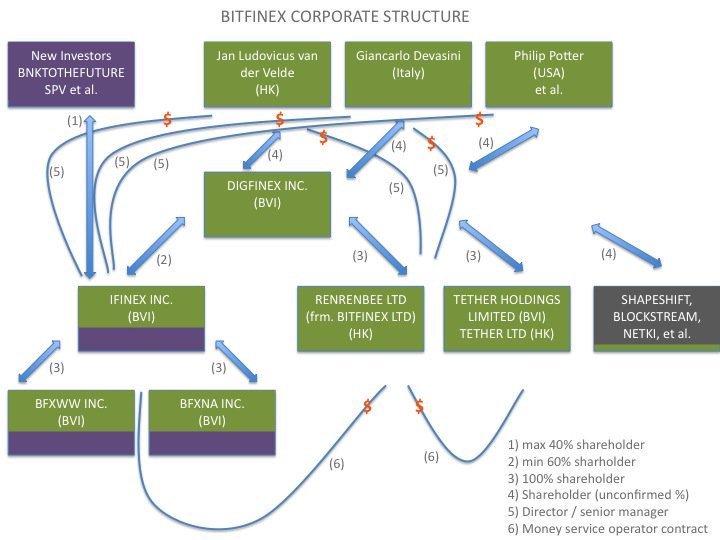
2012 — iFinex Inc., the company that is to become the parent company of Bitfinex and Tether, is founded in Hong Kong. (Like its parent company DigFinex, iFinex is registered in the British Virgin Islands. An org chart from NY AG court filings is here.)
2013 — Bitfinex incorporates in Hong Kong. The cryptocurrency exchange is run by the triad: Chief Strategy Officer Phil Potter, CEO Jan Ludovicus van der Velde and CFO Giancarlo Devasini.
July 9, 2014— Brock Pierce, Bitcoin Foundation director and former Disney child actor, launches Realcoin, a dollar-backed stablecoin. Realcoin is built on a Bitcoin second-layer protocol called Mastercoin, now Omni. Pierce was one of the founding members of the Mastercoin Foundation before resigning in July 2014. He founded Realcoin along with Mastercoin CTO Craig Sellars and ad-industry entrepreneur Reeve Collins. (Wall Street Journal)
September 5, 2014—Appleby, an offshore law firm, assists Bitfinex operators Potter and Devasini in setting up Tether Holdings Limited in the British Virgin Islands, according to the Paradise Papers. (Offshore Leaks Database)
September 8, 2014 — Tether Limited registers in Hong Kong.
October 6, 2014 — The very first tethers are minted, according to the Omni block explorer.
November 20, 2014 — Realcoin rebrands as “Tether” and officially launches in private beta. The company hides its full relationship with Bitfinex. A press release lists Bitfinex as a “partner.” In explaining the name change, project co-founder Reeve Collins tells CoinDesk the firm wanted to avoid association with altcoins.
January 15, 2015 — Bitfinex enables trading of tether on their platform.* (Bitfinex blog.Archive.)
May 18, 2015 — Tether issues 200,000 tethers, bringing the total supply to 450,000.
May 22, 2015— Bitfinex is hit with its first hack. The exchange claims it lost 1,500 bitcoin (worth $400,000 at the time) when its hot wallets were breached. The amount represents 0.05 percent of the company’s total holdings. Bitfinex says it will absorb the losses.
December 1, 2015 — Tether issues 500,000 USDT, bringing the total supply to 950,000. (The price of bitcoin has remained stable throughout most of 2015, but climbs from $250 in October to about $460 in December.)
June 2, 2016— The U.S. Commodity Futures Trading Commission fines Bitfinex $75,000 for offering illegal off-exchange financed retail commodity transactions in bitcoin and other cryptocurrencies and for failing to register as a futures commission merchant as required by the Commodity Exchange Act. In response, Bitfinex moves its crypto funds from an omnibus account to multisignature wallets protected by BitGo.
August 2, 2016 —Bitfinex claims it has been hacked again when 119,756 BTC, worth $72 million at the time, vanish. This is one of the largest hacks in bitcoin’s history, second only to Mt. Gox, a Tokyo exchange that lost 650,000 BTC in 2014. Bitfinex never reveals the full details of the breach. (Chapter 8 of David Gerard’s book “Attack of the 50-Foot Blockchain” offers an in-depth explanation of the hack.)
August 6, 2016— Bitfinex is unable to absorb the losses of the hack. The exchange announces a 36% haircut across the board for its customers. It even takes funds from those who were not holding any bitcoin at the time of the hack. In return, customers receive an I.O.U. in the form of BFX tokens, valued at $1 each.
One large U.S. customer reportedly didn’t get the full haircut. “Coinbase, got a better deal after threatening to sue, multiple sources told me,” said NYT’s Nathaniel Popper.
One point that didn't fit in the story: After getting hacked in 2016, Bitfinex said it gave every customer a 36% haircut to cover losses. But at least one customer, Coinbase, got a better deal after threatening to sue, multiple sources told me.
August 10, 2016 — After having been shut down for a week after the heist, Bitfinex resumes trading and withdrawals on its platform. Meanwhile, Zane Tacket, the exchange’s community director, announces on Reddit (archive) that Bitfinex is offering a bounty of 5% (worth up to $3.6 million) for any information leading to the recovery of the stolen funds.
August 17, 2016— Bitfinex announces it is engaging Ledger Labs, a blockchain forensic firm founded by Ethereum creator Vitalik Buterin, to investigate its recent breach. Bitfinex hires Ledger to do a computer security audit, but leads customers into believing that Ledger is also going to perform a financial audit. A financial audit is key to knowing whether Bitfinex was even solvent at the time of the hack.
“We are also in the process of engaging Ledger Labs to perform an audit of our complete balance sheet for both cryptocurrency and fiat assets and liabilities,” Bitfinex says in a blog post (archive).
A footnote added to the blog post on April 5, 2017, makes a correction: “Ledger Labs has not been engaged to perform a financial audit of Bitfinex. When in initial discussions with Ledger Labs in August 2016, we had initially understood that they could offer this service to us.” The exchange goes on to say that it is in the process of engaging a third-party accounting firm to audit its balance sheet.
This audit, as we are to learn, never happens.
October 12, 2016 — Bitfinex tries to reach out to the hacker. In a blog post (archive), titled “Message to the individual responsible for the Bitfinex security incident of August 2, 2016,” the firm writes: “We would like to have the opportunity to securely communicate with you. It might be possible to reach a mutually agreeable arrangement in exchange for an enormous bug bounty.”
October 13, 2016 — Bitfinex announces (archive) that its largest BFX token holders have agreed to exchange over 20 million BFX tokens for equity shares of iFinex, the exchange’s parent company. Many Bitfinex customers accept the offer, having already watched BFX tokens drop far below $1. One Redditor even reported the price dropping to $0.30.
As a way to incentivize BFX holders to convert, Bitfinex creates yet another new token: a tradable Recovery Rights Token (RRT). According to the exchange, if any of the stolen bitcoins are recovered, any excess of funds after all BFX tokens have been redeemed will be distributed to RRT token holders.
If you convert your BFX to iFinex shares before October 7, you get one RRT for each BFX token converted. If you convert between Oct. 8 and Nov. 1, you get half an RRT for each BFX token converted. After that, you get 1/4 of an RRT per BFX token converted. No further RTTs are given after November 30.
December 31, 2016 — In 2016, Tether issued 6 million USDT, six times what it issued the prior year.
March 31, 2017— Correspondent bank Wells Fargo cuts off services to Bitfinex and Tether, according to court documents in a lawsuit that Bitfinex later files. Bitfinex is not a direct customer of Wells Fargo, but rather a customer of four Taiwan-based banks that use Wells Fargo as an intermediate to facilitate wire transfers.
April 3, 2017 — In a blog post(archive), Bitfinex announces plans to redeem any outstanding BFX tokens. “After these redemptions, no BFX tokens will remain outstanding; they will all be destroyed.”
Meanwhile, Potter reveals in an audio that all of the remaining BFX tokens have been converted to tethers. In a nutshell, this means that none of the victims of the August 2016 Bitfinex hack got back any of their original funds—they were all compensated with BFX tokens, RRT tokens and USDT.
April 5, 2017 — Two days after announcing that it had “paid off” all its debt to customers, Bitfinex, via law firm Steptoe & Johnson, files a lawsuit against Wells Fargo for interrupting its wire transfers. Tether Limited is listed as a plaintiff. In addition to an injunction order, Bitfinex seeks more than $75,000 in damages. (See here for a complete list of documents associated with the lawsuit.)
April 10, 2017— A pseudonymous character known as “Bitfinex’ed” debuts online. In a relentless series of tweets, he accuses Bitfinex of minting tethers out of thin air to pay off debts. At this point, the number of USDT in circulation is 55 million, and BTC’s price has begun a steep ascent that will continue to the end of the year.
April 11, 2017 — Bitfinex withdraws its lawsuit against Wells Fargo. In an audio, Potter admits the lawsuit was frivolous, stating the company was only hoping to “buy time.”
April 17, 2017 — Following a notice about wire delays, Bitfinex announces (archive) it has been shut off by its four main Taiwanese banks: Hwatai Commercial Bank, KGI Bank, First Commercial Bank, and Taishin Bank. Bitfinex is now left to shuffle money between a series of banks in other countries without telling its customers where it is keeping its reserves.
In an audio, Bitfinex CSO Phil Potter tries to calm customers by telling them that Bitfinex effectively deals with this sort of thing by setting up shell accounts and tricking banks.
“We’ve had banking hiccups in the past, we’ve just always been able to route around it or deal with it, open up new accounts, or what have you…shift to a new corporate entity, lots of cat and mouse tricks.”
Around this time, Bitfinex begins to rely increasingly upon Crypto Capital Corp, a Panamanian shadow bank, to shuffle funds around the globe—but it does not make this clear to customers. Also, Bitfinex never engages in a formal contract with Crypto Capital, according to later court documents.
April 24, 2017 — Amidst reports that Bitfinex has lost its banking, USDT temporarily dips to $0.91.
May 5, 2017— After finally clarifying (archive) to customers that it only engaged Ledger Labs for a security audit—not a financial audit—Bitfinex hires accounting firm Friedman LLP to complete a comprehensive balance sheet audit. “A third-party audit is important to all Bitfinex stakeholders, and we’re thrilled that Friedman will be helping us achieve this goal,” Bitfinex writes in a blog post (archive).
June 21, 2017 —The Omni foundation and Charlie Lee announce that tether will soon be issued on the Omni layer of Litecoin, but apparently it never panned out, according to Lee. (Omni Blog, archive)
"Tether will be issuing USDT on Omni on Litecoin 😀"
Launching tether (or anything) on Litecoin requires no approval or corporation from me. I was informed of their decision and I supported it. But I didn't do any work on it. Ultimately, it didn't pan out. I don't have inside info on tether.
August 5, 2017 — Bitfinex’ed publishes his first blog post titled: “Meet ‘Spoofy.’ How a Single Entity Dominates the Price of Bitcoin.” The post explains how an illegal form of market manipulation known as spoofing works. The post includes a video showing a Bitfinex trader putting up a large order of BTC just long enough to push up the price of bitcoin, before canceling the order.
(This is not the first time a crypto exchange has manipulated the price of bitcoin. Mt. Gox, a Tokyo exchange that handled 70% of all global bitcoin transactions before its 2014 collapse, also manipulated its markets. Former Mt. Gox CEO Mark Karpeles admitted in court to operating a “Willy Bot.” An academic paper titled “The Willy Report” shows how the bots were responsible for much of bitcoin’s 2013 price rise.)
September 11, 2017 — Tether announces they will begin making ERC-20 tokens for US dollars and euros on the Ethereum blockchain. (Ethfinex blog,archive)
September 15, 2017 —In the summer of 2017, rumors were afoot that tethers were not fully backed. To quash those rumors, Tether and Bitfinex arrange for accounting firm Friedman LLP to perform an attestation on September 15, 2017.
In the morning, Tether opens an account at Noble Bank. And Bitfinex transfers $382 million from Bitfinex’s account at Noble Bank into Tether’s account at Noble Bank. Friedman conducts its verification of Tether’s assets that evening.
“No one reviewing Tether’s representations would have reasonably understood that the $382,064,782 listed as cash reserves for tethers had only been placed in Tether’s account as of the very morning that Friedman verified the bank balance,” the NY attorney general wrote in its later findings.
The attestation included $61 million held at the Bank of Montreal in an a trust account controlled by Tether and Bitfinex’s general counsel Stuart Hoegner.
September 28, 2017 — Friedman LLP issues a report alleging that Tether’s U.S. dollar balances ($443 million) match the amount of tethers in circulation at the time. Falling far short of a full audit, the report does not disclose the names or locations of banks.
According to the report: “FLLP did not evaluate the terms of the above bank accounts and makes no representations about the Client’s ability to access funds from the accounts or whether the funds are committed for purposes other than Tether token redemptions.”
August 7, 2017 — In a blog post (archive), Bitfinex announces that over the next 90 days, it will gradually discontinue services to its U.S. customers. Effective almost immediately, U.S. citizens are no longer able to trade Ethereum-based ERC20 tokens, commonly associated with initial coin offerings.
The news follows regulatory crackdowns in the U.S. (The previous month, the U.S. Securities and Exchange Commission issued an investigative report that deemed that tokens issued by the DAO—an investor-directed fund built on top of Ethereum that crashed spectacularly in June 2016—were securities.)
November 7, 2017—Leaked documents dubbed “The Paradise Papers” reveal Bitfinex and Tether are run by the same individuals. Up until now, Tether and Bitfinex insisted the two operations were separate, though they were widely suspected to be the same.
November 19, 2017—Tether is hacked when 31 million USDT are moved from the Tether treasury wallet into an unauthorized Bitcoin address. Tether initiates a hard fork to prevent those funds from being spent.
After this hack, Tether notes on its website (archive) that redemption of USDT for real dollars is no longer possible via the Tether website. (It is worth noting that there is no public record of anyone having redeemed their USDT for dollars at any point before this either.)
“Until we are able to migrate to the new platform, the purchase or sale of Tether will not be possible directly through tether.to. For the time being, though, we invite you to use the services of any one of a dozen global exchanges to acquire or dispose of Tethers for either USD or other cryptocurrencies. Such exchanges and other qualified corporate customers can contact Tether directly to arrange for creation and redemption. Sadly, however, we cannot create or redeem tether for any U.S.-based customers at this time.”
From now until December 2018, tether purchases and redemptions can be made only from Bitfinex. (After December 2018, they switch back to tether.io.)
November 30, 2017 — Bitfinex hires 5W, a scrappy New-York public relations firm led by Ronn Torossian. 5W promptly issues a press release stating that an “audit” from Friedman LLP is forthcoming. The agency also tells journalists they can view Bitfinex’s bank accounts if they sign a non-disclosure agreement first. No journalist takes the bait. “We plan to release regular financial statements and are working with journalists who can review our finances as wel[l],” Torossian says in a tweet.
We plan to release regular financial statements and are working with journalists who can review our finances as wel
December 4, 2017— Bitfinex threatens legal action against its critics, according to Bitcoin Magazine. The exchange does not specify who those critics are but the obvious target is Bitfinex’ed, the cynical blogger who continues to accuse Bitfinex of manipulating markets and printing more tether than it can redeem. Bitfinex never actually sues Bitfinex’ed, though Bitfinex’ed collects donations and hires a lawyer just in case.
December 6, 2017— The CFTC subpoenas Bitfinex and Tether, Bloomberg reports. The actual documents are not made public.
December 16, 2017 — The price of bitcoin reaches an all-time high of nearly $20,000, marking the end of a spectacular run-up and bitcoin’s biggest bubble to date. A year before, BTC was only $780.
December 21, 2017 — Without any formal announcement, Bitfinex appears to suddenly close all new account registrations. Those trying to register for a new account are asked for a mysterious referral code but no referral code seems to exist.
December 31, 2017 — Tether has issued roughly $1.4 billion USDT to date.
January 3, 2018— A change to Tether’s legal terms of service (archive) states: “Beginning on January 1, 2018, Tether Tokens will no longer be issued to U.S. Persons.”
January 12, 2018 — After a month of being closed to new registrations, Bitfinex announces it is reopening its doors, but now requires new customers to deposit $10,000 in fiat or crypto before they can trade. Bitfinex does not officially say this, but customers also can no longer make fiat withdrawals of less than $10,000 either.
January 27, 2018 — Tether parts ways with accounting firm Friedman LLP. There is no official announcement; Friedman simply deletes all mention of Bitfinex from its website, including past press releases.
A Tether spokesperson tells CoinDesk: “Given the excruciatingly detailed procedures Friedman was undertaking for the relatively simple balance sheet of Tether, it became clear that an audit would be unattainable in a reasonable time frame.”
January 31, 2018 — The 2017 bitcoin bubble has burst. As the price of BTC plummets, tether issuance takes on a rapid, frenzied pace. In January, Tether issues 850 million USDT, more than any single month prior. Of this, roughly 250 million were created during a mid-month bitcoin price crash.
February 2018 — an ex-NFL owner named Reginald Fowler registers a company called Global Trading Solutions LLC. He goes on to set up bank accounts under the company’s name at HSBC.
February 20, 2018 — Bitfinex posts a fiat transactions delays notice, specifically noting delays between Jan. 10 through Feb 5.
February 20, 2018 — Dutch bank ING confirms Bitfinex has an account there. Two members of parliament in the Netherlands lodge questions for the finance minister after Dutch news site Follow The Money first disclosed the relationship on Feb. 14.
March 28, 2018 — Bitfinex weighs a move to Switzerland. Bitfinex CEO J.L. van der Velde tells Swiss news outlet Handelszeitung: “We are looking for a new home for Bitfinex and the parent company iFinex, where we want to merge the operations previously spread over several locations.” They end up moving their servers to Switzerland.
May 23, 2018 — Phil Potter steps down from his role as Bitfinex chief strategy officer. “As Bitfinex pivots away from the U.S., I felt that, as a U.S. person, it was time for me to rethink my position as a member of the executive team,” he says in a statement.
May 24, 2018 — Bloomberg confirms previous speculations that Bitfinex has been banking at Puerto Rico’s Noble Bank since 2017. Real Coin/Tether creator Brock Pierce is a cofounder of Noble Bank, along with John Betts, a former Wall Street executive.
These individuals had past dealings. In 2014, Betts led a group called Sunlot Holdings to try and acquire the failed Mt. Gox exchange. Pierce, along with former FBI director Louis Freeh were also involved in that effort. (Freeh has his own Twitter whistleblower, by the way.)
May 24, 2018 — The U.S. Justice Department launches a criminal probe into bitcoin markets. The focus is on illegal practices like spoofing, the process of putting up a large sell or buy and then cancelling, and wash trading, where a trader simultaneously buys and sells assets to increase trading volume. The criminal probe will bring in other agencies, including the CFTC.
June 1, 2018 — Looking to reassure its customers, Bitfinex hires Freeh Sporkin & Sullivan, a law firm co-founded by Freeh (the same Freeh who held an advisory role at Sunlot Holdings) to confirm that Tether has $2.55 billion in its banks, enough to cover the USDT in circulation at the time.
FSS is not an accounting firm. Further, there appears to be a conflict of interest. FSS Senior Partner Eugene Sullivan is also an advisor to Noble Bank, where Bitfinex and Tether hold accounts.
“The bottom line is an audit cannot be obtained,” Stuart Hoegner, Bitfinex and Tether’s general counsel, tells Bloomberg. “The big four firms are anathema to that level of risk…. We’ve gone for what we think is the next best thing.”
June 25, 2018 — Bolstering suspicions that tether is being used to prop up the price of bitcoin, researchers John Griffin and Amin Shams at the University of Austin, Texas, release a paper titled “Is Bitcoin Really Un-Tethered?” The two write:
“Using algorithms to analyze the blockchain data, we find that purchases with tether are timed following market downturns and result in sizable increases in bitcoin prices.”
June 27, 2018 — Several Bitfinex customers report delayed and rejected wire deposits. A representative of Bitfinex named “Garbis” takes to Reddit (archive) to explain that the situation was caused by a change in banking relations.
October 1, 2018 — Reports circulate that Noble Bank is up for sale, as a result of having lost several of its big customers, including Bitfinex and Tether. (I don’t know this for sure, but my guess is that Noble’s custodial bank, Bank of New York Mellon, likely told Noble to end its relationship with Bitfinex.)
October 6, 2018 — According to a report in The Block, Bitfinex appears to be banking at HSBC—a bank previously fined $1.9 billion in 2012 for money laundering—under the shell account “Global Trading Solutions.” (We find out later that the shell was registered by Arizona businessman Reginald Fowler.)
October 10, 2018 — Four days after reports comes out that Bitfinex is banking at HSBC, Bitfinex temporarily suspends all cash deposits, suggesting that the exchange is once again on the hunt for a new reserve bank. (As it turns out, the DoJ froze these accounts, so the money became inaccessible.)
October 14, 2018 — Amid concerns over Tether’s solvency and the company’s ability to establish banking relationships, tether’s peg slips again, this time to $0.92, according to CoinMarketCap, which aggregates prices from major exchanges. On a single crypto exchange Kraken, tether momentarily slips to $0.85.
October 16, 2018 — Tether appears to be holding reserves at Deltec Bank in the Bahamas. According to earlier rumors, the bank account was set up by Daniel Kelman, a crypto lawyer who was actively involved in trying to free the remaining Mt. Gox funds.
Further, Bitfinex appears to be banking through the Bank of Communications under “Prosperity Revenue Merchandising,” a shell company created in June 5, 2018. The Hong Kong bank is owned in part by HSBC and uses Citibank as an intermediate to send deposits to Deltec in the Bahamas.
October 24, 2018 — In a blog post (archive), Tether announces it has “redeemed a significant amount of USDT” and will now burn 500 million USDT, representing those redemptions. The remaining 446 million USDT in its treasury will be used as a “preparatory measures for future USDT issuances.”
November 1, 2018 — Tether officially announces (archive) that it is banking with Deltec and provides an attestation letter from the Bahamian bank that the account holds $1.8 billion, enough to cover the amount of tether in circulation at the time. The attestation has a mysterious squiggly signature at the bottom with no name attached to it.
We are pleased to be able to confirm that Tether has an account with Deltec Bank & Trust Limited https://t.co/LSn64soUsC . Balance confirmation at 2018-10-31 attached.
November 30, 2018 — Recall that in May 2017, the U.S. Department of Justice together with the CFTC began looking into illegal manipulation of bitcoin prices. And then in December 2017, the CFTC subpoenaed both Tether and Bitfinex. Now federal prosecutors have supposedly “homed in on suspicions that a tangled web involving Bitcoin, Tether and crypto exchange Bitfinex might have been used to illegally move prices,” according to Bloomberg.
November 27, 2018 — In a blog post (archive), Tether says its customers can once again redeem tether for actual dollars via tether.io. “Today marks an important step in Tether’s journey, as we launch a redesigned platform allowing for the verification of new customers and direct redemption of Tether to fiat.” All accounts require a minimal issuance and redemption of $100,000 USD or 100,000 USDT.
December, 18, 2018 — A Bloomberg reporter says that he has seen Tether bank statements from accounts at Puerto Rico’s Noble Bank and the Bank of Montreal taken over four separate months. The article suggests Tether holds sufficient dollars to back the tether tokens on the market. But again, these are attestations, not the full audit Tether has been promising for months. Notably from the report: $61 million Canadian dollars in the Bank of Montreal is listed under Stuart Hoegner, Bitfinex’s general counsel.
December 19, 2018 — Crypto Capital shares a letter with its customers. The letter is from Global Trade Solutions AG, the parent company of Crypto Capital Corp—not to be confused with Global Trading Solutions LLC, which is a shell set up by Reginald Fowler. The letter states that GTS AG is being denied banking services in the U.S., Europe, and elsewhere “as a result of certain AML and financial crimes investigations” by the FBI and cooperative international law enforcements and/or regulatory agencies.”
December 31, 2018 — By the end of 2018, roughly 1.9 billion tethers are in circulation.
January 16, 2019 — Bitfinex opens a data center in Switzerland, according to Handelszeitung. Previously, Bitfinex was relying on Amazon cloud servers. An earlier Bitfinex blog post confirms the move.
February 25, 2019 — In a blog post (archive), Bitfinex claims the U.S. government has located 27.7 BTC (worth about $100,000 at this time) taken from Bitfinex in the August 2016 hack and returned the funds to Bitfinex. The exchange says it has converted those bitcoin into USD and distributed the money to its RRT token holders. What is odd here is that the U.S. Department of Justice hasn’t issued any statement about recovered bitcoin. And Bitfinex doesn’t share a transaction record to show it actually received the recovered funds.
February 26, 2019 — Tether admits, for the first time that it is operating a fractional reserve and that tethers are no longer backed by cash alone. An update on the company’s website reads:
“Every tether is always 100% backed by our reserves, which include traditional currency and cash equivalents and, from time to time, may include other assets and receivables from loans made by Tether to third parties, which may include affiliated entities (collectively, “reserves”). Every tether is also 1-to-1 pegged to the dollar, so 1 USD₮ is always valued by Tether at 1 USD.”
“Every tether is always backed 1-to-1, by traditional currency held in our reserves. So 1 USD₮ is always equivalent to 1 USD.”
The change is also updated in Tether’s legal section.
April 9, 2019 — Bitfinex lifts its $10,000 minimum equity requirement to start trading. “We simply could not ignore the increasing level of requests for access to trade on Bitfinex from a wider cohort than our traditional customer base,” J.L. van der Velde says in a blog post (archive). Meanwhile, customers continue to complain that they are unable to get cash off of the exchange. And now some are saying they are having trouble getting their crypto off the exchange as well.
April 11, 2019 — Reginald Fowler, an ex NFL minority owner, and Ravid Yosef, who lives in Los Angeles and Tel Aviv, are indicted in the U.S. for charges related to bank fraud. The two were allegedly part of a scheme that involved setting up bank accounts under false pretenses to move money on behalf of series of cryptocurrency exchanges. (CoinDesk)
Also on this day, Bitfinex enables margin trading on tether. Margin pairs include BTC/USDT and ETH/USDT.
April 17, 2019 — Tether goes live on the Tron network as a TRC-20 token, a standard used by the Tron blockchain for implementing tokens, similar to and compatible with Ethereum’s ERC-20 standard. You can view the issuance on Tronscan.
April 24, 2019 — The New York Attorney General has been investigating Tether and Bitfinex for Martin Act violation. Allegedly, Bitfinex has been dipping into Tether’s reserves when it lost access to $850 million in the hands of its payment processor, Crypto Capital Corp. The investigation become public for the first time when the NY AG office sues iFinex, the parent company of Bitfinex and Tether, saying that the company has been commingling client and corporate funds to cover up $850 million in missing funds.
From 2014 to 2018, Bitfinex placed over $1 billion with Crypto Capital because it was unable to find a reputable bank to work with it. Crypto Capital then either lost, stole, or absconded with $850 million.
In order to fill the gap, Bitfinex dipped into Tether’s reserves for hundreds of millions of dollars. According to the NY AG, “Despite the sheer amount of money it handed over, Bitfinex never signed a contract or other agreement with Crypto Capital.”
Bitfinex: we are totes legit
Also Bitfinex: we privately gave $850m of commingled client deposits to a company we didn't sign a contract with, they took the money and ran, so we privately pilfered from our own "stablecoin" fund and demonized anyone who questioned the math pic.twitter.com/cJivO80tNa
April 26, 2019 — In a response to to the NY Attorney General’s allegations, Bitfinex says the $850 million has not been lost, but rather “seized and safeguarded.” Meanwhile, according to CoinDesk, Zhao Dong, a Bitfinex shareholder, claims that Bitfinex CFO Giancarlo Devasini told him that the exchange just needs a few weeks to unfreeze the funds.
April 30, 2019 — In response to the NYAG’s ex-parte order, Bitfinex general counsel Stuart Hoegner files an affidavit accompanied by a motion to vacate from outside counsel Zoe Phillips of Morgan Lewis.
In the affidavit, Hoegner admits that $2.8 billion worth of tethers are only 74% backed. And in its motion to vacate, Morgan Lewis argues that the NYAG has no jurisdiction over Tether or Bitfinex’s actions.
On this same day, Reginald Fowler is arrested. A grand jury has accused him of setting up a network of bank accounts to move money for cryptocurrency firms. He is linked to Crypto Capital’s $850 million in missing funds. (DoJ press release and indictment.)
May 2, 2019 — The U.S. Government wants Fowler held without bail due to flight risk.
May 3, 2019 — The NYAG files an opposition to Bitfinex’s motion to vacate. Bitfinex follows two days later with a response to the opposition. In the memo, Bitfinex argues that “nothing in the Attorney General’s opposition papers justifies the ex parte order having been issued in the first place.”
May 8, 2019 — iFinex has a new plan to raise $1 billion: a token sale. The company releases a white paper for a new LEO token. One LEO is worth 1 USDT, a flashback to when Bitfinex offered BFX tokens to cover the $70 million lost in a hack.
Meanwhile, Fowler is out on $5 million bail. He is required to give up his passport. Bail is posted in the Southern District of New York, where he is to appear for arraignment on May 15. His travel is restricted to parts of New York and Arizona.
May 6, 2019 — New York Supreme Court District Judge Joel M. Cohen rules that the NY AG’s ex parte order should remain in effect, at least in part. However, he thinks the injunction is “amorphous and endless.” He gives the two parties a week to work out a compromise and submit new proposals for what the scope of the injunction should be.
May 13, 2019 — Attorneys for the NYAG and iFinex failed to come to a consensus on what Tether should be allowed to do with its holdings. They submit separate proposals. iFinex is asking for a 45-day limit on the injunction and wants Tether employees to get paid using Tether’s reserves. The NYAG is not opposed to employees being paid, but it wants Tether to to pay them using transaction fees—not reserves.
May 16, 2019 — Judge Cohen grants Bitfinex’s motion to modify a preliminary injunction. The preliminary injunction is limited to 90 days, and Tether is allowed to use its reserves to pay its employees. The judge holds that the Martin Act “does not provide a roving mandate to regulate commercial activity.” Bitfinex and Tether still have to handover documents that the NYAG requested in its November 2018 investigative subpoena.
May 21, 2019 — Bitfinex files a motion to dismiss the proceeding brought by the NYAG on the grounds that Bitfinex/Tether do not do business in NY, the Martin Act does not apply to its business, and the Martin Act cannot be used to compel a foreign corporation to produce documents stored overseas. Bitfinex and Tether also seek an immediate stay of the NYAG’s document demands.
May 22, 2019 — Judge Joel M. Cohen of the New York Supreme Court grants Bitfinex’s motion for an immediate stay of the document demands. He issues an order requiring the companies produce only documents relevant to the limited issue of whether there is personal jurisdiction over the companies in New York but staying the document order in all other respects. The NYAG has until July 8 to file a response. And the judge schedules a hearing on the motion to dismiss for July 29.
July 22, 2019 — iFinex files court docs arguing once again that Bitfinex/Tether are not doing any business in New York and tether is not a security. (Here is Bitfinex counsel Stuart Hoegner’s affidavit and an accompanying memorandum of law submitted by the company’s outside counsel).
October 24, 2019 — Crypto Capital President Molina Lee is arrested by Polish authorities in connection with laundering money for Columbian drug cartels via Bitfinex, according to several Polish news sites.
March 30, 2021 — Tether releases another attestation, essentially saying that Tether has $35 billion in assets backing 35 billion tethers at a blink in time on Feb. 26, 2021. The report was done by Moore Cayman, an accounting firm in the Cayman Islands. It means nothing, as it is not a full audit and doesn’t say what sort of assets tethers are backed by. (David Gerard’s blog,Tether press release)
April 23, 2021 — Coinbase announces that it is listing USDT. (My blog)
May 13, 2021 — Tether publishes a breakdown of the assets behind tethers. It’s a one-pager consisting of two silly pie charts. A critical look reveals there’s only a tiny bit of cash left. (My blog)
# # #
*Update Feb. 20, 2021 — an earlier version of this article said Bitfinex listed tether in Feb. 25, 2015. It was Jan. 15, 2015.)
If you are an investigator or a reporter who has benefited from this work—or just another obsessed Bitfinex follower—please consider making a donation via Patreon.
Ethereum Classic was hit by a 51% attack. A private pool got hold of more than half of the network’s computing power and used that to rewrite history and double spend nearly $1.1 million ETC, the platform’s native currency. Coinbase noted the attack on January 5, and followed with a detailed analysis of what happened.
Here is the irony: Ethereum Classic was founded on the principle of immutability, meaning good or bad, legal or illegal, whatever transactions happen on the network, happen, and you have to live with it. The project took over the pre-fork chain after Ethereum forked to reverse transactions in the DAO hack. If Ethereum Classic wants to stand on that hill, it may have to suffer the consequences, which so far, have not been terrible. ETC was $5 at the time of the attack and is now at $4.66.
How is Ethereum Classic still worth anything right now
Bitcoin saw its 10-year anniversary on January 9. CoinDesk threw a whopping party in New York City, which, judging by photos, was well attended by a lot of white men. For bitcoiners, 10 years is a mark of resilience. But it is worth noting, for the most part, you still cannot buy groceries or pay rent with bitcoin. And if you bought bitcoin a year ago ($14,000) and sold today ($3,700), you would have lost two-thirds of your investment — so much for store of value.
KodakOne announced it generated $1 million in “post-licensing claims” on a beta of its platform. Breaker’s David Z. Morris did a softball interview with KodakOne’s Cam Shell, omitting tough questions like, “How in god’s name did you manage to come out with a beta version of the platform while stiffing all your developers?” I followed up with a story of my own as did Decrypt Media’s Ben Munster and David Gerard, explaining that the $1 million is completely hypothetical money.
Justin Sun, the CEO of blockchain platform Tron, has been unveiled as technically incompetent. Tron recently bought file-sharing client BitTorrent, Now it wants to launch a BitTorrent token. But, in a Breaker interview (another story by Z. Morris, but this one, really good), former BitTorrent executive Simon Morris said there is no way Tron can handle the transaction volume. Simon also said Sun has no technical know-how and Tron is basically little more than a marketing machine.
Rumors swirled a week ago that the co-CEOs of Chinese crypto miner maker Bitmain, Wu Jihan and Zhan Ketuan were going to step down. Turns out, the rumors are true, and Wang Haichao, Bitmain’s director of product engineering, has stepped in to replace them as CEO. In December, CoinDesk reported that Bitmain may be letting go of half of its 3,100 workforce. None of this bodes well for the company’s upcoming IPO.
If you want to trade bitcoin in India, you better keep that information well hidden from your bank. The country’s banks are sending out notices warning customers that they will close accounts without notice, if customers are found dealing in cryptocurrency.
Indian Banks now forcefully taking permission from us to 'reserve right to close our account without further intimation' if we deal in #cryptocurrency transactions
The Texas Department of Banking released a supervisory memorandum on January 2 in regard to treatment of virtual currencies under the Texas Money Services Act. According to the memo, Texas considers pegged stablecoins, like tether, money, which means that anyone dealing with them may need to apply for a Texas money transmitter license.
KodakOne, a photography rights management platform that operates on a blockchain, launched its private beta in October. Since then, the project says it has generated 1,667 new “post-licensing cases” valued at over $1 million, according to a recent press release.
Those numbers sound impressive. Until you consider that the post-licensing cases—instances where the images appeared on the web after being uploaded onto the KodakOne database—were likely the result of a simple reverse image search, similar to what services like TinEye, Google Images, and Berify offer. And the $1 million is unlikely to be actual money—or even KodakCoins, the tokens that drive the platform’s economy.
More likely, $1 million is what those post-licensing cases could have been worth if KodakOne was able to actually reach the infringers and get them to fork over the money. But the press release does not make any of this clear.
Still, that did not stop one reporter from handing out accolades. But this is easy to understand given that what lends this particular blockchain project so much credibility is the name: Kodak. After all, who can forget Paul Anka’s “Times of Your Life,” a song made popular by Kodak 70s commercials?
In fact, KodakOne is not an Eastman Kodak company. A company called RYDE Holding (formerly, WENN Digital, which borrowed the WENN name from paparazzi photo agency WENN Media) licensed the iconic Kodak name. RYDE then went on to build the platform in collaboration with ICOx Innovations, the company that issued the recent press release.
The upside for Eastman Kodak was an increase in its stock price. When Kodak and WENN Digital unveiled the platform in January 2018, Kodak shares went from $3.13 per share to $12.75 in a matter of hours.
How does—or will, or would—KodakOne work? Something like this: Photographers register and archive their work on the site. The platform then trawls the Internet to find unlicensed versions of the images. It then somehow notifies the infringers and tries to get them to pay up. It also matches up buyers and sellers in an online marketplace.
The concept is a good one, except that it makes no sense to put any of this on a blockchain. If you are going to operate a stock photo site, you can do it on a centralized system. And KodakOne could have allowed its users to pay for services in fiat. But then it would not have been able to raise money in an initial coin offering (ICO).
Last spring, KodakOne raised at least $4.1 million via a simple agreement for future tokens (SAFT), meaning it sold rights to future tokens to accredited investors. Unlike a traditional ICO, the idea behind a SAFT is that the tokens are delivered when there is a functioning network in place.
As Bloomberg’s Matt Levine points out, because the tokens were sold in a private placement, this could lead to problems down the road, especially if you want your token to function as an actual utility token on the network.
“But what if the photographer sells her photos for KodakCoins and then wants to sell her KodakCoins for money? Well, she will have a hard time,” Levine wrote, explaining that, for various legal reasons (see U.S. Securities and Exchange Commission Rule 144), you can probably only sell your KodakCoins to accredited investors.
That is just one of the controversies surrounding the project. In June 2018, reports came out that the project was stiffing its developers $125,000 in unpaid fees.
But none of this stopped KodakOne from supposedly moving forward with its plans. According to the recent press release:
“The beta platform is currently operational and being used by agencies including Blaublut Edition and Food Centrale, as well as numerous photographers, with multiple international customers in the pipeline for the next phase of deployment.”
I reached out to Blaublut Edition and Food Centrale for details on how they used the platform, but have yet to hear back.
One critic claims the KodakOne beta platform does not actually exist. Armel Nene, a developer who says he was hired by RYDE to work on the project but has not been paid, wrote in a blog post:
“November 2018, still no payment from Ryde to any of the invoices. Instead the company is publishing fake information on the internet that they are launching their platform in beta mode. This is a lie as the person working on it confirmed that he’s keeping the code as a ransom to the money they owe him.”
So, is the beta version of KodakOne real? How did KodakOne comes up with $1 million? I reached out for comment. If they respond, I’ll update the story. But while how the project came up with this figure is one question, KodakOne still has a lot to answer for.
If you want to dig deeper into the KodakOne project, “Attack of the 50-foot Blockchain” author David Gerard has written a 10-part series on KodakOne and KodakCoin that will tell you everything you need to know.

 Ethereum Classic was hit by a 51% attack. A private pool got hold of more than half of the network’s computing power and used that to rewrite history and double spend nearly $1.1 million ETC, the platform’s native currency. Coinbase noted the attack on January 5, and
 Amy Castor