Bitcoin mining: Riot Platforms’ 10-K is full of tentacles

  • By Amy Castor and David Gerard

We were going to do a quick news update on the world of bitcoin mining —then we got hold of Riot’s 10-K filing for 2023. Hoo boy.

Extreme noise terror

Bitcoin mining in Arkansas is making everyone miserable. The 24/7 noise caused by cooling fans is keeping residents up at night, chasing away wildlife, and lowering property values. 

The Satoshi Action Fund, led by Dennis Porter, is making matters worse for homeowners. The advocacy group, founded by climate denier and former Trump EPA chief of staff Mandy Gunasekara, has been pushing policies that offer greater legal protections for bitcoin miners. [NYT]

In a world where scientists widely hold that the impact of climate change will range from bad to really bad, Gunasekara thinks the impact will be “mild and manageable.” She is unable to come up with any scientific evidence to support this claim. [NPR, 2023

In Hood County, Texas, homeowners living near a Marathon Digital mining facility are equally pissed about the noise and environmental damage wrought by crypto mines. “It’s like sitting on the runway of an airport where jets are taking off, one after another.” [Time; WFAA, archive

The Texas Coalition Against Crypto Mining, led by Jackie Sawicky, is now doing a weekly email newsletter: Proof Of Waste. We’ve been finding it super-useful already. [Issue 1; Issue 2; subscription form]

Bitcoin is a battery of unspecified size

Bitcoin miners really don’t want anyone to know how much power they use. February 23, was the deadline for 82 bitcoin mining companies to cough up details of their energy use to the Energy Information Administration, the statistical arm of the US Department of Energy. The results were to be made public later this year to better inform policymakers about the climate impacts of bitcoin mining.

At the last moment, Riot Platforms and their lobbying arm, Texas Blockchain Council, filed a complaint in Waco, Texas, to delay the deadline. They claimed that the survey was rushed through on an “emergency” basis without a public comment period. The court granted a temporary restraining order on the data collection until a preliminary injunction hearing could be held. [Doc 13, PDF; Semafor]

The EIA reached an agreement with Riot and the Texas Bitcoin Blockchain Council. It will publish a notice on its planned survey and begin collecting public comments over 60 days. The notice will replace the previous survey. [Agreement, PDF]

The Sierra Club filed an amicus brief. “An outcome in this proceeding that prevents EIA from collecting data for months will materially increase the risk of rolling blackouts in extreme weather events or — as in Texas during Winter Storm Uri — cost customers tens of millions of dollars in payments to cryptocurrency miners to keep their lights on.” [Press release; Amicus brief, PDF

As far as we presently know, bitcoin mining in the US consumes as much energy as the state of Utah.

Climate change is an emergency. In return for all the misery and destruction they bring, bitcoin miners contribute zero to their communities.   

A history of flawless repute 

Riot is the largest crypto mining company in the US with facilities in Rockdale and Corsicana, Texas. It trades publicly on the Nasdaq with the ticker symbol RIOT.

Riot used to be a failing biotech under various names — Aspen Biopharma, Venaxis, Bioptix — whose stock traded under $5. In October 2017, in the heat of a crypto bubble, CEO John O’Rourke and Florida businessman Barry Honig figured out a way to pump the stock: blockchain!

The company rebranded as Riot Blockchain and BIOP became RIOT. The stock shot up from $5 to $46 in a matter of months. Fortunately, O’Rourke and Honig were well-invested!

They picked a good time to divest, too. In December 2017, after Riot’s stock hit a high of $46.80 — coinciding with the peak of the 2017 bitcoin bubble — O’Rourke dumped 30,383 shares for over $800,000. Honig dumped 500,000 shares for an undisclosed amount. 

The SEC was not happy with companies adding “blockchain” to their names without any blockchain business. So Riot bought a two-week-old company called Karios, paying more than $11 million for mining equipment worth only $2 million. Honig just happened to be a shareholder of Karios as well.  

Riot also acquired a majority stake in a “blockchain development company” called Tess based in Ontario, Canada. Tess was a shell company associated with bitcoin phishing sites, including a fake Mt Gox website. 

O’Rourke’s stint as Riot CEO was short-lived. He stepped down in 2018, after he, Honig, and a fellow called Mark Groussman were named in a penny stock scam involving three companies. (Riot was not mentioned in the complaint.) Honig was the alleged “primary strategist.” 

In 2018, short-seller Hindenburg advised investors to steer clear of RIOT and said the company was “hurtling toward the abyss.” An investigative piece by CNBC in February 2018 saw RIOT shares drop 33%. The CNBC report is comedy gold. [Hindenburg; CNBC; YouTube]

RIOT 2023 10-K: Extreme accounting

Riot has filed its full-year financials for 2023. The company reported “all-time highs of $281 million in total revenues, 6,626 Bitcoin produced, and $71 million in power credits earned.” [Press release; 10-K]

The company had no analyst call. This is not at all usual. But it’s not illegal! 

As always, Riot made no profit. The company posted a net loss of $49.5 million in 2023. It’s hard to compare this to their net loss of $509.6 million in 2022 — a large part of that number was goodwill write-offs and bitcoin and mining rig value impairment. 

RIOT reduced its losses on the books by $184.7 million by booking the rise in bitcoin price — that is, capital gains on the bitcoins they are holding, and not any sort of actual income — as “cash on hand, earned.”

Their “selling, general and administrative expenses” — mostly payroll — for 2023 totaled $100.3 million. That’s up $32.9 million from 2022.

Riot’s entire bitcoin mining revenue in 2023 was $189 million — only 2% higher than in 2021. Of that mining revenue, $71 million is subsidies from Texas for not mining bitcoin. That’s ordinary citizens paying to keep this company afloat.

Riot changed its name from “Riot Blockchain” to “Riot Platforms” in January 2023,  hoping to diversify into anything that wasn’t bitcoin mining — such as using its supposed expertise in running large data centers. Nobody cared — almost all Riot’s revenue came from mining. Or from not mining.

Adding water to soup

Bitcoin miner accounting is very special, as we covered a couple of years ago.

The scheme is for the executives to leverage being a public company in a bubble to pay themselves money — e.g., as company shares that the C-suite prints and awards to themselves. The suckers are naïve institutional investors who want in on a bubble. The rug pull is when they go bankrupt.

Money comes into Riot from investors who should know better, and it goes out to insiders and operating expenses. This generates a small stream of income — which relies on past spending on mining rigs and the physical plant.

Riot pays its executives well beyond the company’s carrying capacity. Riot CEO Jason Les is getting $21.5 million a year, mainly in bonuses and stock. Executives awarded themselves another $213.6 million in stock and options as of January 2024 — but it’s performance-based! They’re really efficient at setting money on fire.

The company has a history of diluting stock. They’ve gone from 15 million shares in 2019 to 250 million shares in 2024. In 2023, the company netted $517.6 million from selling 45.8 million new shares. [Ycharts]

One of Riot’s big problems is that even the institutional investors who thought RIOT was a way to get bitcoin exposure have ETFs now instead.

Risk factors

Riot has been telling folks in Navarro County, where it’s building a massive one-gigawatt mining facility, that its servers will be immersion-cooled with oil to reduce noise pollution. A demonstration facility seriously impressed Navarro County commissioners with how quiet it was.

But in the 10-K, Riot admits they have no idea if immersion cooling will even work at scale: 

Immersion-cooling is an emerging technology in Bitcoin mining, which is not in widespread use, and has yet to be deployed at this scale. As such, there is a risk we may not succeed in deploying immersion cooling at such a large scale to achieve sufficient cooling performance. All Bitcoin mining infrastructure, including immersion-cooling and air-cooling, is an evolving study.

The company also admits they’re absolutely screwed without the power subsidies from the state of Texas:

… our plans and strategic initiatives for the Rockdale Facility and Corsicana Facility are based, in part, on our understanding of current environmental and energy regulations, policies, and initiatives enacted by federal and Texas regulators. If new regulations are imposed, or if existing regulations are modified, the assumptions we made underlying our plans and strategic initiatives may be inaccurate, and we may incur additional costs to adapt our planned business, if we are able to adapt at all, to such regulations.

From the extreme bingo hall

Denton in Texas used to have Core Scientific, who went bankrupt in late 2022 to the cheers of the townsfolk — but now the city is welcoming more of these bozos. The miner, whoever it is, appears to be pitching itself to the town as a “modular data center.”  [DRC, archive; DRC, archive]

This is the latest swindle we’re seeing from miners — they pitch themselves as “high-speed computing” or “modular data centers,” as if they could use their computing power for something other than mining. They can’t. ASICs are specialized and run for about eighteen months before becoming e-waste.

Jaime Leverton, the CEO of bitcoin miner Hut 8, has stepped down after that short-seller report from J Capital we mentioned previously. Her resignation sent the stock (Nasdaq: HUT) down 8%. Leverton is succeeded by President Asher Genoot. [CoinDesk

Analysts for the Bitfinex crypto exchange say that miners are dumping their bitcoins ahead of the halving. We think this means the miners are desperate for cash, they don’t think the current pump in price will hold, or they’re getting ready to exit the business. [Bitfinex, archive

Ethiopia is suffering a plague of crypto miners, lured by cheap energy. A wave of Chinese miners brought their container data centers to the country after they were kicked out of China in 2021. Several Chinese companies have now invested in a $4.8 billion dam, which the miners would draw power from. Ethiopia has signed a preliminary agreement to establish a $250 million bitcoin mining and AI (apparently) data center, led by the Russian bitcoin miner BitCluster. While all this is going on, about 40% of Ethiopia’s population of 120 million have no electricity. [South China Morning Post, archive; Bloomberg, archive

We hear tell that the bitcoin mining rigs in El Salvador, which President Bukele set up outside the LaGeo plant in Berlín, Usulután, are no longer running, which is unsurprising in a country where power is 15c-20c/kWh — the container mining rig data centers have been left rusting in the sun. There are rumors that much of the setup has been stripped for scrap metal. We look forward to the rest of bitcoin mining going the same way.

Bingo masters break out

Bitcoin miners in the US don’t run on the naïve model of making bitcoins and selling them — they’re creatures of fabulously questionable financial engineering in public markets. And with leverage comes weirdness.

These companies are in an unprofitable business. The only ones making money are the executives, who treat company stock like their personal ATM. 

We expect the US miners to finally admit they’re broke at some point soon — hopefully this year. Apart from mining income halving in a couple of months, the bitcoin price can’t be pumped with billions of tethers forever — ultimately, the retail dollars just aren’t there.

Bitcoin miners could be saved with another crypto bubble.  Any moment now! We don’t think a fresh bubble will kick off this year — it would require a fresh influx of retail dollars that just aren’t in evidence — but we don’t want to bet against human foolishness.

When the companies go bankrupt, the shareholders will end up holding the bag. It’s hard to feel that sorry for them — most of these were institutional investors who really should have known better.

States like Texas will be left figuring out what to do with the mountains of e-waste they leave behind.

Texans versus bitcoin: Jackie Sawicky and the Texas Coalition Against Cryptomining

  • By Amy Castor and David Gerard

  • We need your support to publish more stories like this. Send us money! Here’s Amy’s Patreon, and here’s David’s. Sign up today!
  • If you enjoyed this article, please tell just one other person. Thank you!

Jackie Sawicky recalls the day she got seriously pissed about bitcoin mining. It was April 27, 2022, when Riot Platforms announced it would be building a one-gigawatt facility in Navarro County, seven miles outside of Corsicana, and about an hour south of Dallas. 

Jackie, a lifelong Texan who lives in Navarro, had been looking into the bitcoin bubble and crypto waste. “I watched the Netflix documentary Trust No One on Quadriga, and literally that week, we found out about Riot building the largest bitcoin mine in the US.”

Corsicana’s then-mayor, Don Denbow, had invited citizens to attend a special announcement at the city’s library. [Letter, PDF]

Jackie watched a live stream of the event from her home. Her curiosity turned to horror when Denbow introduced Chad Harris, the executive vice president and chief commercial officer at Riot at the time. 

“We turn energy into opportunity,” Harris said with his best salesman smarm. (Harris is no longer with the company.) Riot would create jobs — hundreds of them — and bring tax revenue to the county. This was good news for Navarro County! [Facebook, video; press release]

Riot already had an existing bitcoin mine in Milam County. This new project was an expansion on a grander scale. 

A voice in the crowd asked but why Navarro? “You have two very valuable resources,” Harris responded. There’s the Navarro switch — meaning Riot could plug itself directly into the state’s power grid — and plenty of fresh water for cooling.

“He told us from the beginning we are coming here to exploit your resources,” Jackie said.

Riot got national attention when it got $31.7 million in energy credits in August 2023 for not mining bitcoins. That money came out of ordinary Texans’ pockets. Welcome to the future of bitcoin mining. 

Radicalized by bitcoin

A self-described environmentalist, Jackie lives “on six acres in the boonies” in Navarro County. She loves Texas for “its natural beauty and the amazing state parks.”

Jackie understood bitcoin’s use case — money laundering and fraud — and the huge threat bitcoin mining poses to the environment. She was shocked to learn a massive crypto mining facility was setting up shop in her backyard: “I lost sleep that weekend.” 

She wasn’t alone. “In the live stream, you can see people reacting in real-time,” Jackie said. She started the Concerned Citizens of Navarro, a group to oppose bitcoin mining in the county. Soon Jackie and her mom were out pounding the pavement and putting flyers on cars to gather support for the cause.

Why Texas?

After China kicked the crypto miners out in mid-2021, the miners looked for other places in the world where they could get cheap energy. China has the cheapest electricity in the world — but the US and Canada have the second cheapest.  

Texas Governor Greg Abbot rolled out the red carpet for the bitcoin miners later in 2021, making the state especially attractive to the industry — at the expense of the people who live there. [Bloomberg, archive]

Jackie thinks Texas is into bitcoin specifically because of crypto mining’s unlimited appetite for power. “They are driving up demand for fossil fuels, and Texas is a fossil fuel state.” A Bloomberg report on the Electric Reliability Council of Texas (ERCOT), the state’s grid operator, concurs: “Everything depends on Bitcoin.” [Bloomberg, PDF]

Bitcoin miners in Texas have negotiated deals with the state for power as cheap as it was in China — 2 to 4 cents per kilowatt-hour. Miners in Texas are subsidized by the taxpayer. For comparison, the going rate for electricity in New York state is 12 to 18 cents per kilowatt-hour.

“When we found out that Texas is number one in bitcoin mining, we changed our name to the Texas Coalition against Cryptomining because it is so much bigger than just Navarro County,” Jackie said. 

Off to fight: SB 1751

In May 2022, Concerned Citizens of Navarro went to Austin to support SB 1751, an unfortunately failed bill to bar tax exemptions for crypto mining facilities. [Texas Legislature]

SB 1751 would have prohibited tax abatements, capped miners’ participation in ERCOT subsidies to large companies to 10 percent, and mandated they register with the state. “This bill would have been the nail in the coffin to this industry here,” said Jackie.

The bill passed the Senate unanimously in April 2022, but the session ended with the bill stalled in the state’s House committee. Jackie hopes to get it back on the agenda for next year.

Riot and Corsicana 

Riot’s plans to expand to Navarro County didn’t come out of nowhere. “We found out through records requests that they had actually been working behind closed doors with the city for five months, so it actually started in December 2021,” Jackie said. 

Jackie and others who oppose the Riot project have tried to reach out to Corsicana city council members and John Boswell, Corsicana’s economic development director. The city says they can’t do anything about the Riot facility because it’s outside of city limits in unincorporated Navarro County. Yet Corsicana city council members are the very people promoting the project.

Riot already has one of North America’s largest bitcoin mines — a 750-megawatt plant in Rockdale (though currently running only 450 megawatts), an hour outside of Austin. The Corsicana facility would be even larger — with a maximum capacity of one gigawatt.

One gigawatt is roughly the size of two coal-fired power plants — enough energy to power 750,000 homes. The proposed plant would put an enormous strain on the state’s already fragile power grid — and the cost would be passed on to ordinary Texans.

Bitcoin mines are huge, ugly, noisy things — warehouses or container buildings full of rows and rows of mining rigs, small servers that guess numbers to win the bitcoins. Texas is hot and humid — not the best climate for a mining farm. The low-frequency sound generated by the fans cooling the rigs can travel up to a mile.

It’s hard to appreciate the immensity of this eyesore of a facility until you look at the videos. Riot broke ground at its 265-acre Corsicana site in October 2022, digging up a section of the pasture and woodland and filling it with concrete and conduit. Riot plans to take the site live with 400 megawatts next year. [YouTube; YouTube]

Riot’s Corsicana facility will displace 265 acres of nature.

Unlike Riot’s Rockdale facility, the planned Corsicana facility is in a residential neighborhood. Residents living near bitcoin mines in other parts of the US liken the sound — produced by the fans used to keep the rigs cool — to a highway, the roar of a jet engine, or an idling semi-truck. The sound is pervasive and unrelenting — because bitcoin mining never sleeps. [Washington Post, 2022]

We asked Jackie if anyone had talked to homeowners in the area.

“​​A Reuters reporter came down here last July,” she said. “He and I knocked on doors but nobody answered. People around here are scared of retaliation, rocking the boat, the local government, etc. There’s a massive chilling effect over the entire county. I’ve been ostracized for being so vocal and confrontational. When we had our first protest at the site, only about six people showed up, even though this project is overwhelmingly opposed by all residents in the county.”

Riot’s Corsicana plant has been pushed back several times. According to a June press release, they are expecting 33,280 MicroBT mining rigs to be delivered in December. Deployment of the rigs, which will provide initially 400 megawatts, is currently set to begin in the first quarter of 2024. Riot expects the rigs to be fully operational by mid-year. [press release]

Job creators

Corsicana and Navarro are poor — Navarro has a 16 percent poverty rate and 17 percent of the population are seniors, likely to be on a fixed income. Thirty-two percent of family households are single parents.

When a city gives breaks to a large business, the pitch is usually jobs. Corsicana already has a candy factory and an iron smelt, but more industry is always welcomed — if they bring jobs. 

Riot’s April 2022 press release told the public that the facility would create 270 jobs when it has 400 megawatts operational — less than half its capacity. In a Cana Girl Speaks podcast, Cody Muldner, Riot’s operations manager at its Corsicana site, said that “when it’s complete there’s going to be 900 full-time employees.” [press release; YouTube, 15:00 on

However, in investor presentations, Riot said that Navarro was only two hours away from its existing Rockdale mine and that the Navarro facility would use existing talent. Riot is not becoming part of the town in the same way the candy factory or the iron smelt are.

“They have their own electric company and their own construction company,” Jackie said of Riot. “They are not going to be creating jobs here. When I spoke with Colleen Cox, Chamber of Commerce, she’s like, it’s not 250 to 900 permanent jobs, it’s at some point in the project, along the way, there would have been these things.”

Anyone familiar with crypto mining knows that Bitcoin mines don’t bring a lot of jobs to an area. Once up and running, they typically employ only a handful of workers to monitor the rigs and swap out dead rigs to throw in the huge pile of e-waste out the back.

The Texas Blockchain Council told the Texas Senate that SB 1751 endangered 22,000 jobs in Texas. Council president Lee Bratcher breaks that down as “directly employs about 2,000 people across the state and another 20,000 people for indirect jobs” — which we still find implausible. Lobbyists, maybe. [Twitter; Decrypt]

“One of the most enraging things that Chad Harris [Riot] did was use very predatory language saying they hire single moms and pay single moms great,” said Jackie. “And I was like, 250 jobs is like .002 percent of the county. And every single mom is going to see higher electricity bills.” [Facebook, video, 20:00 on]

Water

Environmental concerns about bitcoin mining tend to focus on power requirements and hence the CO2 generated. But even crypto people tend not to be aware of how much water-cooling proof-of-work mining actually needs.

At an economics development meeting on June 7, 2022, Eddie Moore, a Navarro County commissioner, said he visited the Riot Rockdale plant and it was “as quiet as it is right here in this room,” because the facility uses immersion cooling — bathing the rigs in oil coolant rather than using noisy fans. “It reminded me of a turkey farm,” he said. [video]

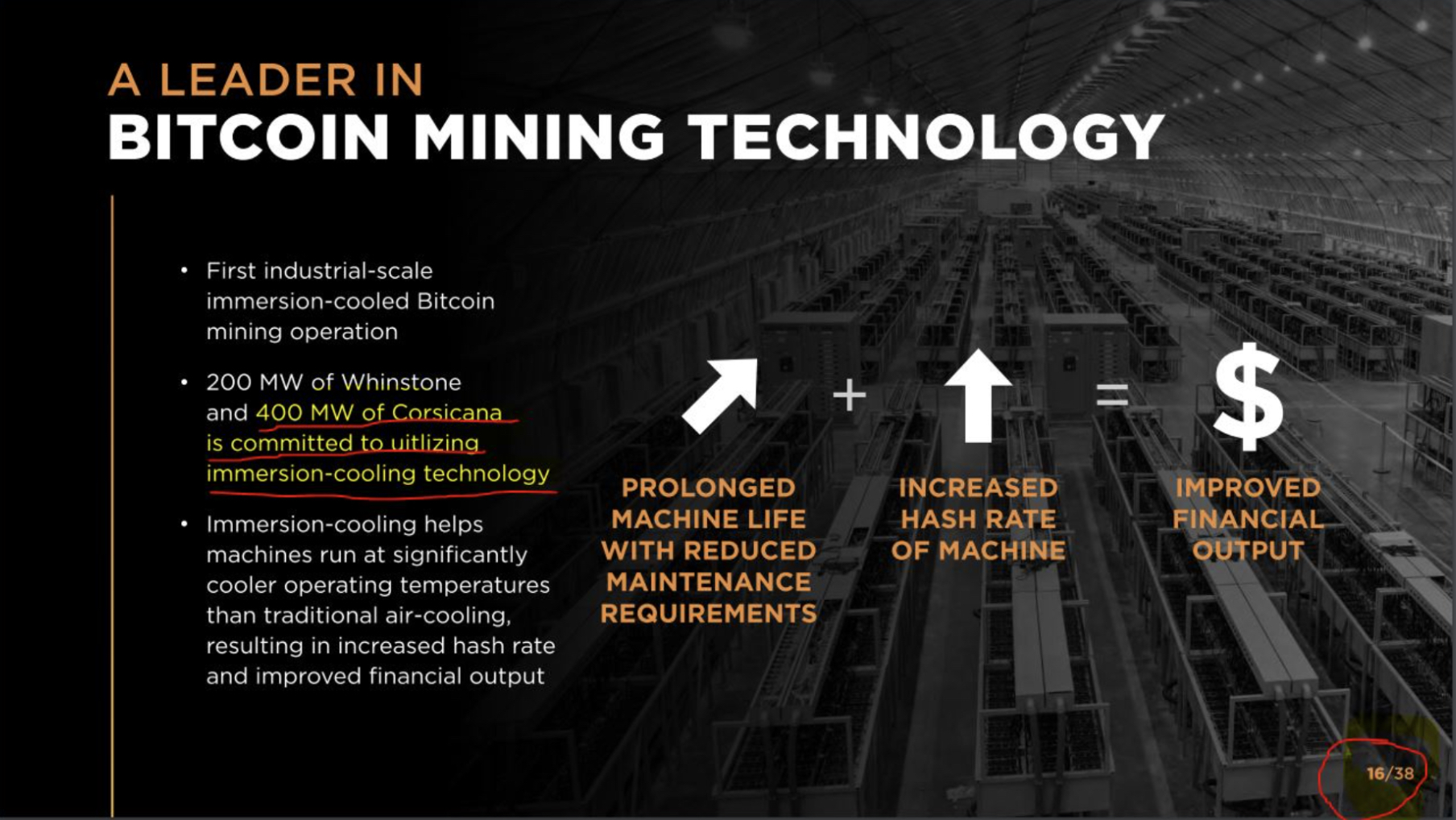
Jackie says this isn’t what’s happening in Navarro. Riot often implied the Corsicana mine would be fully immersion-cooled — something promoters kept referencing as the reason for no noise pollution. “One of the lies they told to get their foot in the door here is that the Navarro County mine is all going to be immersion-cooled. But Riot’s own investor deck says that only 40 percent is going to be immersion-cooled,” she said.

Riot says in its investor deck that only 40% of its Corsicana rigs will be immersion cooled.

We contacted Riot in September asking about all of this — what type of immersion coolant they planned to use, if they’d done any environmental risk studies, how they planned to cool the rest of the facility — but didn’t get a reply. It’s worth noting that oils tend to be flammable. Immersion cooling also carries the risk of leakage, which can cause environmental problems.

“The other 60 percent is going to be traditional fan-cooled,” said Jackie. “So what they do is they need a ton of water — and they feed it through these porous walls and they use fans. It’s like a swamp cooler.”

The water gets quite hot — over 100 degrees Fahrenheit — and that hot water needs to go somewhere. Where will it go?

Jackie hasn’t been able to get a clear answer, but she has concerns. “The property Riot purchased here in Navarro Country feeds into Richland Creek and Richland Creek feeds into Richland-Chambers Reservoir, and that’s the tap water for Arlington-Fort Worth.”

Worse things can happen. “One of my worst-case scenarios is they actually get it up and a fire happens and all these toxic metals leach into the water table and some of the biggest cities in all of Texas have their tap water contaminated. There was never an environmental study done.”

Corsicana will sell Riot the water. Jackie only discovered how much water Riot needed via records requests. “They asked for 1.6 million gallons a day in the height of the summer, and we are all being told to conserve,” Jackie said.

“When Riot tells people they are going to be wasting 1.6 million gallons a day, more than the iron smelt, more than the candy factory, they are going to be the number one user of water,” said Jackie.

This could put a huge strain on other industries. In 2022, a record number of local cattle ranchers had to sell off their herds early — because the price of hay skyrocketed due to the drought. [Corsicana Daily Sun, archive]

But in the June 7 economic development meeting, Boswell, Corsicana’s economic development director, said: “We have enough water to supply the water needs today without any upgrades to our system. We can supply the water to them today and have room for growth. No expansion plans are needed for our treatment plant to be able to meet the needs today.”

Boswell said, in an early email to a Navarro county commissioner, that the Riot facility would end up using 1.4 million gallons of water per day when the site was fully up and running — though he later told the Dallas Observer that the number would be smaller. [Dallas Observer, 2022, archive]

However much the facility will end up needing, Boswell said, the city will be selling water to Riot. All the water that’s sold throughout Navarro County — parts of Hill County, parts of Ellis County — is produced by the city of Corsicana and sold through wholesale water utilities throughout the area. “So, if anything goes on here, it will have an impact on water sales for the city,” said Jackie. 

We are skeptical that Riot will maintain any significant oil immersion cooling for the facility. Bitcoin mining rigs are poorly manufactured disposable hardware with a productive lifetime on the order of 18 months. We expect Riot will overwhelmingly use conventional fan-cooled rigs.

Money for nothing

Riot is a publicly traded company. Its stock (NASDAQ: RIOT) has virtually flatlined, having lost 99 percent of its value from its all-time high in November 2021 during the bitcoin bubble. [Yahoo]

As we’ve discussed, bitcoin mining is not a profitable business. In 2023, Riot is a bitcoin miner that makes most of its money from not mining bitcoins.

Instead, Riot is subsidized by Texas. Bitcoin miners can enroll in demand response programs, which pay them for reducing or shutting down power when called to do so — so they literally get paid to do nothing. [ERCOT, PDF]

During the Texas heatwave in August 2023, Riot made about $9 million from selling bitcoin — but it got $7.4 million in demand response credits from ERCOT and $24.2 million from selling pre-purchased energy back to TXU, the retail electricity provider for ERCOT. [CNBC; Bloomberg, archive; press release; press release]

Riot did the same thing in July 2022 and received $9.5 million in power credits. [press release]

Ordinary citizens don’t get paid to turn up their thermostats and conserve energy — but Riot does.

How you can help

If you’re fired up about what’s going on in Texas, there are lots of ways you can get involved in the fight against bitcoin mining.

In partnership with Greenpeace, the Texas Coalition Against Crypto Mining is having a week of action, starting October 24. The week kicks off with a public town hall meeting on Tuesday, followed by an action event at the Riot site in Navarro on Wednesday, and a press conference on Thursday.

“If you live anywhere near FM 709 and the Navarro Switch, we would really love you to show up and talk to the media,” Jackie said in a tweet. “They are very interested in what you have to say and how you feel about this project.” [Twitter, archive]

If you live in Texas, join the Texas Coalition Against Cryptomining group on Facebook. As well as news updates, they have monthly Zoom meetings. [Facebook]

There is also a separate Facebook group for the National Coalition Against Cryptomining. [Facebook]

At a national level, support Senator Ed Markey’s (D-MA) bill — the Crypto Asset Environmental Transparency Act, which would require miners to disclose their emission levels. [press release; bill, PDF]

At a local level, stay vigilant. “Keep your eyes out for ‘data centers’ coming to your community,” said Jackie. If you live in a county with a bitcoin miner, reach out to one of Jackie’s Facebook groups. “We can help you form a local chapter.”