Crypto collapse: Celsius’s Interim Examiner Report

  • By Amy Castor and David Gerard
  • Our work here is funded via our Patreons — here’s Amy’s, and here’s David’s. Your monthly contributions help greatly with our coffee and ibuprofen budgets!

Shoba Pillay, the examiner in the Celsius bankruptcy, filed her first interim report on Saturday at 11:45 p.m. ET. [Report, PDF]

Appointed by the Office of the US Trustee — an arm of the Department of Justice — Pillay is here to work out precisely what on earth happened here. She is already conducting Rule 2004 investigations, which let her look into almost anything.

This interim report specifically examines Celsius’ crypto holdings, where they were and are stored, and the change from Earn accounts to Custody and Withhold accounts in April 2022, during which time Celsius was feeling the heat. 

Who owns what and under what terms is hugely contentious, with legal briefs flying back and forth: [Debtors’ brief, PDF; Unsecured Creditors’ brief, PDF; Custodial brief, PDF; Withhold brief, PDF]

This investigation revealed that Celsius reacted to the regulatory scrutiny by launching its Custody program without sufficient accounting and operational controls or technical infrastructure … As a result, customers now face uncertainty regarding which assets, if any, belonged to them as of the bankruptcy filing.

This isn’t the bomb under the Celsius bankruptcy that we have been waiting for — it’s just an interim report ordered by Judge Martin Glenn ahead of the Celsius Custody and Withhold hearings on December 7 and 8.

Nevertheless, it’s jam-packed with the sort of hilarity and horrors that you find when anyone looks inside how any crypto firm actually works. All crypto firms are Quadriga. It’s just that some haven’t exploded yet.

The current report is a window into the fraught issue of whose cryptos are in the Custody and Withhold accounts. It will help the court decide whether the depositors will get back 100% of what they put in or whether the cryptos go into the general bankruptcy estate.

The word “Ponzi” does not appear in this report. Whether the Examiner will look into possible Ponzi scheming by Celsius has yet to be determined. The Unsecured Creditors’ Committee — consisting of seven individuals representing the largest Celsius creditors, who are mostly from the crypto industry — wanted to look into this question themselves.

We think the task should be handed to the examiner, a neutral party — and many of the smaller retail investors concur. Also, we’re impressed by what a relentlessly thorough job the examiner did in this interim report.

Celsius hampered the examiner’s investigation as much as they thought they could get away with:

Documents or information responsive to certain requests were not received until days prior to the filing of this Interim Report, and some were not received at all, which may require the Examiner to further supplement the information contained in this Interim Report when she issues her Final Report.

… In addition, Celsius imposed limitations on interviews of its employee witnesses, including by requesting that the Examiner preview any topics to be covered during the interviews and limiting the time of many interviews to two hours. Further, Celsius claimed privilege over communications between Celsius and the regulators, further limiting her ability to obtain the full scope of relevant facts.

On page 19, the examiner cites one of Amy’s 2017 articles for CoinDesk to define what an ERC-20 token is. [CoinDesk]

Custody accounts

Earn was Celsius’ main product. You would deposit cryptos and be paid interest on them.

Regulators in multiple states had been lining up to shut down Celsius’ Earn product through 2021 and early 2022 — they thought it was the unregistered security that it obviously was. New Jersey in particular said that since Celsius was selling the product from their state, the New Jersey cease-and-desist order would take effect for the whole US. The SEC was also subpoenaing information from Celsius. BlockFi had already suffered cease-and-desists for its similar product.

Regulatory heat was a major factor in the creation of Custody and Withhold accounts. Yarden Noy, who headed regulation for Celsius, told Pillay: “Given the regulators, we came up with Custody.”

Celsius was working under the gun — they worried about having a month unable to accept fresh customer deposits — but they had to release Custody before the regulatory deadline or stop accepting any cryptos from retail US customers.

A lack of fresh cryptos coming in from new investors to pay out previous investors would be a serious issue if Celsius happened to be Ponzi-ing.

Celsius was short of developers. Celsius Engineering Director Steven Koprivica characterized the procedure as: “go back to blackboard, do the minimum of all minimums, this may be manual for the start, involve less developers, let’s discuss deadlines.” So everything about the Custody accounts ended up a mess.

Celsius was already tracking the company’s cryptos in the most advanced software known to cryptocurrency: a Google Sheets spreadsheet called the “Freeze Report.” This was an improvement over Celsius’ previous system, which was to just look at each blockchain address and check the balances by hand.

It wasn’t even clear precisely what the “Custody” product was. The accounts certainly weren’t “custody” in the sense that every other crypto custody firm uses the word — storing the keys for a customer’s large crypto holding securely. Different groups in Celsius had different understandings of what the accounts were supposed to do.

Celsius Custody launched on April 15, 2022. Celsius didn’t tell anyone about Custody ahead of its launch — they worried that customers would leave the platform, and they worried that regulators would give them a hard time about the Custody product itself.

Custody was run badly. Celsius didn’t have time to do anything properly. Rather than relying on software, Celsius used manual reconciliation and hoped to add a more robust process later.

Employees were told to tell customers: “Celsius continues to safeguard customer assets.” In fact, Celsius did not safeguard customer assets. Celsius represented each customer’s Custody account as separate — but in practice, they aggregated all of the crypto, lumping everything into one big pile and kept track of the amounts … shoddily.

Celsius had to manually reconcile the amount of crypto listed in each Custody account with the actual cryptos in the aggregate Custody wallet. This was entirely ad-hoc. On 16 dates, there were shortfalls; Celsius topped up the Custody wallet from the Main wallet as needed, and vice versa. (The report details every occasion in Schedule 2, and there’s a graph on page 12. This report is thorough.)

But the key point is that “the Custody wallets ran a substantial deficit relative to Celsius’s Custody liabilities.”

Custody had new terms of service that changed conditions in important ways, such as who owned the cryptos — but customers weren’t necessarily required to click their acceptance, or to read the terms before clicking. This has been a point of serious contention in the bankruptcy — many customers didn’t agree to the terms.

Withhold accounts

Earn customers who were in states where Celsius didn’t feel safe to offer Custody accounts were transferred to a new group, called “Withhold.” This was supposed to just be Celsius holding the coins for customers to then take out later.

Customers didn’t understand this:

Withhold customers expressed confusion about their accounts. For example, one user explained that he “discovered that [he] had a ‘Withhold Account’” only because it “appeared without explanation on the Celsius app.”

Celsius didn’t consider Withhold a product, so it didn’t create a Terms of Use for Withhold.  

But that didn’t stop Celsius from using cryptos in Withhold for revenue generation — loans, rehypothecation, and so on. Also, Celsius didn’t put Withhold funds into separate wallets per customer or even segregate Withhold accounts from their large general pool of cryptos.

The asteroid strikes

The Terra-Luna collapse blew a hole in the Celsius accounts: “In its May 2022 Board Minutes, Celsius reported that its ‘capital sits near zero.’”

Spooked customers withdrew $1.4 billion in crypto between May 9 and May 24, 2022. Cryptos on hand ran so low that Celsius could no longer honor withdrawals — despite CEO Alex Mashinsky’s frequent tweets of reassurance around this time.

Celsius paused all withdrawals on June 12, citing “extreme market conditions” — specifically, that customers wanted their money back.

Custody and Withhold balances increased after withdrawals were cut off — because customers could still deposit, and “customer assets were allocated to Custody when they attempted to withdraw their coins from Earn.”

What happens next?

Pillay’s report outlines the most contentious issues in the bankruptcy in detail — but it doesn’t point to any clear resolutions for them. Judge Glenn is going to have to untangle all of this himself.

The Examiner and the UCC have to resolve who will investigate the “so-called Ponzi schemes” by Celsius. There’s no clear date for this, but the next omnibus hearing is December 5.

The next interim Examiner’s report is due in the first half of December.

Other news in Celsius

Celsius now has an approved bar date. Creditor claims must be in by January 3, 2023. Government claims need to be in by January 10, 2023. [Order, PDF]

Celsius hasn’t put together any plausible business plan as yet. They are asking the court if they can have until March 31, 2023, an extra 141 days to come up with one. [Doc 1317, PDF]
Celsius second bankruptcy hearing — court approves setting more customer funds on fire

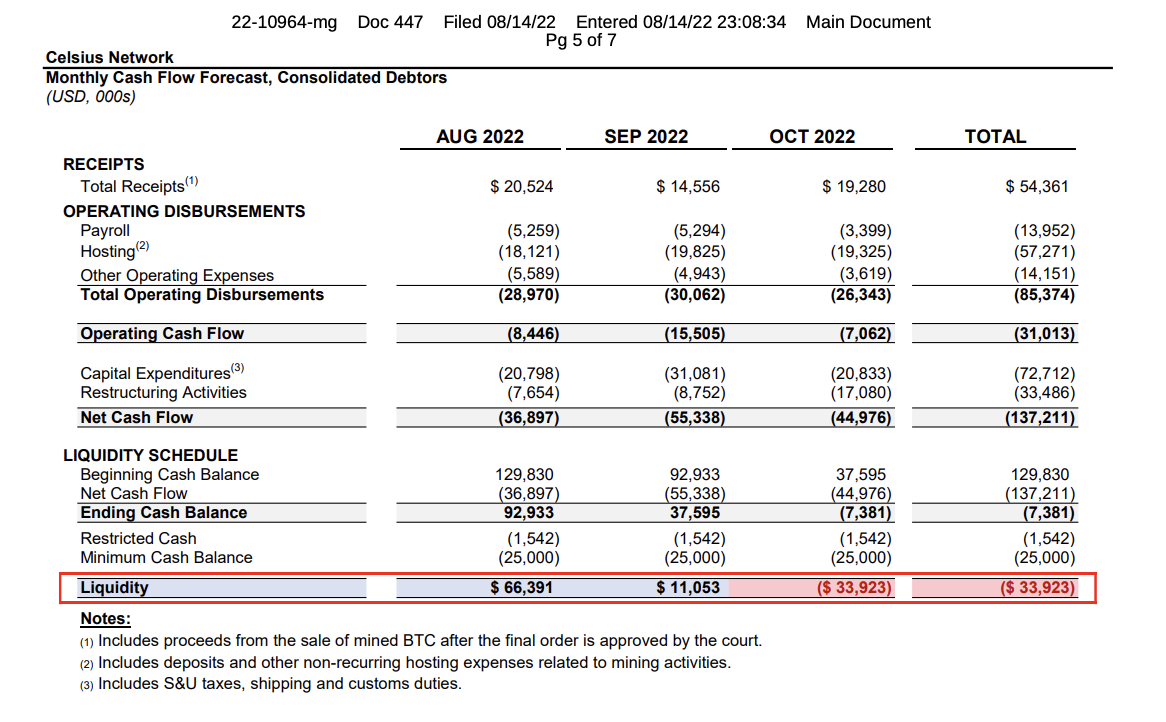
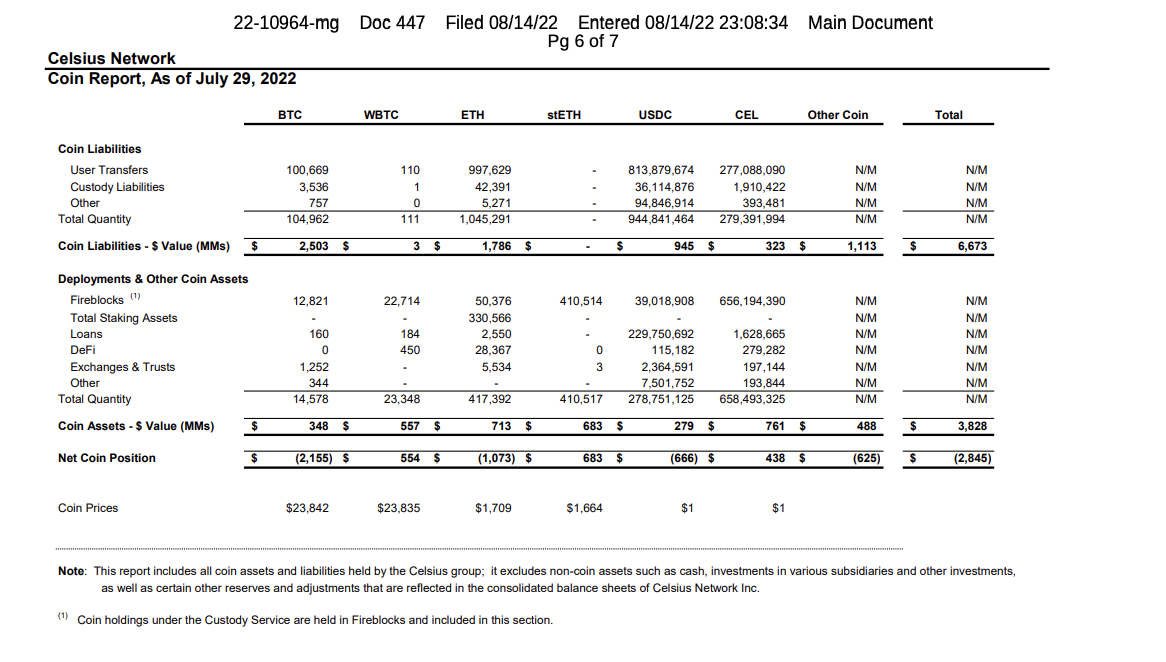
On August 14, Celsius filed a Budget and Coin Report, which put into full view the ongoing train wreck. The company is burning through piles of “cash,” while creditors watch in horror as their remaining hopes of recovering lost money go up in smoke before their eyes. [Docket 447

To generate 18% returns on its Earn product, Celsius dived head-first into some stunningly risky “investments” and lost $1.2 billion in customer funds, at least. The company filed for Chapter 11 on July 13. 

Now, Celsius founder Alex Mashinsky wants creditors to put their faith into another reckless gamble. The company is shifting its entire business model from crypto lending to bitcoin mining — with ludicrous plans to mine its way out of bankruptcy. 

Over a three-month period from August through October, Celsius is allocating $14 million to payroll, $57.3 million to mining,* and $33 million to restructuring costs. By the end of October, Celsius will be operating hugely in the red.

Bitcoin mining is a money-losing proposition, as David Gerard and I detailed in an earlier report. Celsius’ mining business, headquartered in Texas, is currently burning through $19 million of customer money per month. In July, they only mined 432 BTC, worth $8.6 million!

Celsius argues this is because its facilities aren’t fully operational yet — but the facilities will be fully operational if the court will allow them to keep throwing more money into the flames.

All Celsius and its lawyers need to do is to convince creditors — and the judge — that the business will be profitable one day in the fabulous future.    

On August 16, two days after filing its budget report, Celsius had its second-day bankruptcy hearing. The judge ultimately signed off on a motion allowing Celsius to sell mined bitcoin to fund its mining operations but withheld approving a motion authorizing the debtor to sell stocks and shares due to Celsius obfuscating what they were really selling. 

What follows are my notes and comments on the hearing. 

Second-Day Hearing

Judge Martin Glenn began the two-hour hearing by noting that the court has received hundreds of letters from Celsius customers. The letters are all being filed in the docket. “Some have raised important issues that will have to be addressed in this case,” he said.

Molly White has been pulling out excerpts of these letters, and they are indeed heart-wrenching. These are real people, some of whom have lost their life savings because they believed the promises of Celsius founder Alex Mashinsky. [Molly White]

Celsius’s lead lawyer at Kirkland & Ellis, Josh Sussberg, was the first to present at the hearing. Before delving into a nine-page PowerPoint, he took a moment to rant about the “relentless” and “inaccurate” media coverage surrounding the bankruptcy. Sussberg said he’s told Celsius “to take the repeated punches,” and not respond. [Celsius presentation]

Sussberg has clearly been in close talks with Mashinsky, who has a pattern of deflecting blame. When Celsius initially filed for bankruptcy, Mashinsky pinned his company’s failure on “misinformation” in the media and on social media for encouraging customers to withdraw $1 billion in funds over five days in May. Mashinsky’s new message is that the banks are lying, the media is lying, but you can trust me with your money, even though I just lost it all.  

Sussberg noted the elephant in the room: everyone knows that Celsius will run out of money by the end of October. He said that Celsius is working to expedite a restructuring plan that will lead to the company being liquid.  

Celsius is also trying to sell its business and its digital assets to a third party. “We have multiple offers outstanding with several more coming in,” said Sussberg. 

In addition to the official unsecured creditors’ committee, two ad-hoc creditors’ groups have formed. One is for custodial holders, represented by Togut, Segal & Segal. They have $180 million in claims. The other, represented by Troutman Pepper, is for withhold account holders. These were customers in states where Celsius was not licensed. When they tried to withdraw funds, the money went into holding accounts. They represent $14.5 million in claims. Kirkland has been in talks with both groups, Sussberg said. 

Celsius is not seeking to dollarize claims on the petition date. Instead, it wants to return crypto. In other words, Celsius is counting on the markets to rebound — i.e., bitcoin will moon again and everyone’s problems will be solved.  

Interestingly, the creditors also do not want to dollarize claims. Greg Pesce at White & Case, the lead lawyer for the creditors’ committee, said that they too want an in-kind recovery of coins. 

Pesce said the committee has begun its own investigation into Celsius in the hopes of recovering more money for creditors, as they believe they are the only ones able to fight for the customers’ interests. Their search will take them “across the globe, across the country, and across the blockchain.”  

In addition to the possibility of identifying potential insider trading, Pesce seems to be alluding to the Tether loan. Tether loaned Celsius $840 million in USDT backed by bitcoin, and then sold the bitcoin Celsius loaned as collateral just before Celsius filed for bankruptcy. Any attempts to retrieve that bitcoin will be a sideshow in and of itself.

Judge Glenn notes that Celsius’ Earn product attracted lots of government investigations into whether Celsius was selling unregistered securities. The Securities and Exchange Commission has been looking into Celsius since January. Celsius had already been thrown out of Alabama, New Jersey, Texas, and Kentucky for unregistered offerings of securities.

“Since the debtor business model was so heavily dependent on the so-called Earn accounts, and given the number of securities regulator investigations as to whether the debtors were engaged in the sale of unregistered securities, what is the business model going forward?” 

“That’s the $64,000 question,” Pesce responded.

Celsius had 1.7 million customers at the time it filed its petition. About 58,000 held crypto in Celsius’ custody accounts — they might get their crypto back first depending on whether they are deemed secured or unsecured creditors. 

Judge Glenn wants to resolve the custodial accounts sooner rather than later. But Celsius didn’t set up its custodial business until April 2022, and he wants to make sure custodial accounts weren’t a vehicle for insider trading: 

“I am certainly going to want to know whether there are insiders and employees with custodial accounts and whether any of them were able to transfer crypto assets from other accounts into the custodial accounts — and what did they know at the time they made the transfer? Were they contemplating that the business was trending negative and the best way for them to individually protect the value of their accounts was to try and transfer assets into custodial accounts?”

Judge Glenn previously ordered all versions of Celsius’ terms of service going back to 2018. He wanted to trace through all of the changes made over time to determine what is and what isn’t the property of the bankruptcy estate. “Little did I know there were going to be 1,100 pages of them,” he said.   

Bitcoin sell motion

After the presentations, the hearing moved on to the motions.  

Celsius wants to sell bitcoin generated by its mining business and use the cash to fund its mining operations. “We are still in the capital-intensive part of the business and also, importantly, we don’t have all of the mining rigs,” said Sussberg.  

US Trustee attorney Shara Cornell said the Trustee needs more information to form an opinion on the matter: “As of today, we still do not know what expenses are being paid or what bitcoin is being sold,” she said. “We know what the debtors expect to generate but we have no idea what it is going to cost to generate any of that.” 

Cornell said that the Trustee is considering hiring an examiner to address Celsius’ rampant transparency issues. She noted that Celsius said it planned to file a long-term mining plan. “Maybe what we need to do is put this motion on hold until we have more information.”

(Update: Just after I published this story, the Trustee entered a motion for the appointment of an examiner. This is a big deal!)

Surprisingly, Pesce said the creditors’ committee has not made a decision on the mining. Frankly. I was sort of expecting the creditors to push for a liquidation.  

Not all Celsius customers support the idea. 

If they raised a virtual hand during the Zoom hearing, creditors were allowed to speak. One creditor said: “We didn’t sign up to be part of the mining business. We signed up to be part of an exchange. As a fellow miner, I don’t see it being very profitable in the long run.” 

Judge Glenn approved a motion to allow Celsius to sell bitcoin generated from its mining business, but he clearly had reservations: “At bottom, this is a business judgment decision that may turn out to be very wrong, but we will see.” [Order 187]

Not so ‘de minimis’ after all

Celsius wants to sell assets that they claim are “de minimis” and “non-core” to the business to bring in more cash for operating expenses. It turns out these are notes/bonds and equity in other crypto companies, but Celsius never bothered to tell anyone. 

De minimus means too small to be taken into consideration. Debtors can sell assets free and clear of liens. But sales of bankruptcy estate property must be approved by the bankruptcy court.  

Prior to the hearing, the Trustee had objected to the motion, saying the debtor hadn’t provided enough information for the Trustee to evaluate the motion. [Docket 400]

Trustee attorney Shara Cornell told Judge Glenn: “The motion makes it sound like the debtor is selling office furniture or similar hard-type assets that they no longer need. One of our questions in objection had to do with whether or not that might be mining equipment. But what they are actually looking to sell are equities and stocks. And that, in our opinion, is not a de minimis.” 

Judge: “Did you find out what stock they were talking about?” Cornell: “No.” 

Judge Glenn declined to approve the de minimis sales motion and told Celsius to work it out further with the Trustee. Even he was surprised. 

“Certainly I had no inkling the debtor was proposing to sell millions of dollars of equity or notes/investments in other crypto businesses. Those were not what I would normally consider to be de minimis assets, so I want some better definition.”  

Celsius’ business model going forward is all predicated on number go up and making sure the boys get paid. I’m not sure how long this will drag on before the “restructuring” turns into a liquidation, and Celsius management is booted. Likely not before Celsius burns through the rest of their customers’ funds, pays as many of their friends as possible, and the bankruptcy attorneys make their millions. 

The next Celsius hearing is September 1. 

*Celsius calls running mining rigs “hosting.” 

If you like my work, consider supporting my writing by subscribing to my Patreon for $1, $5, $20, $50, or even $100 a month. 

​​