News: Regulators zero in on stablecoins, El Salvador’s colón-dollar, Tether printer remains paused

My Patreon account saw seven new subscribers this month, so far. Thank you! Your support is a big deal. It helps me keep doing what I’m doing.

If you like my writing enough to buy me a cup of coffee now and then, you can sponsor this blog for $5 a month — or $20, $50, or $100 a month, if you want to help out with more than just coffee. Every little bit makes a difference.

Here’s what’s happening in the land of crypto. 

Regulations 

A new academic paper on stablecoins is up on the Social Science Research Network. It’s called “Taming Wildcat Stablecoins.” The 49-page paper was co-authored by Gary Gorton, a finance professor at Yale, and Jeffery Zhang, an attorney at the Federal Reserve.

The pair say that Tether is an equity contract, similar to a money market fund, while other stablecoins, such as USDC, Paxos Standard, and the Gemini Dollar, are more like debt. Liberty Reserve isn’t mentioned anywhere in the paper but the authors draw parallels between stablecoins and 19th Century wildcat banks — which is saying a lot because wildcat banks needed corralling. 

Frances Coppola, a UK freelance writer who spent 17 years in banking, tweeted some harsh criticisms of the report. Overall, I think it is worth a read. FT Alphaville has their own take on the paper.

Secretary of the Treasury Janet Yellen met with the President’s Working Group on Financial Markets — aka “The Plunge Protection Team” or the “holy shit guys” — to discuss stablecoins. The group includes the heads of the Federal Reserve, the Securities and Exchange Commission, and the Commodity Futures Trading Commission. (Treasury Press Release; WSJ, paywalled)

Their discussion builds on a document the PWG published in December outlining regulatory issues regarding stablecoins — back from when former Treasury Secretary Steven Mnuchin brought them all together to discuss Facebook’s Libra, now Diem. That paper, in turn, grew out of the Financial Stability Board’s final report on the regulation of stablecoins in October.

SEC Chair Gary Gensler spoke about crypto exchanges at the Piper Sandler Global Exchange and FinTech conference. “When you go into one of these exchanges, you don’t know whether the order book is accurately reporting the bids and the offers,” he said. “You don’t really know if there is front-running. You don’t know whether some of the trading that is reported is real or fake.” (WSJ, paywalled)

Elizabeth Warren, a Senator from Massachusetts — so famous, she gets into international news slightly more than most senators — sent a letter to Gensler about crypto exchanges telling him that “the lack of common-sense regulations has left ordinary investors at the mercy of manipulators and fraudsters.” She wants the SEC to use its “full authority” to address these risks.

El Salvador and bitcoin

Bitcoin will officially become legal tender in El Salvador on Sept. 7. The fast-approaching deadline has left the country’s President Nayib Bukele and his team scrambling to figure out a way to pull this off without landing on their collective rear ends. 

“So far, it looks like Bukele will be getting everyone onto the government’s official Chivo custodial wallet, using that as an officially-supported payment system, and saying that’s ‘Bitcoin.’” David Gerard wrote in a recent blog post spelling out how Chivo is coming along. Hint: not very well.

In a normal world, you would create the payment system first and then add in the crypto later once you made sure everything was working properly. El Salvador is going about it ass backwards — taking bitcoin, and trying to build a payment system around that. 

The challenge is that bitcoin doesn’t really function as a payment system — and the Lightning Network, a second layer solution that was meant to scale bitcoin, can’t handle a small country with 6.5 million users. 

The Chivo wallet is the one thing that Bukele and his buds can’t afford to screw up on. It’s their wallet, so they’ve hired someone named “Lorenzo” to get the job done right. I assume that Bukele and co’s first instinct was to find someone they could trust to do their bidding — not necessarily someone competent. 

The weird thing is you don’t really need to build a payment system. You can literally hire a white label payment gateway and use it under your name while the processing is done by a third party.

Anyhow, it looks like “Lorenzo” is Lorenzo Rey, the Venezuelan developer from Dash — a crypto that started off as a fork of bitcoin. I’m sure the bitcoin maxis will love that.

El Faro reports that the Bukele regime is now planning to launch a national stablecoin called “colón-dollar.” Colón (Columbus) was the name of El Salvador’s currency before it was replaced by the dollar. It’s technically still legal tender in the country, but nobody uses it. 

According to the plan, the colón-dollar will be issued by El Salvador’s Central Reserve Bank, backed by a reserve of US dollars, and integrated with the Chivo wallet. “The move would restore a key element of monetary policy, which the country lost when it adopted the US Dollar in 2001: the ability to issue national currency,” says El Faro.

A stablecoin makes sense given that Bukele needs greenbacks to pay for the national debt, finance his new party’s campaigns, and pay back owed favors to shadowy figures like José Luis Merino, a high-ranking government official in El Salvador. 

You’ll find Morino’s name — along with several others associated with the Bukele regime — on the US Corrupt and Undemocratic Actors report.

Bukele doesn’t like El Faro — which translates to “The Lighthouse” — a publication that for two decades has dug into corruption, human-rights abuses, and gang violence. 

His government recently expelled an El Faro editor who was Mexican, saying it could not verify his work credentials. (Washington Post, paywalled)

El Faro is co-owned by Jose Simán, Bukele’s rival, so of course, Bukele hates them. The paper has fought a tough battle, but its toughest battle yet may be against the Bukele regime. (Global Investigative Journalism Network)

Circle’s sly plan to go public

I wrote about Jeremy Allaire’s Circle, how it plans to go public via a special purpose acquisition company, and why SPACs are bad. (My blog) 

Circle hasn’t been transparent about what is backing its now 26.4 billion USDC. They haven’t released their Q1 financials to the public, so now we are waiting for the SPAC to file an S-4 sometime in Q4. The S-4 will be the real test of transparency. 

[Update, moments after I published this newsletter, Circle came out with its May attestation. It’s a step toward greater transparency, but we still have questions. Why no full audit? Why the delay in making this info public?]

In his recent article, “A Stablecoin Applies to Become a Stonk,” Doomberg says he thinks SEC chair Gary Gensler is unlikely to let Circle pull off its terrible SPAC. “Under [former SEC chair] Clayton’s watch, the SPAC boom soared to historic heights. But from the early signs, Gary Gensler is no Jay Clayton.”

Here’s something I missed earlier: On page 52 of Circle’s Q4 2020 financials, there is a vague mention of a dispute with a “financial advisor” who claims they are entitled to “9% of any value issued to the Company’s shareholders in connection with the proposed business combination.”

Circle hasn’t disclosed who this financial advisor is, although there is some speculation as to whether Circle tried to go public with a different SPAC company earlier, and that didn’t work out. 

Here’s the text:

“The Company is currently in a dispute with a financial advisor regarding advisory fees in connection with the potential consummation of a proposed business combination. The advisor believes it would be entitled to a fee of approximately nine percent (9%) of any value issued to the Company’s shareholders in connection with the proposed business combination based on the advisor’s interpretation of its engagement letter with the Company. The Company disputes this and maintains that the advisor would receive, at most, a reasonable fee reflecting the custom and practice among investment bankers in similar size and type of transactions. At this time, no business combination has been entered into, and there is no fee owing. However, if any such transaction is completed, and a fee becomes payable to the advisor, we cannot determine the ultimate outcome of this dispute.”

Binance CEO: This is fine. Everything is fine

Binance is fast becoming a train wreck. Regulators around the world have been issuing warnings about the exchange, fiat off-ramps keep shutting, and users are complaining they can’t get their funds out. I wrote about it here and here.

Meanwhile, amidst the smoke and fire, Binance CEO Changpeng Zhao — aka “CZ” — continues to behave like everything is going swimmingly.

“A new chapter awaits us, as we embrace compliance and regulations,” he tweeted — after his Brazil director abruptly quit, and Italy, Lithuania, and Hong Kong issued notices about its questionable stock tokens.

CZ talks a big game when it comes to compliance, but that’s all it is — talk. In a June press release, the exchange bragged about helping to take down a Ukrainian crypto money laundering group.

If Binance was following proper KYC/AML procedures, it likely wouldn’t be a target for money laundering groups to begin with. 

Binance routinely reaches out to law-enforcement agencies to request thank-you notes after it cooperates with criminal probes as a way to show how law-abiding it is. The habit has become so disingenuous that the US Department of Justice straight out told federal agencies to stop signing the letters. (Bloomberg)

A bit of trivia — six years ago, CZ was the head of OKCoin’s Singapore branch, registered as a separate company during the infamous Roger Ver vs OKCoin dispute over the bitcoin.com domain. CZ was the go-between who transmitted — or fabricated — the version of the contract with a grossly forged digital signature. The saga was comedy gold on r/buttcoin in 2015.

Oh, and in case you’ve ever wondered about those “maintenance shutdowns” on leveraged exchanges, this Youtube video by Francis Kim, an investor and founder of 80bots, is a must see. “The biggest mistake I made that night was trusting Binance — that my open position would be safe with them.”

Tether printer still on pause

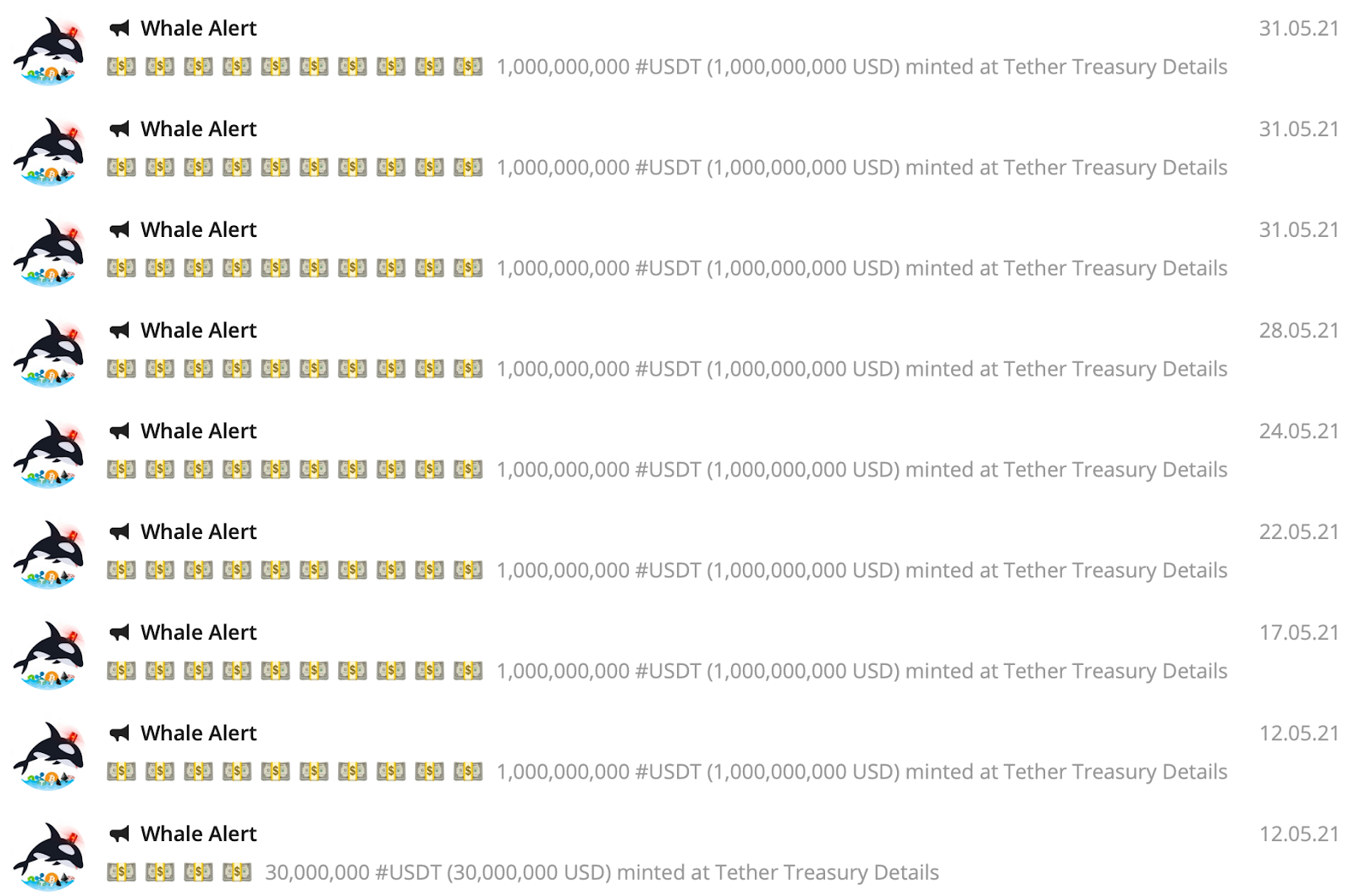
Tether hasn’t printed a darn thing in 50 days. They are stuck at 62.3 billion tethers. Actually, it looks like they even burned 400 million tethers since two weeks ago.

Bitcoin has lost more than half its value since April 14. Down from nearly $68,000, it’s now below $30,000. The concern is that the price of BTC will continue to drop if the Tether printer does not start up again soon.

Keep in mind, there are still a lot of tethers out there moving around between unknown wallets. And we have two other popular stablecoins — USDC and BUSD — to pick up some of the slack. 

In my last newsletter, I offered three theories on why Tether had stopped printing. Now, I am beginning to suspect some regulator may have sent them a cease-and-desist notice.  

There’s also Binance, one of Tether’s biggest customers. Binance is holding 17 billion tethers — about 30% of all the USDT out there. California-based Silvergate Bank terminated their relationship with the exchange in June. (Coindesk)

This means users can no longer transfer US dollars from their US bank to Binance, likely often used to fund purchases of USDT.

Faisal Khan, a banking and payments consultant, thinks that USDT demand probably came from leveraged traders (aka degenerate gamblers) who needed more chips for the Binance casino. (Startups and Econ)

The FT did a profile on Giancarlo Devasini, the 57-year-old CFO of Bitfinex and Tether. A former plastic surgeon, at one point, Devasini got into trouble for “unwittingly” loading unlicensed Microsoft software onto computers he was selling. He goes by the handle “Merlin.”

In communication logs from April 2018 to early 2019 shared with the New York attorney general, Merlin pleaded with “Oz” at Crypto Capital to return funds. Bitfinex had lost access to hundreds of millions of dollars of customer money entrusted to the shadow bank. The exchange had to eventually dip into Tether’s reserves to fund user withdrawals.

“Please understand, all this could be extremely dangerous for everybody, the entire crypto community. BTC could tank to below $1K if we don’t act quickly,” said Merlin. (Court document)

So, to all those who think Tether has nothing to do with the price of bitcoin, Devasini would argue differently. 

Other newsworthy stuff

BlockFi just got hit with a cease and desist from the New Jersey attorney general. The high-yield crypto lender has to stop accepting new clients in NJ as of July 22. (Order)

BlockFi has been funding its lending through the sale of BlockFi Interest Accounts, or BIAs. You put your crypto in and get BIAs in return that earn interest. The NJ AG claims these interest earning accounts are unregistered securities.*

High-yields come with high risks. Still, BlockFi CEO Zack Prince says customer funds are safe. The question is, how safe will your funds be now that BlockFi is not getting as much new money coming in?

Dogecoin dropped below $0.2, so Elon Musk stepped in to do his part. He changed his Twitter profile pic to doge eyes, which helped lift the price back up to $0.19. (Decrypt)

Dogecoin creator Jackson Palmer returned to Twitter briefly to post a scathing thread on why he left crypto. According to him, crypto is an “inherently right-wing, hyper-capitalistic technology built primarily to amplify the wealth of its proponents through a combination of tax avoidance, diminished regulatory oversight and artificially enforced scarcity.” He is 110% correct, of course. (Twitter)

Remember Virgil Griffith, the former Ethereum developer who went to the DPRK against all better judgment to speak at a conference? Virgil doesn’t really listen when people tell him not to do something. He got himself into trouble again, this time for trying to access his crypto — a violation of his bail conditions. (Court filing)  

Reggie Fowler — the person linked to $371 million in missing Bitfinex and Tether funds — has ditched plans for renegotiating a plea deal that he got very, very close to in January 2020. He’s headed to trial with his new defense team early next year. Hopefully, his new lawyer demanded payment in advance. (My blog post)

Trading volumes at the largest crypto exchanges, including Coinbase, Kraken, Binance, and Bitstamp, fell more than 40% in June, according to CryptoCompare. The cause? Bitcoin’s dropping price and China’s renewed crackdown on crypto. (CNBC)

As an article in WSJ points out, China arrested more than 1,100 people suspected of using crypto to launder dirty money in the month of June. That’s enough to put a damper on any exchange volume.

David Golumbia, a professor of digital studies at Virginia Commonwealth University and the author of Politics of Bitcoin, has a new podcast out where he talks about the right-wing politics of crypto. (Tech Won’t Save Us)

The Beijing Civil Affairs Bureau has banned an organization called China Blockchain Application Research Center. The founder is OKEx founder Star Xu, and its members include Huobi founder Lilin, Bibox founder and other giant whales of Chinese crypto. (Wu blockchain)

Hong Kong authorities have arrested four men allegedly tied to a money-laundering racket that used tethers to move $155 million through shell companies. (South China Morning Post, paywalled.)

Image: A one colón note. The colón was the currency of El Salvador between 1892 and 2001, until it was replaced by the US dollar. It is still legal tender, however.

*(July 20, 2021 — Updated to clarify that the NJ AG claims that BlockFi’s BIAs — interest earning accounts — are illegal securities. It doesn’t matter what type of crypto you buy those BIAs with, be it bitcoin, ether, or assets tied to Chainlink or UniSwap. It’s the BIAs. Also added link to the order.)

Related stories:
Binance: Italy, Lithuania, Hong Kong, all issue warnings; Brazil director quits
The curious case of Tether: a complete timeline of events
Tether’s first breakdown of reserves consists of two silly pie charts
NYAG/Tether, Bitfinex settlement reveals commingling of funds, years of shenanigans
Michael Peterson, El Salvador, and Bitcoin Beach
News: Tether printer on hold, China’s crypto crackdown, the world hates Binance, El Salvador’s Chivo wallet

In case you missed my tweet, I ended up sick at the end of June. I was chatting with a friend over Zoom when he noticed that I was tilting over in my chair. Was I drunk? No. Should he call an ambulance? I’m fine.

I ended up in the ER the next day on IV fluids and hooked to monitors. Turns out I had Anaplasmosis from a tick bite. Doxycycline did the trick, and I was on my feet again within 48 hours. 

Apparently, this is the price you pay for walking blissfully unaware through grassy fields and woodsy trails. 

I mentioned earlier I was writing a book on NFTs. While I did a lot of research on the subject, I’m putting the book on hold for now. My concern is, who would read it? NFTs seem to have been a fad, slipping out of fashion. 

If you are interested in the topic, check out my recent notes on NFTs and money laundering. I also wrote for Business Insider on how Metakovan was pumping Beeple NFTs months before he bought Beeple’s $69.3 million NFT at Christie’s. 

I think we can all admit that the art behind almost every NFT is absolute garbage, which the author of this blog post does a fine job of pointing out. 

China’s crackdown on crypto

The People’s Bank of China has hated crypto since 2017, when it initially kicked the crypto exchanges out. 

In recent months, the country has gone after crypto with a renewed vengeance, banning FIs from providing services to crypto firms and forcing bitcoin miners in the country to take their hardware offline. 

Up until recently, most of the world’s bitcoin mining (~ 65% to 75%) took place in China. The country’s crackdown on mining caused more than 50% of the bitcoin hashrate to drop since May.

The hashrate dropped faster than bitcoin’s difficulty algorithm could keep up. Every 2,016 blocks, the difficulty adjusts to account for how many miners are on the network. 

On July 3, bitcoin experienced a record 27.94% drop in mining difficulty, according to BTC.com, meaning now, bitcoin miners will have an easier time finding blocks. (CNBC)

Beijing even told companies they are no longer allowed to provide venues, commercial displays, or even ads for crypto-related businesses. On Tuesday, the PBoC said it had ordered the shutdown of Beijing Qudao Cultural Development, a company that makes software for crypto exchanges. (Reuters)

Why does China loathe crypto? Some people say the PBoC is trying to make way for China’s CBDC, but I doubt that has anything to do with it. The most likely reason is the country wants to stem capital outflows. According to a Chainalysis report last August, $50 billion in crypto assets moved from China to other regions in a 12-month period. 

Why has Tether stopped printing?

Tether is currently at 62.7 billion tethers, and it’s been stuck there for more than a month. Tether had several big prints at the end of May and now, crickets all through June and into July. The printer has totally stopped. 

Nobody is really clear on why Tether has put its printing presses on hold, but the timing seems to correlate with China’s crackdown on crypto.  

We have three theories for why Tether stopped printing

Theory #1 — Less demand

The China crackdown has created a reduced demand for tethers. When bitcoin’s hash rate dropped precipitously, so did the number of newly minted BTC per day — at one point it was down to 350 new BTC per day, as opposed to the 900 BTC per day the network should be producing.

Binance and OKex have mining pools, so bitcoin miners can mint bitcoin directly to their own exchange accounts. Since there is no way to cash out directly, miners convert BTC to tethers (USDT). And then convert USDT to RMB on unregulated over-the-counter platforms, such as Huobi and CoinCola.

With the exodus of miners from China, there was less demand for tethers. 

Theory #2 — Chinese junk debt

Another theory floating around is that Tether may have been getting Chinese junk debt to issue tethers, and now that is no longer possible due to the risks. 

Tether’s latest composition report showed that 50% of the assets backing USDT were unspecified commercial paper. In the US commercial paper market, that would place Tether among the likes of fund managers like Vanguard and BlackRock, which seems unlikely. (FT)

So maybe it’s holding Chinese paper?

“If Tether is holding Chinese commercial paper, the issuer can default on those debts with impunity. What is Tether going to do? Sue in Chinese courts?,” Tether whistleblower Bitfinexed said in a tweet.

He revealed in a DM that the info comes from a “reliable source.”

Theory #3 — USDC is picking up the slack

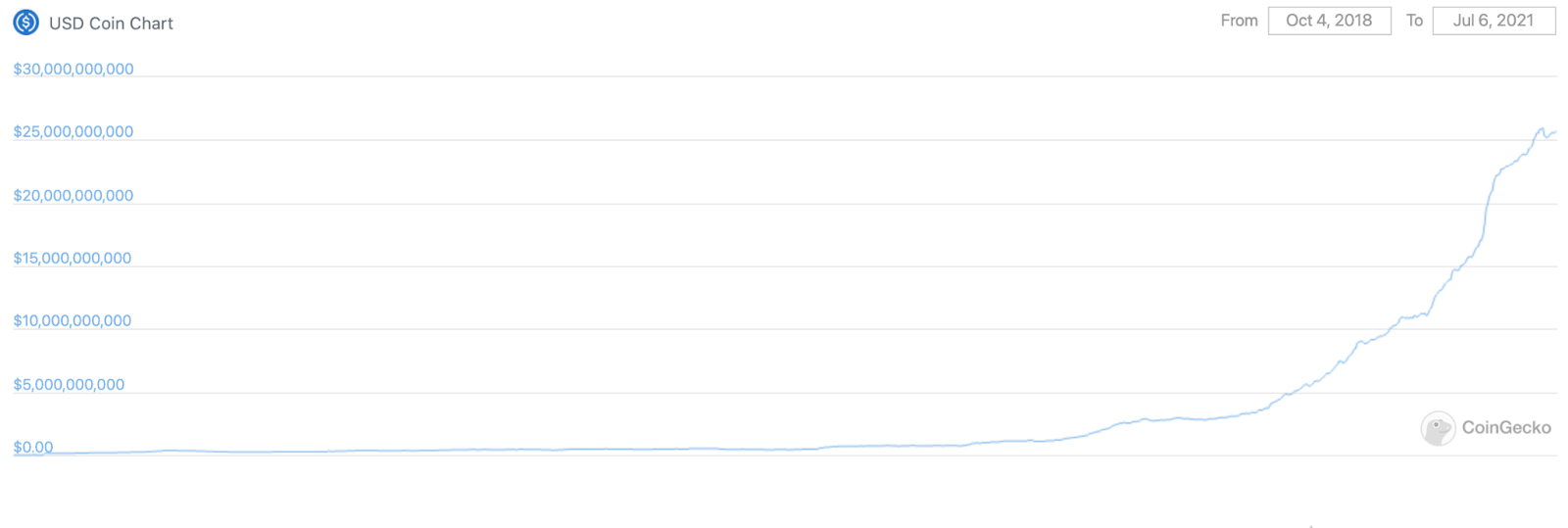
While the tether printer stopped, the USDC printer appears to have picked up speed, issuing 10 million USDC since May 8. 

As of July 5, there are 25.5 billion USDC stablecoins in circulation, so maybe USDC is stepping into Tether’s shoes?

In other news, Tether is working hard to shine up its tarnished image. The company is hiring a Reputation Manager, to “advocate for the company in social media spaces, engaging in dialogues and answering questions where appropriate.” 

If you want to fight the FUD spread by salty nocoiners like myself, this job could be for you. (Teether, archive)

Binance vs the world

The UK, Singapore, Japan, Germany, Canada and now the Cayman Islands are all moving against Binance, the world’s largest crypto exchange. I wrote a blog post detailing Binance’s pariah status. 

The bad news keeps getting worse. Following the FCA banning Binance in the UK on June 26, Barclays says it is blocking customers from using their debit and credit cards to make payments to Binance. (They will let you take money out, but they won’t let you put money in.)

Binance “talks a big game on anti-money laundering and know-your-customer” rules, but was “resistant to throwing human resources at compliance issues,” an executive at a payments company that helped connect Binance to the broader financial market before cutting ties with the group, told the (FT)

And worse still — on Tuesday, Binance told its customers that it will temporarily disable deposits via SEPA bank transfers. Binance said the move was due to “events beyond our control.” (FT)

Binance founder CZ says it’s all FUD.

Binance’s organizational structure

Binance has a lot secrets. The company refuses to say where its headquarters is located. And it’s tight-lipped about its organizational structure, too. 

On May 1, Brian Brooks, former Coinbase chief legal officer and former acting head of the Comptroller of the Currency, took over as CEO of Binance.US, replacing Catherine Coley. (WSJ)

In a Coindesk interview in April, he said he reports to the board of directors, yet he wouldn’t name who was on the board. 

Coindesk: “Brian, what is the reporting structure with Binance US. Who do you report to?”

Brooks: “I have a board of directors, which I will be a member of, and I will report to that board.” 

Coindesk: “Who else is on the board?”

Brooks: “The board is obviously the founder of the company and another person. It’s a private company, so we don’t necessarily go into the governance structure…”

Later when Coindesk asks him where Binance.com is located, Brooks dances around that question as well. He did say, however, that Binance keeps its US customer data separate from Binance.com. 

Binance.US also just brought onboard Manuel Alvarez, a former commissioner at the California Department of Financial Protection and Innovation, as its new chief administrative officer. (Coindesk)

FATF releases 12-month review 

The Financial Action Task Force, a Paris-based global anti-money laundering watchdog, published its second 12-month review of its revised standards for virtual assets and virtual asset service providers, or VASPs

VASPs include crypto exchanges, bitcoin ATM operators, wallet custodians, and hedge funds. 

When the FATF published its guidance in 2019, it recommended full AML data collection by VASPs — and Rule 16, also known as the “travel rule.” 

The travel rule requires VASPs to disclose certain customer data and include that data with a funds transfer, so that the info “travels” down the funds transfer chain.  

Of FATF’s 128 reporting jurisdictions, 58 have implemented the revised FATF standards. The other 70 have not. And the majority of jurisdictions have yet to implement the travel rule.

“These gaps in implementation mean that there is not yet a global regime to prevent the misuse of virtual assets and VASPs for money laundering or terrorist financing,” the FATF said. 

The FAFT plans to publish its revised guidance by November 2021 with a focus on accelerating the implementation of the travel rule as a priority. (Forkfast)

Kaseya ransomware  

The REvil ransomware operation is behind a massive attack centering on Kaseya, a company that develops software for managed service providers. MSPs provide outsourced IT services to small and medium-sized businesses that can’t afford their own IT department. 

Between 800 and 1,500 businesses have been compromised by the global ransomware attack, including schools in New Zealand and supermarkets in Sweden. 

The REvil gang has offered to decrypt all victims for $70 million in Monero (XMR), a cryptocurrency that is harder to track than bitcoin. The immediate ransom demand is $45,000 worth of XMR, rising to $90,000 after a week.

Nicholas Weaver, a researcher at the International Computer Science Institute in Berkeley, wrote a story for Lawfare breaking down the Kaseya ransomware attack. 

He also wrote an earlier story for Lawfare titled “The Ransomware Problem Is a Bitcoin Problem,” where he explains why getting rid of crypto is a great idea. “The ransomware gangs can’t use normal banking. Even the most blatantly corrupt bank would consider processing ransomware payments as an existential risk.”

El Salvador, bitcoin and Bitcoin Beach

Who is the San Diego surfer who brought bitcoin to El Zonte? A white evangelist named Michael Peterson. I wrote about him and his Bitcoin Beach project at length in a recent blog post. 

Peterson read my story. He says it’s full of “glaring inaccuracies” and “plagiarized pieces of other bad reporting.” When asked to substantiate his defamatory accusations, he never replied back. 

Does he use these same bully tactics to get people in El Zonte to use bitcoin? 

David Gerard wrote up a detailed blog post explaining the latest developments on bitcoin and El Salvador. 

Here are some notes, if you want to catch up quick:

  • Nayib Bukele, El Salvador’s president, has announced a government wallet — the Chivo wallet — that will be available for download in September. (Youtube)
  • The Chivo (slang for “cool”) wallet will hold both USD and bitcoin balances. 
  • Salvadorans who sign up for the mobile app will get $30 in bitcoin, but they have to spend it. They can’t sell their BTC for cash — which makes you wonder if Bukele is simply planning to issue new dollars under the guise of bitcoin. (I also recommend you read Gerard’s piece in Foreign Policy on this topic)
  • The technical details of the Chivo wallet are totally unclear. Is Jack Mallers, the CEO of Zap and the remittance app Strike, going to develop the wallet? We don’t know.  
  • Originally, Mallers said Strike was using tether for remittances. (My blog post.) Now, he says Strike is no longer using tethers, and the folks in El Salvador receiving remittances on his app will receive actual dollars. (What Bitcoin Did)
  • How will this happen? Mallers said in his What Bitcoin Did interview that his company has local banking relationships in ES, but we don’t know what banks, where. 
  • Here is a direct quote from the transcript of the interview: “So, I was like, ‘Well, fuck, I don’t know then how I’m going to pull this off!’ So, what I did is, we built Tether into Strike, which was the equivalent of the Chase bank account in America, and it at least gave us some MBP basic functionality, where I can go and just observe and listen and see how people used it and see if it was helpful. But now, we’re already integrating with the top five banks in the country.”
  • Mallers tends to be long on plans and short on details. When the media reaches out to him with questions — like Decrypt did when they learned Zap is not licensed to operate in most US states — he generally just ignores them. 
  • Despite what Mallers keeps claiming, sending remittances via Western Union from the US  to El Salvador isn’t really that costly, to begin with. Steve Hanke, Nicholas Hanlon, and Mihir Chakravarthi point this out in their paper: “Bukele’s bitcoin blunder.”
  • Jack Maller’s company Zap (the parent company of Strike) got $14.9 million in fresh funding in March from “Venture Series – unknown,” on top of a $3.5 million seed round a year prior. Nobody seems to know who is behind the funding. (Crunchbase)
  • Athena, the company that Bukele ordered 1,000 new bitcoin ATMs from, installed a new bitcoin ATM machine — the country’s third installed machine! — in La Gran Vía shopping center. They had a ribbon-cutting ceremony and everything.
  • Unfortunately, the machine was located in front of an upscale department store owned by the Simán family, Bukele’s arch enemy. Worried that the ATM would draw foot traffic to his rival’s business, Bukele had the machine relocated next to the toilets, where it sits unplugged. (Twitter) 
  • The US State Department named 14 El Salvadorans, many associated with the Bukele regime, as corrupt or undemocratic actors. (US State report)

Robinhood’s planned listing

Robinhood had plans to go public in June, but the SEC has some questions about its cryptocurrency business, according to Bloomberg.

The company also agreed to pay FINRA $70 million to settle allegations that the brokerage caused customers “widespread and significant” harm on multiple different fronts over the past few years.

Specifically, FINRA’s investigation found that millions of customers received false or misleading information from Robinhood on a variety of issues, including how much money customers had in their accounts, whether they could place trades on margin and more.

In its SEC S-1 filing, which dropped on July 1,  Robinhood notes that a “substantial portion of the recent growth in our net revenues earned from cryptocurrency transactions is attributable to transactions in Dogecoin. If demand for transactions in Dogecoin declines and is not replaced by new demand for other cryptocurrencies available for trading on our platform, our business, financial condition and results of operations could be adversely affected.”

Robinhood currently supports seven different cryptos. When you trade crypto on Robinhood, you don’t ever hold the keys to your own crypto. Robinhood itself buys the actual crypto and maintains custody, so you can’t move your coins onto or off the platform. You’re stuck in there.

Bitcoin mining turns NY lake into a hot tub

The Greenidge Generation Bitcoin mining plant, owned by private equity firm Atlas Holdings, sits on the shores of beautiful Seneca Lake in New York. 

The tagline on its website reads, “Green Power for Generations to Come.”  

The firm uses lake water to cool its 8,000 computers used to mine bitcoin within the gas-fired plant. Greenidge’s current permit allows it to take in 139 million gallons of water and discharge 135 million gallons daily, at temperatures as high as 108 degrees Fahrenheit in the summer and 86 degrees in winter.  

Locals want the mining facility gone. They have been staging protests. They claim the plant is polluting the air and heating the lake, thanks to its use of fossil fuels.

“The lake is so warm you feel like you’re in a hot tub,” said one nearby resident. (NBC) (Arstechnica)

RSA Conference’s blockchain moment

Over the weekend, the RSA Conference gave infosec and computer science Twitter a bit of a shock when it suggested replacing the entire internet with — a blockchain. 

The tweet quickly disappeared, but not before being archived. The blockchain is immutable! I wrote about the event in a blog post.

(Updated on July 8 to note that Brian Brooks replaced Catherine Coley as CEO of Binance.US.)

If you like my work, please subscribe to my Patreon account for as little as $5 a month.