Coinbase Q1 2024 earnings: number go up, with a bit of juicing

  • By Amy Castor and David Gerard
  • Help our work: if you liked this post, please tell just one other person. It really helps!
  • You can also send money to our one-way ETFs! Here’s Amy’s Patreon and here’s David’s. For casual tips, here’s Amy’s Ko-Fi and here’s David’s.

Coinbase, the largest crypto exchange that deals in actual US dollars, has published its earnings for the first quarter of 2024 — when the bitcoin price reached its previous peak again. [Shareholder letter, PDF; Earnings call webcast; Earnings call transcript, PDF; Analyst call transcript, PDF; 10-Q]

The numbers look great! “We generated $1.6 billion of total revenue and $1.2 billion of net income. Adjusted EBITDA was $1.0 billion – more than we generated in all of 2023,” said CEO Brian Armstrong in the earnings call on May 2.

But those numbers are considerably juiced in important ways.

Numbers go up! When you change how you count them

Coinbase reported $1.6 billion in total revenue and $1.2 billion in net income in Q1 2024.

Those numbers are better than Q4 2023 — the first quarter Coinbase reported a profit in eight quarters. In that quarter, Coinbase reported $954 million in total revenue and $273 million net income.  

But this quarter’s numbers are up because Coinbase holds crypto as an investment — and when the bitcoin price went from $42,000 to $71,000 in the first three months of the year, Coinbase claimed considerable one-time paper gains. 

This is because GAAP accounting for crypto changed. Previously, you could only list the value of crypto you held at what you paid for it or less. You couldn’t account for the number going up as profits. But starting December 13, 2023, you suddenly could, under new FASB rule ASU 2023-08. [FASB, 2023; ASU 2023-08, PDF]

This did wonders for Coinbase’s next quarter!

Coinbase lists $737 million in mark-to-market crypto gains in Q1 — imaginary dollar gains on way more bitcoins than they could ever sell in those quantities — of which $86 million came from gains on digital assets held for operations and $650 million from unrealized investment gains. All this is only listable because of ASU 2023-08.

The crypto gains are listed on the balance sheet as cash coming in. But these aren’t real dollars until Coinbase sells the bitcoins and pays taxes on the capital gains.

“When a company counts bitcoin as revenue — that’s not cash. You can’t pay people with it, you can’t keep the lights on with it. It’s what we call an ‘accounting treatment’ but it is not cash,” Ted Gavin, managing partner and founder of corporate restructuring firm Gavin/Solmonese, told us in a recent phone conversation.  

Trading volume up — a bit

Trading is the lifeblood of any crypto exchange. It’s where Coinbase has traditionally made their money — on trading fees.

Coinbase was profitable in Q4 2021 when they did $547 billion in trading volume. After that, the company was unprofitable for eight straight quarters and trading volume plummeted.

Retail trade volume is three times what it was last quarter! But it’s still a fraction of what it was in the last bull run. Retail volume was $56 billion in Q1 2024 — compared to $177 billion in Q4 2021.

Retail trading is particularly important — it’s where the scarce actually-existing dollars (not just accounting fictions) find their way into the crypto ecosystem.

Institutional trading was the bulk of Coinbase trading — $256 billion volume in Q1 2024 compared to $371 billion in Q4 2021, the last bull run. That’s not terrible — but institutional fees are lower. 

What does this tell us? It means that when number went up, some retail investors came back to try their luck — but many more remain leery of crypto after the collapses of Terra-Luna and then FTX.

Custody — spot ETFs

The SEC approved 11 bitcoin spot ETFs in January — and eight of those, including the largest, Grayscale’s GBTC, use Coinbase as a custodian. 

Coinbase had hoped to make more money as a custodian to supplement its ailing trading business — but the bitcoin ETFs have not pumped up their revenue. 

Despite nearly $11 billion in ETF inflows in the first quarter, Coinbase custodial fees were only $32 million — or 0.2% of their total revenue — up from $19.7 million in Q4 2023. 

Interest

Coinbase makes money on the reserves backing the USDC stablecoin.

It turns out there’s a lot of money in dollar liabilities that you pay zero interest on but which give you 5% interest on the backing reserves. So Coinbase’s income from USDC interest was $197 million in Q1 2024.

There was also $66.7 million from lending out USDC and crypto for trading.

Long-term debt

Coinbase has $4.2 billion in debt. In the first quarter, they added $1.1 billion in long-term debt in convertible senior notes. The money was to pay off existing debt and for general corporate purposes. The notes mature in 2030. [Axios]

Convertible notes are a popular way for startups to raise capital. The primary purpose is that they convert into equity at some point. The notes are usually senior to common stock — if Coinbase went belly up, the holders of senior convertible notes would have priority over common shareholders

While Coinbase purports to have a lot of cash on hand, they also have a lot of debt. They are still spending a lot of money. 

The searing light of regulatory clarity

“We’re driving regulatory clarity,” said Armstrong in the earnings call.

In practice, regulatory clarity is driving Coinbase. One of the biggest challenges that Coinbase faces is a regulatory crackdown on crypto exchanges.

The SEC and 10 states sued Coinbase in June 2023 for operating an unregistered exchange and selling unregistered securities to retail. If the SEC prevails, there goes Coinbase’s entire business model.

EBITDA, the bodybuilding supplement for your numbers

Coinbase really likes its EBITDA numbers. They even started the earnings and analyst calls directly stating they’d hammer on these non-GAAP numbers. “We generated more Adjusted EBITDA than we did all of last year!” Armstrong proudly announced.

EBITDA (earnings before interest, taxes, depreciation, and amortization) is a measure of profitability that many companies put into their quarterly filings.

EBITDA will often look much better than those tawdry old-fashioned standardized GAAP numbers — because it sweeps the real costs of doing business under the rug.

Berkshire Hathaway’s Charlie Munger famously said that every time you see EBITDA, you should substitute “bullsh-t earnings.” [YouTube]

EBITDA isn’t even calculated consistently across different companies. And then there’s “Adjusted EBITDA,” which is a BS number of a BS number. Coinbase is even fonder of this one.

Coinbase’s “adjusted EBITDA” excludes stock-based compensation, because the numbers look way better if you leave out the bit where you have to pay your employees.

“While Coinbase may be reporting $1.2 billion in adjusted EBITDA, that is not what would be left for creditors. It is going to be some number grossly smaller than that,” Ted Gavin told us.

Coinbase’s 10-Q has a whole section excusing their use of these BS numbers. Don’t spend too much time on EBITDA — treat it as a distraction.

What all this means

The bitcoin price recovered — but the market didn’t really recover. The price going up was mostly driven by trading in dubiously-backed stablecoins on unregulated exchanges — not by people liking bitcoins more.

The price rise did seem to get a bit of volume going this quarter. But bitcoin spot ETFs turned out not to be Coinbase’s or the crypto market’s savior. In the last few weeks, we’ve even been seeing more net outflow from the ETFs.

The COIN stock price is up 42% in the year to date — but that’s mainly because the price of bitcoin has gone up this year. 

Coinbase’s numbers in  Q1 2024 are heavily juiced by unrealized gains on the face value of their crypto holdings. The company is not at all out of the woods. ETFs weren’t the magic trick — they’ll need some new Hail Mary.
Coinbase Q3 earnings: Regulatory clarity is all we need. And a miracle or two 

  • By Amy Castor and David Gerard
  • Send us money! Here’s Amy’s Patreon, and here’s David’s. Sign up today!
  • If you like this article, please forward it to just one other person. Thank you!

Coinbase is the biggest crypto exchange that deals in actual dollars, and it’s the first choice for new crypto users. The company went public (NASDAQ: COIN) in April 2021 and enjoyed a few good quarters in the crypto bubble.

But the bubble burst in May 2022 — and the customers just got up and left.

Last week, Coinbase posted its third-quarter earnings. It’s been nearly two years since the company turned a profit. Things have only worsened since the previous quarter. [shareholder letter, PDF; earnings call transcript; earnings call questions; 10-Q]  

Number go down

CEO Brian Armstrong said on the earnings call: “The American people are embracing crypto as more Americans grow unhappy with the traditional financial system.” Armstrong and COO Emilie Choi also harped on how “52 million Americans own crypto.”

Unfortunately, this isn’t sufficiently good news for bitcoin. Per the company’s shareholder letter: “Trading volume has been shifting away from the U.S., where our business is concentrated.” Or, from the 10-Q: “A significant amount of the Trading Volume on our platform is derived from a relatively small number of customers.”

Trading volume is the lifeblood of a crypto exchange — and Coinbase’s is through the floor. The exchange saw $76 billion in total trading volume in Q3, down from $92 billion in Q2. (They did $547 billion in trading volume in Q4 2021, their last profitable quarter.) 

That’s not good for trading fees. Here’s how the numbers have gone starting from Q4 2021:

  • Q4 2021: $2,185.8 million from retail traders; $90.8 million institutional;
  • Q1 2022: $965.8 million from retail traders; $47.2 million institutional;
  • Q2 2022: $616.2 million from retail traders, $39.0 million institutional;
  • Q3 2022: $346.1 million from retail traders, $19.8 million institutional;
  • Q4 2022: $308.8 million from retail traders, $13.4 million institutional;
  • Q1 2023: $352.4 million from retail traders, $22.3 million institutional;
  • Q2 2023: $310.0 million from retail traders, $17.1 million institutional;
  • Q3 2023: $274.5 million from retail traders, $14.1 million institutional.

Coinbase’s net loss for the third quarter was only $2.3 million — the closest the company’s come to making a profit in seven quarters. Total revenue was $674 million, up 14% on Q2. Total operating expenses were $1.1 billion, down 38% on Q2.

The bleeding was stemmed by a $82 million debt repurchase and a $50 million gain in “strategic investments,” said CFO Alesia Haas. In Q3 2022, the company posted a loss of $545 million on total sales of $590 million — just before FTX blew up.

Coinbase ended Q3 with $5.6 billion in cash and a pile of illiquid crypto assets that it accounted for as $483 million.

In the year to date, COIN stock is up 155% and currently trading at $85 — but that’s still a long way from its high of $342 back in the bubble days.

Analysts predicted even worse numbers for Coinbase than it achieved this quarter — so it mostly beat analyst estimates, just! [NASDAQ]

Banking the unbankable

What is going up is interest income. Holders put actual dollars into the USDC stablecoin and get zero interest on it — Coinbase and its partner Circle get all the interest on the USDC reserve.

USDC interest earned Coinbase $172 million in Q3 — up from $151 million in Q2. USDC reserves are mostly in short-term US government debt, and rising interest rates mean more income.

Interest on USDC is cheap revenue for Coinbase. Circle assumes all of the infrastructure-related costs, while Coinbase simply handles marketing.

The main worry is that USDC issuance is way down. The current market cap is 24 billion, down from 55 billion in mid-2022.

Regulatory clarity

The 10-Q and earnings call harped on “regulatory clarity.” What this means is that Coinbase wants special permission to do things that are presently just plain illegal.

We don’t like their chances. What Coinbase calls “The 2022 Events” have brought the regulatory heat — big time. Stated risk factors in the 10-Q include “adverse legal proceedings or regulatory enforcement actions, judgments, or settlements impacting cryptoeconomy participants.”  

As of June, Coinbase is also getting sued by the SEC for selling unregistered securities and running an exchange, a broker-dealer, and a clearinghouse as part of the same operation — and without registering any of these.

Armstrong’s plan is to put pressure on lawmakers and make them see the light. He hopes to get those “52 million” crypto holders in the US to spam Washington D.C. about the case and get them “to come out in force in this 2024 election, make their voice heard.”

We note that those “52 million” are not trading on Coinbase — we’re pretty sure they’re the bagholders stuck with altcoins and apes they can’t sell and may not be so keen to cheer on Coinbase.

If the SEC wins, Coinbase may have to stop trading in any cryptos other than CFTC-regulated commodity coins such as bitcoin. There isn’t enough volume in those for Coinbase to live on.

This is why Coinbase is so insistent on trading blatant unregistered securities  — it’s all they have left for a business model. 

If Coinbase can’t trade unregistered securities in the US — a very real possibility — it will have to rely on custody services and interest income from its stablecoin business. Since Circle runs the infrastructure, Coinbase’s only cost from USDC is marketing. Total marketing was $78 million for the quarter, though half of that was compensation.

The other ongoing legal issue is that multiple states have issued Coinbase show-cause orders, cease-and-desist letters, and fines over their staking products. In July 2023, Coinbase settled with California, New Jersey, South Carolina, and Wisconsin, and shut down staking there. In October 2023, they did the same in Maryland. But the 10-Q states: “The Company and Coinbase, Inc. dispute the claims of the state securities regulators and intend to vigorously defend against them.” OK.

Buddy, can you spare a satoshi

Coinbase needs to figure out new income streams. The company desperately needs to show that it’s profitable at an operating level and not just a black hole.

The earnings call hammered on Coinbase’s hopes that the SEC will finally approve a spot Bitcoin ETF, so Coinbase can charge custody fees. To date, the SEC has shot down every application for a spot bitcoin ETF put before it since 2017. But you can’t prove it won’t happen!

If ETFs do happen, they may hurt Coinbase’s transaction fee income — fees are way lower on ETFs than on Coinbase. Two analysts asked about this on the earnings call and Choi said Coinbase had no plans in place at all — except that ETFs would be super positive for crypto!

Coinbase is also spinning up offshore perpetual futures trading in the Bahamas. Offshore crypto futures could be a huge market if Coinbase can tap into what Binance is doing now and what FTX used to do. In between all the sanctions violations and criming, we mean.

Innovation!

Coinbase’s new tagline is “onchain is the new online.” Coinbase says it stands at the “forefront of this technology.”

Armstrong has the same vision he’s had for the past two quarters — “digital assets, broader access to financial services.” The miracle of onchain “even changes how we think about identity, governance, artwork, and non-financial services.” That is, all the stuff that crypto failed hard at for the past decade. But maybe this quarter it’ll work?

Coinbase’s current bet is Base, an in-house Layer 2 “payments solution” for Ethereum — that is, a completely centralized Ethereum sidechain to run Ethereum applications without Ethereum fees. So far, that means NFTs and scamcoins.

Armstrong also touted plans to put Coinbase itself onto Base — “one of our next major efforts is going to be how to integrate that into all of our products.” It’s not clear how any of that would work, but it should be a hoot.

Coinbase’s risks list in its 10-Q happens to mention that Base “has been in the past, and may in the future, be a target for scam tokens or other illegal activity. For example, in August 2023, a number of fraudulent tokens were identified and traded on Base blockchain.” It’s a pity that’s the use case.

What this means

Coinbase are screwed and they know it. There’s no hope for the greater glory of crypto any time soon. They need the stock price not to completely crater. Not being sued for number going down would probably be nice. And there’s insider stock sales to schedule. This 10-Q is a prayer for a miracle.

Crypto collapse: New Sam Bankman-Fried charges, New York targets CoinEx, Coinbase losses, Voyager, Celsius

  • By Amy Castor and David Gerard

“Sam Bankman-Fried walks into the courtroom. his pants split with a sound like thunder and guns and cocaine spill out all over the floor. he spins around and punches a security officer hard in the face sending him flying. he turns, sits down calmly on his chair and says, to thunderous applause from the fans gathered to hear his famous catchphrase, ‘OK your honour, here’s what I think happened’”

— Hammerite

Mycrimes.txt (2) (FINAL) (USE THIS ONE).docx.pdf

The criminal indictment against Sam Bankman-Fried has been updated, with a superseding indictment on February 23. [Superseding indictment, PDF]

The new charges are clearly informed by the cooperation of Sam’s former co-conspirators — and by his crime confession tours in the press and on Twitter.

The Federal Election Commission is now listed as a victim of Sam’s fraud, with allegations that SBF tried to buy influence over crypto regulation in Washington. 

The indictment details all the tricks that Sam (allegedly) pulled to influence both Democrats and Republicans, in concert with other FTX executives — and how he tried to conceal his influence.

Other new allegations include bank fraud. The act of misleading a bank in the course of business is a crime all by itself — such as when you accept money in the name of one entity (Alameda) for another entity (FTX), or when you set up a shell corporation (North Dimension) and lie to your bank (Silvergate) about what that shell does.

Sam also used Alameda to fill a $45 million hole in FTX US. He gave Alameda a $65 billion credit line, which allowed it unlimited access to customer funds on FTX. Customer and company funds were thoroughly commingled. 

The indictment doesn’t specify the cause of the hole in FTX US, but Sam has repeatedly claimed that FTX US was solvent. 

Sam ultimately controlled both FTX and Alameda, even after claiming to have stepped away from Alameda.

The indictment also lists billions of dollars worth of assets that have been forfeited, including multiple SBF accounts at Binance.

FTX and its subsidiaries was never a legitimate business. It was Sam’s piggy bank. 

New York goes after CoinEx

The New York Attorney General’s office is suing the CoinEx crypto exchange. The NYAG alleges that CoinEx sold securities and/or commodities, did not register with the CFTC or SEC, and misrepresented itself as registered. [Press release; Complaint, PDF; Affidavit of OAG Detective Brian Metz, PDF]

CoinEx, which is based in Hong Kong, has responded by barring all US citizens. You have until April 24 to get your cryptos off the exchange. [Twitter]

New York alleges that CoinEx offered to New York customers various cryptos that are securities — AMP, LUNA, RLY, and LBC  — while the exchange was not registered to deal in securities.

AMP is the token of Flexa, who want to use it to sell burritos. LBC is the token of video site LBRY, which the SEC recently had a slam-dunk win against in court, finding that it was absolutely the security it clearly was. Luna is the twin coin of TerraUSD, which crashed all of crypto last May.

New York says these tokens are all securities under New York’s Waldstein test: “any form of instrument used for the purpose of financing and promoting enterprises, and which is designed for investment, is a security.” They say the tokens are also securities under the federal Howey test — as LBC was recently shown to be.

It happens to be a violation of New York commercial law to call yourself an “exchange” if you offer trading in securities or commodities and you’re not registered with the CFTC or SEC.

CoinEx also failed to respond in any way to a previous NYAG subpoena — and, per General Business Law §353(1), failure to comply with a subpoena is prima facie proof that the subpoenaed entity “is or has been engaged in fraudulent practice.” 

New York wants CoinEx to block New York from its website, pay restitution, disgorgement, and costs, “and provide New York investors with the option to rescind their transactions.”

New York is bringing a “special proceeding” — it wants the court to rule on its filing. “A special proceeding goes right to the merits. The Court is required to make a summary determination upon all the pleadings, papers, and admissions to the extent that no triable issues of fact are raised.”

Why did New York go after CoinEx in particular? This complaint is detailed, but it also looks like a template. We suspect this may be the first of many such complaints against crypto platforms. CoinEx ignoring the subpoena probably annoyed New York a lot too.

The SEC previously called out each of the tokens on CoinEx that the NYAG names as securities:

  • In a July 2022 insider trading complaint against Coinbase, the SEC said AMP and RLY were securities. [Complaint, pdf
  • In Feb 2023, the SEC said LUNA was a security [Complaint, pdf]
  • In November 2022, the SEC won in court against LBRY on whether its LBC token was an unregistered security offering. [SEC]

Binance US has delisted AMP. But Coinbase still lists AMP and RLY. Gary Gensler has been saying for a while that he thinks nearly all crypto tokens are securities and that Coinbase should register with the SEC.

Coinbase posts another loss

Coinbase’s Q4 earnings report is out, as part of its 10-K annual report for the year ending December 31, 2022. Trading volumes are down even further, and they’re still losing money. [10-K]

As a public company, Coinbase has to put on a happy face for investors — but they’ve been bleeding money for a year now. Net loss for 2022 was $2.625 billion, per GAAP. The COIN stock price has gone down 70% in the past 12 months.

Coinbase would prefer you to look at non-GAAP “adjusted EBITDA,” which comes out to a loss of only $371.4 million. Their “adjusted EBITDA” excludes stock-based compensation expenses in particular. Yes, we’re sure your numbers look better if you exclude the bit where you have to pay your employees.

Coinbase makes its money from (1) BTC and ETH trading, and (2) their share of the interest on the USDC reserve. Also, the majority of their volume comes from a few large customers. So Coinbase would extremely much like to diversify.

CFO Alesia Haas said in the investor earnings call: “Our fourth quarter net revenue increased 5% quarter-over-quarter to $605 million. This was driven by strong growth in our subscription and services revenue.” She means that Q4 revenue was only up because of interest on USDC. [Coinbase, PDF]

Coinbase wants to list every token going — even as many of the hottest tokens are blitheringly obviously securities under the Howey test. Coinbase has spent the past several years helping their very good venture capital friends such as a16z dump their bags on retail.

Coinbase goes on at length about the amazing ambiguity in what constitutes a security under US law. Who can even know what might be deemed a security tomorrow? It is a mystery.

Sure, the Howey test is simple and broad, and sure the SEC has won every case it’s ever brought where it claimed a given crypto was a security. But do you feel lucky?

The 10-K even includes a list of tokens Coinbase trades that the SEC has already said are securities! Coinbase questions whether these tokens are really securities, and confidently asserts that “Despite the SEC being the principal federal securities law regulator in the United States, whether or not an asset is a security under federal securities laws is ultimately determined by a federal court.”

This is true. But it’s also true that the SEC has won every single time. And the consent orders in these cases — because almost nobody was stupid enough to take their case to trial — note that the tokens in question were always offerings of securities. It wasn’t a court finding that made the token a security.

But Coinbase is desperate to diversify and makes it clear that they really want to risk their backsides on this business line of maybe-securities that don’t even make them a lot of money.

The SEC shut down Coinbase’s Earn staking product in 2022 before it could be launched. Haas explained in the analyst call why Coinbase thinks its staking product isn’t a security: “we are passing on rewards directly from the protocol. We are not establishing an APY, we are not establishing the reward rate. That is established at the protocol level. And then we are passing that through and collecting a fixed commission on that amount.” We guess we’ll see if the SEC concurs. [Coinbase, PDF]

Coinbase literally lists Satoshi Nakamoto as a risk factor for its business:

“the identification of Satoshi Nakamoto, the pseudonymous person or persons who developed Bitcoin, or the transfer of Satoshi’s Bitcoins”

The FTX fallout continues

FTX Japan K.K. users are getting back 100% of their cryptos. Users in other jurisdictions are likely to get cents on the dollar, if that. This is because the US crypto lobby viciously fought any sensible regulation for years — but Japan locked crypto down hard after Mt. Gox exploded in 2014. Taste the freedom! [Bloomberg]

Galois Capital, a real-money hedge fund that thought they’d get into some crypto, shuts its doors after losing $40 million, half its assets, in the collapse of FTX. Whoops! [Twitter, FT, archive]

The Bank for International Settlements — the central bank for central banks — reports that the fall of FTX didn’t have much impact on the rest of the financial world: [BIS bulletin, PDF, Coindesk

“Nevertheless, despite crypto’s large user base and the substantial losses to many investors, the market turmoil in 2022 had little discernible impact on broader financial conditions outside the crypto universe, underlining the largely self-referential nature of crypto as an asset class.”

Regulatory clarity

Caitlin Long’s Custodia Bank was refused an account at the Kansas Fed. Custodia appealed the decision. The Federal Reserve Board has looked at Custodia’s appeal and told them to go away. [Federal Reserve]

We’ve mentioned previously that the Canadian Securities Administrators (CSA) is introducing new rules for crypto exchange registration in the wake of the collapse of FTX. The new regulations, which will apply in all provinces, have been released:

  • Customer cryptos will need to be segregated into an address per customer.
  • Exchanges cannot pledge or rehypothecate customer cryptos. Margin trading is forbidden.
  • Proprietary tokens — in-house supermarket loyalty card points, in the manner of FTT or BNB — require prior written consent and can’t be counted as an asset in your accounts.
  • No stablecoin dealing without prior written consent.

These apply to any exchange with Canadian customers, including non-Canadian exchanges. [Press release; OSC, PDF]

The Financial Action Task Force, the multi-country advisory group set up to combat money laundering, is not happy that its rules on crypto traceability, such as the travel rule, have not been implemented sufficiently widely. At the FATF Plenary on February 22-24, “delegates further agreed on an action plan to drive timely global implementation of FATF standards relating to virtual assets.” [FATF]

The International Monetary Fund has put out a paper, “Elements of Effective Policies for Crypto Assets,” with guidelines that any country that ever might want to hit up the IMF for a loan would be well advised to follow — “amid the failure of various exchanges and other actors within the crypto ecosystem, as well as the collapse of certain crypto assets. Doing nothing is untenable as crypto assets may continue to evolve despite the current downturn.” [Press release; paper, PDF]

Hong Kong’s Securities and Futures Commission is consulting on licensing requirements for crypto exchanges to be allowed to sell to retail customers. Hong Kong wants safe custody of customer cryptos — they’re not demanding third-party custodians, an arms-length subsidiary will be sufficient — KYC, cybersecurity, accounting and auditing, risk management, AML, and prevention of market misconduct. So, the very basic requirements of being a financial institution. Responses should be in by March 31. [SFC; SFC, PDF]

In the US, the SEC got a lot of stick for not going after crypto harder in the bubble. Then it came out that the Blockchain Eight group of representatives had written to Gary Gensler telling him to back off. Now the legislature has demanded action, and Gensler is delivering. Here’s how the Blockchain Eight got the opposite of what they wanted. [The American Prospect]

“Gensler also made clear that he has been grappling with the same question as many of the rest of us: What, exactly, is the point of crypto?” [Intelligencer]

John Naughton on the latest UK Treasury crypto consultation paper. “The second lesson is that permissionless blockchains can never be allowed within the financial services sector.” [Guardian]

Voyager Digital

97% of Voyager creditors have voted for Binance to buy Voyager Digital! We think it’s unlikely that regulators will let the deal go through, and Binance US doesn’t have the money to cover all those liabilities to Voyager customers — but hey, who knows? [CoinDesk]

FTX in Chapter 11 is suing Voyager Digital in Chapter 11 for the return of a loan that Alameda paid back to Voyager just before it went into bankruptcy protection. FTX, Voyager and both companies’ Unsecured Creditors’ Committees have come to a settlement! An ad-hoc group of Voyager creditors objects to the deal. [Doc 1048, PDF; Doc 1084, PDF]

The Voyager UCC has subpoenaed the ex-top brass of FTX for depositions — Caroline Ellison, Gary Wang, Sam Bankman-Fried, Sam Trabucco, and Daniel Friedberg. The notices to the court don’t detail what the UCC wants to ask — just that they are asking. Voyager’s link to FTX is the huge pile of FTT that the company counted as part of its assets. [e.g., Doc 1018, PDF]

SBF’s lawyers have already moved that the subpoena was deficient because it was handed to Sam’s mom Barbara Fried and not into Sam’s own hands personally. [Doc, PDF]

Celsius Network and your pension

Caisse de Dépôt et Placement du Québec (CDPQ) was the pension fund that invested USD$150 million into equity in Celsius Network. Executive vice-president and CTO Alexandre Synnett, who was the executive involved in the Celsius investment, “left the organization on his own volition about two weeks ago,” said CEO Charles Emond in the 2022 earnings call. CDPQ will not be touching crypto going forward. [BetaKit; The Logic, paywalled]

Other good news for bitcoin

Bitcoin miners are diversifying because mining is sucking as a business. Riot Blockchain has changed its name to Riot Platforms. [Coindesk]

Crypto firm Phoenix Community Capital and its founder Luke Sullivan, with links to various UK parliamentary groups, appears to have vanished. Some of the firm’s assets and its name appear to have been sold to a new company run by an individual called “Dan,” who has told investors it has no obligation towards them. [Guardian]

Data Finnovation, who took out BUSD, now looks into weird bridging on Tether. [Medium

Image: Coinbase CEO Brian Armstrong is being patted down with a makeup sponge as a big green screen looms behind him. Fortune

Coinbase freezes hiring, rescinds job offers: ‘Coinbase ghosted me’

Coinbase is losing money. Its stock is in the toilet. Now, the largest crypto exchange in the US says it’s extending its hiring freeze and rescinding job offers.

L.J. Brock, Coinbase’s chief people officer, shared the grim news in a blog post on Thursday. It’s been only two weeks since the San Francisco firm initially announced plans to pause hiring. Yesterday’s blog post signals just how dire things have become:

“In response to the current market conditions and ongoing business prioritization efforts, we will extend our hiring pause for both new and backfill roles for the foreseeable future and rescind a number of accepted offers.”

The announcement comes on the same day Gemini said it would be trimming 10% of its staff. In a blog post, co-founders Cameron and Tyler Winklevoss attributed the layoffs to “turbulent market conditions that are likely to persist for some time.” 

Coincidently, a CFTC lawsuit also dropped on Thursday claiming Gemini misled regulators to gain approval for a bitcoin futures product it was pursuing in 2017.

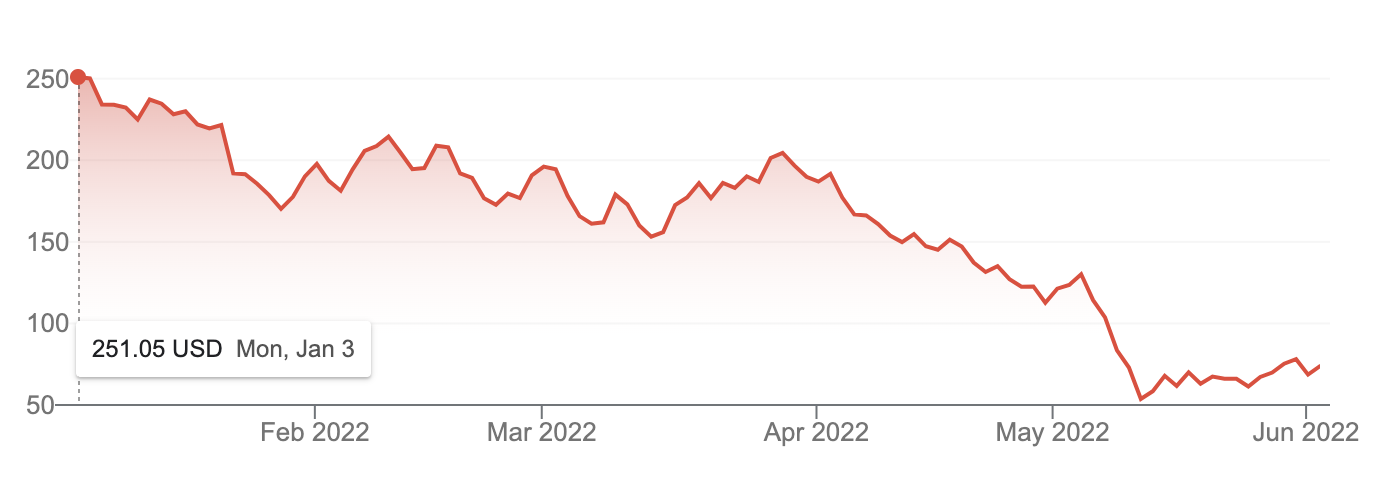
Coinbase is struggling to turn a profit. Last month, it posted a $430 million loss for Q1 2022 after missing analysts’ predictions on both profit and revenue for the quarter. The exchange said it was bleeding users. 

The company’s stock price (Nasdaq: COIN) is down more than 70% since the beginning of the year and is currently trading at $74 per share. It’s hard to imagine that COIN was as high as $343 in November 2021. 

The tumble in Coinbase’s stock price coincides with the crypto markets. Bitcoin has barely been able to keep its head above $30,000, after losing 60% of its value since its November record. The stock market is also suffering. The tech-heavy Nasdaq composite is down 22% since January.  

‘Coinbase ghosted me’

Leading up to 2022, Coinbase planned to triple its workforce. The firm hired 1,200 people in the first quarter and had 3,730 employees at the end of last year, according to its latest earnings report. Now, it’s not even calling some people back after extending job offers. 

I spoke with one person, whose name I won’t reveal, who said Coinbase offered him a job as a security engineer in January. The man, who is in his 30s and has a decade of experience at FAANG companies, told me he had a verbal offer from Coinbase after an interview panel. But then he was ghosted and never heard from them again. 

“I honestly was only interested in getting a competitive offer to better my negotiation at other places I was interviewing,” he told me in a private message. “So grateful Coinbase ghosted me.”

Otherwise, had he gotten the offer in writing, he might have seriously considered taking the job, even as a no-coiner. The comp in the verbal offer was tempting. 

Coinbase offered him a $280,000 base salary plus a 15% bonus and $600,000 annual equity, for total compensation of $920,000, he said.

“We don’t do a four-year program where you vest 25% each year. We don’t have a cliff either, so you start vesting immediately on a quarterly basis,” Coinbase told him.

The company has performance multipliers and suggested that potentially, he could make $1.5 million annually. 

Coinbase has a 2% 401(k) matching program. As an employee, he would get one month off per year along with unlimited paid time off. That’s in addition to four companywide weeks off.

In January, Coinbase proudly announced that the entire company would shut down for one week at the end of each quarter so employees could “recharge.” 

Oh, and there’s a $500 monthly wellness stipend, in case you want to join a gym or take yoga.

After the interview, the would-be employee got an email from the recruiter saying that things went great and they wanted to extend an offer. The recruiter asked if comp would be okay before they put the contract together.

And then, nothing. 

It was just as well, he told me. “Because the equity would have cut in half, and the company will look far worse after the coming collapse.”

Other would-be employees aren’t so relieved. On Blind, an anonymous app for the workforce, someone wrote: “I was supposed to start jun 6th. My offer has been rescinded. This feels like a nightmare that I can’t wait to wake up from.” 

“Dodged a bullet,” a Coinbase employee replied. 

Why rescinding job offers is bad

Rescinding job offers at the last minute is a nasty thing to do to people, especially if they’ve already submitted notice at their current job, told their landlord they are moving, or put their home up for sale. 

It can also blacken the offering company’s reputation. Word gets out, and you’ll have a much harder time convincing people to work for you in the future. It also makes Coinbase’s financial health look worse like they’ve somehow managed to run out of cash running a casino.

Meanwhile, Coinbase execs aren’t doing too bad for themselves. In 2020, including stock options and bonuses, CEO Brian Armstrong made $59 million, Chief Product Officer Surojit Chatterjee made $16 million, and Chief Legal Officer Paul Grewal made $18 million, according to SEC filings

Hacker News is outraged. Coinbase did in any hope of hiring competent non-hodlers.

Here’s what Blotto_Otter on Something Awful wrote: 

“When I read stuff like this, all I can think about is when I started in public accounting right in the middle of the 2007/2008 crash, and out of all the unpleasant stuff most accounting firms did during that time — layoffs, hiring freezes, salary freezes and cuts, benefit cuts — the one thing they did not do was revoke job offers from people who had already accepted offers. They did everything but that because they understood that that is the one thing that will make your name mud when it comes to recruiting new hires in the future.”

Also, Coinbase could potentially get sued for reneging on job offers, if it extended a no-caveat offer and the would-be employee can prove they suffered losses. National Law Review wrote about this in 2019.

In its blog post, Coinbase said it was extending its severance policy to individuals it offered jobs and would notify them by email. Blind posted a copy of the rescind email, along with another email Coinbase sent to new hires two weeks ago telling them it would not rescind job offers. What’s next? Layoffs?

It’s just a shame Coinbase doesn’t put its job offers on the blockchain.  

I need your support. Become a patron! Your contributions make a difference. 

News: Coinbase set to go public, Tether releases meaningless attestation, are NFT sales slipping? 

Happy Easter! NFTs of this disturbing Easter bunny series are available on OpenSea. I was looking for more NFT bunnies but couldn’t find too many. Maybe I wasn’t looking hard enough.

In any case, Bitcoin is now at $58,000 and Tether has more than 42 billion tethers in circulation. Here’s the news:

Coinbase set to go public

Coinbase, the largest crypto exchange in the U.S., will start selling shares on Nasdaq on April 14. The company will trade under the ticker symbol “COIN” and offer 114.9 million shares as part of its direct listing. Share price will be determined by orders coming into the stock exchange. 

Currently valued at $100 billion, Coinbase is going public during the biggest Bitcoin bubble yet. The event will make Coinbase CEO Brian Armstrong—who owns 39.6 million of the company’s shares—a very wealthy man indeed. And the VCs backing the company will realize huge profits, as they all dump their shares on retailers.

On April 6, the exchange is expected to reveal its first quarter financial results and full year outlook. (CNBC) (Coinbase statement)

Tether’s meaningless attestation

In its latest PR move, Tether published an attestation verifying that it had $35 billion in assets backing a similar amount of tether for a blink in time on Feb. 28. The attestation was produced by accounting firm Moore Cayman, based in the Cayman Islands.

Bitcoiners are head over heels about this, but the report is meaningless. The document explicitly states that this does not mean tethers were fully backed at any other time—or are now. And the report doesn’t fit what the NYAG required Tether to publish by mid-May, because it doesn’t break out each category of backing asset by percentage. What’s backing tethers could be mainly bitcoin and toxic assets, for all we know. (David Gerard)

Days after Tether produced the attestation, it printed 1.2 billion tethers—one of its largest issuances ever. What’s a few billion more when bitcoiners think you are legit?

The wonderful world of NFTs

Are NFT sales slipping? Average prices for NFTs have fallen almost 70% from a peak in February to about $1,400, according to Nonfungilble.com, which tracks NFT marketplaces.

The NFT bubble hit its all-time high around the time Metakovan bought Beeple’s “Everydays—The first 5000 days” for $63.9 million on Christie’s. (Bloomberg) 

Cointelegraph also reports that the NFT market is experiencing a silent crash. While we can always see what the price of bitcoin is up to, tracking the movements of illiquid markets is trickier. When it comes to NFTs, buyers simply evaporate and sellers fail to move their wares. 

What is causing the drop in prices? “I suspect it is because the secondary sales have evaporated, so the dream of ‘greater sucker’ has gone away in about the same timeframe as the Crypto Kitties NFT bubble,” Nicholas Weaver said.

Meanwhile, Shares of Funko, a toymaker in Washington, are rising after the company acquired a majority stake in TokenWave, a developer of TokenHead, a mobile app for showing NFT holdings. Funko plans to launch its own NFT offerings this summer. (CNBC)

Other companies are jumping into the space. NFT platform Recur announced a $5 million seed round led by the DeFi Alliance, Delphi Digital, Ethereum co-founder Joe Lubin, and Gemini, among others. (Cointelegraph)

Justin Sun, the CEO of Tron, is now buying serious high art. He bought a Picasso for $20 million at Christie’s in London on March 23, where he also picked up an Andy Warhol for $2 million.

Sun, if you recall, was the second highest bidder for the Beeple “Everydays—the first 5,000 days” piece, driving up the price for Metakovan. Apparently, the Christie’s team in Asia reached out to Sun after the NFT sale to talk him into buying real physical art with all his spare change. (ArtNews)

How does OpenSea, an online market for NFTs, deal with copyright violations? They pocket the buyer’s money and tell them they should have done their own research. Buyer beware! (Vice)

John Cleese’s auction for an NFT of a speedily drawn Brooklyn Bridge ended on April fools’ day. The proud owner is now JeffBezosForeskin who paid $35,000 in ETH for it on Mintable.  

SNL is selling an NFT to their NFT skit an OpenSea. The top bidder gets two tickets to a live taping of the show. This gimmick just does more to promote NFTs, imho. (Decrypt)

Other newsy bits

A DOJ investigation into Representative Matt Gaetz and Joel Greenberg—the former tax collector in Seminole County, Florida—is focused on the pair recruiting women for sex. Greenberg is a bitcoiner. At one time, he wanted to start his own blockchain company, but was accused of dipping into public funds to do so. (The Daily Beast)

Greenberg has made a lot of headlines in recent years.

Terror-linked groups in Syria’s war-torn Idlib are changing their crypto tactics to avoid detection by Western law enforcement. (Wired)

Me, quoted in the news

After I wrote my story revealing the mystery Beeple art buyer, I got a lot of calls from the media asking me for comments about NFTs. 

I am featured in Voice of America: “Cryptocurrency Fuels Digital Art-Buying Frenzy”

Ben Munster quoted me in an article for The Art Newspaper: “NFT art bubble? 2017 crypto bust could spell out the future of current boom”

Kenny Schachter quoted me in an opinion piece for Artnet: “Professor Kenny Schachter Is Here to Teach You More About NFTs (and Put the Crypto Critics in Detention).” David Gerard is quoted in the same story. Kenny refers to us as “curmudgeons.” 

I was also interviewed by the Verge: “NFT mania is here, and so are the scammers.”

(Updated April 4 to add info about Recur.)

Feature image: Scary bunny on OpenSea

If you enjoy my work, please support my writing by becoming a patron. I need all the support I can get!