News: QuadrigaCX has gone bust, Kik is fighting back, and Tether rose to 4th place, briefly

QuadrigaCX customers’ worst fears have come to pass. The Canadian exchange is officially insolvent, and all the crypto is gone—well, most of it anyway.

On January 31, after filing for creditor protection, Jennifer Robertson, the widow of the exchange’s now-deceased CEO Gerald Cotten, filed an affidavit with the Supreme Court of Nova Scotia. As it turns out, Cotten was the only person who held the keys to the exchange’s cold wallets—encrypted wallets where cryptocurrency is kept offline. When he died in December, all that crypto became inaccessible.

According to the affidavit, QuadrigaCX owes 115,000 customers some $250 million CAD ($190 million USD) in both crypto and fiat. Roughly $192 million CAD ($147 million USD) were in crypto assets, most of it in the cold wallets.

In addition to the lost crypto, $30 million CAD is currently held by payment processor Billerfy. Three other third-party payment processors are holding a combined $565,000 CAD. And another $9.2 million USD is stuck inside WB21—a money transfer service that, surprise, surprise, is being sued by the U.S. Securities and Exchange Commission (SEC) for fraud.

But here is where things get strange. Two weeks before he died, Cotten signed a will leaving $100,000 CAD for his two dogs, according to the Globe and Mail (archive.)

I’m not insinuating any foul play here, but let’s go over what we have: Cotten and Robertson supposedly got married two months before his death. Cotten writes up a will to make sure his dogs are taken care of and Robertson takes ownership of 43% of the shares of Quadriga Fintech Solutions, the parent company of QuadrigaCX, should anything awful happen to him. Once that’s all said and done, something awful happens. Cotten goes off to India to help needy children (so nice of him) and dies.

Screen Shot 2019-02-03 at 7.47.19 AM

A month later, Robertson posts an announcement on the exchange’s website telling everyone the company’s CEO is dead. He was a kind, honest, upstanding, guy…after all, he sponsored an orphanage. And then later: Oh, and by the way, all the money is gone, because only Gerald knows where he put it.

[Update: A new twist to this plot may be developing. One Reddit user claims to have found the QuadrigaCX litecoin cold wallet addresses—and the funds appear to be on the move.] 

Elsewhere in the news, Canadian social media startup Kik plans to fight an expected SEC enforcement action over an initial coin offering (ICO). (Read my coverage here.) Kik raised $100 million in 2017 by selling its kin token. In a response to a Wells notice from the SEC, Kik argues that its token is a currency, therefore, it cannot be a security, and besides, the company never marketed kin as an investment anyway.

You could almost go along with that, as long as you completely ignored this 2017 Youtube video of Kik’s CEO Ted Livingston telling everyone how rich they could become if they owned kin. “We’re gonna put [kin] inside Kik and it will become super valuable on day one, we think.” Oops! (Read the full coverage in The Block.)

Two “professional hacking groups” are behind the majority of publicly reported hacks of crypto exchanges and other cryptocurrency organizations, according to a crypto crime report published by blockchain data analytics firm Chainalysis. The two nefarious groups so far have raked in $1 billion of hacking revenues for themselves. Of course, even thieves don’t keep their holdings in bitcoin. They converted everything to fiat.

If you thought SingularDTV was a dreadful name, the blockchain entertainment company has come up with something even more bad. SingularDTV has changed its name to Breaker. The company has a new logo, too—a circle comprised of small lines swirling inward meant to represent the “the hive mind,” a type of groupthink that decentralized projects like to associate themselves with.

Breaker owns Breaker Magazine, which changed its name to BreakerMag to avoid confusion. To go along with the new branding, Breaker (we’re talking about SinglarDTV now) also released a cringe-worthy video that starts with a man gyrating his hips and saying, “It’s like this,” and then devolves into a woman ripping a pink beauty mask off her face. As if the name change wasn’t awkward enough.

Nicholas Weaver, a researcher at International Computer Science Institute, gave a talk at Enigma, a USENIX conference, called “Cryptocurrency: Burn it with Fire!,” where he argued the entire cryptocurrency and blockchain space is effectively one big fraud. Here are the slides to the presentation. The video is not up yet, but Weaver gave a similar talk in April 2018. (It’s funny, watch it.)

For a brief period, tether (USDT), the stablecoin associated with the crypto exchange Bitfinex, rose to become the fourth largest crypto by market cap at $2 billion. It has dropped back down to sixth place now, but who knows, maybe it will rise up again. (Read my tether timeline to learn why tether is so important to crypto markets.)

Banking giant JP Morgan says bitcoin is now worth less than the cost to mine it. “The drop in Bitcoin prices from around $6,500 throughout much of October to below $4,000 now has increasingly pushed margins further and further negative for just about every region except low-cost Chinese miners,” the bank’s analysts said. (Bloomberg)

Despite all the hype, decentralized exchanges (DEX) are not attracting much interest. According to a report in Diar, DEX volume is at an all-time low—something that’s unlikely to change, mainly due to poor usability issues. Another reason to avoid DEXs:  anyone can list any token they like—even if it’s not a legitimate one.

Binance has come up with yet another harebrained business scheme. The Malta-based crypto exchange now allows customers to buy crypto using their credit cards. I can’t see this working out too well. Banks generally distance themselves from all things crypto, and many won’t allow you to put crypto on credit cards. And even if they do, weird things happen. US-based crypto exchange Coinbase no longer accepts credit cards, but when it did, Visa actually overcharged buyers—though, it did eventually issue refunds.

An Italian bankruptcy court found Francisco Firano (aka “Francisco the Bomber”) personally liable for $170 million in losses related to the BitGrail hack in April 2018. (Last year, I wrote a story about the hack for Bitcoin Magazine.) The BitGrail Victims Group posted scans of the court documents along with an explanation of the court’s decision on Medium.

In a big win for nocoiners, David Gerard, author of “Attack of the 50-foot Blockchain,” wrote a op-ed for The Block titled “The Buttcoin Standard: the problem with Bitcoin,” where he basically takes apart bitcoin and criticizes the horrendous energy waste of proof of work. Gerard’s article was solid. But just as you might expect, bitcoiners objected en masse, and even attacked The Block cofounder Mike Dudas.

Most of the criticisms were attempts to discredit the author and consisted of vague comments, such as “[Gerard’s] thought process is fundamentally broken at the protocol level,” “I was hoping for a more astute criticism,” and “terrible journalism!

Apple cofounder Steve Wozniak, who used to go around comparing bitcoin to digital gold, admits he sold all his bitcoin at its peak. “When it shot up high, I said I don’t want to be one of those people who watches and watches it and cares about the number. I don’t want that kind of care in my life,” he said at the Nordic Business Forum. “Part of my happiness is not to have worries, so I sold it all and just got rid of it.” (Satoshi Times)

And finally, the police department in Lawrence, Kansas has been getting reports of bad actors calling people up at random to demand bitcoin.

Social media startup Kik is kicking back—at the SEC

screen shot 2019-01-29 at 12.23.59 amKik is ready to go to battle. The Canadian social media startup has decided to take on the U.S. Securities and Exchange Commission (SEC). At issue is whether Kik’s digital token kin is a security.

Kik raised $47.5 million in September 2017 by selling kin in an initial coin offering, or ICO — though, Kik prefers to call it a token distribution event. That was after Kik pre-sold $50 million worth of kin to a group of 50 wealthy investors, mainly blockchain hedge funds. The presale was a simple agreement for future tokens, or SAFT, which is basically, a Reg D exemption, where the investors would get the tokens at some point in the future after things were up and running.

What is kin?

On its website, Kik describes kin as a “digital currency” that you can use to “earn points for watching video ads, then use points for stickers and custom emojis.” Kin is different from other in-house loyalty points, because it “can be bought and sold for real money.” In other words, you could use Kin as a utility token in the Kik app and also trade it on crypto exchanges for other coins, like bitcoin and ether.

Kik initially announced its token sale in May 2017, four months ahead of its ICO. At the time, the company banned Canadians from taking part in its public sale, because the Ontario Securities Commission (OSC) had already deemed its token to be a security. But that didn’t stop Kik from opening its sale up to U.S. citizens.

Although Kik consulted with lawyers before its public ICO, as far as what I’m reading, they never actually reached out to the SEC for guidance. And it’s not like they weren’t given fair warning that this might pose a problem. 

Fair warning

By mid-2017, the SEC had already begun its crackdown on ICOs. Two months prior to Kik’s ICO, the regulator issued an investigative report concluding that tokens sold by the DAO (a decentralized investment fund that ran on Ethereum) were securities. That report was a cautionary tale to any other project thinking about raising money in an ICO. In a public statement at the time, the SEC said:

“We encourage market participants who are employing new technologies to form investment vehicles or distribute investment opportunities to consult with securities counsel to aid in their analysis of these issues and to contact our staff, as needed, for assistance in analyzing the application of the federal securities laws.” (Emphasis mine.)

But instead of proactively reaching out to the SEC, Kik sat back and waited to hear from them—not a great strategy. 

The SEC first contacted Kik two days after Kik’s token offering began. “It was a friendly contact for information, which we happily responded to,” Kik CEO Ted Livingston wrote in a blog post. But from there the conversations “ramped up,” and on November 16, 2018, the SEC sent Kik and the Kin Foundation a Wells notice—essentially, a letter stating that the regulator was about to bring an enforcement action against them. On December 7, Kik sent back a 31-page response.

As far as the SEC sees it, Kik is in violation of section 5 of the Securities Act of 1933, which states that it is illegal to sell securities unless you register with the SEC or else apply for an exemption, such a private placement, which limits a sale to accredited investors—i.e., wealthy people who can survive the loss, if things go wrong. 

As mentioned, Kik’s private token sale was a Reg D exemption. (Here is the SEC filing from September 2017.) According to SEC rule 506 of Regulation D, purchasers receive “restricted securities,” meaning that the securities cannot be sold for at least six months to a year. Also, Reg D does not pre-empt something from being a security.  

The problem with SAFTs

In general, the problem with SAFTs is that, for various legal reasons (see SEC rule 144), even after the holding period, you can probably only sell your coins to other accredited investors. In other words, you cannot freely trade those coins on the secondary market. Obviously, that limits kin’s usability. It also makes kin not a very good currency, because you can’t actually buy and sell it for real money—at least not that easily.

The basic rule for determining wether something is a security is the Howey test, which states that a security is “an investment of money in a common enterprise with a reasonable expectation of profits to be derived from the entrepreneurial or managerial efforts of others.” In its response letter, Kik claims kin is not a security according to the Howey test, because Kik never marketed its ICO as an investment.

“Simply put, Kik did not offer or promote Kin as a passive investment opportunity. Doing so would have doomed the project, which could only succeed if Kin purchasers used Kin as a medium of exchange (rather than simply holding it as a passive investment). Accordingly, Kik marketed Kin, not as an investment opportunity, but rather as a way to participate in a fundamentally new way for consumers to access digital products and services, and for innovative developers, and their users, to be compensated for the value they provide.”

But Kik’s main rebuttal is that kin is a currency—so securities laws don’t apply.

Let’s take a look at Page 11 of the 1934 Securities Exchange Act. It says:

“The term ‘‘security’’ means any note, stock, treasury stock, security future, security-based swap, bond, debenture, certificate of interest or participation in any profit-sharing agreement… but shall not include currency or any note, draft, bill of exchange, or banker’s acceptance which has a maturity at the time of issuance.”

Lawyers will have to debate how to define kin. But just as the SEC’s Munchee order in December 2017 made it clear that calling a token a “utility token” does not unmake it a security, calling a token a “cryptocurrency” may prove equally as futile—especially, if the token doesn’t actually work as a currency.

News: Radio silence from QuadrigaCX, wash trading doesn’t pay, and KYC data turning up on the dark web

screen shot 2019-01-26 at 11.46.22 pmQuadrigaCX customers are still waiting to get their funds. The Canada-based crypto exchange has been eerily quiet since reporting on January 14 that its CEO Gerald Cotten died in India—a month earlier. 

Since then, the only sign of life has been a single tweet warning customers that another twitter account was fake.

Trouble began a year ago when the Canadian Imperial Bank of Commerce froze about $22 million in US dollars in an account opened by QuadrigaCX’s payment processor. The majority of the frozen funds were released in December, but customers still aren’t getting their money. In recent developments, one user on Reddit claims that he received $18,000. But several more of the exchange’s customers are complaining that their fiat withdrawals are being marked as completed with no money coming through.  

Customers are unable to move crypto out of the exchange either. Some report that requests are simply left pending.

According to a petition submitted to the Supreme Court of British Columbia on January 22, QuadrigaCX was to hold a shareholders meeting on January 25 to appoint a new director. When Cotten died on December 9, he left the company with no officers, and no way to carry out its business. Still, it is not clear if that is what is holding up funds or if something nefarious is going on. Two days after the shareholders meeting, the exchange still hasn’t posted an update.  

Crime, or in this case wash trading, doesn’t pay. Two executives at South Korean crypto exchange Komid are heading off to jail for faking volume, according to BlockinPress. Choi, the CEO, was sentenced to three years; Park, another executive, was sentenced to two years. Court documents say the faked volume led Choi and Park to earn $45 million.

Know-your-customer (KYC) data (ID cards, drivers licenses, and more) from several top exchanges, including Binance, Bittrex, Bitfinex, and Poloniex, appears to have surfaced on the dark web. Binance claims the data is not coming from its servers. Bitfinex also claims its databases have not been breached.

Since the markets crashed, crypto exchanges are looking for ways to boost their profits. To that end, Coinbase announced that is expanding its institutional trading services to Asia. The San Francisco-based exchange also now supports SWIFT wire transfers that will allow clients in Asia to fund their accounts from banks based outside the U.S.  

Immutability (aka “be your own bank”) has been a big selling point for blockchain. But it also makes mistakes especially painful. Korean crypto exchange Coinzest (not to be confused with Coinnest, a separate exchange) accidentally airdropped $5.3 million worth of bitcoin and other crypto to its customers. 

Polkadot, a project founded by former Ethereum CTO Gavin Wood, aims to solve the problem of blockchain interability. (If you’re not sure what that means, Wood tries to explain it here.) In October 2017, Polkadot raised $145 million worth of ETH in an ICO. Shortly after, $98 million of those funds became frozen due to a bug in Parity wallets, another Wood project. But that’s okay, because you can always get more funding.

In fact, earlier this month, Ethereum gave Parity Technologies, the umbrella company that Parity and Polkadot fall under, a $5 million grant. (Read this Reddit thread to get a sense of how the community felt about that.) Now Polkadot is reportedly looking to raise $60 million through another ICO, according to the Wall Street Journal. Polkadot still does not have a working product.

After one year of serving as CEO of decentralized media platform po.et, Jarrod Dicker has stepped down and returned to the Washington Post. Po.et allows journalists to create time-stamped titles for their work on a blockchain. The problem is, creating archives of our work is not a problem we journalist have. (I mean, there are lots of services that do that, and most of them are free.) Rather, it appears to be just another thinly veiled excuse for launching an ICO. Po.et raised $10 million in August 2017. 

Crypto lawyer Stephen Palley reports on the latest developments in the Tezos class action suit for The Block. In support of “yeah, this was a securities offering,” plaintiffs in the case cite emails from Tezos CEO Kathleen Breitman with securities-like wording. Oops! Tezos raised $232 million in an uncapped ICO in June 2017. The project has gotten criticism for raising above and beyond what most startups need to launch a business.

Galaxy Digital, the crypto merchant bank launched by former hedge fund manager Michael Novogratz, is reportedly raising $250 million for a credit fund aimed at helping needy crypto firms, according to Business Insider. If you are curious about how Novogratz got into crypto (hint: he was Ethereum co-founder and crypto billionaire Joe Lubin’s roommate at Princeton), read this New Yorker piece from April 2018. 

Bitcoiners don’t like to pay taxes. Some crypto folks are getting riled up about Senator Elizabeth Warren’s proposed wealth tax, calling it “theft.” Warren wants to levy a 2 percent tax on assets over $50 million and a 3 percent tax on assets over $1 billion.

Kyle Gibson, a crypto enthusiast and avid researchers who lives in Boston has pulled together a wealth of information on the Texas Department of Banking Memo 1037 and what it could mean for crypto, beyond stablecoins and their issuers. It is worth a read. 


News: ETC hacker returns some of the money, Constantinople will have to wait, and a new twist in the QuadrigaCX saga

Stealing money is not easy. So why go to all the effort if you’re not serious? Screen Shot 2019-01-20 at 12.41.31 AM.png

Earlier this month, Ethereum Classic fell victim to a 51% attack when someone got hold of the majority of the network’s computing power and used it to double spend coins, stealing $1 million in funds. Now the hacker has returned some of the money. 

Gate.io, which originally lost $271,000 worth of ETC said the hacker returned $100,000 worth. And YoBit reported it got back $61,000 of $65,000 worth of stolen ETC. 

“We still don’t know the reason [for the return],” Gate.io said in a blog post on January 10. “If the attacker didn’t run it for profit, he might be a white hacker who wanted to remind people the risks in blockchain consensus and hashing power security.”

If you are a crypto exchange, you’re probably not seeing the profits you did back in the crypto heydays of 2017 and early 2018. So how do you make up for that? One option is to start listing lots of questionable coins. Another is to set the stage for the long-hoped-for influx of institution money.

Along those lines, Bittrex announced an over-the-counter (OTC) desk on January 14. The service handles trades of $250,000 or greater for the nearly 200 coins already offered by the exchange. In doing so, Bittrex joins other U.S.-based exchanges in launching OTC trading desks, including Coinbase and Poloniex.

Ethereum’s Constantinople upgrade has been delayed yet again. Shortly before the scheduled January 17 release, smart contract audit firm ChainSecurity found vulnerabilities in one of five ethereum improvement proposals (EIP). ChainSecurity describes the vulnerability in detail here. Ethereum core developers are now weighing late February as a time to move ahead with the upgrade—sans the buggy EIP.

A new twist has emerged in the saga of QuadrigaCX, one of the largest crypto exchanges in Canada. The saga began in January 2018 when the Canadian Imperial Bank of Commerce froze about $22 million in US dollars in an account opened by Quadriga’s payment processor. The majority of the frozen funds were released in December, but customers still aren’t getting their money.

Now, after waiting more than a month to post the news, Quadriga says that its CEO and founder Gerald Cotten is dead. Usually, when the CEO of a company dies, that is something you want to tell people right away.   

The announcement (archive) on the company’s website appears to come from Cotten’s wife, Jennifer Robertson, who explains that Cotten went to India to build an orphanage for needy children. While there, he died of complications to Crohn’s disease.  

“Gerry cared deeply about honesty and transparency — values he lived by in both his professional and personal life. He was hardworking and passionate, with an unwavering commitment to his customers, employees, and family,” Robertson wrote. [Emphasis mine.]

Several of Quadriga’s customers went to Reddit asking for proof of Cotten’s death. Some wondered how Cotten found time to travel to India when his company was in the midst of major litigation. 

Binance, one of the world’s largest crypto exchanges by trading volume, has launched a  fiat-to-crypto exchange in Jersey. A tiny 5-by-9-mile island in the English Channel, Jersey is one of the world’s wealthiest offshore tax shelters.

In October, Binance also set up a fiat-to-crypto exchange in Uganda. And it is planning to set up more of these entities in countries like Singapore, Malta, South Korea, Liechtenstein, Argentina, Russia, Turkey, and Bermuda.

Tron’s accelerator developer contest is looking like a big scam. The event was supposed to offer $1 million in prizes, with the first prize being $200,000. After the competition ended on January 4, developers took to Twitter and Reddit to complain that something “fishy” was going on. Apparently, Tron changed the prize amounts, and the main prize went to some vague company nobody has ever heard of.  

Brave browser, the project run by JavaScript creator and former Mozilla CEO Brendan Eich, claims that is is no longer fundraising on behalf of others, after releasing version 0.58.21 of the browser. David Gerard wrote an update and posted some pics of the new interface. If you get a chance, tip Gerard some BAT via his YouTube channel, so he can continue to test out the platform.  

Also, Brave browser has started allowing developers and testers to view ads. You can’t earn BAT for viewing the ads yet, but all that is coming. Eventually, Brave says, “users will then be able to earn 70% of the revenue share coming from those ads.”

The business model has gotten a ton of criticism. Essentially, the browser strips all ads and add trackers — which is how most publishing sites make their money — and then substitutes its own Brave-approved ads.

There’s been some important developments in the Tezos class-action litigation. Next up, likely the court will rule on whether the Tezos initial coin offering—which raised a record-setting $232 million in mid-2017—was an unregistered securities offering.

A ransomware threat known as Ryuk has pulled in $3.7 million in bitcoin over five months.

The Winklevoss Twins still think Bitcoin will be worth more than gold, maybe in the hopes they will be billionaires again. “The only thing gold has over bitcoin is a 3,000 year head start,” Cameron told Fortune.  

Brock Pierce, who got into cryptocurrency in the early days, and his wife Crystal Rose Pierce are expecting a child in March. They are naming the baby Crypto Pierce.

About 5% of daily Bitcoin transactions involve tether (USDT), according to a Medium post by Omni, the platform that tether operates on.  

Despite competition from a slew of new stablecoins, tether still dominates the stablecoin market, according to the latest report from CryptoCompare.

In case you missed it, I published a complete Tether timeline. I’m continuing to to update the story based on whatever new info I stumble upon. So keep checking back—and if you have information to add, send me details!


News: ETC hit by 51% attack, Tron is a marketing machine, and India’s banks want nothing to do with bitcoin

screen shot 2019-01-12 at 10.30.16 pmEthereum Classic was hit by a 51% attack. A private pool got hold of more than half of the network’s computing power and used that to rewrite history and double spend nearly $1.1 million ETC, the platform’s native currency. Coinbase noted the attack on January 5, and followed with a detailed analysis of what happened.
Here is the irony: Ethereum Classic was founded on the principle of immutability, meaning good or bad, legal or illegal, whatever transactions happen on the network, happen, and you have to live with it. The project took over the pre-fork chain after Ethereum forked to reverse transactions in the DAO hack. If Ethereum Classic wants to stand on that hill, it may have to suffer the consequences, which so far, have not been terrible. ETC was $5 at the time of the attack and is now at $4.66.

Bitcoin saw its 10-year anniversary on January 9. CoinDesk threw a whopping party in New York City, which, judging by photos, was well attended by a lot of white men. For bitcoiners, 10 years is a mark of resilience. But it is worth noting, for the most part, you still cannot buy groceries or pay rent with bitcoin. And if you bought bitcoin a year ago ($14,000) and sold today ($3,700), you would have lost two-thirds of your investment — so much for store of value.

KodakOne announced it generated $1 million in “post-licensing claims” on a beta of its platform. Breaker’s David Z. Morris did a softball interview with KodakOne’s Cam Shell, omitting tough questions like, “How in god’s name did you manage to come out with a beta version of the platform while stiffing all your developers?” I followed up with a story of my own as did Decrypt Media’s Ben Munster and David Gerard, explaining that the $1 million is completely hypothetical money.

Justin Sun, the CEO of blockchain platform Tron, has been unveiled as technically incompetent. Tron recently bought file-sharing client BitTorrent, Now it wants to launch a BitTorrent token. But, in a Breaker interview (another story by Z. Morris, but this one, really good), former BitTorrent executive Simon Morris said there is no way Tron can handle the transaction volume. Simon also said Sun has no technical know-how and Tron is basically little more than a marketing machine.  

Rumors swirled a week ago that the co-CEOs of Chinese crypto miner maker Bitmain, Wu Jihan and Zhan Ketuan were going to step down. Turns out, the rumors are true, and Wang Haichao, Bitmain’s director of product engineering, has stepped in to replace them as CEO. In December, CoinDesk reported that Bitmain may be letting go of half of its 3,100 workforce. None of this bodes well for the company’s upcoming IPO.

If you want to trade bitcoin in India, you better keep that information well hidden from your bank. The country’s banks are sending out notices warning customers that they will close accounts without notice, if customers are found dealing in cryptocurrency.

The Texas Department of Banking released a supervisory memorandum on January 2 in regard to treatment of virtual currencies under the Texas Money Services Act. According to the memo, Texas considers pegged stablecoins, like tether, money, which means that anyone dealing with them may need to apply for a Texas money transmitter license.  

After impressive claims, image rights platform KodakOne still has a lot to explain

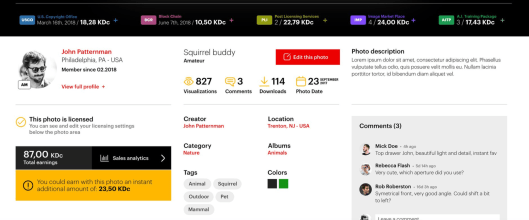
KodakOne, a photography rights management platform that operates on a blockchain, launched its private beta in October. Since then, the project says it has generated 1,667 new “post-licensing cases” valued at over $1 million, according to a recent press release.

screen shot 2019-01-10 at 9.29.31 pm

Those numbers sound impressive. Until you consider that the post-licensing cases—instances where the images appeared on the web after being uploaded onto the KodakOne database—were likely the result of a simple reverse image search, similar to what services like TinEye, Google Images, and Berify offer. And the $1 million is unlikely to be actual money—or even KodakCoins, the tokens that drive the platform’s economy.

More likely, $1 million is what those post-licensing cases could have been worth if KodakOne was able to actually reach the infringers and get them to fork over the money. But the press release does not make any of this clear.

Still, that did not stop one reporter from handing out accolades. But this is easy to understand given that what lends this particular blockchain project so much credibility is the name: Kodak. After all, who can forget Paul Anka’s “Times of Your Life,” a song made popular by Kodak 70s commercials?

In fact, KodakOne is not an Eastman Kodak company. A company called RYDE Holding (formerly, WENN Digital, which borrowed the WENN name from paparazzi photo agency WENN Media) licensed the iconic Kodak name. RYDE then went on to build the platform in collaboration with ICOx Innovations, the company that issued the recent press release. 

The upside for Eastman Kodak was an increase in its stock price. When Kodak and WENN Digital unveiled the platform in January 2018, Kodak shares went from $3.13 per share to $12.75 in a matter of hours.

How does—or will, or would—KodakOne work? Something like this: Photographers register and archive their work on the site. The platform then trawls the Internet to find unlicensed versions of the images. It then somehow notifies the infringers and tries to get them to pay up. It also matches up buyers and sellers in an online marketplace.

The concept is a good one, except that it makes no sense to put any of this on a blockchain. If you are going to operate a stock photo site, you can do it on a centralized system. And KodakOne could have allowed its users to pay for services in fiat. But then it would not have been able to raise money in an initial coin offering (ICO).

Last spring, KodakOne raised at least $4.1 million via a simple agreement for future tokens (SAFT), meaning it sold rights to future tokens to accredited investors. Unlike a traditional ICO, the idea behind a SAFT is that the tokens are delivered when there is a functioning network in place.

As Bloomberg’s Matt Levine points out, because the tokens were sold in a private placement, this could lead to problems down the road, especially if you want your token to function as an actual utility token on the network.

“But what if the photographer sells her photos for KodakCoins and then wants to sell her KodakCoins for money? Well, she will have a hard time,” Levine wrote, explaining that, for various legal reasons (see U.S. Securities and Exchange Commission Rule 144), you can probably only sell your KodakCoins to accredited investors.

That is just one of the controversies surrounding the project. In June 2018, reports came out that the project was stiffing its developers $125,000 in unpaid fees.

But none of this stopped KodakOne from supposedly moving forward with its plans. According to the recent press release:

“The beta platform is currently operational and being used by agencies including Blaublut Edition and Food Centrale, as well as numerous photographers, with multiple international customers in the pipeline for the next phase of deployment.”

I reached out to Blaublut Edition and Food Centrale for details on how they used the platform, but have yet to hear back.

One critic claims the KodakOne beta platform does not actually exist. Armel Nene, a developer who says he was hired by RYDE to work on the project but has not been paid, wrote in a blog post:

“November 2018, still no payment from Ryde to any of the invoices. Instead the company is publishing fake information on the internet that they are launching their platform in beta mode. This is a lie as the person working on it confirmed that he’s keeping the code as a ransom to the money they owe him.”

So, is the beta version of KodakOne real? How did KodakOne comes up with $1 million? I reached out for comment. If they respond, I’ll update the story. But while how the project came up with this figure is one question, KodakOne still has a lot to answer for.

If you want to dig deeper into the KodakOne project, “Attack of the 50-foot Blockchain” author David Gerard has written a 10-part series on KodakOne and KodakCoin that will tell you everything you need to know.